699
DOI: 10.1590/0004-282X20130154
VIEWS AND REVIEWS
Progressive multifocal leukoencephalopathy:
new concepts
Leucoencefalopatia multifocal progressiva: novos conceitos
Marco A. Lima
Progressive multifocal leukoencephalopathy (PML) is a rare demyelinating disease of the CNS caused by reactivation
of JC virus (JCV). Primary infection occurs in childhood and it is asymptomatic in most patients. hereafter, the virus re -mains latent in the kidney, bone marrow and lymphoid or-gans, but, in a setting of cellular immunosuppression, the vi-rus reactivates, spreads to the central nervous system (CNS), leading to infection of oligodendrocytes and demyelination1.
Most often, PML presents with motor deicits, visual dis -turbances and cognitive impairment, in a subacute
evolu-tion. On MRI, lesions are hyperintense on T2-weighted and Fluid attenuated inversion recovery (FLAIR) sequences and
located predominantely in the subcortical white matter of the cerebral hemispheres and cerebellar peduncles2. Originally, PML was observed in patients with advanced HIV infec -tion, lymphoproliferative disorders and transplant recipients.
However, the widespread use of HIV antiretroviral drugs and
new selective immunomodulatory and immunosuppressive medications, such as Rituximab and Natalizumab, had
re-cently modiied the epidemiology, clinical presentation and
prognosis of PML3.
Herein, we discuss the new concepts on PML,
emphasi-zing the recent modiication in the epidemiology, the impact
of new immunomodulatory treatments in the disease,
PML-IRIS, new treatment strategies and other JCV related CNS
diseases.
Epidemiology
From the 1958 to 1980`s, PML was observed mostly in
patients being treated with corticosteroids and other im-munosuppressive drugs, as well as individuals with
hema-tological malignancies. A review of the literature in 1984 revealed only 230 cases, most of them associated with hema -tological diseases4. he emergence of AIDS changed the PML ABSTRACT
Progressive multifocal leukoencephalopathy (PML) is a demyelinating disease of the CNS caused by reactivation of JC virus (JCV) in a set-ting of cellular immunosuppression. Originally, PML was observed in patients with advanced HIV infection, lymphoproliferative disorders and transplant recipients. However, the widespread use of HIV antiretroviral drugs and the new selective immunomodulatory and immunosup-pressive medications, such as Rituximab and Natalizumab, has recently modified the epidemiology, clinical presentation and prognosis of PML. Herein, we discuss the new concepts on PML, emphasizing the recent modification in the epidemiology; the impact of new immuno-modulatory treatments in the disease, PML-IRIS (Immune reconstitution inflammatory síndrome), new treatment strategies and other JCV related CNS diseases.
Keywords: leukoencephalopathy, natalizumab, JC virus.
RESUMO
A leucoencefalopatia multifocal progressiva (LMP) é uma doença desmielinizante do sistema nervoso central (SNC) causada pela reativação do vírus JC (JCV) em um ambiente de imunossupressão celular. Originalmente, LMP foi descrita em pacientes com infecção avançada pelo HIV, doenças linfoproliferativas e transplantados. No entanto, a utilização generalizada de anti-retrovirais para a infecção pelo HIV e novos imunomoduladores seletivos e imunossupressores, como Rituximab e Natalizumab, modificaram recentemente a epidemiologia, apresen-tação clínica e prognóstico da LMP. Neste artigo, vamos discutir os novos conceitos sobre LMP, enfatizando a recente modificação na epide-miologia, o impacto de novos tratamentos imunomoduladores na doença, síndrome inflamatória da reconstituição imune, novas estratégias de tratamento e outras doenças relacionadas ao JCV no SNC.
Palavras chave: leucoencefalopatia, natalizumab, virus JC.
MD, PhD, Instituto de Pesquisa Clínica Evandro Chagas, FIOCRUZ, Rio de Janeiro RJ, Brazil.
700 Arq Neuropsiquiatr 2013;71(9-B):699-702
epidemiology. Its incidence increased 50-fold and HIV infec -tion quickly became the leading predisposing condi-tion for the development of disease1. In the pre-HAART era, up to 5% of HIV –infected individuals were diagnosed with PML and the median survival was only 6 months. Less than 10% were
alive one year after the onset of symptoms5.
he introduction of more potent antiretroviral regimens
led to a considerable decrease in its incidence and mortality
in the last 17 years. Data from the Swiss cohort showed a de
-crease of the incidence from 0.24 cases per 100 patient-years before HAART era to 0.06 cases per 100 patient-years from 1996 on6. However, some authors believe that the impact of
HAART was less evident in PML incidence compared to other central nervous system opportunistic infections7. Since res-toration of the cellular immune response against JCV is the
best predictor of survival in PML8, the introduction of
com-bined antiretroviral drugs led to a signiicant improvement
in mortality. Worldwide, the one-year survival increased from
10% in the 1980-1990´s to around 50% nowadays1. Also
im-portant is the fact that more than half of the long-term PML survivors have no or only mild disability9.
More recently, the introduction of new
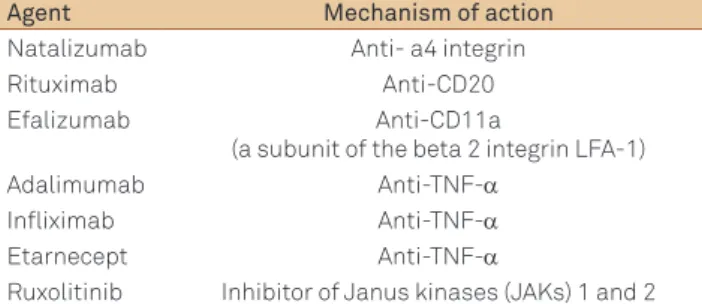
immunomodula-tory and immunosuppressive drugs (Table 1) in the treatment
of tumors and autoimmune diseases expanded the spectrum of conditions associated with PML as described below1, 10,11.
PML and immunomodulatory drugs
In the last years, several monoclonal antibodies and other particles designed to act on speciic steps of the immune
res-ponse have been designed and used in the treatment of malig-nancies and autoimmune diseases (multiple sclerosis, Crohn’s
disease, psoriasis, systemic erythematous lupus). he associa -tion between Rituximab, a humanized monoclonal antibody
directed against the CD20 antigen on B-lymphocytes and PML
was described more than ten years ago12, but it was only after the temporary withdrawn of Natalizumab, an anti- a4 integrin, from market in 2005 after three cases in Crohn’s disease and
multiple sclerosis patients, that a clear relationship between some immunomodulatory agents and the development of the disease was established13,14. Efalizumab, an antibody Anti-CD11a used in the treatment of psoriasis was also withdrawn from market in 2009 due to its association with PML15.
Natalizumab blocks the alpha-4 subunit integrin associa -tion with vascular receptors, limiting adhesion and
transmi-gration of leukocytes. In multiple sclerosis, eicacy may be
related to blockade of T-lymphocyte migration into the cen-tral nervous system16. On the other hand, immune surveil-lance performed by these cells against JCV and other virus
may be impaired resulting in the development of PML. Overall, the incidence of PML in Natalizumab-treated
patients was estimated as 2.1/1000 patients17, but the risk depends on JCV serology status, duration of Natalizumab
treatment and prior immunosuppressant use. While the risk
was estimated as 0.09/1000 or less in patients without JCV antibodies, it was 11.1/1000 in patients with JCV
antibo-dies, previous use of immunosuppressants and exposure to
Natalizumab >24 months.
Clinically, the development of PML in multiple sclerosis
patients poses an additional diiculty in the diagnosis, since
PML onset is frequently mistaken with MS exacerbation, stroke or other neurological condition18. Cognitive, language,
motor and visual symptoms are commonly seen in this set-ting, with cognitive changes being more prominent, possibly because of the multifocal multiple sclerosis lesions already present in these patients1. While optic nerve or spinal cord
lesion involvement is more suggestive of multiple sclerosis exacerbation and seizures were the presenting symptom of PML in several Natalizumab-treated patient, their
occur-rence should always raise suspicion of this condition. MRI indings in Natalizumab-associated PML are similar to clas -sical PML except that contrast enhancement was more fre-quently observed at presentation18.
he irst step in the treatment is to discontinue
Na-talizumab. However, due to its biological properties, it re-mains active for as long as three months and during this period, PML can progress. Empiric treatment with plasma exchange or immunoadsorption has been tried in an attempt to accelerate the elimination of the monoclonal antibody19. his approach frequently results, three to six weeks later, in the development of an intense IRIS due to the restoration of the lymphocyte traicking into the central nervous system
that can be fatal. Most of the reported patients who
deve-loped IRIS received high-dose glucocorticoids (dexametha -sone or methylprednisolone) followed by a slow tapering in order to lessen the immune reconstitution and avoid ad-ditional damage18. here is evidence of a better survival in PML associated with Natalizumab use (70%) compared to
other conditions, but survivors may have a higher degree of disability20.
PML HIV-related IRIS
IRIS is deined as a paradoxical worsening of preexisting
infectious processes or development of new symptoms fol-lowing the initiation of highly active antiretroviral therapy
(HAART) in HIV-infected individuals. It usually follows the Table 1. Immunomodulatory agents associated with PML.
Agent Mechanism of action
Natalizumab Anti- a4 integrin
Rituximab Anti-CD20
Efalizumab Anti-CD11a
(a subunit of the beta 2 integrin LFA-1)
Adalimumab Anti-TNF-α
Infliximab Anti-TNF-α
Etarnecept Anti-TNF-α
701
Marco A. Lima. PML: new concepts
rapid restoration of the immune function and is often self-limited, but it can be fatal or associated with permanent se-quelae. PML is one of the most frequent opportunist
infec-tions associated with IRIS and, in the HAART era, between 10 and 20% of the PML patients develop inlammatory manifes -tations21. In a recent Brazilian series of HIV infected PML pa -tients, the incidence was 6%22. Clinical presentation is marked
by a transient worsening or development of new neurological symptoms and, in severe cases, signs and symptoms of
intra-cranial hypertension. Most often, PML-IRIS starts between
three to six weeks after HAART is begun, but it has been
des-cribed between 1 and 104 weeks1. Contrast enhancement
and edema, denoting blood brain barrier disruption
secon-dary to the inlammatory process, can be observed on MRI. Brain biopsy usually shows CD8+T lymphocyte iniltrates in areas of demyelination, which is diferent from classical PML where inlammatory iniltrates are mild or absent1,2.
In most cases, IRIS is a transient self-limited process and
HAART should not be discontinued. However, there are re-ports of fatal outcome due to brain swelling and herniation. Corticosteroids have been used by several groups in order to
modulate inlammatory reaction and avoid a catastrophic
deterioration, but their use is controversial since they can
also potentiate immunosuppression and blunt the JCV spe
-ciic cellular immune response21. We believe that steroids should be reserved only for PML-IRIS patients with brain
edema and risk of herniation.
Interestingly, the development of IRIS has no impact in
the outcome of PML as observed in a recent study23.
Treatment
here are no speciic antivirals drugs against JCV. Drugs such as cidofovir, cytarabine, topotecan and meloquine were
evaluated in several trials but results were disappointing and
associated with serious adverse efects1,2.
here is evidence that JCV infects the cells trough the 5-HT2A serotonin receptor. Mirtazapine, an antidepressant
that acts inhibiting this receptor has been used in treatment of PML. Although the concept sounds attractive and the drug is usually well tolerated, the evidence to date is scarce and based mostly in case reports and small series24. he beneit is
modest at best, but it can be considered both in patients with
and without HIV infection.
he increase in the PML survival rates observed over the
last years resulted from the widespread use of HAART in
HIV infected patients1-3. Restoration of the adaptive immune
response is crucial in controlling JCV replication and stabili-zing disease. hus, the introduction of HAART in drug–naï ve
patients or a change in the antiretroviral regimen must be done after PML diagnosis. However, there is evidence that
some antiretroviral classes may have an additional beneit over others. In a study with a cohort of 98 PML patients from
Spain, the use of antiretroviral regimens containing protea-se inhibitors were associated with reduction in mortality25. Another interesting approach is to use an early-intensiied antiretroviral combination with ive drugs in order to quick
-ly reduce the HIV load and restore JCV immune response. Gasnault et al studied 28 PML patients who received efavi
-renz, ritonavir-boosted lopinavir, and the ixed-dose emtric
-itabine- tenofovir combination for 12 months and enfuvirtide for the irst six months26. he one-year survival was 75%,
which was better to previous observed but it was an open la-bel non-comparative trial without a control group.
In other clinical scenarios (autoimmune diseases, post
transplantation) where PML have been observed, an attempt to reduce or stop immunosuppressive drugs should be
con-sidered in an individual basis since it can restore the JCV spe
-ciic immune response but also can result in a lare of an au -toimmune disease or graft rejection1.
Other JCV CNS related diseases
Oligodendrocytes are the preferred CNS cells infected by
JCV, leading to demyelination and PML. However, JCV has
been also associated with other neurological diseases. A syn-drome marked by progressive incoordination, dysarthria and cerebellar gait and atrophy of the cerebellum without white
matter on MRI lesions occurs when a mutant virus with a 10 bp deletion in the C terminus of the VP1 capsid protein infects the granule cell neurons. JCV granule cell neuronopa -thy has been described in isolation or concomitant to PML27. Rarely, JCV has been associated with meningitis and en -cephalitis28,29. here are reports of JCV isolation in the CSF
of immunocompetent and immunosuppressed patients with a meningeal syndrome and no focal symptoms28. he pre-valence of JCV meningitis is not known but it is believed to be extremely low. he predominant involvement of the gray matter with limited demyelination by JCV results in an en -cephalopathy with progressive cognitive decline29. In all other JCV CNS related diseases, the rationale of treatment follows
what is observed for PML: restore immune response trough
HAART in HIV patients or discontinue immunosuppression
whenever possible.
References
1. Tan CS, Koralnik IJ. Progressive multifocal leukoencephalopathy and other disorders caused by JC virus: clinical features and pathogenesis. Lancet Neurol 2010;9:425-437.
702 Arq Neuropsiquiatr 2013;71(9-B):699-702
3. Ferenczy MW, Marshall LJ, Nelson CD, et al. Molecular biology, epidemiology, and pathogenesis of progressive multifocal leukoencephalopathy, the JC virus-induced demyelinating disease of the human brain. Clin Microbiol Rev 2012;25:471-506.
4. Brooks BR, Walker DL. Progressive multifocal leukoencephalopathy. Neurol Clin 1984;2:299-313.
5. Berger JR, Pall L, Lanska D, Whiteman M. Progressive multifocal leukoencephalopathy in patients with HIV infection. J Neurovirol 1998; 4:59-68.
6. Khanna N, Elzi L, Mueller NJ, et al. Incidence and outcome of progressive multifocal leukoencephalopathy over 20 years of the Swiss HIV Cohort Study. Clin Infect Dis 2009;48:1459-1466.
7. Sacktor N. The epidemiology of human immunodeficiency virus-associated neurological disease in the era of highly active antiretroviral therapy. J Neurovirol 2002;8(Suppl 2):S115-S121.
8. Du Pasquier RA, Kuroda MJ, Zheng Y, et al. A prospective study demonstrates an association between JC virus-specific cytotoxic T lymphocytes and the early control of progressive multifocal leukoencephalopathy. Brain 2004;127:1970-1978.
9. Lima MA, Bernal-Cano F, Clifford DB, et al. Clinical outcome of long-term survivors of progressive multifocal leukoencephalopathy. J Neurol Neurosurg Psych 2010;811288-1291.
10. Nakamichi K, Mizusawa H, Yamada M, et al. Characteristics of progressive multifocal leukoencephalopathy clarified through internet-assisted laboratory surveillance in Japan. BMC Neurol 2012;12:121.
11. Wathes R, Moule S, Milojkovic D. Progressive multifocal leukoencephalopathy associated with ruxolitinib. N Engl J Med 2013; 369:197-198.
12. Goldberg SL, Pecora AL, Alter RS, et al. Unusual viral infections (progressive multifocal leukoencephalopathy and cytomegalovirus disease) after high-dose chemotherapy with autologous blood stem cell rescue and peritransplantation rituximab. Blood 2002;99:1486-1488.
13. Langer-Gould A, Atlas SW, Green AJ, Bollen AW, Pelletier D. Progressive multifocal leukoencephalopathy in a patient treated with natalizumab. N Engl J Med 2005;353:375-381.
14. Van Assche G, Van Ranst M, Sciot R, et al. Progressive multifocal leukoencephalopathy after natalizumab therapy for Crohn’s disease. N Engl J Med 2005;353:362-368.
15. Kothary N, Diak IL, Brinker A, Bezabeh S, Avigan M, Dal Pan G. Progressive multifocal leukoencephalopathy associated with efalizumab use in psoriasis patients. J Am Acad Dermatol 2011;65: 546-551.
16. Rudick R, Polman C, Clifford D, Miller D, Steinman L. Natalizumab: bench to bedside and beyond. AMA Neurol 2013;70:172-182.
17. loomgren G, Richman S, Hotermans C, et al. Risk of natalizumab-associated progressive multifocal leukoencephalopathy. N Engl J Med 2012;366:1870-1880.
18. Clifford DB, De Luca A, Simpson DM, Arendt G, Giovannoni G, Nath A. Natalizumab-associated progressive multifocal leukoencephalopathy in patients with multiple sclerosis: lessons from 28 cases. Lancet Neurol 2010;9:438-446.
19. Wenning W, Haghikia A, Laubenberger J, et al. Treatment of progressive multifocal leukoencephalopathy associated with natalizumab. N Engl J Med 2009;361:1075-1080.
20. Dahlhaus S, Hoepner R, Chan A, et al. Disease course and outcome of 15 monocentrically treated natalizumab-associated progressive multifocal leukoencephalopathy patients. J Neurol Neurosurg Psych 2013 Apr 19. [Epub ahead of print]
21. Tan K, Roda R, Ostrow L, McArthur J, Nath A. PML-IRIS in patients with HIV infection: clinical manifestations and treatment with steroids. Neurology 2009;72:1458-1464.
22. Piza F, Fink MC, Nogueira GS, Pannuti CS, Oliveira AC, Vidal JE. JC virus-associated central nervous system diseases in HIV-infected patients in Brazil: clinical presentations, associated factors with mortality and outcome. Braz J Iinfect Dis 2012;16:153-156.
23. Marzocchetti A, Tompkins T, Clifford DB, et al. Determinants of survival in progressive multifocal leukoencephalopathy. Neurology 2009;73:1551–1558.
24. Cettomai D, McArthur JC. Mirtazapine use in human immunodeficiency virus-infected patients with progressive multifocal leukoencephalopathy. Arch Neurol 2009;66:255-258.
25. Fanjul F, Riveiro-Barciela M, Gonzalez J, et al. Evaluation of progressive multifocal leukoencephalopathy treatments in a Spanish cohort of HIV-infected patients: do protease inhibitors improve survival regardless of central nervous system penetration-effectiveness (CPE) score? HIV Med 2013;14:321-325.
26. Gasnault J, Costagliola D, Hendel-Chavez H, et al. Improved survival of HIV-1-infected patients with progressive multifocal leukoencephalopathy receiving early 5-drug combination antiretroviral therapy. PLoS One 2011;6:e20967.
27. Koralnik IJ, Wüthrich C, Dang X, et al. JC virus granule cell neuronopathy: A novel clinical syndrome distinct from progressive multifocal leukoencephalopathy. Ann Neurol 2005;57:576-580.
28. Viallard JF, Ellie E, Lazaro E, Lafon ME, Pellegrin JL. JC virus meningitis in a patient with systemic lupus erythematosus. Lupus 2005; 14:964-966.