ISSN 0100-2945 http://dx.doi.org/10.1590/0100-29452017200
‘JAFFA’ SWEET ORANGE PLANTS GRAFTED
ONTO FIVE ROOTSTOCKS
1ELÍDIO LILIANO CARLOS BACAR2, CARMEN SILVIA VIEIRA JANEIRO NEVES3,
RUI PEREIRA LEITE JUNIOR4, INÊS FUMIKO UBUKATA YADA5,
ZULEIDE HISSANO TAZIMA4
ABSTRACT – Low genetic diversity of citrus scion and rootstock cultivars makes the crop more vulnerable to diseases and pests. The objective of this study was to evaluate the performance of ‘Jaffa’ sweet orange
grafted onto five rootstocks over six harvests in subtropical conditions in the north of Paraná state, Brazil. The experiment used a randomized block design, with six replications and two trees per plot, spaced at 7.0 m x
4.0 m. The rootstocks were: ‘Rangpur’ lime, ‘Cleopatra’ and ‘Sunki’ mandarins, ‘Fepagro C-13’ citrange, and
‘Swingle’ citrumelo. The variables evaluated were vigor, yield, and yield efficiency of the trees as well as the
physical andchemical characteristics of the fruits. Data were subjected to analysis of variance, complemented by Scott-Knott test at 5% probability. The smallest tree canopy for ‘Jaffa’ sweet orange plants was induced by the ‘Rangpur’ lime rootstock. The trees had the same cumulative yield performance over six seasons for all
rootstocks. The best yield efficiency for ‘Jaffa’ sweet orange trees was provided by ‘Fepagro C-13’ citrange rootstock. With regard to fruit quality, no differences were observed among the rootstocks and the ‘Jaffa’ sweet orange fruits met the standards required by the fresh fruit market and the fruit processing industry. Index terms:Citrus sinensis, agronomic characteristics, fruit quality, fruit yield.
LARANJEIRA ‘JAFFA’ SOBRE CINCO PORTA-ENXERTOS
RESUMO - A baixa diversidade de cultivares de copa e de porta-enxertos na produção de citros no Brasil
contribui para tornar a atividade mais vulnerável a doenças e pragas. O objetivo deste estudo foi avaliar o
desempenho da laranjeira ‘Jaffa’ enxertada sobre cinco porta-enxertos, ao longo de seis colheitas, em condições
de clima subtropical, na região norte do Estado do Paraná. O pomar foi instalado no espaçamento de 7,0 m x 4,0 m no delineamento experimental, em blocos casualizados, com seis repetições e duas plantas por
parcela. Os porta-enxertos foram: limoeiro ‘Cravo’, tangerineiras ‘Cleópatra’ e ‘Sunki’, citrange ‘Fepagro
C-13’ e citrumelo ‘Swingle’. As variáveis avaliadas foram: vigor, produção e eficiência de produção das árvores e características físicas e químicas dos frutos. Os dados foram submetidos à análise de variância, complementada pelo teste de Scott-Knott, a 5% de probabilidade. O menor volume de copa foi induzido pelo
limoeiro ‘Cravo’. As árvores de laranja ‘Jaffa’ não se diferenciaram quanto à produção acumulada em seis safras, para todos os porta-enxertos. A melhor eficiência de produção foi induzida pelo citrangeiro ‘Fepagro
C-13’. Em relação à qualidade dos frutos, não foram observadas diferenças entre os porta-enxertos, e os
frutos alcançaram os padrões exigidos pelo mercado de fruta fresca e pela indústria de suco.
Termos para indexação:Citrus sinensis, características agronômicas, qualidade de fruto, produção de frutos.
1(Paper 064-16).Received May 05, 2016. Accepted February 24,2017.
2Agronomist, MSc., Cashew Promotion Institute (Incaju), Nampula, Mozambique. E-mail: [email protected]
3Agronomist, PhD, State University of Londrina (UEL), Londrina-PR, Brazil. E-mail: [email protected]
4Agronomist, PhD, Agronomic Institute of Parana State (IAPAR), Londrina-PR, Brazil. E-mail: [email protected]; [email protected]
INTRODUCTION
Brazil is the major producer of sweet orange
[Citrus sinensis (L). Osbeck] worldwide and Paraná
is the third largest producer of this fruit among the
Brazilian states. However, production is based on
only four cultivars (AULER et al., 2014). The main
rootstock used for citrus in Paraná is ‘Rangpur’
lime (C. limonia Osb.), which has several favorable characteristics (LEITE JUNIOR, 1992). However, citrus production is highly vulnerable due to the low genetic diversity among the citrus scions and the use of primarily a single rootstock. Therefore, there is a need to introduce new scion and rootstock cultivars to diversify the genetics and to provide more highly
prized options for growers and the citrus industry. In Paraná, a state quarantine restriction
program has been established for the development of the citrus industry due to the incidence of citrus canker disease caused by Xanthomonas citri subsp.
citri (LEITE JUNIOR, 1992). One of the most important measures instituted by this program is the planting of citrus cultivars less susceptible to citrus canker (LEITE JUNIOR, 1992). Jaffa sweet orange, which is originally from Palestine and still has economic importance in that region, is recommended
for planting in the State of Paraná (OLIVEIRA et al., 2008; TAZIMA; LEITE JUNIOR, 2000). This
mid-season cultivar is resistant to citrus canker
and produces highly prized fruits for both the fresh
fruit market and industrial processing. However, limited information is available on the performance of this cultivar when grafted onto rootstocks other
than ‘Rangpur’ lime (TAZIMA; LEITE JUNIOR,
2000). An appropriate rootstock-scion combination is important with regard to several characteristics of the citrus tree, including tree vigor, resistance to pests and diseases, longevity, and yield, and fruit quality,
including size, juice acidity, sugar content, and maturation (POMPEU JUNIOR, 2005; STENZEL et al., 2006; STUCHI, 2012). In addition, a rootstock
should be adaptable to different soil types and climate conditions.
The objective of this study was to evaluate the performance of ‘Jaffa’ sweet orange plants grafted
onto five different rootstocks in the northern region of Paraná state, Brazil, for vigor and yield of the citrus
trees, as well as the physicochemical characteristics of the fruits.
MATERIALS AND METHODS
The field plot was established in Londrina, Paraná, located at 23° 21′34″ S, 51° 09′53″ W, at
an altitude of 585 m on a Dystroferric Red Latosol,
according to the classification of the United States
Department of Agriculture (USDA/NRCS, 1999). The climate of the region is Cfa according to the
Köppen classification, with mean maximum and
minimum temperatures of 27.3 °C and 16 °C, respectively. The average annual rainfall is 1,600 mm and the mean relative humidity is 70.4% (IAPAR, 2013).
The ‘Jaffa’ sweet orange experimental orchard was planted in December 2005 with a tree spacing of 7.0 m × 4.0 m, corresponding to 357 trees ha-1. Scion and rootstock propagation material was obtained from the Instituto Agronômico do Paraná - IAPAR Citrus Active Germplasm Bank. The experiment had a randomized block design, with five treatments, six replications, and two trees
per plot. The rootstocks included in the study were ‘Rangpur’ lime (C. limonia Osb.), ‘Cleopatra’ (C. reshni hort ex Tanaka) and ‘Sunki’ (C. sunki hort ex Tanaka) mandarins, ‘Fepagro C-13’ citrange [C. sinensis (L.) Osb. × Poncirus trifoliata (L.) Raf], and ‘Swingle’ citrumelo [C. paradisi Macfad. cv. Duncan × P. trifoliata (L.) Raf.]. The cultural practices applied followed the recommendations
for the northern region of Paraná (LEITE JUNIOR,
1992). The orchard was managed without irrigation, and weed control was performed using a Kamaq®
ecological rotary mower.
Tree vigor was evaluated using a graduated ruler, following fruit harvest in 2013. The diameter of the canopy (m) was measured parallel and perpendicular to the planting line and the mean diameter was calculated. The volume of the canopy
was calculated using the equation V = (π/6) × H ×
Dl × Dr, where V = canopy volume (m3); H = tree height (m); Dl = canopy diameter measured parallel
to the planting line (m), and Dr = canopy diameter measured perpendicular to the planting line (m) (MENDEL, 1956). The circumference of the trunk was determined 10 cm above and 10 cm below the grafting line. The diameter of the trunk and the ratio between the diameter above and below the grafting line were calculated based on trunk circumference.
Fruit yield per tree was determined for the harvests of 2008 through 2013 using a digital scale
(Líder®, Model PR 30). The cumulative fruit yield
The cumulative yield of the trees grafted onto ‘Rangpur’ lime was considered as 100% to determine the relative yield of ‘Jaffa’ sweet orange trees on the other rootstocks since as ‘Rangpur’ lime is the most
used rootstock in Paraná. Fruit yield and canopy volume data were used to determine yield efficiency
(YE) for the 2013 season according to the following equation: YE (kg m-3) = fruit yield (kg/tree)/canopy
volume (m3/tree).
Analyses of fruits were performed using samples of 10 fruits per plot. The fruits were randomly harvested at a tree height of 1–2 m in June, during the period from 2009 through 2013.
The following variables were analyzed: a) fruit mass (FM), determined using a Filizola® scale with
a maximum capacity of 15 kg and a precision of 5
g; b) fruit size, measuring the fruit length (from the
stalk to the apex) and equatorial diameter (measured perpendicular to the length) using a Mitutoyo Absolute-Coolant Proof® caliper, with data expressed in mm and classified according to the Horticulture Quality Center (CQH) standards of CEAGESP (2011); c) number of seeds, with seeds extracted from fruits and counted; d) soluble solids (SS), measured
in °Brix using a digital refractometer Atago®; e)
titratable acidity (TA), determined by titrating 25 mL of juice with a 0.1 N solution of NaOH (AOAC, 1990), using a Tritoline Easy® titrator, with data expressed as percentage of citric acid; f) SS/TA ratio; g) juice yield (JY), expressed in percentage as the relationship between juice and fruit mass;
h) technological index (TI), calculated using the equation TI = (JY × TSS × 40.8)/10,000, expressed
in kg of SS per 40.8 kg of orange (DI GIORGI et al., 1990); i) theoretical number of trees per hectare,
calculated according to De Negri and Blasco (1991), considering a free distance of 2.5 m between rows and 25% of branches overlaid in the planting line, using the equations E1 = D + 2.5 and E2 = D × 0.75, where E1 = spacing (m) between rows, D = mean diameter of the canopy (m), and E2 = spacing (m)
between trees in the row; and j) yield estimation,
based on the theoretical number of trees per hectare. For statistical analyses, the values were compared by using the Scott-Knott test (p < 0.05) with SISVAR software.
RESULTS AND DISCUSSION
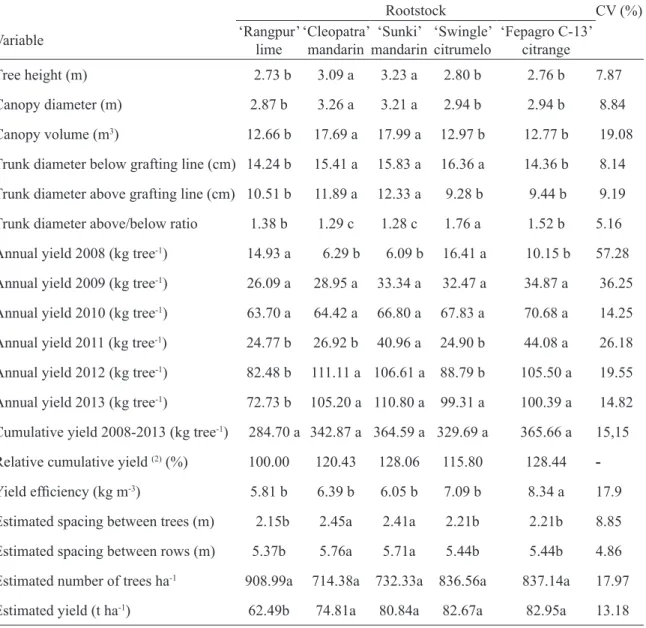
Trees of ‘Jaffa’ sweet orange grafted onto ‘Cleopatra’ and ‘Sunki’ mandarins were larger than those on the other rootstocks in terms of tree height, diameter, and canopy volume (Table 1). In a study carried out in the same location with ‘Okitsu’
satsuma mandarin (C. unshiu Marc.), similar results were observed with regard to these parameters for trees grafted onto ‘Cleopatra’ and ‘Sunki’ mandarins rootstocks, which did not differ from each other and resulted in the largest vegetative growth of the ‘Okitsu’ mandarin trees (TAZIMA et al., 2013). These results are also consistent with those obtained
for ‘Valência’ sweet orange trees [C. sinensis (L.)
Osb.] in the northwestern region of Paraná, where
‘Cleopatra’ and ‘Sunki’ mandarins rootstocks induced larger canopy volumes (AULER et al., 2008). Therefore, ‘Valencia’ trees grafted onto these two rootstocks require larger planting spacing than those grafted onto Rangpur lime rootstock (AULER et al., 2008). However, there is currently a tendency to use rootstocks that induce smaller tree canopies as such small trees usually provide higher yield
efficiency relative to the canopy volume. Further,
these characteristics allow high yields because of the increased density of trees per area (CASTLE et al., 2010), as well as reduce harvest costs and
improve efficiency for pest control and fertilization
(MADEMBA-SY et al., 2012). They may also
contribute to greater carbon sequestration (LIGUORI
at al., 2009).
With regard to trunk diameter, ‘Sunki’ and ‘Cleopatra’ mandarins, and ‘Swingle’ citrumelo rootstocks provided the largest trunk diameters below the grafting line for the ‘Jaffa’ trees (Table 1). Furthermore, trees on ‘Sunki’ and ‘Cleopatra’ mandarins’ rootstocks also had the largest trunk diameters above the grafting line (Table 1).
The ratio of the trunk diameter below and above the grafting line was larger than 1.0 for ‘Jaffa’ sweet orange trees with all rootstocks (Table 1), indicating that the rootstock diameter was larger than all of the scion diameters. The largest difference between trunk diameter below and above the grafting line was for the trees grafted onto ‘Swingle’ citrumelo. This result is consistent with the
observations of Tazima et al. (2014), who evaluated
that characteristic for ‘Okitsu’ mandarin grafted onto the same rootstocks. ‘Swingle’ citrumelo is well
known for its incompatibility with specific citrus cultivars, such as ‘Pêra’ (LEITE JUNIOR, 1992;
evaluation for a few more years because citrus trees with some scion and rootstock combinations may
grow normally during the first years after grafting
and may subsequently exhibit late incompatibility
(PINA; ERREA, 2005). For more conclusive studies
on this aspect, it is necessary to investigate the trunk tissues to detect gum accumulation or necrosis, characteristics of incompatibility (SCHINOR et al., 2013).
At the first harvest in 2008, the highest yields of ‘Jaffa’ sweet oranges were from the trees grafted onto ‘Swingle’ citrumelo and ‘Rangpur’ lime rootstocks. In contrast, trees on ‘Cleopatra’ and ‘Sunki’ mandarins, and ‘Fepagro C-13’ citrange rootstocks had the lowest yields (Table 1). The low
yield in the first years of production for citrus trees
on ‘Cleopatra’ mandarin is a major drawback of this rootstock (POMPEU JUNIOR, 2005).
In the harvests of 2009 and 2010, no differences in yield were observed among the ‘Jaffa’
trees grafted onto the five rootstocks. In the following
years, some variation was observed in the yield of the ‘Jaffa’ trees grafted onto the different rootstocks (Table 1). While the trees with ‘Sunki’ mandarin and ‘Fepagro C-13’ citrange rootstocks had the highest yields in the 2011 harvest, there were no differences among the trees with these two rootstocks and the ones with ‘Cleopatra’ mandarin rootstocks for the 2012 harvest. Furthermore, in 2012, the yields of the trees on these rootstocks were higher than those for trees grafted onto ‘Rangpur’ lime and ‘Swingle’ citrumelo rootstocks. In the 2013 harvest, there were again no differences in yield among the trees of ‘Jaffa’ on the different rootstocks, with the exception of the trees with ‘Rangpur’ lime rootstocks. In the last three harvests, the yields of trees with ‘Cleopatra’ and ‘Sunki’ mandarins and ‘Fepagro C-13’ citrange rootstocks were the highest (Table 1). These results contradict the reports that citrus trees with ‘Cleopatra’ mandarin rootstocks require several years to attain high yields (POMPEU JUNIOR,
2005; ZEKRI; AL-JALEEL, 2004). Thus, scion
and rootstock interaction is a very important factor in citrus production. The rootstock can induce good performance for certain scions and poor performance for others. Another relevant factor to consider is the environmental condition of the location where the study was carried out. These conditions can determine whether the rootstocks achieve their full potential.
With regard to cumulative yield, no differences were observed among the ‘Jaffa’ trees grafted onto the different rootstocks (Table 1). However, when compared with ‘Rangpur’ lime, the
most used rootstock variety in Brazil, trees on the
four other rootstocks had relatively higher cumulative yield than did ‘Rangpur’ lime considering the six harvests, with the differences ranging from 15 to 28% higher (Table 1). These results are consistent with those obtained by Auler et al. (2008) in an
experiment with ‘Valência’ sweet oranges carried out in the northwestern region of Paraná, Brazil. In that
study, trees on ‘Sunki’ and ‘Cleopatra’ rootstocks had the highest relative cumulative fruit yields.
The yield efficiency (kg fruits m-3 canopy) of
trees grafted onto ‘Fepagro C-13’ citrange rootstock was higher than that from trees with the other four rootstocks (Table 1). This characteristic is probably
associated with the smaller tree size and canopy
volume, a characteristic that may be derived from the parent P. trifoliata (POMPEU JUNIOR, 2005). The data from this study are not consistent with
those obtained by Stenzel et al. (2005), where no differences in yield efficiency were observed for
trees of ‘Folha Murcha’ sweet orange [C. sinensis
(L.) Osb.] grafted onto ‘Fepagro C-13’ citrange rootstock, as compared to ones with ‘Rangpur’ lime. In another study, also conducted in the northwestern
region of Paraná, Brazil, the yield efficiency of five-year-old trees of ‘Valência’ sweet orange with
‘Troyer’ citrange rootstocks [C. sinensis (L.) Osb. × P. trifoliata (L.) Raf.] was higher than for the ones with ‘Orlando’ tangelo rootstock (C. paradisi
Macf. × C. reticulata Blanco) (AULER et al., 2008).
However, in that study, the yield efficiency of the
trees on both rootstocks was not different from those with ‘Rangpur’ lime, ‘Caipira’ sweet orange [C. sinensis (L.) Osb.], and ‘Sunki’ and ‘Cleopatra’ mandarins (AULER et al., 2008). However, at nine
years of age, ‘Valência’ sweet orange trees grafted
onto ‘Rangpur’ lime, ‘Sunki’ mandarin, and ‘Troyer’
citrange rootstocks had the highest yield efficiency
(AULER et al., 2008).
Rootstocks that induce higher canopy yield
efficiency and lower canopy volume are certainly
more interesting than those with a higher canopy volume, despite the higher total fruit yield per tree. The lower yield of small citrus trees can be compensated for an increase in tree density per area
(POMPEU JUNIOR; BLUMER, 2009). This is
the case in the present study for the ‘Jaffa’ trees on ‘Fepagro C-13’ citrange rootstocks, as compared to the other rootstocks (Table 1).
Based on the equation to determine orchard
spacing (DE NEGRI; BLASCO 1991), ‘Jaffa’ sweet
Furthermore, the estimated production of ‘Jaffa’ orange trees for all rootstocks reached values of up to 82.95 ton per ha (Table 1), which is a yield potential
much higher than the current Brazilian average yields (NEVES et al., 2007; NEVES; TROMBIN, 2012).
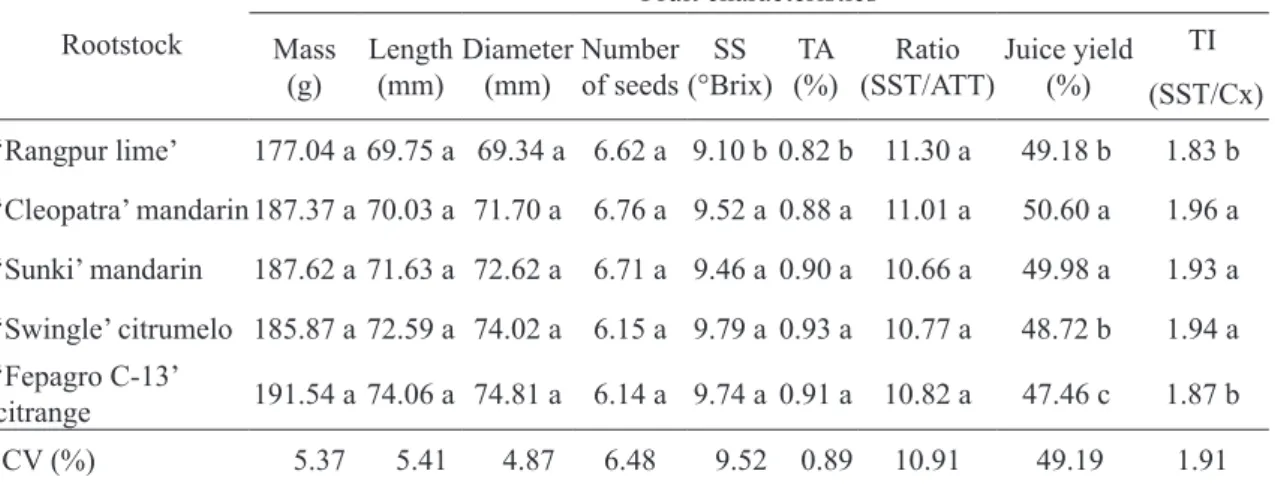
Regarding quality, fruit mass ranged from
177.04 to 191.54 g but no significant differences
were observed among the fruits of ‘Jaffa’ produced by trees grafted onto the different rootstocks (Table 2).
Stenzel et al. (2005) also did not find any significant
differences in fruit mass of ‘Folha Murcha’ sweet oranges produced on trees with ‘Fepagro C-13’ citrange, ‘Rangpur’ lime, ‘Cleopatra’ mandarin, and ‘Africa’ rough lemon (C. jambhiri Lush) rootstocks.
‘Jaffa’ fruit sizes obtained in the present study were
generally larger than the 180 g obtained in the state
of Rio Grande do Sul, Brazil, for the same cultivar
(OLIVEIRA et al., 2008).
The lengths and diameters of the fruits ranged from 69.8 to 74.1 mm and from 69.3 to 74.8 mm, respectively (Table 2). The diameter of the fruits of ‘Jaffa’ sweet oranges from trees grafted onto all
rootstocks met the requirements of the Brazilian fresh
fruit market and belonged to the classes Medium (65-71 mm) and Big (> 71 mm) (CEAGESP, 2011).
The number of seeds in the fruits of ‘Jaffa’ sweet oranges was similar for all trees with the different rootstocks, with an average of six seeds per fruit (Table 2). However, higher numbers of seeds in ‘Jaffa’ sweet orange fruits have been observed in other studies, to as many as 18 seeds per fruit
(CASTLE; BALDWIN, 2011). For industrial
purposes, the number of seeds should preferably fall
between zero and eight seeds per fruit (DONADIO
et al., 1999), while citrus fruits for the fresh market should have a minimal number seeds or even be
seedless (CAPUTO et al., 2012; FERRARO et al., 2006; SENNA et al., 2007).
The sugar content and acidity of the juice from ‘Jaffa’ sweet oranges had some differences. Soluble solids (SS) content in the juice of fruits from trees with ‘Rangpur’ lime rootstocks was the lowest among all of the rootstocks included in this study (Table 2). The average SS content of ‘Jaffa’ fruits was close to those obtained by Ishfaq et al.
(1999) in Pakistan (9.12 °Brix) but lower than the sugar contents of 12.5, 11.5, and 11.7 °Brix reported in other studies (Al-MOUEI; CHOUMANE, 2014; CAVALCANTE et al., 2006; CASTLE; BALDWIN,
2011). These differences may be related to the environmental conditions of the different locations, which have more impact on sugar formation during fruit maturation (STENZEL et al., 2006).
With regard to the effects of rootstock on fruit
quality, ‘Rangpur’ lime rootstock usually induces
lower quality in citrus fruits (GONZATTO et al., 2011; POMPEU JUNIOR, 2005). In a study carried out in Paranavaí, Paraná state, Brazil, trees of ‘Folha
Murcha’ sweet orange on ‘Fepagro C-13’ citrange and ‘Sunki’ mandarin rootstocks produced fruits of higher quality than those produced by trees on ‘Rangpur’ lime and ‘Cleopatra’ mandarin rootstocks (STENZEL et al., 2005).
Juice acidity was lower for fruits of ‘Jaffa’ sweet orange produced by trees grafted onto ‘Rangpur’ lime rootstocks as compared with fruits from trees on the other rootstocks (Table 2).
However, the fruits produced on all five rootstocks
had titratable acidity (TA) values consistent with those recommended for the juice industry (DI
GIORGI et al., 1990), i.e., between 0.75 and 1.0%.
The TA values of fruits of ‘Jaffa’ sweet orange trees grafted onto ‘Rangpur’ lime rootstocks were
similar to those obtained elsewhere (AL-MOUEI; CHOUMANE, 2014; CAVALCANTE et al., 2006;
ISHFAQ et al., 1999). However, the fruits from trees grafted onto ‘Swingle’ citrumelo rootstocks had TA higher than that obtained for the same combination by Castle and Baldwin (2011).
The SS/TA ratio ranged from 10.7 to 11.3 but no differences were observed among the fruits from the trees grafted onto the different rootstocks (Table 2). However, the SS/TA ratio of the fruits of ‘Jaffa’ sweet orange plants grafted onto ‘Rangpur’ lime rootstocks were lower than the value reported
in other studies (Al-MOUEI; CHOUMANE, 2014; CAVALCANTE et al., 2006). In contrast, no
differences were observed for other sweet oranges from trees on ‘Cleopatra’ and ‘Sunki’ mandarins and ‘Rangpur’ lime rootstocks in studies also carried
out in Paraná (AULER et al., 2008; STENZEL et
al., 2005).
A higher juice content of ‘Jaffa’ was observed for fruits from trees with ‘Cleopatra’ and ‘Sunki’ rootstocks (Table 2). Fruits produced by trees on ‘Fepagro C-13’ citrange rootstocks had the lowest percentage of juice (47%), while fruits produced by trees on ‘Rangpur’ lime and ‘Swingle’ citrumelo rootstocks had an intermediate juice content (Table 2).
In the State of São Paulo, Brazil, the
recommended values for fresh market oranges are as follows: a minimum juice content of 44–45%,
SS ≥ 10 °Brix, and a ratio ≥ 9.5 (CEAGESP, 2011).
Considering these parameters, the quality of the
‘Jaffa’ fruits produced by trees grafted onto all five
acceptable range, as oranges should have a SS/TA ratio between 6 and 20, with the best ratios between
11 and 14 (PETTO NETO; POMPEU JUNIOR,
1991).
The technological indexes of ‘Jaffa’ sweet oranges, produced by trees on ‘Cleopatra’ and ‘Sunki’ mandarins, and ‘Swingle’ citrumelo rootstocks, were better than the ones obtained for fruits from trees with ‘Rangpur’ lime and ‘Fepagro C-13’ citrange rootstocks (Table 2).
TABLE 1 - Tree height, canopy diameter and volume, trunk diameter below and above the grafting line, and
the below/above ratio of trunk diameter for the 2013 season; mean annual yields, cumulative and relative cumulative yield, yield efficiency, spacing between trees and rows, number of trees, and estimated yield of ‘Jaffa’ sweet orange trees grafted onto five different rootstocks from 2008 through 2013, in Londrina, Paraná (1).
Rootstock CV (%)
Variable ‘Rangpur’
lime
‘Cleopatra’ mandarin
‘Sunki’ mandarin
‘Swingle’ citrumelo
‘Fepagro C-13’ citrange
Tree height (m) 2.73 b 3.09 a 3.23 a 2.80 b 2.76 b 7.87
Canopy diameter (m) 2.87 b 3.26 a 3.21 a 2.94 b 2.94 b 8.84
Canopy volume (m3) 12.66 b 17.69 a 17.99 a 12.97 b 12.77 b 19.08
Trunk diameter below grafting line (cm) 14.24 b 15.41 a 15.83 a 16.36 a 14.36 b 8.14
Trunk diameter above grafting line (cm) 10.51 b 11.89 a 12.33 a 9.28 b 9.44 b 9.19
Trunk diameter above/below ratio 1.38 b 1.29 c 1.28 c 1.76 a 1.52 b 5.16
Annual yield 2008 (kg tree-1) 14.93 a 6.29 b 6.09 b 16.41 a 10.15 b 57.28
Annual yield 2009 (kg tree-1) 26.09 a 28.95 a 33.34 a 32.47 a 34.87 a 36.25
Annual yield 2010 (kg tree-1) 63.70 a 64.42 a 66.80 a 67.83 a 70.68 a 14.25
Annual yield 2011 (kg tree-1) 24.77 b 26.92 b 40.96 a 24.90 b 44.08 a 26.18
Annual yield 2012 (kg tree-1) 82.48 b 111.11 a 106.61 a 88.79 b 105.50 a 19.55
Annual yield 2013 (kg tree-1) 72.73 b 105.20 a 110.80 a 99.31 a 100.39 a 14.82
Cumulative yield 2008-2013 (kg tree-1) 284.70 a 342.87 a 364.59 a 329.69 a 365.66 a 15,15
Relative cumulative yield (2) (%) 100.00 120.43 128.06 115.80 128.44
-Yield efficiency (kg m-3) 5.81 b 6.39 b 6.05 b 7.09 b 8.34 a 17.9
Estimated spacing between trees (m) 2.15b 2.45a 2.41a 2.21b 2.21b 8.85
Estimated spacing between rows (m) 5.37b 5.76a 5.71a 5.44b 5.44b 4.86
Estimated number of trees ha-1 908.99a 714.38a 732.33a 836.56a 837.14a 17.97
Estimated yield (t ha-1) 62.49b 74.81a 80.84a 82.67a 82.95a 13.18
TABLE 2 – Mass, length, diameter, number of seeds, soluble solids (SS), titratable acidity (TA), ratio (SS/ TA), juice yield, and technological index (TI) of fruits of Jaffa sweet oranges from trees grafted
onto five different rootstocks, in Londrina, Paraná, 2009-2013(1).
Rootstock
Fruit characteristics
Mass (g)
Length (mm)
Diameter (mm)
Number of seeds
SS
(°Brix) (%)TA
Ratio (SST/ATT)
Juice yield (%)
TI
(SST/Cx)
‘Rangpur lime’ 177.04 a 69.75 a 69.34 a 6.62 a 9.10 b 0.82 b 11.30 a 49.18 b 1.83 b
‘Cleopatra’ mandarin 187.37 a 70.03 a 71.70 a 6.76 a 9.52 a 0.88 a 11.01 a 50.60 a 1.96 a
‘Sunki’ mandarin 187.62 a 71.63 a 72.62 a 6.71 a 9.46 a 0.90 a 10.66 a 49.98 a 1.93 a
‘Swingle’ citrumelo 185.87 a 72.59 a 74.02 a 6.15 a 9.79 a 0.93 a 10.77 a 48.72 b 1.94 a ‘Fepagro C-13’
citrange 191.54 a 74.06 a 74.81 a 6.14 a 9.74 a 0.91 a 10.82 a 47.46 c 1.87 b
CV (%) 5.37 5.41 4.87 6.48 9.52 0.89 10.91 49.19 1.91
1Means followed by the same letter in the column are not significantly different according to the Scott-Knott test (p < 0.05).
CONCLUSIONS
The smallest ‘Jaffa’ sweet orange tree canopy is induced by ‘Rangpur’ lime, ‘Fepagro C-13’ citrange, and ‘Swingle’ citrumelo rootstocks.
The best yield efficiency for ‘Jaffa’ sweet
orange trees is provided by ‘Fepagro C-13’ citrange rootstocks.
Trees of ‘Jaffa’ sweet orange have the same cumulative yield for all evaluated rootstocks.
Fruits of ‘Jaffa’ sweet oranges attend the standards required by the fresh fruit market and the fruit processing industry when grafted onto all of the evaluated rootstocks.
REFERENCES
AL-MOUEI, R.; CHOUMANE, W. Physicochemical
juice characteristics of various Citrus species in Syria. International Journal of Plant & Soil Science, The Hague, v.3, p.1083–1095, 2014. (1)
AOAC - Association of Official Analytical Chemists. Official methods of analysis. 15th ed. Arlington,
1990. (2)
AULER, P.A.M.; FIORI-TUTIDA, A.C.G.;
TAZIMA, Z.H. Comportamento da laranjeira
‘Valência’ sobre seis porta-enxertos no Noroeste do Paraná. Revista Brasileira de Fruticultura, Jaboticabal, v.30, n.1, p.229–234, 2008. (1)
AULER, P.A.M.; LEITE JUNIOR, R.P.; TAZIMA, Z.H.; ANDRADE, P.F.S. A Citricultura no Paraná. Citricultura Atual, Cordeirópolis, v.99, p. 17-20, 2014. (1)
BARBASSO, D.V.; PIO, R.M; CARVALHO,
S.A. Compatibility of mandarin varieties and some hybrids on ‘Swingle’ citrumelo. Laranja, Cordeirópolis, v.26, p.59–67, 2005. (1)
CAPUTO, M.M.; MOURÃO FILHO, F.A.A. ; SILVA, S.R. da; BREMER NETO, H.; COUTO, H.T.Z. do; STUCHI, E.S. Seleção de cultivares de laranja doce de maturação precoce por índices de
desempenho. Pesquisa Agropecuária Brasileira,
Brasília, DF, v.47, p.1669-1672, 2012. (1)
CASTLE, W.S.; BALDWIN, J.C. Young tree
performance of juvenile sweet orange canopy on Swingle citrumelo rootstock. Hortscience, Alexandria, v.46, p.541-552, 2011. (1)
CASTLE, W.S; BALDWIN, J.C.; MURARO, R.P.
Performance of ‘Valencia’ sweet orange trees on 12 rootstocks at two locations and an economic interpretation as a basis for rootstock selection. HortScience, Alexandria, v. 45, p. 523-533, 2010. (1)
CAVALCANTE, I.H.L.; MARTINS, A.B.G.;
CEAGESP - Companhia de Entrepostos e Armazéns Gerais de São Paulo. Normas de classificação de citros de mesa. São Paulo, 2011. 12p. Disponível em: <http://www.ceagesp.gov.br/wp-content/ uploads/2015/07/citros.pdf >. Acesso em: 18 jan 2017. (5)
DE NEGRI, J.D.; BLASCO, E.E.A. Planejamento e implantação de um pomar cítrico. In: RODRIGUEZ, O.; VIÉGAS, F.; POMPEU Jr., J.; AMARO, A.A.
(Ed.). Citricultura brasileira. 2.ed. Campinas: Fundação Cargill, 1991. p. 318-332. (2)
DI GIORGI, F.; IDE, B.Y.; DIB, K.; MARCHI, R.J.; TRIBONI, H.R.; WAGNER, R.L. Contribuição ao
estudo do comportamento de algumas variedades de citros e suas implicações agroindustriais. Laranja, Cordeirópolis, v.11, p.567-612, 1990. (1)
DONADIO, L.C.; STUCHI, E.S.; POZZAN, M.;
SEMPIONATO, O.R. Novas variedades e clones de laranja doce para indústria. Jaboticabal: FUNEP,
1999. 42 p. (Boletim Citrícola, 8). (1)
FERRARO, A.E.; PIO, R.M.; AZEVEDO, F.A. de. Influência da polinização com variedades de
laranja-doce sobre o número de sementes de tangelo Nova. Revista Brasileira de Fruticultura, Jaboticabal, v.28, n2, p.244-246, 2006. (1)
GONZATTO, M.P.; KOVALESKI, A.P.; BRUGNARA, E.C.; WEILER, R.L.; SARTORI, I.A.; LIMA, J.G. de; BENDER, R.J.; SCHWARZ,
S.F. Performance of ‘Oneco’ mandarin on six
rootstocks in South Brazil. Pesquisa Agropecuária Brasileira, Brasília, DF, v.46, p.406-411. 2011. (1)
IAPAR - Instituto Agronômico do Paraná. Estações meteorológicas. Londrina, 2013. Disponível em: <http://www.iapar.br/arquivos/Image/ monitoramento/Medias_Historicas/ Londrina.htm>. Acesso em: 14 maio 2014. (5)
ISHFAQ, M.; HAFIZ, I.A; HUSSAIN, A.; CHAUDHARY, G.A. Growth, yield and fruit quality
of sweet orange varieties under rainfed conditions of Chakwal. International Journal of Agriculture & Biology, Faisalabad, v.1, p.100-102, 1999. (1)
LEITE JUNIOR, R.P. Cultivares de copa e
porta-enxertos. In: IAPAR - Instituto Agronômico do Paraná. Citricultura no Paraná. Londrina, 1992. p. 91-116. (Circular, 72). (1)
LIGUORI, G.; GUGLIUZZA, G.; INGLESE,
P. Evaluating carbon fluxes in orange orchards in relation to planting density. The Journal of Agricultural Science, Cambridge, v. 147, p. 637-645, 2009. (1)
MADEMBA-SY, F.; LEMERRE-DESPREZ, Z.; LEBEGIN, S. Use of flying dragon trifoliate orange
as dwarfing rootstock for citrus under tropical climatic conditions. HortScience, Alexandria, v. 47, p.11-17, 2012. (1)
MENDEL, K. Rootstock-scion relationships in Shamouti trees on light soil. Ktavim,Rehovot, v.6, p.35-60, 1956. (1)
MORAES, L.A.C.; MOREIRA, A.; PEREIRA,
J.C.R. Incompatibility of ‘Cleopatra’ mandarin
rootstock for grafting citrus in Central Amazon, State of Amazonas, Brazil. Revista de Ciências Agrárias,
Belém, v.54, p.299-306, 2011. (1)
NEVES, M.F.; LOPES, F.F.; TROMBIN, V.G.; AMARO, A.A.; NEVES, E.M.; JANK, M.S. Mais
gestão e tecnologia. Agroanalysis, Rio de Janeiro, v.27, p.14-16, 2007. (1)
NEVES, M.F.; TROMBIN, V.G. Mapping and quantification of the Brazilian citrus chain. Fruit Processing,Hertfordshire, n.2, p.50-59, 2012.
OLIVEIRA, R.P.; SCIVITTARO, W.B.; ROCHA, P.S.G. Cultivares de laranjeira resistentes ao cancro cítrico. Pelotas: Embrapa. 2008a. (Documentos, 249). (1)
OLIVEIRA, R.P.; SOARES FILHO, W.S.; PASSOS, O.S.; SCIVITTARO, W.B.; ROCHA, P.S.G. Porta-enxertos para citros. Pelotas: Embrapa, 2008b. (Documentos, 226). (1)
PETTO NETO, A.; POMPEU JUNIOR, J. Colheita, beneficiamento e transporte. In: RODRIGUEZ, O.; VIÉGAS, F.C.P.; POMPEU JUNIOR, J.; AMARO,
A.A. (Ed.). Citriculturabrasileira. 2.ed. Campinas: Fundação Cargill, 1991. p. 892-897. (2)
PINA, A.; ERREA, P. A review of new advances in
POMPEU JUNIOR, J. Porta-enxertos. In: MATTOS
JUNIOR, D.; DE NEGRI, J.D.; PIO, R.M.; POMPEU
JUNIOR, J. (Ed.). Citros. Campinas: Instituto
Agronômico, 2005. p.63-104. (2)
POMPEU JUNIOR, J.; BLUMER, S. Híbridos
de trifoliata como porta-enxertos para a laranjeira
‘Valência’. Pesquisa Agropecuária Brasileira,
Brasília, DF, v.44, p.701-705, 2009. (1)
SCHINOR, E.H.; CRISTOFANI-YALY, M.; BASTIANEL, M.; MACHADO, M.A. Sunki
mandarin vs Poncirus trifoliata hybrids as rootstocks for Pera sweet orange. Journal of Agricultural Science, Toronto, v.5, n.6, p.190-200, 2013. (1)
SENNA, A.J.T.; PEDROZO, E.A.; KOLLER, O.C. Identificação e análise da cadeia de distribuição de frutas cítricas sem sementes: um estudo de caso
na cidade de São Paulo. Revista Brasileira de Fruticultura, Jaboticabal, v.29, n.3, p.508-512, 2007. (1)
STENZEL, N.M.C; NEVES, C.S.V.J; MARUR, C.J.; SCHOLZ, M.B.S; GOMES, J.C. Maturation curves
and degree-days accumulation for fruits of ‘Folha Murcha’ orange trees. Scientia Agricola, Piracicaba, v.63, p. 219-225, 2006. (1)
STENZEL, N.M.C.; NEVES, C.S.V.J.; SCHOLZ, M.B.S.; GOMES, J.C. Comportamento da laranjeira
‘Folha Murcha’ em sete porta-enxertos no Noroeste
do Paraná. Revista Brasileira de Fruticultura, Jaboticabal, v.27, n.3, p.408- 411, 2005. (1)
STUCHI, E.S. Controle do tamanho de plantas cítricas Citrus Research & Technology, Cordeirópolis, v.33, p.91-112, 2012. (1)
TAZIMA, Z.H.; LEITE JUNIOR, R.P. Novos cultivares de citros para o Paraná. Londrina: IAPAR, 2000. Folder (1)
TAZIMA, Z.H.; NEVES, C.S.V.J.; YADA, I.F.U.;
LEITE JUNIOR, R.P. Performance of ‘Okitsu’ mandarin on nine rootstocks. Scientia Agricola, Piracicaba, v.27, p.422-427, 2013. (1)
TAZIMA, Z.H.; NEVES, C.S.V.J.; YADA, I.F.U.;
LEITE JUNIOR, R.P. Performance of ‘Okitsu’ satsuma mandarin trees on different rootstocks in Northwestern Parana State. Semina Ciências Agrárias, Londrina, v.35, p. 2297-2308, 2014.
Disponível em: <DOI: 10.5433/1679-0359.2014v3 5n5p2297>.
USDA/NRCS - United States Department of Agriculture. Soil survey staff, natural resources conservation service. 1999. (Official Series
Descriptions). Disponível em: <http://soils.usda.gov/
technical/ classification/osd/index.html>. Acesso em: 7 set. 2014. (5)
ZEKRI, M.; AL-JALEEL, A. Evaluation of rootstocks