Participation and relative autonomy
in the EBC’s Curator’s Council
Allana Meirelles Vieira & Iluska Maria da Silva Coutinho
Abstract
This paper aims to analyze the acting of the Curator’s Council of Empresa Brasil de Co-municação (EBC), the main space of civil society participation of the communication company of public service in the country. From the analysis of documents, it seeks to analyze the profile of the actors who take part of the Curator’s Council and the segments of civil society they represent, reflecting on the relative autonomy of the organism. In addition, it is adopted a content analysis of the debates about the EBC work plans in order to think about the participation of the actors in the deliberations of the Curator’s Council. In this sense, it is adopted a maximalist perspective of participation, understanding that it goes beyond the interaction with the content, in the media sphere. Similarly, it is understood the limitations of the representation process and, therefore, the proposal is to reflect on what groups can take part of this space, since the beginning of EBC until today. Furthermore, it is understood that the process of participation of civil society and the autonomy of the Curator’s Council reflect on the relative autonomy of the enterprise as a whole.
Keywords
Participation; relative Autonomy; EBC; public service
Introduction1
In contrast with many European countries, in Brazil, the media development has fol-lowed the private model (Bolaño, 2004), despite the fact that the broadcasting channels can be managed just as from the public concession. The role of publicity and propaganda2 of
the Cultural Industry, observed by Bolaño (2000) has historically been fulfilled by the com-mercial channels, especially, Rede Globo. In this sense, those so-called public channels have presented a role of “marginal complementarity” (Valente, 2009).
1 This text departs from work developed by one of the authors elsewhere (Vieira, 2016).
2 According to Bolaño (2000, p. 53), the Cultural Industry is responsible for realizing the “symbolic mediation” between the
capital and the State on the one hand and the consumers and electors on the other hand. This mediation role is exercised from the opposition of two general functions of the Cultural Industry: the publicity and the propaganda. In this perspective, the propaganda is responsible for the social cohesion, “being monopolized by the State and by the capitalist sectors that control the mass media communication”, while the second is established considering the capital accumulation, being “as service of the capitalist concurrence” (Bolaño, 2000, p. 53). According to him, the ideological role of the publicity “appears diluted and serves to the constitution of a capitalist culture in the general sense of the term, a culture built on the individu-alization and the massification processes, on the fragmentation and on the rearticulating of the social body, on the compul-sive individual consumption and on the mass production” (Bolaño, 2000, pp. 92-93). Empirically, however, the limits of the propaganda and the publicity are not clear. Bolaño says that “the elementary way of the publicity is the propaganda too, to the extent of the fact that it conforms a symbolic universe of undeniable ideological power, besides the numerous acts of buying and selling (Bolaño, 2000, p. 53).
Considering this context, the Empresa Brasil de Comunicação (EBC) was created in 2007, with the proposal of building a network of public radio and television stations, hence complementing the Brazilian communication system. According to the Brazilian Constitution of 1988, it is necessary a complementation between the private, the state-owned and the public model of TV and radio channels (Constituição, 1988). However, there is not a clear definition of what “public” means in this document, which generates a dispute over the project to be implemented.
Between the perspective that analyses “public” communication from what it ought to be – based generally on Habermas’ historical analysis of the public sphere (Haber-mas, 1991), independent from the State and from the market – and the perspective that analyzes these channels based on what they are – through a Gramscian vision of State3,
understanding the impossibility of having a completely independent sphere of the politi-cal society and of the market – we adopt the second vision. However, it is also considered the possibility of a relative autonomy in the sense of a certain level of detachment from the government and the market.
In this sense, despite considering the impossibility of a complete detachment from the governmental or commercial interests, it is comprehended the need of an autonomy level in relation to these spheres. EBC is sometimes closer to the public field and sometimes closer to the governmental communication. On the one hand, EBC is responsible for public channels – such as TV Brasil, TV Brasil Internacional, Agência Brasil, Radioagência Nacional and the public radio system, composed by eight stations; on the other hand, EBC provides services to the main institutional communication organism of the Federal Government – the Communication Secretary of Federal Government (SECOM), producing governmental pro-grammes – such as Voz do Brasil, Café com a Presidenta and Bom dia Ministro. In addition, EBC is linked to Secom and the EBC’s Executive Management is chosen by the President of the Republic, which causes doubts about the public role of EBC. However, there are some rules that prevent the government transforming the enterprise in an instrument of propa-ganda, such as the fixed term of office of these Executive Managers, who cannot be replaced at will of the President of the Republic.
Whereas there is this relationship with the government, EBC has a Curator’s Cou-ncil, which is responsible for guaranteeing the fulfillment of EBC’s public commitment and autonomy. Its role is analyzing and defining the programming. In addition, it is the main space of civil society participation inside the enterprise. The civil society partici-pation is one of the main differences between public and commercial or governmental televisions. According to various authors (Coutinho, 2013; Fidalgo, 2005; Pinto, 2005a; Rincón, 2002; Rodríguez & Villanueva, 2010; Rothberg, 2011), from the normative view,
3 In Gramsci’s theory, the State is not restricted to the government. According to him, “State = political society + civil
soci-ety, in other words hegemony protected by the armour of coercion” (Gramsci, 1971 p. 532). In this sense, civil society is “the ensemble of organisms commonly called ‘private’” (Gramsci, 1971, p. 145) – as the Church, the political parties, the trade unions, the media, the school, the scientific and artistic institutions etc. – and inside it the “spontaneous” consent is built. The political society refers to the “The apparatus of state coercive power which “legally” enforces discipline on those groups who do not “consent” either actively or passively” (Gramsci, 1971, p. 145). However, according to him, this separation is a methodological strategy more than an organic or real difference.
there is a need of autonomy and participation on the public channels as well as a respon-sibility with the citizenship:
The citizens’ participation is or should be intrinsic to the idea of public tel-evision service, since this service just completely justify itself when and to the extent that includes the citizens in all the steps and dimensions, since the policy definition to the realization and evaluation. (Pinto, 2005b, p. 57)
In this sense, Pinto endorses that the public channel role is building a space of civil society groups and organizations, creating “another way of socializing” and being a “true citizens’ television” (Pinto, 2005a, p. 14). Equally, Rumphorst establishes that the difference of the public service is that “public service broadcasting is broadcasting made for the public, financed by the public and controlled by the public” (Rumphorst quoted in Pinto, 2005a, p. 9).
Taking this into consideration this paper intends to analyse the structure and composi-tion of the EBC’s Curator’s Council, observing its funccomposi-tioning rules, the involved actors, and civil society representatives – assuming that this is representation is limited in scope given that it would be difficult to approach all the plurality of civil society. In this sense, it is pos-sible to think about the participation mechanisms in the channels of public service. Research was conducted by analysing official statutory documents, and by conducting a content analy-sis of the most relevant debates on the working plans for the corporation. The results of this study, which was part of a macro research developed since 2010, within the Laboratório de Jornalismo e Narrativas Audiovisuais and, between 2014 and 2016, as part of a masters thesis4
were to be profoundly contrasted with the alterations produced by recent political decisions in Brazil. Temporary measure 744, of September 2nd 2016, extinguished the Curator’s Coun-cil and modified EBC’s structure, allowing for the replacement of its president, at any given moment, by order of the Head of State. The publication of this temporary law one day after the departure from office of President Dilma Roussef unleashed a series of formal protests by entities like Intercom, Brazilian Society for interdisciplinary Studies in Communication, EBC and Public Communication Defense Forum, Intervozes, etc. These actions denounced the new restrictions on civil society participation and on the independence of EBC from fed-eral government control.
Media participation
The theories of democratic participation can be classified as minimalist or maximalist, as Carpentier (2011) discusses in his study. According to this author, minimalist theories tend to focus on representation and on power delegation, from a point of view that assumes politics as a privilege of the elite. On the other hand, maximalist theories consider both participation and representation, focusing mainly on participation. In addition, there is a dif-ference between the two approaches relating to the focus on macro or micro participation.
4 See Allanda Meirelles Vieira’s master dissertation at
While the minimalists consider just the macro perspective, which means the policy decision at national level or at an imagined political community, the maximalists understand the participation also in a micro reality – as the school, the family, the neighborhood, the church etc. Therefore, the first ones focus on a strict sense of “politics” and the maximalists com-prehend politics as a social dimension, approaching various spheres.
Moreover, according to the author, the minimalists consider unidirectional par-ticipation, which means that it is oriented just towards institutionalized politics. Even when engaged in other spheres, the participation is considered as an instrument of this institutionalized politics. On the other hand, the maximalist perspective have the idea of a multi-participation, not necessarily connected to institutionalized politics, consider-ing that it can strengthen democracy even in other spheres. Finally, the minimalists seek homogeneity between the actors involved in the participation process in order to be able to reach political decisions, while the maximalist advocate heterogeneity of actors.
It is possible to adopt both theoretical approaches to analyse the communication means. In a minimalist approach, the participation is limited to the access or the inter-action with the content. In this sense, he says: “participation remains unidirectional, articulated as a contribution to the public sphere but often mainly serving the needs and interests of the mainstream media system itself, instrumentalizing and incorporating the activities of participating non-professionals” (Carpentier 2011, p. 69).
In this perspective, Carpentier says that participation is considered a depoliticized standpoint. Especially with the development of the Internet, the demand for participation looks increasingly frequent. However, in practice, the communication companies appro-priate this demand in order to pursue audience loyalty and, thus, their profits. As Carpen-tier explains, “in Marx’ view of the bourgeois capitalist society, the political-ideological environment serves the interests of the bourgeoisie, which minimizes participation and makes societal equality (and more maximalist forms of participation) impossible, even when bourgeois capitalist society becomes more democratized” (Carpentier 2011, p. 27).
Discussing the structural changes in the public sphere, Habermas points out some inconsistencies in the consolidation of this space in a capitalist system. According to the author, “the public sphere of civil society stood or fell with the principle of universal access. A public sphere from which specific groups would be eo ipso excluded was less than merely incomplete; it was not a public sphere at all” (Habermas, 1991, p. 85).
The mass media development could amplify the access to the public sphere, owing to their greater range. However, as Habermas said, the privatization of the media led to the prioritization of other interests and the exclusion of some groups from the mediated public sphere. In this sense, we would have a simulated public sphere. Thus, participa-tion as stated by the commercial media has just hiding the permanent exclusion of cer-tain groups of the public sphere.
Considering that, this paper follows the maximalist view of participation, under-standing that democracy is not reduced to the election issues and can be strengthened by the action in other spheres, such as the media. Therefore, the deepening of the democrat-ic system also depends on the democratization of the media. Moreover, the maximalist
perspectives in the field of media participation, as stated by Carpentier, consider it from a political point of view and tend to defend their maximization, going beyond mere inter-activity or access, which justifies the choice of this point of view in this paper.
Regarding the participatory component relating to media, Carpentier considers two forms of participation, which can be termed “participation in the media and through the media” (Carpentier, 2011, p. 67). According to him, participation through the media refers to “mediated participation in public debate” and to “self-representation in the variety of public spaces that characterize the social” (Carpentier, 2011, p. 67). In this sense, the media sphere is an instrument for citizens voicing their thoughts, point of views and experiences. Mean-while, participation in the media includes a “content-related participation”, which means an interaction with media content, and a “structural participation”, which refers to the decision-making. As Carpentier says, “these forms of media participation allow citizens to be active in one of the many (micro-)spheres relevant to daily life, and to put into practice their right to communicate” (Carpentier, 2011, p. 68). In this category of participation, it is possible to include the activities of civil society in the Curator’s Council of EBC.
In commercial channels, in general, participation is restricted to the access levels and to interaction. It is often used as a form of legitimizing and guaranteeing the audi-ence loyalty. Meanwhile, the community communication would have potentially the most genuine opportunity for popular participation in the media field, in which the groups produce content and its own representation. Therefore, in advance, we assume that pub-lic channels do not fully realize the maximalist participation neither is restricted to a minimalist approach, since they need a certain level of participation to legitimate them-selves. However, with professionalization and adoption of similar hierarchical structures to commercial broadcasters, the public vehicles end up not providing participation at its deepest level.
Regarding participation in public television, Pinto (2005b, p. 53) provides two as-pects: one refers to a “substantive level”, which includes contributions to productions, programming and scheduling; the other involves a ‘methodological level’, including co-responsibilization, interaction, advice and continuous evaluation. According to the au-thor, the second perspective assumes that “the quality of a public service is established not only by the content but also by the processes of participation that it promotes and values” (Pinto, 2005b, pp. 53-54).
From this, Pinto establishes some types of citizen participation in public service tel-evision as: 1) the individual action – referring to the evaluation done by individuals; 2) the associative dimension – this category refers to the viewers and consumers associations and other organizations directly or indirectly connected to the television; 3) the representative via and the regulation instances – which is composed by constitutional and normative insti-tutions, linked to the legislative, executive branch, judiciary or even the civil society; 4) the educational institutions actions – which refer to the “media literacy”; (Pinto, 2005b, p. 56)5) and other types of intervention. In Brazil and within TV Brasil, it is possible to observe all these forms of participation. The EBC has an Ombudsman’s office, which is the main indi-vidual participation channel inside the enterprise, collecting suggestions and evaluations of
the audience. Social movements and civil society organizations – such as Intervozes - Coletivo Brasil de Comunicação Social, Fórum Nacional pela Democratização da Comunicação (FNDC), Centro de Estudos da Mídia Alternativa Barão de Itararé etc. – act in an associative dimension. Similarly, Brazilian universities have participated in the development of EBC, by means of partnership in researches related to the analysis of media content. With respect to the repre-sentative via and the regulation instances, there is the Social Communication Council of the Senate, externally to the EBC; and the Curator’s Council, internally, having a role of guaran-teeing the autonomy of the public channels and the civil participation inside the enterprise.
Civil society participation in the EBC
The Curator’s Council is considered the main instrument for guaranteeing the pub-lic commitment of EBC, being responsible for following and evaluating the contents of the public channels. According to the law which allowed the creation of EBC (Lei 11.652, 2008), the Curator’s Council is responsible for: 1) deciding on the communication policy, presented by the Executive Board of EBC, with regard to educational, artistic, cultural and informative guidelines; 2) ensuring the compliance with the principles and objec-tives set in the Law; 3) giving an opinion on issues related to the compliance with these principles and objectives; 4) deciding on the editorial line of production and program-ming, as proposed by the Executive Board of the EBC; 5) submitting the decisions taken to the Social Communication Council of the Senate; 6) giving no confidence vote for the members of the Executive Board; 7) and electing its president. Moreover, the Curator’s Council is responsible for establishing the guidelines and organizing the public consulta-tion process for the renewal of its members (Brasil, 2008). Thus, the Curator’s Council is, institutionally, more than just an advisory council, since it has the possibility of action in the company’s management as well as in the content presented by their channels.
In addition to the oversight role, the Curator’s Council is an instance of civil society representation and participation. It has 22 members, who are: four Ministers of State (from the Ministry of Education, Ministry of Culture, Ministry of Science and Technol-ogy and Communication Secretary of Federal Government – SECOM); one representa-tive of the House of Representarepresenta-tives and one of the Senate; 15 representarepresenta-tives of civil society; and a representative of the company’s employees. The representatives’ terms of office of four years with the possibility of being renewed only once5. As an exception, the representative of the employees has two-year term of office, without being able to be reappointed.
The representative of the employees is chosen through election, by secret and di-rect vote of the EBC staff. The members of the civil society, although appointed by the president, are currently indicated by a public consultation process with civil society or-ganizations (Conselho Curador, 2015). According to the law of EBC’s creation, these enti-ties should be, even partially, related to:
5 Among the first representatives of civil society, chosen by the President, eight had a term of two years and seven of four
I - the promotion of ethics, peace, citizenship, human rights and democ-racy; II - education and research; III - the promotion of culture and the arts; IV - the protection of historic and artistic heritage; V - the protection, pres-ervation and conspres-ervation of the environment; VI - the union, classist and professional representation. (Brasil, 2008)
The political parties and religious institutions cannot participate in the indication. Considering these points, it is possible to affirm that the institutional structure of the Curator’s Council offers the possibilities for an effective action of the organism. However, it is necessary to analyse how the rules are put into practice, which actors ef-fectively have representation in the Board and which of them take part in discussions and decisions, how the relationship between the Curator’s Council and the Executive Board of EBC is, among other characteristics that influence on the participation effectiveness. Thus, the relative autonomy of this field has an impact on the relative autonomy of EBC, and the possibilities of hegemony dispute within that Board may have consequences to the journalistic practice and in the produced content.
The composition of the Curator’s Council
The first Curator’s Council was chosen by the President of the Republic, Luiz Inácio Lula da Silva. The representatives of the civil society were: 1) Alex Pereira Barboza (known as MV Bill), a rapper, writer and social activist; 2) Ângela Gutierrez, an entrepreneur, researcher, art collector and ex-secretary of Culture of Minas Gerais; 3) Antônio Delfim Neto, an economist, politician and university teacher, who was minister during the military regime; 4) Claudio Salvador Lembo, a lawyer, university professor, politician, ex-governor of São Paulo (PSD); 5) Ima Célia Guimarães Vieira, an agronomist and researcher at Museu Paraense Emílio Goe-ldi (MPEG); 6) Isaac da Silva Pinhanta, an indigenous teacher; 7) José Antônio Fernandes Martins, a mechanical engineer and entrepreneur; 8) Jose Bonifácio de Oliveira Sobrinho (known as Boni), a publicist, entrepreneur and director of television, having held the posi-tion of vice president of Rede Globo; 9) José Paulo Cavalcanti Filho, a lawyer, ex-secretary of the Ministry of Justice, in the government of José Sarney, ex-president of CADE and the former EBN; 10) Luiz Edson Fachin, a lawyer and university professor, current minister of the Supreme Court; 11) Luiz Gonzaga de Mello Belluzzo, an economist, university professor and ex-secretary of economic policy of the Ministry of Finance in the government of José Sarney; 12) Lucia Willadino, a scientist, neuropsychologist, university professor and director of the Sarah Hospital Network; 13) Maria da Penha, a pharmaceutical and coordinator of Studies, Researches and Publications of the Associação de Parentes e Amigos de Vítimas de Violência (APAVV); 14) Rosa Lúcia Benedetti Magalhães, a teacher, artist and designer; 15) Wanderley Guilherme dos Santos, a political scientist and university professor.
That composition was marked by a dialogue with the academic, cultural, political and business areas. Although there were some social activists, none of the members of this first board were part of an organized social movement, according to the data provided by the secretary of the Curator’s Council. In addition, seven of the first 15 representatives of
civil society did not complete their terms in office: Alex Pereira Barboza, Ângela Gutierrez, Antônio Delfim Neto, José Paulo Cavalcanti, Luiz Edson Fachin, Luiz Gonzaga Belluzzo e Wanderley Guilherme dos Santos. Therefore, they were replaced by other names indicated by SECOM and by the other members of the Curator’s Council, respectively: 1) João Jorge San-tos Rodrigues, a lawyer, cultural producer and president of the Olodum group; 2) Heloísa Maria Murgel Starling, an historian, teacher and researcher at the Department of History at UFMG; 3) Murilo César Oliveira Ramos, a professor at the School of Communication at UNB; 4) Wagner Tiso, a conductor, pianist, arranger and composer; 5) Paul Ramos Deren-goski, a journalist; 6) Paulo Sérgio Pinheiro de Moraes Sarmento, a professor of Political Science, rapporteur on the rights of the child at the Inter-American Commission on Human Rights of OAS and ex-secretary of Human Rights, in the government of Fernando Henrique Cardoso; 7) Aaron Daniel Filho, a professor of History at UFF. With them, the dialogue with the academic and cultural field was kept, but with political field was reduced, due to the de-parture of names who have occupied positions in ministries and secretaries.
After the end of these terms of office, the public consultation process for renewal of the Curator’s Council started, considering the procedures that were discussed – in-cluding in public hearings – and established by the Board. The process includes three main steps: 1) the civil society organizations apply to participate in the indications; 2) the accepted institutions indicate a name for each vacant chair; 3) from these names, the members of the Curator’s Council elect three names for each position, which are sent to the President of the Republic, who is responsible for appointing them. In order to main-tain the representativity of the Curator’s Council, the law of EBC creation establishes that at least one citizen of each region of the country must have a chair in the council, as well as the representatives should follow the principles of cultural diversity and professional plurality (Brasil, 2008).
Considering that, the public consultation process launched in 2014, established the presence of: 1) an indigenous representative; 2) a disabled; 3) a representative of young people, between 15 and 29 years old. It was also planned the occupation of 40% of the positions of the representatives of civil society for black people (Conselho Curador, 2014). Moreover, according to the rules, it was sought to ensure the presence of the fol-lowing segments of civil society in the Curator’s Council:
a) a representative of the artistic community; b) a television or radio direc-tor, screenwriter, producer; c) a scientist; d) a teacher; e) a professional with expertise in communication and health; f) an education professional; g) a representative of public TVs and radios; h) a sportsmen or sportswomen; i) a representative of social movements related to human rights; j) a rep-resentative of social movements related to communication; k) an expert at education and at children and adolescents behavior (psychologists, psycho-therapists, educators, psychiatrists); l) an entrepreneur; m) a professional of Information Technology (Conselho Curador, 2014, pp. 3-4).
The public consultation process done in 2014 – to replace the counselors: Jose Antônio Martins, Maria da Penha, Daniel Aarão, João Jorge Santos and Murilo Ramos – had 205
entities authorized to indicate names and 58 candidates nominated6. According to an article
published in the website of the Curator’s Council (Crispi, 2014), it was considered the top voted names in five areas: 1) young people; 2) indigenous; 3) researchers; 4) professionals working in the field of human rights and diversity; 5) and communication professionals, en-trepreneurs and audiovisual producers. From this, each counselor may vote for up to three names of each area7, considering the need for gender, race and regionalism equality. Finally,
the counselors should formulate three lists to send to the President of the Republic8. On
June 18, 2015 – after more than a year of the list definition, which occurred on April 16, 2014 – the President Dilma Rousseff appointed the new members of the Board, respecting the more voted names in each area.
In addition to these five new counselors, appointed in August 2015, five others were chosen from indication of the civil society through public consultation process: Ana Maria da Conceição Veloso, Mário Augusto Jakobskind and Takashi Take joined, in 2010; Rita Freire and Rosane Bertotti, in 2013. Thus, currently, the majority of the counselors has effectively represented the civil society (in the sense of they have been chosen by its entities), and only five come from the first composition, chosen by the President.
In relation to the first composition, the current has a greater participation of social movements’ representatives. Most of them are involved with the movements for the com-munication democratization. There are trade unions representatives, activists from feminist movements and black social movements, an indigenous representative and a representative of people with disabilities. There are also counselors who work in organizations of interna-tional scope, aimed at social change, such as the World Social Forum9 and the Ashoka10
or-ganization. Moreover, although some members are not directly linked to social movements, they act in defense of the claims from these organizations – such as the filmmaker Joel Zito Araújo, an expert on movies and documentaries about the black culture in Brazil; and the professor Venício Arthur de Lima, communication researcher and active in the public media field.
6 Among the names indicated, there were two claims: one presented by EBC Employees Committee in relation to Mario
Jefferson Leite Melo, indicated by 51 entities, due to statements characterized by sexism, homophobia and disrespect to human rights, published on his personal Facebook profile; and the other referred to Cosette Espindola Castro, indicated by 13 entities, due to the fact that she used to provide services to the EBC. Both claims were denied, since there was no explicit limitation in relation to these cases. But neither name was mentioned on the three lists.
7 Three counselors did not vote because of the absence at the meeting: the Minister of Science and Technology, the Minister
of Education and the representative of civil society, Heloísa Starling.
8 The three lists prepared by the Curator’s Council had the following names: 1) Youth: a) Enderson Araújo de Jesus Santos
(black) - 14 votes; b) Paulo Victor Purificação Melo (black) - 12 votes; c) Gizele de Oliveira Martins (black) - 9 votes. 2) Indigenous: a) Letícia Luiza Yawanawá - 17 votes; b) Iranilde Barbosa dos Santos - 16 votes; c) Alexandre dos Santos Panka-raru - 15 votes. 3) Researchers: a) Venício Artur de Lima - 16 votes; b) Ana Cristina Garcia Fernandez Olmos - 11 votes; c) Margarida Maria Krohling Kunsch - 9 votes. 4) Professionals working in the field of Human Rights and Diversity: a) Isaías Dias (disabled person) - 11 votes; b) Ana Angelica Sebastião (black) - 10 votes; c) Cicera Rodrigues Alencar - 10 votes; 5) Communication professionals, entrepreneurs and audiovisual producers: a) Joel Zito Araújo Almeida (black) - 16 votes; b) Antonio Sérgio Pires Miletto - 9 votes; c) Renata Vicentini Mielli - 7 votes (Crispi, 2014).
9 The World Social Forum is an international event organized by social movements, with the proposal to develop
alterna-tives to global social transformation.
10 Ashoka is a global organization, established in 1980, which supports social entrepreneurs – which seek changes of social
As shown in Table 1, besides identifying the participation of the counselors in social movements, it was also made a survey of the entities that indicated counselors in the public consultation processes11.
Classification of the enti-ties that indicated them Social Movements Graduation and Profession Name - ANDI - Ashoka
- Fórum Pernambucano de Co-municação (FOPECOM) - Rede Mulher e Mídia
- Fórum de Mulheres de Pernambuco - Centro das Mulheres do Cabo - Sinos Comunicação - Centro Dom Hélder Câ-mara (CENDHEC) - Coletivo Intervozes Journalist and teacher at
UNICAP, at the project Jornalista Amiga da Criança/ANDI and social entrepreneur Ashoka. Ana Veloso
- Labor Union of the Journa-lists from Rio de Janeiro Journalist and writer
Mário Augusto Jakobskind Electrical Engineer in Telecommunica-tions Technology Takashi Tome
- Communication and Culture: 6 - Professional Councils: 2 - Political issues: 1 - Ciranda Internacional da
Co-municação Compartilhada - Feminist Social Movements - World Forum of Free Media - International Council of World Social Forum Journalist
Rita Freire (Vice-president)
- Labor issues: 10
- Communication and Culture: 8 - Professional Councils: 2 - Political Issues: 1 - Consumer Rights: 1 - CUT Nacional
- Fórum Nacional pela Democrati-zação da Comunicação (FNDC) - Comissão Operativa Nacio-nal da Coordenação dos Mo-vimentos Sociais (CMS) - Federação dos Trabalha-dores da Agricultura Fami-liar (FETRAF Brasil) Sociologist and
fa-miliar farmer. Rosane Bertotti
- Communication and Culture: 3 - Labor Issues: 1
- Social Movements of the Black Young People - Group of Young Commu-nicators Mídia Periférica Content Producer Enderson Araújo - Labor Issues: 20 - Movements of disa-bled people: 4 - Community Action: 2 - Communication and Culture: 2 - Environmental issues: 1 - Defense of populations at risk: 1 - Movements of disabled people
- Conselho Nacional dos Direitos da Pessoa com Deficiência, by CUT - Labor Union from Santander Banes-pa, Banesprev e Cabesp (AFUBESP) Bank worker
Isaías Dias
- Race and ethnicity: 3
- Defense of populations at risk: 1 - Community Action: 1
- Labor Issues: 2
- Communication and Culture: 3 PhD in Communication
Film Maker Joel Zito Araújo
- Communication and Culture: 1 - Professional Classes: 1 - Indigenous Leader
- Coordenação Indígena da Amazônia Brasileira. There is no
informa-tion in the website Letícia Luiza Yawanawá
11 According to the information of the Curator’s Council’ secretary, there is no document for the process of 2010. For this
- Labor issues: 18
- Communication and Culture: 5 - Defense of
popula-tions at risk:: 1 - Community Action: 2 - Environmental issues: 1 Sociologist and professor in
Political Science and Com-munication by the UnB. Venício Arthur de Lima
Table 1: The Representatives of Civil Society of the Curator’s Council, indicated by public consultation process.
With the analysis of these organizations, it is possible to think about what civil soci-ety groups have, to some extent, representation on the Curator’s Council. 70 civil socisoci-ety organizations had at least one of their indicated individuals named to the Board, in the process of 2012 and 2014. Among these organizations, 34 are linked to labor issues – such as trade unions, associations and confederations of workers –, three labor unions of journalists and five of telecommunications or broadcasting workers. One hypothesis for the fact that almost half of the entities are this category is a possible mobilization of the network of trade unions and labor centers around the indication of some candidates.
In addition, 18 organizations are linked to the defense of the right to communication and culture, four to the cause of people with disease and disabilities, three to the defense of populations at risk, three to the community action, three to the defense of black people, one to environmental issues, one to political issues, one to the defense of the consumers, and two professional class councils. Some entities, such as Observatório da Mulher, for ex-ample, are connected to more than one group, being, however, accounted for only one12. It
is important to notice that not all of these entities can be classified as social movement. The intention of this mapping, more than a deep analysis of this mode of representation and of the organizations, is to have an idea of these relationships, expanding therefore the informa-tion available for next analysis.
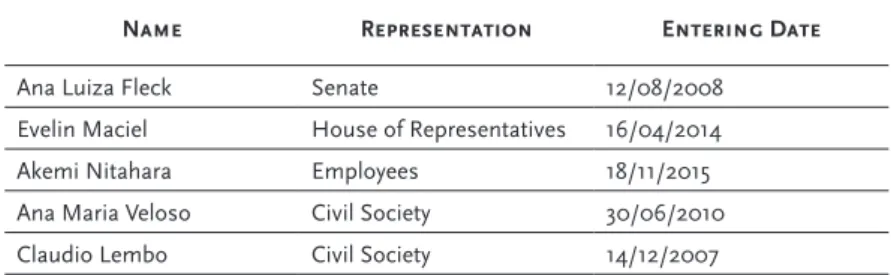
In addition to these counselors and to the ministers of State, five representatives of civil society have still been the individuals named by the President Lula: Claudio Lembo, Ima Vieira, Heloisa Starling, Paul Ramos Derengoski and Wagner Tiso13. The representa-tive of the Senate is Ana Luiza Fleck, and of the House of Representarepresenta-tives is Evelin Ma-cial; and the representative of the employees is Akemi Nitahara, as can be observed in Table 2. Entering Date Representation Name 12/08/2008 Senate
Ana Luiza Fleck
16/04/2014 House of Representatives Evelin Maciel 18/11/2015 Employees Akemi Nitahara 30/06/2010 Civil Society
Ana Maria Veloso
14/12/2007 Civil Society
Claudio Lembo
12 Due to the impossibility of investigating each entity deeply, we chose to frame each one in only one category – from the
name or from the information consulted on the websites of such organizations.
13 In February 2016, these five counselors would finish their terms of office and would be replaced by names indicated by the
13/08/2015 Civil Society Enderson Araújo 11/05/2010 Civil Society Heloisa Starling 14/12/2007 Civil Society Ima Vieira 13/08/2015 Civil Society Isaias Dias 13/08/2015 Civil Society
Joel Zito Araújo
13/08/2015 Civil Society
Letícia Luiza Yawanawá
01/06/2010 Civil Society
Mário Jakobskind
23/06/2009 Civil Society
Paulo Ramos Derengoski
17/04/2013 Civil Society Rita Freire 17/04/2013 Civil Society Rosane Bertotti 01/06/2010 Civil Society Takashi Tome 13/08/2015 Civil Society
Venício Arthur de Lima
08/02/2012 Civil Society
Wagner Tiso
Table 2: Curator’s Council Counselors (July 2015)
The Curator’s Council has already had three presidents: Ima Vieira, representative of civil society; Ana Luiza Fleck, representative of the Senate. In December 2015, at the 59th meeting, the counselor Rita Freire was elected the president of the Curator’s Council
and Evelin Maciel the vice-president.
The participation of civil society representatives at the Curator’s Council’ meetings
In order to deepen the research, a content analysis of some excerpts from the meet-ings was conducted. From an initial mapping of the agenda of the meetmeet-ings (from the beginning of the Curator’s Council up to July 2015), excerpts of the discussions on the working plans of EBC were selected, because of their strategic value. The work plans pre-sent the goals of the company each year and must be approved by the Curator’s Council, being one of the most important deliberations of the organism.
Among the 16 discussions on work plan, it was analysed those for the years 2010, 2012, 2014 and 2015, in addition to the EBC’s strategic plan for 2022, totalizing eight debates. The selected excerpts correspond to the following meetings: 1) the 14th (February 8, 2010), on
the work plan of the same year; 2) 33th (February 8, 2012), on the work plan of 2012; 3) 34th
(March 14, 2012), on the strategic planning of the EBC; 4) 48th (December 11, 2013), on the
work plan of 2014; 5) 49th (February 5, 2014), also on this plan; 6) the second extraordinary
meeting (March 12, 2014), the third meeting on the plan of 2014; 7) 53rd (December 9, 2014),
on the plan of 2015; 8) 54th (February 4, 2015), also on the plan of 2015.
The choosing of the years 2010, 2012 and 2014 was made because of: 1) the two-year interval between them; 2) the correspondence to election two-years – at the federal and the state level (2010 and 2014) and at the municipal level (2012) –, giving the possibility of demonstrating points in relation to the relative autonomy and to the economic sures; 3) the changes in the composition of the Curator’s Council, with the growing pres-ence of members chosen by the public consultation process. In addition, the debates of 2015 were analysed due to its time proximity. It is noteworthy that, in the macro research,
other data were observed, but, in this paper, we highlighted the results of the participa-tion of the agents.
Considering that the representatives of civil society represent about 68.1% of the members of the Curator’s Council (with 15 people among 22), it was observed if the number of those who participated in each of the analysed discussions has fulfilled this percentage or not. In relation just to the counselors, the percentage of participation of the representatives of civil society was close to or greater than the space they represent, as it is possible to observe in the Graph 1. In this sense, it is possible to affirm that, at least in the analysed discussions, the participation of the civil society representatives was effective.
Graph 1: Percentage of the members’ participation in the Curator’s Council’ debates on the work plan
In the discussions on the work plan, just at the 14th meeting, the percentage of
partici-pation of the representatives of civil society was considerably lower, reaching 50%. At the meetings of 2012 and 2013, the participation of these members amounted to 66.6% – the difference between this amount and the percentage of the space of these members can be considered irrelevant. Since 2014, the percentage of these representatives has been over than 70% (71,4% at the second extraordinary meeting; 72,7% at the 54th meeting; 73,3% at
the 49th, and 76,9% at the 53rd).
Regarding the representative of the employees, it is possible to notice an increas-ingly participation. Conversely, the ministers have a downward trend of participation, at the analysed meetings, since three of them spoke at the first meeting analyzed; two of them spoke at the second and the sixth; one of them spoke at the third and the fifth; and no one spoke at the last two meetings.
In addition to the comparison among the counselors, it was also made a comparison in relation to guests (directors, secretaries, ombudsmen and people outside the EBC). Of this total number (counselors and non counselors), we measured up the participation of civil society representatives in the meetings.
In the deliberations on the work plan, we found the greater participation of the counselors as well as a growing curve in relation to their percentage of performance, as can be seen in the graphs below.
Graph 2: Percentage of the members and non members’ participation in the Curator’s Council’ debates on the work plan.
Comparing the representatives of civil society and people who do not take part of the Curator’s Council, just at the first meeting the non counselors had a higher percent-age of participation. During the time, although it varies to some extent, we can observe a trend of increasing percentage of these representatives in relation to the total number of participants in the debate (counselors or not).
Final considerations
As the main body of civil society participation within the EBC, the Curator’s Council has a role of guaranteeing the public commitment of the channels. In this sense, it is un-derstood that this space – as its members are, in majority, representatives of civil society – is configured as a way to ensure certain autonomy of EBC from the government and from the market. At least from the point of view of institutional model and composition, it is possible to affirm that.
Between the year of EBC creation and 2015, it was possible to observe a change in the profile of the counselors, due to the decline of the names that have occupied politi-cal positions and the increase of participants who have taken part of social movements. A reasonable explanation is the fact that the first composition had been chosen by the President of the Republic and after that there were public consultations processes to choose the members. The dialogues with the academic and cultural field have been kept.
The social movements involved with the cause of communication democratization are greater represented in the Curator’s Council. There is also a dialogue with movements linked to race and gender equality as well as labor actions – in this case, however, it is concentrated within one of the central of trade unions (Central Única dos Trabalhadores - CUT), which has
a historical relationship with the political party, Partido dos Trabalhadores – PT, which was in the federal government from 2002 up to 2016.
In recent years, as a result of the increasing number of civil society representatives chosen via public consultation, the participation of this group increased at the Cura-tor’s Council meetings, dedicated to discuss the work plans of EBC. In addition, the counselors have become more critical, which can be observed for the fact that the work plan was not approved in the first instance, in the last years. Therefore, it is possible to notice the learning nature of the participation. In this sense, achieving more experience, the Curator’s Council becomes more able to deal with the limitations, the procedures and the strategies, and consequently the participation becomes more effective. Finally, it is important to point out that this analysis have to be complemented by other observa-tions, as it was made in the macro research that was presented as the thesis Autonomia relativa e disputa por hegemonia na televisão pública: a participação dos movimentos sociais na TV Brasil.
Despite the limitations of the deliberative process, of the representation and of the participation, the existence of a space, mostly occupied by representatives of civil society, is the main difference between governmental communication and the public commu-nication. Although it is considered the impossibility of a complete autonomy, from the market and the State, the effective participation of civil society adds a new pole in dispute within the institution, contributing to greater autonomy of public channels. Furthermore, having the commitment to monitor and guarantee the public role, the Curator’s Coun-cil is constitutionally required to comply with these commitments. Indeed, the institu-tional framework does not necessarily reflect on that realization, but is the basis for the practices. Moreover, in the Curator’s Council of the EBC, it was possible to observe an increasing participation – both in terms of quantity and efficiency – of the representatives of civil society, associated with a more combative action, being another force in dispute for hegemony within the institution.
Finally, the current Brazilian political conjuncture poses a risk on autonomy of EBC, due to the recent interferences of the government – characterized by, at least, a question-able legitimacy – of Michel Temer, after the approval of the impeachment of President Dilma Rousseff. Since the occupation of the post of interim president, Temer has taken arbitrary decisions about EBC, without any discussion process. As an example, it is possible to point the attempt to change the Executive Management of the institution – a decision that was annulled by the Supreme Court (STF), since its unconstitutionality, as the terms of office are fixed and cannot be changed. In addition, in September of 2016, the government launched the Medida Provisória 744, which finishes with the public nature of the company, extinguish-ing the Curator’s Council. This suggests the importance of the Curator’s Council in definextinguish-ing the public role of EBC, since it should be eliminated to enable the governmental use of the enterprise as a propaganda instrument, such as Temer has demonstrated he wants to trans-form it. In this sense, it is possible to observe how the autonomy of the public enterprises is linked to the respect of the governments for the democratic and public institutions. There-fore, this autonomy is the result of an uninterrupted struggle and it is not definitive.
Funding
Master Scholarship of Coordenação de Aperfeiçoamento de Pessoal de Nível Su-perior (CAPES).
Bibliographic references
Bolaño, C. (2000). Indústria cultural, informação e capitalismo. São Paulo: Hucitec / Polis.
Bolaño, C. (2004). Mercado brasileiro de televisão. São Cristóvão: Universidade Federal de Sergipe; São Paulo: EDUC.
Carpentier, N. (2011). Media and Participation: A site of ideological-democratic struggle. Bristol/Chicago: Intellect.
Coutinho, I. (Ed.) (2013). A informação na TV Pública. Florianópolis: Insular.
Fidalgo, J. (2005). De que é que se fala quando se fala em Serviço Público de Televisão? In M. Pinto (Ed.),
Televisão e cidadania: contributos para o debate sobre o serviço público (pp. 23-40). Porto: Campo das
Letras.
Gramsci, A. (1971). Prison Notebooks. London: ElecBook.
Habermas, J. (1991). The Structural Transformation of the Public Sphere. Cambridge: MIT Press.
Pinto, M. (2005a). Serviço Público – uma perspectiva. In M. Pinto (Ed.), Televisão e cidadania: contributos para
o debate sobre o serviço público (pp. 11-21). Porto: Campo das Letras.
Pinto, M. (2005b). Pensar e projectar o serviço público com a participação do público. In M. Pinto (Ed.),
Televisão e cidadania: contributos para o debate sobre o serviço público (pp. 41-60). Porto: Campo das
Letras.
Rincón, O. (Ed.). (2002). Televisão pública: do consumidor ao cidadão. São Paulo: Friedrich-Ebert-Stiftung. Rodríguez, F. N. & Villanueva, E. (2010). Justificación y características de lós médios de servicio público.
In F. N. Rodríguez & E. Villanueva, Medios de servicio público y transparência: análisis y medición de su
desempeño (p. 13). Quito: CIESPAL.
Rothberg, D. (2011). Jornalismo público: informação, cidadania e televisão. São Paulo: Editora Unesp.
Valente, J. C. L. (2009). TV pública no Brasil: A criação da TV Brasil e sua inserção no modo de regulação setorial
da televisão brasileira. Master dissertation, University of Brasília, Brasília, Brazil.
Vieira, A. M. (2016). Autonomia relativa e disputa por hegemonia na televisão pública: a participação dos
movimentos sociais na TV Brasil. Dissertação de Mestrado em Comunicação. Universidade Federal de
Juiz de Fora. Juiz de Fora. Brasil.
Other references
Brasil. (1988). Constituição da República Federativa do Brasil. Retrieved from: http://www.planalto.gov.br/ ccivil_03/Constituicao/Constituicao.htm.
Conselho Curador. (2014). Edital de Consulta Pública 01/2014. Retrieved from http://conselhocurador.ebc. com.br/sites/_conselhocurador/files/edital_consulta_publica-2014.pdf.
Conselho Curador. (2015). Resolução 04/2015. Retrieved from http://conselhocurador.ebc.com.br/sites/_ conselhocurador/files/resolucao_04_2015_com_regimento_interno_do_cc_-_final.pdf.
Crispi, P. (2014). Conselho Curador define listas tríplices para escolha de novos integrantes. Conselho Curador, Brasília. Retrieved from: http://www.conselhocurador.ebc.com.br/
noticia/17-04-2014-conselho-curador-define-listas-triplices-para-escolha-de-novos-integrantes.
Biographical notes
Allana Meirelles Vieira is Master in Communication and Society by the Federal Uni-versity of Juiz de Fora and graduated in Communication by the same UniUni-versity. Member of the research group Laboratório de Jornalismo e Narrativas Audiovisuais, since 2010. Ba in Social Sciences (UFJF).
E-mail: [email protected]
R. Monsenhor Gustavo Freire, 550, São Mateus Juiz de Fora, MG, 36016-470, Brasil
Iluska Maria da Silva Coutinho is an Associate Professor at the Federal University of Juiz de Fora. Journalist by UFES, Master in Communication and Culture (UnB) and PhD in Social Communication (Umesp), with doctoral internship at Columbia University (NYC). Post-Doctoral in Communication (Universidade Nova de Lisboa) and coordina-tor of the research group Laboratório Jornalismo e Narrativas Audiovisuais. Scientific Director of Intercom and member of the Rede de Pesquisadores de Telejornalismo (Tel-ejor). Productivity Researcher, PQ2.
E-mail: [email protected]
R. Eduardo de Campos Bastos, 70/202, Granbery Juiz de Fora, MG, 36010-590, Brasil
* Submitted: 10-03-2016 * Accepted: 11-04-2016