CHANGES IN THE AMOUNT OF SOLUBLE
CARBOHYDRATES AND POLYPHENOLS CONTENTS DURING
DECOMPOSITION OF
Montrichardia arborescens
(L.) SCHOTT.
Marcela Bianchessi da CUNHA-SANTINO
1, Lucilia Dias PACOBAHYBA
1,
Irineu BIANCHINI JR.
1,21Programa de Pós Graduação em Ecologia e Recursos Naturais, Universidade Federal de São Carlos, Rodovia
Washington Luis, km 235, CEP: 13565-905, Caixa Postal 676. São Carlos, SP, Brasil. E-mail: [email protected]
2Universidade Federal de São Carlos, Departamento de Hidrobiologia, Rodovia Washington Luis, km 235,
CEP: 13565-905, Caixa Postal 676. São Carlos, SP, Brasil. E-mail: [email protected]
ABSTRACT - This study describes the aerobic and anaerobic decay of soluble carbohydrates (CH) and polyphenols (PH) during decomposition of Montrichardia arborescens. Plant and water samples were collected in the Cantá stream (2º 49' 11" N and 60º 40' 24" W), Roraima, Brazil. Decomposition chambers with plant fragments and stream water were incubated. Particulate or-ganic matter was separated from dissolved oror-ganic matter and concentrations of CH and PH were determined. The results were fitted to 1st order kinetics models. CH and PH comprised a
labile fraction (LCH and LPH) and a refractory fraction (RCH and RPH). The global coefficient associated with LCH weight loss was 1.4 times higher under aerobic conditions (3.4 day-1) higher
than for anaerobic conditions. On the other hand, the RCH decay rate in the anaerobic process (0.0074 day-1) was 1.39 times higher. LCH was estimated to be 92% while RCH amounted to
8%. The LPH anaerobic decay was 5.2 times the value for the aerobic decay (0.67 day-1). For
both conditions, RPH decay coefficients were similar (≈ 0.011 day-1). In the aerobic experiments
LPH and RPH corresponded to 92.5% and 7.5%, respectively. For the anaerobic process these contents were 85.5% and 14.5%, respectively. From these results, we concluded that in the Cantá stream, the anaerobic degradation of phenols is more efficient than the aerobic counterpart. The aerobic condition provides a faster decay of carbohydrates of this plant.
Key-words: carbohydrates, polyphenols, aerobic and anaerobic decomposition, Montrichardia
arborescens.
Variação dos teores de carboidratos e de polifenóis solúveis durante
a decomposição de
Montrichardia arborescens
, (L.) Schott.
RESUMO - Este estudo descreveu o decaimento aeróbio e anaeróbio de carboidratos (CH) e polifenóis (PH) durante a decomposição de Montrichardia arborescens. As amostras de planta e de água foram coletadas no igarapé do Cantá (2º 49 ‘ 11 “ N e 60º 40 ‘ 24 “ W), Roraima, Brasil. Câmaras de decomposição contendo fragmentos de plantas e água do iguarapé foram incubadas. A matéria orgânica particulada foi separada da dissolvida e as concentrações CH e PH foram determinadas. Os resultados foram ajustados a um modelo cinético de 1ª ordem. O CH e o PH apresentaram duas frações: uma lábil (LCH e LPH) e uma refratária (RCH e RPH). Verificou-se que o coeficiente global relacionado com a perda de massa do LCH para condição aeróbia (3,4 dia-1) foi 1,4 vezes mais elevado que para a anaeróbia. Por outro lado, o coeficiente de decaimento
do RCH para o processo anaeróbio (0,0074 dia-1) foi 1,39 vezes mais elevado. O LCH foi estimado
em 92% e o refratário em 8%. A degradação anaeróbia de LPH foi 5,2 vezes mais elevada que a aeróbia (0,67 dia-1). Os coeficientes de decaimento do RPH foram similares (≈ 0,011 dia-1) para
INTRODUCTION
Photosynthesis is the process by which organisms convert light into chemical energy and use these chemicals to drive carbon fixa-tion and sugar producfixa-tion (Bowyer & Leegood, 1997). The sugars thus produced provide raw material for biosynthesis of all the organic molecules found in plants. Phenols are impor-tant as cellular support materials; they form an integral part of cell wall structures, mainly in polymeric materials such as lignin, provid-ing mechanical support (Strack, 1997). Another organic compound responsible for this support is cellulose, which is a structural carbohydrate formed by a long, linear sequence of D-glucose residues joined together by β(1→4) glycosyl linkages. Many carbohydrates in the cell wall serve as reserve material, e. g. starch and su-crose among others (Grant Reid, 1997). These organic compounds can enter in the aquatic ecosystem with the loss of cellular integrity, during senescence and death of aquatic macro-phytes. In aquatic systems, carbohydrates and polyphenols range from dissolved organic mat-ter (DOM) to large aggregates of particulate organic matter (POM). DOM consists of dif-ferent organic compounds, many of which may serve as microbial substrates. These com-pounds comprise dissolved free amino acids, carbohydrates (Bunte & Simon, 1999), polypeptides, lipids, polyphenolic compounds and humic substances (Hessen, 1992). POM contains mostly cellulose and lignin (Cunha & Bianchini Jr., 1998).
Decomposition of POM and DOM re-sults in gaseous end products. POM can be converted enzymatically or chemically to soluble organic compounds by microflora. De-composition of organic matter in aquatic eco-systems is driven by the nature of the organic matter and the supply of electron acceptors.
destes resultados, supõe-se que no igarapé do Cantá, a degradação anaeróbia dos polifenóis seja mais eficiente que a aeróbia. A condição aeróbia promove um decaimento mais rápido dos carboidratos desta planta.
Palavras-chave: carboidratos, polifenóis, decomposição aeróbia e anaeróbia, Montrichardia
arborescens.
In the Amazon area the aquatic macro-phytes are found in large quantities and wide diversity (Rodrigues, 1989), which make them important for the energy and matter fluxes. Although several studies on decomposition of aquatic macrophytes exist in Brazil, only scant data can be found for the Amazon area. This work is aimed at describing and discussing the kinetics of decomposition of carbohydrates (CH) and polyphenols (PH) during the cycling of DOM and POM from Montrichardia
arborescens assessed under both aerobic and
anaerobic conditions.
MATERIALS AND METHODS
Montrichardia arborescens (L.) Schott.
is a typical plant of flooded areas with a height of 2-4 m. This aquatic macrophyte species is popularly known as aninga and belongs to the Araceae family. It is usually found in the Amazon area and Northeast of Brazil (Rodrigues, 1989). Samples of water and plants (adults samples) were collected in the Cantá stream, municipal district of Cantá (02º 49' 11" N and 60º 40' 24" W), in the State of Roraima, Brazil. The plants were washed in the stream; in laboratory, these plants were washed with tap water to remove the periphyton, sediment particles and coarse material. After being washed the plant material was oven-dried (45ºC) and triturated; the fragments of leaves, stems and stalks were homogeneized. The water samples were filtered with glass wool to remove coarse particles. For decomposition experiments, the plant material (10 g l-1 DW)
was added to the samples of the stream water. The flasks (n = 10 for each condition) were maintained in the dark, at room temperature (26.3oC ± 0.32) under aerobic conditions (by
amount of available dissolved oxygen in each chamber (≈ 3.25 mg = [OD]sat ´ 0.4 l; where [OD]sat at 26.3oC ≈ 8.11 mg l-1), the mixtures
were considered to become anaerobic 2 h after adding the plant fragments. After 1, 3, 5, 10, 15, 20, 30, 60, 90 and 120 days, the flask contents were fractionated into dissolved organic matter (DOM) and particulate organic matter (POM) by pre-filtration in nylon mesh (pore diameter = 0.4 mm) followed by centrifu-gation (1 h, 978.2 g). Subsamples of DOM and POM were used to measure the concentrations of soluble carbohydrate (n = 3) and polyphe-nol (n = 2); these determination were based on colorimetric methods according to the procedures prescribed in Dubois et al. (1956) and Bianchini Jr. & Toledo (1981). Ex-traction of CH and PH from POM of the
par-ticulate detritus was made with ammonium oxalate (0.5%) and methanol (50%), respectively.
RESULTS AND DISCUSSION
The changes in the amount of soluble CH and PH over a 120-day period are shown in Figure 1, which brings the remaining frac-tions of dissolved (DCH and DPH) and particulate (PCH and PPH) detritus. The greatest losses in the first 24-h of decomposi-tion was noted for CH under both condidecomposi-tions. In terms of percentages of the initial biomass, after 1 day PCH = 88.82% and DCH = 87.82% for aerobic process and PCH = 83.72% and DCH = 94.65% for the anaerobic condition.
For PH there was less significant
de-Figure 1 - Percentile of remaining carbohydrates (A and B) and polyphenols (C and D) during aerobic and anaerobic decomposition from M. arborescens.
0 1 3 5 1 0 1 5 2 0 3 0 6 0 9 0 1 2 0 0
2 0 4 0 6 0 8 0 1 0 0
A e ro b ic C o n d itio n s (A ) Re m a in ing C a rbohyd rat e s (% )
T im e (d a y)
P O M D O M
0 1 3 5 10 15 20 30 60 90 1 20 0 20 40 60 80 1 00
A n a ero b ic C o n d itio n s (B ) Re m a ini ng C ar bohy d ra tes (% )
T im e (d a y )
P O M D O M
0 1 3 5 1 0 1 5 2 0 3 0 6 0 9 0 1 2 0 0
2 0 4 0 6 0 8 0 1 0 0
A e ro b ic C on d itio n s (C ) Re m a ini n g P ol yph e n ol s ( % )
T im e (da y)
P O M D O M
0 1 3 5 1 0 1 5 2 0 3 0 6 0 9 0 1 2 0 0
2 0 4 0 6 0 8 0 1 0 0
A na e ro b ic C on d itio n s (D ) R e m ai ni ng P ol yp heno ls ( % )
T im e (d ay)
crease in concentrations in the early stage of decomposition than carbohydrates. For in-stance, after one day PPH = 43.74% and DPH = 62.22% for the aerobic condition, and for the anaerobic process PPH = 83.01% and DPH = 54.28%. In contrast, the accelerated de composition for DCH and PCH is related to the chemical structure of monomers se-quences linked by glycosyl bonds that facili-tate the microbial attack (Hurst & Burges, 1967). On the other hand, polyphenols are characterized by at least one aromatic ring (6C) bearing one or more hydroxyl groups. The benzene nucleus is one of the commonest chemical structures found in natural organic products (Strack, 1997). Three modes of aro-matic ring cleavage by microorganisms have
been described: i) ortho-cleavage pathway, ii) meta-cleavage pathways and gentisate path-ways (Dagley, 1986). Phenols are relatively stable structures that require high amounts of energy to be cleaved (Walker, 1975), resulting in the low uptake of PH in comparison with CH.
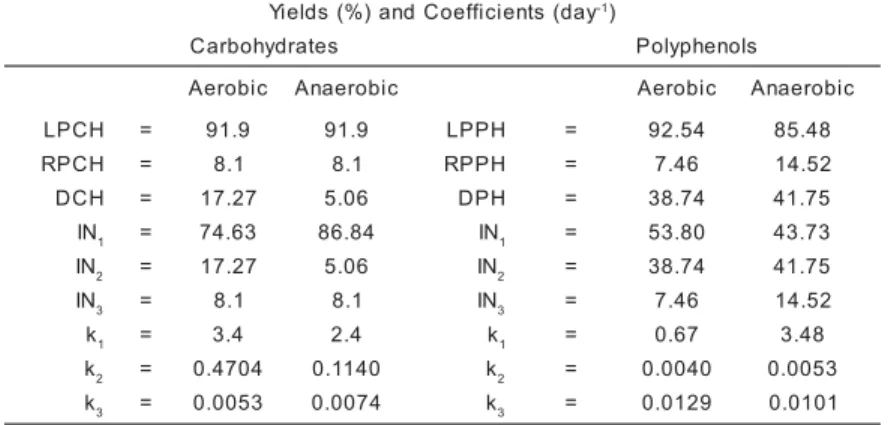
The results of remaining CH and PH were fitted to first-order kinetics model (Bianchini Jr., 1997; Higgins & Walker, 2001). This model considers that the rates are pro-portional to substrate concentrations and com-bines equations describing leaching and miner-alization (Equations 1-3). The parameterization of aerobic and anaerobic CH and PH decay is summarized in Table 1.
The decrease in CH and PH
concentra-(
kt)
L
M
POM
e
k
k
IN
1
11
1
=
−
−
+
−
+
=
−kt −ktL L
e
k
k
k
e
k
k
k
POM
k
k
IN
1 21 2 1 2 1 2 1 2
1
(
kt)
R
e
POM
IN
1
33 −
−
=
…...…...(Eq. 1)
...……...(Eq. 2)
...……...(Eq. 3)
(
kt)
L
M
POM
e
k
k
IN
1
11
1
=
−
−
+
−
+
=
−kt −ktL L
e
k
k
k
e
k
k
k
POM
k
k
IN
1 21 2 1 2 1 2 1 2
1
(
kt)
R
e
POM
IN
1
33 −
−
=
…...…...(Eq. 1)
...……...(Eq. 2)
...……...(Eq. 3)
P O M L = L ab ile/so lu b le p articu late o rg an ic m atter (L P C H o r L P P H );
P O M R R efracto ry p articu late o rg an ic m atter (R P C H o r R P P H );
D isso lv ed o rg an ic m atter: L
P O M
L (D C H o r D P H );k
k
D O M
1
=
D O MT im e;
k1 P O M L g lo b al d ecay co effic ien t (kL + kM); w h ere : kL = P O M L leach ate co effic ien t an d kM = P O M L m in eralizatio n co effic ien t;
k2 D O M m in e ralizatio n co effic ien t;
P O M R m in era lizatio n co effic ien t;
In o rg an ic co m p o u n ds p ro d u ced fro m th e th ree m in era lizatio n ro u tes. IN1 a 3
= = = = = = = t k3
P O M L = L ab ile/so lu b le p articu late o rg an ic m atter (L P C H o r L P P H );
P O M R R efracto ry p articu late o rg an ic m atter (R P C H o r R P P H );
D isso lv ed o rg an ic m atter: L
P O M
L (D C H o r D P H );k
k
D O M
1
=
D O MT im e;
k1 P O M L g lo b al d ecay co effic ien t (kL + kM); w h ere : kL = P O M L leach ate co effic ien t an d kM = P O M L m in eralizatio n co effic ien t;
k2 D O M m in e ralizatio n co effic ien t;
P O M R m in era lizatio n co effic ien t;
In o rg an ic co m p o u n ds p ro d u ced fro m th e th ree m in era lizatio n ro u tes. IN1 a 3
tions was nonlinear with time, presenting a biphasic decay pattern that points to a hetero-geneous compound from the kinetics point of view. These organic compounds presented two fractions: a labile (LCH and LPH) and a refrac-tory (RCH and RPH) one. The kinetics model allowed us to identify three decay pathways for CH and PH: (i) the labile fractions of CH and PH are changed quickly (k1). Simulta-neously, the second pathway (k1) is a trans-formation of LPCH into dissolved (DCH and DPH). In the sequence, this fraction breaks down according to k2. In the third route, there is a slow change in the refractory fraction (RCH and RPH) occurs (k3).
During aerobic and anaerobic CH de-composition, the labile fractions were esti-mated to be 92% and the refractory fraction was 8%. The coefficient k1 is related to LCH decay. For aerobic decomposition it was 3.4 day-1, 1.4 times the value for the anaerobic
process (2.4 day-1). Decomposition of
Montrichardia arborescens is dominated by an
abiotic process of leaching during the initial 12-h to 1-d (Bianc12-hini Jr. et al., 2002). T12-his pro-cess is accomplished by the loss of many
Table 1 - Parameters of the aerobic and anaerobic decomposition of carbohydrates and polyphe-nol from M. arborescens. Where: k1 = coefficient of leachate/product formation + mineraliza-tion (k1 = kL + kM; kL = leaching coefficient and kM = labile CH or PH mineralization coeffi-cient); k2 = decay coefficient of DCH or DPH; k3 = decay coefficient of RPCH or RPPH; LPCH and LPPH = labile fractions of particulate carbohydrates and polyphenols; RPCH and RPPH = refractory fractions of particulate carbohydrates and polyphenols; DCH and DPH = fractions of dissolved carbohydrate and polyphenols. IN = yields of CH and PH decay prod-ucts; IN1 = from LPCH or LPPH; IN2 = resulting from DCH or DPH and IN3 = from RPCH or RPPH. y a d ( s t n e i c i f f e o C d n a ) % ( s d l e i
Y -1)
s e t a r d y h o b r a
C Polyphenols
c i b o r e
A Anaerobic Aerobic Anaerobic
H C P
L = 91.9 91.9 LPPH = 92.54 85.48
H C P
R = 8.1 8.1 RPPH = 7.46 14.52
H C
D = 17.27 5.06 DPH = 38.74 41.75
N
I 1 = 74.63 86.84 IN1 = 53.80 43.73
N
I 2 = 17.27 5.06 IN2 = 38.74 41.75
N
I 3 = 8.1 8.1 IN3 = 7.46 14.52
k1 = 3.4 2.4 k1 = 0.67 3.48
k2 = 0.4704 0.1140 k2 = 0.0040 0.0053
k3 = 0.0053 0.0074 k3 = 0.0129 0.0101
soluble organic substances (e. g. CH and PH) and labile materials from the protoplasmatic fraction of plant material. The decay coefficient k1 is governed by the nature of the plant tis-sues, e.g. type and amount of organic com-pound released in leaching. Dissolved carbohy-drates (DCH) represent 5.06% for the anaero-bic process and 17.27% for the aeroanaero-bic one. These fractions changed according k2, which was 0.96 day-1 and 0.344 day-1 for the aerobic
and anaerobic conditions, respectively. The RCH mineralization rate, k3, was 0.0074 day-1
for the anaerobic process, 1.39 times higher than the aerobic value. This coefficient was related with the solubilization and oxidation of ligno-cellulosic residues.
In the aerobic decomposition experi-ments, the PH contents of detritus of LPH and RPH corresponded to 92.5% and 7.5%, re-spectively. For the anaerobic process these frac-tions were 85.5% and 14.5%, respectively. Higher coefficients of LPH consumption (k1) occurred during the anaerobic decomposition of
M. arborescens (3.48 day-1), while under
is produced and mineralized according to k1. Under aerobic conditions, k2 for the DPH de-cay mineralizatin rate was 0.011 day-1 and for
the anaerobic process this value was 0.0009 day-1. These fractions represent 41.75% in the
anaerobic process and 38.74% in the aerobic one. RPH decay rates (k3) were similar for both conditions (≈ 0.011 day-1).
The effect of the microbial degradation in the regulation of carbohydrate and polyphe-nol concentrations in the Cantá stream is di-rectly associated with the k’s (k1, k2 and k3 from Table 1). It is supposed that the labile fraction of these compounds with high decomposition rates, with an average k1 for aerobic and anaero-bic conditions being 2.9 day-1 for CH and 2.07
day-1 for PH, have a greater potential for
bio-degradability than the refractory fractions. For the latter, the average k3 for anaerobic and aero-bic conditions was 0.0064 day-1 for CH and
0.0115 day-1 for PH. Overall, the high values
of k’s for the labile fractions probably indicate that carbohydrates and polyphenols do not tend to accumulate in the Cantá stream. On the other hand, the refractory fractions presented low k’s and remained unaffected for a long time (t1/2: CH = 108 days and PH = 60 days). The k’s from the model (Table 1) suggest that the anaerobic decomposition of LPH was more effective than the aerobic, and that the aerobic condition provides a faster decomposition for CH of M. arborescens.
ACKNOWLEDGEMENTS
The authors thank Coordenadoria de Aperfeiçoamento de Pessoal de Nível Superior (CAPES) for partial support of this research. We are also indebted to Dr. Osvaldo N. Oliveira Jr. (IFSC-USP) for his critical proof reading of the manuscript.
LITERATURE CITED
Bianchini Jr., I.; Toledo, A. P. P. 1981. Determinação de compostos fenólicos com reagente de Folin-Denis. Ciênc. Cult., 33(4): 576-577.
Bianchini Jr., I.; Pacobahyba, L. D. a Cunha-Santino, M. B. 2002. Aerobic and anaerobic decomposition of
Montrichardia arborescens (L.) Schott.
Acta Limnol. Brasil., 14(3): 27-34.
Bianchini, Jr., I. 1997. The degradation process of organic matter in reservoirs. In: Rosa, L. P.; Santos, M. A. (eds.). Hydro-power Plants and Greenhouse Gas
Emissions. Editora Tecnologica, Rio de
Janeiro.
Bowyer, J. R.; Leegood, A. R. C. 1997. Photosynthesis. In: Dey, P. M., Harborne, J. B. (eds). Plant Biochemistry. Academic Press, San Diego, p. 49-110.
Bunte, C.; Simon, M. 1999. Bacterioplankton turnover of dissolved free monosaccharides in a mesotrophic lake.
Limnol. Oceanogr., 44(8): 1862-1870.
Cunha, M. B.; Bianchini Jr., I. 1998. Cinéticas de mineralização aeróbia de celulose e lignina durante a degradação de Cabomba
piauhyensis e Scirpus cubensis. Acta
Limnol. Brasil., 10(2): 59-69.
Dagley, S. 1986. Catabolism of aromatic com-pounds by micro-organisms. Adv. Ecol. Res., 15:1-48.
Dubois, M.; Gilles, K.; Hamilton, J. K.; Rebers, P. A.; Smith, F. 1956. Colorimet-ric method for determination of sugar and related substances. Anal. Chem., 28: 350-356.
Hessen, D. O. 1992. Dissolved organic carbon in a humic lake: effect on bacterial produc-tion and respiraproduc-tion. Hydrobiol., 229:115-123.
Higgins, C. W.; Walker, L. P. 2001. Validation of a new model for aerobic organic solids decomposition: simulations with substrate specific kinetics. Proc. Biochem., 36:875-84.
Grant Reid, J. S. 1997. Carbohydrate Metabo-lism: Structural Carbohydrates In: Dey, P. M., Harborne, J. B. (eds.), Plant
Biochem-istry. Academic Press, San Diego,
p. 205-236.
Rodrigues, R. M. 1989. A Flora Amazônica. Ed. CEJUP, Belém, 462p.
Recebido: 24/07/2002
Aceito: 20/03/2003
Strack, D. 1997. Phenolic Metabolism. In: Dey, P. M., Harborne, J. B. (eds.), Plant
Bio-chemistry. Academic Press, San Diego, p.
205-236.
Walker, R. L. 1975. The biology of plant
phe-nolics. Edward Arnold Limited,