Printed version ISSN 0001-3765 / Online version ISSN 1678-2690 www.scielo.br/aabc
Luminescence dated Late Pleistocene wave-built terraces
in northeastern Brazil
KENITIRO SUGUIO1, FRANCISCO H.R. BEZERRA2 and ALCINA M.F. BARRETO3 1Instituto de Geociências, Universidade de São Paulo, Rua do Lago, 562,
Cidade Universitária, 05508-080 São Paulo, SP, Brasil
2Departamento de Geologia, Universidade Federal do Rio Grande do Norte,
Campus Universitário Lagoa Nova s/n, 59078-970 Natal, RN, Brasil
3Departamento de Geologia, Universidade Federal de Pernambuco,
Avenida Acadêmico Hélio Ramos s/n, Cidade Universitária, 50740-530 Recife, PE, Brasil
Manuscript received on December 8, 2009; accepted for publication on December 22, 2010
ABSTRACT
This study presents field and chronological investigations along the coast of northeastern Brazil from ∼4◦S to 9◦S latitude, which corresponds to∼700 km of coastline under a semi-diurnal mesotidal regime. We investigated wave-built terrace deposits and dated sediments using the optically stimulated luminescence and thermoluminescence methods on quartz grains. The wave-built terraces yielded two main age groups: 200-230 ka and 100-130 ka, which we interpreted as depositional ages. We correlated these age groups with oxygen-isotope stages 7c and 5e, respectively. These events correspond to the antepenultimate and penultimate transgressions along the Brazilian coast. The deposits occur mainly in patches on low-lying flat plateaus along the littoral zone and incision valleys that cut across coastal tablelands. The altitude of the base of the 200-230 ka terraces ranges from 10 m above mean sea level (asl) to –2m asl, whereas the base of the 100-130 ka varies from 12 m asl to –2 m asl. Both terraces were deposited in the foreshore and upper shoreface zones. We noted a coincidence between sea-level highstand chronologies in northeastern Brazil and those in the Bahamas and Bermuda.
Key words:luminescence dating, northeastern Brazil, Pleistocene, sea-level change.
INTRODUCTION
The recognition of Late Pleistocene wave-built terrace deposits along the eastern coast of South America is becoming increasingly common. These deposits rep-resent sea levels higher than the prep-resent one. Recently, two studies have presented ages of the wave-built de-posits. Barreto et al. (2002) presented thermolumines-cence (TL) and optically stimulated luminesthermolumines-cence (OSL) dates at 220-206 ka and 117-110 ka of two wave-built terrace deposits along 340 km of coast in the state of Rio Grande do Norte, northeastern Brazil. They corre-spond to the highstands of marine oxygen-isotope
sub-Correspondence to: Francisco H.R. Bezerra E-mail: [email protected]
stages 7c and 5c sea levels, respectively. The former ranges between 7.5 and 1.3 m high above mean sea level asl. The latter occurs at altitudes that vary between 1 m and 20 m. A second study by Tomazelli and Dil-lenburg (2007) described shoreline sedimentation dur-ing the last interglacial highstand on the Rio Grande do Sul Coastal Plain, southern Brazil. They described, but did not date, a wave-built highstand associated with the last interglacial period around 125 ka. The maximum reached sea level was around 7 m above the present. Both studies presented evidence that hydrodynamics and sediment transport during these highstands were similar to present-day conditions.
poorly understood owing to limited knowledge of wave-built terrace chronology (Barreto et al. 2002). In addition, the obtained data are frequently imprecise in both space and time, and the assumed chronology is mostly based on geomorphological attributes such as asl altitudes, the terrace reshaping degree, or tentative correlation with deep-sea, oxygen isotope stages (e.g., Suguio et al. 2001).
The objective of our present study is to describe the occurrence and luminescence chronology of wave-built terraces in northeastern Brazil along the coast of the states of Pernambuco (PE), Paraíba (PB), and Rio Grande do Norte (RN) (Fig. 1). We also compare these ages with the wave-built terrace chronology obtained by Barreto et al. (2002).
GEOLOGICAL AND GEOMORPHOLOGICAL COASTAL SETTINGS
The Brazilian coast is more than 9,200 km long and diversified geologically and geomorphologically. It ex-tends from a latitude of 04◦N to 33◦S (Cruz et al. 1985). In general, there is a succession of coastal plains alter-nating with sea cliffs and rock coasts, following an an-cient continental area composed of Precambrian poly-metamorphic and igneous complexes on whose sum-mits of sedimentary and volcanic sequences of Paleo-zoic, Mesozoic and Cenozoic ages were deposited.
The coastal plains, mostly composed of Quater-nary deposits, were accumulated within continental, transitional and marine environments, being most con-spicuously developed around major river mouths, where a terrigenous clastic sediment supply was dominant. Rocky coasts appear in several coastal sectors, where erosive processes supplant depositional processes. Sea cliffs occur where older sedimentary deposits are ex-posed to the open-sea hydrodynamics, and rocky coasts occur where igneous and metamorphic crystalline com-plexes are exposed to open-sea conditions.
According to Cruz et al. (1985), the coast of north-eastern Brazil extends from São Marcos Bay in the state of Maranhão (MA) to Todos os Santos Bay, state of Bahia (BA) (Fig. 1). Coastal tablelands, composed of the Miocene Barreiras Formation and Quaternary sed-iments, are the most common geomorphological fea-ture along this coast. These tablelands reach the
coast-line, where they form sea cliffs, partially eroded dur-ing the Pleistocene and Holocene. The Barreiras For-mation overlies the Precambrian crystalline basement or the older sedimentary deposits in several sedimentary basins of the Brazilian continental margin.
Two sectors can be distinguished along this coast. The coast, which extends from São Marcos Bay to Calcanhar Cape (Fig. 1), is characterized by rivers with small sediment loads, associated with small-scale sandy-barrier/lagoon systems. Lagoons and estuaries exhibit mangrove swamps in their margins, whereas sandy barriers are frequently washed over by strong and persistent trade winds also responsible for the forma-tion of well-developed eolian dunefields, magnificently exemplified by the Lençóis Maranhenses. The west part of this coast is characterized by a macrotidal regime, whereas the east part is characterized by a mesotidal regime.
The oriental Northeastern Coast extends from the Calcanhar Cape to the Todos os Santos Bay (Fig. 1), which shows the same geological context and is submit-ted to a mesotidal regime. This area is marked by sea cliffs carved in the Barreiras Formation and by beach-rock reefs supporting organic reefs, mainly composed of hermatypic corals and calcareous algae favored by a small terrigenous sediment supply. Stone reefs pro-tect the coastline against the hydrodynamics of the open sea along many stretches of this coast, giving origin to sheltered beaches with natural pools. Deltaic complexes with Pleistocene and Holocene sandy-barrier/lagoon systems occur in the vicinities of the most important river mouths (Martin et al. 1983). The lagoons and es-tuaries are occupied by mangrove swamps with beach ridges reworked by trade winds, originating many dune fields. In this sector, the São Francisco River is fun-damental for its suspension load is being transported southward by coastal currents inhibiting organic reef buildups and maintaining the muddy waters along the coast of the state of Sergipe (SE), in contrast with the clean waters along the coast further to the north (Fig. 1).
Fig. 1 – (A) Brazilian coast and main location discussed in text; (B) study area and sample locations from the 200-230 ka terraces and the 100-130 ka wave-built terraces.
30◦C, and the rainfall is 600-1,000 mm/yr (Nimer 1989). The area has a mesotidal, semi-diurnal regime, where normal tides attain a maximum of 2.0 m and spring tides have a range of 3.2 m (Hayes 1979).
LATE PLEISTOCENE SEA-LEVEL HIGHSTANDS IN BRAZIL
Late Pleistocene sea-level highstand deposits in the Brazilian coast were first recognized in 1973 at Cana-néia Island, state of São Paulo. The deposits were named Cananéia Formation (Suguio and Petri 1973), and the related event was named Cananéia Transgression (Suguio and Martin 1978) or Penultimate Transgression (Bittencourt et al. 1979, Martin et al. 1988). Relative sea level during this event reached∼8±2 m asl. The
first age of these deposits was obtained from charcoal fragments and dated by the radiocarbon method. The age was viewed as minimum because it was beyond the limit of the radiocarbon method (∼70 ka). Later, five
coral sample fragments of genus Siderastrea from Oli-vença (state of Bahia-BA, Fig. 1), dated by the Io/U method, yielded an average age of 123.5±5.7 ka
(Ber-nat et al. 1983). The Cananéia Formation at that time
was considered as existent from Rio Grande do Sul (RS) (33◦S latitude) to as far as the state of Pernambuco (PE) (9◦S latitude) (Fig. 1).
In a few places, however, such as the Todos os Santos Bay in the state of Bahia (Martin et al. 1984a) and the Macaé area in the state of Rio de Janeiro (Fig. 1) (Martin et al. 1984b), these Late Pleistocene wave-built deposits have probably been subsided as a consequence of recent tectonic activity.
The age of this highstand event is consistent with the North American Sangamon Interglacial Stage or European Riss-Würn interglacial stage (Bloom 1967). Details of the dates by Bernat et al. (1983) confirm this assumption. The uranium concentrations changed from about 2.6 to 3.0µ/g, which are normal levels for coral
fragments with an average age of 123.5±5.7 ka. This
Their absolute age, however, has not been measured. According to some studies (e.g. Tomazelli and Villwock 2000), tentative correlation with theδ18O isotopic stage
chrono-stratigraphic scale could indicate ages ranging from 325 ka to 400 ka.
The scheme of sea-level highstands at the Rio Grande do Sul strandplain is established. The barrier-islands/lagoon system IV, about 4 m asl, corresponds to the last transgressive event, whose culmination stage occurred at about 5.5 ka. The barrier-islands/lagoon system III ∼8 ±2 m asl corresponds to the
penulti-mate transgressive event, whose maximum occurred at
∼120 ka. The barrier-islands/lagoon system II
meas-uring∼13-15 m asl, and the barrier-islands/lagoon
sys-tem I measuring∼20-25 m asl, situated at the inner
con-tinental positions in relation to the previous ones, were formed during high sea levels older than 120 ka BP, most likely at 325 ka (δ18O isotope stage 7) and 400 ka
(δ18O isotope stage 9) (Tomazelli and Villwock 2000,
Tomazelli and Dillenburg 2007). On the other hand, along the states of Santa Catarina (SC), Paraná (PR), and Rio Grande do Sul (RS) (Fig. 1), marine terraces with a minimum height of 13 m asl were found by Martin et al. (1988). They are older than the barrier-islands/lagoon system III found in the state of Rio Grande do Sul and probably record the transgressive-regressive episode of the barrier-islands/lagoon system II. Presently, it is assumed that this ∼120 ka high
sea-level record extends, at least, from the state of Rio Gran-de do Sul (RS) to as far as Rio GranGran-de do Norte (RN) (Fig. 1).
METHODS
FIELD-WORK
We measured wave-built terrace altitudes by leveling, and normalized them to two local standard ports ac-cording to the Admiralty Hydrograph Department (1996) using tide-table predictions from the Brazilian Navy (2009). The method is based on the assumption that the duration of the rise and fall of the tide lies within the scope of a graph (height vs.time diagram), which
approximates to a cosine curve. We also corrected alti-tudes to the Brazilian Córrego Alegre National datum. In our field study, we sampled marine sediments away from sunlight by pushing or hammering plastic tubes into
freshly cleaned vertical trench walls. In this study, we used the altitude of the base of deposits for correlation because the top of a few deposits show signs of erosion.
LUMINESCENCEDATING
Thermoluminescence (TL) and optically stimulated lu-minescence (OSL) dating was carried out at the Labo-ratory of Glasses and Dating of the Faculdade de Tec-nologia de São Paulo (FATEC-SP). These techniques make possible the dating of the last exposure of sedi-ment to sunlight. First, we obtained quartz grains 88-180 µm in size after chemical treatments of 20% HF
for 45 min, 20% HCl for 2 h, and heavy liquid (SPT separation). These were performed to prevent problems associated with the cover of fine silt and clay particles on sand grains due to translocation. All of the irradi-ations were performed with a 60Co source from the
Instituto de Pesquisas Energéticas e Nucleares – Comis-são Nacional de Energia Nuclear (IPEN/CNEN), and for bleaching experiments the samples were exposed di-rectly to sunlight for 16 hours. Both TL glow and OSL shines down curves were recorded with Daybreak Nu-clear and Medical Systems Incorporated Model 1100-series Automated TL/OSL systems. TL ages were eva-luated using total bleach and additional dose methods. OSL ages were obtained using the additional dose method following the multiple aliquot protocol with natural normalization. The annual doses were calcu-lated using235U,238U,232Th, and40K concentrations
and Bell’s equations. The U, Th, and K concentrations were measured by neutron activation analysis (Tables I and II). Natural radioactive isotope contents in the samples were determined with gamma spectroscopy using an Inspector portable spectroscopy workstation, lead shield model 727, and a Canberra 802 NaI (Tl) detector. Details of the methodology described above are found in Tatumi et al. (2001, 2008).
UPPER PLEISTOCENE MARINE TERRACES IN NORTHEASTERN BRAZIL
RIOGRANDE DONORTECOAST
Marine wave-built terraces outcropping along this 280 km long coast yielded ages from 215 ± 7 ka to
109 ± 4 ka (Table I and Fig. 2). They form raised
infor-TABLE I
Rio Grande do Norte and Paraíba states coast showing locations of the 200-230 ka BP and 100-130 ka BP outcrops. Source: (1) Barreto et al. (2002), (2) this study.
Location TL age OSL age Base Corrected Sample
(UTM) (Ky) (Ky) altitude altitude Source
(m) asl (m) asl
5-97 258440; 935130 213±2 220±2 0.8 1.8±1.5 (1)
6-97 258440; 935130 215±4 207±4 0.8 1.8±1.5 (1)
15-98 266601; 933000 206±5 210±2 2.5 3.5±1.5 (1) 32-98 172340; 944250 117±10 117±4 0.8 1.8±1.5 (1)
39-98 172340; 944250 109±4 – – – (1)
PB07B 283280; 926886 88.9±6 70.3±5 2.0 60±1.5 (2) PB07C 283280; 926886 110±6.2 86±5 2.0 6.0±1.5 (2)
PB10A 301166; 920971 108±8 110±20 8.8 9.8±1.5 (2)
PB10B 301166; 920971 138±5 120±2 8.8 9.8±1.5 (2) PB11 301718; 920496 230±6 186±14 3.7 4.7±1.5 (2) PB12 301123; 919347 103±14 103±6 0.45 1.45±1.5 (2) PB14A 300716; 920092 117±1 109±9 4.0 3.0±1.5 (2)
PB14B 300716; 920092 217±4.5 212±4 4.0 3.0±1.5 (2)
PB15 301498; 9185015 220±26 220±22 1.7 2.7±1.5 (2) PB16A 300897; 9182065 117±14 116±14 0.8 1.8±1.5 (2) PB17A 300668; 9182066 101±9 100±11 0.8 4.1±1.5 (2) PB17B 300668; 9182066 71±7.7 46±4 2.65 4.1±1.5 (2) PB18A 300600; 9179938 79±0.7 95±1.1 4.0 4.8±1.5 (2)
mal stratigraphic units, named 220-206 and 117-110 ka marine terraces (Barreto et al. 2002).
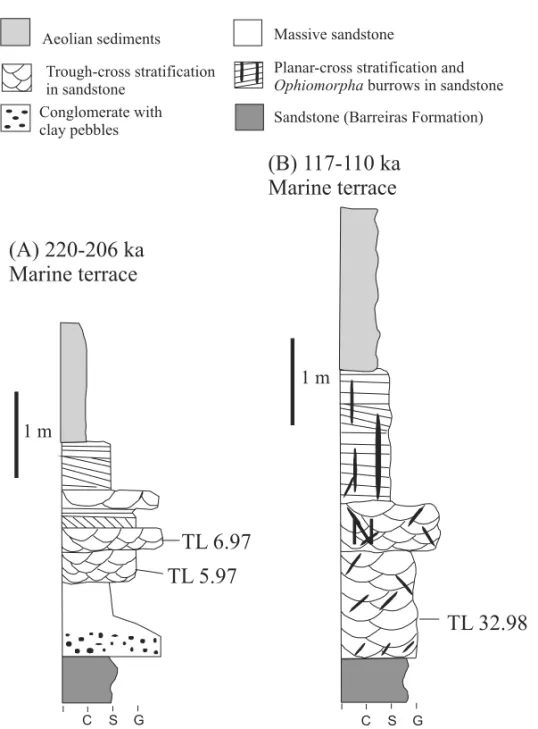
Lucena (1997) was the first to recognize the 220-206 ka deposits. He informally named them the Bar-ra de Tabatinga unit. This was later formalized by Su-guio et al. (2001) as the Barra de Tabatinga Formation. This unit was dated with three samples (5.97, 6.97, and 15.98 in Table I). It usually crops out in patches along the shoreline between Natal and Barra de Sagi (Fig. 1), but more conspicuously at the former site where out-crops are about 1 km long. At Natal, the top of these deposits is 7.5 m asl. Its base rises from mean beach level to 2.6 m asl (Fig. 2A).
These deposits were formed in the intertidal zone. We recognized beach structures in three main parts of the columnar section. The lower part of the deposit consists of a wave-cut surface that abruptly truncates the lower Barreiras Formation. This structure forms an unconformity that is marked by a conglomerate layer made up chiefly of highly weathered Barreiras Forma-tion laterite pebbles. This basal part shows a lateral con-tinuity of moderately to well sorted, clast supported seaward-dipping beds. The intermediate part of the
beach deposit is characterized by through cross-bedded sandstone, consisting of coarse- to medium-grained well-rounded to subangular quartz grains. The summit of this deposit is defined by gently seaward dipping planar-bedded, well-sorted quartzose sandstone (Fig. 2A). Its grain size ranges from fine to medium sand.
We did not find macrofossils, although Lucena (1997) identified foraminifera Globigerina sp. and Quinqueloculina sp. at the base of the deposit, which could be an indication of an intertidal zone.
The marine terrace deposit about 1 km north from Formosa Bay has not been directly dated, but can be correlated with those dated at Natal and Barra de Taba-tinga sites based on petrography, sedimentary structures, stratigraphic relations, and geomorphologic features. The base of the marine deposit at Formosa Bay was not observed in the outcrop, because it overlies the Barreiras Formation at the lower intertidal zone. These marine deposits, as shown by Yee et al. (2000), are overlain at many sites by the 189-186 ka eolian deposits.
1 m
TL 6.97
TL 5.97
(A) 220-206 ka
Marine terrace
(B) 117-110 ka
Marine terrace
Fm.
N
1 m
TL 32.98
C S G C S G
Sandstone (Barreiras Formation) Massive sandstone
Planar-cross stratification and burrows in sandstone
Conglomerate with clay pebbles
Aeolian sediments
Trough-cross stratification in sandstone
Fig. 2 – Columnar sections of Barra de Tabatinga Formation (220-206 ka wave-built terraces) and Touros Formation (117-110 ka wave-built terraces) on the coast of the state of Rio Grande do Norte (modified from Barreto et al. 2002).
current shoreline between São Bento and Zumbi (Fig. 1). This marine terrace outcrops mainly along the E-W-trending coast. The most conspicuous outcrops are more than 2 km long and are located between São Bento and Touros (Fig. 1), where they reach 1 to 10 m high and rise to a maximum of about 20 m asl 2 km to the north of Zumbi.
The São Bento and Touros outcrops typify the Tou-ros Formation stratigraphy, whose sedimentary struc-tures were first described by Campos-e-Silva et al. (1964). Subsequent studies were carried out by Srivas-tava and Corsino (1984) and Lima-Filho et al. (1995).
More recently, Testa et al. (1997) and Testa and Bosen-ce (1998) obtained14C ages at 30 ka BP and suggested that this deposit is older than the limit of conventional radiocarbon dating. They then concluded that the ob-tained dates were minimum ages. Bezerra et al. (2000) recognized these problems using x-ray diffraction and scanning electron microscopy, which indicated that re-crystallization and overgrowth of calcite in coral and mollusk shells from this deposit were too serious or too difficult to remove or clean for reliable radiocarbon dating.
made up of medium- to coarse-grained sandstones. The most common biodetritus are coraline algae, mollusks and foraminifera. The basal portion of the deposit is composed of coarse to conglomeratic, tabular, and trough bedded sandstone. Herringbone cross-bedded sandstone occurs on the top of the deposit, where Ophiomorpha nodosa burrows that are
charac-teristic of beach sub-environments also occur (Barreto et al. 2001). These features, viewed collectively, indi-cate a high sedimentation rate in the intertidal to shore-face zone. This deposit overlies the Barreiras Forma-tion unconformably. Inactive (fossil) and active sand dunes overlie this formation (Fig. 2B).
The Touros Formation was dated by two samples: 32-98, dated by TL additive dose, TL total bleach and OSL methods; and sample 39-98 dated by the TL addi-tive dose method (Table I) (Barreto et al. 2002). Two TL ages and one OSL age for a quartzose sandstone layer at Touros, and one TL age for a sandstone layer about 15 km to the west of São Bento, both situated at the base of the deposits (Barreto et al. 2002), indicated an age from 117±10 to 110±10 ka, which corresponds to the last Pleistocene sea-level highstand along the Brazilian coast. We present the TL and OSL ages of these deposits in Figure 3.
PARAÍBACOAST
This coast is∼120 km long and exhibits almost
con-tinuously Miocene Barreiras Formation sea cliffs that border the ocean. We collected thirteen samples from nine outcrops of the marine terraces and dated them using the TL and OSL techniques (Table I and Fig. 3). The TL analyses yielded 7.9 to 230 ka, whereas the OSL analysis yielded 9.5 to 220 ka. Late Pleistocene wave-built terraces occupy incision valleys, which cut across the Barreiras Formation tableland, in general. The outcrops PB-11 and PB-15 represent 200-230 ka terraces, which could be correlated with the Barra de Tabatinga Formation of the coast of the state of Rio Grande do Norte. The outcrops PB-07, PB-10, PB-12, PB-16, and PB-17 yielded ages of 100-130 ka. They could be correlated with the Touros Formation of the coast of Rio Grande do Norte (Figs. 4, 5, and 6). Dif-fering from the Rio Grande do Norte coast, the out-crops PB-07, PB-10, PB-15, PB-16, and PB-17 in the state of Paraíba exhibit sandy beds with massive
struc-tures. However, outcrops PB-11 and PB-12 exhibit sed-imentary structures suggestive of intertidal to shoreface shallow marine deposits such as those described in Rio Grande do Norte coast (Barreto et al. 2002).
PERNAMBUCOCOAST
The coast of the state of Pernambuco extends for about 160 km and, similarly to the Paraíba coast, pres-ents continuous Neogene Barreiras Formation sea cliffs being eroded on the present shoreline. We collected twelve samples from eight outcrops of the marine ter-races and dated them using the TL and OSL methods (Table II). The TL analyses yielded ages from 14 to 351 ka, whereas the OSL analyses yielded ages from 96 to 346 ka (Fig. 3). Late Pleistocene wave-built ter-races occur sheltered within Barreiras Formation inci-sion valleys, which are commonly controlled by faults. The outcrops PE-09 and PE-10 represent 200-230 ka terraces (Figs. 7 and 8), corresponding to the Barra de Tabatinga Formation of Rio Grande do Norte’s coast.
Differently from Rio Grande do Norte coast, and similarly to the Paraíba coast, all the outcrops of this state presented sandy beds with massive structure. Nev-ertheless, the sedimentary structures shown by these outcrops are also suggestive of intertidal to shoreface shallow marine deposits.
IMPLICATIONS FOR RELATIVE SEA-LEVEL CHANGES
This study presents absolute ages from wave-built ter-races collected along ∼700 km of coast. Most (17)
TL ages are in agreement with the OSL results, con-sidering the experimental error limits. The consistent results of the OSL and TL ages concentrated in two main periods (∼100-130 ka and∼200-230 ka) indicate
that two highstands occurred in the region. However, six TL ages are older than the OSL results, and one TL age is younger than one of the OSL results. The TL ages that do not match those of OSL may indicate that depositional bleaching of these samples has not been completed, and that TL results are maximum ages of the deposits. This could indicate, for example, that ages older than 100-130 ka and younger than 200-230 ka represent overestimated ages of the Penultimate Trans-gression (∼100-130 ka). Ages younger than the
-2 2
0 0
2 2
4 4
6 6
8 8
10 10
12 12
0 0
50 50
100 100
150 150
200 200
250 250
300 300
-Height asl
(m)
TL age (ka BP)
OSL age (ka BP) Height asl
(m)
(A)
(B)
Fig. 3 – Samples from northeastern Brazil: (A) sample heightvs.TL age; and (B) sample heightvs.OSL age diagrams.
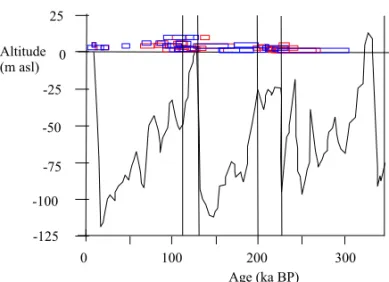
It is not possible to delineate any relative sea-level curve from the TL or OSL data. However, until more numerous chronological data are available, these ages can be correlated with marine oxygen-isotope stages after Raymo et al. (1990) and Haddad (1994). Dates from the∼200-230 ka deposits indicate that they were
deposited during the oxygen-isotope stage 7 sea-level highstand, mainly in substage 7c (Chappell 1983, Chap-pell and Shackleton 1986, Shackleton 1987, Raymo et al. 1990). This period represents the antepenultimate interglacial stage in the northern hemisphere (Fig. 9). Dates from the 100-130 ky terraces indicate that they
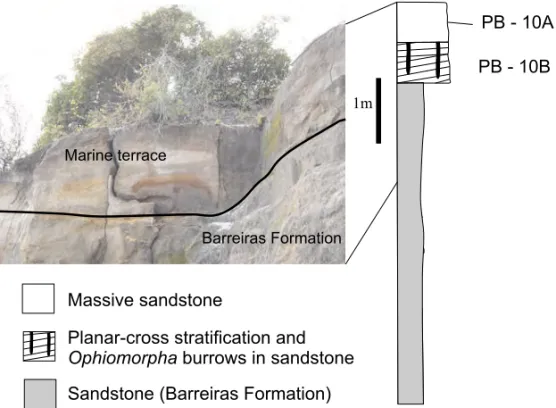
Fig. 4 – Wave-built terrace∼10 m asl at Cabo Branco Cliff, state of Paraíba, which yielded OSL ages of 110-120 ka.
Fig. 5 – Wave-built terraces∼6 m asl at Cordosas beach, state of Paraíba, which yielded OSL ages of 70-86 ka.
ages that may have correlations with our results: 191,000 ± 27,000 and 112, 000 ± 14,000. Possible
correlations between ages in northern and northeastern Brazil, however, should be addressed in further studies.
The 100-130 ka terraces are in a few cases at
al-titudes higher than those of the∼200-230 ka deposits
TABLE II
Pernambuco state coast showing locations of the 200-230 ka BP and 100-130 ka BP outcrops. Source: (2) this study.
Location TL age OSL age Base Corrected Sample
(UTM) (Ky) (Ky) altitude altitude Source
(m) asl (m) asl
PE3B 284573; 909581 53±3.6 – – – (2)
PE3C 284573; 909581 109±8 113±8.4 5.7±1.5 5.7±1.5 (2) PE9A 269430; 903521 219±17 193±15 0.0 1.3±1,5 (2) PE9B 269430; 903521 179±19.8 182±28 0.0 1.3±1,5 (2) PE10A 276976; 904005 241±26 263±41 0.0 1.0±1.5 (2) PE10B 276976; 904005 246±26 174±19 0.0 1.0±1.5 (2)
PE10C 276976; 904005 74±8 – 0.0 1.0±1.5 (2)
PE13 276856; 905435 87±6 97±11 3.5 4.5±1.5 (2)
PE17 282116; 906738 14 – – – (2)
PE23 300393; 915770 149±22 144±20 4.7 4.0±15 (2)
PE24 290199; 915054 17 – – – (2)
PE25 291451; 914979 351±31 346±31 6.0 – (2)
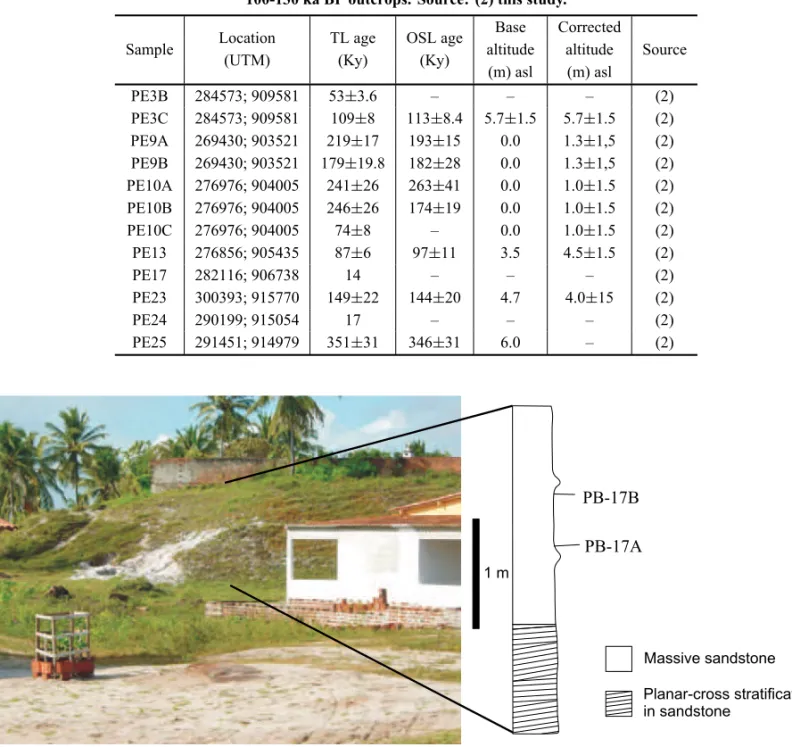
Fig. 6 – Wave-built terrace 0.8 m asl at Pitimbu beach, state of Paraíba, which yielded OSL ages of 46-100 ka.
(Bezerra and Vita-Finzi 2000, Bezerra et al. 2008) and in northern Brazil (Miranda et al. 2009, Rossetti 2010). This also needs further studies in northeastern Brazil.
We compare the Pleistocene sea-level highstands from northeastern Brazil with known patterns in the Bahamas and Bermuda, which include two highstands at about 210 ka BP and 125 ka BP (Harmon et al. 1983, Lundblerg and Ford 1994, Hearty 1998, Hearty and Kaufman 2000). In spite of the very different tectonic evolution at that time in the Bahamas, and chiefly in Bermuda, from that of the Brazilian coast, there is a
remarkable coincidence between the sea-level highstand chronologies among these areas. This coincidence is more striking in the 100-130 ka wave-built terraces. It strongly suggests that these areas experienced the same sea-level highstands in the Late Pleistocene.
The sea-level highstand corresponding to the
∼200-230 ka deposits was first documented by
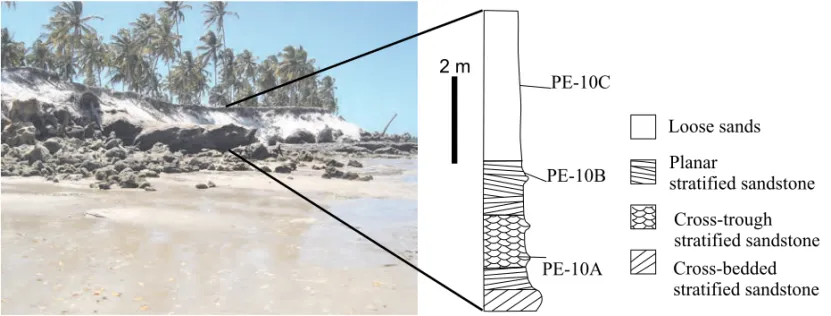
Fig. 7 – Wave-built terrace 0.0 m asl at Guadalupe beach, state of Pernambuco, which yielded OSL ages of 174-263 ka.
Fig. 8 – Wave-built terrace 0.0 m asl at Porto do Tijolo ranch, near Guadalupe beach, state of Pernambuco, which yielded OSL ages of 182-193 ka.
the 100-130 ka terraces was originally dated by Bernat et al. (1983), about 1,000 km southward of the study area in the state of Bahia. This marine terrace, although given different stratigraphic names, occurs at least from the coast of Rio Grande do Sul (33◦S latitude) to that of Rio Grande do Norte (4◦S latitude).
ACKNOWLEDGMENTS
This work was supported by Project Fundação de Am-paro à Pesquisa do Estado de São Paulo (FAPESP) 2001/07468-8 coordinated by KS. We thank three an-onymous reviewers for positive criticism. Sonia Tatumi deserves special thanks for numerous constructive sug-gestions on OSL dating, which have greatly improved
this work. KS holds a senior research grant from Con-selho Nacional de Desenvolvimento Científico e Tec-nológico (CNPq). FHRB and AMFB thank CNPq for their PQ grants. FHRB has also been supported by an INCT/CNPq project.
RESUMO
fornece-Fig. 9 – Correlation of OSL-TL ages from northeastern Brazil and sea-level changes from the sea-level curve after Haddad’s conversion (1994) of theδ18O record of Raymo et al. (1990) from ODP core 607
to sea level.
ram dois grupos de idades: 200-230 ka e 100-130 ka, que in-terpretamos como idades de deposição. Nós correlacionamos estas idades com idades do estágio isotópico do oxigênio 7c e 5e, respectivamente. Estes eventos correspondem a ante-penúltima e ante-penúltima transgressões que ocorreram ao longo da costa brasileira. Os depósitos ocorrem predominantemente em faixas sobre plateaus horizontais e de baixa altitude ao longo da zona litorânea e em vales incisos que cortam os tabu-leiros costeiros. A altitude da base dos terraços de 200-230 ka varia entre 10 m e –2 m anm (acima do nível do mar), enquanto a base do terraço de 100-130 ka varia entre 12 m e –2 m anm. Ambos os terraços foram depositados na zona de frente de praia e zona de antepraia superior. Nota-se uma coincidência entre a cronologia de níveis marinhos elevados no nordeste do Brasil e aquelas das Bahamas e Bermudas.
Palavras-chave: datação por luminescência, Nordeste do Brasil, Pleistoceno, variação do nível do mar.
REFERENCES
ADMIRALTYHYDROGRAPHDEPARTMENT. 1996. Admi-ralty tide tables. The Atlantic. AdmiAdmi-ralty Hydrograph Department, Hydrographer of the Navy, Southampton. BARRETOAMF, BEZERRAFHR, SUGUIOK, TATUMISH,
YEEM, PAIVARPANDMUNITACS. 2002. Late Pleis-tocene marine terrace deposits in northeastern Brazil: sea-level change and tectonic implications. Palaeogeogr, Palaeoclimatol, Palaeoecol 179: 57–69.
BARRETOAMF, SUGUIO K, ALMEIDAJACANDBEZER
-RAFHR. 2001. A presença da icnoespécieOphiomorpha nodosaLundgren em rochas sedimentares Pleistocênicas
da costa norte-riograndense e suas implicações paleoam-bientais. Rev Brasil Paleontol 3: 17–23.
BERNATM, MARTINL, BITTENCOURTACSPANDVILAS -BOASGS. 1983. Datation Io/U du plus haut niveau marin interglaciaire sur le côte du Brésil: Utilization du 229Th comme traceur. Comptes Rendus de L’Académie de Sci-ences de Paris 296: 197–200.
BEZERRAFHR, NEVESBBB, CORREA ACB, BARRETO
AMFANDSUGUIOK. 2008. Late Pleistocene tectonic-geomorphological development within a passive margin – the Cariatá trough, northeastern Brazil. Geomorphology 97: 555–582.
BEZERRAFHRANDVITA-FINZIC. 2000. How active is a
passive continental margin? Paleoseismology in North-eastern Brazil. Geology 28: 591–594.
BEZERRAFHR, VITA-FINZICANDLIMA-FILHOFP. 2000. The use of marine shells for radiocarbon dating of coastal deposits. Rev Brasil Geocienc 30: 211–213.
BITTENCOURTACSP, MARTINL, VILAS-BOASGSAND
FLEXORJM. 1979. The marine formations of the coast
of the state of Bahia, Brazil. In: SUGUIOK, FAIRCHILD
TR, MARTINL AND FLEXOR JM (Eds), International Symposium on Coastal Evolution in the Quaternary, Pro-ceedings..., São Paulo, p. 232–253.
BLOOM AL. 1967. Pleistocene shorelines: a new test of isostasy. Geol Soc Am Bull 78: 1477–1494.
BRAZILIANNAVY. 2009. Tide predictions.
www.mar.mil.br/dhn/chm/tabuas/index.htm. Accessed Nov-ember 05, 2009.
CAMPOS-E-SILVAA, SILVADDANDVASCONCELOSMDT.
1964. Informações sobre a malacofauna dos beach-rocks de Touros e São Bento do Norte, Rio Grande do Norte. Arq Inst Arqueol, UFRN 1: 79–89.
CHAPPELL JMA. 1983. A revised sea level record for the last 300,000 years from Papua to New Guinea. Search 14: 99–101.
CHAPPELL JMA AND SHACKLETON NJ. 1986. Oxygen isotopes and sea level. Nature 324: 137–140.
CRUZ O, COUNTINHO PN, DUARTE GM AND GOMES
AMB. 1985. Brazil. In: BIRDECF ANDSCHWARTZ
ML (Eds), The world’s coastline. New York: Van Nos-trand Reinhold, p. 85–91.
HADDADGA. 1994. Calcium carbonate dissolution patterns at intermediate water depths of the tropical oceans dur-ing the Quaternary. PhD thesis, Rice University, Houston, Texas.
HARMONRS, MITTERRERRM, KRIASAKALN, LANDLS, SCHWARCAHP, GARRETP, LARSONGJ, VACHERHL
racemisa-tion geochronology of Bermuda: implicaracemisa-tions for eustatic sea-level fluctuations over the past 250,000 years. Palaeo-geogr, Palaeoclimatol, Palaeoecol 44: 41–70.
HAYESMO. 1979. Barrier island morphology as a function of tidal and wave regime. In: LEATHERMANSP (Ed), Barrier Islands. New York, Academic Press, p. 1–27. HEARTYPJ. 1998. The geology of Eleuthera Island,
Baha-mas: a rosetta stone of Quaternary stratigraphy and sea-level history. Quat Sci Rev 17: 333–355.
HEARTYPJANDKAUFMANDS. 2000. Whole rock
aminos-tratigraphy and Quaternary sea-level history of the Ba-hamas. Quat Res 54: 163–173.
LIMA-FILHOFP, CÓRDOBAVC, CALDASLHO, PEREIRA
MMV, FONSECAVP, NOGUEIRAAMBANDBEZERRA
FHR. 1995. Considerações sobre a geologia costeira de São Bento do Norte-Caiçara, RN: evidências de indica-dores do nível do mar. In: SIMPÓSIO DEPROCESSOS
SEDIMENTARES EMEIOAMBIENTE, Recife. Extended Abstracts, p. 150–152.
LUCENALRF. 1997. Unidade Barra de Tabatinga – Novas Evidências de um paleodepósito quaternário de praia no litoral Potiguar. In: SIMPÓSIO DE GEOLOGIA DO
NORDESTE 17, Fortaleza. Extended Abstracts,
Forta-leza, SBG, p. 168–171.
LUNDBERGJ ANDFORDDC. 1994. Late Pleistocene sea level change in the Bahamas from mass spectrometric U-series dating of submerged speleothems. Quat Sci Rev 13: 1–14.
MARTIN L, BITTENCOURT ACSP, FLEXOR JM AND
VILAS-BOASGS. 1984a. Evidências de um tectonismo quaternário nas costas do Estado da Bahia. In: CON
-GRESS BRAS GEOL, SBG, 33, Proceedings..., Rio de
Janeiro 1: 19–35.
MARTINL, SUGUIOKANDFLEXORJM. 1983. As flutua-ções do nível do mar durante o Quaternário superior e a evolução geológica de “deltas” brasileiros. Bol IG-USP, Public Esp 15: 1–186.
MARTIN L, SUGUIO K AND FLEXOR JM. 1988. Hauts niveaux marins pléistocene du littoral brésilien. Palaeo-geogr, Palaeoclimatol, Palaeoecol 68: 231–238.
MARTIN L, SUGUIO K, FLEXOR JM, DOMINGUEZ JML
ANDAZEVEDOAEG. 1984b. Evolução da planície cos-teira do Rio Grande do Sul (RS) durante o Quaternário: influência das flutuações do nível do mar. In: CONGRESS
BRASGEOL, SBG, 33, Proceedings..., Rio de Janeiro 1:
84–97.
MIRANDA ACC, ROSSETTI DF AND PESSENDA LCR. 2009. Quaternary paleoenvironments and relative
sea-level changes in Marajó Island (Northern Brazil): Fa-cies, δ13C,δ15N and C/N. Palaeogeogr, Palaeoclimatol, Palaeoecol 282: 19–31.
NIMERE. 1989. Climatologia do Brasil. Instituto Brasileiro de Geografia e Estatística, Departamento de Recursos Na-turais e Ambientais, Rio de Janeiro, 421 p.
RAYMOME, RUDDIMANWF, SHACKLETONNJANDOPPO
DW. 1990. Evolution of Atlantic-Pacificδ13O gradients over the last 2.5 M.y. Earth Planet Sci Lett 97: 353–368. ROSSETTI DF. 2010. Tectonic control on the stratigraphic
framework of Late Pleistocene and Holocene deposits in Marajó Island, State of Pará, eastern Amazonia. An Acad Bras Cienc 82: 439–450.
SHACKLETONNJ. 1987. Oxygen isotopes, ice volumes and
sea-level. Quat Sci Rev 6: 183–190.
SRIVASTAVANKANDCORSINOAR. 1984. Os carbonatos de Touros (RN): petrografia e estratigrafia. In: SIMPÓ
-SIO DEGEOLOGIA DONORDESTE, 11, Natal. Extended
Abstract, p. 166–175.
SUGUIO K, BARRETO AMF ANDBEZERRA FHR. 2001. Barra de Tabatinga and Touros Formations: evidence for Pleistocene high sea-level stillstands of the Rio Grande do Norte coast. Revist Pesq Geoc, UFRGS 28: 5–12. SUGUIOKANDMARTINL. 1978. Quaternary marine
for-mations of the states of São Paulo and southern Rio de Ja-neiro. In: INTERNATIONALSYMPOSIUM ONCOASTAL
EVOLUTION IN THEQUATERNARYSPECIALPUBLICA -TION, Proceedings..., São Paulo 1: 1–55.
SUGUIOKANDPETRIS. 1973. Stratigraphy of Iguape-Ca-nanéia lagoonal region sedimentary deposits, São Paulo State, Brazil. Part I: Field observations and grain size analysis. Bol IG, Inst Geoc, USP 4: 1–20.
TATUMI SH, KOWATA EA, GOZZI G, KASSAB LRP, SUGUIO K, BARRETO AMF AND BEZERRA FHR. 2001. Optical dating results of beachrock, eolic dunes and sediments applied to sea-level changes study. J Lumin 102-103: 562–565.
TATUMI SH, SILVA LP, PIRES EL, ROSSETTI DF, GÓES
AM ANDMUNITA CS. 2008. Datação de sedimentos
pós-Barreiras no Norte do Brasil: implicações paleogeo-gráficas. Rev Bras Geocienc 38: 514–524.
TESTA VANDBOSENCE D. 1998. Carbonate-siliciclastic sedimentation on a high-energy, ocean-facing, tropical ramp, NE Brazil. In: WRIGHT VP ANDBURCHETTE
TP (Eds), Carbonate Ramps. Geol Soc London Sp Pub 149: 55–71.
TESTAV, BOSENCEDANDVIANNAM. 1997. Submerged
oscilla-tion in Rio Grande do Norte, NE Brazil. In: CONGRESSO DAABEQUA, Proceedings..., Belém, p. 155–160.
TOMAZELLILJANDDILLENBURGSR. 2007. Sedimentary facies and stratigraphy of a last interglacial coastal barrier in south Brazil. Mar Geol 244: 33–45.
TOMAZELLI LJ AND VILLWOCK JA. 2000. O Cenozóico
no Rio Grande do Sul: geologia da planície costeira. In: HOLZ M AND DE ROS LF (Eds), Geologia do Rio Grande do Sul, Porto Alegre: CIGO/UFRGS, p. 375–406.
YEE M, TATUMI SH, SUGUIO K, BARRETO AMF, MO
-MOSE EF, PAIVA RP AND MUNITA CS. 2000.
Ther-moluminescence (TL) dating of inactive dunes from the Rio Grande do Norte coast, Brazil. In: SIMPÓSIOBRASI