http://www.uem.br/acta ISSN printed: 1806-2636 ISSN on-line: 1807-8672
Doi: 10.4025/actascianimsci.v36i1.18993
Nutritional value of Xaraes and Piata palisadegrass silages prepared
with additives or wilting
Ana Carolina Cruvinel Guimarães Azevedo1, Kátia Aparecida de Pinho Costa2, Edgar Alain Collao-Saenz1*, Fernando José Dos Santos Dias1, Eduardo da Costa Severiano2 and Welma SantosCruvinel2
1
Programa de Pós-graduação em Produção Vegetal, Universidade Federal de Goiás, Rod. BR-364, km 192, 75801-615, Cx. Postal 03, Jataí, Goiás, Brazil. 2
Programa de Pós-graduação em Zootecnia e Ciências Agrárias, Instituto Federal Goiano, Rio Verde, Goiás, Brazil. *Author for correspondence. E-mail: [email protected]
ABSTRACT. The nutritional value of Xaraes and Piata palisadegrass silages wilted or with additives was evaluated in a completely randomized design (2x4 factorial arrangement), being two cultivars of Brachiaria brizantha (Xaraes and Piata palisadegrass) and four ensiling methods as treatments: T1- control, in natura
forage (INF); T2– INF wilted for 4 hours under the sun; T3- INF + bacterial additive (BactoSilo®
Lallemand) 2 g ton-1 of in natura forage; T
4– INF + 15% of pearl millet meal. For ensiling, the grasses were
harvested in the growth stage of 40 days, at 20 cm from the ground level. The addition of the inoculant and millet meal improved the fermentative and chemical parameters of both cultivars silages, by increasing soluble carbohydrates (SC), CP and TDN contents and reducing ammonia-nitrogenand pH. Because of its composition, 15% of millet meal inclusion affected SC, NDF, ADF and increased the IVDDM of silages. Bacterial inoculant or millet meal inclusion enhanced the nutritional value of Brachiaria brizantha
silages and, could have a positive performance response on ruminants fed with these silages. Wilting was also effective in improving the fermentative stability of grass silages and may be a cheaper alternative to additives.
Keywords:Brachiaria brizantha, millet meal, bacterial inoculant.
Valor nutricional das silagens de capins Xaraes e Piatã emurchecidas ou acrescidas de
aditivos
RESUMO. O valor nutricional de silagens pré-secadas ou aditivadas dos capins Xarães e Piatã foi avaliado em delineamento experimental inteiramente casualizado (esquema fatorial 2x4), sendo duas cultivares de
Brachiaria brizantha (Xarães e Piatã) e quatro métodos de ensilagem: T1- controle, forragem in natura (FIN);
T2- FIN pré-secada ao sol por 4 horas; T3- FIN + aditivo bacteriano (BactoSilo® Lallemand) 2 g t -1 FIN;
T4- FIN + 15% de farelo de milheto. Para a ensilagem, os capins foram colhidos no estágio de crescimento
de 40 dias, a 20 cm do nível do solo. A adição do inoculante e farelo de milheto melhoraram os parâmetros fermentativos e bromatológicos das silagens, elevando os teores de carboidratos solúveis (CHOS), PB, NDT e reduzindo o nitrogênio amoniacal e pH. Devido a sua composição, a adição de 15% de farelo de milheto, afetou os CHOS, FDN, FDA e incrementou a DIVMS nas silagens. A adição de inoculantes bacterianos ou farelo de milheto melhorou o valor nutricional das silagens de Brachiaria brizantha e, poderiam ter resposta positiva no desempenho de ruminantes alimentados com estas silagens. O pré-emurchecimento foi efetivo no incremento da estabilidade fermentativa de silagens de capim e, pode ser uma alternativa mais econômica aos aditivos.
Palavras-chave:Brachiaria brizantha, farelo de milheto, inoculante bacteriano.
Introduction
Forage production is dependent on seasonal climatic factors such as rainfall, temperature, lighting, and thus varies between high in the rainy season, and low in the dry season under tropical conditions. In livestock production systems with tropical grasses as the staple food, it is important to evaluate the nutritional value of silages prepared
with the high forage volumes produced in the summer to meet the animals’ requirements during the winter.
these forages present nutritional characteristics suitable for ensiling (COSTA et al., 2011).
Nevertheless, forage grasses have characteristics that limit the process of making good silages. The low content of dry matter, soluble carbohydrates and high buffering power can inhibit the rapid decrease in pH, which may lead to secondary fermentations in the silo. Conversely, when ensiled at young stage, they present a greater nutritional value (SILVA et al., 2011).
In this context, several techniques have been examined to improve the fermentation of silages of these forages. Among them: the wilting allows a dry matter content increase of grasses before ensiling; addition of enzyme-bacterial inoculants at the time of ensiling promotes a sharpest drop in pH and allow controlling losses in the process and increase the availability of soluble carbohydrates (COAN et al., 2005) and, addition of meals or absorbing ingredients provides reduction in the moisture content, incorporation of soluble carbohydrates and increase in nutritional value (COSTA et al., 2011; FERRARI JR. et al., 2009). Thus, the nutritional value of Xaraes and Piata palisadegrass silages produced by different ensiling process was evaluated.
Material and methods
The experiment was conducted at the Universidade de Rio Verde, in Fazenda Fontes do Saber, municipality of Rio Verde, Goiás State. Cultivars of Brachiaria brizantha (Xaraes and Piata) came from an area established a year ago. Before
harvesting for the ensiling process, 100 kg ha-1
nitrogen and 80 kg ha-1 K
2O were applied as
topdressing, using ammonium sulfate and potassium chloride as sources, respectively.
The experimental design was completely randomized with four replications in a 2 x 4 factorial arrangement, with two cultivars of Brachiaria brizantha (Xaraes and Piata palisadegrass) and four
silage techniques as treatments: T1- forage without
treatment (control); T2- in natura forage wilted for 4
hours under the sun; T3- forage with bacterial
additive (BactoSilo® of Lallemand) 2 g ton-1 of in
natura forage; T4 - 15% of pearl millet meal of in
natura forage, totaling 32 experimental silos.
For T2, forages were harvested by the morning
and remained spread on the field during 4 hours for dehydration (wilting). Meteorological data during the harvest were: rainfall: 0 mm, relative humidity: 75%, maximum temperature: 30.5°C, minimum temperature: 22.3°C, mean temperature: 26.4°C,
mean wind speed: 3.5 km h-1.
An enzyme-bacterial inoculant was added in T2,
were used 6 mg (corresponding to 2 g for 1 ton
forage) of BACTO SILO® (
La
ctobacillus plantarumMA18/5U and Pediococcus acidilactici MA18/5M) diluted in 80 mL distilled water and homogeneously sprayed on 3 kg forage to be ensiled. The millet grains were grinded and the amount applied (15%) was based on the natural matter of forages and homogeneously mixed with the forages.
For all treatments, the grasses were harvested at 40 days after the standardization cut and maintenance fertilization, 20 cm from the ground level using a backpack brush cutter. Then forages were chopped with a stationary shredder into 10-30 mm particles.
Afterwards, materials were stored in PVC experimental silos, with 10 cm diameter and 40 cm length. The ensiled material was compacted with iron pendulum and silos were closed with PVC caps and sealed with adhesive tape to prevent the entrance of air. Soon after were stored at room temperature and protected from rain and sunlight.
After 60 days to ensure full fermentation, silos were opened, discarding the top and bottom portion of each. A period of 3 to 4 weeks has generally been recommended for active silage fermentations to cease and reach a stable phase but Der Bedrosian et al. (2012) suggested that concentrations of soluble N and ammonia-N increased with length of storage, indicating that proteolytic mechanisms were active beyond 2 to 3 mo of storage.
The central portion of the silo was homogenized and placed on plastic trays. Part of fresh silage after opening the silos was separated to analyze fermentation parameters such as pH, soluble carbohydrates (CHOS) and ammonia nitrogen as
percentage of total nitrogen (N-NH3). The pH was
determined using a Beckman Expandomatic SS-2 potentiometer after opening the silos, and the CHOS was measured by the colorimetric method (JOHNSON et al., 1966).
Subsequently, the silage was divided into two portions. The first was wrapped in plastic bags and
frozen to determine ammonia nitrogen (N-NH3) as
percentage of the total nitrogen, according to AOAC (1980). For the determination of the pre-dried matter, the second portion, of approximately 1 kg, was weighed and taken to a forced air oven at 55ºC
for 96 hours until a constant mass was obtained. The
samples were ground in a Willey type mill with 1 mm sieve.
Chemical analyseswere undertaken to determine
method of Silva and Queiroz (2002). Total digestible nutrients (TDN) were obtained by the equation proposed by Chandler (1990). The in vitro digestibility of dry matter (IVDDM) was determined according to Tilley and Terry (1963), with two-stage incubation of 48 hours.
Before the ensiling process it was carried out the chemical analysis of Xaraes, Piata palisadegrass and millet meal (Table 1).
Table 1. Chemical composition of Xaraes and Piata palisadegrass and of millet meal, used for silage production.
Composition*
Xaraes palisadegrass
Piata palisadegrass
Millet meal
DM (% NM) 19.10 18.80 92.40
CP (% DM) 12.80 13.20 16.50
NDF (% DM) 69.50 67.60 21.60
ADF (% DM) 39.70 37.50 9.40
Lignin (% DM) 4.30 4.25 2.70
Cellulose (% DM) 35.40 33.55 6.70
Hemicellulose (% DM) 29.80 30.10 12.20
TDN (% DM) 57.50 59.40 68.80
IVDDM (%) 63.5 65.4 69.7
*Dry matter (DM), natural matter (NM), crude protein (CP), neutral detergent fiber (NDF), acid detergent fiber (NDF), total digestible nutrients (TDN) and in vitro
digestibility of dry matter (IVDDM).
Data were subjected to analysis of variance, considering the silage techniques, the two Brachiaria brizantha cultivars and the interaction between these factors as variation sources. The means were compared by Tukey test at 5% level, using the statistical program SISVAR 4.6 (FERREIRA, 2000).
Results and discussion
There were no differences between cultivars of
Brachiaria brizantha silages for (p > 0.05) for CP,
N-NH3, CHOS, NDF, ADF, lignin, cellulose,
hemicellulose content and pH and IVDDM. However, treatments had significant effect (p < 0.05) within cultivars for all variables studied specially for inoculant or additive inclusion. Only DM and TDN had a significant interaction (p < 0.05) between cultivars and treatments.
For the Xaraes palisadegrass silage, the highest content of DM was observed in treatments with addition of inoculant and of millet meal (Table 2). For the Piata palisadegrass silage, the content of DM was similar among treatments of wilting, addition of inoculant and millet meal, differing only from the control. When compared the content of DM of silages of both cultivars, the Piata palisadegrass silage presented a higher content of DM when added of inoculant. For the other treatments, the DM content of Xaraes and Piata palisadegrass silages was similar.
Similar results were found by Bergamaschine et al. (2006) who verified that additives and 4 hours sun exposure increased the Marandu palisadegrass silages DM content. In an experiment using
different levels of millet meal, Costa et al. (2011) also verified that millet meal is an effective additive to absorb water in the silo. The addition of 15% millet meal was sufficient to increase the DM content from 20.5 to 28.4%, from 21.9 to 31.5%, and from 19.7 to 31.0% DM for Marandu, Piata and Xaraes palisadegrass cultivars of Brachiaria brizantha silages, respectively.
The N-NH3 is an index of silage quality and
assists in characterizing the fermentation profile occurred in the process and according to McDonald et al. (1991), lower ratios indicate lower proteolysis of the ensiled material and better silage quality. In
the present experiment, the N-NH3 was similar
between treatments with bacterial inoculant and with millet meal inclusion and different from wilted and control treatments, which presented higher
values. Wilted silages had lower N-NH3 when
compared with control treatment. This result can be
related to the lower values of pH for T2, T3 and T4,
which could reduce Clostridium bacteria. Bacteria of the genus Clostridium promote proteolysis and release of ammonia nitrogen during the ensilage process (VIANA et al., 2013).
Table 2. Content of dry matter (DM), ammonia-nitrogen as percentage of total nitrogen (N-NH3), soluble carbohydrates
(CHOS) and pH of Xaraes and Piata palisadegrass silages in different treatments.
Cultivars
Xaraes Piata Treatments
DM (% NM)
Control 20.05 Ca 20.47 Ba
Wilted (4 hs) 22.85 Ba 24.44 Aa
Bacterial inoculant 24.07 Ab 26.05 Aa
Millet meal (15% MN) 24.84 Aa 26.52 Aa
CV (%) ... 5.12 ...
N-NH3 (% of total N)
Control 10.8 Aa 10.3 Aa
Wilted (4 hs) 8.6 Ba 7.9 Ba
Bacterial inoculant 4.4 Ca 4.8 Ca
Millet meal (15% MN) 3.7 Ca 4.0 Ca
CV (%) ... 10.4 ... CHOS (% DM)
Control 2.53 Ca 2.75 Ca
Wilted (4 hs) 3.75 Ca 3.15 Ca
Bacterial inoculant 5.12 Ba 5.08 Ba
Millet meal (15% MN) 9.25 Aa 10.20 Aa
CV (%) ... 9.76 ...
pH
Control 5.00 Aa 4.95 Aa
Wilted (4 hs) 4.00 Ba 4.00 Ba
Bacterial inoculant 4.25 Ba 4.00 Ba
Millet meal (15% MN) 4.00 Ba 4.00 Ba
CV (%) ... 5.74 ...
Coefficient of variation (CV). Mean values followed by different letters, upper case in the column (treatments) and lower case in the row (cultivars) are significantly different by Tukey’s test (p < 0.05).
The highest N-NH3 in the control can be due to
Except for the control, all treatments presented
N-NH3 values consistent with those recommended
for a high quality silage. These contents remained below 10% indicating that the silage had a good quality for this parameter according to Tomich et al. (2004). Therefore, the fermentation did not result in an excessive breakdown of protein into ammonia, and amino acids comprised the majority of non-protein nitrogen (VAN SOEST, 1994).
Regarding the content of CHOS (Table 2), the control and wilted treatments presented similar values, being different from other treatments. The addition of millet meal provided the highest content of CHOS, for both Xaraes and Piata palisadegrass silages, with increases of 80.6 and 100.7%, respectively in relation to silages that received the bacterial inoculant. The CHOS content in
treatments T1, T2, and T3 was lower than the
minimum level of 8-10% DM recommended by McDonald et al. (1991) for a suitable fermentation.
Evaluating the quality and nutritional value of Marandu palisadegrass silage produced with additives and wilted forage; Bergamaschine et al. (2006) registered content of CHOS of 2.23 and 2.50% for treatments with enzyme-bacterial additive and wilted forage, respectively. These values were lower than found in our study.
Considering the pH (Table 2), in the silage of both grasses, the treatments with wilting, inoculant and millet meal were efficient to lower the silage pH. This is important to maintain the acidification of silage by means of lactic acid that inhibits the action of undesirable bacteria on the ensiled mass (McDONALD et al., 1991).
Higher pH values in control silages are due to the lower content of soluble carbohydrates (Table 2) in Brachiaria cultivars and low DM content at the cutting time (Table 1). McDonald et al. (1991) reported that the high moisture and low soluble carbohydrates content at the time of cutting of tropical grasses are factors that inhibit the suitable fermentation, hindering the production of good quality silages. These factors negatively affect the fermentation, preventing the rapid pH decrease to proper levels (3.8 to 4.2) and allowing undesirable secondary fermentations (JAYME et al., 2009). Thus, the final pH of the silage indicates the quality of the fermentation process, and its value inside the silo should become as fast as possible low enough to inhibit the development of undesirable bacteria like Clostridium (McDONALD et al., 1991).
Reduction in pH values were also registered by Ferrari Jr. et al. (2009), which investigated additives
(Lactobacillus plantarum and Pediococcus pentosaceus) in
elephant-grass silage, and observed changes in the
fermentation profile in the silo, providing silages with pH lower than the control silage, from 3.36 to 3.15.
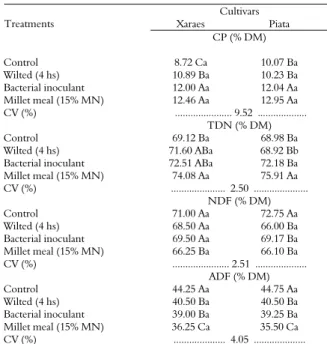
Both silages had the highest CP values in treatments with inoculant or millet meal addition, with an increase of 37.6 and 42.8%, respectively, in relation to the control (Table 3). The millet meal is considered a good additive for the ensiling, given its quality characteristics (GUIMARÃES JR. et al., 2008). The higher CP content (16.5%) in millet grains increased total protein of the silages. An increase of CP content in Tanzânia guineagrass silages after millet meal inclusion was also observed by Paziani et al. (2006).
Table 3. Content of crude protein (CP), total digestible nutrients (TDN), neutral detergent fiber (NDF) and acid detergent fiber (ADF) of silages of Xaraes and Piata palisadegrass in different treatments.
Cultivars
Xaraes Piata Treatments
CP (% DM)
Control 8.72 Ca 10.07 Ba
Wilted (4 hs) 10.89 Ba 10.23 Ba
Bacterial inoculant 12.00 Aa 12.04 Aa
Millet meal (15% MN) 12.46 Aa 12.95 Aa
CV (%) ... 9.52 ...
TDN (% DM)
Control 69.12 Ba 68.98 Ba
Wilted (4 hs) 71.60 ABa 68.92 Bb
Bacterial inoculant 72.51 ABa 72.18 Ba
Millet meal (15% MN) 74.08 Aa 75.91 Aa
CV (%) ... 2.50 ...
NDF (% DM)
Control 71.00 Aa 72.75 Aa
Wilted (4 hs) 68.50 Aa 66.00 Ba
Bacterial inoculant 69.50 Aa 69.17 Ba
Millet meal (15% MN) 66.25 Ba 66.10 Ba
CV (%) ... 2.51 ...
ADF (% DM)
Control 44.25 Aa 44.75 Aa
Wilted (4 hs) 40.50 Ba 40.50 Ba
Bacterial inoculant 39.00 Ba 39.25 Ba
Millet meal (15% MN) 36.25 Ca 35.50 Ca
CV (%) ... 4.05 ...
Dry matter (DM); coefficient of variation (CV). Mean values followed by different letters, upper case in the column (treatments) and lower case in the row (cultivars) are significantly different by Tukey’s test (p < 0.05).
When analyzed the TDN content (Table 3), for the Xaraes palisadegrass silage, only the millet meal treatment was different from the control. The Piata palisadegrass silage presented TDN content similar between control, wilted and inoculant treatments, being different only from the millet meal. For the silages of both cultivars, the highest content of TDN was achieved in the treatment with millet meal, owing the higher TDN content of this ingredient.
With regard to NDF content (Table 3), only the treatment with 15% millet meal inclusion was consistent in reducing NDF content. This reduction is due to a dilution effect on the fiber because of the lower NDF values in the millet meal (21.60%). Bacterial inoculant effect was small and inconsistent. Nadeau et al. (2000) and Rodrigues et al. (2003) reported no effect of inoculant on cell-wall concentration.
For both silages, the lowest ADF values were observed in the treatment with 15% millet meal (Table 3). A decrease in ADF content was also observed by Paziani et al. (2006) when millet meal was added in the ensiling process. ADF content
was similar in T2 and T3 but different from the
control, corroborating Bergamaschine et al. (2006) who evaluated the quality and nutritional value of silages of Marandu palisadegrass produced with additives or wilted forage, and observed similar content of ADF of treatments wilted for 4 hours (42.33%) and enzyme-bacterial inoculant (42.58%). Meanwhile, Coan et al. (2005) examined silages of Tanzânia and Mombaça guineagrass with enzyme-bacterial inoculant and found that the inoculant had no effect in reducing the content of ADF of silages. These authors still reported that this result can be explained by the lack of activity of enzymes in the enzyme-bacterial inoculant, which promote the solubilization of cell wall constituents and increase the availability of soluble carbohydrates for fermentation by lactic acid bacteria.
Analyzing the content of lignin (Table 4) it is observed that the addition of inoculant and millet meal reduced the lignin content in the Xaraes palisadegrass silage. Comparing these treatments with the wilted silage, a decrease of 6.49 and 7.65% was registered for lignin content, respectively. Moreover, the control had the highest value of lignin content.
For both silages, a significant difference was detected in the lignin content between control and millet meal. Such result is related to the lowest concentration of lignin in the millet meal (2.7%), which contributed with reduced content of lignin in the silage; due to the dilution effect. The inoculant effects on lignin were a bit in consistent and differed between cultivars, showing effect in Xaraes and no effect in Piata palisadegrass silages when compared with the control treatment. Rodrigues et al. (2003) investigated the addition of microbial inoculants on the chemical composition and fermentation of elephant grass silage but did not find significant effect on the lignin content.
Table 4. Content of lignin, cellulose, hemicellulose and in vitro digestibility of dry matter (IVDDM) of silages of Xaraes and Piata palisadegrasses in different treatments.
Cultivars
Xaraes Piata Treatments
Lignin (% DM)
Control 5.22 Aa 4.92 Aa
Wilted (4 hs) 4.92 Ba 4.70 Aba
Bacterial inoculant 4.62 Ca 4.52 Aba
Millet meal (15% MN) 4.57 Ca 4.50 Ba
CV (%) ... 4.36 ... Cellulose (% DM)
Control 39.02 Aa 39.82 Aa
Wilted (4 hs) 35.97 ABa 35.80 Ba
Bacterial inoculant 34.37 BCa 34.72 Ba
Millet meal (15% MN) 31.67 Ca 31.00 Ca
CV (%) ... 4.78 ... Hemicellulose (% DM)
Control 26.75 Ba 25.55 Ba
Wilted (4 hs) 28.12 Aa 28.00 Aa
Bacterial inoculant 30.50 Aa 29.92 Aa
Millet meal (15% MN) 30.00 Aa 30.60 Aa
CV (%) ... 7.85 ...
IVDDM (% DM)
Control 52.3 Da 53.8 Ca
Wilted (4 hs) 59.5 Ca 61.3 Ba
Bacterial inoculant 62.7 Ba 63.1 Ba
Millet meal (15% MN) 65.8 Aa 66.5 Aa
CV (%) ... 6.54 ...
Coefficient of variation (CV). Mean values followed by different letters, upper case in the column (treatments) and lower case in the row (cultivars) are significantly different by Tukey’s test (p < 0.05).
Regarding the cellulose content, the bacterial inoculant and the millet meal had lower cellulose values than in natura forage. Ferrari Jr. et al. (2009) studying the use of additives in capim-elefante paraíso grass observed reduction effect of enzyme-bacterial inoculant on the cellulose content of silages and cited that in grass silages, an small fraction (less than 5%) of cellulose can be fermented by enzymes. Due the low cellulose content in its own composition, 15% millet meal inclusion diluted total cellulose in silage.
The hemicellulose content was lower in the control treatment compared to the other ones for both cultivars. The hemicellulose is the main additional source of substrate for fermentation, and can be consumed in the range of 40-50% by microorganisms in the ensiling process (HENDERSON, 1993). According to Patrizi et al.
(2004), Bacillus and Aspergillus genus produce
cellulases, hemicellulases, amylases, Glico-amylases and proteases which promote structural and non-structural carbohydrates digestion. Van Soest (1994) reported that its breakage during the fermentation provides additional sugars for lactic fermentation. Addition of millet meal reduced the hemicellulose content, because this additive has low content of fiber fractions, which can be diluted in the silage.
with 15% millet meal had the highest values of IVDDM. This observation is probably associated with the chemical composition of the fraction with reduced content of NDF and ADF of the silage, which certainly make available readily digestible carbohydrates to ruminal microorganisms (FERNANDES et al., 2002).
However, for the Piata palisadegrass silage, the IVDDM of wilted and inoculant treatments was similar, being superior to the control and inferior to the millet meal treatment, which also presented a higher digestibility when compared with other treatments.
Conclusion
Inoculant or millet meal addition can enhance the nutritional value of Xaraes and Piata cultivars of Brachiaria brizantha silages. Both treatments were effective in improving the fermentation and chemical parameters of both cultivars silages, by elevating the CHOS, CP, TDN contents and
reducing the N-NH3 and pH. Because of their
composition, 15% of millet meal inclusion provided the best content of CHOS, NDF, ADF and increased IVDDM of silages. Wilting can also be effective in improving the aerobic stability of grass silages and may be a cheaper alternative to additives.
References
AOAC-Association of Official Analytical Chemists.
Official Methods of Analysis. 13th ed. Washington, D.C.: AOAC International, 1980.
BERGAMASCHINE, A. F.; PASSIPIÉRI, M.; VERIANO FILHO, W. V.; ISEPON, O. J; CORREA, L. A. Qualidade e valor nutritivo de silagens de capim-marandu (B. brizantha cv. Marandu) produzidas com aditivos ou forragem emurchecida. Revista Brasileira de Zootecnia, v. 35, n. 4, p. 1454-1462, 2006.
CHANDLER, P. Energy prediction of feeds by forage testing explorer. Feedstuffs, v. 62, n. 36, p. 12, 1990. COAN, R. M.; REIS, R. A.; BERNARDES, T. F.; POIATTI, M. L.; PEDROSO, M. S.; SCHOCKEN-ITURRINO, R. P. Composição química e padrão de fermentação de silagens de Tifton 85 com diferentes conteúdos de umidade. ARS Veterinária, v. 21, p. 168-174, 2005. (Suplemento).
COSTA, K. A. P.; ASSIS, R. L.; GUIMARÃES, K. C.; SEVERIANO, E. C.; ASSIS NETO, J. M.; CRUVINEL, W. S.; GARCIA, J. F.; SANTOS, N. F. Qualidade de silagem de cultivares de Brachiaria brizantha ensilado com diferentes níveis de farelo de milheto. Arquivo Brasileiro de Medicina Veterinária e Zootecnia, v. 63, n. 1, p. 188-195, 2011.
DER BEDROSIAN, M. C.; NESTOR JR., K. E; KUNG JR., L. The effects of hybrid, maturity, and length of storage
on the composition and nutritive value of corn silage.
Journal of Dairy Science, v. 95, n. 9, p. 5115-5126, 2012. EMBRAPA-Empresa Brasileira de Pesquisa Agropecuária. Embrapa Gado de Corte. Capim-Piatã homenageia povo indígena Tupi Guarani. Informativo Piatã. Campo Grande: Embrapa Gado de Corte, 2008. Ano 1, ed. 2. FERNANDES, L. O.; REIS, R. A.; RODRIGUES, L. R. A.; LUDIC, I. L.; MANZAN, R. J. Qualidade do feno de braquiária decumbens stapf. submetido ao tratamento com amônia anidra ou uréia. Revista Brasileira de Zootecnia, v. 31, n. 3, p. 1325-1332, 2002.
FERRARI JR., E.; PAULINO, V. T.; POSSENTI, R. A.; LUCENAS, T. L. Aditivos em silagem de capim elefante paraíso (Pennisetum hybridum cv. Paraíso). Archivos de Zootecnia, v. 58, n. 222, p. 185-194, 2009.
FERREIRA, D. F. Análises estatísticas por meio do Sisvar para Windows versão 4.0. In: Reunião Anual da Região Brasileira da Sociedade Internacional de Biometria. São Carlos: UFSCar, 2000. p. 255-258.
GUIMARAES JR., R.; GONÇALVES, L. C.; MAURÍCIO, R. M.; PEREIRA, L. G. R.; TOMICH, T. R.; PIRES, D. A. A.; JAYME, D. G.; SOUSA, L. F. Cinética de fermentação ruminal de silagens de milheto.
Arquivo Brasileiro de Medicina Veterinária de Zootecnia, v. 60, n. 5, p. 1174-1180, 2008.
HENDERSON, N. Silage additives. Animal Feed Science and Technology, v. 45, n. 1, p. 35-56, 1993. JAYME, C. G.; MOLINA, L. R.; GONÇALVES, L. C.; JAYME, D. G.; PIRES, D. A. A.; BORGES, I. Determinação do momento de colheita da Brachiaria brizantha (hochest.) stapf. cv. Marandu para produção de silagem. Ciência e Agrotecnologia, v. 33, n. 2, p. 586-591, 2009.
JOHNSON, R. N.; BALINANI, T. L.; JOHNSON, L. L. Corn plant maturity. II. Effect on “in vitro” cellulose digestibility and soluble carbohydrate content. Journal of Animal Science, v. 25, n. 2, p. 617-623, 1966.
LEONEL, F. P.; PEREIRA, J. C.; COSTA, M. G.; MARCO JR., P.; SILVA, C. J.; LARA, L. A. Consórcio capim-braquiária e milho: comportamento produtivo das culturas e características nutricionais e qualitativas das silagens. Revista Brasileira de Zootecnia, v. 38, n. 1, p. 166-176. 2009. McDONALD, P.; HENDERSON, A. R.; HERON, S. J. E. The biochemistry of silage. 2nd ed. Bucks: Chalcombe Publications, 1991.
NADEAU, E. M. G.; BUXTON, D. R.; RUSSELL, J. R. ALLISON, M. J.; YOUNG, J. W. Enzyme, bacterial inoculant, and formic acid effects on silage composition of orchardgrass and alfalfa. Journal of Dairy Science, v. 83, n. 7, p. 1487-1502, 2000.
PATRIZI, W. L.; MADRUGA JR., C. R. F.; MINETTO, T. P.; NOGUEIRA, E.; MORAIS; M. G. Efeito de aditivos biológicos comerciais na silagem de capim-elefante (Pennisetum purpureum Schum). Arquivo Brasileiro de Medicina Veterinária e Zootecnia, v. 56, n. 3, p. 392-397, 2004.
bacteriano nas características físicas e químicas da silagem de capim-tanzânia. Acta Scientiarum. Animal Sciences, v. 28, n. 3, p. 265-271, 2006.
RODRIGUES, P. H. M.; LOPES, T. F. T.; ANDRADE, S. J. T.; MELOTTE, L.; LUCCI, C. S.; MEYER, P. M. Adição de inoculantes microbianos sobre a composição química e perfil fermentativo da silagem de capim-elefante (Pennisetum purpureum, Schum). Ciência Animal Brasileira, v. 25, n. 2, p. 397-402, 2003.
SILVA, J. B.; REIS, S. T.; ROCHA JR., V. R.; SALES, E. C. J.; MOTA, V. J. G.; JAYME, D. G.; SOUZA, V. M. Características fermentativas da silagem do capim Marandu manejado em diferentes alturas de dossel.
Revista Brasileira de Saúde e Produção Animal,
v. 12, n. 2, p. 329-339, 2011.
SILVA, D. J.; QUEIROZ, A. C. Análise de alimentos (métodos químicos e biológicos). 3. ed. Viçosa: Imprensa Universitária da UFV, 2002.
TILLEY, J. M. A.; TERRY, R. A. A two stage technique for in vitro digestion of forages crops. Journal of the British GrasslandSociety, v. 18, n. 2, p. 104-111, 1963.
TOMICH, T. R.; RODRIGUES, J. A. S.; TOMICH, R. G. P.; GONÇALVES, L. C.; BORGES, I. Potencial forrageiro de híbridos de sorgo com capim-sudão.
Arquivo Brasileiro de Medicina Veterinária e Zootecnia, v. 56, n. 2, p. 258-263, 2004.
VAN SOEST, P. J. Nutritional ecology of the ruminant. 2. ed. Ithaca: Cornell, 1994.
VIANA, P. T.; TEIXEIRA, F. A.; PIRES, A. J. V.; GIORDANO, G.; CARVALHO, P.; FIGUEIREDO, M. P.; SANTANA JR., H. A. Losses and nutritional value of elephant grass silage with inclusion levels of cottonseed meal. Acta Scientiarum.Animal Sciences, v. 35, n. 2, p. 139-144, 2013.
Received on October 30, 2012. Accepted on July 18, 2013.