Rev. Caatinga
SOIL ENZYMATIC ACTIVITIES IN AREAS WITH STAGES AND
MANAGEMENT OF FOREST REGENERATION FROM CAATINGA
1ANDREZZA EMANUELLA OLIVEIRA SILVA2, ÉRIKA VALENTE DE MEDEIROS2*, EUZELINA DOS SANTOS
BORGES INÁCIO3, IGNÁCIO HERNAN SALCEDO4, LAERTE BEZERRA DE AMORIM5
ABSTRACT - The tropical dry areas have suffered the most severe anthropic pressures. This factor motivates studies aimed at characterizing and monitoring the soil quality to determine the management measures to apply and to suggest appropriate recovery procedures. The objective of this study was to evaluate the enzymatic activity of acid and alkaline phosphatases, urea and arylsulfatase in the superficial layers of soils in areas under different stages of forest regeneration, in Floresta-PE City.. Soil sampling was conducted at 0-5, 5-15 and 15-30 cm layer in the following areas: C-18 (vegetation regeneration for 18 years), P-13 (13 years), L-12 (12 years), C-9 (9 years), C-7 (7 years) and G-4 (4 years). The analytical methods used in the study were based on the incubation of the soil samples with a buffered solution of substrate specific for each enzyme. The methods were based on colorimetric determinations. The activity of acid and alkaline phosphatase and urease represented sensitive measures for detecting changes in soil quality at various stages of regeneration in tropical dry forests. The area with the longest duration of forest regeneration (C-18) showed higher enzyme activities. The soil enzymatic activities respond to different stages and management of forest regeneration in Brazilian tropical dry areas, namely Caatinga. The acid and alkaline phosphatase, arylsulfatase and urease increased with time of regeneration.
Keywords: Extracelular soil enzymes. Soil quality. Phosphatase. Urease. Arylsulfatase.
ATIVIDADES ENZIMÁTICAS DE SOLO COM ESTÁGIOS E MANEJO DE REGENERAÇÃO DE FLORESTAS DA CAATINGA
RESUMO- As áreas tropicais secas são as que sofrem as mais severas pressões antrópicas. Este fator motiva
estudos que objetivam caracterizar e monitorar a qualidade do solo visando determinar estratégias de manejo para os produtores. O objetivou-se avaliar a atividade enzimática das enzimas fosfatases ácida e alcalina, uréase e arilsulfatase nas camadas superficiais de solos em áreas sob diferentes estágios de regeneração florestal, no município de Floresta-PE. Amostras de solos foram coletadas nas camadas 0-5, 5-15 e 15-30 cm nas áreas C-18 (regeneração por 18 anos), P-13 (13 anos), L-12 (12 anos), C-9 (9 anos), C-7 (7 anos) e G-4(4 anos). Os
métodos analíticos usados neste estudo foram baseados na incubação das amostras de solo com soluções tamponadas de substratos específicos de cada enzima. Os métodos foram baseados em determinações colorimétricas. As atividades das fosfatases e uréase foram sensíveis em detectar mudanças na qualidade de solos com vários estágios de regeneração em áreas secas tropicais. As áreas com maior tempo de regeneração (C-18) mostraram maiores atividades enzimáticas. As atividades enzimáticas do solo respondem a diferentes
estágios e manejo de regeneração florestal nas áreas secas tropicais brasileiras, nomeadamente Caatinga. A fosfatase ácida e alcalina, arilsulfatase e urease aumentaram com o tempo de regeneração.
Palavras-chave: Enzimas extracelulares do solo. Qualidade do solo. Fosfatase. Uréase. Arilsulfatase.
_______________________________ *Corresponding author
1Received for publication in 01/23/2017; accepted in 07/05/2017. Extracted from the first author's Master's dissertation.
2Department of Agronomy, Universidade Federal Rural de Pernambuco, Garanhuns, PE, Brazil; [email protected], [email protected].
3Department of Agronomy, Universidade Federal do Recôncavo da Bahia, Cruz das Almas, BA, Brazil; [email protected]. 4Instituto Nacional do Semiárido, Campina Grande, PB, Brazil; [email protected] (In memorian).
INTRODUCTION
The use of tropical dry forests (TDF) has focused on the extraction of timber products to satisfy the demands of human population (FOLEY et al., 2005). Clear felling of trees and shrubs is a productive type of management that is widely practiced in Brazilian TDF (MMA, 2008). This management method involves the regular trimming of trees that are valuable for their wood properties and allows local recovery via natural regeneration (MEDEIROS et al., 2017).
Generally, logging in the rainforest is still conducted unsustainably. Many loggers return to the same area at increasingly shorter intervals to remove the remaining trees with economic value, disregarding the cutting cycle, a basic principle of forest management in a regime based on sustainable yield (AMARAL; PINTO, 2012). The principal challenges faced by forest managers is to maintain biodiversity and the integrity of the forest and at the same time meet human needs through productive activities (BURKE et al., 2008).
Logging and its effects on the remaining vegetation, the soil and natural regeneration should be considered in the management of TDF. According to Ma et al. (2010), the management practices as clear cutting, pruning, burning, thinning and selective logging cause changes in forest microclimate conditions. This influence directly or indirectly the soil properties as changes in nutrient cycling (MEDEIROS et al., 2017), reducing the inventory of those forests as a result of the removal of large amounts of organic matter (WALMSLEY et al., 2009). Thus, a strong effort has been made to develop mechanisms for monitoring degradation, i.e., activities that can be used as indicators of changes in soil quality in response to management practice (TRANNIN; SIQUEIRA; MOREIRA, 2008).
Soil enzymes activities (SEA) are sensitive to management practices (MEDEIROS et al., 2015) and are directly related to the transformation of nutrients (YANG et al., 2008) and the microbial community (VALLEJO et al., 2012). Wick, Tiessen and Menezes (2000), concluded that SEA and microbiological variables reflected changes in land management more rapidly than fertility. SEA participate in almost all transformation processes involving the decomposition of detritus and play a central role in maintaining the fertility of forest soil,
releasing nutrients from organic sources
(BALDRIAN; ŠTURSOVÁ, 2010).
Soil urease activity is involved in the N-cycle and is easily detected in the soil with different cover (MEDEIROS et al., 2015). The arylsuphatase activity is involved in S-cycle. Soil phosphatases are involved in the P-cycle, but acid phosphatase activity can be inhibited by high concentrations of inorganic phosphate in the soil (TRANNIN; SIQUEIRA;
MOREIRA, 2007).
Studies have been conducted to evaluate the SEA and changes due to clear cutting of natural forest. Geng, Dighton and Gray (2012) found that an Entisol in an upland pine woods in New Jersey showed changes after one year of succession due to a decrease in SEA resulting from the cutting of trees. Boerner et al. (2008) studied regeneration in forests of North America and found low SEA after forest cutting. Medeiros et al. (2017) reported large variations in microbial biomass and SEA in a tropical dry area submitted to natural regeneration.
The objective of this study was to evaluate the enzymatic activities in three soil layers in areas under different stages of forest regeneration, in Floresta-PE city.
MATERIAL AND METHODS
Characterization of the study areaThe areas investigated in this study are located in the Floresta city, Pernambuco state, in Northeastern Brazil (8° 36′ 02′′ S, 38° 34′ 05′′ W) and 401 m of altitude. According to the Köppen classification, the climate of the study area is BSw’h’, a very hot, semi-arid steppe. The average annual temperature is 26.5 ºC, and the average annual rainfall is approximately 623 mm, with an average potential evapotranspiration of 1,646 mm per year and an annual water deficit of 1,023 mm (EMBRAPA, 2013).
The Floresta city is located in the Peripheral Depression of the São Francisco River. The landscape is typical of the Northeastern semiarid region and is characterized by rather monotonous surface pediplanation and predominantly gentle, rolling relief (JATOBÁ, 2003). The dominant vegetation is hyperxerophilic savanna vegetation and is generally not highly dense or bushy (FERRÃO, 2014).
The sites were chosen according to a field survey performed in areas showing high heterogeneity with respect to the following characteristics: landscape position, soil types, plant species diversity and cutting times. Because of this high variability, the areas were separated into homogeneous environmental units differentiated by the type of soil and cutting times of Caatinga vegetation in accordance with the forest management plan established for each area. The areas were named in: C-18, P-13, L-12, C-9, C-7 and L-4 that correspond to the name and the time of preservation.
The C-18 area has been preserved for 18 years. The most recent clear cut in the area
occurred in 1995. Its vegetation consists of quipembe
(Piptadenia moniliformis), juá (Ziziphus joazeiro),
mandacaru (Cereus jamacaru), macambiras
Rev. Caatinga
tuberosa) (FERRÃO, 2014).
The P-13 area has undergone regeneration for 13 years. The most recent clear cut in the area occurred in 2000. The area has a high density of
plants, with species such as faveleira (Cnidoscolus
bahianus), umburana (Commiphora leptophloeus),
canafistula (Peltophorum dubium), moleque duro
(Varronia leucocephala), malva (Sida paniculata),
angico (Piptadenia zehntneri), baraúnas (Schinopsis
brasiliensis) and abundant caroá (Neoglasiovia
variegata), juazeiros (Ziziphus joazeiro) and mororó
(Bauhinia forficata).
The L-12 area has been preserved for 12 years. The most recent clear cut in the area
occurred in 2001. The predominant plant species in
this area are caatingueira (Caesalpinia pyramidalis),
pereiro (Aspidosperma pyrifolium), carrapicho de boi
(Desmodium uncinatum) and faveleira (Cnidoscolus
bahianus). A number of gaps in the vegetation were
observed in this area.
The C-9 area was used for agriculture (cotton cultivation) for approximately 15 years. Currently, the vegetation is undergoing regeneration in the presence of caprine grazing. The most recent clear cut occurred in 2004. The predominant plant species
are faveleira (Cnidoscolus bahianus) and umbuzeiro
(Spondias tuberosa).
The C-7 area has undergone regeneration for seven years. The most recent clear cut in this area occurred in 2006. The predominant plant species are
quipembe (Piptadenia moniliformis), juá (Ziziphus
joazeiro) and mandacaru (Cereus jamacaru).
The L-4 area has undergone regeneration for four years. The most recent clear cut in this area occurred in 2009. The area’s plant species include
umbuzeiro (Spondias tuberosa), mandacaru (Cereus
jamacaru), caroá (Neoglasiovia variegata) and
abundant carqueja (Baccharis genisteloidis) and
marmeleiro (Croton blanchetianus).
Experimental design and soil sampling
The experimental design was completely randomized with 6 areas considered the treatments. In each area, three replicates soil samples were collected with a cylindrical auger at layers 0-5, 5-15 and 15-30 cm. Each sample consisted of five sub-samples taken within a radius of approximately 0.50 m. To evaluate the density of the soil, we collected three undisturbed samples for each environment and depth with a volumetric ring 5 cm in diameter. One-half of all collected samples were then kept under refrigeration (-4 °C) to determine the biochemical attributes of the soil. Ferrão (2014)
provided detailed the chemical (pH, Al3+, P and K+),
microbiological and physical soil attributes from the areas.
Enzyme activities
We selected the enzymes of the main nutrients cycle. The activity of acid and alkaline phosphatase (EC 3.1.3) and arylsulfatase (EC 3.1.6.1) was determined according to the
methodology proposed by Eivazi and Tabatabai (1988) and Eivazi and Tabatabai (1977) and Tabatabai and Bremner (1972), respectively. The activity of urease (EC 3.5.1.5) was estimated according to Kandeler and Gerber (1988). These methodologies are based on the incubation of the soil samples with a buffer solution specific for the
substrate of each enzyme. The release of p-nitrophenol was used in the acidic and alkaline
phosphatase assays and in the arylsulfatase assay. The release of ammonia was used in the urease assay. The assays were based on spectrophotometric determinations. For each sample, three analytical replicates and two controls (white) were performed.
Acid and alkaline phosphatase
The activities of acid and alkaline phosphatase were determined by spectrophotometry.
The assay quantified the release of p-nitrophenol
following the incubation of 1.0 g of soil in 0.2 mL toluene and 4 mL of modified universal buffer (MUB). A pH of 6.5 was used in the acid phosphatase assay, and a pH of 11 was used in the alkaline phosphatase assay. In these assays, 1 mL of a p-nitrophenyl phosphate solution (0.025 M) was used at 37 ºC for 1 h. The samples were then filtered and read in a spectrophotometer (400 nm). The
activity values were expressed in units of µg p-nitrophenol (PNP) g-1 h-1.
Arylsulfatase
Arylsulfatase activity was determined by spectrophotometry (410 nm). The assay quantified
the release of p-nitrophenol following the incubation
of 1.0 g of soil in 0.25 mL of toluene and 4 mL of
acetate buffer (0.5 mol L-1) A pH of 5.8 was used in
this assay. A total of 1 mL of p-nitrophenyl
sulfate (0.05 M) was used at 37 °C for 1 h. The activity values were expressed in units of µg p-nitrophenol g-1 h-1.
Urease
Urease activity was quantified via the
incubation of 5 g of soil in 2.5 mL of urea for 2 hours at 37 °C. Readings were taken in a
spectrophotometer (690 nm), and the activity values
were expressed in units of µg N-NH4+ g-1 2 h-1.
Statistical analysis
Significant differences were compared through the Student Newmna-Keul´s test at 5 % probability for each layer. These data and the results of the chemical analysis were subjected to a multivariate (principal components) statistical analysis to identify the attributes most responsible for the variation between the different stages of forest regeneration. A multivariate analysis was separately applied to each of the layers.
RESULTS AND DISCUSSION
Acid phosphatase
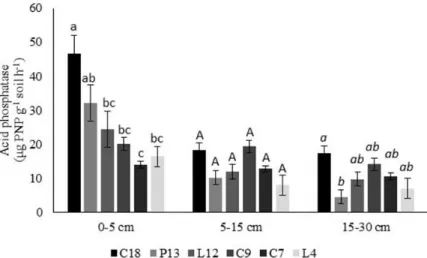
In the 0-5 and 15-30 cm layers, the acid phosphatase activity varied (P < 0.05) among environments having different durations of forest regeneration. In the 0-5 cm layer, the maximum acid phosphatase activity was observed in the C-18 area. In this area, the average activity was 46.59 µg PNP g
-1 soil h-1. The C-7 area showed the lowest activity of
acid phosphatase, with a mean of 13,87 µg PNP g-1
soil h-1. This value was 70% less than the activity
found in C-18 (Figure 1).
Figure 1. Acid phosphatase activity in different areas of forest regeneration at 0-5, 5-15 and 15-30 cm soil layers. (C-18:
vegetation regeneration for 18 years; P-13: 13 years; L-12: 12 years; C-9: 9 years; 7-C: 7 years; L-4: 4 years). Different
lower case letters indicate significant differences (P < 0.05) in the layer 0-5 cm, capital letters in the 5-15 cm layer and italic
case letters in the 15-30 layer cm by ANOVA followed by Student Newman-Keuls test.
The acid phosphatase activity ranged from
7.97 to 19.29 µg PNP g-1 soil h-1 in the 5- to 15-cm
soil layer, with the highest and lowest observed values in areas with nine years (C-9) and
four years of regeneration (L-4), respectively. In the 15-30 cm soil layer, area C-18 had the highest acid phosphatase activity, with an
average of 17.44 µg PNP g-1 soil h-1. Area P-13
(4.45 µg PNP g-1 soil h-1) showed the lowest acid
phosphatase activity.
The results of the present study showed that the area with the highest acid phosphatase activity (C-18) also had the soils with the lowest observed phosphorus content (FERRÃO, 2014). In general, acid phosphatase activity is favored by low P availability to plants and microorganisms and can be inhibited by high concentrations of inorganic phosphate in the soil (TRANNIN; SIQUEIRA; MOREIRA, 2007). Another factor that most likely influenced the activity of acid phosphatase was the type of soil, e.g., Haplic Cambisol in area C-18 and Yellow Latossol in area L-4.
The strong variation in soil acid phosphatase activity found in the present study shows that this enzyme is sensitive to soil disturbance in areas with
different durations of natural regeneration and agree with Medeiros et al. (2017) that evaluated this enzyme in a Cambissol with three stages of natural regeneration. Similar results were found by Silva et al. (2012), evaluating acid phosphatase activity in a Cambisol in the Middle Paraíba Valley South region (RJ) in certain forest systems. That study found
enzyme activities of 35 µg PNP g-1 soil h-1 in a
secondary forest in early stages of succession and 47 µg PNP g-1 solo h-1 in a secondary forest in an advanced stage of succession. In general, areas with longer durations of regeneration showed higher acid phosphatase activity than areas with shorter durations of regeneration. This finding suggests that the amount of available substrates is higher in areas with longer durations of regeneration. This result is consistent with the findings of many studies that increased activity of acid phosphatase results from changes in organic matter (KREMER; LI, 2003; VINHAL-FREITAS, 2010).
Rev. Caatinga
plots with herbaceous vegetation than in plots with forest vegetation, most likely due to differences between plots in the decomposition of plant materials. The results of this study are according to Medeiros et al. (2017), who found that the type of vegetation cover influences microbial growth and the activity of enzymes in areas with different natural regeneration.
As in the present study, Balota, Machineski and Truber (2011), observed a decrease in acid phosphatase activity with increasing depth under a tillage system. The decrease in enzyme activity with soil depth may be associated with a low content of labile C and O2, which may result in a lower
microbial biomass (NOTARO et al., 2014) and less activity than found in the surface layer.
Alkaline phosphatase
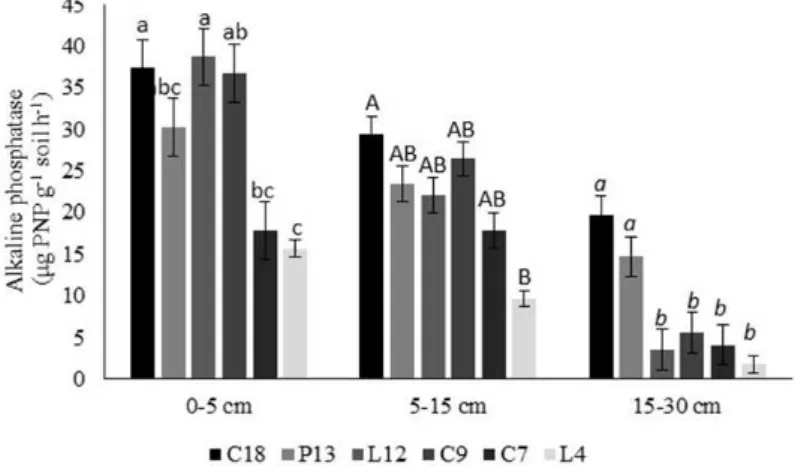
The activity of alkaline phosphatase varied (P < 0.05) among the studied environments and soil layers. In the 0-5 cm layer, area L-12 showed the highest values of alkaline phosphatase activity, with
an average of 38.70 µg PNP g-1 soil h-1. In the 5-15
and 15-30 cm layers, however, area C-18 had higher values of alkaline phosphatase activity. In these two layers, the average activity was 29.42 and
19.62 µg PNP g-1 soil h-1, respectively (Figure 2).
Figure 2. Alkaline phosphatase activity in various areas of forest regeneration at 0-5, 5-15 and 15-30 cm soil layers. (C-18:
vegetation regeneration for 18 years; P-13: 13 years; L-12: 12 years; C-9: 9 years; C-7: 7 years; L-4: 4 years). Different
lower case letters indicate significant differences (P < 0.05) in the layer 0-5 cm, capital letters in the 5-15 cm layer and italic
case letters in the 15-30 layer cm by ANOVA followed by Student Newman-Keuls test.
In all soil layers, the L-4 area was notable for its lower alkaline phosphatase activity, with a 38% decrease in the 5-15 cm layer and an 89% decrease in the 15-30 cm layer compared with the activity of the 0-5 cm layer, which showed an average activity of 15.67 µg PNP g-1 soil h-1.
The higher alkaline phosphatase activity at 0-5 cm compared to 5-15 and 15-30 cm may be related to the high concentration of forest litter on the soil surface. These residues (leaves, twigs and shells) facilitate major modifications in this layer and, consequently, can affect microbial activity.
At the 15-30 cm layer, areas P-13 and L-12 had significantly different alkaline phosphatase activity despite the small difference between the areas in the duration of regeneration. This finding can be explained by differences in soil pH because the enzyme is sensitive to changes in pH (ACOSTA-MARTINEZ et al., 2008) and because area P-13 shows a greater density and variety of plants than area L-12 that can produce higher litterfall and exudate compositions. This higher changes help the microbial community that release nutrients (SMITH; MARÍN-SPIOTTA; BALSER, 2015) and have consequences in soil biochemical attributes.
Arylsulfatase
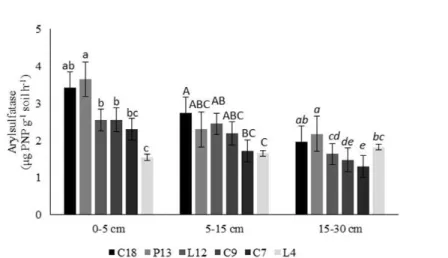
The results of the assays showed high variability (P < 0.05) in arylsulfatase activity in soils in areas varying in the duration of forest regeneration in Brazilian semi-arid. In the 0- to 5- and 5- to 15-cm layers, the soils of area C-18 showed the highest arylsulfatase activity. These layers showed an
average activity of 3.43 and 2.75 µg PNP g-1 soil h-1,
respectively. The soils of area L-4 showed lower arylsulfatase activity in these two layers, with
averages of 1.55 and 1.66 µg PNP g-1 soil h-1,
Figure 3. Arylsulfatase activity in different areas of forest regeneration at 0-5, 5-15 and 15-30 cm soil layers. (C-18:
vegetation regeneration for 18 years; P-13: 13 years; L-12: 12 years; C-9: 9 years; C-7: 7 years; L-4: 4 years). Different
lower case letters indicate significant differences (P < 0.05) in the layer 0-5 cm, capital letters in the 5-15 cm layer and italic
case letters in the 15-30 layer cm by ANOVA followed by Student Newman-Keuls test.
The high arylsulfatase activity in the 0- to 5- and 5- to 15-cm layers in C-18 is most likely due to the high density of plants and the resulting high production of biomass. This process would generate higher amounts of substrate for microbial growth and enzyme production. According to Geng, Dighton and Gray (2012), arylsulfatase is the enzyme that is involved in the mineralization of sulfate esters in the soil. The literature reports a broad range of arylsulfatase activity related to soil properties and soil management (BANDICK; DICK, 1999).
Urease
The values of urease at the study sites decreased with increasing layers (Fig. 4). Area C-18
had the greatest urease activity in the 0- to 5-cm layer, with an average of 6.34 µg N-NH4+ g-1 h-1. Area L-4 showed a lower level of activity of this enzyme, 66% less than that for area C-18. It is probable that this difference is a result of the continued and diversified contribution of organic matter to the soil, primarily the quality of OM. The OM may be richer in N at site C-18 due to the presence of leguminous plants. In the 5- to 15-cm layer, the mean urease activity varied among the six studied areas. The area with the longest duration of regeneration (C-18) showed the highest average activity of urease, and the area with the shortest duration of regeneration (L-4) showed the lowest average activity of urease (Figure 4).
Figure 4. Urease activity in different areas of forest regeneration at 0-5, 5-15 and 15-30 cm soil layers. (C-18: vegetation
regeneration for 18 years; P-13: 13 years; L-12: 12 years; C-9 : 9 years; C-7: 7 years; L-4: 4 years). Different lower case
letters indicate significant differences (P < 0.05) in the layer 0-5 cm, capital letters in the 5-15 cm layer and italic case
letters in the 15-30 layer cm by ANOVA followed by Student Newman-Keuls test.
The soil from C-18 areas showed the highest urease activity in the 0-5 cm layer. This level of activity was higher than that found in area L-4 due to the diversified supply of organic matter incorporated into the soil of area C-18. According to Matsuoka,
Rev. Caatinga
biomass and, consequently, better conditions for the development of the microbiota and for enzyme synthesis.
In soils cultivated with maize and wheat in the southeastern Po Valley, Italy, Giacometti et al. (2013) found urease activity of
8.77 µg N-NH4+ g-1 soil h-1 in the absence of organic
soil fertilization, 9.79 µg N-NH4+ g-1 soil h-1 in soil
with crop residues and 14.6 µg N-NH4+ g-1 soil h-1 in
soil treated with manure.
The observed decrease of urease activity with increasing soil depth may be related to the limitation of the growth of microorganisms in the soil in the absence of sources of nitrogen and oxygen. Accordingly, the addition of organic matter can influence the size and activity of the microbial
community (BUZINARO; BARBOSA; NAHAS, 2009).
Multivariate analysis
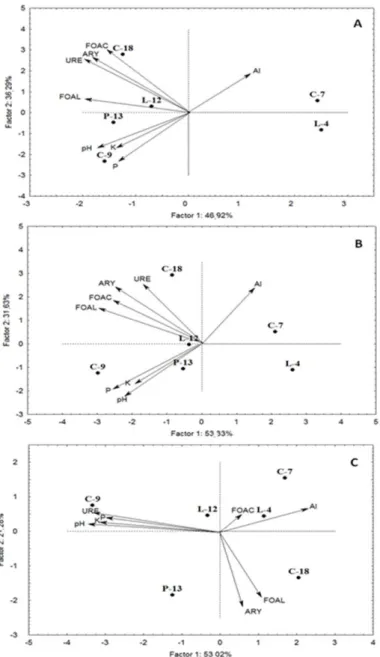
Vector diagrams were generated to display two principal components (Factor 1 and Factor 2) for
the chemical attributes (pH, Al3+, P and K+) and the
biochemical attributes (FOAC - acid phosphatase,
FOAL - alkaline phosphatase, ARY - arylsulfatase
and URE - urease) at the each studied layer (Figure
5). The first two factors explained the following cumulative percentages of the total variation in the data: 83.21% for the 0-5 cm layer, 84.96% for 5-15 cm and 74.30% for 15-30 cm.
Figure 5. Diagram of projection vectors obtained with a multivariate principal component analysis (PCA), based on the chemical and enzymatic attributes of soils from areas subjected to different durations of forest regeneration at different
layers. A) 0-5 cm; B) 5-15 cm; C) 15-30 cm. FOAC = acid phosphatase; FOAL = alkaline phosphatase;
ARY = arylsulfatase; URE = urease; C-18= vegetation regeneration for 18 years; P-13= 13 years; L-12 = 12 years;
In the surface layer, the factor 1 explained
46.92% of the total variation. The variables
that most influenced this factor were
FOAL > URE > ARY > AL, in descending order of influence. These attributes were the most sensitive to differences among the areas. The variables that most influenced factor 2 were P > pH > FOAC > K, in descending order of influence. Factor 2 explained 36.29% of the total variation. These characteristics are evident from the vector projection diagram, which shows that these variables are farther from the factor 2 (Figure 5A).
At 5-15 cm layer, the two principal components (factors 1 and 2) cumulatively explained a percentage of 84.96% of the total variance, with factor 1 responsible for 53.33% of the total variance. The most influential variables, in decreasing order, were FOAL > FOAC > K > P > pH >ARY. Factor 2 explained 31.63% of the total variance, with URE > AL as the most influential variables (Figure 5B). At 15-30 cm layer, the factor 1 explained
53.02% of the total variance. The most
influential variables, in decreasing order, were URE > pH > K > P > FOAC. Factor 2 explained
21.28% of the total variance, with ARY > FOAL as the most influential variables (Figure 5C).
The multivariate analysis at 0-5, 5-15 and 15-30 cm layer shows a distinct separation between the areas. The first group of areas consists of those with longer regeneration durations (C-18, P-13, L-12 and C-9). This group is located in the upper and lower left quadrants of the diagram and is correlated with biochemical (enzymatic activities) and chemical attributes. The second group consists of areas with shorter regeneration durations (C-7 and L-4) and is located in the upper and lower right quadrants of the diagram. This group is correlated with a chemical attribute, Al3+.
The result of the multivariate principal component analysis confirmed the strong association of the biochemical variables (acid and alkaline phosphatase, arylsulfatase and urease) with the forest systems having longer durations of regeneration. Silva et al. (2012), also using a principal component analysis, observed that in the moist season, areas of secondary forest in a middle successional stage were associated with most of the studied biochemical variables.
CONCLUSIONS
The soil enzymatic activities respond to different stages and management of forest regeneration in Brazilian tropical dry areas, namely Caatinga. The acid and alkaline phosphatase, arylsulfatase and urease increased with time of regeneration.
The chemical and biochemical soil attributes discriminate areas with stages and management of
forest regeneration through the multivariate principal component analysis. The PCA’s showed that the areas with higher time of regeneration (C-18 and L-12) are grouped in the same quadrant in the surface layer.
ACKNOWLEDGMENTS
The authors thank Plants of the Northeast Association (APNE) for their technical support in the experimental areas; José Claudio Fonseca, the owner of the experimental area; and the financial support given by the State of Pernambuco Foundation of Support for Science (FACEPE) and Technology and the National Council for Scientific and Technological Development (CNPq) for the
productivity scholarship granted to the
corresponding author (CNPq -306401/2015-0).
REFERENCES
ACOSTA-MARTINEZ, V. et al. Microbial communities and enzymatic activities under different
management in semiarid soils. Applied Soil
Ecology, Firenze, v. 38, n. 3, p. 249-260, 2008.
AMARAL, P.; PINTO A. Manejo florestal como base para produção e conservação florestal na
Amazônia. In: CASES, M. O. (Ed.). Gestão de
Unidades de Conservação: compartilhando uma experiência de capacitação. Brasília: Instituto de Pesquisas Ecológicas- WWF-Brasil, 2012. v. 1, p. 265-278.
BALDRIAN, P.; ŠTURSOVÁ, M. Enzymes in forest soils. In: BALOTA, E. L.; MACHINESKI, O.;
TRUBER, P. V. (Eds.). Soil Enzymology. Noida:
Springer Science & Business Media, 2010. v. 22, cap. 4, p. 61-73.
BALOTA, E. L.; MACHINESKI, O.; TRUBER, P. V. Soil enzyme activities under pig slurry addition
and different tillage systems. Acta Scientiarum.
Agronomy, Maringá, v. 33, n. 4, p. 729-737, 2011.
BANDICK, A. K.; DICK, R. P. Field management
effects on soil enzyme activities. Soil Biology and
Biochemistry, Leicestershire, v. 31, n. 11, p. 1471-1479, 1999.
BOERNER, R. E. J. et al. Initial effects of fire and mechanical thinning on soil enzyme activity and nitrogen transformations in eight North American
forest ecosystems. Soil Biology and Biochemistry,
Leicestershire, v. 40, n. 12, p. 3076-3085, 2008.
Rev. Caatinga
on the understory vegetation of southern Ontario
woodlands. Forest Ecology and Management, New
South Wales, v. 255, n. 7, p. 2204-2212, 2008.
BUZINARO, T. N.; BARBOSA, J. C.; NAHAS, E. Soil microbialactivities in orchard citrus as a
response to green manure cultivation. Revista
Brasileira de Fruticultura, Jaboticabal, v. 31, n. 2, p. 408-415, 2009.
EMPRESA BRASILEIRA DE PESQUISA
AGROPECUÁRIA – EMBRAPA. Banco de dados
climáticos do Brasil. Disponível em: <http:// www.bdclima.cnpm.embrapa.br/resultados/
balanco.php?UF=&COD=141>. Acesso em: 20 ago. 2013.
EIVAZI, F.; TABATABAI, M. A. Phosphatases in
soils. Soil Biology and Biochemistry,
Leicestershire, v. 9, n. 3, p. 167-172, 1977.
EIVAZI, F.; TABATABAI, M. A. Glucosidases and
galactosidases in soils. Soil Biology and
Biochemistry, Leicestershire, v. 20, n. 5, p. 601-606, 1988.
FERRÃO, N. G. Atributos microbianos em solos
sob Caatinga manejada. 2014. 44 f. Monografia (Ciências biológicas- Ciências ambientais) –
Universidade Federal Rural de Pernambuco, Recife, 2014.
FOLEY, J. A. et al. Global consequences of land
use. Science, United Kingdom, v. 309, n. 5734, p.
570-574, 2005.
GENG, Y.; DIGHTON, J.; GRAY, D. The effects of thinning and soil disturbance on enzyme activities under pitch pine soil in New Jersey Pinelands. Applied soil ecology, Firenze, v. 62, n. 1, p. 1-7, 2012.
GIACOMETTI, C. et al. Chemical and microbiological soil quality indicators and their potential to differentiate fertilization regimes in
temperate agroecosystems. Applied Soil Ecology,
Firenze, v. 64, p. 32-48, 2013.
JATOBÁ, L. Geologia e recursos minerais. In:
ANDRADE, M. C. O. (Ed.). Atlas escolar
pernambucano: espaço geo-histórico e cultural. João Pessoa: Grafset, 2003. v. 2, p. 27-34.
KANDELER, E.; GERBER, H. Short-term assay of soil urease activity using colorimetric determination
of ammonium. Biology and fertility of Soils,
Firenze, v. 6, n. 1, p. 68-72, 1988.
KREMER, R. J.; LI, J. Developing weed-suppressive soils through improved soil quality management.
Soil and Tillage Research, Kiel, v. 72, n. 2, p. 193-202, 2003.
LUCAS-BORJA, M. E. et al. Influence of forest cover and herbaceous vegetation on the microbiological and biochemical properties of soil
under Mediterranean humid climate. European
Journal of Soil Biology, Braunschweig, v. 46, n. 5, p. 273-279, 2010.
MA, S. et al. Spatial variability in microclimate in a mixed-conifer forest before and after thinning and
burning treatments. Forest Ecology and
Management, New South Wales, v. 259, n. 5, p. 904 -915, 2010.
MATSUOKA, M.; MENDES, I. C.; LOUREIRO, M. F. Biomassa microbiana e atividade enzimática em solos sob vegetação nativa e sistemas agrícolas anuais e perenes na região de Primavera do Leste (MT). Revista Brasileira de Ciência do Solo, Viçosa, v. 27, n. 3, p. 425-433, 2003.
MEDEIROS, E. V. et al. Absolute and specific enzymatic activities of sandy entisol from tropical
dry forest, monoculture and intercropping areas. Soil
and Tillage Research, Kiel, v. 145, n. 1, p. 208-215, 2015.
MEDEIROS, E. V. et al. Soil organic carbon, microbial biomass and enzyme activities responses to natural regeneration in a tropical dry region in
Northeast Brazil. CATENA, Amsterdam, v. 151, n.
1, p. 137-146, 2017.
MINISTÉRIO DO MEIO AMBIENTE – MMA. Manejo sustentável dos recursos florestais da Caatinga / MMA. Secretaria de Biodiversidade e Florestas. Departamento de Florestas. Programa Nacional de Florestas. Natal : MMA, pp. 28. 2008.
NOTARO, K. A. et al. Agroforestry systems, nutrients in litter and microbial activity in soils
cultivated with coffee at high altitude. Scientia
Agricola, Piracicaba, v. 71, n. 2, p. 87-95, 2014.
SILVA, C. F. et al. Total organic carbon, microbial biomass and soil enzyme activity areas of agriculture, forestry and grassland in the middle
Valley of Paraíba do Sul River (RJ). Revista
Brasileira de Ciência do Solo, Viçosa, v. 36, n. 6, p. 1680-1689, 2012.
SMITH, A. P.; MARÍN-SPIOTTA, E.; BALSER, T. Successional and seasonal variations in soil and litter microbial community structure and function during tropical postagricultural forest regeneration: a
multiyear study. Global change biology, Illinois, v.
TABATABAI, M. A.; BREMNER, J. M. Distribution of total and available sulfur in selected
soils and soil profiles. Agronomy Journal, Auburn,
v. 64, n. 1, p. 40-44, 1972.
TRANNIN, I. C. B.; SIQUEIRA, J. O.; MOREIRA, F. M. S. Características biológicas do solo indicadoras de qualidade após dois anos de aplicação
de biossólido industrial e cultivo de milho. Revista
Brasileira de Ciência do Solo, Viçosa, v. 31, n. 5, p. 1173-1184, 2007.
TRANNIN, I. C. B.; SIQUEIRA, J. O.; MOREIRA, F. M. S. Atributos químicos e físicos de um solo tratado com biossólido industrial e cultivado com
milho. Revista Brasileira de Engenharia Agrícola
e Ambiental, Campina Grande, v. 12, n. 3, p. 223
-230, 2008.
VALLEJO, V. E. et al. Effect of land management and Prosopis juliflora (Sw.) DC trees on soil microbial community and enzymatic activities in intensive silvopastoral systems of Colombia. Agriculture, Ecosystems & Environment, Zurich, v. 150, n. 15, p. 139-148, 2012.
VINHAL-FREITAS, I. C. et al. Microbial and enzymatic activity in soil after organic
composting. Revista Brasileira de Ciência do Solo,
Viçosa, v. 34, n. 3, p. 757-764, 2010.
WICK, B.; TIESSEN, H.; MENEZES, R. S. C. Land quality changes following the conversion of the natural vegetation into silvo-pastoral systems in semi -arid NE Brazil. Plant and Soil, Crawley, v. 222, n. 1-2, p. 59-70, 2000.
WALMSLEY, J. D. et al. Whole tree harvesting can
reduce second rotation forest productivity. Forest
Ecology and Management, New South Wales, v. 257, n. 3, p. 1104-1111, 2009.
YANG, L. et al. Fertilization regulates soil enzymatic activity and fertility dynamics in a
cucumber field. Scientia Horticulturae, British