FREE THEMES
Reported diabetes mellitus: incidence and determinants
in cohort of community dwelling elderly people in São Paulo
City, Brazil: SABE study, health, wellness and aging
Abstract To verify the association between the incidence of DM and predictors, in a cohort of elderly people. Elderly people (≥ 60 y) were an-alyzed, of both genders, participants of the SABE Survey, carried out in the city of São Paulo, Brazil, in 2000 (n = 2,143) and 2006 (n = 1,115). The study variables were: DM; demographic (gender, age group, education level, companionship in the residence), nutritional status (risk for obesity, body obesity, and high abdominal fat), clinical (number of reported diseases), and lifestyle (al-cohol consumption, smoking, intake of meat and fruit and vegetables). Multiple logistic regression (p < 0.05) was used to verify the association be-tween variables of this study, with the statistical software Stata/SE 10.1. In 2006, 914 subjects, sur-vivors of 2000, were analyzed and 72 were identi-fied as new cases of DM (7.7/1.000 person-years). It was found that body obesity (OR = 1.67, CI = 1.00 to 2.81) and high abdominal fat (OR = 2.32, CI = 1.47 to 3.67) were predictors of the incidence of DM in the elderly (p < 0.000). It was concluded that body obesity and abdominal fat are the vari-ables which contribute to the development of DM in the elderly.
Key words Incidence, Diabetes mellitus, Elderly,
Predictors Manuela de Almeida Roediger 1
Maria de Fátima Nunes Marucci 1
Luis Alberto Gobbo 2
Daiana Aparecida Quintiliano Scarpelli Dourado 1
Jair Licio Ferreira Santos 3
Yeda Aparecida de Oliveira Duarte 4
Maria Lúcia Lebrão 5
1 Departamento de
Nutrição, Faculdade de Saúde Pública (FSP), Universidade de São Paulo (USP). Av. Dr. Arnaldo 715, Cerqueira César. 01246-904 São Paulo SP Brasil. [email protected] 2 Departamento de
Educação Física, Universidade Estadual Paulista. Presidente Prudente SP Brasil. 3 Faculdade de Medicina
de Ribeirão Preto, USP. Ribeirão Preto SP Brasil. 4 Departamento de
Enfermagem Médico-Cirúrgica, Escola de Enfermagem, USP. São Paulo SP Brasil. 5 Departamento de
R
oe
dig
Introduction
The aging population has been accompanied by an increase in the incidence and prevalence of non-communicable diseases and disorders (NCDs), which generate a greater burden for individuals, families, and the State, and are the main cause of morbidity, disability, and mor-tality in the elderly population, in all regions of the world, becoming a challenge for developing
countries, such as Brazil1,2. Among the most
fre-quent chronic diseases in the Brazilian elderly
population, is type 2 diabetes mellitus (DM)3.
Studies show that the prevalence and inci-dence of DM present a tendency to increase.
Biggs et al4. studied a cohort of elderly people (≥
65 years) with a 12.4-year follow-up and found a DM incidence of 7.1/1000 person-years. Accord-ing to these authors, the incidence of DM has doubled in the last 15 years and is higher in in-dividuals between 65 and 79 years of age. Wild et
al5. found that in the countries of Latin America
and the Caribbean, the number of elderly (≥ 65
years) with DM will increase by 2030 by 194%.
In Brazil, 21% of elderly individuals ≥ 65 years of
age reported having DM, according to data from the Surveillance of risk factors and protection for chronic diseases by telephone survey
(VIGI-TEL)6, representative of Brazilian capitals and the
Federal District.
The scientific literature contains evidence re-garding the main factors that predispose individ-uals to the occurrence of DM in the adult pop-ulation; however, there is still controversy about which determinants are associated with the de-velopment of DM in the elderly. Studies show
that advancing age per se has been considered
an independent condition for decreased glucose tolerance and, consequently, for the development
of DM in the elderly7,8. However, other factors,
such as level of schooling, physical inactivity, the presence of other morbidities, inadequate diet, obesity, intra-abdominal fat, smoking, and abu-sive use of alcoholic beverages are also associated
with the risk of DM8-10.
Knowledge of the main determinants of DM is essential to compose policies and projects aimed at reducing the occurrence of this public health problem in the population, especially in individuals living in the community, a scenario of propitious action to propose preventive ac-tions to control determinants that may
contrib-ute negatively to the state of health11. According
to Silva et al.12 the presence of chronic disease in
this segment of the population is influenced by
risk factors that can be avoided or controlled, as long as they are recognized by both the individu-al and heindividu-alth professionindividu-als.
Epidemiological studies on DM in Brazil have been increasing, mainly with the young population and adults. However, studies to estab-lish the incidence of DM, with follow-up of the same population, considering elderly individuals, living at home, are still incipient. Thus, this study aims to verify the determinant factors that con-tribute to the development of DM, in a cohort of elderly Brazilians living at home.
Methods
Study design and population
This is a longitudinal, association study, using data from the SABE Study: Health, Welfare, and Aging, carried out in the city of São Paulo-SP/ Brazil, in 2000 and 2006.
In 2000, the SABE Study was coordinated by the Pan American Health Organization (PAHO), characterized as a multicenter, epidemiological, international, home-based survey in seven Latin American and Caribbean countries (Argentina, Barbados, Brazil, Chile, Cuba, Mexico, and Uru-guay), with the objective of evaluating the living conditions and health status of the elderly in
Lat-in America13.
In Brazil, the study was carried out in the city of São Paulo, in 2000 and 2006, in order to verify changes in the living and health conditions of the elderly and their determinant factors, as a func-tion of time. The survey was coordinated by the Faculty of Public Health (FSP) of the University of São Paulo (USP) and financed by the Foun-dation for Research Support of the State of São
Paulo (FAPESP) and the Ministry of Health14.
The SABE study population in 2000 consisted
of 2,143 elderly (≥ 60 years) of both sexes,
liv-ing in the city of São Paulo, who agreed to par-ticipate. The sampling process of this study was performed in a probabilistic way, using the two-stage cluster sampling method. For the sample of the first stage, the 72 census tracts registered in the Department of Epidemiology of the FSP of the University of São Paulo (USP) were con-sidered, selected according to probability criteria proportional to the number of households, from the 263 census tracts of the National Survey of Household Sample (1995), from urban areas of the municipality of São Paulo, corresponding to
e C
ole
tiv
a,
23(11):3913-3922,
2018
The second stage consisted of 575 individ-uals, who lived near the selected sectors or, at most, within the limits of the districts to which the selected sectors belonged, corresponding to the increase made to compensate for the lower population density of elderly people aged 75 and over, and the higher mortality rate among men,
totaling 2,143 household interviews13,14.
In 2006, the individuals interviewed in 2000 were reevaluated, corresponding to 1,115
elder-ly (≥ 65 years), who again agreed to participate
in the study. The reduction in the number of el-derly people in the study period (2000 to 2006) occurred due to deaths (649), refusals (178), non-location (139), change of domicile (51), and
institutionalization (11)14.
The questionnaire used to collect data for the SABE study was proposed by PAHO, translated and adapted for use in Brazil. Data collection was performed by trained interviewers, in two stages: 1) a home visit, conducted by one interviewer, covering questions about the health status of the elderly; 2) home visit, performed by two inter-viewers, responsible for anthropometric mea-surements, and balance, flexibility, and strength tests. The data collected were reviewed by a
spe-cialized technical group from FSP/USP13.
The SABE Study was approved by the Na-tional Research Ethics Committee - CONEP and by the Research Ethics Committee - COEP of the FSP of USP. The elderly individuals who agreed to participate signed a Term of Free and Informed Consent, in 2000 and in 2006.
For the present study, of the 2,143 elderly interviewed in 2000, 1,747 reported not having received a diagnosis of DM in the SABE Study. Of those who reported not having received a diag-nosis of DM in 2000, 914 were reassessed in 2006, after loss of participants due to death (649) and elderly who had not performed the measures of waist circumference, weight, and height (184).
Study variables
The dependent variable was diabetes mellitus in the 6-year study period (2000-2006), identi-fied by the question “Has a doctor or nurse ever told you that you have diabetes mellitus, that is, high blood sugar levels? “. The response alter-natives were: yes, no, do not know, and did not
answer; the final two were considered as missing.
To verify the determinant factors of the inci-dence of DM in the study population, sociode-mographic, nutritional status, clinical, and life-style variables were selected from the SABE study
in 2000, which correspond to questions used in the international scientific literature to evaluate the causal hypotheses for the development of this disease. We chose to analyze these variables, prior to the reference to having the disease, in order to verify their effect in the 6-year period.
The sociodemographic variables were sex, age group, schooling, and living with others at home, which were reported by the elderly, iden-tified and categorized in dichotomous variables, respectively, as: What is the sex of the interview-ee? (Man and woman); How many full years of
age are you? (60 to 74 and ≥ 75 years); What was
the last grade you attended at school, did you
pass? (< 8 and ≥ 8 years of schooling); and Do
you currently live alone or with others? (alone and with others).
Regarding nutritional status and clinical vari-ables, the risk for obesity, body obesity, abdomi-nal fat, and number of diseases (systemic arteri-al hypertension, heart disease, and stroke) were used, respectively.
The risk for obesity (≥ 28 and < 30 kg/m2)
and body obesity (BMI ≥ 30 kg/m2) was
iden-tified through the body mass index (BMI =
weight - kg/height2 - m) and classified according
to PAHO15, considering these classifications as
possible causes for the development of DM. Ab-dominal fat was identified by the waist
circum-ference values (elevated when WC ≥ 102 cm for
men and ≥ 88 cm for women) proposed by the
WHO16. The number of diseases was reported by
the elderly and classified into 0-2 and 3 or more diseases.
Weight was measured using a portable scale (SECA, Germany), with a capacity of 150 kg and sensitivity of 1 kg. Waist circumference was mea-sured using an inelastic tape measure. Measure-ment techniques were standardized according to
Frisancho17 and measurements were performed
in triplicate using the mean values for the anal-ysis.
In relation to the lifestyle variables, we also used the information reported and categorized in dichotomous variables as follows: ingestion of alcoholic beverage in the last three months (yes/no), current smoking (yes/no), at least three meats (beef, pork, poultry, and fish) per week (yes/no), and intake of at least two servings of fruits and vegetables (FLV) per day (yes/no).
Statistical procedures
sta-R
oe
dig tistical tests indicated for
surveys were used. The relative frequency of all variables corresponds to the frequency weighted by the census sector to which the elderly belonged.
To calculate the incidence, the DM reported in 2006 was considered. The observation peri-od (6 years) was determined for the survivors,
considering the time between the 1st interview in
2000 (n = 2143) and the last in 2006 (n = 1115) and in a specific way for each case, since there were deaths and losses between the interview periods. The number of deaths that occurred up to the conclusion of data collection of the SABE 2006 study was 649, of which 560 were cases with a known date and 89 with a date attributed to those cases in which the date of death was un-known. There were 379 losses during the period, including 178 individuals who refused to be in-terviewed (considering the time elapsed between the first interview in 2000 and the date of the sec-ond interview in 2006, in which the refusal was given), and 139 individuals who could not be lo-cated, 51 individuals were transferred to another municipality and 11 were institutionalized (con-sidering the average number of days between the date of the first interview in 2000 and the second interview in 2006).
The association between the dependent vari-able and the independent varivari-ables was verified by the Rao & Scott test and multiple logistic regression, with a significance level of 5%. The measure of magnitude of effect was verified by odds ratio (OR) values, and respective confidence intervals (95% CI).
Through the univariate analysis, the variables with p < 0.20, in ascending order of entry, were selected to compose the final multiple regression model, with the variables with p < 0.05 remain-ing, or those that changed by at least 10%, the
value of the odds ratio. The collinearity was
veri-fied by the Variance Inflation Factor (VIF), con-sidering absence of collinearity when the VIF was between 0.19 and 5.30. Sex and age groups were maintained to fit the model, regardless of the p value.
The calculations were performed using the
statistical program Stata Version 10.1 (Stata
Corp., College Station, USA).
Results
Of the 914 individuals reevaluated in 2006, 842 did not report DM (60% female) and 72 reported having DM (58% female), constituting new cases
of the disease (Table 1). The incidence rate of DM in 6 years of study was 7.7/1000 person-years.
Regarding the sociodemographic variables, it was found that of those who developed DM during the study period, 58.1% were women, 85.7% were 60-74 years old, 80.5% reported < 8 years of schooling, and more than 80% lived with others (Table 1).
Regarding the nutritional status, 59.2% of the new cases of the disease presented a risk for obe-sity, 30.8% were classified as obese, and 67.9% had excess abdominal fat.
According to the clinical and lifestyle vari-ables, it was verified that 71.4% reported having 3 or more chronic diseases, 40% reported ingest-ing alcoholic beverages, 18.5% were smokers, and 8.9% and 12.9% reported not ingesting meats or fruits and vegetables (FLV), respectively (Table 1). Of all the analyzed variables, the risk for obe-sity, body obeobe-sity, elevated abdominal fat, and three or more reported diseases were those that presented associations (p < 0.20) with the devel-opment of DM in the elderly (Table 2).
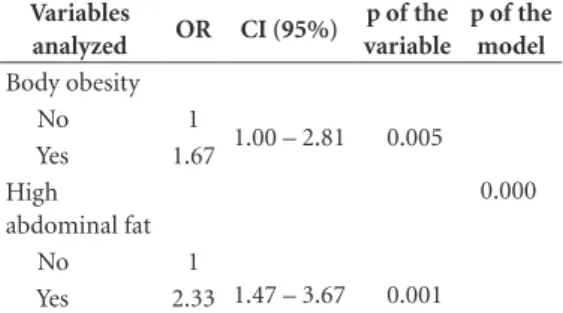
Through the logistic regression analysis, the variables that remained in the final model and demonstrated a direct and positive association with the incidence of DM were body obesity and elevated abdominal fat, being the determinant variables for the occurrence of this disease in the elderly, regardless of gender and age groups. Obese individuals and those with excess abdom-inal fat presented 1.67 and 2.33 more odds, re-spectively, of developing DM in 6 years of study (p < 0.05). No multicollinearity was observed among the studied variables (Table 3).
Discussion
The present study was developed to fill a gap in the scientific area, since, despite the existence of programs, policies, and actions aimed at the control and treatment of diabetes mellitus in the Brazilian population, results show a high inci-dence rate of DM in the Brazilian elderly
pop-ulation, in relation to developing countries18,19.
The rate, however, is similar or inferior to other
studies carried out in developed countries20,21,
according to the country development
classifi-cation proposed by the World Economic Outlook
Report22.
e C
ole
tiv
a,
23(11):3913-3922,
2018
elderly individuals identified 51 new cases of DM in 4 years of study, corresponding to 1.84/1000
person-years18. Another study carried out in
Cos-ta Rica with 7039 adult and elderly individuals found an incidence of DM of 1.62/1000
per-son-years19.
Rockwood et al.20 analyzed a cohort of 9008
elderly (≥ 65 years), from the Canadian Study
of Health and Aging (CSHA-1), and found an incidence rate of DM of 8.6/1000 person-years, in 4.6 years of study, similar to that observed in the present study. However, another study car-ried out in Germany with 6,012 adult and elderly individuals verified a high number of new cases
(401) of DM in 9 years of study21. It should be
noted that all of these studies considered the
re-Table 1. Distribution of the elderly according to the year of study, diabetes mellitus, and sociodemographic, nutritional status, clinical, and lifestyle variables. SABE Study, São Paulo-SP/Brazil.
Analyzed Variables
2000 2006
Overall (N 1467) Yes (N 72) No (N 842)
% % %
Sociodemographic Sex
Male Female
41.0 58.0
41.9 58.1
39.6 60.4 Age group
60-74 75 and over
78.5 21.5
85.7 14.3
83.2 16.8 Schooling
< 8 years
≥ 8 years
83.3 16.7
80.5 19.5
77.6 22.4 Companionship at home
Lives alone
Lives with others
13.2 86.8
15.3 84.7
12.6 87.4 Nutritional Status
Risk for body obesity Yes
No
68.2 31.8
59.2 40.8
67.7 32.3 Body obesity
No Yes
79.5 20.5
69.2 30.8
79.0 21.0 GHigh abdominal fat
No Yes
54.9 45.1
32.1 67.9
48.1 51.9 Clinical
Number of reported diseases 0-2
3 or more
39.4 60.6
28.6 71.4
43.2 56.8 Lifestyle
Intake of alcoholic beverages No
Yes
78.6 21.4
60.0 40.0
65.8 34.2 Smoker
No Yes
83.3 16.7
81.5 18.5
85.0 15.0 IIntake of meat
Yes No
91.9 8.1
91.1 8.9
92.5 7.5 Intake of FLV
Yes No
82.5 17.5
87.1 12.9
82.1 17.9
R
oe
dig
ported information of this disease, as used in the present study.
A meta-analysis study investigated the pre-dictive incidence of DM in 32 studies in adults and elderly people in many countries and found different incidence rates among the regions ana-lyzed. In the present study the new cases of DM were analyzed according to the geometric mean
by regions; it is possible to note that the incidence of DM (7.7/1000 person-years) in this study is similar to that of European countries (7.2/1000 person-years), higher than Asian countries (5.2/1,000 person-years), and below rates in the
United States (13.5/1000 person-years)23.
These results are worrying, especially in de-veloping countries such as Brazil and specifically in the elderly, who are more susceptible to health problems and, therefore, less able to address them. According to some studies, the presence of DM may decrease the quality of life and func-tional capacity for the performance of basic and instrumental activities of daily living, as well as increase the risks of clinical complications,
hos-pitalizations, and even death in this age group24.
Although no statistical differences were found between sex and age groups in the present study, the incidence rate of DM was higher in women, and in the age group 60-74, for both sexes, as in
other studies18,25. Some studies found an inverse
relationship, verifying a higher incidence of DM
in men26,27. One of the reasons that may explain
this result is that women seek medical assistance more often than men, allowing early diagnosis, in addition to hormonal changes during the menopause period, promoting the use of estro-gens and, consequently, increasing body weight and abdominal fat, factors that predispose to the
development of this disease27.
Another possible explanation for the lower
incidence of the disease in the group ≥ 75 years
may be related to survival bias, since elderly indi-viduals more vulnerable to complications of the
disease would be more likely to die prematurely28.
Lebrão and Duarte13 found that DM was the only
Table 2. Univariate analysis of the association between the incidence of diabetes mellitus and variables studied. SABE Study, São Paulo-SP/Brazil.
Variables analyzed OR CI (95%) p
Sex
Male 1
0.52 - 1. 58 0.739
Female 0.91
Age group
60-74 years 1
0.43 – 1.54 0.522
≥ 75 years 0.81
Schooling
1 1.01
0.95 – 1.08 0.582 > 8 years
≤ 8 years
Companionship at home
1 1.25
0.55 – 2.82 0.582 Lives with others
Lives alone Risk for obesity
No 1
0.89 – 2.32 0.130
Yes 1.44
Body obesity
No 1
1.00 – 2.81 0.050
Yes 1.67
High abdominal fat
1.23 – 3.11 0.005
No 1
Yes 1.96
Number of reported diseases 1
1.89 0.96 – 3.73 0.063 0 - 2
3 or more
Intake of alcoholic beverages No
Yes
1
1.18 0.68 – 2.15 0.328 Smoker
No Yes
1 1.29
0.70 – 2.32 0.403
Intake of meat No Yes
1 1.20
0.43 – 3.30 0.712
Intake of FLV No Yes
1 0.67
0.27 – 1.63 0.376
Note: SABE - Health, Welfare and Aging; OR - odds ratio; CI - confidence interval; FLV – fruits and vegetables; bold p < 0.20. Rao & Scott test22.
Table 3. Association between diabetes mellitus in 6 years of study and variables of nutritional status. SABE Study, São Paulo-SP/Brazil.
Variables
analyzed OR CI (95%)
p of the variable
p of the model Body obesity
0.000
No 1
1.00 – 2.81 0.005
Yes 1.67
High abdominal fat
1.47 – 3.67 0.001
No 1
Yes 2.33
e C
ole
tiv
a,
23(11):3913-3922,
2018
chronic disease whose frequency decreased with advancing age in elderly people in São Paulo. Ac-cording to these authors, deaths due to complica-tions of the disease may have contributed to this result.
In the present study, there were no statistical differences between sociodemographic variables and reported DM, indicating that, in this popu-lation, the incidence of the disease is not influ-enced by these variables, as evidinflu-enced by other
authors29. However, Barceló et al. found that the
occurrence of diabetes mellitus (15.7%) was pos-itively associated with low levels of education (0
to 6 years of schooling)30.
It has been verified that the risk for obesi-ty was not associated with DM, similar to
oth-er studies poth-erformed29,30. These results indicate
that being over the appropriate weight for height does not constitute a risk for the development of DM in the elderly, despite being a condition predisposing to the occurrence of the disease in
adults31. Differently, in the present study it was
found that obese elderly individuals were more likely to develop DM. This evidence confirms the hypothesis that there are differences in the impact of nutritional status and development of chronic diseases among adult and elderly indi-viduals, yet it is still a poorly studied area, lacking conclusive results and requiring more research to investigate this relationship.
A longitudinal study conducted in Barba-dos-Caribbean with obese individuals aged 40 to 84 years, using reported information on DM, as in this study, found a positive and significant as-sociation between DM and obesity (4th quartile,
when BMI ≥ 29.8 kg/m2), and the risk of
devel-oping DM in nine years of study was 3.7 times
higher for obese individuals32. Although, in
Bra-zil, there are no studies of this nature
investigat-ing this relationship, Passos et al.29 evaluated the
elderly from the Bambuí Project (Health and Ag-ing Study) in Minas Gerais and verified that the prevalence of DM may be associated with obesity
(≥ 30 kg/m2).
In the present study it was observed that ab-dominal fat is a variable that contributes to the increase in the number of DM cases in the elder-ly, being the variable that presented the greatest risk for the development of this disease in 6 years of study, in the same way as has also been ob-served in adult individuals, thus representing a common determinant between both population
groups18,23. A longitudinal study performed with
individuals 25 to 74 years old from Jamaica using reported information on DM, as in the present
study, verified that elderly individuals with excess abdominal fat presented a higher risk for the
de-velopment of DM18.
Few studies have performed this analysis
with the elderly. Srikanthan et al.33, who
evalu-ated a cohort of elderly people participating in The MacArthur Successful Aging Study, found that the development of DM occurs specifically in subjects with excess fat in the abdominal region, regardless of gender and age group, as found in the present study. To date, there are no longitu-dinal studies with Brazilian elderly which present this information, highlighting the importance of the present study as, probably, the first Brazilian study to investigate factors that determine the de-velopment of DM in this age group.
One of the methodological limitations of the present study is the fact that the estimates of in-cidence of DM are based on reported data related to the time of disease development. It is possible that the data on the incidence of DM may be un-derestimated as it may not have been self-report-ed, even when present. On the other hand, the re-ported information on DM, without clinical tests to prove the diagnosis of the disease, is valid and
can be used, as already verified by other authors34.
Another limitation refers to loss of follow-up and lack of knowledge of when data were cen-sored, which may interfere with the estimation of the incidence rate. In addition, it is not possible to establish if there were changes over time, re-garding the explanatory variables, since the data of the participants were only obtained at two moments (2000 and 2006). Differences in age, schooling, ethnicity, research design, and BMI and WC reference values are also highlighted, which may interfere in the comparison between studies and make it difficult to identify the real effect of these indicators on the incidence of DM. However, considering the significant inci-dence of DM and its negative effects, and given the paucity of information on this condition and associated determinants in the elderly in Bra-zil, this study makes a relevant contribution to broadening the understanding of DM in this age group and the formulation of future studies to reduce the occurrence of DM in the population.
R
oe
dig implemented in care protocols for the elderly, in
different areas of attention, considering that, in the future, this population group will constitute the Brazilian epidemiological scenario.
Conclusion
Based on the considerations presented, it was possible to verify that the variables body obesi-ty and abdominal fat contributed to the devel-opment of DM in the elderly. This information is valid and deserves attention from researchers and professionals in the area, in order to stimu-late discussions on whether the strategies imple-mented contemplate the determinants analyzed and if these strategies are effective and efficient to avoid the development of DM.
Collaborations
MA Roediger proposed this work, and carried out organization and analysis of the data and writing of the manuscript. MFN Marucci, LA Gobbo, DAQS Dourado, JLF Santos participated in the analysis and interpretation of results, and revision and final approval of the manuscript. YAO Duarte and ML Lebrão participated in the revision and approval of the final version of the manuscript.
Acknowledgments
e C
ole
tiv
a,
23(11):3913-3922,
2018
References
1. Campolina AG, Dini OS, Ciconelli RM. Impacto da doença crônica na qualidade de vida de idosos da co-munidade em São Paulo (SP, Brasil). Cien Saude Colet
2011; 16(6):2919-2925.
2. Centers for Disease Control and Prevention (CDC).
The State of Aging & Health in America 2013. Atlanta: National Center for Chronic Disease Prevention and Health Promotion, Division of Population Health; 2013.
3. Instituto Brasileiro de Geografia e Estatística (IBGE).
Estudos e Pesquisas, Informações Demográficas e Socio-econômicas, n°.27. Síntese de Indicadores Sociais: uma análise das condições de vida da população brasileira. Rio de Janeiro: IBGE; 2010.
4. Biggs ML, Mukamal KJ, Luchsinger JA, Ix JH, Carne-thon MR, Newman AB, de Boer IH, Strotmeyer ES, Mozaffarian D, Siscovick DS. Association Between Adi-posity in Midlife and Older Age and Risk of Diabetes in Older Adults. JAMA 2010; 303(24):2504-2512. 5. Wild S, Roglic G, Green A, Sicree R, King H. Global
prevalence of diabetes: estimates for the year 2000 and projections for 2030. Diabetes Care 2004; 27(5):1047-1053.
6. Brasil. Ministério da Saúde (MS). Vigitel Brasil 2010: Vigilância de fatores de risco e proteção para doenças crô-nicas por inquérito telefônico. Brasília: MS; 2011. 7. Qin X, Li J, Zhang Y, Ma W, Fan F, Wang B, Xing H,
Tang G, Wang X, Xu X, Xu X, Huo Y. Prevalence and Associated Factors of Diabetes and Impaired Fasting Glucose in Chinese Hypertensive Adults Aged 45 to 75 Years. Plos one 2012; 7(8):1-8.
8. Tanaka T, Gjonça E, Gulliford MC. Income, wealth and risk of diabetes among older adults: cohort study using the English longitudinal study of ageing. Eur J Public
Health 2011; 22(3):310-317.
9. Chen R, Song Y, Hu Z, Brunner EJ. Predictors of Dia-betes in Older People in Urban China. Plos one 2012; 7(11):1-11.
10. Neeland IJ, Turer AT, Ayers CR, Powell-Wiley TM, Vega GL, Farzaneh-Far R, Grundy SM, Khera A, McGuire DK, Lemos JA. Dysfunctional adiposity and the risk of prediabetes and type 2 diabetes in obese adults. JAMA
2012, 308(11):1150-1159.
11. Dorner B, Friedrich EK, Posthauer ME. Practice paper of the American Dietetic Association: Individualized nutrition approaches for older adults in health care communities. J Am Diet Assoc 2010; 110(10):1554-1563.
12. Silva RCP, Simões MJS, Leite AA. Fatores de risco para doenças cardiovasculares em idosos com diabe-tes mellitus tipo 2. Rev Ciênc Farm Básica Apl 2007; 28(1):113-121.
13. Lebrão ML, Laurenti R. Saúde, bem-estar e envelheci-mento: o estudo SABE no Município de São Paulo. Rev.
Bras Epidemiol 2005; 2(8):127-141.
14. Lebrão ML, Duarte YAO. Desafios de um estudo longitudinal: o Projeto SABE. Saúde Coletiva 2008; 5(24):166-167.
15. Organização Pan-Americana da Saúde (OPAS). XXXVI Reunión Del Comitê Asesor de Investgaciones em Salud – Encuesta Multicêntrica – Salud Belnestar y de Enveje-cimiento (SABE) em América Latina e ela Caribe –
In-forme preliminar. Brasília: OPAS; 2001.
16. World Health Organization (WHO). Obesity: prevent-ing and managprevent-ing the global epidemic. Report of a WHO
Consultation. Geneva: WHO; 2000. [WHO Technical
Report Series 894].
17. Frisancho RA. Anthropometric Standards fort the
Assess-ment of Growth and Nutritional Status. Ann Arbor: The
University of Michigan Press, 1990.
18. Sargeant LA, Bennett FI, Forrester TE, Cooper RS, Wilks RJ. Predicting Incident Diabetes in Jamaica: The Role of Anthropometry. Obesity Res 2002; 10(8):792-798.
19. Laclé-Murray A, Valero-Juan LF. Incidencia de diabetes tipo 2 en un área urbano marginal de Costa Rica. AMC
2008; 50(1):29-34.
20. Rockwood K, Awalt E, MacKnigh C, McDowell I. In-cidence and outcomes of diabetes mellitus in elderly people: report from the Canadian Study of Health and Aging. CMAJ 2000; 162(6):769-772.
21. Meisinger C, Döring A, Thorand B, Heier M, Löwel H. Body fat distribution and risk of type 2 diabetes in the general population: are there differences between men and women? The MONICA/KORA Augsburg Cohort Study. Am J Clin Nutr 2006; 84(3):483-489.
22. World Economic Outlook (International Monetary Fund). World economic outlook: a survey by the staff of
the International Monetary Fund. Washington:
Interna-tional Monetary Fund; 2014.
23. Vazquez G, Duval S, Jacobs DR, Silventoinen K. Com-parison of Body Mass Index, Waist Circumference, and Waist/Hip Ratio in Predicting Incident Diabetes: A Me-ta-Analysis. Epidemiol Rev 2007; 29(1):115-128. 24. Sinclair A, Morley J, Rodriguez-Mañas L, Paolisso G,
Bayer T, Zeyfang A, Bourdel-Marchasson I, Vischer U, Woo J, Chapman I, Dunning T, Meneilly G, Ro-driguez-Saldana J, Gutierrez Robledo LM, Cukier-man-Yaffe T, Gadsby R, Schernthaner G, Lorig K. Di-abetes Mellitus in Older People: Position Statement on behalf of the International Association of Gerontology and Geriatrics (IAGG), the European Diabetes Work-ing Party for Older People (EDWPOP), and the Inter-national Task Force of Experts in Diabetes. J Am Med
Dir Assoc 2012; 13(6):497-502.
25. González-Villalpando C, Dávila-Cervantes CA, Zamo-ra-Macorra M, Trejo-Valdivia B, González-Villalpando ME. Incidence of type 2 diabetes in Mexico: Results of The Mexico City Diabetes Study after 18 years of fol-low-up. Salud pública Méx 2014; 56(1):11-17. 26. Sánchez Martínez M, Blanco A, Castell MV, Gutiérrez
Misis A, González Montalvo JI, Zunzunegui MV, Otero Á. Diabetes in older people: Prevalence, incidence and its association with medium- and long-term mortality from all causes. Aten Primaria 2014; 46(7):376-384. 27. McBean AM, Li S, Gilbertson DT, Collins AJ.
Differ-ences in diabetes prevalence, incidence, and mortality among the elderly of four racial/ethnic groups: whites, blacks, hispanics, and asians. Diabetes Care 2004; 27(10):2317-2324.
R
oe
dig 29. Passos VMA, Barreto SM, Dniz LM, Lima-Costa MF.
Type 2 diabetes: prevalence and associated factors in a Brazilian community – the Bambuí Health and Aging Study. Med J 2005; 123(2):66-71.
30. Barceló A, Gregg EW, Valero MP, Robles SC. Waist cir-cunference, BMI and the prevalence of self-reported diabetes among the elderly of the United States and sxi cities of Latin America and the Caribean. Diab Res Cli
Pract 2007; 78(3):418-427.
31. Wald NJ, Bestwick JP, Morris JK. Body weight reduc-tion to avoid the excess risk of type 2 diabetes. Br J Gen
Pract 2012; 62(599):411-414.
32. Nemesure B, Wu SY, Hennis A, Leske MC. The Rela-tionship of Body Mass Index and Waist-Hip Ratio on the 9-Year Incidence of Diabetes and Hypertension in a Predominantly African-Origin Population. Annals of
Epidemiology 2008; 18(8):657-663.
33. Srikanthan P, Seeman TE, Karlamangla AS. Waist-Hip-Ratio as a Predictor of All-Cause Mortality in High-Functioning Older Adults. Ann Epidemiol 2009; 19(10):724-731.
34. Lima-Costa MF, Peixoto SV, Firmo JOA, Uchoa E. Va-lidade do diabetes auto-referido e seus determinantes: evidências do projeto Bambuí. Rev Saude Publica 2007; 41(6):947-953.
Article submitted 30/05/2015 Approved 22/11/2016
Final version submitted 24/11/2016
This is an Open Access article distributed under the terms of the Creative Commons Attribution License