“SURGERIOUS TWEEZERS”: EXPLORING DOCTORS’
PERCEPTION!
By Tiago Filipe Rodrigues Fonseca, Gonçalo Jorge Morais
Costa and Nuno Sotero Alves Silva
Abstract
Serious games are a key component within technological mashups that characterise future learning environments, namely in medicine. Recent empirical studies denote ambiguous results about their role or influence in education or training; however, this paper explores Portuguese doctors’ awareness regarding serious games, their advantages/disadvantages within training and probable ethical impacts in their medical practices through a qualitative interview. The reason for this contribution is literature disregard pertaining to medical staff awareness, because its current focus entails: games applications, features or design; medical practices for clinical decision making; surgical techniques; acquiring knowledge/skills; and, limitations in the prior dimensions.
Keywords
Serious games, medicine, doctors awareness, qualitative analysis
Introduction
Serious games can be deemed as a novel opportunity for education or training; so, to neglect them is a remarkable mistake (Swertz, 2009) which some European Union positive actions demonstrate (Felicia, 2009). In spite of their importance to education, some authors continue to be sceptical about their role in medicine (Congdon, 2010). Serious medical games literature focuses its attention upon the following dimensions: specific games application, as for instance knee replacement surgery or laparoscopic interventions (e.g., Verdaasdonk et al., 2009); medical practices concerning clinical decision making (Alhadeff, 2009) or surgical techniques (Kullman, 2008); acquiring knowledge and skills (Lewis, 2007); game assessment, specifically technical features (Marks, Windsor and Wünsche, 2007) or design (Cabas Vidani and Chittaro, 2009). Hitherto, literature neglects doctors’ awareness and acceptance pertaining to serious games. In fact, the authors find out a single study about medical staff acceptance (Cabas Vidani, Chittaro and Carchietti, 2010). Against this backdrop, this contribution debates Portuguese doctors’ awareness regarding serious games through a qualitative interview because it may peril these technologies acceptance.
Serious Games
Definition
Serious games literature acknowledges a lack of consensus concerning its definition, as the following examples illustrate:
2. games that move from entertainment per se to learning in its broadest sense (Stone, 2008);
3. a mental contest mediated through ICT with specific rules to promote governmental or corporate training (Zyda, 2005).
Serious games can be classified into (Năhlinder and Oskarsson, 2007): (i)
advergaming, product advertisement; (ii) edutainment, educate and amuse; (iii) games-base learning, learning outcomes; (iv) diverted, political or geopolitical issues;
(v) simulation, simulate an aspect of reality; (vi) persuasive, promote behavioural changes; (vii) organisational, teach and reflect about organisational dynamics; (viii)
educational, primary and secondary education. Thus, these are key components
within technological mashups that characterise future learning environments.
Medical applications
The development of medical serious applications denotes an unbelievable pace, as for instance: Orthopaedic Patient Education 1.0, iMedic, or Pulse. In spite of acknowledging diverse medical specialties, their common features permit: (i) three dimensional (3D) imaging; (ii) create medical scenarios and change their settings; (ii) import/export results, simulations or reports from/to other learning environments; (iv) access/deliver results comparison to international databases; (v) import data from healthcare databases (patients data).
Orthopaedic Patient Education 1.0
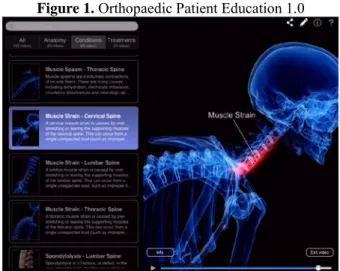
3D 4 Medical (2013) is “an animation based patient education app for healthcare professionals to effectively communicate orthopaedic anatomy, conditions and treatments”. In addition, doctors can use the tablet or smartphone pen to: (i) highlight and include annotations for future practices or inform their patients; (ii) simulate the tweezers procedures in surgery.
Figure 1. Orthopaedic Patient Education 1.0
Source: 3D 4 Medical (2013) iMedic
iMedic is a virtual reality game to view human anatomy, i.e., “the program created a 3D X-ray that allow doctors to examine the body from every angle” (Wan, 2010). This author also refers that: (i) iMedic allows medical staff to expand, shrink or rotate
the 3D image by doing hand movements that eyeglasses recognise; (ii) through some commands (similar to pincers) users can simulate surgical procedures.
Figure 2. iMedic
Source: Wan (2010) Pulse
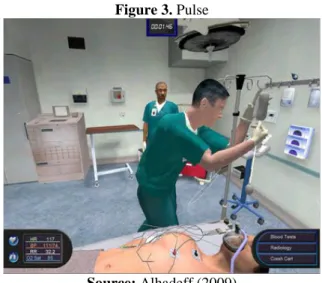
Pulse explores complex medical practices in diagnosis illnesses and emergency services through a virtual learning environment, so the aim to improve decision making and diagnostic protocol (Alhadeff, 2009). Some examples of this game features are (i) medical history; (ii) physiological response to drug treatment; (iii) use of complex medical systems; (iv) surgical procedures.
Figure 3. Pulse
Source: Alhadeff (2009)
“Surgerious tweezers”: Forwards or sideways?
Why “surgerious tweezers”: Forwards or sideways?
To recognise medical serious games overlaps, i.e., doctors’ future tweezers as a result of training through virtual objects manipulation using heptic devices. Therefore, the authors acknowledge a two dimensional analysis: (i) the meaning of “surgerious tweezers”; (ii) if serious games are the “ultimate” learning tool or just another
learning tool (educational and ethical challenges)? Considering that tweezers are
hands physiological limitations; the expression “surgerious tweezers”, symbolises doctors’ usage of an old-fashioned instrument (tweezers) through a novel technology (serious games) which promotes educational and ethical challenges.
Challenges
Werkhoven and van Erp (2007) advocate valid content and intuitive interfaces, as serious games educational challenges. Valid content embraces the contextual environment realism, as well as the need to people experience causal and non-causal relations; and, intuitive interfaces facilitate creative and educational processes. However, is impossible to neglect pedagogy and learning outcomes... Gunter, Kenny and Vick (2008) argue that educational content within a game does not presume educational goals achievement, so pedagogy has been changing throughout games generations: (i) first generation, behaviourism and cognitivism; (ii) second generation, constructivism is added; (iii) third generation, all theories. In spite of these improvements learning assessment continues to be difficult, even when non-traditional assessment techniques are explored (e.g., Shute et al., 2011). And to expect serious games alone may change learners’ behaviours is a wishful thinking (Shegog, 2010), because behavioural determinants include motivation, social environment, etc. These assumptions reveal at some extent why serious games usage in education is short, although lecturers’ acceptance or knowledge about it is another constraint. Swertz (2009) stresses two challenges regarding serious games introduction in learning environments: responsibility and power. Content responsibility moves from the lecturer to game designer (educational challenge), which in specific contexts has alarming effects (e.g., military context). Simultaneously, this role transfer undermines lecturers’ power position, which may explain their non-acceptance regarding serious games (ethical dilemma). Another ethical quandary involves patient privacy and confidential medical data, since serious games import data from healthcare databases.
Research design
Aims and objectives
The key research question endeavours to comprehend about Portuguese doctors’ awareness concerning serious games, as well as, understand these games impact over their work and ethical practices.
Methodology Research methods
Qualitative research explores social and cultural facts (Yin, 2009), as well as the researcher investigates a small amount of cases, numerous variables through text or simple numerical analyses. Interpretive research aims to understand “the context of the information system, and the process whereby the information system influences and is influenced by its context” (Walsham, 2011, pp. 9) rather than figures and percentages. A non-experimental qualitative survey serves as a research method, which is typical in qualitative inquiry within medical contexts (Clamp, Gough and Land, 2004).
Data collection and analysis
The authors promote personal interviews or face-to-face surveys, since these are appropriate for probe respondents’ opinions and observe individual or group behaviour (Sincero, 2012). Qualitative content analysis, despite its non-homogenous understanding procedure, has a long tradition in text analysis (Titscher et al., 2000) which validates the authors’ choice. After codifying, i.e., “the process of transforming raw data into a standardized form” (Babbie, 2001, pp. 309), the researcher endeavours to create codifications. This process involves seven analytical procedures (Mayring, 2003): proper communication model (empirical results); systematic and rule-based analysis (content units); interpretive categories reviewed through feedback loops (first and second analytical reviews); refer the subject instead of technique (open-code structure); instruments verification (pilot analysis); theory-guided analysis (serious games literature); inclusion of quantitative steps of analysis (number of codes); trustworthiness (authors procedures). The open-code structure is ID answer_ID medical staff_content analysis expresses (e.g., Q3_D1_one learning tool- mashup). Note that in order to avoid lost of sensitive meanings interviews translation is not an option.
Interview protocol
Design and interview guide
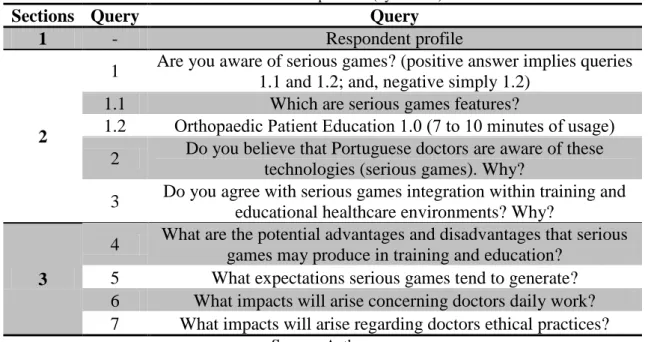
The interview survey has three sections:
• section 1 (profile)- recognises the respondents profile, namely as regards to gender, age, years of professional practice, and medical specialty;
• section 2 (background)- comprehends doctors’ awareness regarding serious games concept and their characteristics;
• section 3 (analysis)- explores serious games advantages/disadvantages to medical education, as well as their trends (practices and ethical impacts). The next step is to expose the English version of the interview protocol (by section), which table 1 illustrates.
Table 1. Interview protocol (by section)
Sections Query Query
1 - Respondent profile
2
1 Are you aware of serious games? (positive answer implies queries 1.1 and 1.2; and, negative simply 1.2)
1.1 Which are serious games features?
1.2 Orthopaedic Patient Education 1.0 (7 to 10 minutes of usage) 2 Do you believe that Portuguese doctors are aware of these
technologies (serious games). Why?
3 Do you agree with serious games integration within training and educational healthcare environments? Why?
3
4 What are the potential advantages and disadvantages that serious games may produce in training and education?
5 What expectations serious games tend to generate? 6 What impacts will arise concerning doctors daily work? 7 What impacts will arise regarding doctors ethical practices?
The introduction of Orthopaedic Patient Education usage during the interview enables a behavioural analysis, as well as minimises the potential respondents’ bias (none awareness) pertaining to serious games characteristics.
Diagnosis
Yin (2009) suggests that surveys (interviews or questionnaires) assume several perils, so it is fundamental to conduct a diagnosis (pilot procedure). McNamara (2009) argues that contextual circumstances (interview environment), participant/interviewer personal characteristics, and type of interview may constraint empirical results quality. Thus, this author recommends eight principles to prepare an interview: (i) choose an environment with minor interruptions (medical learners- researcher office; doctors- office prior to consultations); (ii) explain the purpose of the interview (aims/objectives); (iv) explain the interview format (types of queries and game usage); (v) indicate interview average time (40-45 minutes); (vi) further contact with the researcher (respondents have the researchers contacts); (vii) ask for doubts before the interview (initial query); (viii) bear in mind to prepare answers recording or taking notes (interviews have been recorded). As a final note, the parenthesis exhibit authors’ actions regarding the pilot studies, as well as the interviews.
Table 2. Respondents profile (pilot studies)
Respondent Gender Age Medical specialty
L1 Female 22 Orthopaedics
L2 Male 21 Palliative Medicine
Source:Authors
The absence of professional practice is not a decisive constraint, as well as in contemporary medicine courses (Bologna Process) students’ initial decision about the medical specialty is in 3rd year. Moreover, the pilot interviews enable an equal gender representation.
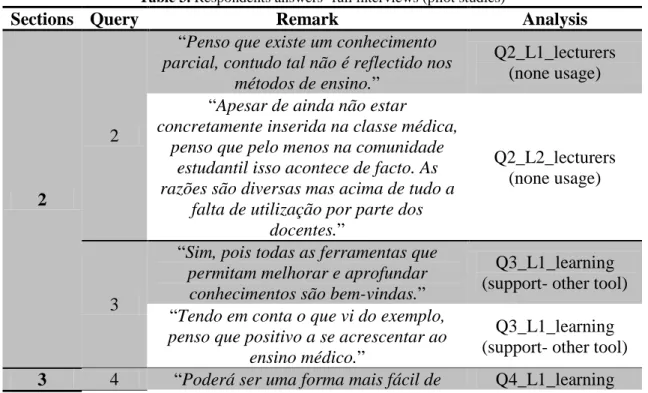
Table 3. Respondents answers- full interviews (pilot studies)
Sections Query Remark Analysis
2
2
“Penso que existe um conhecimento
parcial, contudo tal não é reflectido nos métodos de ensino.”
Q2_L1_lecturers (none usage) “Apesar de ainda não estar
concretamente inserida na classe médica, penso que pelo menos na comunidade
estudantil isso acontece de facto. As razões são diversas mas acima de tudo a
falta de utilização por parte dos docentes.”
Q2_L2_lecturers (none usage)
3
“Sim, pois todas as ferramentas que
permitam melhorar e aprofundar conhecimentos são bem-vindas.”
Q3_L1_learning (support- other tool) “Tendo em conta o que vi do exemplo,
penso que positivo a se acrescentar ao ensino médico.”
Q3_L1_learning (support- other tool)
adquirir conhecimentos, ao estimular a interactividade.”
environment (interactivity) “Sim, tendo em conta o ambiente
tridimensional, as funções de simulação e importação de dados poderão facilitar e
muito a aprendizagem.”
Q4_L1_features (serious games)
5
“Acima de tudo realismo.” Q5_L1_realism (context) “Que consiga reproduzir os contextos
médicos (problemas e soluções), mas também o nível de stress associado a questões críticas (exemplo cirurgia
complexa).” Q5_L1_realism (context); Q5_L1_realism (stress) 6
“Penso que nos ajudará a tomar decisões
mais rápidas e de melhor qualidade. Ainda assim, sem experimentar é difícil
dizer.”
Q6_L1_decision making (better) “Não consigo responder, pois nunca
havia utilizado os jogos sérios.” -
7
“Sim, porque as competências sociais e
emocionais do médico podem ser diminuídas se a relação pessoal no
ensino for minimizada.”
Q7_L1_doctors skills (social/emotional) “Penso que terá claramente muitas
implicações, como por exemplo: privacidade e segurança. A meu ver obrigará necessariamente a uma revisão
do código deontológico no sentido de se adaptar aos novos desafios do futuro.”
Q7_L2_privacy; Q7_S2_security; Q7_S2_deontological
code (revision)
Source:Authors
Respondents are ignorant about the topic and denote lecturers’ non usage. After exploring the demo learners feel that is another important to help medical training (obtain better decisions) due its intrinsic features. Even so, respondents’ answers reveal the need for contextual realism as for instance stress levels. As regards to serious games impacts their focus is ethical issues like privacy or security.
Empirical findings
Section 1
In this case, interviews respondents, have a similar equal gender representation. Age varies from 32 to 51, i.e., three different age groups (30-40, 41-50, above 50). Each age group has two elements with similar ages despite different gender, so a quite representative sample. Medical specialties are completely unlike (contexts and challenges), which enriches the analysis.
Table 4. Respondents profile (final interviews) Respondent Gender Age Years of professional
experience Medical specialty
D1 Female 32 8 General Practice
D2 Male 44 20 Military Medicine
D3 Male 32 6 Emergency Medicine
D4 Male 51 24 Orthopaedics
D5 Female 41 16 Internal Medicine
Source:Authors
Section 2
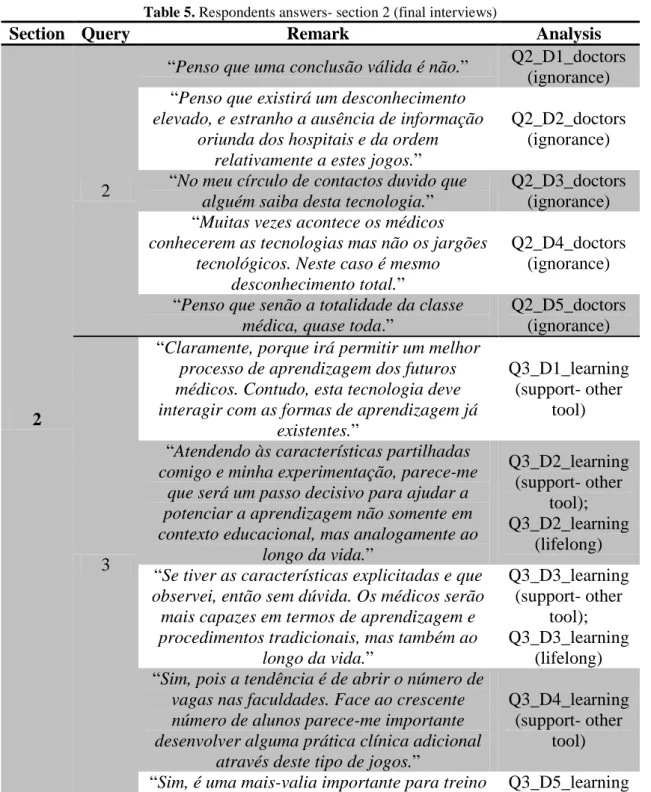
Table 5. Respondents answers- section 2 (final interviews)
Section Query Remark Analysis
2
2
“Penso que uma conclusão válida é não.” Q2_D1_doctors (ignorance) “Penso que existirá um desconhecimento
elevado, e estranho a ausência de informação oriunda dos hospitais e da ordem
relativamente a estes jogos.”
Q2_D2_doctors (ignorance) “No meu círculo de contactos duvido que
alguém saiba desta tecnologia.”
Q2_D3_doctors (ignorance) “Muitas vezes acontece os médicos
conhecerem as tecnologias mas não os jargões tecnológicos. Neste caso é mesmo
desconhecimento total.”
Q2_D4_doctors (ignorance) “Penso que senão a totalidade da classe
médica, quase toda.”
Q2_D5_doctors (ignorance)
3
“Claramente, porque irá permitir um melhor
processo de aprendizagem dos futuros médicos. Contudo, esta tecnologia deve interagir com as formas de aprendizagem já
existentes.”
Q3_D1_learning (support- other
tool) “Atendendo às características partilhadas
comigo e minha experimentação, parece-me que será um passo decisivo para ajudar a potenciar a aprendizagem não somente em contexto educacional, mas analogamente ao
longo da vida.” Q3_D2_learning (support- other tool); Q3_D2_learning (lifelong) “Se tiver as características explicitadas e que
observei, então sem dúvida. Os médicos serão mais capazes em termos de aprendizagem e procedimentos tradicionais, mas também ao
longo da vida.” Q3_D3_learning (support- other tool); Q3_D3_learning (lifelong) “Sim, pois a tendência é de abrir o número de
vagas nas faculdades. Face ao crescente número de alunos parece-me importante desenvolver alguma prática clínica adicional
através deste tipo de jogos.”
Q3_D4_learning (support- other
tool) “Sim, é uma mais-valia importante para treino Q3_D5_learning
dos formandos para o aperfeiçoamento da destreza dos já formados.”
(support- other tool); Q3_D5_learning
(lifelong)
Source:Authors
Remarkably all respondents are completely unaware of serious games! Interviewee 2 refers that the “Medical Association” and hospitals do not inform about the topic, which respondent 4 opinion validates since he is a regional board member. Pertaining to serious games appliance in medical training all respondents are in favour, namely as another tool that promotes lifelong learning.
Section 3
Table 6. Respondents answers- section 3 (final interviews)
Section Query Remark Analysis
3
4
“Facilitar a aprendizagem, validação
contínua de procedimentos; “sensibilidade” do sistema face aos
instrumentos reais.”
Q4_D1_learning tool; Q4_D1_realism
(requirement) “Facilitar a aprendizagem na educação e
on-the-job; necessidade absoluta de realismo gráfico e de resposta face à
realidade do corpo humano.”
Q4_D2_learning tool; Q4_D2_realism
(requirement) “Melhoria da aprendizagem; percepção
errónea dos limites do corpo humano caso os sistemas não sejam reais; pluralidade
de áreas médicas deve ser um constrangimento.”
Q4_D3_learning tool; Q4_D3_realism
(requirement) “Treino contínuo e criação de cenários
menos prováveis; não sabemos a textura e relevo do corpo humano o que faz diferença em contexto cirúrgico.”
Q4_D4_learning tool; Q4_D4_realism
(requirement) “É um jogo; capacidade de treinar sem
que o paciente sofra.” Q4_D_learning tool
5
“Reprodução fiel da realidade. É
importante que os diferentes cenários guardem os resultados para que o médico
monitorize a sua evolução; é um jogo e a resposta fisiológica é sempre díspar.”
Q5_D1_realism (context); Q5_D1_features
(serious games) “A capacidade de gerar diferentes desafios
que permitem ao médico testar os seus procedimentos.”
Q5_D2_features (serious games) “Enquanto componente de apoio ao
processo de aprendizagem dos médicos.” Q5_D3_learning tool
“Utilização no ensino para treino dos
médicos em início de carreira.” Q5_D4_learning tool
“Base científica viável relativamente à
anatomia humana para que cumpra a função didática.”
6
“Melhor preparação implica decisões
mais rápidas e de melhor qualidade.”
Q6_D1_decision making (better) “Teoricamente ajudará o clínico a ter
decisões mais rápidas.”
Q6_D2_decision making (better) “Em termos práticos penso que não irá
gerar influência directa.” Q6_D3_no influence
“Á partida ajudará a melhorar a tomada
de decisão dos médicos.”
Q6_D4_decision making (better) “Irá promover uma maior rotina dos
médicos, logo maior rapidez de decisão.”
Q6_D5_decision making (better)
7
“Como supostamente irão apenas servir
intentos de formação ou de melhoria de performance não têm dilemas éticos.”
Q7_D1_ethical dilemmas (none) “Estes não implicarão dilemas
deontológicos, pois são apenas uma componente da formação.”
Q7_D2_ethical dilemmas (none) “À partida não haverá, pois se o médico
falhar na vida real não poderá culpabilizar os criadores dos jogos.”
Q7_D3_ethical dilemmas (none) “Não me sinto à vontade para responder,
mas provavelmente irá induzir alterações no código deontológico.”
Q7_S2_deontological code (revision) “Difícil de prever, mas não será um tema
fracturante.”
Q7_D5_ethical dilemmas (none)
Source:Authors
All doctors stress the importance of serious games as a learning tool (improve decision making), although focused realism as an essential requirement. This explains doctors’ resistance to use serious games beyond training, since the expression “is only a game” is quite common. The lack of knowledge clearly influences doctors’ ethical dilemmas understanding (moral sensitivity), since: only respondent 4 feels that the deontological code needs a revision; and, interviewee 3 neglects game designers responsibility.
Limitations
A trustworthy qualitative research emerges from an effort to realise meaning or validity about data collection (Huxham and Vangen, 2003). In fact, literature encompasses four quality standards: (i) credibility, results’ accuracy through member checking; (ii) transferability, “thick description”; (iii) dependability, record the research process and documentation; (iv) conformability, data audit. Therefore, the authors’ strategies reveal an extremely positive retort in understanding doctors’ opinions or beliefs, i.e.:
1. the systematic approach that merges interpretative flexibility, interview design/preparation and content analysis is rigorous in spite of potential subjectivity;
2. and, the empirical results denote interesting insights as regards to the paper aims/objectives.
At last, two probable critics may arise due to a restrict analysis: the number of interviews (5 or 7 including the pilot studies), and why not another type of survey (e.g., questionnaire with open queries). Borges-Costa et al. (2006) illustrate a non-response rate above 85% for Portuguese doctors’ within a hospital context and in studies conducted by medical staff/hospital administration. The prior assumption clearly validates personal interviews as a key data collection procedure.
Conclusion
In spite of the nature of this research, it exhibits significant findings: (i) doctors’ unawareness about serious games and their ethical dilemmas; (ii) which learners’ recognise and recent literature continues to ignore (Bredl and Bösche, 2013). A probable explanation for this discrepancy is that learners are digital natives; (iii) both groups acknowledge serious games as another learning tool, but indicate contextual realism as vital. Future studies are essential to promote a better understanding, as for instance concerning the code Q7_L1_doctors skills (social/emotional).
Acknowledgments
For financial assistance pertaining ETHICOMP 2013, the second co-author gratefully recognises Autónoma University of Lisbon.
References
3D 4 Medical (2013), Orthopaedic Patient Education 1.0, 3D 4 Medical, online at
http://applications.3d4medical.com/orthopedic_education#ss, accessed 05.03.2013.
Alhadeff, E. (2009), Serious games futuring medical training in France, Serious Games Market, online at http://seriousgamesmarket.blogspot.com/2009/11/serious-games-futuring-medical-training.html, accessed 01.03.2013.
Annetta, L. (2010), The “I’s” have it: A framework for serious educational game design, Review of General Psychology, 14, 2, 105-112.
Babbie, E. (2001), The practice of social research, 9th ed, Wadsworth, Belmont. Borges-Costa, S. et al. (2006), Evaluation of a virtual electronic patient record use by the medical doctors working at a hospital, Wiki de Ciência e Tecnologia em Saúde, online at
http://mimwiki.med.up.pt/images/5/53/Evaluation_of_a_Virtual_Electronic_Patient_
Record_use_by_the_medical_doctors_working_at_a_hospital.pdf, accessed
05.03.2013.
Bredl, K. and Bösche, W. (eds) (2013), Serious games and virtual worlds in education, professional development and education, IGI Global, Hershey, PA.
Cabas Vidani, A. and Chittaro, L. (2009), Using a task modelling formalism in the design of serious games for emergency medical procedures, in Proceedings of IEEE 1st International Conference on Games and Virtual Worlds for Serious Applications, IEEE Computer Society Press, Los Alamitos, CA, 95-102.
Cabas Vidani, A., Chittaro, L. and Carchietti, E. (2010), Assessing nurses’ acceptance of a serious game for emergency medical services, in Debattista, K. et al. (eds), Proceedings of 2sd International Conference on Games and Virtual Worlds for Serious Applications, IEEE Computer Society Press, Los Alamitos, CA, 101-108.
Clamp, C. G. L., Gough, S. and Land, L. (2004), Resources for nursing research, 4th ed, Sage Publications, London.
Congdon, K. (2010), Can video games play a serious role in medicine, Health Care Technology, online at
http://www.healthcaretechnologyonline.com/article.mvc/Video-Games-Play-A-Serious-Role-In-Medicine-0001, accessed 01.03.2013.
Felicia, P. (2009), Digital games in schools, European Schoolnet, Brussels. Gunter, G. A., Kenny, R. F. and Vick, E. H. (2008), Taking educational games seriously: Using the retain model to design endogenous fantasy into standalone educational games, Educational Technology Research and Development, 56, 5/6, 511-537.
Huxham, C. and Vangen, S. (2003), Researching organisational practice through action research, Organizational Research Methods, 6, 3, 383-403.
Kullman, J. (2008), “Wii” bit of technology aids medical technology, Arizona State University, online at http://asunews.asu.edu/20080222_wiistudy, accessed 02.03.2013. Lewis, M. (2007), Analysis of the roles of “serious games” in helping teach health-related knowledge and skills and in changing behaviour, Journal of Diabetes Science and Technology, 1, 6, 918-920.
Marks, S., Windsor, J. and Wünsche, B. (2007), Evaluation of game objectives for simulated surgical training, in Proceedings of 5th International Conference on Computer Graphics and Interactive Techniques in Australia and Southeast Asia Serious, ACM, New York, NY, 273-280.
Mayring, P. (2003), Qualitative inhaltsanalyse, grundlagen und techniken, 8th ed, Beltz, Weinheim (in German).
McNamara, C. (2009), Guidelines for conducting research interviews, Free Management Library, online at
http://managementhelp.org/businessresearch/interviews.htm, accessed 05.03.2013.
Năhlinder, S. and Oskarsson, P-A. (2007), Learning from computer games, Defence Research Agency, Linköping.
Shegog, R. (2010), Application of behavioural theory in computer game design for health behaviour change, in Cannon-Bowers, J. and Bowers, C. (ed), Serious Game Design and Development: Technologies for Learning and Training, IGI Global, Hershey, PA, 196-232.
Shut, V. J. et al. (2011), Modelling, assessing, and supporting key competencies within game environments, in Ifenthaler, D., Pirnay-Dummer, P and Seel, N. M. (eds), Computer-Based Diagnostic and Systematic Analysis of Knowledge, Springer, New York, NY, 281-309.
Sincero, S. M. (2012), Personal survey interview, Explorable, online at
http://explorable.com/personal-interview-survey, accessed 05.03.2013.
Stone, B. (2008), Human factors guidelines for interactive 3D and games-based training systems design, University of Birmingham, online at
www.eece.bham.ac.uk/Default.aspx?tabid=154, accessed 03.03.2013.
Swertz, C. (2009), Serious games taken seriously, Eludamos- Journal for Computer Game Culture, 3, 1, 7-8.
Titscher, S. et al. (2000), Methods of text and discourse analysis (Jenner, B. Trans.), Sage Publications, London.
Verdaasdonk, E. et al. (2009), Serious gaming and voluntary skills training: A multicenter study, Minimally Invasive Therapy & Applied Technologies, 18, 4, 232-238.
Walsham, G. (2011), Interpreting information systems in organizations, Information Systems, online at
http://dl.dropbox.com/u/31779972/Interpreting%20Information%20Systems%20in%2 0Organizations.pdf, accessed 05.03.2013.
Wan, J. (2010), Playing doctor: Learning about the slips of the knife better on “patients” than patients, The Washington Post, online at
http://www.washingtonpost.com/wp-dyn/content/article/2010/10/29/AR2010102904783.html, accessed 05.03.2013.
Werkhoven, P. J. and van Erp, J. B. F. (2007), Serious games requires serious interfaces, University of Twente, online at
http://hmi.ewi.utwente.nl/brainplay07_files/werkhoven.pdf, accessed 05.03.2013.
Yin, R. K. (2009), Case study research: Design and methods, 4th ed, Sage Publications, London.
Zyda, M. (2005), From visual simulation to virtual reality to games, Computer, 38, 9, 25-32.