IUL School of Social Sciences Department of Political Economy
How gender free are HPWP?
A moderated mediation model across participatory safety towards
team performance
Constança Isabel Jardim Tavares
Dissertation submitted as partial requirement for the conferral of Master in Human Resources Development Policies
Supervisor:
Doutor Nelson Campos Ramalho, Assistant Professor ISCTE – University Institute of Lisbon
I
IUL School of Social Sciences Department of Political Economy
How gender free are HPWP?
A moderated mediation model across participatory safety towards
team performance
Constança Isabel jardim Tavares
Dissertation submitted as partial requirement for the conferral of Master in Master in Human Resources Development Policies
Supervisor:
Doutor Nelson Jorge Campos Ramalho, Assistant Professor ISCTE – University Institute of Lisbon
II
III
Acknowledgments
“I wanted to thank you," I said. She wrinkled her nose and squinted like I'd said something funny. "Thank me for what?" she said. "You give me strength I didn't know I had," I said. "You make me better.” ~Ransom Riggs
Words will never be able to convey how deeply my sentiments are for each and every person that has helped me through this journey. I wouldn’t be where I am today and I wouldn’t have accomplished what I have without your undying and kind-hearted support. To my parents, thank you not only for supporting me while I was working on my thesis but for your constant support and encouragement when it came to my studies and my decisions. Thank you for your unconditional love even in the moments when I didn’t appreciate or deserve it. I love you.
To Professor Nelson Ramalho, thank you for accepting me as your student and for your continued guidance in this process. This thesis would be a shell of what it is without your invaluable assistance, and I am forever grateful.
To my sister, thank you for keeping me sane. I love you even when you annoy me. To my grandmother Ivone for always trying to help me.
To my grandfather Luís for believing in me.
To my Jardim family and Graça Caldeira, thank you for the brightness you bring into my life.
To my Tavares family, thank you for always pushing me further.
To my dearest friends: Ana Azevedo, Ana Tetino, Ana Martins, Constança Gomes, Daniel Santos, Inês Pires, Jéssica Cruz, Joana Lourenço, Helena Costa, Luís Carvalho, Sandra Bestenbreur, Tiago Rodrigues, Themis Jacobus and Vanessa Chumbinho. Thank you for supporting and always trying to help me. Thank you for always being here even when I am not.
To Beatriz, thank you for always understanding. To Graça and Ester, for all the love.
To my grandmother Odete, my grandfather Clemente and my cousin Luís, who are and always will be missed.
IV
V
Resumo
A perspetiva universal de GERH assume um efeito positivo no desempenho decorrente da Práticas de Trabalho de Alto Desempenho. Contudo, ainda estão a ser explorados os mecanismos subjacentes a este processo. Propusemo-nos a examinar a relação entre estas práticas e o desempenho subjetivo de equipa através da participação segura como mediador, testando as condições-limite do género (sexo e identidade) nesta relação.
Com uma amostra de 123 participantes, utilizámos o macro PROCESS de Hayes (2017) de modo a testar o modelo de mediação moderada. Os resultados evidenciam uma mediação parcial que não se altera em função do género o que evidencia o seu carácter neutro. Apesar das limitações existentes em relação ao nosso estudo, encorajamos ao estudo da participação segura e do género na temática dos RH.
Palavras-Chave: HPWP, participação segura, sexo, género, desempenho de equipa
subjetivo
VI
VII
Abstract
The universal perspective of SHRM assumes a positive effect on the performance due to the implementation of HPWP. However, the mechanisms that underlie it are still a matter of research. We set ourselves to examine the relationship between these practices and the subjective team performance by means of the participatory safety as a mediator, testing boundary conditions related to gender (both sex and gender identity) in this relationship.
With a sample of 123 employees, we use PROCESS macro (Hayes, 2017) to test the moderated mediation model. Finding show a partial mediation that does not change according with gender which highlights its gender neutral character. Despite limitations, findings encourage further research focused on participatory safety and gender within HR domain.
Key-Words: HPWP, participatory safety, gender, sex, subjective team performance JEL Codes: M12 (Personnel management)
VIII
IX
Table of Contents
INTRODUCTION ... 13
I. LITERATURE REVIEW ... 15
1. Strategic Human Resource Management ... 15
1.1. High Performance Work Practices ... 16
2. Mediating role of Participatory Safety ... 21
3. Boundary conditions: Gender ... 22
II. METHOD ... 26
2.1. Procedure ... 26
2.2. Sample ... 26
2.3. Data analysis strategy ... 26
2.4. Measures ... 27
III. RESULTS ... 31
IV. DISCUSSION AND CONCLUSION ... 35
V. REFERENCES ... 38
X
XI
List of Abbreviations
AVE Average Variance Extracted BSRI Bem’s Social Role Inventory CFA Confirmatory Factor Analysis
CMIN/DF Chi-Square/Degree of Freedom Ratio CR Composite Reliability
DV Dependent Variable
EFA Exploratory Factor Analysis HPWP High Performance Work Practices HPWS High Performance Work Systems HRM Human Resource Management IV Independent Variable
KMO Kaiser-Meyer-Olkin
MSA Measure of Sample Adequacy MV Mediator Variable
NFI Normed Fit Index
RMSEA Root Mean Square Error of Approximation SHRM Strategic Human Resource Management SRMR Standardized Root Mean Square Residual
XII
13
INTRODUCTION
Due to the pressures from the competitive business market, organizations found themselves needing to use their resources to their full potential. Therefore, to gain a competitive advantage, it was necessary for Human Resources Management to acquire a strategic vein, where the practices are developed in order to fit in the organization’s overall strategic vision and strategy. Strategic Human Resources Management developed a set of “best practices” that allegedly lead to higher performance and productivity, both individual and organizational.
High Performance Work Practices are a universally developed set that focuses on the employees as the key to achieving high performance, through the investment in their work abilities and on a participative and communicative climate. However, this universal perspective seems to imply the existence of a linear and direct relation between HPWP and (individual/team/organizational) performance, when properly implemented. As literature review suggests, this relation cannot remain a black-box (Sun, Aryee & Law, 2007) and there are many variables influencing the results in their own way. For the present study, we explore participation as the key to achieving a high performance through HPWP since it has not been thoroughly studied in HRM literature.
Considering that HPWP have been promoted as a universal measure with a universal effect, we wonder that by having gender (sex and identity) moderating the relationship, if it will have an impact on the outcome, that is, if the practices will not be affected by the conditions applied by gender. As literature on gender notes, men and women do not have access to the same work conditions (e.g. career growth, pay gap), which in turn has a negative effect on productivity and costs for the organization (Robinson & Dechant, 1997). We asked ourselves if such setting would not reflect itself upon HPWP differential impact according to gender.
The purpose of this research is threefold. First, we wish to ascertain an association between HPWP and subjective team performance as is depicted by current SHRM literature. Second, we aim to understand if the identification of participatory safety will have an impact on the identified relationship. Third, and lastly, we wish to examine the moderating role of gender identity (BSRI) and sex in the relationship, that is, if the HPWP are indeed as universal as they claim to be and will be gender free.
Therefore, this research is structured as follows: Chapter I focuses on presenting the literature review regarding Strategic Human Resources Management, High Performance Work Practices, Participatory Safety and Gender, mainly what it means and how it may be achieved.
14
It also presents the research questions stated as hypotheses. Chapter II focuses on the method chosen for this research, mainly the procedure, research sample, strategy and measures used. Chapter III shows the results obtained through our research. And, Chapter IV focuses on opening a discussion regarding said results and the limitations that can be found within our research.
15
I. LITERATURE REVIEW
Literature review will cover the main concepts and theoretical developments starting with explaining strategic human resource management, exploring each high performance work practice and linking it to participatory safety and how it relates with gender. The hypothesized relationships are integrated into a final moderated mediation model.
1. Strategic Human Resource Management
Due to the unstable and ever-changing nature of the market-based economy, organizations have developed a need to structure themselves strategically to keep up with the competitive market and maximize organizational performance. Since Human Resources Management (HRM) focuses on organizing and motivating employees to reach their full potential, and because people are believed to be an organization’s best assets, it is only natural for HRM to gain a strategic focus and align itself to the overall vision, goals and business strategy of its organization (Rotich, 2015; Flores, Posthuma and Campion, 2016). Thus, Strategic Human Resources Management (SHRM) is the effective implementation of an organization’s strategy and strategic needs across its policies, practices and employee’ behavior (Schuler, 1992) in order to aid the organization in achieving its set goals.
Literature collected on SHRM notes that there are different perspectives on how to view its management. The three most common perspectives are the contingency, configurational and universalistic perspectives (Delery and Doty, 1996), though Wright and McMahan (1992) have presented an extended theoretical list to include resource-based view, and cybernetic systems.
The contingency perspective implies an interaction between the strategic practices and the organizational context, i.e. its own strategy (Delery and Doty, 1996). The outcome of the interaction between the HR practices and organizational performance is contingent upon the overall strategy, which suggests the need for an alignment between these two variables in order to reach the desired performance. The configurational perspective expands from a contingency view in the sense that, it procures to identify the configurations that will be beneficial in the goal of high performance. It is a perspective that explores the existent black box in the relationship between HR and performance by creating a mix of patterns and combinations that will aid in the relationship. Last, but not least, the universalistic perspective predicts a linear interaction between SHRM and performance through a set of ‘best practices’ that guarantee an increase in productivity and apply to most situations therefore it being “universal”
(Martín-16
Alcázar, Romero-Fernández and Sánchez-Gardeym 2005). For this research purpose, we will work under the idea of a set of best practices and a universalistic perspective.
However, SHRM is also the studious understanding of the affect HRM practices have in the organization’s outcome (Combs, Liu, Hall and Ketchen, 2006) as well as how the overall strategy may be successfully implemented and carefully planned via its decision-making (Wright and McMahan, 1992). And according to Schuler (1992) there are certain implications to the successful development of a strategic management.
First of all, it is not possible to develop a strategic management without identifying the organization’s strategic needs, generally expressed through its mission or vision statement. It is important to be aware of the organization’s status quo in order to try to manage it. Secondly, keeping in mind the important role the employees have is essential when implementing strategy since they are directly affected by it. A strategic management must implement participatory processes to close the bridge between the organization’s strategy and HR practices, and be open to the involvement of employees in the planning process (Schuler, 1992). Thirdly, it being a
strategic type of management, it needs to be developed and implemented in a systematic and
analytic manner where the needs are identified in the beginning so that they may be taken into account during the design of the HR practices. Finally, Schuler states that HR has the ability to positively impact its organization, especially if they apply a carefully thought out strategic management plan.
Since SHRM believes employees are the key to achieve organizational high performance (Pfeffer, 1998; 2005), they must be managed under a set of best practices established as high performance work practices (Huselid, 1995; Wright, Garner, Moynihan and Allen, 2005) so that it may maximize organizational effectiveness.
1.1.High Performance Work Practices
High performance work practices (HPWP) are strategic practices developed in order to improve the employees’ performance through the development of their skills and work mentality. Since the employees are the focus of these practices, they are stimulated by the organization in order to develop their skill set, work abilities and knowledge (KSAs), their motivation and satisfaction with the tasks at hand (Lepak, Liao, Chung and Harden, 2006), and ensured a safe environment of trust and communication between employees and their superiors. Pfeffer (1998; 2005), based on the empirical data collected, determines the existence of seven essential practices that, under the right circumstances, have positive effects on one’s business and employees. These key practices are employment security, recruitment and selective hiring,
17
extensive training, compensation contingent to performance, self-managed teams, reduced status distinctions and barriers, and, open knowledge about the organizations’ financial and performance situation:
Employment security
Employment security is a promise between the employer and its employees regarding the security of their job position in case of external pressures (e.g. economic crisis) or any other events, beyond the employees’ control, that may negatively impact the workplace. It is one of the most important practices, according to Pfeffer (1998), when establishing a strategic management and, equally, the most efficient as it provides positive effects for both the organization as well as the employee. On an individual level, with the assurance of a contract, the worker no longer fears the loss of their position by reasons beyond their performance, and is motivated to have more initiative and creative in order to give back to the employer, which reflects in an improvement in productivity. On an organizational level, the advantage in establishing employment security resides in preventing a loss of talent to the competition and wasting resources (i.e. money, time, and workforce) in the recruitment and training of new workers. Moreover, this practice builds trust between the employer and its employees as it shows thoughtfulness that is rewarded by a spike in productivity, cooperation and a positive work environment between the individuals.
Recruitment and Selective Hiring
By employing the employment security policy, organizations will need to be rigorous in their recruitment and selection process in order to hire the person that will best fit the job description and their organizational culture. When an organization establishes a strategic management with the purpose of enhancing its performance, it is important to have the right people that align with the organization’s culture, vision and values. The idea is to recruit individuals with attributes that can’t be learnt and with good teamwork and cooperation. The recruitment and selection process can be executed through various phases in order to be assured over the right candidate for the organization, with the aid of personality, skill and group tests. By undertaking an extended selection process, the candidates will get the sense that they are applying for an important position, therefore, they are important to the organization and when they are finally hired they will come into work motivated and eager to do the best work possible.
Extensive Training
The idea is to hire the best people for the organization, not only for the job position, and even if some skills may be lacking, it is the organization’s duty to provide an adaptation period
18
where the new employees may learn the ropes so to speak, how the organization is structured and functions on a daily basis and to get to know their team colleagues. After the adaptation period, the organization must provide a continuous training to all its employees in order to develop the skills useful for their line of work and teamwork. Training is an investment partaken by the employer on its employees, and it represents how essential they are to the well-functioning of the organization which is reciprocated through their performance.
Training may be focused on a particular aspect from the person’s job position or on a cross-sectional skill (e.g. technological literacy). Moreover, training may focus on a person’s flexibility to different task and job rotation. When there are a variety of tasks, employees are faced with the challenge to come up with new ways to problem solving or to improve their own work practices (Pfeffer, 2005).
Compensation contingent to performance
Compensation is not only the monetary payment for the work provided by the individual, but it is a measure used by the organization in order to recognize the quality and the effort provided by the employee for their performance. If the compensation is below the labour market’s sector average the employees will feel underappreciated by their employer, since it shows a lack of consideration and value for what each individual achieves. If an employee is unhappy with their job conditions, they will look elsewhere for better opportunities or they will remain disconnected and unmotivated in their workplace. Either case, the organization will see a drop in the individuals’ performance or a loss of talent to its competition (Pfeffer, 1998).
A basis compensation must guarantee the satisfaction of the basic needs of its employees, taking into account the average cost of living, in order to guarantee the successful application of performance incentives. Considering Maslow and Herzberg’s theories, an individual that does not meet their basic needs, guaranteed by the salary, they will not feel motivated to increase their productivity despite the incentives and, eventually, will leave the organization (Ozguner and Ozguner, 2014). Performance incentives are a practice that aims to improve one’s performance and may be attributed depending on the individual, team or organizational performance, separately or simultaneously, when performance standards are met.
Self-managed teams
The advantages in creating self-managed teams vary; according to Pfeffer (1998), when compared to a traditionally managed team by a supervisor, self-manage teams possess a higher level of productivity, job quality and responsibility which, in return, will aid in reaching the established performance objectives. The team’s progress is monitored by every member as the
19
incentives depend on the overall team performance, so if one person fails everyone in the team will bear the failure. The peer pressure and the need to not disappoint fellow colleagues, not only contributes to the control but also leads to cooperation so that the set target can be met. Self-managed teams are teams that possess a high level of flexibility in their work, specifically how they perform it and in its decision-making, which means any problems encountered are solved internally between team members. Problem solving requires an open dialogue where the individuals feel free to express their opinions and their knowledge, and through this dialogue the team develops a climate of cooperation and a space where ideas and creativity can be shared in order to solve any difficulties and present the best work they can.
Reduced status, distinctions and barriers
This practice has a symbolic determination since it aims to reduce differences between employees within the organization in order to create a culture where every individual is valued and brings something to the table. It can be done through a symbolic manner, by the language and designation applied, the structure of the physical space, the dress code, and in a materialistic manner through the reduction of salary gaps (i.e. equal pay for men and women in the same job position).
Examples of this practice are the removal of reserved parking spaces, a shared food cafeteria for everyone to use no matter the job position or altering job position designations [«The title "secretary" seems subservient, Wilson [a consultant at Miss Paige Personnel agency in Sherman Oaks, California] said, "whereas administrative assistant sounds more career-oriented, and they like that.» (Schlosberg, 1991 cit in Pfeffer, 1998)].
By changing the dress code, the way executives socialize with line management employees, open spaces for the office with no walls separating everyone, all these practices aim to create an environment of trust and open communication, where everyone feels comfortable enough to ask questions regardless of one’s hierarchy position within the organization.
Open knowledge
In order to pursue a strategic management, it is important to establish an open space where employees feel free to communicate with their employers, and have access to information. When the organization is transparent with its strategy, productivity, vision, why some decisions and investments are made, it shows there are no secrets and the employees are trusted to safeguard what is shared. The transparency in showing how the organization works, its values and goals, it includes the individuals in the organization and is rewarded by their productivity since they feel a certain commitment to reciprocate.
20
According to Pfeffer (1998; 2005), many empirical cases show the level of efficiency that HPWP bring to the table in terms of individual, team and organizational performance. Turnover, as in an employee’s resignation, decreases substantially under these strategic systems, and employees are encouraged to be creative and innovative as well as flexible with the job description.
There is, however, conflicting literature that begs to differ. While Ashkanasy, Bennett, and Martinko (2016) acknowledge the reputation HPWP has acquired regarding its effectiveness and profitability, there are underlying negative consequences to its application regarding the employees outcomes, such as a deterioration of the quality of work life, motivation techniques employed in the form of physical, emotional and psychological abuse, and work induced stress from the pressures for productivity. Despite the positive research regarding the relationship between HPWP and performance (be it individual or organizational), few studies focus on exploring the employee experiences in this context (Flores, Posthuma and Campion, 2016) which, consequently, fails to grasp the complete impact that high performance holds over employees. That being said, despite the mixed opinions, it is undeniable the positive effect that HPWP has when the practices are properly implemented and managed in one’s organization. As Ashkanasy, Bennett, and Martinko (2016) state, the negative impacts on the employees’ well-being are found when the high performance practices are poorly managed and reviewed. HPWP cannot simply be implemented without the careful planning and sustained management with feedback from the employees.
Through empirical research, it is possible to affirm that high performance work practices possess a positive association with organizational performance (Pfeffer, 1998; 2005; Appelbaum et al., 2000; Evans and Davis, 2005; Combs et al., 2006; Muduli, 2015) characterized by a diminished employee turnover and high productivity (Huselid, 1995). Moreover, Combs et al. (2006) meta-analysis shows a statistically significant impact of HPWP on performance, where an organization “can increase their performance by .20 of a standardized unit for each unit increase in HPWP use” (Combs et al., 2006: 524).
Considering the positive effect on organizational performance and how HPWP establishes a common ground where employees work in an open communication environment with self-managed teams, we hypothesize that these practices also possess a positive association with perceived team performance (Evans & Davis, 2005; Muduli, 2015).
21
2. Mediating role of Participatory Safety
Despite the empirical evidence presented formerly, a sheer association between HPWP and team/organizational performance does not comprehend any underlying mediators that could bring a new perspective as to how this relation occurs, what contexts or dispositions may benefit it and how it can be successfully replicated. In HRM these sort of approaches (establishing direct effects without concern for the explanative mechanisms) are often labeled the black-box (Sun, Aryee & Law, 2007).
Several studies have been carried out in order to determine the black-box of HRM, variables such as organizational citizenship behavior (Evans & Davis, 2005), critical role of line managers (Harney & Jordan, 2008), diversity levels (Lu et al. 2015), among others, have been identified as having a role in the relation between HPWP and performance. Muduli (2015) explores a research gap where a positive human resource development climate mediates the relation between HPWS and organizational performance, namely when the organization invests in establishing an open and cooperative environment for its employees, it contributes to their well-being which, in turn, is reciprocated through their productivity.
Another proposal differentiates a new facet of team climate: participatory safety. Participatory safety is a measure that belongs to Team Climate Inventory (TCI), which aims to characterize the objectives, participation and support existence in one’s teams (Anderson & West, 1996). In fact, West’s four-factor theory of innovation (1990) theorizes that the existence of a safe and participatory team climate is fundamental to achieving innovation within the team. Empirically, Appelbaum et al. (2000) showed that all HPWP positively associate with practices that aim to promote participation between employees and teams. McMurray, Islam, Sarros and Pirola-Merlo (2012) found a strong correlation between participatory safety and team effectiveness while Comber (2014) found a weak but significant (p<.001) association. Group maturity (that integrates participatory safety) was found to predict job satisfaction, and in stage 4 of the Integrated Model of Group Development (Wheelan, 2009), group maturity cushions emotional exhaustion (Jacobsson, Rydbo and Börresen, 2014). Openness and team cohesion are considered the ultimate stage of the Integrated Model of Group Development (Wheelan, 2009) which is taken as the highest level for team effectiveness and strongly identify with participatory safety.
Therefore, we trust that when employees are surrounded by a positive team environment where safety, cooperation and most importantly, participation, are valued and encouraged, they will have a stronger and positive contribute to their team performance. Additionally, as Schuler (1992) has stated, participatory processes are the critical element to successfully implementing
22
a strategic management and, therefore, HPWP, since employees have a positive response to its presence.
HPWP are designed to enhance the employee’s productivity by providing the best possible environment (with job security, supportive teams and communication) where they can easily be able to focus on their work tasks, which seems to associate with our mediator of Participatory Safety (Anderson & West, 1996).
H2: Participatory safety will mediate the positive relationship between HPWP and perceived team performance
3. Boundary conditions: Gender
SHRM is the strategic perspective that human resource management is able to achieve given the proper management and as the literature review on this subject states, there is many empirical evidence and theoretical reviews on how it may be developed. As stated in the beginning of Chapter I, the three most common perspectives studied upon are the universal, contingency and configurational perspectives on SHRM. For our research purposes, we have chosen to study SHRM according to the universal perspective and its ‘best practices’, as Pfeffer (1998; 2005) has defended. The idea of having best practices expresses that, independently of the context of the organization, these practices have positive outcomes when accurately implemented (e.g. in the recruitment and selection practice, hiring an individual that will not fit into the organization’s culture will be prejudicial).
Despite the enduring nature of the idea of best practices, such as implied in the HPWP literature, there is indication that some sociodemographic variables may play a key role. For instance, Qiao et al. (2009) found that men are more committed to HPWP. Pichler, Varma, Yu, Beenen and Davopour (2014) tested the boundary conditions linked to gender in the relationship between HPWP and its effects. They found a significant interaction for gender, where higher proportion of women in organizations increased the negative association between HPWS and turnover, i.e. HPWS were more effective into preventing employee turnover in situations where organizations employ higher proportion of women. They end by calling for further research to explore gender demography in organizations, HPWS and effectiveness.
Most recently, Andersén and Andersén (2019) argue that organizations with HPWS should be less discriminating towards women because they tend to state objective criteria (e.g. to reward or promote). They found that HPWP increase affective commitment both in men and women when they hold managerial positions, but that HPWP is counterproductive for men holding managerial positions.
23
Relating gender differences to our mediation model proposed, Goh, Eccles, and Steen (2009) empirical study is informative. They found gender to correlate with team climate (also participatory safety) with a -2 log-likelihood delta of 4.34 (p<.05) suggesting males tend to report higher perceived team climate as measured by TCI (Anderson & West, 1996). Thus, gender makes a difference.
It is worth noting that in the development of the arguments in favor of gender differences in HPWP, researchers pointed out work-life balance due to social sex roles. White, Hill, McGovern, Mills & Smeaton (2003) found HPWP are harmful to work-life balance which is in disarray with expectation as women tend to take the highest family burden (Robinson & Dechant, 1997) and, consequently, abandon their jobs when they cannot conciliate the work-family life. However measuring gender as male vs female is not as informative as regards sex roles as measuring it as gender identity.
First and foremost, despite popular belief, sex and gender are not the same thing. As Deaux (1985 in Fischer & Arnold, 1994) acknowledges, sex is the term referred to biologically based categories of male and female that are daily used. Gender is the psychological identity associated with the features, traits and roles that are socially ingrained and based on society’s social structure of a “gendered division of labor” (Bem, 1993: 133), which characterizes gender identity (Fischer & Arnold, 1994).
On a sociologically level, not only does society develop gender-stereotyped expectations for men and women where women are expected to become the caretakers and the men the providers, as that expectation translates itself into reality as Bracke, Christiaens and Wauterickx (2008) empirical study exemplifies. Bem (1993) also notes that, since women are expected to be nurturers, they are raised from a young age to develop an interest in children and their caretaking, whilst the same cannot be said about men. Moreover, through a psychological perspective, these gender expectations develop a self-fulfilling prophecy of their own as society reproduces its gender-stereotyped expectations and gendered roles by treating young children differently based on their sex, which they will learn through socialization and, consequently, contribute to its continuance as they grow older.
Additionally, the binary gender as perpetuated by society has also lead to its social organization, to the division of human experience into cultural categories, categories forged according the homogenized concepts of masculinity and femininity (Bem, 1993), also known as gender polarization. Gender polarization is achieved through two mechanisms: gendered language and functional categorization by gender. Gendered language is the creation of a distinction between individuals due to their gender through language where, for example, we
24
label children as boys and as girls because of their sex (Liben & Bigler, 2017) while functional categorization by gender it refers to the way we organize ourselves, our activities and our environment through our gender. It means we create spaces that are to be specifically used by girls only or boys only, e.g. gender assigned bathrooms, or we assign specific activities where we tell young girls to play with dolls and we give educational toys to young boys. These two mechanisms work in conjunction to create gender polarization: we attribute each individual to their assigned gender and, consequently, to the spaces they must use. Because a child is seen as a boy, he must use the boy assigned bathroom and, if he uses the girls’ bathroom, it will be seen as breaking a socially established rule.
Under these circumstances, Bem (1993) calls for a reframing in the discussion over gender and the socially constructed gendered-mechanisms, and its dismantlement so that individuals would no longer be socially divided or controlled to belong in the boxes of either male or female when they could be androgynous (both masculine and feminine) or something of its own. Therefore, Bem (1974) developed a sex-role inventory with the intent to measure psychological androgyny through two independent scales of masculinity and femininity, comprised with personality traits that are attributed to each gender. The individual, based on how they score themselves on each scale, will be sex typed as either masculine or feminine if the score difference is high, or they will be sex typed as androgynous when the difference is low. A masculine sex role represents the rejection of feminine attributes and vice versa, whereas androgyny represents a balance of both attributes and suggests emotional maturity (Fischer & Arnold, 1994).
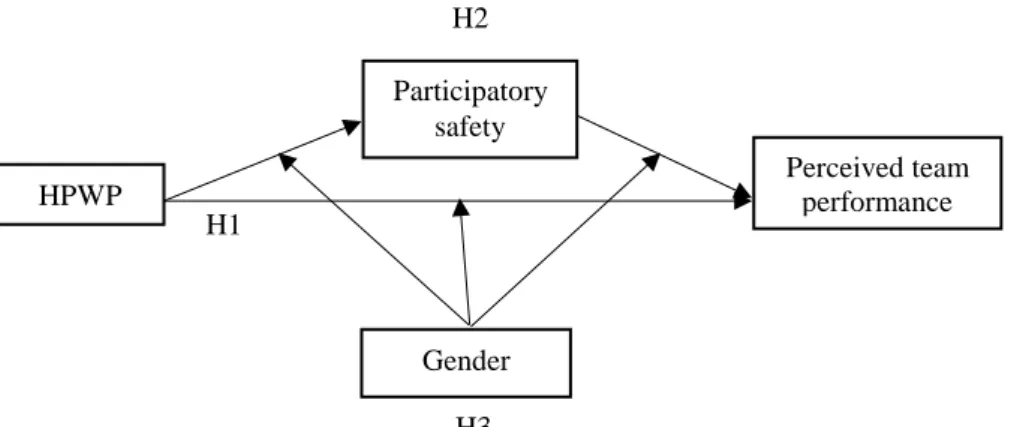
Pfeffer (1983 in Frink et al., 2003) once noted that organizational demography, i.e., an organization’s proportion of men and women, is critical to group processes, which Frink et al. (2003) confirms by stating that high organizational performance is associated with a balanced gender composition. As such, we aim to explore what kind of impact gender identity (as measured by BSRI and by sex) may have in the relationship hypothesized in Figure 1. More specifically, considering HPWP are practices believed to have a universal outcome of high performance and improved work conditions for employees, we wonder if these practices are in fact universal or if they are gender-dependent.
H3: Gender moderates the mediated relationship by participatory safety between HPWP and subjective team performance
25 HPWP Participatory safety Perceived team performance H1 H2 Gender H3
Figure 1. Integrated Model (Source: Personal)
collection)
The integrated model is depicted as follows:
As Chapter I reviews the existing literature review on the topics of interest, the model for our research thesis has been developed and expanded. Not only will we expand on the black box relation of HPWP and perceived team performance through participatory safety, but explore the role of gender.
Therefore, our H1 expects that HPWP will positively associate with subjective team performance. H2 suggests that participatory safety will mediate the positive relationship between HPWP and perceived team performance. Lastly, H3 suggests that gender (identity and sex) moderates the mediated relationship by participatory safety between HPWP and perceived team performance.
26
II. METHOD
This chapter will identify all methodological options made to empirically test hypotheses. For such purpose we will explain the procedure, characterize the sample, the strategy deployed to conduct data analysis and identify the measures used to operationally define the constructs as well as their psychometric quality.
2.1.Procedure
The study required individuals within work teams to answer an online questionnaire via Qualtrics. To participate, we addressed an invitation via LinkedIn, chosen due to its professional outreach. The invitation stated the nature of the research, making clear it was conducted within the Master of Human Resources Development Policies at ISCTE-IUL under supervision, and that the answers were strictly anonymous and confidential. We offered assurance of the ethical code of research and the protection of all participants from undue disclosure. At the end of the invitation, we provided a direct email address in case of doubt or just to double check the authenticity of the research.
2.2.Sample
The empirical research targeted active working population that is daily operating in work teams, independently of the industry. We collected 147 filled questionnaires from which 123 were valid. The exclusion of questionnaires took into consideration missing values (all above 5% were excluded) as well as within subject variance (those that showed monotonous answers as shown by null variance of the constructs were excluded).
2.3.Data analysis strategy
Data is firstly screened for missing values and abnormal cases (e.g. null variance) and then subjected to psychometric quality analysis for both validity and reliability. Validity concerns being able to measure the exact construct it is intended to, and we opted to test for construct validity via factorial analysis. Therefore, a given construct is valid if the factor analysis (exploratory) offers indicators that it has quality, namely: the KMO should be higher than .500, all measures of sampling adequacy (MSAs) must be at least .500, the Bartlett’s sphericity test should give a significant p-value for the chi-square, and all item should have
27
commonalities above .500. For factor extraction we will use Keiser criterion where only factor that have eigenvalue of at least 1.00 will be retained. For clarity sake we will opt for varimax rotation if theory does not preclude it. In this case, items that crossload will be removed, and we will consider any simultaneous loading distancing .200 as indication of possible crossload and only items that load above .500 will be considered for inclusion in the solution. Solutions are required to explain at least 60% of total variance, after rotation. Otherwise, items will be excluded. Furthermore, factor solutions are tested for convergent validity which is measured by means of Average Extracted Variance (AVE) which should attain at least 50% (Fornell & Larcker, 1981) and in case the solution includes two or more factors, we will test for divergent validity, i.e. that the interfactor correlations do not outweigh intrafactor correlation which is tested by comparing the squared AVE with all the correlations for each pair of latent factor variables. Additionally, a high-quality measure is required to be consistent, i.e. that items measure always the same construct, which can be gauged by means of Cronbach’s alpha (Nunnaly, 1994) or Composite reliability (Jöreskog, 1971). In both cases, reliability indicators for reflective constructs are expected to achieve at least .700. If a construct is formative, such as in the case of Bem’s (1974) gender identity none of these apply.
To test hypotheses, as the model of research comprehends a path that proposes a moderated mediation, we will use Hayes (2017) macro PROCESS that integrates into SPSS and allows for the simultaneous test of all paths via direct and indirect effects. The indirect effects express mediation processes and the statistical significance of the effects is observed via a Corrected Confidence interval that is originated with bootstrapping. Following Hayes (2017) recommendations, we will set the confidence interval at 95% and we will conduct the analysis with 5000 repetitions. The interval between the lower and upper CI95 bounds is used to judge on the statistical significance. Whenever the interval includes zero value, there is indication that the effect is not significant for CI95.
2.4.Measures
Variables included in this study comprehend high performance work practices, employability orientation climate, gender diversity, age diversity, team climate’s participatory safety, and team performance.
28
High Performance Work Practices
HPWP is measured by means of Pfeffer’s (1998) proposal for the key practices. The scale comprehends 7 items expressing job security, rigorous recruitment and selection, autonomous work teams, fair and contingent reward, training and development, status equality, and organizational financial performance awareness. The specific items used were the following: 1) The organization values stable and secure job contracts; 2) There is a high effort into the selection of a new employee; 3) The organization encourages its employees to take the initiative and have autonomy in their work; 4) The organization is generous in their compensation, benefits and bonuses, which reflect the employees’ performance; 5) The organization invests in the training and development of all its employees; 6) There are no status distinctions between the employees, and between the employees and their managers; 7) Management provides to the employees with information regarding organizational performance and explains motives for decisions undertaken.
The items are conceived to aggregate into a single index. Because this is not a construct that is expected to be reflective (i.e. where individuals tend to have a shared cognitive representation of its nature) and is instead a formative construct (taken as a theoretical expression of an expert based view of the idea of high performance work practices) we will not proceed with a factorial analysis, but will simply compute the average for these items. Participants were requested to indicate in a 5 point Likert scale (1=Strongly disagree, to 5=Strongly agree) the extent to which each of the items characterized the organization where they work.
Participatory safety
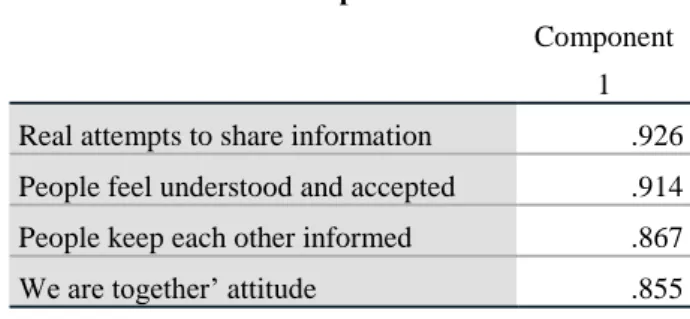
Participatory safety was measured Kivimaki, and Elovainio (1999) 4 item scale (e.g. “We are together’ attitude”, “People keep each other informed”, “People feel understood and accepted” and “Real attempts to share information”) which fall into a single factor (KMO=.812, .798<MSA<.828, Bartlett’s X2(6)=350.007, p<.001), accounting for 79.4% total variance. The scale has also good reliability (Cronbach alpha=.912; CR=.939) and convergent validity (AVE=.794). Participants were requested to indicate in a 5 point Likert scale (1=Strongly disagree, to 5=Strongly agree) the extent to which each of the items reflects their team climate.
29
Table 1. Component Matrixa
Component 1 Real attempts to share information .926 People feel understood and accepted .914 People keep each other informed .867 We are together’ attitude .855 Extraction Method: Principal Component Analysis. a. 1 components extracted.
Perceived Team performance
Perceived team performance was measured with a single subjective indicator where respondents were expected to signal in a scale from 0 (weak) to 10 (strong) their opinion regarding the following question: “If you could assess the average professional performance of your team, you would say it is…?”. This follows Ehrardt, Miller, Freeman and Hom (2014) and Thomas et al. (2019) examples due to the same reasons concerning keeping measures simple and unambiguous to prevent long questionnaires, as recommended by Sackett and Larson (1990).
Gender
Gender was measured in both connotations as physical gender (sex) and gender identity (sex role). The first was dummy coded as binary gender where 1 = female, and 2=male. The second was measured by means of Bem’s Social Role Inventory (BSRI, Bem, 1974) that comprehends 20 items organized as a formative construct around two dimensions (masculine and feminine). Masculine subscale comprehends 10 items (e.g. defends own beliefs, independent, assertive, strong personality, forceful, leadership ability, ambitious, dominant, willing to take a stand and aggressive), the same number as feminine subscale (e.g. affectionate, sympathetic, sensitive to other’s needs, understanding, compassionate, eager to soothe hurt feelings, warm, tender, loves children and gentle). Participants were requested to indicate in a 5 point Likert scale (1=Strongly disagree, to 5=Strongly agree) the extent to which each of the presented items reflects their personal behavior.
30
Team Tenure
Team tenure was measured through a 5 point scale (1= 1 year or less; 2= 2-5 years; 3= 6-10 years; 4= 11-20 years; 5= 21 years or more) where participants were asked to indicate how long on average they have been working in their current work team.
Age group
Age group of the participants was measured through a 6 point scale (1= Up to 25 years; 2= 26-35 years where it was asked to indicate which age range the individuals belong in.
Supervisory position
Supervisory position was measured by participants indicating in a polar question scale (1=Yes and 2=No) whether they have a supervisory or leadership position within their work team.
Level of Education
Level of education was measured through a 5 point scale (1= Up to 9th grade; 2=9th grade completed; 3=12th grade completed; 4=Licentiate degree or equivalent; 5=Masters degree; 6=PhD Doctorate degree) where participants were requested to indicate their individual level of education.
31
III. RESULTS
This third chapter presents the findings from the statistical tests conducted in order to corroborate the hypotheses formulated in Chapter I. The aim of this research is to, not only analyze the relationship between HPWP and team performance through participatory safety, but to also to understand the role of gender (sex and gender identity) in this relation.
Table 2 shows sociodemographic variables correlate between themselves in an expectable fashion, namely age-related variables are positively correlated among themselves (e.g. age group and team tenure). As regards sociodemographic variables correlation with variables included in the research model, it is worth mentioning that age related variables are positively correlated both with gender feminine and masculine scales suggesting older individuals tend to identify more with sex roles. Participatory safety is also associated with supervisory position (r=-.208, p<.05). Although HPWP has no significant correlation with any of the sociodemographic variables, the presence of some correlations and their magnitude advises their use as control variables in ensuing analyses.
Table 2. Correlations, Means, Standard Deviations and Reliabilities
Mean s.d. min-max 1 2 3 4 5 6 7 8 9 1. HPWP 3.18 .79 1-4.86 1 2. Particip. Safety 3.47 .93 1-5 .536** 1 3. Gender 1.34 .47 1-2 .100 .073 1 4. BSRI Feminine 3.94 .48 2.7-5 .230* .112 .016 1 5. BSRI Masculine 3.65 .49 1.8-5 -.103 -.110 .128 .168 1 6. Team_Perform 6.97 1.67 0-10 .231* .535** .196* .091 .084 1 7. Team tenure 2.29 1.17 1-5 .101 .056 .179 .227* .179 .068 1 8. Age group 2.76 1.22 1-6 .079 -.007 .125 .302** .213* .073 .573** 1 9. Superv. position 1.65 .48 1-2 -.132 -.208* -.145 -.066 -.220* -.080 -.189* -.205* 1 10. Education 4.20 .81 2-6 -.025 .179 .221* .035 .054 .185 -.126 -.037 -.029
Pearson’s r correlation coefficients: Cronbach’s alpha in diagonals; a Association measures expresses Cramer’s V; * p<.05; ** p<.01
32
The remaining correlations observed in the Table 2 encourage the research model as participatory safety is positively associated both with HPWP (r=.536, p<.01) and with perceived team performance (r=.535, p<.01). These are the strongest associations in the table and suggest a mediation. However, the relatively weaker one between HPWP and perceived team performance also deserves highlight (r=.231, p<.05) as it may suggest a possible direct effect and thus, a partial mediation.
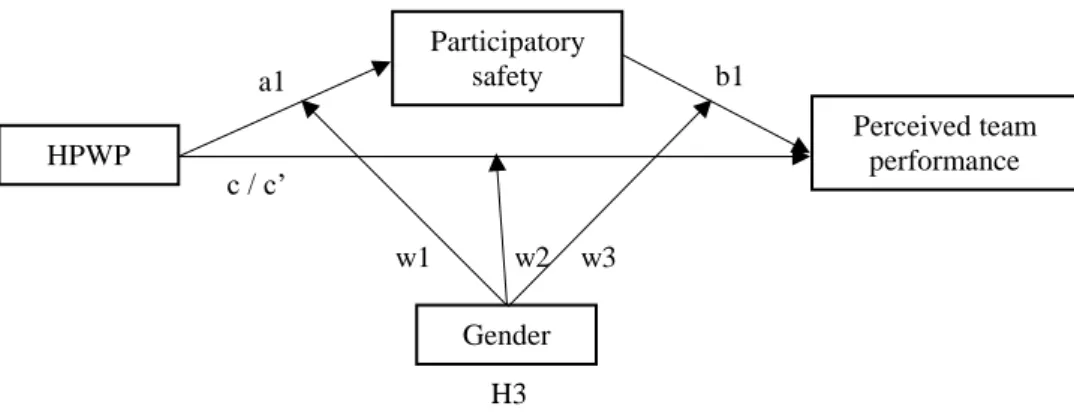
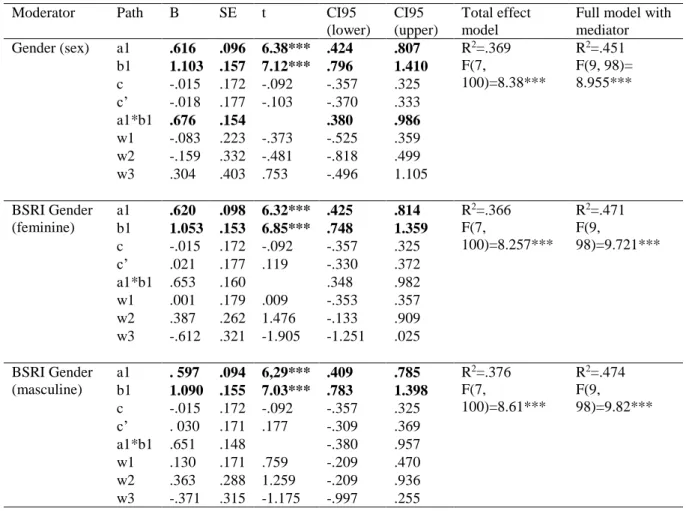
As stated, hypotheses testing was conducted with Hayes (2017) Process macro, namely, with model 59. Table 3 shows findings for each of the path and corresponding indirect effect from HPWP to perceived team performance via participatory safety, as depicted in the next Figure 2. HPWP Participatory safety Perceived team performance a1 b1 Gender H3 c / c’ w1 w2 w3
Figure 2. Path Model for Conditional Process Analysis (Hayes,
33
Table 3 – coefficients for conditional process analysis of the research model Moderator Path B SE t CI95
(lower)
CI95 (upper)
Total effect model
Full model with mediator Gender (sex) a1 .616 .096 6.38*** .424 .807 R2=.369 F(7, 100)=8.38*** R2=.451 F(9, 98)= 8.955*** b1 1.103 .157 7.12*** .796 1.410 c -.015 .172 -.092 -.357 .325 c’ -.018 .177 -.103 -.370 .333 a1*b1 .676 .154 .380 .986 w1 -.083 .223 -.373 -.525 .359 w2 -.159 .332 -.481 -.818 .499 w3 .304 .403 .753 -.496 1.105 BSRI Gender (feminine) a1 .620 .098 6.32*** .425 .814 R2=.366 F(7, 100)=8.257*** R2=.471 F(9, 98)=9.721*** b1 1.053 .153 6.85*** .748 1.359 c -.015 .172 -.092 -.357 .325 c’ .021 .177 .119 -.330 .372 a1*b1 .653 .160 .348 .982 w1 .001 .179 .009 -.353 .357 w2 .387 .262 1.476 -.133 .909 w3 -.612 .321 -1.905 -1.251 .025 BSRI Gender (masculine) a1 . 597 .094 6,29*** .409 .785 R2=.376 F(7, 100)=8.61*** R2=.474 F(9, 98)=9.82*** b1 1.090 .155 7.03*** .783 1.398 c -.015 .172 -.092 -.357 .325 c’ . 030 .171 .177 -.309 .369 a1*b1 .651 .148 -.380 .957 w1 .130 .171 .759 -.209 .470 w2 .363 .288 1.259 -.209 .936 w3 -.371 .315 -1.175 -.997 .255 *** p<.001, ** p<.01, * p<.01
Taking gender (sex) as a moderator, findings show that paths a1 (B=0.616, p<.001, CI95 [0.424; 0.807]) and b1 (B=1.103, p<.001, CI95 [0.796; 1.410]) are both significant and meaningful for the bootstrapping interval generated while the direct relation between HPWP and perceived team performance is not both with and without the mediator in the equation. The indirect effect (a1*b1) is meaningful (B=.676, CI95 [.380; .986]) suggesting a total mediation that explains 45.1% variance in team performance (F(9,98)=8.955, p<.001). This gives support
to Hypothesis 1. None of the proposed interaction effects occurred for path a1 (B=-.083, p>.05, CI95 [-.525; .359]), b1 (B=-.159, p>.05, CI95 [-.818; .499]) or c (B=.304, p>.05, CI95 [-.496; 1.105]) which does not support Hypothesis 2.
Taking gender (BSRI femininity) as a moderator, findings show a similar situation as previously described, with meaningful a1 (B=.610, p<.001, CI95 [.425; .814]) and b1 (B=1.053, p<.001, CI95 [.748; 1.359]) paths as well as a non-significant direct relationship between HPWP and perceived team performance (both with and without the mediator considered). The indirect effect (a1*b1) is meaningful (B=.653, CI95 [.348; .982]) suggesting the same total
34
mediation as found before. The explained variance is 47.1%. This supports hypothesis 1. Also similar to previous findings, there is no significant interaction effect between femininity and any of the paths (a1, B=.001 p>.05 CI95 [-.353; .357]; b1 B=.387 p>.05 CI95 [-.133; .909], and c B=-.612 p>.05 CI95 [-1.251; .025]). This does not support Hypothesis 2.
Taking gender (BSRI masculinity) as a moderator, findings show a similar situation as previously described, with meaningful a1 (B=.597, p<.001 CI95 [.409; .785]) and b1 (B=1.090 p<.001 CI95 [.783; 1.398]) paths as well as a non-significant direct relationship between HPWP and perceived team performance (both with and without the mediator considered). The indirect effect (a1*b1) is meaningful (B=.651, CI95 [-.380; .957]) suggesting a total mediation as found before, which explains 47.4% variance of perceived team performance. This supports hypothesis 1. Also similar to previous findings, there is no significant interaction effect between masculinity and any of the paths (a1, B=.130 p>.05 CI95 [-.209; .407]; b1 B=.363 p>.05 CI95 [-.209; .936], and c B=-.371 p>.05 CI95 [-.997; .255]). This does not support Hypothesis 2.
Overall, the first hypothesis stating participatory safety is a mediator between HPWP and perceived team performance is supported while the second hypothesis that tests boundary conditions for this mediation pertaining gender is not.
35
IV. DISCUSSION AND CONCLUSION
HPWP are mainly theorized as being universal practices expected to increase overall job performance due to many mechanisms. This research proposed to cross the organizational participation literature with HPWP by designing a model that took participatory safety as a mediator between HPWP and team performance, more specifically, perceived team performance. Findings, indeed, supported these hypotheses showing all variance between HPWP and perceived team performance flows through participatory safety, which corroborates the theoretical choices underlying the proposed model. As Schuler (1992) once stated, employees under a strategic management have a positive reaction to participatory safety processes, that is, to the investment of an environment that promotes participation and communication between everyone involved and is psychologically safe (Anderson & West, 1996).
Findings concerning possible genderization of HPWP are very clear in removing this proposal as the mediation effect and all the path coefficients between variables under study remain quite stable, independently from the gender of the participant. The fact that gender was measured both as physical gender (sex, male & female) and as gender identity (via sex roles, with two independent scales, masculine and feminine) confers robustness to the assertion that HPWP are gender-free as regards their perceived effects. Therefore, these HR practices, taken as the best practices, are expected to exert the same effects in workplace with no gender distinction. This adds to its universal value and application in organizations.
Limitations and Suggestions for Future Research
The sample is not very large which, adding to its convenience nature, could hamper its generalizability. However, the data analysis technique chosen (Conditional process analysis, Hayes, 2017) operates with bootstrapping intervals of confidence, which offers some assurance about findings’ meaningfulness.
The fact that all measures originated from the same participant and that they are subjective in nature raise doubts about possible endogeneity effects, known as common method variance (Podsakoff et al., 2003). This is a serious problem regarding many inferences that can be draw from data, namely concerning true causal direction (as the research design is correlational in nature) and also the true effects occurring in real settings. An ex-post remedial test that can be conducted in Harman’s test which is intended to verify if data aggregates into a
36
single factor that is mixed and accounts for at least 50% of explained total variance of a factorial analysis (before rotation). The test conducted showed no indication of such phenomenon as the main factor explains 18.8% variance out of 67.6% and is composed only of HPWP.
Future research may opt to build upon these limitations to generate more robust designs such as multi-wave (due to the mediation) or multi-sourced data (to remove possibility of common-source bias) and multi-level (as HPWP can be treated as we did at the perceptive level but it is more suitably seen as a group-level variable) but such design is hardly compatible with the time available to complete a masters dissertation. It is especially important to focus not only upon subjective dependent variables such as perceived team performance but also upon objective criteria itself to gauge true performance. Alongside with methodological options, future research could explore the possibility that the effects of HPWP may still hold differently based on organizational culture as it should set the background for a gendered effect of HWPW. To conclude, through our research we set out to uncover a part of the black-box relation between HPWP and performance, more specifically, subjective team performance. HPWP are practices aimed to invest in the employee so that they may securely focus on the tasks at hand and develop autonomy within the work place. They are also practices that promote team work and communication between employees, so that an open, participatory environment may take place (Pfeffer, 1998; 2005). Hence, we theorized that the presence of a participatory safety climate had a positive impact in achieving high performance in the context it would be applied in. According to literature, the promotion of a safe and supportive environment within the organization brings positive outcomes overall (Anderson & West, 1996; Schuler, 1992) since employees feel they can develop and express their opinions within a safe space. However, the impact of a participatory safety environment through the interaction of HPWP and performance has not received the empirical attention it deserved, which led to the development of this research.
Since HPWP are practices that are thought of as being universal in their application, that is, by definition, they are expected to have a positive effect on the organization and the individuals when duly implemented, and considering the recent discussion regarding gender diversity in the workplace, it is timely to test if the effect of these practices varies depending on gender identity or the sex of the individual. Moreover, this research explored a not so frequent path in HRM-related gender studies which lies in distinguishing gender from sex and theorizing the moderating conditions they have in the mediated interaction of HPWP and performance.
The results obtained showed support for two of our hypotheses. It is supported that, not only is there a positive association between HPWP and subjective team performance, which
37
empirical evidence has already proven, as participatory safety has a mediating role in said interaction, meaning that its presence will lead to a higher team performance, at least to the perception about it. In contrast, the results do not support the moderating gender hypothesis that HPWP impact varies due to gender distinctions, which ascertains the universal vein of these practices and that they are indeed gender-free.
Our research does have limitations regarding its sample size and the subjective nature to our measures, but we believe that this is an important discussion worth having and it may be beneficial for the design of HR practices. Developing a participatory safety climate through HPWP, where individuals feel free to express their ideas and learn from each other, may be the key to further improving work conditions and productivity in an organization that is also striving not to be gender-biased.
38
V. REFERENCES
Andersén, J. & Andersén, A. (2019), Are high-performance work systems (HPWS) appreciated by everyone? The role of management position and gender on the relationship between HPWS and affective commitment, Employee Relations, 41 (5), 1046-1064.
Anderson, N., & West, M. A. (1996). The Team Climate Inventory: Development of the TCI and its applications in teambuilding for innovativeness. European Journal of work and
organizational psychology, 5(1), 53-66.
Appelbaum, E., Bailey, T., Berg, P. B., Kalleberg, A. L., & Bailey, T. A. (2000). Manufacturing
advantage: Why high-performance work systems pay off. Cornell University Press.
Ashkanasy, N. M., Bennett, R. J., & Martinko, M. J. (2016). Understanding the high performance workplace: Introduction. In Understanding the High Performance
Workplace (pp. 19-30). Routledge.
Bem, S. L. (1974). The measurement of psychological androgyny. Journal of consulting and
clinical psychology, 42(2), 155.
Bem, S. L. (1993). The lenses of gender: Transforming the debate on sexual inequality. Yale University Press.
Bracke, P., Christiaens, W., & Wauterickx, N. (2008). The pivotal role of women in informal care. Journal of Family Issues, 29(10), 1348-1378.
Comber, E. (2014). Does team leader level of transformational leadership, emotional stability,
conscientiousness, and agreeableness impact team member stress, trust, and team climate?
(Doctoral dissertation, Northern Illinois University).
Combs, J., Liu, Y., Hall, A., & Ketchen, D. (2006). How much do high‐performance work practices matter? A meta‐analysis of their effects on organizational performance. Personnel
psychology, 59(3), 501-528.
Delery, J. E., & Doty, D. H. (1996). Modes of theorizing in strategic human resource management: Tests of universalistic, contingency, and configurational performance predictions. Academy of management Journal, 39(4), 802-835.
Ehrhardt, K., Miller, J. S., Freeman, S. J., & Hom, P. W. (2014). Examining project commitment in cross-functional teams: Antecedents and relationship with team performance. Journal of Business and Psychology, 29(3), 443-461.
Evans, W. R., & Davis, W. D. (2005). High-performance work systems and organizational performance: The mediating role of internal social structure. Journal of management, 31(5), 758-775.
39
Fisher, E., & Arnold, S. J. (1994). Sex, gender identity, gender role attitudes, and consumer behaviour. Psychology and marketing, 11(2), 163-182.
Flores, G., Posthuma, R. A., & Campion, M. A. (2016). Managing the risk of negative effects of high performance work practices. In N. Ashkanasy, R. Bennett & M. Martinko (Eds.),
Understanding the high performance workplace: The line between motivation and abuse.
New York: Routledge
Fornell, C., & Larcker, D. F. (1981). Evaluating structural equation models with unobservable variables and measurement error. Journal of marketing research, 18(1), 39-50.
Frink, D., Robinson, R., Reithel, B., Arthur, M., Ammeter, A., Ferris, G.R., Kaplan, D. & Morrisette, H.S. (2003), Gender demography and organization performance: a two-study investigation with convergence, Group & Organization Management, 28 (1), 127-147. Goh, T. T., Eccles, M. P., & Steen, N. (2009). Factors predicting team climate, and its
relationship with quality of care in general practice. BMC Health Services Research, 9 (1), 138. doi:10.1186/1472-6963-9-138.
Hayes, A. F. (2017). Introduction to mediation, moderation, and conditional process analysis:
A regression-based approach. Guilford Publications.
Huselid, M.A. (1995), The impact of human resource management practices on turnover, productivity, and corporate financial performance, Academy of Management Journal, Vol. 38 No. 3, pp. 635-672.
Jacobsson, C., Rydbo, N., & Börresen, J. E. (2014). The links between group development and health in manufacturing industry. Small group research, 45(4), 400-415.
Jöreskog, K. G. (1971). Statistical analysis of sets of congeneric tests. Psychometrika, 36(2), 109-133.
Kivimaki, M., & Elovainio, M. (1999). A short version of the Team Climate Inventory: Development and psychometric properties. Journal of occupational and organizational
psychology, 72(2), 241-246.
Lepak, D. P., Liao, H., Chung, Y., & Harden, E. E. (2006). A conceptual review of human resource management systems in strategic human resource management research. In Research in personnel and human resources management (pp. 217-271). Emerald Group Publishing Limited.
Liben, L. S., & Bigler, R. S. (2017). Understanding and undermining the development of gender dichotomies: The legacy of Sandra Lipsitz Bem. Sex Roles, 76(9-10), 544-555.
40
Lu, C. M., Chen, S. J., Huang, P. C., & Chien, J. C. (2015). Effect of diversity on human resource management and organizational performance. Journal of Business Research, 68(4), 857-861.
Martin-Alcazar, F., Romero-Fernandez, P. M., & Sánchez-Gardey, G. (2005). Strategic human resource management: integrating the universalistic, contingent, configurational and contextual perspectives. The International Journal of Human Resource Management, 16(5), 633-659.
McMurray, A. J., Islam, M., Sarros, J. C., & Pirola-Merlo, A. (2012). The impact of leadership on workgroup climate and performance in a non-profit organization. Leadership &
Organization Development Journal, 33(6), 522-549.
Muduli, A. (2015). High performance work system, HRD climate and organisational performance: an empirical study. European journal of Training and development, 39(3), 239-257.
Nunnally, J. C., & Bernstein, I. H. (1994). Psychometric theory (3rd ed.). New York: McGrawHill
Ozguner, Z., & Ozguner, M. (2014). A managerial point of view on the relationship between of Maslow's hierarchy of needs and Herzberg's dual factor theory. International Journal of
Business and Social Science, 5(7).
Pfeffer, J. (1998). Seven practices of successful organizations. In California Management
Review (Vol. 40, No. 2, pp. 96-124).
Pfeffer, J. (2005). Producing sustainable competitive advantage through the effective management of people. Academy of Management Perspectives, 19(4), 95-106.
Pichler, S., Varma, A., Yu, A., Beenen, G., & Davoudpour, S. (2014). High performance work systems, cultures and gender demography. Employee Relations, 36(6), 693-707.
Podsakoff, P.M., MacKenzie, S.B., Lee, J.Y., & Podsakoff, N.P. (2003). Common method biases in behavioral research: A critical review of the literature and recommended remedies. Journal of Applied Psychology, 88, 879–903.
Qiao, K., Khilji, S. & Wang, X. (2009), High-performance work systems, organizational commitment, and the role of demographic features in the People’s Republic of China,
International Journal of Human Resource Management, 20 (11), 2311-2330.
Robinson, G., & Dechant, K. (1997). Building a business case for diversity. Academy of
Management Perspectives, 11(3), 21-31.
Rotich, K. J. (2015). History, evolution and development of human resource management: a contemporary perspective. Global Journal of Human Resource Management, 3(3), 58-73.