Full Terms & Conditions of access and use can be found at
http://www.tandfonline.com/action/journalInformation?journalCode=cjms20
ISSN: 1369-183X (Print) 1469-9451 (Online) Journal homepage: http://www.tandfonline.com/loi/cjms20
Labour market integration of immigrants in
Portugal in times of austerity: resilience, in situ
responses and re-emigration
Alina Isabel Pereira Esteves, Maria Lucinda Cruz dos Santos Fonseca & Jorge
da Silva Macaísta Malheiros
To cite this article: Alina Isabel Pereira Esteves, Maria Lucinda Cruz dos Santos Fonseca & Jorge da Silva Macaísta Malheiros (2018) Labour market integration of immigrants in Portugal in times of austerity: resilience, in�situ responses and re-emigration, Journal of Ethnic and Migration Studies, 44:14, 2375-2391, DOI: 10.1080/1369183X.2017.1346040
To link to this article: https://doi.org/10.1080/1369183X.2017.1346040
Published online: 30 Aug 2017.
Submit your article to this journal
Article views: 221
View Crossmark data
Labour market integration of immigrants in Portugal in times
of austerity: resilience,
in situ responses and re-emigration
Alina Isabel Pereira Esteves, Maria Lucinda Cruz dos Santos Fonseca and Jorge da Silva Macaísta Malheiros
Centre for Geographical Studies (CEG)– Institute of Geography and Spatial Planning (IGOT), Universidade de Lisboa, Lisboa, Portugal
ABSTRACT
The austerity regime implemented in Portugal to face the financial and economic crisis caused readjustments in the country’s productive structure and labour market with an impact on immigrants’ lifeworlds. This article aims at analysing the consequences of the crisis in the lives of third-country nationals living in Portugal, reflecting particularly on the impact on their integration process, understood as economic incorporation, in a context of increasing work precariousness. Special attention will be given to the resilience of immigrants visible in their responses to the labour market constraints, namely through their choices of geographic (im)mobility and also the implementation of strategies to ‘normalise’ their lives. Starting with a brief reference to the meaning of integration in Portugal in a context of crisis, we draw on data from two research projects, arguing that despite the increased hardship, the resilience of foreign workers is considerable and they still think it is worth coming to Portugal. The strategies adopted may be either in situ or implying onward migration, resulting from the combination of context opportunities and individual agency. Factors like legal status, education and having relatives abroad play a moderate role in this process.
KEYWORDS
Immigration; labour market; integration; resilience; im (mobility); Portugal
1. Introduction
Migrant integration is not easily defined. It is interpreted differently at several levels and by distinct actors, holding diverse meanings in different geographical and social contexts as well as across time. Acknowledging the contentious character of the term integration, Erdal and Oeppen (2013) point out the underlying ideas of migrant adaptation, inclusion and incorporation in the hosting society as proxies or synonyms of integration. Indepen-dently of the theoretical model or normative view concerning integration in a social context, the economic participation of migrants and their formal citizenship status are two prevailing issues in the field (Papademetriou 2003; Liebig and Von Haaren 2011; Vink 2013; Roos and Zaun2016). In a context of economic crisis like the one lived by many Southern European countries since 2007, with massive job losses, increase of
© 2017 Informa UK Limited, trading as Taylor & Francis Group
CONTACT Alina Isabel Pereira Esteves [email protected] https://doi.org/10.1080/1369183X.2017.1346040
poverty, and growing competition for dwindling resources and benefits, the issue of migrant integration, has become an even hotter topic among politicians and researchers. However, the number of researches about the effects of the crisis over the integration process of immigrants is not only recent but still scarce, as underlined by Finotelli and Ponzo (2018). In the storm of events that followed the bankrupt of an American bank in September 2008, the Southern European economies were particularly affected by the ‘Great Recession’ that followed and among these set of countries, Portugal was, and still is, one of the most seriously hit by the crisis. Despite the huge volume of information on the impact of the austerity measures imposed to the population after the country’s bailout by the Troika,1 namely poverty, unemployment rates and emigration, little is known about the specific consequences of the crisis on the migrants’ daily life and in their integration process. Acknowledging the complexity and density of the concept of integration but keeping in mind that the labour flows were for decades the main factor explaining migration to Portugal, this paper intends to debate the meaning of integration in a context of crisis, seen essentially in a perspective of economic incorporation. In fact, migrants residing in Portugal have continuously shown activity rates higher than nationals representing an essential production factor for the Portuguese productive model based on the intensive use of labour (Reis et al.2010; Oliveira and Gomes2016). Amidst recession, several questions arise: How do immigrants fare in economic terms, in Portugal, when they are mostly incorporated in the secondary labour market in jobs affected by the econ-omic meltdown? Moreover, how have immigrant families incorporated the challenges, brought about by recession, in their lives? How did they react to joblessness, wage cuts and dwindling social benefits? How do they perceive their integration in Portugal? In a context of economic recession does integration mean to stay put and resort to one’s savings and to in situ family and institutional support or does it involve geographical mobility as an ‘integrative mechanism’ (Trenz and Triandafyllidou 2017) to reach labour opportunities somewhere else? Taking the Portuguese case in hands, the goals of this paper are (1) to shed some light on the immigrants’ own perceptions of their inte-gration in Portugal confronted with national macroeconomic indicators and also (2) to understand the resilience of immigrants uncovering the strategies of adjustment of immi-grant families in the context of the crisis.
Portugal seems to be a case worth looking at, as several authors noticed that Southern European countries, with the exception of Greece, have not given up on integration despite the huge budget cuts implemented in areas ranging from social security and health to edu-cation and employment (Collett 2011; Ponzo et al. 2015). Discussing the literature on migrant integration in Europe and economic crisis, our research will draw on the results of two research projects – CRISIMI and THEMIS,2 – recurring also to national data published by official agencies in order to benchmark immigrants to Portuguese citi-zens in labour market variables. We will argue that (1) the aggravation of the labour market situation, visible in deskilling and temporary/partial exclusion from work, does not necessarily mean that the majority of migrants feels excluded from other social spheres, and (2) migrants show a reasonable resilience to the impacts of the crisis, either through the development of in situ strategies (e.g. very short-term jobs; use of local kinship support) or through re-emigration to other destinations of some family members, either holding a Portuguese passport or not.
The paper starts with a discussion of the conceptualisation of immigrant integration in the context of recession, giving particular attention to the economic incorporation. Then, recurring to Eurostat data, we analyse the economic wellbeing of migrants before and after the onset of the crisis benchmarking them to Portuguese citizens in terms of material deprivation, poverty and unemployment. With quantitative and qualitative information from two research projects we analyse the perception of migrants’ satisfactions concerning their situation in Portugal in different fields of social life. The strategies adopted by migrant families to overcome the constraints imposed by the recession are then identified and the paper will end with some concluding remarks that will underline the main find-ings on the two key issues under discussion, which are the identification of the impacts of the crisis in the integration of immigrants and their resilience to these effects.
2. Migrations and economic integration in a context of crisis
Diversity brought by international migration to hosting societies has been placing major challenges to liberal democracies in recent years and the classic referential of integration based on the accommodation of diversity with a more multiculturalist slant has been ques-tioned (Lindley 2014; Irastorza and DeVoretz 2015). The perception, on the part of national governments, that significant differences between immigrants and nationals remain in areas considered central for integration, despite the investments made, has been leading several governments to opt for more coercive integration measures (Vasta
2006). The top–down approach in the definition of integration criteria was reinforced,
noticeable in the increasing need for migrants to go through language and civics tests at any moment of the migratory process, reinforcing the notion that integration is closely linked to national citizenship and civic integration (Joppke2007; Trenz and Triandafylli-dou 2017). Moreover, the reinforcement of neo-liberal policies in the management of European economies in a context of deep recession has been causing a substantial reduction of public expenditures that involve a decline of investments on integration (Collett2011; Collett and Petrovic 2014), with consequences such as the closing down of agencies specifically targeting immigrants.3 In addition, immigrants have to support more often the costs of their integration paying for the language and civics classes (Erdal and Oeppen2013).
The prevalence of the national, and even European, authorities in the design of inte-gration policies reveals not only the maintenance of a top–down attitude, but also a posture showing an asymmetric understanding of the social process which implies inter-action in its very essence. The way integration is designed and sponsored leaves little room for migrants’ agency (Erdal and Oeppen2013) and integration as a state political project may differ quite significantly of the migrant’s individual (and family) project (McGarrigle and Ascensão2017). If understood as a one-way path, integration policy regards migrants as passive and malleable actors on a stage moving according to the labour market needs, or humanitarian commitments, of destinations countries. Being foreign workers still very much needed in post-industrial societies, economic integration (access to labour market and to education, and education performance) has been granted particular attention in the diverse initiatives sponsored by the European Commission like the Common Basic Principles (2004), the European Agenda for Integration (2011), and the Integration Action Plan of Third-Country Nationals (2016). These involve departure and
pre-arrival measures, in several domains, to promote integration, with emphasis in employ-ment and vocational training, including actions to facilitate recognition of qualifications and skills, and sponsor early integration into the labour market and migrants’ entrepreneurship.
However, in a context of growing volatility of labour markets, very rigid modes of inte-gration imposed by nation-states and often sponsored by the EU collide with immigrants’ strategies that are, by nature, more flexible and adaptable to contextual conditions. Escap-ing the crisis, and still feel part of different social spheres, may involve moments of unem-ployment (Janicka and Kaczmarczyk2016) or labour informality associated with alternate periods of immobility and mobility, often with no pre-fixed time length, and variable geo-graphical scope according to the constantly negotiated balance between immigrants’ agency and the constraints imposed by structure (Bakewell2010).
However, migrants’ malleability and mobility are significantly constrained by legal status with undocumented migrants and temporary workers in clear disadvantage (Tilly
2011). EU citizens enjoy a remarkable level of freedom of movement within the European space and in heights of recession we may observe an intensification of the flows from seriously hit Southern European regions to less impacted countries in the West and North (Graeber 2016; Wiesböck et al. 2016; Bartolini, Gopras and Triandafyllidou
2017) demonstrating the relevance of the principle of ‘Free Circulation of Labour’ and how mobility can work as an ‘integrative mechanism’ (Trenz and Triandafyllidou
2017). As Lindley points out ‘ … migration is central to how people experience and respond to crisis – showing how individuals, families and communities use mobility in sometimes pre-emptive, often reactive, and other times more strategic fashion’ (2014, 16). Nonetheless, mobility involves costs and is not an option available to all, or at any time, being clearly more limited to third-country nationals (TCN) living in the EU countries. Besides legal status, further mobility also depends on the social networks and labour market demands, among other factors (Castles 2011; Carling2016). Thus, more often than not, migrants have to build their integration in situ, that is, in the place where they live because the crisis reinforced restrictions in the access of foreigners– par-ticularly non-EU– to national labour markets, imposed stricter conditions of access to social benefits, brought about disinvestment in several economic sectors and contributed to bring back the discourse about the need to reintroduce the internal EU borders (Roos and Zaun2016; Trenz and Triandafyllidou2017). However, if mobility is still assumed as the option, migrants implement a range of solutions that involve mobilising and combin-ing resources placed outside the main destination place– in the origin and in new desti-nations – through the use of networks of friends or family, or acquiring multiple citizenships in order to overcome entry and permanence restrictions. With strategies like these, that may involve re-emigration but keep the first place of destination as the main residence place, migrants show a considerable resilience and a remarkable ability to build integration along the time. Inspired by Aysa-Lastra and Cachón (2015), the notion of resilience adopted in this article is associated to the capacity of individuals and families to resist to constraints through the implementation of reaction strategies that contribute to overcome risk and difficulties. Within the crisis context, immigrants actively develop a process of constrained responses with the goal of recovering from nega-tive outcomes (e.g. unemployment, wage reductions, and loss of formal status) and restore a socio-economic situation at least equivalent to that existing before the crisis. Immigrants’
responses can take the form of collective mobilisation (e.g. demonstrations, petitions with the aim of claiming rights and mobilising the public opinion) or individual/family action (e.g. looking for new jobs, starting a business), being the later forms the focus of this paper. Keeping in mind that the mutual accommodation of natives and migrants underpins life in a society involved in migration, in this paper the term integration is seen as a non-linear process of convergence built across time, often as a family project mobilising several of its members at different moments of the life cycle which may be constructed in more than one place. Thus, integration, seen as two-way process of adaptation involving migrants and the hosting society (Papademetriou2003; McGarrigle and Ascensão2017) does not have an‘identifiable endpoint’ (Erdal and Oeppen2013), that is, it is in perma-nent construction. Even in the specific domain of economic or labour market integration, we are dealing with a process marked by several trajectories that include work opportu-nities and careers, adjustment between the skills of immigrants and the skills required by the jobs fulfilled, evolution of wages and professional recognition. This being said, and acknowledging the limitations of essentialising and reifying nationality (Wimmer and Glick-Schiller2002; Erdal and Oeppen 2013), for operational reasons, in this paper integration will privilege a comparative perspective of the outcomes of foreign and Portu-guese citizens in a set of socio-economic indicators, combining it with the perceptions and responses of migrants to the challenges posed by economic recession, which may, in turn, involve distinct levels of (im)mobility.
3. Portugal, migrants’ economic integration and the impacts of the crisis As highlighted by Trenz and Triandafyllidou (2017, 546), ‘ … European governments have turned again more favourable towards labour migration in the 1990s and in the first decade of the twenty-first century’, with immigrants feeding the economic growth in many European nations (Collett 2011). In this context, Portugal was no exception and a substantial part of the inflows during the 1990s and first half of the 2000s responded to labour market needs due to the public investments in the sectors of civil construction and public works but also to the internationalisation of Portuguese economy especially since membership to the EU (Peixoto 2008; Fonseca and McGarrigle 2014).4 Foreign workers coming from Portuguese-Speaking African countries, between the second half of the 1980s and the second half of the 1990s, and then from Brazil and Eastern Europe, from the end of the 1990s until the onset of the crisis, faced little regulation in their entry, permanence and insertion into the labour market due to a significant comple-mentarity, thus little competition, with national workers5 (Peixoto 2008; Ponzo et al.
2015). Due to specific needs of the country’s productive structure, migrant workers have predominantly been incorporated in the secondary labour market (Pereira 2010). Considering data from 2014, more than half of foreign employees worked in groups at the bottom of the occupational ladder (52.1% as skilled and unskilled workers of industry and construction as well as craftsmen and plant and machinery operators), being the non-skilled jobs dominant (32.5%). These proportions are considerably higher than among nationals (38.6% and 12.2%, respectively) showing that‘ … foreign workers continue to be overrepresented in the least attractive jobs of the Portuguese labour market, demanding low or no skills and with high levels of insecurity’ (Oliveira and Gomes2016, 90). Several authors have already remarked on the deskilling that immigrants go through in their
incorporation in the Portuguese labour market due to obstacles in the formal recognition of skills and qualifications, language barriers or discrimination (Peixoto 2009; Marques and Góis2010).
Despite this, economic incorporation has been such a pivotal feature of integration that the Strategic Plan for Migration 2015–2020 recognises that ‘The integration [in the pre-vious decades] was essentially work-related, attempting a better inclusion in Portuguese society through this route’ (ACM 2016, 16). This is an interesting point because ‘The employment situation of migrants during the boom is often the key to understanding their experience in the subsequent recession’ (Castles, de Haas, and Miller 2014, 242) and in the case of Portugal their overrepresentation in seriously crisis-impacted sectors aggravated poverty levels and led to re-emigration, issues to be discussed in the next section.
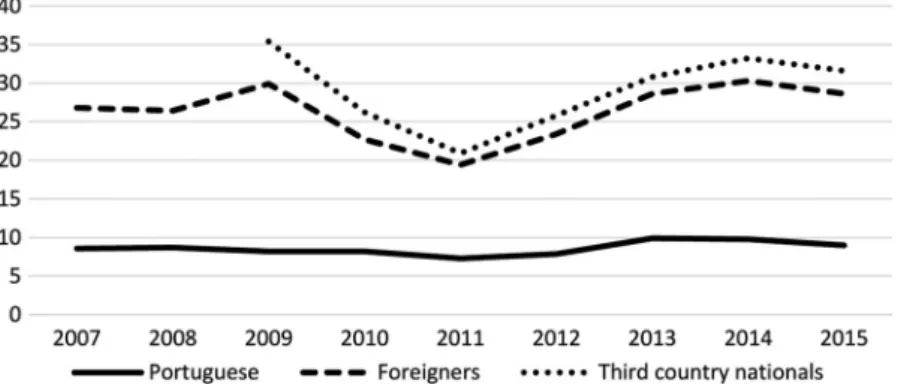
The onset of the crisis brought about budget cuts in several social areas and although Portugal still kept its commitment to integration (Huddleston et al. 2015) by making immigrants eligible for the basic literacy training available to beneficiaries of Social Inser-tion Income, sponsoring Immigrant Entrepreneur and Mentor programmes and ensuring social assistance for immigrants living in situations of extreme poverty regardless of resi-dence status (Collett2011, 15),6the fact is that poverty increased among foreign citizens, especially third-country nationals. For instance, according to Eurostat data, the severe material deprivation rate7tends to be higher for the foreign population comparatively to the Portuguese citizens displaying their disadvantageous situation in several social fields (Figure 1). Between 2009 and 2011, foreigners’ severe material deprivation rate,
especially for third-country nationals, experienced a decline – which eventually results from an early mobilisation of resilience strategies– and converged towards the Portuguese rates. However, in 2011, when the Troika Readjustment Program started, there was an inversion of the foreigners’ trend that not only resumed the growth but also diverged from the nationals’ trend, that also increased but at a much smaller pace (Figure 1). The relative improvement of Portuguese economic performance is visible in the slight reduction of the severe material deprivation rate for all groups in 2015, although the gap between nationals and foreigners remains quite high: a 22.6 percentage points’ differ-ence for the third-country nationals and a 19.6 percentage points differdiffer-ence for the total
Figure 1.Severe material deprivation rate by broad group of citizenship, 2007–2015 (%). Source: Euro-stat (table ilc_mddd15). Only the population aged 18 and over is being considered.
foreign population. Their legal status, length of stay in the host country, combined with benefit entitlement, positioning in the labour ladder, recognition of skills and wage dis-crimination influence the economic comfort of migrants with different intensities. Thus, even incorporated in the labour market foreigners, particularly third-country citi-zens, find themselves less protected than nationals against poverty, especially the more recent ones (OECD2015).
The recession aggravated the situation due not only to the reduction of jobs available, particularly noticeable among non and low skilled activities8 (Malheiros, Oliveira, and Albrecht 2015), but also by increasing selectivity in the access to social benefits that could compensate the loss of income due to joblessness or wage reduction. Despite the previously mentioned positive measures (Collett 2011), the changes in the juridical regime of social protection9 excluded many families and children from eligibility to social protection benefits (Eurofound 2015, 60). Thus, in a country with a welfare system of the familialist type, and where social policies provide limited compensation for the inequalities generated by the market (Ponzo et al. 2015, 58), the social sector and civil society have been playing a central role in finding ways of providing greater support for families, through food distribution, free meals for children in school canteens, and school books and clothes banks (Wall2016).
In the opinion of migrants interviewed in the ambit of the project CRISIMI in the Lisbon Metropolitan Area (LMA) the main resources to face the expenses, besides the regular monthly wages, are first and foremost their individual resources, namely savings (63.6%).10 The relevance of family and friend-based networks living in Portugal comes second (21.4%) and it assumes more relevance for long-standing communities in Por-tugal like the Portuguese-Speaking African migrants. For the very recently arrived migrants or for those with flimsy social networks in the hosting country, the financial help from relatives in the sending country or elsewhere can be somehow important (4.9%). Among the interviewees, this option is more frequently mentioned by the recent communities from Asia that seem to rely more often on the economic help from relatives and friends outside Portugal comparatively to other geographical origins. This monetary flow can coexist between sending and receiving countries showing reciprocity mechanisms still not much explored (Bartolini and Castagnone
2015).
Table 1.Agreement with a set of statements assessing the situation of interviewees in LMA at the present moment (2015) (%).
Year of migration to Portugal
I am better today than if I had stayed in my country of origin
I moved to a better professional position comparatively to one year after arrival
Before 1991 50.0 70.0 1991–2000 62.1 61.9 2001–2008 64.6 54.4 2009 to the present 55.1 50.0 Total 60.2 54.2 Respondents (No.) 315 252 Non-responses 14 72
Source: CRISIMI database.
Note: Non-responses were excluded from the calculations. These proportions refer to‘I agree’ responses. The number of respondents in each question is different because some respondents chose the option‘I disagree’, whereas others did not answer the questions.
Despite the economic constraints, migrants’ perceptions of how they fare in the Portu-guese society is still positive with 60.2% of the respondents admitting they are better today than if they had stayed in the country of origin (Table 1). Slightly more than half of the respondents (54.2%) acknowledge they moved to a better professional position compara-tively to one year after arrival. In both variables, it is possible to see, generally speaking, that immigrants who migrated to Portugal before 2008 report higher satisfaction com-paratively to those more recently arrived who most probably faced harsher conditions and had less time to build potential in situ response mechanisms, such as dense local net-works or solid formal statuses.
4. Immigrants’ responses to recession: in situ strategies and mobility
Integration in Portugal, in a context of recession, may actually hold distinct meanings. It may imply remaining in the country, in a‘wait and see’ strategy (Janicka and Kaczmarczyk
2016), living more often in poverty or jobless, although not feeling excluded from the wider society, or resorting to networks of relatives and friends in different geographical locations. The strategy adopted by individuals and families will depend on the personal and community resources that can be mobilised and for some immigrants the identifi-cation of labour market niches can be the solution to avoid returning to the origin country or re-emigration to another destination. These niches are usually associated to principles of part-time, precarity or short-term execution, whose specific segmented nature seems to adjust more to the particular features and skills of some groups. For instance, the call centres of transnational enterprises serving the Brazilian market need people who speak Portuguese with a ‘very fresh’ Brazilian accent. Therefore, drawing on the pool of the more recently arrived immigrants, international corporations hire oper-ators for their‘call centres’ in Portugal. In addition, the more resourceful individuals may become entrepreneurs as a reactive strategy to overcome the constraints from lack of salary (Oliveira and Rath2008). Immigrants, similarly to natives, establish small business of personal or domestic services that respond to identified labour market needs:‘ … I’ve noticed that many hairdresser salons have opened and I also notice lots of take away shops … a shop specialized … in Brazilian typical dishes (opened) … ’ (Interview to the Pro-fessional Insertion Office in the House of Brazil, 6/3/2015, Lisbon). According to Oliveira and Gomes (2016), the number of immigrant entrepreneurs in Portugal has kept pace with the positive evolution of foreign citizens in Portugal but they show higher propensity for entrepreneurship comparatively to nationals (+15% and −7%, between 2001 and 2011, respectively).
Obtaining the citizenship of the destination country can also be seen as a strategy to build integration by securing residence, widening the social and economic rights11 and facilitating eventual future mobility(ies) (Domingo and Ortega-Rivera2015; Ponzo et al.
2015; Graeber2016; Finotelli and Ponzo2018). In Portugal, the change in the nationality law in 2006,12 reducing the minimum length of residence time needed for citizenship application and slightly reinforcing the jus soli regime, led to a notorious increase in the number of citizenship requests. Deferred applications leaped from an average of 3428 in the 2004–2006 period to an average of 22,424 in the 2008–2015 time span, namely among third-country nationals who represent the vast majority of acquisitions (97%), and come from Portuguese-speaking countries (64.3% for the 2008–2015
span).13Among the immigrants surveyed in LMA in the ambit of the project CRISIMI, 30.0% admitted having tried to acquire Portuguese citizenship.
4.1. Re-emigration from Portugal and EU mobility as‘integrative strategies’
Immobility or niche entrepreneurship may not be the solution for migrants in a context of recession and despite the investments sponsored by official agencies, the structural fragi-lities of the Portuguese economy (larger share of vulnerable sectors, deregulation of the financial sector, investment in non-tradable goods, cf. Ponzo et al.2015) led to a higher exposure of migrants to unemployment and poverty, as discussed in the previous section. When the economic integration in the destination country proves to be unbear-ably difficult, migrants may decide to return to the origin country. That depends on the conditions there, among other factors, and in the context of the present crisis they often have been unwilling to leave even when jobless (Castles2011; Janicka and Kaczmarc-zyk 2016). However, they may also use their networks established across several desti-nations and (re)build their integration by re-emigrating to another country showing an interplay between agency and structure at multiples scales (McGarrigle and Ascensão
2017). As stressed by Trenz and Triandafyllidou (2017) mobility may function as an ‘inte-grative mechanism’, that is, looking for integration somewhere else or supporting social integration in the original host country (the first destination of the migrant), that may remain as the key residence place where some family members stay, through work and earnings coming from another destination place (the country of re-emigration).
In this context of recession, holding the citizenship of a European Member State may be seen as an incentive for mobility due to the panoply of economic and social rights associ-ated with it (Bellamy 2004; Isin and Saward 2013; Graeber 2016), namely, freedom of movement but also the right to work, to social security protection and to health assistance. In the present conjuncture of economic meltdown, many third-country-born workers use the circumstance of having Portuguese citizenship as a resource allowing them to emigrate and seek employment more easily in another EU member state. An OECD report assessing how migration can work as an adjustment mechanism in the crisis reveals that‘ … a sig-nificant part of the free mobility stems from immigrants from third countries who have taken on the nationality of their Eurozone host country’ (Jauer et al.2014, 5). This is par-ticularly relevant among ‘Naturalised migrants with a nationality from a country of Southern Europe, especially naturalised Spaniards, Italians and Portuguese, [who] appear to be particularly mobile’ (Jauer et al.2014, 15). What is more, not only do they take advantage of their own networks, but they also use Portuguese emigrant networks that partially support the routes of the new Portuguese emigration pushed by the crisis.
In João Peixoto’s (migration expert interviewed) opinion
… we just know that these new outflows of Portuguese people to England, The Netherlands and [other] European countries are characterized by the fact that many of those leaving are Portuguese of immigrant origin… There have been several references to young Portuguese people living in London, many of them are of Cape Verdean origin…
Actually, the perception and use by immigrants of the possibilities brought about by the free circulation within the EU are clearly explained by an interviewed Cape Verdean associative leader:
A Cape Verdean living in Portugal and holding [Portuguese] citizenship can travel through-out Europe where there are more possibilities to enter the labour market. The Cape Verdeans are adventurous people and in a second stage of migration there is a tendency to use Portugal as a platform in order to make the dream come true.
The results of our research are consistent with previous studies conducted by Esteves et al. (2015), Pereira (2013), Fonseca, Esteves, and McGarrigle (2016), Lopes (2015) and McGarrigle (2016) suggesting that re-emigration to other countries is mostly male and, in many cases, it is a survival strategy tofind work, keeping the residence, and sometimes part of the family, in Portugal, therefore falling into what has been defined as resilience. Together with the help of networks, and the acceptance of a certain degree of irregularity in the whole process, this intra-family arrangements (Janicka and Kaczmarczyk 2016) allow to overcome the limitations in terms of mobility and employment in the Eurozone for foreign citizens with long-term permits in Portugal. Keeping the legal residence in Por-tugal can be seen as a mindful strategy to reach citizen status and consequently increased mobility (McGarrigle2016).
In addition to this, there is also evidence that this new mobility, particularly, within the EU free movement area is complex, because, often, we find cases of step-wise or temporary migration projects. In the case of Brazilians, the perception of Portugal as a gateway to Europe is evident since the first migratory movement to Europe. Portugal is easy to access due to visa procedures or cultural/language proximity and enables access to travel and experience Europe. In interviews conducted in LMA the ambit of the THEMIS project we encounter stories of multiple circulations. One example of this is the trajectory of Elisa (and her sister):
So, we had to opt for Italy or Portugal. We decided to enter through Portugal, a sibling country with Brazil, everything easier… We stayed for one year and three months, until, once again, we decided to leave Portugal and try one country with a useful language… So we started arranging things to go to Italy. One month before I decided that we would not go to Italy but to France… So, we went to Paris and lived there for one year … After that I went to Brazil to see my family knowing that it was to Portugal that I would return to. (tuguese and Brazilian citizenships, female, 41, born in the state of São Paulo, migrated to Por-tugal in 1991, living in PorPor-tugal at the time of the interview in 2011)
Despite the complexity of non-EU immigrants’ circulation within the European space, there is evidence that in context of crisis, geographical mobility, transnational relations and family and kin support strategies involving Portugal and other destination places acquire increasing relevance.
4.2. Determinants of migrants’ mobility choices: the interplay between agency and contextual factors
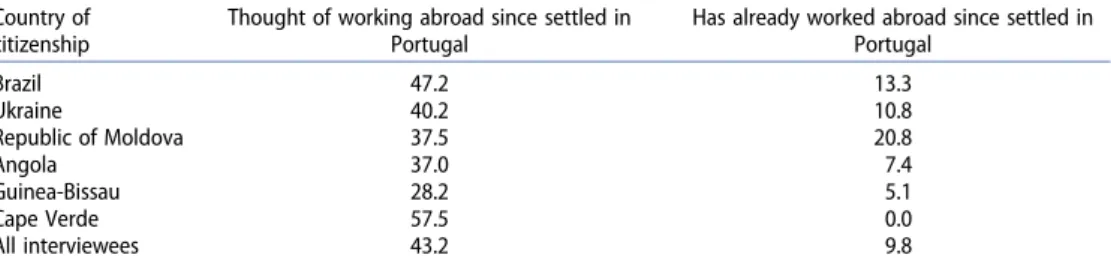
Thinking of working abroad since settled in Portugal has been on the mind of 43.2% of the CRISIMI respondents residing in the LMA. However, only 9.8% of the interviewees have really done so. The difference between intention and practice is quite remarkable showing that immigrant agency in the decision-making process of onward migration is constrained by individual factors such as skill levels, legal status or the existence of dependent minors and also by contextual ones like access to an EU nationality, existence of job offers abroad or the presence of relatives in other countries. Indeed, among the respondents who spent
some time working abroad after migrating to Portugal, the majority (84.6%) had a visa or a valid residence permit for Portugal. Onward migration is also confirmed by a survey con-ducted to Brazilian immigrants in Metropolitan London in the ambit of the THEMIS project. In fact, 6.7% of the respondents have already been living in Portugal before they moved to the U.K.
Despite the constraints on mobility and employment faced by long-term residents, some immigrants still take the risk of trying to make a living in a country for which they do not hold legal documents. According to Table 2, this option was more often taken by Brazilians (13.3%) and Ukrainians (10.8%) on the contrary to Guinea-Bissauans (5.1%) or Cape Verdeans (0.0%). Again the disparity between concretisation and intention is remarkable. If one considers the responses on the thought of working abroad, the pro-portions are much higher, especially among Portuguese-Speaking immigrants from the former African colonies: Cape Verdeans (57.5%) and Guinea-Bissauans (28.2%). The idea had already crossed the mind of 47.2% of the Brazilian respondents and 40.2% of the Ukrainians.
Factors like the level of skills, which can be roughly assessed through schooling level, may play a difference in the decision to re-emigrate because education is a determinant of wages. In some countries the more mobile people are the better educated ones, whereas in others it is a different picture. Referring to Portugal (and Turkey), Dustmann and Glitz (2011, 10) remark that‘those who decide to emigrate appear to come predomi-nantly from the middle of the educational spectrum’, that is neither from the top nor the bottom end of the education range. In the case of LMA, it is among the interviewees who have between 6 and 9 years of education that one finds the higher proportion of those who have already been working abroad (11.4%). The proportions are lower for graduated and post-graduated individuals (9.3%) and also for illiterate or who have less than six years of education (8.0%). One may suggest that the more educated were able to find a place in the Portuguese labour market, not necessarily compatible with their skills, and the less edu-cated do not have the means (relational and financial capital) to take this step.
Having relatives abroad can also play a role in the decision to stay or to re-emigrate being networks of co-ethnics recognised as essential to reduce the costs of migration and limiting its associated risks (Massey et al.2005). Among the respondents who have relatives abroad, 13.0% said they had already worked in other countries since settled in Portugal whereas for those who do not have family outside the country, only 8.4% had the experience of re-emigrating to work.
Table 2.Working abroad since settled in Portugal: intention and detected effective practice among interviewees in LMA (%).
Country of citizenship
Thought of working abroad since settled in Portugal
Has already worked abroad since settled in Portugal Brazil 47.2 13.3 Ukraine 40.2 10.8 Republic of Moldova 37.5 20.8 Angola 37.0 7.4 Guinea-Bissau 28.2 5.1 Cape Verde 57.5 0.0 All interviewees 43.2 9.8
Source: CRISIMI database.
Finally, factors like schooling levels, perceived cultural proximity and the level of migratory culture can also play a role in the decision-making process that leads (or not) to re-emigration. Although further research is needed in this field, it is significant that immigrants from the African groups in Portugal with the exception of Cape Verdeans, the most transnational PALOP population – display lower levels of intention to implement this strategy than Moldavians, Ukrainians and Brazilians (who display on average higher school levels and in the first two cases are part of a broad ‘European culture’) and an even more reduced capacity to concretise it.
5. Concluding remarks
The central aim of this article has been to unravel the effects of the Portuguese economic and financial crisis that started approximately twelve years ago and has deepened after 2011 on the labour market integration of immigrants considering their resilience, visible in the strategies adopted to overcome the challenges, either these are locally devel-oped or involve geographical mobility, namely re-emigration.
In a framework of post-fordism where neo-liberal ideas of economic deregulation thrive and the access to welfare state benefits is growingly more conditioned, migrants’ resilience is being constantly put to the test. The higher unemployment rates of third-country citizens and lower wages comparatively to nationals for medium and low skilled jobs in the same professional group reveal immigrants’ increased vulnerability to harsher conditions in the labour market integration.
The reinforcement of the disparities between Portuguese and foreign citizens concern-ing the severe material deprivation rate shows that for these, economic integration has become more challenging in the crisis context. The reductions in social support to families combined with wage cuts, increasing unemployment in sub-sectors where migrants are found more often concur to unpack the disparities between Portuguese citizens and foreigners, especially third-country nationals.
The challenges TCN have to face in the labour market do not demote most of them from thinking it was worth coming to Portugal also because employment precariousness or even exclusion does not necessarily mean they do not feel part of other social worlds (Finotelli and Ponzo 2018). However, the tone of opinions expressed by interviewees residing in the LMA is less positive among the recently arrived individuals (from 2009 onwards) concerning professional position, monthly income and joblessness. The con-frontation of expectations immigrants have about their possible success in the host country and the life here on the one hand, and the comparison with what might have been their lives had they not migrated varies according to skills and the social and econ-omic situation at the home country.
To face the several drawbacks imposed by recession, immigrants develop a set of reac-tive individual and family strategies which configure their resilience process. These strat-egies, aiming for the normalisation of immigrants’ lives in Portugal, can be clustered in two major groups:
(a) the in situ options in which immigrants decide to keep their residence and their work in Portugal and resort to individual resources (63.6%), ask for help to relatives, friends and neighbours (26.3%) or simply change their consumption habits (4.4%). Concerning the specific relationship with the labour market in‘times of crisis’, communities such as the
Brazilians try to explore some market niches based on the mobilisation of specific individual resources, such as the attractive Portuguese accent or the ability to cook. In addition, an increase in situations of job precarity– lower wages, odd jobs – is also taking place.
(b) the choice for continuing their international moves, even when the‘official’ resi-dence remains in Portugal, re-emigrating to countries, mostly in the EU (U.K., France, Belgium…), where free circulation devices facilitate mobility, at least until the recent refu-gees’ crisis. Immigration to these ‘second’ destination countries is often supported by net-works of friends and relatives and is pushed by the expectancies to find higher levels of economic integration (a wider job offer, higher wages, and a professional career). Indeed, 9.8% of the TCN interviewed had spent some time working abroad since living in Portugal.
As far as the re-emigration strategy is concerned, evidences of a mix with the increasing outflows of Portuguese nationals in terms of destinations, jobs and recruitment forms could also be found. In several cases, there is a connection of both strategies (e.g. to re-emi-grate leaving the main residence and some family members in Portugal), situation that contributes to resilience to the crisis effects and simultaneously to support the continu-ation of the social integrcontinu-ation process in Portugal, because economic resources are poured into the family members that did not leave the country.
The choice for strategies of immobility and mobility depend on individual factors (age, skill levels, stage in family cycle, and legal status) that are embedded in contextual factors like the access to job offers abroad (formal or informal), the perceived and effective cul-tural proximity or the formal regulatory framework.
Taking into account the evidences of increasing re-emigration within EU countries of TCN settled in Portugal, either with Portuguese citizenship or in possession of a long-term residence permit, it is important to have a deeper understanding about the role and the intensity in the use of both the co-ethnics network and the Portuguese emigration network and to what extend these merge. In addition, a reading of the complex table of transnational and translocal relations, namely at intra-EU level, of immigrants and immigrant families in Portugal that are involved in re-emigration, involving identities, residential strategies, work options and reference places for both production and reproduction, also deserves a deeper attention. Actually, it would be interesting to investigate if the reduction in unemployment rates and the increase in social trust presently taking place in Portugal have an effect in the number of TCNs that abandon the option of re-emigration and return to their ‘first’ destination place in Portugal.
Finally, a future development of the analysis of the link between political and economic contexts and international geographical mobility should explore the changing nature of migration flows when crisis or economic expansion periods take place at origin and des-tination places, namely within specific migration systems.
Notes
1. The Troika is a group of international lenders– the European Commission, the International Monetary Fund and the European Central Bank– that provided the Portuguese 78-billion euros bailout in exchange for a strict austerity policy, agreed in 2011.
2. The project CRISIMI (The impact of the economic crisis on the living conditions and dynamics of the incorporation in the labour market of the immigrants settled in Portugal)
was developed between November 2014 and August 2015, and was funded by the High Com-mission for Migration through the European Fund for the Integration of Third-Country Nationals. The project THEMIS (Theorising the Evolution of European Migration Systems) was sponsored by the NORFACE Research Programme on Migration and was developed between February 2010 and January 2014.
3. According to Collett and Petrovic (2014), three types of mainstreaming activities can be identified among European countries (through discourse, through governance and though policy).
4. The number of foreign citizens living in the country had a remarkable growth, leaping from 157 thousand individuals in 1994 to 454 thousand in 2009 (1.6% and 4.3% of the resident population, respectively), the highest stock ever registered.
5. Similarly, to other Southern European countries, Portugal implemented several extraordi-nary regularization campaigns between 1992/1993 and 2005, and having a valid labour con-tract was an essential condition for document regularization.
6. The network of local centres supporting migrant integration and offices providing specialized support had a remarkable expansion involving a growing number of local authorities and NGOs in its management and resource provision. Moreover, the High Commission for Migration’s budget was also reinforced immediately after the onset of the crisis (from 5.5 million€ in 2007 to 10.5 million in 2009) and no integration pro-jects were cut (Collett 2011). The Programme“Portuguese for All” set up in 2008 and had a constantly increasing number of foreign citizens wanting to learn Portuguese language.
7. The material deprivation rate is an indicator in EU-SILC that expresses the inability to afford some items considered to be desirable to lead an adequate life.
8. According to data from the employees’ boards from the Ministry of Solidarity, Employment and Social Security, there was the contraction of employed persons (−17.0% between 2007 and 2013), particularly noticeable among non-higher educated workers (−22.1%) and third-country nationals (−29.6%) comparatively to Portuguese employees (−16.7%) and in opposite direction to EU workers (+21.8%). The unemployment rate of third-country nationals was already higher than that of Portuguese citizens before the onset of the crisis (2007: 13.0% and 8.3%, respectively) becoming the gap even wider with the economic melt-down (2013: 30.4% and 16.6%, respectively)– Eurostat data.
9. Decree-law no. 133/2012, 27th June.
10. In the Lisbon Metropolitan Area there were a total of 537, non-randomly selected, intervie-wees. Due to the constraints imposed by the source of funding only third-country nationals could be considered in the survey. To the question about the resources mobilized to face expenses, 453 valid responses were obtained.
11. Graeber (2016, 1676) is very direct in pointing out an immigrant’s commitment to the labour market and to the country by holding that country’s citizenship.
12. Organic Law no.2/2006, 17 April.
13. Data from Eurostat and Statistics Portugal.
Disclosure statement
No potential conflict of interest was reported by the authors.
References
ACM.2016. Strategic Plan for Migration. Lisboa: Alto Comissariado para as Migrações.
Aysa-Lastra, M., and L. Cachón. 2015. “Introduction: Vulnerability and Resilience of Latin American Immigrants During the Great Recession.” In Immigrant Vulnerability and Resilience. Comparative Perspectives on Latin American Immigrants During the Great Recession, edited by M. Aysa-Lastra and L. Cachón, 1–21. Heidelberg: Springer.
Bakewell, O.2010.“Some Reflections on Structure and Agency in Migration Theory.” Journal of Ethnic and Migration Studies 36 (10): 1689–1708.
Bartolini, L., and E. Castagnone.2015.“Remittances and the Economic Crisis: Evidence from the Greenback 2.0 Survey in Italy.” The World Bank, Greenback Working Paper 1.
Bartolini, L., R. Gropas, and A. Triandafyllidou. 2017.“Drivers of Highly Skilled Mobility from Southern Europe: Escaping the Crisis and Emancipating Oneself.” Journal of Ethnic and Migration Studies 43 (4): 652–673.
Bellamy, R. 2004.“Introduction: The Making of Modern Citizenship.” In Lineages of European Citizenship Rights, Belonging and Participation in Eleven Nation-States, edited by R. Bellamy, D. Castiglione and E. Santoro, 1–21. Basingstoke: Palgrave Macmillan.
Carling, J. 2016. “Making and Breaking a Chain: Migrants’ Decisions About Helping Others Migrate.” In Beyond Networks. Feedback in International Migration, edited by O. Bakewell, G. Engbersen, M. L. Fonseca, Horst, C., 156–182. Basingstoke: Palgrave MacMillan.
Castles, S.2011.“Migration, Crisis, and the Global Labour Market.” Globalizations 8 (3): 311–324. Castles, S., H. de Haas, and M. Miller. 2014. The Age of Migration. International Population
Movements in the Modern World. 5th ed. Basinstoke: Palgrave Macmillan.
Collett, E. 2011. Immigrant Integration in Europe in a Time of Austerity. Washington, DC: Migration Policy Institute.
Collett, E., and M. Petrovic.2014. The Future of Immigrant Integration in Europe: Mainstreaming Approaches for Inclusion. Washington, DC: Migration Policy Institute.
Domingo, A., and E. Ortega-Rivera. 2015. “Acquisition of Nationality as Migration Policy.” In Demographic Analysis of Latin American Immigrants in Spain. From Boom to Bust, edited by D. Domingo, Valls, A. Sabater Coll, and R. R. Verdugo, 29–54. Heidelberg: Springer.
Dustmann, C., and A. Glitz.2011.“Migration and Education.” NORFACE Migration Discussion Paper 2011–11.
Erdal, M. B., and C. Oeppen. 2013. “Migrant Balancing Acts: Understanding the Interactions Between Integration and Transnationalism.” Journal of Ethnic and Migration Studies 39 (6): 867–884.
Esteves, A. (coord.), A. Estevens, A. Amilcar, J. McGarrigle, J. Malheiros, L. Moreno, M. L. Fonseca, and S. Pereira.2015. CRISIMI. O Impacto da Crise Económica Sobre as Condições de Vida e Dinâmicas de Inserção Laboral dos Imigrantes em Portugal, final report. Lisboa: IGOT and ACM.
Eurofound. 2015. Families in the Economic Crisis: Changes in Policy Measures in the EU. Luxembourg: Publications Office of the European Union.
Finotelli, C., and I. Ponzo2018.“Integration in Times of Economic Decline. Migrant Inclusion in Southern European Societies: Trends and Theoretical Implications.” Journal of Ethnic and Migration Studies 44 (14): 2303–2319.doi:10.1080/1369183X.2017.1345830.
Fonseca, M. L., A. Esteves, and J. McGarrigle. 2016. “The Economic Crisis as a Feedback-Generating Mechanism? Brazilian and Ukrainian Migration to Portugal.” In Beyond Networks. Feedback in International Migration, edited by O. Bakewell, G. Engbersen, M. L. Fonseca, and C. Horst, 113–133. Basingstoke: Palgrave MacMillan.
Fonseca, M. L., and J. McGarrigle. 2014. “Immigration and Policy: New Challenges After the Economic Crisis in Portugal.” In Impacts of the Recent Economic Crisis (2008–2009) on International Migration, edited by E. Levine and M. Verea, 51–75. México, DF: Universidad Nacional Autónoma de México.
Graeber, J.2016.“Citizenship in the Shadow of the Euro Crisis: Explaining Changing Patterns in Naturalisation Among Intra-EU Migrants.” Journal of Ethnic and Migration Studies 42 (10): 1670–1692.
Huddleston, T., Ö. Bilgili, A.-L. Joki, and Z. Vankova.2015. Migrant Integration Policy Index 2015. Barcelona: CIDOB and MPG.
Irastorza, N., and D. DeVoretz.2015.“Border-Blind Love: Till Origin Do Us Part? A Theoretical Model to Analyse the Divorce Risk of Binational Couples.” International Journal of Migration and Residential Mobility 1 (2): 107–121.
Isin, E. F., and M. Saward. 2013. “Questions of European Citizenship.” In Enacting European Citizenship, edited by E. F. Isin and M. Saward, 1–18. Cambridge: Cambridge University Press. Janicka, A., and P. Kaczmarczyk.2016.“Mobilities in the Crisis and Post-Crisis Times: Migration Strategies of Poles on the EU Labour Market.” Journal of Ethnic and Migration Studies 42 (10): 1693–1710.
Jauer, J., T. Liebig, J. P. Martin, and P. Puhani.2014.“Migration as an Adjustment Mechanism in the Crisis? A Comparison of Europe and the United States”, OECD Social, Employment and Migration Working Papers, No. 155. Paris: OECD Publishing.
Joppke, C.2007.“Beyond National Models: Civic Integration Policies for Immigrants in Western Europe.” West European Politics 30 (1): 1–22.
Liebig, T., and F. Von Haaren.2011.“Citizenship and the Socioeconomic Integration of Immigrants and Their Children.” In OECD, Naturalisation: A Passport for the Better Integration of Immigrants? 23–57. Paris: OECD.
Lindley, A.2014.“Exploring Crisis and Migration: Concepts and Issues.” In Crisis and Migration. Critical Perspectives, edited by A. Lindley, 1–23. London: Routledge.
Lopes, A.2015. Migrantes Cabo-Verdianos em Portugal: Estratégias de Acção em Contexto de Crise. Cidade da Praia: Sotavento.
Malheiros, J., I. T. Oliveira, and R. Albrecht. 2015. “Portugal: Did the Crisis Aggravate Brain Drain?” In Brain Gain-Brain Drain: European Labour Markets in Times of Crisis, edited by A. Schelinger, 72–84. Berlin: Friedrich-Ebert-Stiftung. http://library.fes.de/pdf-files/id/ipa/12032. pdf.
Marques, J. C., and P. Góis.2010.“Do Leste ao Oeste: Novos Fluxos Migratórios em Portugal.” In Imigração Ucraniana: A Emergência de Uma ou Várias Comunidades? organized by M. I. Baganha, J. C. Marques, and P. Góis, 26–30. Lisboa: ACIDI.
Massey, D., J. Arango, G. Hugo, A. Kouaouci, A. Pellegrino, and J. Taylor.2005. Worlds in Motion: Understanding International Migration at the End of the Millennium. Oxford: Clarendon Press. McGarrigle, J. 2016. “Islam in Urban Spaces: The Residential Incorporation and Choices of
Muslims in Lisbon.” Journal of Ethnic and Migration Studies 42 (3): 437–457.
McGarrigle, J., and E. Ascensão. 2017. “Emplaced Mobilities: Lisbon as a Translocality in the Migration Journeys of Punjabi Sikhs to Europe.” Journal of Ethnic and Migration Studies.
doi:10.1080/1369183X.2017.1306436.
OECD.2015. Indicators of Immigrant Integration 2015: Settling in. Paris: OECD.
Oliveira, C. (coord.), and N. Gomes. 2016. Indicadores de Integração de Imigrantes. Relatório Estatístico Anual 2016. Lisboa: Alto Comissariado para as Migrações.
Oliveira, C., and J. Rath.2008.“Introduction to the Special Issue.” Migrações Journal 3 (October): 11–27.
Papademetriou, D.2003.“Policy Consideration for Immigrant Integration”, Migration Information Source, October 2003.http://www.migrationinformation.org/feature/display.cfm?ID=171. Peixoto, J. 2008. “Imigração e Mercado de Trabalho em Portugal: Investigação e Tendências
Recentes.” Revista Migrações 2 (Abril): 19–46.
Peixoto, J. 2009. “New Migrations in Portugal: Labour Markets, Smuggling and Gender Segmentation.” International Migration 47 (3): 185–210.
Pereira, S. 2010. Trabalhadores de Origem Africana em Portugal. Impacto das Novas Vagas de Imigração. Lisboa: Edições Colibri.
Pereira, S. 2013. “Replacement Migration and Changing Preferences: Immigrant Workers in Cleaning and Domestic Service in Portugal.” Journal of Ethnic and Migration Studies 39 (7): 1141–1158.
Ponzo, I., C. Finotelli, J. Malheiros, M. L. Fonseca, and E. Salis.2015.“Is the Economic Crisis in Southern Europe Turning Into a Migrant Integration Crisis?” Politiche Sociali 1: 59–88. Reis, J., T. Pereira, J. Tolda, and N. Serra. 2010. Imigrantes em Portugal – Economia, Pessoas,
Qualificações e Territórios. Coimbra: Almedina.
Roos, C., and N. Zaun.2016.“The Global Economic Crisis as a Critical Juncture? The Crisis’s Impact on Migration Movements and Policies in Europe and the U.S.” Journal of Ethnic and Migration Studies 42 (10): 1579–1589.
Tilly, C.2011.“The Impact of the Economic Crisis on International Migration: A Review.” Work, Employment and Society 25 (4): 675–692.
Trenz, H. J., and A. Triandafyllidou.2017.“Complex and Dynamic Integration Processes in Europe: Intra EU Mobility and International Migration at Times of Recession.” Journal of Ethnic and Migration Studies 43 (4): 546–559.
Vasta, E.2006.“From Ethnic Minorities to Ethnic Majority Policy: Changing Identities and the Shift to Assimilationism in the Netherlands.” Centre on Migration, Policy and Society Working Paper No. 26, University of Oxford.
Vink, M.2013. Immigrant Integration and Access to Citizenship in the European Union: The Role of Origin Countries. San Domenico di Fiesole: European University Institute.
Wall, K.2016.“Family Policies in Portugal: Brief Overview and Recente Developments.” In A(s) Problemática(s) da Natalidade em Portugal: Uma Questão Social, Económica e Política, organized by V. Cunha, D. Vila, K. Wall, J. Lavinha, and P. T. Pereira, 191–201. Lisboa: Imprensa de Ciências Sociais, ICS.
Wiesböck, L., R. Verwiebe, C. Reinprecht, and R. Haindorfer. 2016.“The Economic Crisis as a Driver of Cross-border Labour Mobility? A Multi-method Perspective on the Case of the Central European Region.” Journal of Ethnic and Migration Studies 42 (10): 1711–1727. Wimmer, A., and N. Glick-Schiller.2002.“Metodological Nationalism and Beyond: Nation-state