TÍTULO
Nome completo do Candidato
Subtítulo
Dissertação / Trabalho de Projeto / Relatório de
Estágio apresentada(o) como requisito parcial para
obtenção do grau de Mestre em Estatística e Gestão
de Informação
Mobile payment:
Filipe Miguel Lopes Campos
Understanding the determinants of customer
adoption and technology recommendation
Dissertação apresentada como requisito parcial para
obtenção do grau de Mestre em Gestão de Informação
Instituto Superior de Estatística e Gestão de Informação Universidade Nova de Lisboa
MOBILE PAYMENT: UNDERSTANDING THE DETERMINANTS OF
CUSTOMER ADOPTION AND TECHNOLOGY RECOMMENDATION
por
Filipe Miguel Lopes Campos
Dissertação apresentada como requisito parcial para a obtenção do grau de Mestre em Gestão de Informação, Especialização em Gestão do Conhecimento e Business Intelligence
ACKNOWLEDGEMENTS
This dissertation was only possible with the support from people around me, to whom I would like to thank.
I would like to express my sincere thanks to Professor Tiago Oliveira for his essential guidance, commitment, constant availability and confidence in the successful implementation of this project.
I am also grateful to Professor Manoj Thomas for his precious help and validation.
I express my thanks to ISEGI-NOVA for providing me necessary conditions to conduct my research and all my professors for valuable teaching.
I would like to thank my parents for the support and for making possible my graduation, which has a major role in my personal and professional future.
To all my friends, thanks for the support and, in some cases, by sharing anguish and outbursts during this journey.
Last, but not least, a special thanks to my girlfriend for their unconditional support, and for always being present when I needed it.
RESUMO
Este estudo visa perceber quais os principais determinantes da adopção e recomendação da tecnologia de pagamentos móveis. Para atingir este objectivo, foi desenvolvido um modelo de pesquisa que combinou os modelos de adopção unified theory of acceptance and use of technology 2 (UTAUT2) e diffusions on innovations (DOI), juntamente com a variável perceived technology security (PTS). Foi realizado um questionário online, tendo sido obtidas 301 respostas válidas. Os dados recolhidos foram analisados utilizando a técnica de structured equation modeling (SEM), de forma a testar empiricamente o modelo e pesquisa. As principais conclusões retiradas são que os principais factores, com efeitos directos e indirectos, para a adopção e recomendação da tecnologia de pagamentos móveis são compatibility, perceived technology security, performance expectations, innovativeness e social influence. As conclusões deste estudo fornecem informações úteis às partes interessadas na tecnologia de pagamentos móveis.
PALAVRAS-CHAVE
Pagamentos móveis; Comunicação por campo de proximidade; UTAUT2; Difusão a inovação; Segurança tecnológica percebida
ABSTRACT
This study aims to understand the key determinants of mobile payment adoption and technology recommendation. To achieve this goal, we developed a research model that combine unified theory of acceptance and use of technology 2 (UTAUT2), diffusions on innovations (DOI) together with perceived technology security (PTS). An online survey was conducted and we obtained 301 usable responses. The data collected were analyzed using the structured equation modeling (SEM) technique to empirical test the research model. We conclude that the most important drivers that have direct and indirect effects on the adoption and technology recommendation of mobile payment are compatibility, perceived technology security, performance expectations, innovativeness and social influence. The findings of this study provide useful information for mobile payment stakeholders.
KEYWORDS
Mobile payment; Near Field Communication; UTAUT2; Diffusion of innovation; Perceived technology security
SUBMISSION
SUBMISSION RESULTING FROM THIS DISSERTATION
PAPER
Campos, F., Oliveira, T., & Thomas, M.. Mobile payment: Understanding the determinants of customer adoption and technology recommendation. (Submitted to a Top Journal)
TABLE OF CONTENTS
1. Introduction ... 1
2. Theoretical background ... 3
2.1.The concept of mobile payment ... 3
2.2.Prior research on mobile payment ... 3
2.3.Adoption models ... 5
2.3.1.Unified theory of acceptance and use of technology 2 (UTAUT2) ... 5
2.3.2.Diffusion of innovation (DOI) ... 6
2.3.3.Perceived technology security (PTS) ... 6
3. Research Model ... 8
3.1.UTAUT2 variables ... 9
3.2.DOI variables ... 11
3.3.Perceived technology security (PTS) ... 12
3.4.Recommendation ... 12
4. Methods ... 13
4.1.Measurement ... 13
4.2.Data ... 13
5. Data analysis and results ... 15
5.1.Measurement model ... 15
5.2.Structural model ... 17
6. Discussion ... 21
6.1.Practical implications ... 22
6.2.Theoretical implications ... 24
6.3.Limitations and future research ... 24
7. Conclusion ... 26
8. References ... 27
9. Appendix ... 31
9.1.Appendix A - Questionnaire ... 31
9.2.Appendix B - Demographic information ... 33
LIST OF FIGURES
Figure 2.1 - UTAUT2 model ... 6 Figure 3.1 - Research model ... 9 Figure 5.1 - Structural model results ... 18
LIST OF TABLES
Table 2.1 - Mobile payment studies published in peer reviewed journals ... 5 Table 5.1 - Quality Criteria (AVE, Composite Reliability, Alpha) and Factor Loadings ... 16 Table 5.2 - Fornell-Lacker Criteria: Matrix of correlation constructs and the square root
of AVE (in bold) ... 17 Table 5.3 - Total effects ... 20
LIST OF ACRONYMS AND ABBREVIATIONS
ATM Automated teller machine
AVE Average variance extracted
BI Behavioral intention
C Compatibility
C-TAM-TPB Hybrid model combining constructs from TAM and TPB DOI Diffusion of innovation
EE Effort expectancy
FC Facilitating conditions
HM Hedonic motivation
I Innovativeness
IDT Innovation diffusion theory
IT Information technology
K-S Kolmogorov–Smirnov statistic test
MM Motivational model
MPCU Model of PC utilization
NFC Near Field Communication
PC Personal computing
PDA Personal digital assistant
PE Performance expectancy
PLS Partial least squares
PTS Perceived technology security
PV Price value
REC Recommendation
RFID Radio-frequency identification
SCT Social cognitive theory
SEM Structural equation modeling
SI Social influence
TAM Technology acceptance model
TPB Theory of planned behavior
1. INTRODUCTION
A new form of payment that utilizes short-range contactless technologies, such as Near Field Communication (NFC) are now integrated in many mobile phones and portable devices. They are anticipated to become an essential component in mobile commerce. The widespread use of mobile devices and their permanent proximity to the users make them suitable for mobile payment scenarios without the need for a physical wallet (Mallat, 2007). With mobile payments that use NFC, customers just need to "wave" their mobile phones near a reader for payments to be completed (Shin, 2010). NFC-enabled mobile phones allow contactless payments in a vast variety of business. It renders numerous benefits including quick purchasing of products and transferring of secure information between devices, as well as convenience and speed in an environment where the volume of payments are high, for example in restaurants and large retailers (Leong et al., 2013). The great advantage of this technology is the significant decrease in time of the operation. In addition to speeding up the payment process and productivity gains by traders and consumers, mobile payment technology also allows lower transaction costs and fees paid by merchants (Dias, 2013). According to IE Market Research Corporation (Corporation, 2012), the revenue for the global mobile payment is anticipated to achieve USD998.5 billion in 2016, thus becoming one of the most important means of conducting mobile transactions.
To date, only three studies have analyzed the adoption of mobile payments using NFC technology (Leong et al., 2013; Slade et al., 2014; Tan et al., 2014). In Leong et al. (2013) study, it was suggested to explore the determinants of mobile payment using other adoption models different from their research model - which included constructs from psychological science, trust-based, behavioral control, and parsimonious TAM. In Slade et al. (2014) study, it was suggested to explore further extensions of UTAUT2 different from their extensions - trust and perceived risk. In Tan et al. (2014) study, it was suggested that different factors from their research model - which included constructs from psychological science, finance-related risks, and TAM - should be included to analyze mobile payment adoption. Therefore, this study seeks to complement previous studies findings, to understand the determinants of mobile payment adoption and recommendation. We developed a conceptual model that combine unified theory of acceptance and use of technology 2 – UTAUT2 (Venkatesh et al., 2012), DOI theory (Rogers, 2003), and a perceived technology security construct (Cheng et al., 2006), to understand the facilitators and inhibitors of this technology.
The contribution of this study is threefold. First, we investigate the direct and indirect effects of the determinants on mobile payment adoption using an integrated research model. Second, is the inclusion of a component of product recommendation to evaluate the success of the technology. This component has been underused in research and can be of great importance when one wants to study a new technology (Miltgen et al., 2013). Product recommendation has not been tested before in the mobile payment research area. Third, using an empirical evaluation of the determinants of mobile payment, we provide insights to stakeholders - merchants, issuers, acquirers and NFC device owners, and contribute to the wider body of scientific knowledge on the use and adoption of this technology (Smart Card Alliance, 2012).
The paper is structured as follows. In the next section we describe the concept of mobile payment, current theories that explain customers adoption of technology, and earlier research on this topic. The research model is then conceptualized. The research model, methodology, and results are then presented. The paper concludes with the discussion of the theoretical contributions and managerial implications, as well as avenues for future research.
2. THEORETICAL BACKGROUND
2.1. THE CONCEPT OF MOBILE PAYMENTGhezzi et al. (2010, p. 5) summarized the concept of mobile payment as "a
process in which at least one phase of the transaction is conducted using a mobile device (such as mobile phone, smartphone, PDA, or any wireless enabled device) capable of securely processing a financial transaction over a mobile network, or via various wireless technologies (NFC, Bluetooth, RFID, etc.)". Dahlberg et al. (2008, p.
165) describes mobile payment as the ‘‘payments for goods, services, and bills with a
mobile device such as mobile phone, smart-phone, or personal digital assistant by taking advantage of wireless and other communication technologies’’.
Mobile payment technology uses several techniques to ensure the security of transactions. First, the phone must be activated with a longer pin chip operation. Additionally, transactions without pin are limited to the amount set by the consumer (in Europe it is set as 20€ initially, but users can switch to the amount they wish). Finally, there is a limit on the cumulative transactional value, (e.g., usually between 50 to 60€ in Europe), after which the user has to enter the pin again in the terminal or ATM (Dias, 2013).
2.2. PRIOR RESEARCH ON MOBILE PAYMENT
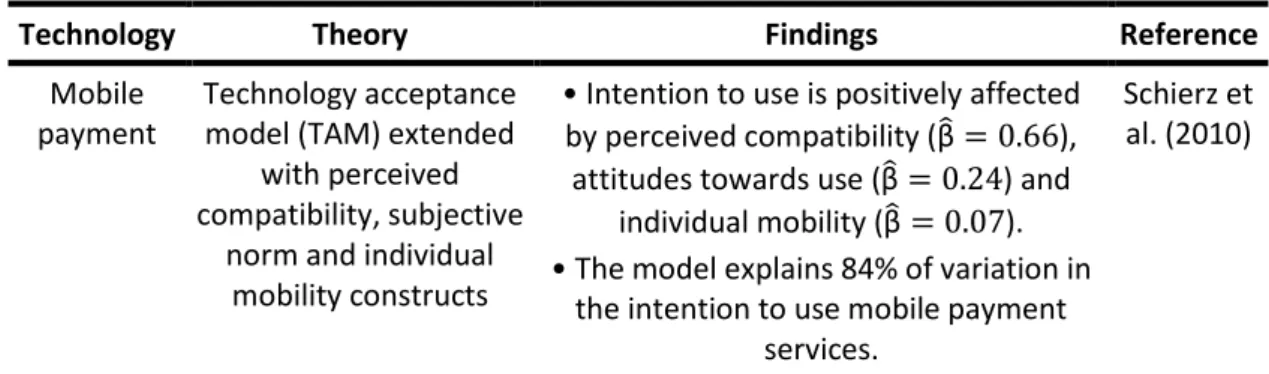
Although there are many quantitative studies on mobile payment (Dahlberg et al., 2008; Madlmayr, 2008; Zhou, 2013, 2014), there is a paucity of research on its determinants, acceptance, and adoption factors (Leong et al., 2013; Schierz et al., 2010; Slade et al., 2014; Tan et al., 2014). A summary of previous research on mobile payments is presented on Table 2.1. From previous studies on mobile payment, we can observe that there is few research using UTAUT2 theory (Slade et al., 2014). Unlike mobile payment which is a relatively new area of technology research, studies on internet banking (Cheng et al., 2006; Martins et al., 2014; Tan & Teo, 2000) and mobile banking (Gu et al., 2009; Koenig-Lewis et al., 2010; Oliveira et al., 2014; Yang, 2009) have been widely conducted.
Technology Theory Findings Reference
Mobile payment
Technology acceptance model (TAM) and
constructs from psychological science,
trust-based and behavioral control
• There is a significant and direct relationship between both perceived ease of use and perceived usefulness on intention to use while trust and personal
innovativeness in information technology (IT) have significant indirect
effects on the intention to use
Leong et al. (2013) Mobile payment UTAUT2 model extended with perceived risk and trust
• Intention to adopt NFC mobile payment is positively influenced by performance expectancy , social
influence ), habit ( , perceived risk ( and trust
.
• The model explains 58% of variation in the intention to adopt NFC mobile
payments. Slade et al. (2014) Mobile payment Technology acceptance model (TAM) extended with behavioral and
finance-related risk constructs
• Personal innovativeness ( ), was found to be the most significant
predictor of behavioral intention. • Perceived risk was not found to predict behavioral intention. • The model explains 45% of variation in
the intention to adopt mobile credit card. Tan et al. (2014) Mobile payment Exploring consumer adoption of mobile payment
• A qualitative approach using focus group interviews was chosen to explore consumer adoption of mobile payment.
The relative advantage of mobile payment includes independence of time
and place, availability, possibilities for remote payment, and queue avoidance.
The adoption of mobile payment was found to be dynamic.
Mallat (2007)
Mobile payment
Past, present and future of mobile payment
research
• The two most studied factors in mobile payment research are mobile payment technologies, and consumer perspective
of mobile payment. The social and cultural factors impacting mobile payment, as well as traditional payment
services in comparison to mobile payment were discovered as the uncharted black areas of past research.
Dahlberg et al. (2008)
Technology Theory Findings Reference
Mobile payment
Technology acceptance model (TAM) extended
with perceived compatibility, subjective
norm and individual mobility constructs
• Intention to use is positively affected by perceived compatibility ( ), attitudes towards use ( ) and
individual mobility ( ). • The model explains 84% of variation in
the intention to use mobile payment services.
Schierz et al. (2010)
Table 2.1 - Mobile payment studies published in peer reviewed journals
2.3. ADOPTION MODELS
2.3.1. Unified theory of acceptance and use of technology 2 (UTAUT2)
Venkatesh et al. (2003) provided a comprehensive examination of eight prominent models and developed the unified theory of acceptance and use of technology (UTAUT). The eight models studied were the theory of reasoned action [TRA – Fishbein & Ajzen, (1975)], technology acceptance model [TAM – Davis, (1989)], motivational model [MM – Davis, Bagozzi, and Warshaw, (1992)], theory of planned behavior [TPB – Ajzen, (1991)], a hybrid model combining constructs from TAM and TPB [C-TAM-TPB – Taylor & Todd, (1995)], model of PC utilization [MPCU – Thompson, Higgins, and Howell, (1991)], innovation diffusion theory [IDT – Moore & Benbasat,(1996)], and social cognitive theory [SCT – Compeau & Higgins, (1995)]. The UTAUT model postulates that four constructs are determinants of behavioral intentions and use behavior: (i) performance expectancy, (ii) effort expectancy, (iii) social influence, and facilitating conditions. In addition, UTAUT also posits the role of four key moderator variables: gender, age, experience, and voluntariness of use. Since its inception in 2003, researchers have increasingly turned to testing UTAUT to explain technology adoption. UTAUT has distilled the critical factors and contingences related to the prediction of behavioral intention to use a technology and technology use primarily in organizational contexts (Venkatesh et al., 2012).
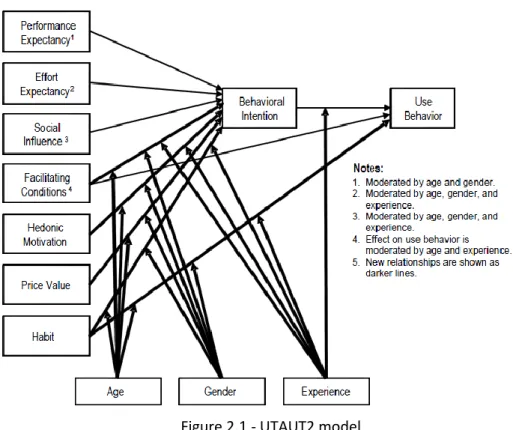
In 2012, Venkatesh et al. (2012) extended the UTAUT theory to study acceptance and use of technology in a consumer context, launching UTAUT2 theory. This extension added three constructs to the UTAUT model (hedonic motivation, price value, and habit), altered some existing relationships in the original conceptualization of UTAUT, and introduced new relationships. Individual differences (age, gender, and experience) were hypothesized to moderate the effects of those constructs on behavioral intention and technology use. The UTAUT2 model is shown on Figure 2.1.
Figure 2.1 - UTAUT2 model
2.3.2. Diffusion of innovation (DOI)
Diffusion of innovation (DOI) theory, contributes by examining innovations and the success of their dissemination through a more precise indicator of consumer behavior (Rogers, 2003). Oliveira et al. (2014, p. 499) summarized DOI as "the
characteristics of the technology and the users perceptions of the innovation".
Research on innovation diffusion and technology acceptance suggest that compatibility is an important variable in determining technology acceptance outcomes (Yi et al., 2006). Personal innovativeness in the domain of IT is defined by Yi et al. (2006, p. 351) as "the willingness of an individual to try out any new IT, plays an
important role in determining the outcomes of user acceptance of technology". It was
initially proposed as a moderator, but later re-conceptualized as a direct determinant of perceived usefulness and perceived ease of use (Yi et al., 2006).
2.3.3. Perceived technology security (PTS)
Perceived technology security (Cheng et al., 2006) analyzes the potential feelings of uncertainty using a technology. Information security concerns are defined as the buyers perception about a sellers inability and unwillingness to safeguard their
transactions (George, 2002), and has been viewed as a major barrier to e-commerce adoption (Hoffman et al., 1999; Rose et al., 1999). In an e-commerce context, Salisbury et al. (2001) demonstrated that perceived information security is a stronger determinant of intention to make online purchases. In the same context, Cheng et al. (2006) proved that perceived web security is a direct predicting variable for internet banking adoption. Assuming that users of mobile payments will have the same profile and characteristics of the users of internet banking, perceived technology security can be adapted and tested in the mobile payment context.
3. RESEARCH MODEL
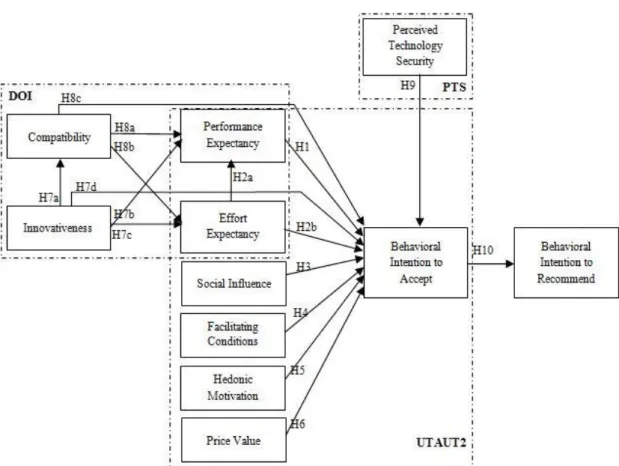
The research model is shown on Figure 3.1. The model combines UTAUT2 constructs with the innovation characteristics of DOI theory and the perceived technology security (PTS) for better understanding mobile payment phenomena. Based on UTAUT2 model we include six drivers (performance expectancy, effort expectancy, social influence, facilitating conditions, hedonic motivations, and price value). The habit construct from UTAUT2 was not included in the research model since mobile payment is relatively disruptive new technology that is not yet gained widespread utilization among consumers to generate a habit.
Considering mobile payment as a disruptive technology, innovation factors play an important role in the behavioral intention leading to its adoption. A user who tends to be innovative will be more likely to use new technologies than others. Similar to previous studies that that confirmed the influence of DOI constructs to predict intention to adopt IT systems (Hung, 2006), we therefore include the DOI constructs to determine their influence on the adoption of mobile payment. Relative advantage and complexity constructs from the DOI theory are not included in the model as they are similar to the two UTAUT2 construct, performance expectancy and effort expectancy.
As mobile payment involves financial information that is personal and sensitive, the security concerns can be a barrier to technology adoption. Previous studies have concluded that security concerns are an inhibitor to the intention to adopt technologies when monetary information is involved (Cheng et al., 2006; Pavlou et al., 2007; Salisbury et al., 2001). Therefore, perceived technology security (PTS) is an important determinant included in the research model. This study also includes the customers intention to recommend the technological innovation as a possible way to evaluate the adoption of mobile payment. Recommending a technology to others is of great commercial interest to the service providers, but has often been neglected by researchers due to an overwhelming emphasis on use. We may also recognize that, today technology adoption is more than just individual significance. For instance, technology providers now routinely use social networks as new routes for the dissemination of attitude and behavior influencing messages. The research model we propose thus includes intention to recommend as a second key dependent variable (Miltgen et al., 2013).
Figure 3.1 - Research model
3.1. UTAUT2 VARIABLES
Performance expectancy (PE) is "the degree to which using a technology will
provide benefits to consumers in performing certain activities" (Venkatesh et al., 2012,
p. 159). For mobile payment, it reflects the user perception of performance improvement from its use. It is the user perception of performance improvement, such as convenience of payment, fast payment process, and service effectiveness. The individuals perception that using mobile payment will help to attain gains in performing payment tasks may thus influence the behavioral intention to adopt mobile payment.
H1. Performance expectancy positively influences the behavioral intention to adopt mobile payment.
Effort expectancy (EE) is "the degree of ease associated with consumers use of
technology" (Venkatesh et al., 2012, p. 159). According to Miltgen et al. (2013), effort
expectancy (EE) contributes to a precise prediction of intention to adopt a new technology. It not only has a direct effect on the behavioral intention, but also is a
positive antecedent of performance expectancy (PE). When users feel that mobile payments is easy to use and does not require much effort, they have a high expectation towards acquiring the desired performance; otherwise, the performance expectancy will be low (Venkatesh et al., 2003).
H2. Effort expectancy positively influences (a) performance expectancy, and (b) behavioral intention to adopt mobile payment.
Social influence (SI) reflects the effect of environmental factors such as the opinions of users friends, relatives, and superiors on user behavior (Venkatesh et al., 2003). Their opinions will affect users intention to adopt mobile payment services; it can both encourage and discourage adoption. "Is the extent to which consumers
perceive that important others (e.g., family and friends) believe they should use a particular technology" (Venkatesh et al., 2012, p. 159).
H3. Social influence positively influences the behavioral intention to adopt mobile payment.
Facilitating conditions (FC) are the operational infrastructure to support the use of mobile payment, such as users knowledge, ability, and resources (Venkatesh et al., 2003). This construct "refer to consumers perceptions of the resources and support
available to perform a behavior" (Venkatesh et al., 2012, p. 159). Mobile payments
requires users to have certain skills such as configuring and operating smartphone's, and connecting to the application. If users do not have the necessary operational skills, the behavioral intention to adopt mobile payments will decrease.
H4. Facilitating conditions positively influences the behavioral intention to adopt mobile payment.
Hedonic motivation (HM) is defined as the fun or pleasure derived from using a technology. It has been shown to play an important role in determining technology adoption and use (Venkatesh et al., 2012). In the consumer context, hedonic motivation has also been found to be an important determinant of technology adoption and use (Brown et al., 2005). Enabling a new form of payment, mobile payments may be enjoyable for users and, therefore, may influence the behavioral intention to adopt mobile payment.
For the consumer, price value (PV) is an important determinant of mobile payment adoption, as the cost and pricing structure will have significant impact on the decision to use mobile payment. Venkatesh et al. (2012) defines price value as the consumers cognitive trade-off between the perceived benefits of the technologies and the monetary cost for using them. The greater perceived benefits of using a technology, the positive price value it has and the less perceived monetary cost. Price value therefore has a positive impact on the intention to adopt mobile payment.
H6. Price value positively influences the behavioral intention to adopt mobile payment.
3.2. DOI VARIABLES
Innovativeness has been shown not only as a significant direct predictor of behavioral intention to adopt a new technology Yi et al. (2006), but also as an antecedent of compatibility, performance expectancy and effort expectancy. Yi et al. (2006) argues that, besides behavioral intention to adopt a new technology, disposition towards innovativeness directly determines three factors, namely performance expectancy, effort expectancy and compatibility. The higher the innovative level of a user, the greater the propensity to feel compatible with the technology and also recognizes the benefits and the ease of use of the technology.
H7. Consumers with higher innovativeness levels have higher (a) compatibility, (b) performance expectancy, (c) effort expectancy, and (d) behavioral intention to adopt mobile payment.
Compatibility has been shown as a direct predictor of the behavioral intention to adopt a new technology, and also as an antecedent of performance expectancy and effort expectancy (Koenig-Lewis et al., 2010). Customers may view mobile payment to be more compatible if it does not take much effort to use the technology. Users may also perceive mobile payment to be more compatible if they see benefits in using mobile payment to perform certain activities. Furthermore, if customers consider mobile payment to fit into their lifestyle, they are more likely to use the technology. Compatibility therefore reinforces performance expectancy, effort expectancy, and the intention to adopt mobile payment.
H8. Consumers with higher compatibility levels have higher (a) performance expectancy, (b) effort expectancy, and (c) behavioral intention to adopt mobile payment.
3.3. PERCEIVED TECHNOLOGY SECURITY (PTS)
Feeling secure in doing transactions with mobile technologies is important to minimize concerns regarding the effective use of the technology to make mobile payments (Salisbury et al., 2001). Therefore, perceived technology security has a positive influence on the customers intention to adopt mobile payment.
H9. Perceived technology security positively influences the behavioral intention to adopt mobile payment.
3.4. RECOMMENDATION
If consumers are influenced by word-of-mouth when judging the quality of an technology, they may also contribute their own opinion to the discourse. Literature exploring the relationship between behavioral intention and action notes that consumers with a higher intention to adopt a new technology are more likely to become adopters of the technology (Kuo et al., 2009), and also recommend the technology to others (Miltgen et al., 2013). As suggested by Goldsmith & Flynn (1992), a higher level of consumers adoption of technology can influence the intention to recommend the technology to their social network.
H10. Behavioral intention to adopt mobile payment positively influences the behavioral intention to recommend.
4. METHODS
4.1. MEASUREMENTA questionnaire was developed using constructs and items from literature worded to fit the mobile payment context (refer Appendix A). Measurement items for performance expectancy, effort expectancy, social influence, facilitating conditions, hedonic motivation, price value and behavioral intention are adapted from Venkatesh et al. (2012) and Bélanger et al. (2008); innovativeness and compatibility from Miltgen et al. (2013); perceived technology security from Cheng et al. (2006); and items for the recommendation construct was self-developed. Each item was measured on a seven-point Likert scale, ranging from 1 (totally disagree) to 7 (totally agree). Two demographic questions (age and gender) were also included. Age was measured in years and gender was measured in a dummy variable, where 0 represented women.
The questionnaire was created and administrated in English, and was reviewed for content validity by language experts from a university. Because the questionnaire was administered in Portugal, the English version of the instrument was translated into Portuguese by a professional translator. The questionnaire was then reverse translated into English to confirm translation equivalence.
To test the instrument and correct any errors, the questionnaire was pilot tested with a sample of 30 subjects in April of 2014. The results evidence that the scales were reliable and valid. This data from the pilot test was not used in the second phase of data collection to avoid skewing of results.
4.2. DATA
For data collection, 789 students and alumni of universities in Portugal were contacted by e-mail in May of 2014. A hyperlink to the online survey was included in the email. 203 valid responses were received. A followup e-mail was sent to those who had not answered after four weeks, from which additional 98 responses were validated, for a combined total of 301 valid responses for data analysis. The overall response rate was 38% which is reasonable for studies of this scale. 60% of the subjects were females. The age ranged from 18 to 66 years, and the mean age was 29 years (refer Appendix B). 78% of respondents were academic graduates with a university degree. The sample is an indicative group to test the instrument since university students has high potential to adopt new information technologies such as mobile payment (Sohn et al., 2008; Yang, 2005). Additionally, contacting students
across the country enable a generalization of the findings that represent the overall Portuguese context. To test for non-response bias, the sample distribution of the first and second respondents groups was compared using the Kolmogorov–Smirnov (K–S) test (Ryans, 1974). K–S test suggests that the sample distributions of the two groups did not differ statistically (Ryans, 1974), indicating that non-response bias was not present. The common method bias was examined using the Harman's test (Podsakoff et al., 2003). No significant common method bias was found in the data.
5. DATA ANALYSIS AND RESULTS
Structural equation modeling (SEM) is a technique for estimating causal relations applying a combination of statistical data and qualitative causal hypothesis. Previous researchers recognize the potential of distinguishing between measurement and structural models, and take measurement error into consideration (Henseler et al., 2009). There are two types of SEM techniques: (i) covariance-based techniques and (ii) variance-based techniques. The variance-based technique, partial least squares (PLS) is suitable for this study, because: (i) not all items in our data are distributed normally (p<0.01 based on Kolmogorov-Smirnov test; (ii) the research model has not been tested in previous literature; (iii) the research model is considered as complex. Smart PLS 2.0 M3 software is used to estimate the research model (Ringle et al., 2005). The measurement model is first analyzed to assess reliability and validity, and the structural model is then tested.
5.1. MEASUREMENT MODEL
The measurement model was assessed for construct reliability, indicator reliability, convergent validity, and discriminant validity. The construct reliability was tested using the composite reliability and Cronbach’s alpha. As shown in Table 5.1, all the constructs have composite reliability and Cronbach’s alpha above 0.7, which suggests that the constructs are reliable (Straub, 1989). The indicator reliability was evaluated based on the criteria that the loadings should be greater than 0.70, and that every loading less than 0.4 should be eliminated (Churchill Jr, 1979; Henseler et al., 2009). One item for innovativeness (I3) was dropped due to a low factor loading. This item was also excluded in previous research (Yi et al., 2006). The remaining loadings are greater than 0.7, and all the items are statistically significant at 0.01. Overall, the instrument thus presents good indicator reliability. Average variance extracted (AVE) was used as the criterion to test convergent validity. The AVE should be higher than 0.5, so that the latent variable explains more than half of the variance of its indicators (Fornell & Larcker, 1981; Hair et al., 2012; Henseler et al., 2009). As shown in Table 5.1, all constructs have an AVE higher than 0.5, meeting this criterion.
Construct Item AVE Composite Reliability
Cronbach's
Alpha Loading t-value
Performance expectancy (PE) PE1 0.87 0.96 0.95 0.91 66.45***
PE2 0.94 93.73***
PE3 0.95 100.56***
PE4 0.94 107.35***
Effort expectancy (EE) EE1 0.82 0.95 0.93 0.90 61.75***
EE2 0.92 70.63***
EE3 0.91 51.7***
EE4 0.90 49.81***
Social influence (SI) SI1 0.95 0.98 0.97 0.97 121.92***
SI2 0.98 254.24*** SI3 0.98 239.39*** Facilitating conditions (FC) FC1 0.76 0.90 0.84 0.85 37.85*** FC2 0.85 35.76*** FC3 0.92 71.64*** Hedonic motivation (HM) HM1 0.86 0.95 0.92 0.90 52.21*** HM2 0.95 139.88*** HM3 0.92 65.55*** Prive value (PV) PV1 0.91 0.97 0.95 0.97 143.86*** PV2 0.97 127.79*** PV3 0.92 43.15*** Innovativeness (I) I1 0.79 0.92 0.87 0.91 81.53*** I2 0.87 48.8*** I4 0.89 47.75*** Compatibility (C) C1 0.89 0.97 0.96 0.93 62.99*** C2 0.95 129.34*** C3 0.93 78.87*** C4 0.96 121.01***
Perceived technology security (PTS) PTS1 0.92 0.98 0.97 0.95 94.64***
PTS2 0.96 163.47***
PTS3 0.96 159.92***
PTS4 0.96 114.46***
Behavioural intention (BI) BI1 0.97 0.99 0.98 0.98 220***
BI2 0.98 181.43***
BI3 0.99 392.52***
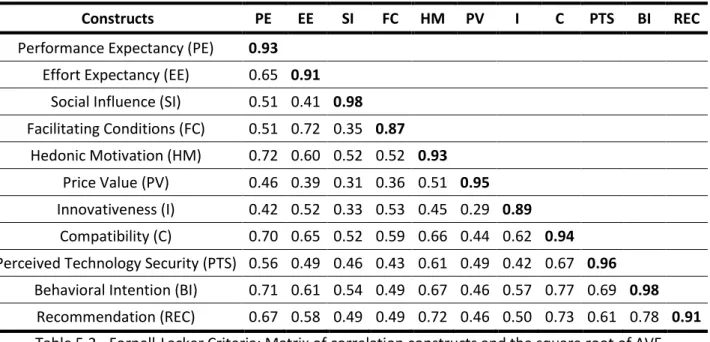
Discriminant validity of the constructs was evaluated using two criteria: Fornell-Larcker criteria and cross-loadings criteria. Fornell-Fornell-Larcker indicates that the square root of AVE should be greater than all correlations between each pair of constructs (Chin, 1998). As referred in Table 5.2, all diagonal values (square root of AVE) are greater than off-diagonal values (correlations between the construct). Cross-loadings criteria suggests that the loading of each indicator should be higher than all cross-loadings (Fornell & Larcker, 1981). As referred in Appendix C, the cross-loadings are greater than the correspondent cross-loadings. Therefore, both criteria are satisfied, providing evidence of discriminant validity of the scales.
Constructs PE EE SI FC HM PV I C PTS BI REC
Performance Expectancy (PE) 0.93
Effort Expectancy (EE) 0.65 0.91
Social Influence (SI) 0.51 0.41 0.98
Facilitating Conditions (FC) 0.51 0.72 0.35 0.87
Hedonic Motivation (HM) 0.72 0.60 0.52 0.52 0.93
Price Value (PV) 0.46 0.39 0.31 0.36 0.51 0.95
Innovativeness (I) 0.42 0.52 0.33 0.53 0.45 0.29 0.89
Compatibility (C) 0.70 0.65 0.52 0.59 0.66 0.44 0.62 0.94
Perceived Technology Security (PTS) 0.56 0.49 0.46 0.43 0.61 0.49 0.42 0.67 0.96
Behavioral Intention (BI) 0.71 0.61 0.54 0.49 0.67 0.46 0.57 0.77 0.69 0.98
Recommendation (REC) 0.67 0.58 0.49 0.49 0.72 0.46 0.50 0.73 0.61 0.78 0.91
Table 5.2 - Fornell-Lacker Criteria: Matrix of correlation constructs and the square root of AVE (in bold)
The measurement model results indicate that the construct reliability, indicator reliability, convergent validity, and discriminant validity of the constructs are satisfactory, and the constructs can be used to test the structural model.
5.2. STRUCTURAL MODEL
Figure 5.1 shows the PLS estimation results. The model explains 71.8% of behavioral intention (BI) to adopt mobile payments. Hypotheses related to behavioral intention - H1, H3, H7d, H8c, and H9 are confirmed, and hypotheses H2b, H4, H5, H6 are not confirmed. The model explains 38.5% of variation in compatibility (C), and validates the hypothesis (H7a) that consumers with higher innovativeness are more compatible with mobile payment. This model explains 55.4% of variation in performance expectancy (PE), and confirms hypotheses between the determinants
performance expectancy, compatibility (H8a), and effort expectancy (H2a). H7b is not confirmed. This model explains 44.9% of variation in effort expectancy (EE). The results confirm the hypotheses between the determinants effort expectancy, innovativeness (H7c), and compatibility (H8b). This model also explains 61.3% of variation in the recommendation of mobile payment and confirms the hypothesis that behavioral intention influences the intention to recommend the technology to others (H10). The structural model confirms 11 of the 16 hypothesis formulated. The results of this model were analyzed without the two moderator factors from UTAUT2 model (age and gender). The model was then tested by including the two moderator factors, but the complexity of the results supersede the minimal gain in R² (from 72% to 74%). These analysis results are therefore not included (the results are available from authors on request).
Note: Paths coefficients that are not statistically significant are in dashed arrows Figure 5.1 - Structural model results
The results show that compatibility (C) is the most important construct in explaining the behavioral intention (BI) to adopt mobile payments ( =0.26; p<0.01),
expectancy (PE) ( =0.23; p<0.01), innovativeness (I) ( =0.16 ; p<0.01), and social influence (SI) ( =0.08; p<0.10).
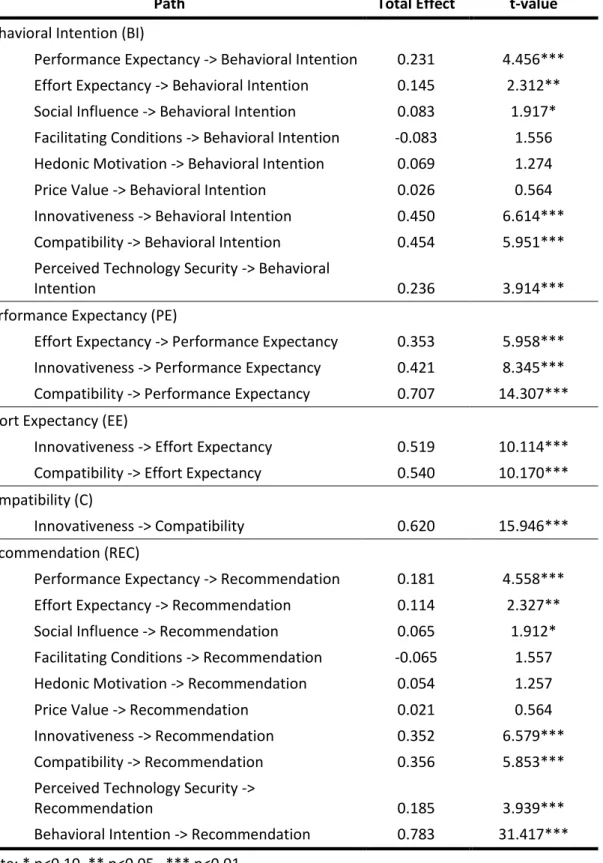
The study further extends the analysis to evaluate the total effect of independent variables. We provide one example of why the evaluation of total effects is significant. As the recommendation (REC) construct has only one direct effect (BI), the total effect is particularly relevant to better understand the indirect effect of the other constructs. As referred in Table 5.3, besides the direct effect of behavioral intention (BI) on recommendation (REC), the total effect of compatibility (C) ( =0.356; p<0.01), innovativeness (I) ( =0.352; p<0.01), perceived technology security (PTS) ( =0.185; p<0.01), performance expectancy (PE) ( =0.181; p<0.01), effort expectancy (EE) ( =0.114; p<0.05) and social influence (SI) ( =0.065; p<0.10) are significant in explaining the behavioral intention of the user to recommend the technology to others.
Path Total Effect t-value
Behavioral Intention (BI)
Performance Expectancy -> Behavioral Intention 0.231 4.456*** Effort Expectancy -> Behavioral Intention 0.145 2.312** Social Influence -> Behavioral Intention 0.083 1.917* Facilitating Conditions -> Behavioral Intention -0.083 1.556 Hedonic Motivation -> Behavioral Intention 0.069 1.274 Price Value -> Behavioral Intention 0.026 0.564 Innovativeness -> Behavioral Intention 0.450 6.614*** Compatibility -> Behavioral Intention 0.454 5.951*** Perceived Technology Security -> Behavioral
Intention 0.236 3.914***
Performance Expectancy (PE)
Effort Expectancy -> Performance Expectancy 0.353 5.958*** Innovativeness -> Performance Expectancy 0.421 8.345*** Compatibility -> Performance Expectancy 0.707 14.307*** Effort Expectancy (EE)
Innovativeness -> Effort Expectancy 0.519 10.114*** Compatibility -> Effort Expectancy 0.540 10.170*** Compatibility (C)
Innovativeness -> Compatibility 0.620 15.946*** Recommendation (REC)
Performance Expectancy -> Recommendation 0.181 4.558*** Effort Expectancy -> Recommendation 0.114 2.327** Social Influence -> Recommendation 0.065 1.912* Facilitating Conditions -> Recommendation -0.065 1.557 Hedonic Motivation -> Recommendation 0.054 1.257
Price Value -> Recommendation 0.021 0.564
Innovativeness -> Recommendation 0.352 6.579*** Compatibility -> Recommendation 0.356 5.853*** Perceived Technology Security ->
Recommendation 0.185 3.939***
Behavioral Intention -> Recommendation 0.783 31.417*** Note: * p<0.10, ** p<0.05, *** p<0.01
6. DISCUSSION
The influence that various factors may have on the behavioral intention to adopt mobile payment has not been fully understood until now. With the potential for mobile payment to become mainstream, this study fills an important research gap, and make contributions to practice and research on this emerging technological direction.
We develop an integrative model to evaluate the factors influencing the behavioral intention to adopt, as well as recommend mobile payment. The model combines constructs from two theoretical models (UTAUT2 and DOI), and incorporates the perceived technology security construct.
With regard to UTAUT2 constructs, the results reveal that performance expectancy is significant for the behavioral intention to adopt mobile payment (H1). Thus the extent to which mobile payment provides benefits in performing payment tasks is significant to the adoption of mobile payment. Similarly, effort expectancy is found significant to the performance expectancy (H2a) of mobile payment, but not significant in explaining the behavioral intention to adopt mobile payment. The findings are consistent with Cheng et al. (2006) and Slade et al. (2014). The results suggest that, lower effort in using mobile payment may result in higher expectations of attaining gains in performing payment tasks, but not necessarily the adoption of mobile payment technology. The study results also suggest that effort expectancy (H2b), facilitating conditions (H4), hedonic motivation (H5) and price value (H6) are not significant predictors of the behavioral intention to adopt mobile payment. However, the findings confirm the significance of social influence (H3) on the intention to adopt mobile payment. This may suggest that the opinion and recommendation of those who are influential and important may in fact drive the use technologies designed for the mobile platform. In addition, the results of our study show that performance expectancy and social influence are direct predictors of mobile payment adoption, while effort expectancy, facilitating conditions, hedonic motivation, and price value have lower relevance in the intention to adopt this technology. We may conclude that the newer constructs of UTAUT2 - hedonic motivation and price value - are not found relevant to the context of mobile payment adoption.
The results indicate that the influence of innovativeness construct on compatibility (H7a), effort expectancy (H7c) and behavioral intention (H7d) are validated, but does not validate its effect on performance expectancy (H7b). This results indicated the direct and indirect effect of innovativeness on behavioral
intention. As suggested by Agarwal & Prasad (1998), the findings confirm the importance of this construct in technology adoption models. The study suggests that regardless of the effort expectancy, if the user does not see the qualities and advantages associated with mobile payment (compatibility), the person may not be willing to try the new technology. The innovative the user, the more predisposed the person may be towards new technologies such as mobile payment.
With regard to compatibility, the results indicate that performance expectancy (H8a), effort expectancy (H8b) and behavioral intention (H8c) are higher when the customer perceives the technology to be compatible. This findings are similar to previous studys (Miltgen et al., 2013; Schierz et al., 2010) who have suggested the importance of compatibility in technology adoption. The results of our study therefore provide support to the argument that the behavioral intention to use technologies such as mobile payment may be higher when they fit the customers life style.
The results highlight the importance of perceived technology security on behavioral intention to adopt mobile payment (H9). The findings are similar to Cheng et al. (2006) study on internet banking adoption. This suggests that for technologies involving sensitive and personal data, the security capability to secure transactions is relevant, and a direct determinant of the customers intention to adopt the technology. Stakeholders such as financial institutions, and developers of mobile commerce applications should consider technology security as a priority in the mobile payment environment. A sense of insecurity may turn into an inhibitor for the adoption of technology applications that utilize mobile payment.
Our study also included the customers intention to recommend mobile payment, an important consideration that has often been neglected in adoption studies (Miltgen et al., 2013). The influence of behavioral intention variable on recommendation (H10) is validated. Our model explains 61% of the variance in recommendation. The result reinforces the findings of Miltgen et al. (2013), and our study affirms the importance and relevance of including the recommendation construct in studies on the adoption of innovative new technologies.
6.1. PRACTICAL IMPLICATIONS
This study contributes to understanding the determinants of mobile payment systems and its adoption. By examining the main facilitators (namely compatibility,
security) of mobile payment, we provide insights to all stakeholders interested in the development, use, and commercialization of this technology.
For stakeholders, the findings of this research point to initiatives and promotions that engage the customers innovativeness characteristics, as well as investing in resources that ensure a secure environment for their everyday transactions. If stakeholders combine these two features with marketing campaigns designed to pass the message to promote users comfort and welfare by the time they win with a faster payment system, customers will be even more attracted to adopt mobile payments.
The study enables us to identify three areas that influence users adoption of mobile payments: (1) customer specific characteristics, (2) technology specific characteristics, and (3) environmental characteristics. The first area involves the innovativeness characteristics of potential users of mobile payment. The study found innovativeness as one of the most important factors that explain the adoption of mobile payment. As well-informed customers are more likely to adopt a newer technology such as mobile payment, showcasing technology benefits and security features through advertising may be beneficial. Target marketing by running promotional campaigns that emphasize compatibility of mobile payment technology with their life styles may serve to engage the innovativeness characteristics of prospective customers.
The second area involves technology specific factors like compatibility, perceived security, and performance expectancy. Communication around mobile payment should emphasize its usefulness such as faster shopping, productivity gains, improved performance, etc. Additionally, the development and use of this technology should seek to reinforce security factors to ensure that consumers feel safe in performing the intended tasks.
The third area involves environmental factors that include social influence. If stakeholders are able to attain a following behind mobile payment, the social influence among customers may encourage new customers to adopt the technology. In this realm of influence, the impact of recommendation is a significant factor. Social network marketing, and opinion shared by friends, relatives and superiors are powerful ways that can help in the recognition, promotion, and success of mobile payment technology.
6.2. THEORETICAL IMPLICATIONS
With the ubiquitous popularity of mobile applications, and the integration of NFC technology in smart phones, mobile payment is set to gain rapid prominence. This study makes important contributions to the body of research on mobile payment technology. To understand the main facilitators and inhibitors of mobile payment how customers will respond to mobile payment, we develop an integrative research model that combines two theoretical models (UTAUT2 and DOI) with the perceived technology security construct. Through a survey of 301 users across the country of Portugal, this research comprehensively evaluates the determinants of the behavioral intention to adopt and recommend mobile payment. The results of the model indicate good explanatory power as evidenced by the statistical significance of the results. The elaboration of the results lends richness in the investigation of this new technology.
This research contributes to existing literature by evaluating determinants that previous studies have suggested to be significant for studying adoption of new technologies. The study complements prior research by considering determinants such as perceived technology security, innovativeness and compatibility that are emergent and relevant to the ongoing life style changes. Our findings indicate that these variables should be used as predictors in future studies on new technologies. In addition to the inclusion of these items in our model, the study evaluates the direct and indirect effect of the determinants on the behavioral intention to adopt and recommend mobile payment. Further, we highlight the importance of recommendation as an important construct for studying technologies with the potential to impact the routine activities of users.
6.3. LIMITATIONS AND FUTURE RESEARCH
The study has limitations which may provide the impetus for further research in this field of investigation. The main limitation is that it deals with a relatively new technology. There is a paucity of investigation and published literature, which hinders the literature review process, and the comparison of results and conclusions. This research did not assess factors that may influence the adoption of mobile payment, such as trust (Liébana-Cabanillas et al., 2013) and risk (Slade et al., 2014). This represents research opportunities to advance the understanding of mobile payment.
Another limitation of this research concerns the age range of the questionnaire respondents. 59% of the sample were aged 25 years or less, 29% was between the ages of 26 and 45, and only 12% respondents were over 45 years old. Although the older generation may be more reluctant than younger generations to use mobile payment, this disparity is not considered in this research, which prevents generalization of our findings. Another limitation related to the sample data is that all respondents belong to European countries. We therefore recommend caution in interpreting the findings of this study to non-European cultures. Future research can address the differences in age and culture.
This study focused on the intention to adopt mobile payment, but the activities of end-users related to mobile payment are not considered. Future research can target: (1) the usability of this technology (trying to assess significance of usage pattern, for example, shopping, restaurants, fast food, grocery, etc); (2) whether or not the use of the technology enables productivity gains for businesses and saves customers time; (3) outcome measures such as pattern of usage of the technology (for example, with or without PIN, the volume of usage, comparison with credit card use, etc).
7. CONCLUSION
Mobile payment is gaining attention, especially among consumers with mobile phone, as an alternative to using cash, check or credit cards. However, the factors influencing the adoption and future recommendation of this disruptive technology has not yet been comprehensively assessed. To fill this research gap, we formulate an integrated research model by combining constructs from two theories, namely DOI and UTAUT2, and the perceived technology security construct. We test the research model using a sample of 301 users across the country of Portugal. The results indicate that the important drivers to explain the acceptance and recommendation of mobile payments are compatibility, perceived technology security, innovativeness, performance expectancy, and social influence. The research offers practical suggestions to improve the marketing behind this innovative new technology, and provide suggestions for future research in this emerging field.
8. REFERENCES
Agarwal, R., & Prasad, J. (1998). A conceptual and operational definition of personal innovativeness in the domain of information technology. Information Systems
Research, 9(2), 204-215.
Ajzen, I. (1991). The theory of planned behavior. Organizational Behavior and Human
Decision Processes, 50(2), 179-211.
Alliance, S. C. (2012). Card payments roadmap in the United States: how will EMV
impact the future payments infrastructure? In
http://www.smartcardalliance.org/ (Ed.).
Bélanger, F., & Carter, L. (2008). Trust and risk in e-government adoption. The Journal
of Strategic Information Systems, 17, 165-176.
Brown, S. A., & Venkatesh, V. (2005). Model of adoption of technology in the household: A baseline model test and extension incorporating household life cycle. MIS Quarterly, 29(4), 399-426.
Cheng, E., Lam, D., & Yeung, A. (2006). Adoption of internet banking: An empirical study in Hong Kong. Decision Support Systems, 42, 1558–1572.
Chin, W. W. (1998). Issues and opinion on structural equation modeling. MIS Quarterly,
22(1), 7-16.
Churchill Jr, G. A. (1979). A paradigm for developing better measures of marketing constructs. Journal of Marketing Research, 16(1), 64-73.
Compeau, D. R., & Higgins, C. A. (1995). Computer self-efficacy: Development of a measure and initial test. MIS Quarterly, 19(2), 189-211.
Corporation, I. M. R. (2012). New research report by IE market research corporation. In http://www.businesswire.com/news/home/20120209005292/en/Global-Mobile-Payment-Market-Revenues-Rise-998.5#.VGiOxfmsU5U (Ed.).
Dahlberg, T., Mallat, N., Ondrus, J., & Zmijewska, A. (2008). Past, present and future of mobile payments research: A literature review. Electronic Commerce Research
and Applications, 7, 165-181.
Davis, F. D. (1989). Perceived usefulness, perceived ease of use, and user acceptance of information technology. MIS Quarterly, 13(3), 319-339.
Davis, F. D., Bagozzi, R. P., & Warshaw, P. R. (1992). Extrinsic and intrinsic motivation to use computers in the workspace. Journal of Applied Social Psychology, 22(14), 1111–1132.
Dias, A. P. (2013). Pagamentos mais rápidos. In Revista Exame Informática (pp. 21). Fishbein, M., & Ajzen, I. (1975). Belief, attitude, intention and behavior: An introduction
to theory and research.
Fornell, C., & Larcker, D.F. (1981). Evaluating structural equation models with unobservable variables and measurement error. Journal of Marketing
Research, 18(1), 39-50.
George, J. (2002). Influences on the intent to make internet purchases. Internet
Research, 12(2), 165-180.
Ghezzi, A., Renga, F., Balocco, R., & Pescetto, P. (2010). Mobile payment applications: Offer state of the art in the Italian market. Info, 12(5), 3-22.
Goldsmith, R., & Flynn, L.R. (1992). Identifying innovators in consumer product markets. European Journal of Marketing, 26 (12), 42–55.
Gu, J.-C., Sang-Chul, & Suh, Y.-H. (2009). Determinants of behavioral intention to mobile banking. Expert Systems With Applications, 36, 11605–11616.
Hair, J., Sarstedt, M., Ringle, C., & Mena, J. (2012). An assessment of the use of partial least squares structural equation modeling in marketing research. Journal of
the Academy of Marketing Science, 40(3), 414-433.
Henseler, J., Ringle, C. M., & Rudolf R. S. (2009). The use of partial least squares path modeling in international marketing. New Challenges to International
Marketing (Advances in International Marketing), 20, 277-319.
Hoffman, D. L., Novak, T. P., & Peralta, M. (1999). Building Consumer Trust Online.
Communications of the ACM, 42(4), 80-85.
Hung, S.-Y., Chang, C.-M., & Yu, T.-J. (2006). Determinants of user acceptance of the e-Government services: the case of online tax filing and payment system.
Government Information Quarterly, 23(1), 97–122.
Koenig-Lewis, N., Palmer, A., & Moll, A. (2010). Predicting young consumers' take up of mobile banking services. International Journal of Bank Marketing, 28 (5), 410-432.
Kuo, Y.-F., & Yen, S.-N. (2009). Towards an understanding of the behavioral intention to use 3G mobile value-added services. Computers in Human Behavior, 25(1), 103–110.
Leong, L.-Y., Hew, T.-S., Tan, G. W.-H., & Ooi, K.-B. (2013). Predicting the determinants of the NFC-enabled mobile credit card acceptance: A neural networks approach. Expert Systems With Applications, 40, 5604-5620.
Liébana-Cabanillas, F., Nogueras, R., Herrera, L.J., & Guillén, A. (2013). Analysing user trust in electronic banking using data mining methods. Expert Systems With
Applications, 40, 5439–5447.
Madlmayr, G. (2008). A mobile trusted computing architecture for a near field communication ecosystem. In 10th international conference on information
integration Web-based applications & services (pp. 563-566). New York, NY,
USA.
Mallat, N. (2007). Exploring consumer adoption of mobile payments – A qualitative study. Journal of Strategic Information Systems, 16, 413-432.
Martins, C., Oliveira, T., & Popovic, A. (2014). Understanding the Internet banking adoption: A unified theory of acceptance and use of technology and perceived risk application. International Journal of Information Management, 34, 1-13. Miltgen, C. L., Popovic, A., & Oliveira, T. (2013). Determinants of end-user acceptance
of biometrics: Integrating the "Big 3" of technology acceptance with privacy context. Decision Support Systems, 56, 103-114.
Moore, G. C., & Benbasat, I. (1991). Development of an instrument to measure the perceptions of adopting an information technology innovation. Information
Oliveira, T., Faria, M., Thomas, M. A., & Popovic, A. (2014). Extending the understanding of mobile banking adoption: When UTAUT neets TTF and ITM.
International Journal of Information Management, 34, 689-703.
Oliveira, T., Thomas, M., & Espanadal, M. (2014). Assessing the determinants of cloud computing adoption: An analysis of the manufacturing and services sectors.
Information & Management, 51, 497-510.
Pavlou, P. A., Huigang, L., & Yajiong, X. (2007). Understanding and mitigating uncertainty in online exchange relationships: A principal-agent perspective. MIS
Quarterly, 31(1), 105-136.
Podsakoff, P. M., MacKenzie, S. B., Jeong-Yeon L., & Podsakoff, N. P. (2003). Common method biases in behavioral research: A critical review of the literature and recommended remedies. Journal of Applied Psychology, 88, 879-903.
Ringle, C. M., Wende, S., & Will, A. (2005). SmartPLS 2.0. Retrieved from: http://www.smartpls.de. In.
Rogers, E. M. (2003). Diffusion of innovations, 5th Edition, The Free Press, New York. Rose, G., Khoo, H., & Straub, D. (1999). Current technological impediments to
business-to-consumer electronic commerce. Communications of the AIS, 16, 1-73.
Ryans, A. B. (1974). Estimating consumer preferences for a new durable brand in an established product class. Journal of Marketing Research, 11(4), 434-443. Salisbury, W., Pearson, R., Pearson, A., & Miller, D. (2001). Identifying barriers that
keep shoppers off the World Wide Web: Developing a scale of perceived web security. Industrial Management & Data Systems, 101(4), 165-176.
Schierz, G. P., Schilke, O., & Wirtz, W. B. (2010). Understanding consumer acceptance of mobile payment services: An empirical analysis. Electronic Commerce
Research and Applications, 9, 209-216.
Shin, D. H. (2010). Modeling the interaction of users and mobile payment system: Conceptual framework. International Journal of Human Computer Interaction,
26(10), 917-940.
Slade, E., Williams, M., Dwivedi, Y., & Piercy, N. (2014). Exploring consumer adoption of proximity mobile payments. Journal of Strategic Marketing, 1-15.
Sohn, S. Y., & Kim, Y. (2008). Searching customer patterns of mobile service using clustering and quantitative association rule. Expert Systems With Applications,
34, 1070–1077.
Straub, D. W. (1989). Validating Instruments in MIS Research. MIS Quarterly, 13(2), 147-169.
Tan, G., Ooi, K.-B., Chong, S.-C., & Hew, S.-C. (2014). NFC mobile credit card: The next frontier of mobile payment? Telematics and Informatics, 31, 292–307.
Tan, M., & Teo, T. S. H. (2000). Factors influencing the adoption of Internet banking.
Journal of the Association for Information Systems, 1.
Taylor, S., & Todd, P. A. . (1995). Assessing IT usage: The role of prior experience. MIS
Quarterly, 19(2), 561-570.
Thompson, R. L., Higgins, C. A., & Howell, J. M. (1991). Personal computing: Toward a conceptual model of utilization. MIS Quarterly, 15(1), 124-143.
Venkatesh, V., Davis, G. B., Davis, F. D., & Morris, M. G. (2003). User acceptance of information technology: Toward a unified view. MIS Quarterly, 27(3), 425–478.
Venkatesh, V., Thong, J. Y. L., & Xu, X. (2012). Consumer acceptance and use of information technology: Extending the unified theory of acceptance and use of technology. MIS Quarterly, 36, 157-178.
Yang, A. S. (2009). Exploring adoption difficulties in mobile banking services. Canadian
Journal of Administrative Sciences-Revue Canadienne Des Sciences De LAdministration, 26, 136-149.
Yang, K. C. C. (2005). Exploring factors affecting the adoption of mobile commerce in Singapore. Telematics and Informatics, 22(3), 257–277.
Yi, M. Y., Jackson, J.D., Park, J.S., & Probst, J.C. (2006). Understanding information technology acceptance by individual professionals: toward an integrative view.
Information Management, 43(3), 350-363.
Zhou, T. (2013). An empirical examination of continuance intention of mobile payment services. Decision Support Systems, 54, 1085–1091.
Zhou, T. (2014). An empirical examination of initial trust in mobile payment. Wireless
9. APPENDIX
9.1. APPENDIX A-QUESTIONNAIRE
Construct Items Source
Performance Expectancy (PE)
PE1 - Mobile payments are useful to carry out my tasks.
(Venkatesh et al., 2012) PE2 - I think that using mobile payment would enable me to conduct
tasks more quickly.
PE3 - I think that using mobile payment would increase my productivity. PE4 - I think that using mobile payment would improve my performance.
Effort Expectancy (EE)
EE1 - My interaction with mobile payment would be clear and understandable.
(Venkatesh et al., 2012) EE2 - It would be easy for me to become skilfull at using mobile payment.
EE3 - I would find mobile payment easy to use.
EE4 - I think that learning to operate mobile payment would be easy for me.
Social Influence (SI)
SI1- People who influence my behavior think that I should use mobile payment.
(Venkatesh et al., 2012) SI2- People who are important to me think that I should use mobile
payment.
SI3- People whose options that I values prefer that I use mobile payment.
Facilitating Conditions (FC)
FC1 - I have the resources necessary to use mobile payment.
(Venkatesh et al., 2012) FC2 - I have the knowledge necessary to use mobile payment.
FC3 - Mobile payment is compatible with other systems I use. Hedonic
Motivation (HM)
HM1 - Using mobile payment is fun.
(Venkatesh et al., 2012) HM2 - Using mobile payment is enjoyable.
HM3 - Using mobile payment is very entertaining. Price Value (PV)
PV1 - Mobile payment is reasonably priced.
PV2 - Mobile payment is a good value for the money.
PV3 - At the current price, mobile payment provides a good value.
(Venkatesh et al., 2012)
Innovativeness (I)
I1 - If I heard about a new information technology, I would look for ways to experiment with it.
(Yi et al., 2006) I2 - Among my peers, I am usually the first to try out new information
technologies.
I3 - In general, I am hesitant to try out new information technologies. I4 - I like to experiment with new information technologies.
Compatibility (C)
C1 - Using mobile payment is compatible with all aspects of my life style.
(Moore et al., 1991) C2 - Using mobile payment is completely compatible with my current