http://journal.pan.olsztyn.pl Original research article
Section: Food Quality and Functionality
© Copyright by Institute of Animal Reproduction and Food Research of the Polish Academy of Sciences
© 2019 Author(s). This is an open access article licensed under the Creative Commons Attribution-NonCommercial-NoDerivs License (http://creativecommons.org/licenses/by-nc-nd/3.0/).
INTRODUCTION
Rapeseed meal is a by-product of vegetable oil produc-tion [Kreps et al., 2014]. In recent years, a steady increase in the generation of rapeseed meal worldwide is observed due to enhanced interest in rapeseed oil as a stock for biofuel production [Zentková & Cvengrošová, 2013]. Its quantity may reach up to 48% of the rape seeds used [Ivanova, 2012]. The most typical application of the rapeseed meal is as a pro-tein-rich additive for the feed industry [Kreps et al., 2014]. However, high fi ber and anti-nutrient availability limit its in-clusion levels due to adverse physiological effect on animals. This is especially valid for rapeseed meal, which, compared to canola meal, contains higher amounts of phytates, allyl iso-thiocyanates, glucosinolates, and polyphenols [Das Purkay-astha et al., 2014]. Alternatively, the rapeseed meal can serve as a raw material for preparation of protein-rich ingredients for the food industry [Ivanova et al., 2016; Wanasundara et al., 2016]. According to Das Purkayastha et al. [2014], antinutri-ents may remain as a part of the fi nal product and negatively affect its nutritive quality and functional properties.
To reduce the antinutrient level in the rapeseed meal and increase the applicability of this by-product, various pre-* Corresponding Author: Tel.: 0359 32 603 855;
E-mail: [email protected] (V. Chalova)
treatment approaches have been studied [Ghodsvali et al., 2005; Gu et al., 2011; Das Purkayastha et al., 2013]. Among them, treatment with an aqueous ethanol solution is one of the most widely used due to its high reduction effi ciency on phenols and glucosinolate and possible use in the food industry as a safe reagent [Chabanon et al., 2007]. However, this specifi c treatment may alter the nutritive quality or func-tional properties of the protein-rich derived products and, as a consequence, impact their application in the food industry.
The most common approach for preparation of protein isolates includes alkaline extraction of proteins with NaOH followed by isoelectric precipitation. Rapeseed meal protein isolates are characterized with relatively balanced amino acid composition and attractive techno-functional properties be-cause of which they are considered alternatives to plant pro-tein ingredients currently utilized in the food industry [Wana-sundara et al., 2016]. However, regardless of the advantages of the rapeseed meal protein isolates as protein-rich ingredi-ents, their commercial production is highly limited due to low protein yield recovery (approximately 20%) [Lqari et al., 2002; Chabanon et al., 2007] and as a consequence, low profi tabil-ity [Li & Guo, 2017]. Therefore, a concordant production of multiple value-added products would result in enhanced effi ciency of the rapeseed meal use, diversifi ed application of rapeseed meal-derived products and overall better eco-nomical outcome [Li & Gui, 2017]. The aim of the current
Functional Properties of Protein Isolate and Acid Soluble Protein-Rich Ingredient
Co-Produced from Ethanol-Treated Industrial Rapeseed Meal
Hristo Kalaydzhiev
1, Petya Ivanova
1, Cristina L. M. Silva
2, Vesela I. Chalova
1*
1
Department of Biochemistry and Molecular Biology, University of Food Technologies, 26 Maritsa Blvd, Plovdiv 4002, Bulgaria
2
Universidade Católica Portuguesa, CBQF – Centro de Biotecnologia e Química Fina – Laboratório Associado,
Escola Superior de Biotecnologia, Rua Arquiteto Lobão Vital 172, 4200–374 Porto, Portugal
Key words: ethanol pre-treatment, rapeseed meal, protein isolate, acid soluble protein, functional properties
Rapeseed meal is produced in large quantities as a by-product of vegetable oil production. To enhance the utility and profi tability of the rapeseed meal, it was treated with ethanol and used for concomitant preparation of two protein-rich ingredients, namely protein isolate (PI) and acid soluble protein (ASP). Their functional properties were evaluated in response to two boundary concentrations of NaCl (0.03 and 0.25 mol/L) in a wide pH range (2 to 10). The PI exhibited the lowest protein solubility at isolectric point (pH 4.5) which increased both at lower and higher pH. In contrast, ASP exhibited high protein solubility (>70%) which was negligibly infl uenced by pH. The addition of 0.03 mol/L NaCl increased its protein solubility to almost 100% at acidic pH. The water holding capacity of PI was positively infl uenced by the addition of 0.25 mol/L NaCl. The ASP did not exhibit any capacity to hold water but demonstrated higher ability to absorb oil compared to the PI. Both ingredients exhibited different thermal stability in response to salt addition at pH 7 and 8. PI and ASP exhibited completely different pattern of emulsion stability as infl uenced by pH. While the stabil-ity of PI emulsions was close to 100% and only negligibly affected by pH, the ASP emulsion stabilthe stabil-ity signifi cantly varied in response to pH variation. The concomitant production of PI and ASP resulted in products with distinctive techno-functional properties, which makes them suitable for different applications as additives in the formulation of new food products.
research was to evaluate functionality of two protein-rich products, a protein isolate (PI) and an acid soluble protein--containing ingredient (ASP), concomitantly produced from ethanol-treated industrial rapeseed meal. Due to the large infl uence of salts and pH on the functional properties of pro-teins, the impact of NaCl at two boundary concentrations (0.03 and 0.25 mol/L) in a wide pH range (2.0–10.0) was evaluated as well.
MATERIAL AND METHODS
Co-production of protein isolate (PI) and an acid soluble protein-rich ingredient (ASP)
Industrially manufactured rapeseed meal was provided by a local company. It was produced after thermal treatment of rape seeds at 110–115°C followed by extraction with hex-ane at 60–65°C for approximately 1 h. Proximate composition of the meal was previously analyzed in our laboratory by Iva-nova et al. [2016]. The meal was ground and sieved to obtain samples with uniform size particles (0.315 mm). To enhance the practical application of the study and achieve more effi -cient utilization of the rapeseed meal as a by-product, it was not subjected to further modifi cations, except for treating with ethanol, which aimed at reducing phenol and glucosinolate levels. The procedure included a 4-step treatment with a 75% aqueous ethanol solution (v/v) at a meal to solvent ratio of 25% (w/v) for 30 min at room temperature as described by Chaba-non et al. [2007]. The residue was collected by decanting, dried in air and stored in a closed container for further use as a source for preparation of the protein-rich ingredients. The PI was pro-duced by extraction of 5% (w/v) meal dispersion with 1 mol/L NaOH (pH 12.0) at 40°C for 60 min under continuous agi-tation. Extracted proteins were precipitated with 1 mol/L HCl at pH 4.5 which corresponded to the lowest protein solubil-ity. The resulting sediment (PI) was collected by centrifugation for 15 min at 1800×g (MPW-251, Med. Instruments, Poland) and dried by lyophilization (Lyovac GT2, Leybold-Heraeus, Germany). The supernatant, containing acid soluble protein, was collected and lyophilized (Lyovac GT2, Leybold-Heraeus, Germany) as well to obtain ASP. The crude protein content of both products was established by Kjeldahl method [AOAC, 1990] with a conversion coeffi cient of 6.25.
Protein solubility
Protein solubility of PI and ASP in water was determined as described by González-Pérez et al. [2007] with some modi-fi cations. Samples were dispersed in water to a modi-fi nal protein concentration of 4 mg/mL. The pH was varied from 2 to 8.5 with an increment of 0.5 by using either concentrated or diluted NaOH and HCl solutions as appropriate. NaCl was added to a fi nal concentration of 0.03 or 0.25 mol/L when needed. After 2 h at room temperature, samples were centri-fuged for 15 min at 1800×g (MPW-251, Med. Instruments, Poland) and supernatants were collected. Protein solubility was calculated as a ratio of the amount of the protein in a su-pernatant as determined by the biuret method [AACC, 1983] and the initial concentration of the protein used in the test sys-tem. The result was multiplied by 100 to express in percent-age. Bovine serum albumin was used as a standard protein.
Determination of water- and oil absorption capacity Water absorption capacity (WAC) was determined as de-scribed by Rodriguez-Ambriz et al. [2005]. Each protein sam-ple (100 mg) was mixed with 1 mL distilled water. The result-ing suspension was centrifuged for 20 min at 1800×g (23°C) (MPW-251, Med. Instruments, Poland) and the supernatant was decanted for 10 min at a 45° angle. WAC was calculated by dividing the weight of the absorbed water (g) by the weight of the protein sample (g).
Oil absorption capacity (OAC) was determined by the method of Lin & Zayas [1987]. Each protein sample (100 mg) was mixed with 1 mL sunfl ower oil and vortexed for 30 s. The emulsion was incubated at room temperature (23°C) for 30 min and subsequently centrifuged for 10 min at 13,600×g (MPW-251, Med. Instruments, Poland). The su-pernatant was decanted and drained for 20 min at a 45° angle. OAC was calculated by dividing the weight of the absorbed oil (g) by the weight of the protein sample (g).
Thermal stability
Thermal stability was determined as described by Tang et al. [2012]. Aliquots of 5 mL of protein solutions (2 mg pro-tein/mL) were adjusted to either pH 7 or 8 and were heated for 20 min at temperatures varying from 50 to 90°C with in-crements of 10°C. After cooling to room temperature (23°C), the turbidity of the solutions was measured at λ=500 nm (Spe-kol 11, Carl Zeiss Jena, Jena, Germany). Distilled water was used as a control. Thermal stability was evaluated by changes in samples turbidity relative to turbidity of the sample at room temperature (23°C) and multiplied by 100 to express in per-centage. Negative values indicate decrease in turbidity. Emulsifying properties
Emulsifying activity and emulsion stability were deter-mined as described by Neto et al. [2001]. Five milliliter pro-tein solution (5 mg propro-tein/mL) was homogenized with 5 mL sunfl ower oil. The emulsion was centrifuged at 1800×g for 5 min and the height of the emulsifi ed layer was recorded. The emulsifying activity was calculated as a ratio of the height of the emulsifi ed layer and the height of the total content of the tube and multiplied by 100 to express in percentage. Emulsion stability was established by heating protein emul-sion at 80°C for 30 min followed by centrifugation at 1800×g for 5 min. Emulsion stability was calculated by the height of emulsifi ed layer after heating divided by the height of the emulsifi ed layer before heating and multiplied by 100 to express in percentage. NaCl was added to a test system to reach a fi nal concentration of either 0.03 or 0.25 mol/L when-ever appropriate. The infl uence of pH on emulsifying proper-ties was tested by varying pH from 2 to 10 with an increment of 2.0 by using either concentrated or diluted NaOH and HCl solutions as appropriate.
Statistical analysis
Results are presented as means of at least three indepen-dent determinations ± standard deviation (SD). Statistical evaluation was performed by using one-way analysis of vari-ance (ANOVA) of the IBM SPSS Statistics program (Somers, NY, USA). Mean differences were established by Fisher’s
least signifi cant difference test for paired comparison with a signifi cance level of α=0.05.
RESULTS AND DISCUSSION Protein solubility
Solubility of protein is a key determinant of the other functional properties such as gelling, foaming and emulsifi -cation and, as a consequence, their appli-cation as food ad-ditives [Vioque et al., 2000]. Protein solubility is infl uenced by numerous factors including amino acid composition, pro-tein conformation, interaction with other food compounds, and pH and NaCl, which are the parameters of the highest practical impact [Kinsella et al., 1985]. The pH was studied in a wide range of values (from 2 to 8.5), while the two sup-plementation levels of NaCl were chosen as the most typical boundary concentrations used in food processing [Antova et al., 2008; Dragoev et al., 2009].
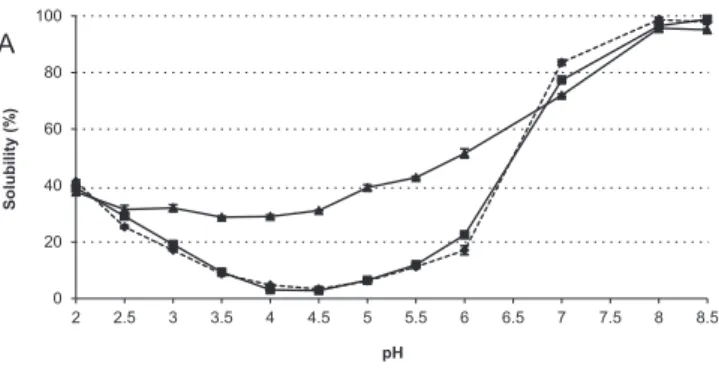
PI and ASP exhibited different protein solubility behavior in response to NaCl supplementation and pH variation (Fig-ures 1A and B). The PI expressed negligible protein solubility (2.80%) at isolectric point (pH 4.5). Improvement of the pro-tein solubility was observed below or above the pI value, but more prominently in alkaline media (Figure 1A). This is a typ-ical trend for solubility of protein isolates obtained from oil-seed crops [Xu & Diosady, 1994; Vioque et al., 2000; Ogun-wolu et al., 2009; Ivanova et al., 2013]. At pH in the range of 2.5–6, the protein solubility of PI did not exceed 30%. This
feature limits the application of the PI as an additive in food processing, since numerous food products have a typical pH from 4.5 to 6.0 [FDA, 2018]. Our results agree with fi ndings reported by Alashi et al. [2013] who implied low utilization of canola/rapeseed protein isolates in the food industry due to their poor solubility in neutral and low acidic media. The ad-dition of the lower concentration NaCl (0.03 mol/L) did not change the protein solubility pattern. However, supplementa-tion of the reacsupplementa-tion mixture with 0.25 mol/L NaCl resulted in more than a 10-fold increase of protein solubility at the iso-electric point (pH 4.5). The protein solubility in the low acidic area was augmented and reached 51% at pH 6.
In contrast, ASP exhibited protein solubility higher than 70% over the entire pH range studied (Figure 1B). It was slightly infl uenced by pH in the acidic range and insensitive to alkaline media. A similar infl uence of pH on solubility of Chi-nese rapeseed protein isolate, obtained by membrane process-ing, was observed by Xu & Diosady [1994]. A greater solubil-ity of ultrafi ltered protein isolate compared to a precipitated protein isolate was reported by Yoshie-Stark et al. [2008] as well. The better protein solubility of the ASP compared to PI is partially due to its protein profi le. A previously performed SDS-PAGE study by Ivanova et al. [2017] revealed that ASP was composed of proteins with low molecular weights which did not exceed 33 kDa. The PI contained proteins with higher molecular weights which accounted for the higher susceptibil-ity to agglomeration and coagulation near of pI. Our observa-tions agreed with fi ndings reported by Aider & Barbana [2011] who underlined the importance of low molecular proteins for acquiring good solubility. Improved solubility of rapeseed meal protein isolate was achieved by Vioque et al. [2000] af-ter partial hydrolysis. Except at pH 3, the protein solubility of ASP increased to more than 90% for all pH values after sup-plementation with 0.03 mol/L NaCl. The higher ash content of ASP (20.5%) compared to PI (2.3%) [Ivanova et al., 2017] is most probably responsible for the higher impact of the low concentration NaCl (0.03 mol/L) (Figure 1B). The addition of 0.25 mol/L NaCl slightly enhanced the protein solubility at acidic pH but not in alkaline media. The higher impact of NaCl addition on protein solubility of both PI and ASP in acidic than in alkaline media may be due to the greater af-fi nity of Cl- to positively charged proteins in the acidic range
than that of Na+ to negatively charged proteins in alkaline
media [Schnepf, 1992]. The infl uence of salts on protein solu-bility is complex because it is not only pH dependent but also affected by salt concentration and protein conformation. Water and oil absorption capacity
The ability of protein-containing ingredients to absorb and retain water and oil is an important feature which in-fl uences texture and mouthfeel of food products [Okezie & Bello, 1988]. The PI and ASP, prepared in our study, exhib-ited signifi cant differences in both WAC and OAC (Table 1). The WAC of the PI (2.00 g H2O/g sample) was lower than that of commercial soybean protein isolates, such as Pu-rina Protein 500E and 760 [Zayas, 1997], but higher than the WAC of an industrial sunfl ower meal protein isolate [Iva-nova et al., 2014], cashew nut protein concentrate [Ogun-wolu et al., 2009], and a rapeseed protein isolate [Vioque
0 20 40 60 80 100 2 2.5 3 3.5 4 4.5 5 5.5 6 6.5 7 7.5 8 8.5 Solubility (% ) рН
0.00 mol/L NaCl 0.03 mol/L NaCl 0.25 mol/L NaCl
0 20 40 60 80 100 2 2.5 3 3.5 4 4.5 5 5.5 6 6.5 7 7.5 8 8.5 Solubility (% ) рН
0.00 mol/L NaCl 0.03 mol/L NaCl 0.25 mol/L NaCl
FIGURE 1. Solubility of protein isolate – PI (A) and acid soluble protein ingredient – ASP (B) at different pH values and NaCl concentrations.
A
et al., 2000]. The addition of the higher NaCl concentration (0.25 mol/L) signifi cantly increased the WAC to 2.70 g H2O/g sample, while the lower NaCl level (0.03 mol/L) did not alter the capacity of the PI to retain water. The ASP did not ex-hibit any capacity to hold water (Table 1). This may be due to the relatively lower protein content of ASP (28.8%) compared to PI (86.8%). Lower WAC of a sunfl ower protein isolate with a lower protein content compared to a similar protein isolate but with higher protein level was observed by Ivanova et al. [2014]. In contrast, the ASP showed higher OAC than PI (Ta-ble 1). This feature may be due to differences in the chemi-cal composition and protein fractional profi les of the two protein-containing products as previously established in our laboratory by Ivanova et al. [2017]. The authors reported that the ASP was composed of proteins with low molecular weights up to 33 kDa with a prevailing 8 kDa fraction (ap-proximately 35%). According to Vioque et al. [2000], small polypeptide chains provide better exposure of amino acid
nonpolar sides to hydrocarbon chains, thus contributing to an increase of OAC. Both levels of NaCl supplementations did not alter OAC of either PI or ASP (Table 1).
Thermal stability
Thermal stability of functional protein ingredients is es-sential when a heat treatment is a part of the food processing scheme. Aiming at comparison between PI and ASP, the ther-mal stability was evaluated at pH 7 and 8 where the two ingre-dients exhibited similar protein solubility. PI and ASP showed completely different behavior in response to temperature increase, which was also highly infl uenced by pH (Table 2). The PI exhibited better thermal stability at pH 7 than at pH 8, regardless of the higher protein solubility of this ingredient at the higher pH (Figure 1A). In contrast, the ASP expressed higher thermal stability at pH 8 than at pH 7, as evidenced by the decrease of turbidity. Since the protein solubility of the ASP at both pH values is not signifi cantly different, TABLE 1. Water and oil absorption capacity of protein isolate and acid soluble protein ingredient at different concentrations of NaCl.
Sample
Water absorption capacity (g H2O/g sample)
Oil absorption capacity (g oil/g sample) NaCl concentration (mol/L) NaCl concentration (mol/L)
0.00 0.03 0.25 0.00 0.03 0.25 Protein isolate 2.00±0.13b 2.16±0.16b 2.70±0.02a 1.29±0.10a,B 1.45±0.22a,B 1.47±0.04a,B
Acid soluble protein – – – 2.77±0.12a,A 2.79±0.00a,A 3.03±0.09a,A
a-bMeans in a row for a particular functional property with common lowercase superscripts do not differ signifi cantly (p0.05). A-BMeans in a column with common uppercase superscripts do not differ signifi cantly (p0.05).
TABLE 2. Thermal stability of protein isolate and acid soluble protein ingredient at pH 7 and 8.
Temperature (oC)
Turbidity alteration (%)
Protein isolate Acid soluble protein
NaCl concentration (mol/L) NaCl concentration (mol/L)
0.00 0.03 0.25 0.00 0.03 0.25 pH 7 50 -0.15±0.1bB -3.58±0.28aC 15.19±0.11eA 0.57±0.1eA -3.46±0.52eB -7.19±0.43eC 60 1.19±0.3aB -5.69±0.18cC 9.91±0.16bA 6.86±0.1dA -0.34±0.14dB -5.42±0.43dC 70 -1.09±0.4cB -4.50±0.16bC 41.67±0.48bA 15.5±1.2cA 5.99±0.15cC 11.86±0.58cB 80 -1.23±0.5cB -6.79±0.33dC 12.51±0.21dA 36.38±0.65bA 19.83±0.53bC 22.22±0.58bB 90 1.43±0.4aB -4.92±0.26bC 42.71±0.27aA 55.56±0.4aA 35.44±0.25aC 26.98±0.16aB pH 8 50 0.62±0.3cB -4.99±0.36cC 20.62±0.36eA -13.27±0.5dA -18.82±0.24dB -19.34±0.15eC 60 0.41 ±0.2cB -6.83±0.31dC 33.96±0.69dA -13.61±0.4dA -19.06±0.71dC -17.76±0.55dB 70 0.72±0.2cB -3.97±0.36bC 66.44±0.55cA -8.98±0.4cA -12.16±0.49cC -11.46±0.80cB 80 1.34±0.5bB -3.85±0.18bC 114.07±0.43bA -3.81±0.1bA -6.82±0.23bC -5.16±0.30bB 90 5.73±0.2aB -1.93±0.18aC 167.35±0.75aA 4.56±0.6aBA -2.04±0.36aC -0.70±0.15aB a-e Means in a column with same lowercase letter do not differ signifi cantly (p0.05). A-B Means in a row for a specifi c ingredient with same capital letter do not differ signifi cantly (p0.05). Negative values indicate decrease in turbidity.
it cannot account for the different pattern of thermal stability observed. Overall, PI had better thermal stability than ASP at pH 7 but worse at pH 8, regardless of the similar protein solubility (80%) at the higher pH (Figures 1A and B). Ac-cording to Jiang et al. [2010], proteins with higher solubil-ity are supposed to have a better thermal stabilsolubil-ity. However, our data imply that more factors might be involved in this process. The previously established differences in the chemi-cal composition and protein fractional profi le of PI and ASP [Ivanova et al., 2017] might affect the number and position of hydrogen bonds, protein density packing and the number and fractional volume of protein cavities formed, which are signifi cant determinants of protein thermal stability [Vogt & Argos, 1997]. Internal van der Waals’ packing and interplay of the hydrophobic and electrostatic interactions may also be important for stabilizing proteins against heat [Kaushik & Bhat, 1999]. In addition, variations in long-range protein contacts, infl uencing the formation of protein-stabilizing centers and the content of stabilization center elements un-der the studied conditions, may occur [Magyar et al., 2016]. According to the same authors, an increase in the latter and, therefore, an increase of thermal stability of thermolabile proteins may occur up to 80°C. This might explain the sharp decrease in thermal stability of both protein-containing ingre-dients at 90°C under all studied conditions (Table 2).
The addition of NaCl signifi cantly infl uenced the thermal stability of both ingredients at the two pH values studied, but to a different extent. A decrease in turbidity and, therefore, an increase in thermal stability of PI and ASP, was observed at the lower concentration of NaCl (0.03 mol/L). Fontanari et al. [2012] implied that the stabilizing effect of low salt concen-trations was due to improved hydration of protein molecules as a result of electrostatic induction and/or structural altera-tion of water molecules surrounding the protein. In contrast, supplementation with 0.25 mol/L NaCl reduced the thermal stability which was more pronounced for the PI. At a higher ionic strength, the reduced protein stability is rather attributed to nonspecifi c osmotic effects [Pegram et al., 2010] and pro-tein conformational changes [Beauchamp & Khajehpour, 2012]. Different response of PI and ASP to salt addition is most probably due to differences in their protein
composi-tion and profi le, which in turn leads to variacomposi-tions in electri-cal charge on the protein surface and interaction with water molecules. Arntfi eld et al. [1986] also observed alteration of the heat resistance of faba bean legumin and vicilin in re-sponse to different NaCl load.
Emulsifying properties
Emulsifying activities of PI and ASP are presented in Table 3. For both protein-containing ingredients, the emulsifying activ-ity varied in a narrow range, from 57 to 63%, under all stud-ied conditions. The lowest activity of PI was observed at pH 4, which is in the pH range with the lowest protein solubility for this ingredient (Figure 1A). According to Kinsella [1985], poor emulsifying properties of plant proteins at a pH close to their isoelectric point are due to weak electrostatic repulsive forces. Similar observations were reported by Ivanova et al. [2014] and Mao & Hua [2012] who studied the emulsifying properties of protein isolates obtained from sunfl ower meal and walnut, respectively. The ASP also exhibited the lowest emulsifying activ-ity at pH 4. In contrast to PI, this ingredient was highly soluble over the entire pH range studied (Figure 1B) and, therefore weak electrostatic repulsive forces cannot be a probable explanation. Due to relatively high impurity of the ASP [Ivanova et al., 2017], other interactions in addition to the protein-protein ones may also infl uence the overall emulsifying capacity. The addition of 0.25 mol/L NaCl neutralized the infl uence of pH on the emul-sifying activity of both PI and ASP (Table 3).
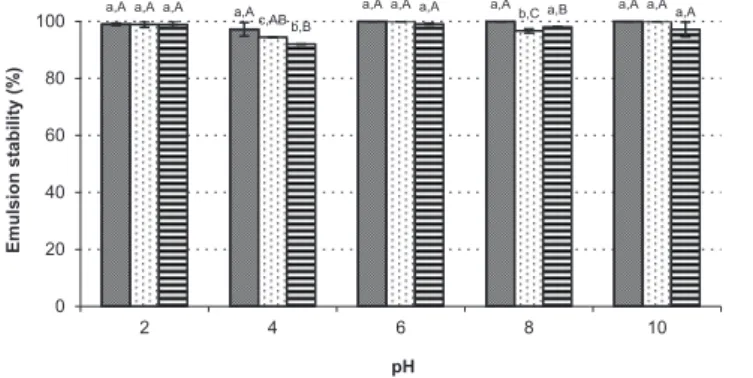
PI and ASP exhibited a completely different pattern of emulsion stability as infl uenced by pH. While the stabil-ity of PI emulsions was close to 100% and only negligibly affected by all pH conditions studied (Figure 2), the ASP emulsion stability highly varied depending on pH (Figure 3). The highest stability was observed at pH 4, 8, and 10 (Fig-ure 3). Except at pH 10, the emulsion stability of ASP was lower than that of PI (Figures 2 and 3). Our results differ from these obtained by Xu & Diosady [1994] who reported higher emulsion stability of a soluble protein isolate (111.1%) than that of a protein isolate (98.4%) obtained from Chinese rapeseed meal. This may be due to differences in the meth-odologies used for their preparation, and, as a consequence, in their chemical composition. The infl uence of NaCl on TABLE 3. Emulsifying activity of protein isolate and acid soluble protein ingredient at different pH and NaCl concentrations.
Sample NaCl concentration (mol/L)
Emulsifying activity (%) pH
2 4 6 8 10
Protein isolate
0.00 59.00±0.25c,A 57.46±0.19d,B 62.20±0.00a,A 58.99±0.23c,A 61.46±0.39b,B 0.03 57.83±0.71d,A 59.28±1.34cd,B 62.50±0.00a,A 61.41±0.32ab,A 60.48±0.33bc,C 0.25 60.97±1.74a,A 63.29±0.00a,A 63.81±1.85a,A 62.11±1.68a,A 63.04±0.13a,A
Acid soluble protein
0.00 59.88±0.87b,A 58.13±0.28c,B 61.22±0.05a,A 61.46±0.39a,A 62.05±0.21a,A 0.03 59.75±0.36b,A 60.12±0.17b,A 60.06±0.76b,AB 59.52±0.68b,B 61.46±0.39a,A 0.25 59.52±0.68a,A 59.35±0.75a,AB 59.08±0.62a,B 59.39±0.18a,AB 60.59±0.83a,A a-d Means in a row with same lowercase superscripts do not differ signifi cantly (p0.05). A-B Means in a column for a specifi c sample with same letter do not differ signifi cantly (p0.05).
the emulsion stability of ASP also differed from that of PI (Figures 2 and 3). The addition of 0.25 mol/L NaCl reduced the emulsion stability of ASP at all pH values except at pH 2 (Figure 3). A similar trend was observed by Cheung et al. [2015] who observed destabilization of napin protein isolate emulsions after NaCl addition.
The chosen methodology for the evaluation of emulsify-ing activity and stability of the PI and ASP is a quick approach which allows discrimination between emulsifying capacities of the two protein-containing products. Once the superiority of emulsifying properties of the PI to the ASP is established, additional experiments and analyses, including but not lim-ited to hydrophobicity evaluation, particle size measurement, and determination of emulsion stability from turbidity mea-surements, are needed to provide a better insight and a more profound explanation of the phenomenon.
CONCLUSION
The study demonstrated the opportunity to concomi-tantly prepare two protein-containing ingredients from ethanol-treated industrial rapeseed meal with valuable func-tionality. While PI protein solubility was pH dependent, the one of the ASP was slightly sensitive to pH and remained higher than 70% for the entire pH range studied. Compared to the PI, the ASP demonstrated higher ability to absorb oil and higher thermal stability at pH 8 than at pH 7. The emul-sifying activity of PI and ASP varied from 57.46% to 63.81% for all combinations of pH and NaCl. The emulsion stability of the ASP was lower than that of the PI. Distinctive techno-functional properties of the two ingredients defi ne their wide and versatile application in the food industry as additives. The simplicity of the procedure and the lack of purifi cation steps lead to a better and more complete use of the industri-ally produced rapeseed meal, with the potential for a higher profi tability.
ACKNOWLEDGEMENTS
Authors would like to express their appreciation to pro-fessor Turid Rustad, Department of Biotechnology and Food
Science, Norwegian University of Science and Technology, Trondheim, Norway, for her comments and improvement of manuscript quality.
CONFLICT OF INTERESTS
Authors declare no confl ict of interests. REFERENCES
1. AACC, 1983, Method 46–15: Crude protein – 5-minute Biu-ret method for wheat and other grains. In: Approved Methods of the American Association of Cereal Chemists, American As-sociation of Cereal Chemists, St. Paul, MN, USA
2. Aider, M., Barbana, C. (2011). Canola proteins: composition, extraction, functional properties, bioactivity, applications as a food ingredient and allergenicity – A practical and critical re-view. Trends in Food Science and Technology, 22(1), 21–39. 3. Alashi, A.M., Blanchard, C.L., Mailer, R.J., Agboola, S.O.
(2013). Technological and bioactive functionalities of canola meal proteins and hydrolysates. Food Reviews International,
29(3), 231–260.
4. Antova, T., Nenkova, G., Georgieva, L. (2008). Compara-tive investigation of trade marks butter. Scientifi c Papers, 36, 111–117 [http://blogs.uni-plovdiv.net/argon/fi les/2008/03/014_ NT36_2008.pdf].
5. AOAC: Offi cial Methods of Analysis. Association of Offi cial Analytical Chemists, Washington, DC, USA (1990).
6. Arntfi eld, S., Murray, E., Ismond, M. (1986). Effect of salt on the thermal stability of storage proteins from fababean (Vicia
faba). Journal of Food Science, 51(2), 371–377.
7. Beauchamp, D.L., Khajehpour, M. (2012). Studying salt effects on protein stability using ribonuclease t1 as a model system.
Bio-physical Chemistry, 161, 29–38.
8. Chabanon, G., Chevalot, I., Framboisier, X., Chenu, S., Marc, I. (2007). Hydrolysis of rapeseed protein isolates: Kinetics, char-acterization and functional properties of hydrolysates. Process
Biochemistry, 42(10), 1419–1428.
9. Cheung, L., Wanasundara, J., Nickerson, M.T. (2015). Effect of pH and NaCl on the emulsifying properties of a napin protein isolate. Food Biophysics, 10(3), 30–38.
a,Aa,A a,A a,A a,A a,A c,AB
a,A
b,C a,A a,A
b,B
a,A a,B a,A
0 20 40 60 80 100 2 4 6 8 10 Emulsion stability (% ) pH
0.00 mol/L NaCl 0.03 mol/L NaCl 0.25 mol/L NaCl
FIGURE 2. Emulsion stability of protein isolate (PI).
a-c Means with same lowercase letter for a particular NaCl concentration do not differ signifi cantly (p0.05). A-C Means with same capital letter for a particular pH do not differ signifi cantly (p0.05).
e,C c,A d,A b,A a,A d,B c,C b,A a,A d,A b,B e,Be,B c,B a,B 0 20 40 60 80 100 2 4 6 8 10 Emulsion stability (% ) pH
0.00 mol/L NaCl 0.03 mol/L NaCl 0.25 mol/L NaCl
FIGURE 3. Emulsion stability of acid soluble protein ingredient (ASP). a-e Means with same lowercase letter for a particular NaCl concentration do not differ signifi cantly (p0.05). A-CMeans with same capital letter for a particular pH do not differ signifi cantly (p0.05).
10. Das Purkayastha, M., Das, S., Manhar, A.K., Deka, D., Man-dal, M., Mahanta, C.L. (2013). Removing antinutrients from rapeseed press-cake and their benevolent role in waste cooking oil-derived biodiesel: Conjoining the valorization of two dispa-rate industrial wastes. Journal of Agricultural and Food Chemistry, 61(45), 10746–10756.
11. Das Purkayastha, M., Gogoi, J., Kalita, D., Chattopadhyay, P., Nakhuru, K.S., Goyary, D., Mahanta, C.L. (2014). Physico-chemical and functional properties of rapeseed protein isolate: infl uence of antinutrient removal with acidifi ed organic solvents from rapeseed meal. Journal of Agricultural and Food Chemistry, 62(31), 7903–7914.
12. Dragoev, S.G., Vulkova-Yorgova, K.I., Balev, D.K. (2009). Tech-nology of Functional and Special Meat and Fish Products. Mi-nerva: Sofi a, Bulgaria, p. 370, ISBN: 954–24–0053–5 (in Bulgar-ian).
13. FDA, 2018. Approximate pH of foods and food products. [http:// ucfoodsafety.ucdavis.edu/fi les/266402.pdf].
14. Fontanari, G.G., Martins, J.M., Kobelnik, M., Pastre, I.A., Arêas, J.A.G., Batistuti, J.P., Fertonani, F.L. (2012). Thermal studies on protein isolates of white lupin seeds (Lupinus albus). Journal
of Thermal Analysis and Calorimetry, 108(1), 141–148.
15. Ghodsvali, A., Khodaparast, M.H.H., Vosoughi, M., Diosady, L.L. (2005). Preparation of canola protein materials using mem-brane technology and evaluation of meals functional properties.
Food Research International, 2005, 38(2), 223–231.
16. González-Pérez, S., Vereijken, J.M. (2007). Sunfl ower proteins: overview of their physicochemical, structural and functional properties. Journal of the Science of Food and Agriculture, 87(12), 2173–2191.
17. Gu, X., Dong, W., He, Y. (2011). Detoxifi cation of rapeseed meals by steam explosion. Journal of the American Oil Chemists
Society, 88(11), 1831–1838.
18. Ivanova, P., Chalova, V., Koleva, L. (2014). Functional properties of proteins isolated from industrially produced sunfl ower meal.
International Journal of Food Studies, 3, 203–212.
19. Ivanova, P., Chalova, V., Koleva, L., Pishtiyski, I. (2013). Amino acid composition and solubility of proteins isolated from sun-fl ower meal produced in Bulgaria. International Food Research
Journal, 20, 2995–3000.
20. Ivanova, P., Chalova, V., Uzunova, G., Koleva, L., Manolov, I. (2016). Biochemical characterization of industrially produced rapeseed meal as a protein source in food industry. Agricultural
Science Procedia, 10, 55–62.
21. Ivanova, P., Kalaydzhiev, H., Rustad, T., Silva, C.L.M., Chalo-va, V.I. (2017). Comparative biochemical profi le of protein-rich products obtained from industrial rapeseed meal. Emirates
Jour-nal of Food Agriculture, 29(3), 170–178.
22. Ivanova, R. (2012). Rapeseed – The Culture of Present and Fu-ture. Videnov & Son: Sofi a, Bulgaria p. 305, ISBN: 978–954– 8319–59–1 (in Bulgarian).
23. Jiang, J., Xiong, Y.L., Chen, J. (2010). pH shifting alters solu-bility characteristics and thermal stasolu-bility of soy protein isolate and its globulin fractions in different pH, salt concentration, and temperature conditions. Journal of Agricultural and Food
Chemistry, 58(13), 8035–8042.
24. Kaushik, J.K., Bhat, R. (1999). A mechanistic analysis of the in-crease in the thermal stability of proteins in aqueous carboxylic acid salt solutions. Protein Science, 8, 222–233.
25. Kinsella, J.E., Damodaran, S., German, B. (1985). Physico-chemical and functional properties of oilseed proteins with emphasis on soy proteins. In: A.M. Altshul, H.L. Wilcke (eds.). New Protein Foods: Seed Storage Proteins. Academic Press Inc., London, pp.107–179.
26. Kreps, F., Vrbiková, L., Schmidt, Š. (2014). Industrial rapeseed and sunfl ower meal as source of antioxidants. International
Jour-nal of Engineering Research and Applications, 4(2), 45–54.
27. Li, J., Guo, Z. (2017). Complete utilization of rapeseed meal to produce lipophilic antioxidants, protein, and monosugars in a concordant manner. ACS Sustainable Chemistry &
Engineer-ing, 5(7), 6218–6226.
28. Lin, C., Zayas, J. (1987). Functionality of defatted corn germ proteins in a model system: fat binding capacity and water reten-tion. Journal of Food Science, 52(5), 1308–1311.
29. Lqari, H., Vioque, J., Pedroche, J., Millán, F. (2002). Lupinus
angustifolius protein isolates: chemical composition, functional
properties and protein characterization. Food Chemistry, 76(3), 349–356.
30. Magyar, C., Gromiha, M.M., Sávoly, Z., Simon, I. (2016). The role of stabilization centers in protein thermal stability.
Bio-chemical Biophysical Research Communications, 471(1), 57–62.
31. Mao, X., Hua, Y. (2012). Composition, structure and functional properties of protein concentrates and isolates produced from walnut (Juglans regia L.). International Journal of Molecular
Sci-ences, 13(2), 1561–1581.
32. Neto, V.Q., Narain, N., Silva, J.B., Bora, P.S. (2001). Functional properties of raw and heat processed cashew nut (Anacardium
occidentale, L.) kernel protein isolates. Nahrung-Food, 45(4),
258–262.
33. Ogunwolu, S.O., Henshaw, F.O., Mock, H., Santros, A., Awono-rin, S.O. (2009). Functional properties of protein concentrates and isolates produced from cashew (Anacardium occidentale L.) nut. Food Chemistry, 115(3), 852–858.
34. Okezie, B.O., Bello, A. (1988). Physicochemical and functional properties of winged bean fl our and isolate compared with soy isolate. Journal of Food Science, 53(2), 450–454.
35. Pegram, L.M., Wendorff, T., Erdmann, R., Shkel, I., Bellissimo, D., Felitsky, D.J., Record, M.T. (2010). Why Hofmeister effects of many salts favor protein folding but not DNA helix forma-tion. Proceedings of the National Academy of Sciences of the United
States of Amercia, 107(17), 7716–7721.
36. Rodríguez-Ambriz, S., Martínez-Ayala, A., Millán, F., Davila-Ortiz, G. (2005). Composition and functional properties
of Lupi-nus campestris protein isolates. Plant Foods for Human Nutrition, 60(3), 99–107.
37. Schnepf, M.I. (1992). Protein-water interactions. In: B.J.F. Hud-son (ed.). Biochemistry of Food Proteins. Springer, Boston, MA, USA, pp. 1–33.
38. Tang, L., Sun, J., Zhang, H.C., Zhang, C.S., Yu, L.N., Bi, J., Zhu, F., Liu, S.F., Yang, Q.L. (2012). Evaluation of physicochemical and antioxidant properties of peanut protein hydrolysate. PloS
One, 7(3), e37863.
39. Vioque, J., Sánchez-Vioque, R., Clemente, A., Pedroche, J., Millán, F. (2000). Partially hydrolyzed rapeseed protein isolate with improved functional properties. Journal of the American Oil
Chemists Society, 77(4), 447–450.
40. Vogt, G., Argos, P. (1997). Protein thermal stability: hydrogen bonds or internal packing? Folding & Design, 2(2), S40-S46.
41. Wanasundara, J.P.D., McIntosh, T.C., Perera, S.P., Withana-Gamage, T.S., Mitra, P. (2016). Canola/rapeseed protein-func-tionality and nutrition. OCL – Oilseed and Fats Crops and Lipids,
23(4), D407-D422.
42. Xu, L., Diosady, L.L. (1994). Functional properties of Chinese rape-seed protein isolates. Journal of Food Science, 59(5), 1127–1130. 43. Yoshie-Stark, Y., Wada, Y., Wäsche, A. (2008). Chemical
com-position, functional properties, and bioactivities of rapeseed pro-tein isolates. Food Chemistry, 107(1), 32–39.
44. Zayas, J.F. (1997). Solubility of proteins. In: Functionality of Proteins in Food. Springer-Verlag, Heidelberg, Germany, pp. 6–75 ISBN: 978–3-642–63856–5.
45. Zentková, I., Cvengrošová, E. (2013). The utilization of rapeseed for biofuels production in the EU. Visegrad Journal
of Bioecono-my and Sustainable Development, 2, 11–14.
Submitted: 14 June 2018. Revised: 19 September 2018. Accepted: 16 November 2018. Published on-line: 19 March 2019.