ScienceDirect
Available online at www.sciencedirect.com
Procedia Computer Science 164 (2019) 546–551
1877-0509 © 2019 The Authors. Published by Elsevier B.V.
This is an open access article under the CC BY-NC-ND license (http://creativecommons.org/licenses/by-nc-nd/4.0/)
Peer-review under responsibility of the scientific committee of the CENTERIS -International Conference on ENTERprise Information Systems / ProjMAN - International Conference on Project MANagement / HCist - International Conference on Health and Social Care Information Systems and Technologies.
10.1016/j.procs.2019.12.218
10.1016/j.procs.2019.12.218 1877-0509
© 2019 The Authors. Published by Elsevier B.V.
This is an open access article under the CC BY-NC-ND license (http://creativecommons.org/licenses/by-nc-nd/4.0/)
Peer-review under responsibility of the scientific committee of the CENTERIS -International Conference on ENTERprise Information Systems / ProjMAN - International Conference on Project MANagement / HCist - International Conference on Health and Social Care Information Systems and Technologies.
Available online at www.sciencedirect.com
ScienceDirect
Procedia Computer Science 00 (2019) 000–000www.elsevier.com/locate/procedia
1877-0509 © 2019 The Authors. Published by Elsevier B.V.
This is an open access article under the CC BY-NC-ND license (http://creativecommons.org/licenses/by-nc-nd/4.0/)
Peer-review under responsibility of the scientific committee of the CENTERIS - International Conference on ENTERprise Information Systems / ProjMAN – International Conference on Project MANagement / HCist - International Conference on Health and Social Care Information Systems and Technologies
CENTERIS - International Conference on ENTERprise Information Systems / ProjMAN -
International Conference on Project MANagement / HCist - International Conference on Health
and Social Care Information Systems and Technologies
Developing an Information System for Social Value Creation
Luís CS Barradas
a,*, João Nascimento
a, Luís Martins
a, Sandra Oliveira
a,b, Susana Leal
a,c,
Carla Vivas
a, Ricardo São João
a,da Polytechnic Institute of Santarém, Complexo Andaluz, Apartado 295 - 2001-904, Santarém, PORTUGAL b Centre for Health Studies and Research, University of CoimSbra, Coimbra, PORTUGAL c Life Quality Research Centre, Complexo Andaluz, Apartado 279 - 2001-904, Santarém, PORTUGAL d Centre of Statistics and its Applications, University of Lisbon, Campo Grande, 1749-016, Lisbon, PORTUGAL
Abstract
This paper presents a proposal for an Information System (IS) to operationalise a social business model to promote active ageing and create social value. The aim of the IS is to support a senior social exchange programme grounded on Travel 2.0 concepts in social economy organisations that seeks to promote tourism experiences for the elderly and underlying active ageing. The design of the IS was guided by the Dynamic Systems Development Method framework and considers a set of identified requirements and the specific needs of each stakeholder. Since the product is intended to be used by a heterogeneous group of users from distant geographic places, the resulting software artefact should be sensitive to these conditions.
© 2019 The Authors. Published by Elsevier B.V.
This is an open access article under the CC BY-NC-ND license (http://creativecommons.org/licenses/by-nc-nd/4.0/)
Peer-review under responsibility of the scientific committee of the CENTERIS - International Conference on ENTERprise Information Systems / ProjMAN – International Conference on Project MANagement / HCist - International Conference on Health and Social Care Information Systems and Technologies
Keywords: Social Business Model; Information System; Travel 2.0; Tourim; Social Value Creation.
* Corresponding author. Tel.: + 351 243 303 200. E-mail address: [email protected]
Available online at www.sciencedirect.com
ScienceDirect
Procedia Computer Science 00 (2019) 000–000www.elsevier.com/locate/procedia
1877-0509 © 2019 The Authors. Published by Elsevier B.V.
This is an open access article under the CC BY-NC-ND license (http://creativecommons.org/licenses/by-nc-nd/4.0/)
Peer-review under responsibility of the scientific committee of the CENTERIS - International Conference on ENTERprise Information Systems / ProjMAN – International Conference on Project MANagement / HCist - International Conference on Health and Social Care Information Systems and Technologies
CENTERIS - International Conference on ENTERprise Information Systems / ProjMAN -
International Conference on Project MANagement / HCist - International Conference on Health
and Social Care Information Systems and Technologies
Developing an Information System for Social Value Creation
Luís CS Barradas
a,*, João Nascimento
a, Luís Martins
a, Sandra Oliveira
a,b, Susana Leal
a,c,
Carla Vivas
a, Ricardo São João
a,da Polytechnic Institute of Santarém, Complexo Andaluz, Apartado 295 - 2001-904, Santarém, PORTUGAL b Centre for Health Studies and Research, University of CoimSbra, Coimbra, PORTUGAL c Life Quality Research Centre, Complexo Andaluz, Apartado 279 - 2001-904, Santarém, PORTUGAL d Centre of Statistics and its Applications, University of Lisbon, Campo Grande, 1749-016, Lisbon, PORTUGAL
Abstract
This paper presents a proposal for an Information System (IS) to operationalise a social business model to promote active ageing and create social value. The aim of the IS is to support a senior social exchange programme grounded on Travel 2.0 concepts in social economy organisations that seeks to promote tourism experiences for the elderly and underlying active ageing. The design of the IS was guided by the Dynamic Systems Development Method framework and considers a set of identified requirements and the specific needs of each stakeholder. Since the product is intended to be used by a heterogeneous group of users from distant geographic places, the resulting software artefact should be sensitive to these conditions.
© 2019 The Authors. Published by Elsevier B.V.
This is an open access article under the CC BY-NC-ND license (http://creativecommons.org/licenses/by-nc-nd/4.0/)
Peer-review under responsibility of the scientific committee of the CENTERIS - International Conference on ENTERprise Information Systems / ProjMAN – International Conference on Project MANagement / HCist - International Conference on Health and Social Care Information Systems and Technologies
Keywords: Social Business Model; Information System; Travel 2.0; Tourim; Social Value Creation.
* Corresponding author. Tel.: + 351 243 303 200. E-mail address: [email protected]
2 Luís CS Barradas et al/ Procedia Computer Science 00 (2019) 000–000
1. Introduction
Contemporary society is facing an unprecedented ageing process due to the increase in overall life expectancy and, consequently, an ever-growing number of elderly people. The total population of the European Union, in average per year, is projected to increase from 511 million in 2016 to 520 million in 2070 [1]. This phenomenon brings both challenges and opportunities to modern society. Some industries, like Health and Tourism, have already started to adapt so as to take advantage of this ageing process. The emergence of active ageing practices in the tourism industry, along with the growing importance of the elderly quality of life, has increased the interest and willingness to participate in this specific type of touristic activities. It encourages, as well, the senior tourism segment, boosts job creation and helps to combat the seasonal nature of the tourism sector. The ageing phenomenon also affects Portugal where a large number of elderly people have lack economic and financial resources and face increased economic and social difficulties as the population grows. Tourist packages targeting this group need to be adapted to address its profile [2].
The Information and Communication Technologies (ICT) allowed the development of systems that enabled the creation and establishment of a vast network of information encompassing the various tourism industry actors, which is now essential to improving tourism industry performance. The Web 2.0 introduced and streamlined profound changes in the distribution channel relationships [3]: new communication dynamics (new producers and new consumers), new business models, proximity to customers, flexibility in providing and sharing information. This has also resulted in changes in tourists’ behaviour when selecting destinations, planning travel and sharing experiences [4]. Naturally, with the growth of Travel 2.0 applications – Web 2.0 applied to tourism (e.g., Booking.com) –, a different type of consumer behaviour has emerged, who can easily access information and share contents, opinions and suggestions in a non-formal and collaborative way; moreover, they can decisively influence and be influenced by other tourists/consumers [5].
In Travel 2.0 services, tourists find support and mediation for the three critical stages of the tourist experience [6]: (1) pre-experience (before travelling), which is built based on experiences shared by others; (2) the experience (during the trip or stay) through the real-time use of mobile applications; (3) post-experience (after travelling) through the sharing of comments/stories, reviews and emotions that reflect the lived experience. Web 2.0 applications in conjunction with mobile device technologies provide an essential ecosystem in the support of the three moments of the tourist experience continuum [7].
E-Tourism is a living and dynamic ecosystem in continuous change and growth, that is influenced not only by technology but also by human variables, that is by users and their emotions, their willingness to communicate and establish relationships and also their wants and needs [8].
Grounded on these concepts, this paper presents the VOLTO JÁ Information System (VJIS) which aims to operationalise and give support to the business model of the VOLTO JÁ Project [2].
This paper is organised as follows: section 2 presents the research background and the research methodology; section 3 describes the VJIS core business processes, main functionalities, and block architecture proposal; and section 4 advances preliminary results, conclusions, and further work.
2. Research background and Methodology
2.1. The VOLTO JÁ Project
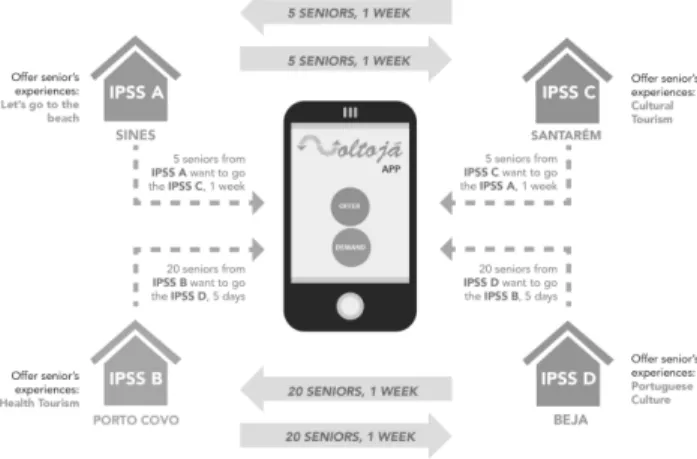
The promotion of active ageing is a challenge for governments. A large number of studies have shown that participation in social tourism for seniors contributes to healthy and active ageing, preventing dependent situations and improving the quality of life of elderly people, which in turn reduces public spending on health and social services and the burden on informal caregivers [9]. The VOLTO JÁ Project is closely connected with the opportunities generated by the Portuguese tradition in Tourism and by making this available to the Social Economy, creating social value. The project focuses on Social Tourism for low-income groups, particularly institutionalised seniors, who would not otherwise go on holiday. A particular focus is placed on the elderly population’s motivations to experience new cultural expressions and on the impact that this process may have on their active ageing and quality of life. As shown in figure 1, VOLTO JÁ is essentially a social senior exchange programme between Social
Luís CS Barradas et al. / Procedia Computer Science 164 (2019) 546–551 547
ScienceDirect
Procedia Computer Science 00 (2019) 000–000
www.elsevier.com/locate/procedia
1877-0509 © 2019 The Authors. Published by Elsevier B.V.
This is an open access article under the CC BY-NC-ND license (http://creativecommons.org/licenses/by-nc-nd/4.0/)
Peer-review under responsibility of the scientific committee of the CENTERIS - International Conference on ENTERprise Information Systems / ProjMAN – International Conference on Project MANagement / HCist - International Conference on Health and Social Care Information Systems and Technologies
CENTERIS - International Conference on ENTERprise Information Systems / ProjMAN -
International Conference on Project MANagement / HCist - International Conference on Health
and Social Care Information Systems and Technologies
Developing an Information System for Social Value Creation
Luís CS Barradas
a,*, João Nascimento
a, Luís Martins
a, Sandra Oliveira
a,b, Susana Leal
a,c,
Carla Vivas
a, Ricardo São João
a,da Polytechnic Institute of Santarém, Complexo Andaluz, Apartado 295 - 2001-904, Santarém, PORTUGAL b Centre for Health Studies and Research, University of CoimSbra, Coimbra, PORTUGAL c Life Quality Research Centre, Complexo Andaluz, Apartado 279 - 2001-904, Santarém, PORTUGAL d Centre of Statistics and its Applications, University of Lisbon, Campo Grande, 1749-016, Lisbon, PORTUGAL
Abstract
This paper presents a proposal for an Information System (IS) to operationalise a social business model to promote active ageing and create social value. The aim of the IS is to support a senior social exchange programme grounded on Travel 2.0 concepts in social economy organisations that seeks to promote tourism experiences for the elderly and underlying active ageing. The design of the IS was guided by the Dynamic Systems Development Method framework and considers a set of identified requirements and the specific needs of each stakeholder. Since the product is intended to be used by a heterogeneous group of users from distant geographic places, the resulting software artefact should be sensitive to these conditions.
© 2019 The Authors. Published by Elsevier B.V.
This is an open access article under the CC BY-NC-ND license (http://creativecommons.org/licenses/by-nc-nd/4.0/)
Peer-review under responsibility of the scientific committee of the CENTERIS - International Conference on ENTERprise Information Systems / ProjMAN – International Conference on Project MANagement / HCist - International Conference on Health and Social Care Information Systems and Technologies
Keywords: Social Business Model; Information System; Travel 2.0; Tourim; Social Value Creation.
* Corresponding author. Tel.: + 351 243 303 200. E-mail address: [email protected]
Available online at www.sciencedirect.com
ScienceDirect
Procedia Computer Science 00 (2019) 000–000www.elsevier.com/locate/procedia
1877-0509 © 2019 The Authors. Published by Elsevier B.V.
This is an open access article under the CC BY-NC-ND license (http://creativecommons.org/licenses/by-nc-nd/4.0/)
Peer-review under responsibility of the scientific committee of the CENTERIS - International Conference on ENTERprise Information Systems / ProjMAN – International Conference on Project MANagement / HCist - International Conference on Health and Social Care Information Systems and Technologies
CENTERIS - International Conference on ENTERprise Information Systems / ProjMAN -
International Conference on Project MANagement / HCist - International Conference on Health
and Social Care Information Systems and Technologies
Developing an Information System for Social Value Creation
Luís CS Barradas
a,*, João Nascimento
a, Luís Martins
a, Sandra Oliveira
a,b, Susana Leal
a,c,
Carla Vivas
a, Ricardo São João
a,da Polytechnic Institute of Santarém, Complexo Andaluz, Apartado 295 - 2001-904, Santarém, PORTUGAL b Centre for Health Studies and Research, University of CoimSbra, Coimbra, PORTUGAL c Life Quality Research Centre, Complexo Andaluz, Apartado 279 - 2001-904, Santarém, PORTUGAL d Centre of Statistics and its Applications, University of Lisbon, Campo Grande, 1749-016, Lisbon, PORTUGAL
Abstract
This paper presents a proposal for an Information System (IS) to operationalise a social business model to promote active ageing and create social value. The aim of the IS is to support a senior social exchange programme grounded on Travel 2.0 concepts in social economy organisations that seeks to promote tourism experiences for the elderly and underlying active ageing. The design of the IS was guided by the Dynamic Systems Development Method framework and considers a set of identified requirements and the specific needs of each stakeholder. Since the product is intended to be used by a heterogeneous group of users from distant geographic places, the resulting software artefact should be sensitive to these conditions.
© 2019 The Authors. Published by Elsevier B.V.
This is an open access article under the CC BY-NC-ND license (http://creativecommons.org/licenses/by-nc-nd/4.0/)
Peer-review under responsibility of the scientific committee of the CENTERIS - International Conference on ENTERprise Information Systems / ProjMAN – International Conference on Project MANagement / HCist - International Conference on Health and Social Care Information Systems and Technologies
Keywords: Social Business Model; Information System; Travel 2.0; Tourim; Social Value Creation.
* Corresponding author. Tel.: + 351 243 303 200. E-mail address: [email protected]
2 Luís CS Barradas et al/ Procedia Computer Science 00 (2019) 000–000
1. Introduction
Contemporary society is facing an unprecedented ageing process due to the increase in overall life expectancy and, consequently, an ever-growing number of elderly people. The total population of the European Union, in average per year, is projected to increase from 511 million in 2016 to 520 million in 2070 [1]. This phenomenon brings both challenges and opportunities to modern society. Some industries, like Health and Tourism, have already started to adapt so as to take advantage of this ageing process. The emergence of active ageing practices in the tourism industry, along with the growing importance of the elderly quality of life, has increased the interest and willingness to participate in this specific type of touristic activities. It encourages, as well, the senior tourism segment, boosts job creation and helps to combat the seasonal nature of the tourism sector. The ageing phenomenon also affects Portugal where a large number of elderly people have lack economic and financial resources and face increased economic and social difficulties as the population grows. Tourist packages targeting this group need to be adapted to address its profile [2].
The Information and Communication Technologies (ICT) allowed the development of systems that enabled the creation and establishment of a vast network of information encompassing the various tourism industry actors, which is now essential to improving tourism industry performance. The Web 2.0 introduced and streamlined profound changes in the distribution channel relationships [3]: new communication dynamics (new producers and new consumers), new business models, proximity to customers, flexibility in providing and sharing information. This has also resulted in changes in tourists’ behaviour when selecting destinations, planning travel and sharing experiences [4]. Naturally, with the growth of Travel 2.0 applications – Web 2.0 applied to tourism (e.g., Booking.com) –, a different type of consumer behaviour has emerged, who can easily access information and share contents, opinions and suggestions in a non-formal and collaborative way; moreover, they can decisively influence and be influenced by other tourists/consumers [5].
In Travel 2.0 services, tourists find support and mediation for the three critical stages of the tourist experience [6]: (1) pre-experience (before travelling), which is built based on experiences shared by others; (2) the experience (during the trip or stay) through the real-time use of mobile applications; (3) post-experience (after travelling) through the sharing of comments/stories, reviews and emotions that reflect the lived experience. Web 2.0 applications in conjunction with mobile device technologies provide an essential ecosystem in the support of the three moments of the tourist experience continuum [7].
E-Tourism is a living and dynamic ecosystem in continuous change and growth, that is influenced not only by technology but also by human variables, that is by users and their emotions, their willingness to communicate and establish relationships and also their wants and needs [8].
Grounded on these concepts, this paper presents the VOLTO JÁ Information System (VJIS) which aims to operationalise and give support to the business model of the VOLTO JÁ Project [2].
This paper is organised as follows: section 2 presents the research background and the research methodology; section 3 describes the VJIS core business processes, main functionalities, and block architecture proposal; and section 4 advances preliminary results, conclusions, and further work.
2. Research background and Methodology
2.1. The VOLTO JÁ Project
The promotion of active ageing is a challenge for governments. A large number of studies have shown that participation in social tourism for seniors contributes to healthy and active ageing, preventing dependent situations and improving the quality of life of elderly people, which in turn reduces public spending on health and social services and the burden on informal caregivers [9]. The VOLTO JÁ Project is closely connected with the opportunities generated by the Portuguese tradition in Tourism and by making this available to the Social Economy, creating social value. The project focuses on Social Tourism for low-income groups, particularly institutionalised seniors, who would not otherwise go on holiday. A particular focus is placed on the elderly population’s motivations to experience new cultural expressions and on the impact that this process may have on their active ageing and quality of life. As shown in figure 1, VOLTO JÁ is essentially a social senior exchange programme between Social
548 Luís CS Barradas et al/ Procedia Computer Science 00 (2019) 000–000 Luís CS Barradas et al. / Procedia Computer Science 164 (2019) 546–551 3 Economy Entities (SEE) that promote cultural, touristic and artistic experiences. It encompasses a set of activities that have a direct impact on the mobility and active ageing of seniors.
The project is based on an innovative social tourism business model (STBM) [2] in the social economy sector, for elderly people institutionalised in homes for senior citizens or nursing homes. It will be implemented through a network of SEE that guarantees the exchange of services in the Alentejo region (Portugal). The STBM was designed using the Osterwalder e Pigneur [10] and will be operationalised through an IS (VJIS) that is being developed.
Fig. 1. VOLTO JÁ Business Model overview.
The project is supported by a multidisciplinary team from academia and SEE. The SEE are key stakeholders since they are both clients and providers and, additionally, the pilot test will be performed in these institutions.
2.2. Research Methodology
Information Systems research is usually an interdisciplinary domain and is anchored at the confluence of people, organisations, and technologies, that is, in the study of the effects of IS on the behaviour of individuals, groups and organisations [11]. This research is designed according to the Design Science framework in Information Systems [11] [12] that comprises three research cycles: (1) Relevance Cycle; (2) Design Cycle; and (3) Rigor Cycle. The research activities of this project (Design Cycle) are related to the development of a software artefact and an instantiation that will operationalise the VOLTO JÁ Business Model in a real scenario of elderly mobility, aiming to assess the utility, efficiency, and quality of the artefact [11], in order to achieve the goals of the project.
The design of the software artefact (VJIS) was guided by the Dynamic Systems Development Method framework (DSDM) [13] [14]. The Feasibility study (first step of the framework) was included in the VOLTO JÁ Project, so it was out of our scope. This work encompasses only the Business study, and then the functional model iteration and implementation iteration.
The Business study comprised the definition of the Business Process Model (presented on the next section) and the requirements management: (1) the requirement elicitation; (2) specification and (3) validation.
3. Volto Já Information System
3.1. Core Business Processes
The Business Model Canvas [10] of the STBM allowed us to identify some critical elements, such as partners, activities, resources, customers, and relationships, for the design of the proposed IS (VJIS). The operationalisation of the STBM will be based on eight core business processes (figure 2): (1) Enrolment; (2) Participant administration; (3) Offer administration; (4) Demand administration; (5) Mediation; (6) Communication/Negotiation; (7) Mobility administration; and (8) Assessment.
4 Luís CS Barradas et al/ Procedia Computer Science 00 (2019) 000–000
Fig. 2. Volto Já Core Business Processes
The Enrolment allows the SEE Director (SEED) to subscribe to the partnership. This is controlled and validated by the VJIS administrator. The main characteristics of the SEE are collected and checked. After acceptance, the SEED starts the routine administrative activities on: the Participants (elderly), the Offers and the Demands. Occasionally, when there is a match between a registered Offer and a Demand (from different SEEs), the SEEDs are informed, and Mediation takes place. This is the start of the Communication/Negotiation process where the two SEEDs (from different SEEs) exchange proposals until they both agree on the terms of the deal (or perhaps give up). Once the agreement is reached, the Mobility Programme and therefore the Mobility Administration starts (the check-in of participants and activation and closing of experiences). The Assessment of the Mobility experiences begins immediately and allows all participants to register opinions and photos about their experiences. The SEEDs validate all this content.
After the end of each experience and Mobility Programme, the participants make a quantitative assessment. The assessment results are essential to the maintenance of the business.
3.2. Requirements and functionalities
In the context of the DSDM framework, before entering the iterative component of the development, the requirements elicitation was conducted. The list of requirements was produced based on the BM and the underlying Business Processes presented above. The consolidated list of requirements includes sixty one items. Each requirement received an identification number, a classification (in accordance with its functional and non-functional nature; and degree of importance). The MoSCoW technique was used to identify the relevance of each requirement on the list [14]. At the end of the process, forty five requirements were identified, of which: twenty seven were considered mandatory (Must); nine important (Should); eight suggested (Could); and only one was considered as excluded (Won’t).
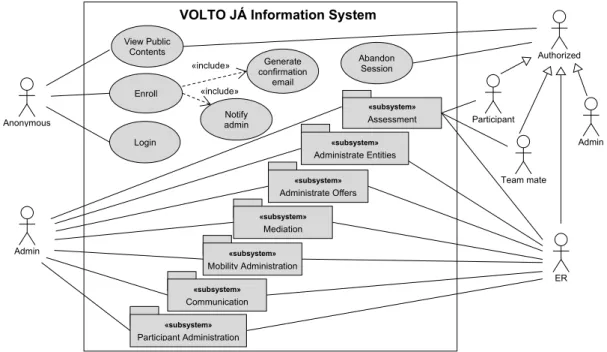
All the non-excluded requirements became part of the VJIS functionalities list. Thus, the Use Cases Diagrams [15] were represented, grouping in subsystems the identified functionalities. Figure 3 presents the ‘big picture’ Use Case diagram representation. In addition of showing the technical requirements (Login and Abandon session) and the generic requirement (View public contents), figure 3 also represents almost all of the VOLTO JÁ Core Business Processes as packages. The only exception is Enrolment, which is a simple process and simultaneously part of a subsystem (Administrate Entities). The other identified processes (e.g. Participant administration, Offer administration, Demand administration, Mediation, Communication, Mobility administration and Assessment) are represented by the traditional subsystems [15].
The Administrate Entities subsystem deals with the data on the partners – SEE. All the relevant operations with these economic agents are suitably treated. This subsystem is related to five of the identified requirements.
The Offer administration subsystem deals with the data on the Social and Cultural activities/experiences that SEE can provide to its visitor. This subsystem is related to six requirements.
The Participant administration subsystem treats the data on the seniors who will participate in the mobility experiences. This subsystem implements four requirements.
Enrolment
Offer Administration
Participant
Administration Mediation Communication/Negotiation Demand Administration Assessment Mobility Administration [Agreement]
[without formal registration of offer and demand] [Receiver]
Economy Entities (SEE) that promote cultural, touristic and artistic experiences. It encompasses a set of activities that have a direct impact on the mobility and active ageing of seniors.
The project is based on an innovative social tourism business model (STBM) [2] in the social economy sector, for elderly people institutionalised in homes for senior citizens or nursing homes. It will be implemented through a network of SEE that guarantees the exchange of services in the Alentejo region (Portugal). The STBM was designed using the Osterwalder e Pigneur [10] and will be operationalised through an IS (VJIS) that is being developed.
Fig. 1. VOLTO JÁ Business Model overview.
The project is supported by a multidisciplinary team from academia and SEE. The SEE are key stakeholders since they are both clients and providers and, additionally, the pilot test will be performed in these institutions.
2.2. Research Methodology
Information Systems research is usually an interdisciplinary domain and is anchored at the confluence of people, organisations, and technologies, that is, in the study of the effects of IS on the behaviour of individuals, groups and organisations [11]. This research is designed according to the Design Science framework in Information Systems [11] [12] that comprises three research cycles: (1) Relevance Cycle; (2) Design Cycle; and (3) Rigor Cycle. The research activities of this project (Design Cycle) are related to the development of a software artefact and an instantiation that will operationalise the VOLTO JÁ Business Model in a real scenario of elderly mobility, aiming to assess the utility, efficiency, and quality of the artefact [11], in order to achieve the goals of the project.
The design of the software artefact (VJIS) was guided by the Dynamic Systems Development Method framework (DSDM) [13] [14]. The Feasibility study (first step of the framework) was included in the VOLTO JÁ Project, so it was out of our scope. This work encompasses only the Business study, and then the functional model iteration and implementation iteration.
The Business study comprised the definition of the Business Process Model (presented on the next section) and the requirements management: (1) the requirement elicitation; (2) specification and (3) validation.
3. Volto Já Information System
3.1. Core Business Processes
The Business Model Canvas [10] of the STBM allowed us to identify some critical elements, such as partners, activities, resources, customers, and relationships, for the design of the proposed IS (VJIS). The operationalisation of the STBM will be based on eight core business processes (figure 2): (1) Enrolment; (2) Participant administration; (3) Offer administration; (4) Demand administration; (5) Mediation; (6) Communication/Negotiation; (7) Mobility administration; and (8) Assessment.
Fig. 2. Volto Já Core Business Processes
The Enrolment allows the SEE Director (SEED) to subscribe to the partnership. This is controlled and validated by the VJIS administrator. The main characteristics of the SEE are collected and checked. After acceptance, the SEED starts the routine administrative activities on: the Participants (elderly), the Offers and the Demands. Occasionally, when there is a match between a registered Offer and a Demand (from different SEEs), the SEEDs are informed, and Mediation takes place. This is the start of the Communication/Negotiation process where the two SEEDs (from different SEEs) exchange proposals until they both agree on the terms of the deal (or perhaps give up). Once the agreement is reached, the Mobility Programme and therefore the Mobility Administration starts (the check-in of participants and activation and closing of experiences). The Assessment of the Mobility experiences begins immediately and allows all participants to register opinions and photos about their experiences. The SEEDs validate all this content.
After the end of each experience and Mobility Programme, the participants make a quantitative assessment. The assessment results are essential to the maintenance of the business.
3.2. Requirements and functionalities
In the context of the DSDM framework, before entering the iterative component of the development, the requirements elicitation was conducted. The list of requirements was produced based on the BM and the underlying Business Processes presented above. The consolidated list of requirements includes sixty one items. Each requirement received an identification number, a classification (in accordance with its functional and non-functional nature; and degree of importance). The MoSCoW technique was used to identify the relevance of each requirement on the list [14]. At the end of the process, forty five requirements were identified, of which: twenty seven were considered mandatory (Must); nine important (Should); eight suggested (Could); and only one was considered as excluded (Won’t).
All the non-excluded requirements became part of the VJIS functionalities list. Thus, the Use Cases Diagrams [15] were represented, grouping in subsystems the identified functionalities. Figure 3 presents the ‘big picture’ Use Case diagram representation. In addition of showing the technical requirements (Login and Abandon session) and the generic requirement (View public contents), figure 3 also represents almost all of the VOLTO JÁ Core Business Processes as packages. The only exception is Enrolment, which is a simple process and simultaneously part of a subsystem (Administrate Entities). The other identified processes (e.g. Participant administration, Offer administration, Demand administration, Mediation, Communication, Mobility administration and Assessment) are represented by the traditional subsystems [15].
The Administrate Entities subsystem deals with the data on the partners – SEE. All the relevant operations with these economic agents are suitably treated. This subsystem is related to five of the identified requirements.
The Offer administration subsystem deals with the data on the Social and Cultural activities/experiences that SEE can provide to its visitor. This subsystem is related to six requirements.
The Participant administration subsystem treats the data on the seniors who will participate in the mobility experiences. This subsystem implements four requirements.
Enrolment
Offer Administration
Participant
Administration Mediation Communication/Negotiation Demand Administration Assessment Mobility Administration [Agreement]
[without formal registration of offer and demand] [Receiver]
550 Luís CS Barradas et al. / Procedia Computer Science 164 (2019) 546–551
Luís CS Barradas et al/ Procedia Computer Science 00 (2019) 000–000 5 Both Offer and Demand administration are essential elements to Mediation (another Core Business process), which tries to match the registered Offer and/or Demand. The Demand administration functionalities were included in the Mediation subsystem due to its affinity and simplicity. Together, they represent five requirements.
The Communication subsystem provides the functionality necessary to allow the SEEDs to negotiate with each other when trying to reach an agreement about a Mobility programme. Once both SEEDs confirm the agreement, the Mobility programme may start. The Communication subsystem is related to nine requirements.
The Mobility Administration subsystem deals with administrative data on the experiences throughout the Mobility Programme. Data such as participants, start date, finish date, etc. are necessary to allow the assessment of each event. This subsystem is related to seven requirements.
The Assessment subsystem is related to four requirements. This subsystem lets the Participants register different types of data on their experiences. This includes posting comments and photos but also a quantitative classification of their satisfaction with the experience. Figure 3 represents four other requirements.
Fig. 3. Use Case – Overview of VOLTO JÁ Information System.
3.3. System architecture proposal
The VJIS comprises two software applications: (1) a Web application and (2) a Mobile Application. The Web Application implements all the defined functional requirements and operationalises all the core business processes. The Mobile Application is more lightweight, implementing only part of the functionalities and operationalising only some of the business processes. Figure 4 presents the system architecture proposal.
Fig. 4. System architecture proposal. VOLTO JÁ Information System
Enroll Generate confirmation email View Public Contents Login «include» Anonymous Participant ER Authorized Team mate Abandon Session Notify admin «include»
«subsystem» Administrate Offers «subsystem» Participant Administration
«subsystem» Mobility Administration
«subsystem» Communication Admin Admin
«subsystem» Mediation
«subsystem» Assessment
«subsystem» Administrate Entities Presentation
Layer Application Layer Business Logic Layer
Service Layer (REST) Web App UI Mobile App UI Mediation Security/
Authentication AdministrationEntities Offers
Administration AdministrationMobility
Communication Participant Administration Assessment Per si st enc e Lay er D ata Lay er Mobile App Web App
6 Luís CS Barradas et al/ Procedia Computer Science 00 (2019) 000–000
The proposed system architecture is grounded on a Layered Architectural Pattern, encompassing six layers. The Data layer is responsible for persistent data storage and is operationalised by a database management system (DBMS). The Persistence layer provides an interface between the business logic and the DBMS and is responsible for connection details and for database manipulation through data access objects. The Business Logic layer is responsible for the operationalisation and orchestration of the business processes, dealing with models and business rules. The Application layer provides an abstraction of the Business layer to the Presentation layer that is responsible for the user interface. It also provides some coordination logic. The Service layer was introduced to provide the mobile application with an integration point.
4. Conclusions
This work strives to establish a link between senior tourism and a business model for the social economy, supported by an IS, to promote active ageing and the creation of social value. Although this sector is known for searching to find creative solutions to major problems, organisations often fail to work together. This is an opportunity to join technology and creativity with resources that are available and underused. This project seeks to bridge this gap and open space for an unexplored opportunity of social value creation.
As far as we know, there are no other similar projects so we can make a comparison. We could remotely compare our project to Travel 2.0 systems, such as Booking.com. However, we are focused on a very specific target with peculiarities that these systems are not prepared to deal with. This attests to the relevance and uniqueness of our proposal. The VJIS is still in an early stage of development. Further work includes the technology selection, implementation and testing of the VJIS in a real case scenario of elderly mobility, aiming to assess its utility, efficiency, and quality.
Acknowledgements
The authors wish to thank the Fundação para a Ciência e a Tecnologia (FCT), which is financing support entity of the project “VOLTO JÁ: PROGRAMA DE INTERCÂMBIO SENIOR” Ref: ALT20-03-0145-FEDER-024111. The authors are also grateful to all the Social Economy Entities that have been active collaborators in the project.
References
[1] European Union. (2018) “The 2018 Ageing Report - Economic & Budgetary Projections for the 28 EU Member States (2016-2070)”, In E. Union (Ed.), European Economy, online: http://data.europa.eu/doi/10.2765/615631.
[2] Oliveira, Sandra, Susana Leal, Carla Vivas, João Nascimento, Luís CS Barradas, Marta Amaral, Ana Isabel Rodrigues, Ricardo São João, Cristina Santos, Aldo Passarinho and Regina Ferreira. (2019) “A Social Business Model For Active Ageing: The Case of VOLTO JÁ Project”, Paper presented at the I Luso-Brazilian Meeting of Social Education (AGEINGCONGRESS2019), Coimbra, Portugal.
[3] Holloway, J Christopher and Neil Taylor. (2006) “The business of tourism”, Pearson Education.
[4] Buhalis, Dimitrios. (2003) “eTourism: Information Technology for Strategic Tourism Management”, Pearson Education.
[5] Miguéns, Joana, Rodolfo Baggio and Carlos Costa. (2008) “Social media and tourism destinations: TripAdvisor case study”, Paper presented at the IASK - Advances in Tourism Research, Aveiro, Portugal.
[6] Milano, Roberta, Rodolfo Baggio and Robert Piattelli. (2011) “The effects of online social media on tourism websites”, Paper presented at the ENTER.
[7] Figueiredo, Cátia. (2014) “A complexidade da experiência turística mediatizada e tecnologicamente mediada: uma reflexão”, In M. d. L. Martins and M. Oliveira (Eds.) Comunicação ibero-americana: os desafios da Internacionalização: 1455 –1463.
[8] Raposo, Rui, Pedro Miguel Beça Pereira, Cátia Figueiredo and Hélder Santos. (2012) “A abordagem do e-tourism como um ecossistema de inter-influências composto por rizomas de redes pessoais”, Revista Turismo & Desenvolvimento, 1(17): 351-361.
[9] Ferri, Mireia, Estrella Durá and Jordi Garcés. (2013) “Functional health benefits for elderly people related to social tourism policy promotion”, International Journal of Multidisciplinary Social Sciences, 1: 1-8.
[10] Osterwalder, Alexander and Yves Pigneur. (2010) “Business model generation: a handbook for visionaries, game changers, and challengers”, John Wiley & Sons.
[11] Hevner, A. R., S. T. March, J. Park and S. Ram. (2004) “Design science in Information Systems research”, MIS Quarterly, 28(1): 75-105.
[12] March, S. T. and G. F. Smith. (1995) “Design and Natural-Science Research on IT”, Decision Support Systems, 15(4): 251-266.
[13] Anwer, Faiza, Shabib Aftab, Usman Waheed and Syed Shah Muhammad. (2017) “Agile Software Development Models TDD, FDD, DSDM, and Crystal Methods: A Survey”, International journal of multidisciplinary sciences and engineering, 8(2): 1-10.
[14] DSDMC. (2014) “The DSDM Agile Project Framework Handbook”, Ashford, Kent, UK, DSDM Consortium.
[15] OMG. (2017) “OMG unified modeling language specification 2.5.1”, O. M. Group (Ed.): Retrieved from https://www.omg.org/spec/UML/2.5.1/PDF/changebar
Both Offer and Demand administration are essential elements to Mediation (another Core Business process), which tries to match the registered Offer and/or Demand. The Demand administration functionalities were included in the Mediation subsystem due to its affinity and simplicity. Together, they represent five requirements.
The Communication subsystem provides the functionality necessary to allow the SEEDs to negotiate with each other when trying to reach an agreement about a Mobility programme. Once both SEEDs confirm the agreement, the Mobility programme may start. The Communication subsystem is related to nine requirements.
The Mobility Administration subsystem deals with administrative data on the experiences throughout the Mobility Programme. Data such as participants, start date, finish date, etc. are necessary to allow the assessment of each event. This subsystem is related to seven requirements.
The Assessment subsystem is related to four requirements. This subsystem lets the Participants register different types of data on their experiences. This includes posting comments and photos but also a quantitative classification of their satisfaction with the experience. Figure 3 represents four other requirements.
Fig. 3. Use Case – Overview of VOLTO JÁ Information System.
3.3. System architecture proposal
The VJIS comprises two software applications: (1) a Web application and (2) a Mobile Application. The Web Application implements all the defined functional requirements and operationalises all the core business processes. The Mobile Application is more lightweight, implementing only part of the functionalities and operationalising only some of the business processes. Figure 4 presents the system architecture proposal.
Fig. 4. System architecture proposal. VOLTO JÁ Information System
Enroll Generate confirmation email View Public Contents Login «include» Anonymous Participant ER Authorized Team mate Abandon Session Notify admin «include»
«subsystem» Administrate Offers «subsystem» Participant Administration
«subsystem» Mobility Administration
«subsystem» Communication Admin Admin
«subsystem» Mediation
«subsystem» Assessment
«subsystem» Administrate Entities Presentation
Layer Application Layer Business Logic Layer
Service Layer (REST) Web App UI Mobile App UI Mediation Security/
Authentication AdministrationEntities Offers
Administration AdministrationMobility
Communication Participant Administration Assessment Per si st enc e Lay er D ata Lay er Mobile App Web App
The proposed system architecture is grounded on a Layered Architectural Pattern, encompassing six layers. The Data layer is responsible for persistent data storage and is operationalised by a database management system (DBMS). The Persistence layer provides an interface between the business logic and the DBMS and is responsible for connection details and for database manipulation through data access objects. The Business Logic layer is responsible for the operationalisation and orchestration of the business processes, dealing with models and business rules. The Application layer provides an abstraction of the Business layer to the Presentation layer that is responsible for the user interface. It also provides some coordination logic. The Service layer was introduced to provide the mobile application with an integration point.
4. Conclusions
This work strives to establish a link between senior tourism and a business model for the social economy, supported by an IS, to promote active ageing and the creation of social value. Although this sector is known for searching to find creative solutions to major problems, organisations often fail to work together. This is an opportunity to join technology and creativity with resources that are available and underused. This project seeks to bridge this gap and open space for an unexplored opportunity of social value creation.
As far as we know, there are no other similar projects so we can make a comparison. We could remotely compare our project to Travel 2.0 systems, such as Booking.com. However, we are focused on a very specific target with peculiarities that these systems are not prepared to deal with. This attests to the relevance and uniqueness of our proposal. The VJIS is still in an early stage of development. Further work includes the technology selection, implementation and testing of the VJIS in a real case scenario of elderly mobility, aiming to assess its utility, efficiency, and quality.
Acknowledgements
The authors wish to thank the Fundação para a Ciência e a Tecnologia (FCT), which is financing support entity of the project “VOLTO JÁ: PROGRAMA DE INTERCÂMBIO SENIOR” Ref: ALT20-03-0145-FEDER-024111. The authors are also grateful to all the Social Economy Entities that have been active collaborators in the project.
References
[1] European Union. (2018) “The 2018 Ageing Report - Economic & Budgetary Projections for the 28 EU Member States (2016-2070)”, In E. Union (Ed.), European Economy, online: http://data.europa.eu/doi/10.2765/615631.
[2] Oliveira, Sandra, Susana Leal, Carla Vivas, João Nascimento, Luís CS Barradas, Marta Amaral, Ana Isabel Rodrigues, Ricardo São João, Cristina Santos, Aldo Passarinho and Regina Ferreira. (2019) “A Social Business Model For Active Ageing: The Case of VOLTO JÁ Project”, Paper presented at the I Luso-Brazilian Meeting of Social Education (AGEINGCONGRESS2019), Coimbra, Portugal.
[3] Holloway, J Christopher and Neil Taylor. (2006) “The business of tourism”, Pearson Education.
[4] Buhalis, Dimitrios. (2003) “eTourism: Information Technology for Strategic Tourism Management”, Pearson Education.
[5] Miguéns, Joana, Rodolfo Baggio and Carlos Costa. (2008) “Social media and tourism destinations: TripAdvisor case study”, Paper presented at the IASK - Advances in Tourism Research, Aveiro, Portugal.
[6] Milano, Roberta, Rodolfo Baggio and Robert Piattelli. (2011) “The effects of online social media on tourism websites”, Paper presented at the ENTER.
[7] Figueiredo, Cátia. (2014) “A complexidade da experiência turística mediatizada e tecnologicamente mediada: uma reflexão”, In M. d. L. Martins and M. Oliveira (Eds.) Comunicação ibero-americana: os desafios da Internacionalização: 1455 –1463.
[8] Raposo, Rui, Pedro Miguel Beça Pereira, Cátia Figueiredo and Hélder Santos. (2012) “A abordagem do e-tourism como um ecossistema de inter-influências composto por rizomas de redes pessoais”, Revista Turismo & Desenvolvimento, 1(17): 351-361.
[9] Ferri, Mireia, Estrella Durá and Jordi Garcés. (2013) “Functional health benefits for elderly people related to social tourism policy promotion”, International Journal of Multidisciplinary Social Sciences, 1: 1-8.
[10] Osterwalder, Alexander and Yves Pigneur. (2010) “Business model generation: a handbook for visionaries, game changers, and challengers”, John Wiley & Sons.
[11] Hevner, A. R., S. T. March, J. Park and S. Ram. (2004) “Design science in Information Systems research”, MIS Quarterly, 28(1): 75-105.
[12] March, S. T. and G. F. Smith. (1995) “Design and Natural-Science Research on IT”, Decision Support Systems, 15(4): 251-266.
[13] Anwer, Faiza, Shabib Aftab, Usman Waheed and Syed Shah Muhammad. (2017) “Agile Software Development Models TDD, FDD, DSDM, and Crystal Methods: A Survey”, International journal of multidisciplinary sciences and engineering, 8(2): 1-10.
[14] DSDMC. (2014) “The DSDM Agile Project Framework Handbook”, Ashford, Kent, UK, DSDM Consortium.
[15] OMG. (2017) “OMG unified modeling language specification 2.5.1”, O. M. Group (Ed.): Retrieved from https://www.omg.org/spec/UML/2.5.1/PDF/changebar