EUROPEAN ORGANIZATION FOR NUCLEAR RESEARCH (CERN)
CERN-EP/2016-295 2017/01/06
CMS-EXO-14-006
Search for leptophobic Z
0
bosons decaying into four-lepton
final states in proton-proton collisions at
√
s
=
8 TeV
The CMS Collaboration
∗Abstract
A search for heavy narrow resonances decaying into four-lepton final states from cas-cade decays of a Z0 boson has been performed using proton-proton collision data at
√
s = 8 TeV collected by the CMS experiment, corresponding to an integrated lumi-nosity of 19.7 fb−1. No excess of events over the standard model background expecta-tion is observed. Upper limits for a benchmark model on the product of cross secexpecta-tion and branching fraction for the production of these heavy narrow resonances are pre-sented. The limit excludes leptophobic Z0 bosons with masses below 2.5 TeV within the benchmark model. This is the first result to constrain a leptophobic Z0 resonance in the four-lepton channel.
Submitted to Physics Letters B
c
2017 CERN for the benefit of the CMS Collaboration. CC-BY-3.0 license
∗See Appendix A for the list of collaboration members
arXiv:1701.01345v1 [hep-ex] 5 Jan 2017
1
1
Introduction
Extensions of the standard model (SM) that incorporate one or more extra Abelian gauge groups predict the existence of one or more neutral gauge bosons [1, 2]. These occur natu-rally in most grand unified theories. Heavy neutral bosons are also predicted in models with extra spatial dimensions [3, 4], e.g. Randall–Sundrum models [5, 6], where these resonances may arise from Kaluza–Klein excitations of a graviton. Searches for heavy neutral resonances at hadron colliders, and most recently at the CERN LHC, are typically performed using the dijet [7–10], dilepton [11–14] diphoton [15–17], and tt [18–21] final states. The dilepton chan-nel provides a clean signal compared with the dijet and tt chanchan-nels. However, in leptophobic Z0 models, where the Z0 does not couple to SM leptons, the dilepton limits are not applicable. Although searches based on the dijet final state remain applicable, they suffer from large di-jet backgrounds produced by quantum chromodynamics (QCD) subprocesses. We extend the search for heavy neutral vector bosons by considering possible Z0 decays into new particles predicted by various theoretical extensions of the SM.
In this Letter, we report on a search for a leptophobic Z0resonance that decays into four leptons via cascade decays as described in Ref. [22]. In this model, the Z0 is coupled to quark pairs but not to lepton pairs, and can be produced with a large cross section at the LHC. These non-standard Z0resonances also decay to pairs of new scalar bosons (ϕ) each of which subsequently decays to pairs of leptons (ϕ→ ``0, where`and`0 =e or µ). Figure 1 shows the leading-order Feynman diagram for the production of four-lepton final states via a Z0 resonance at a hadron collider. The reconstruction of the ϕ bosons in the dilepton channel is inefficient because the two daughter leptons are highly collimated. In the following sections we describe a technique to increase the selection efficiency.
¯
q
q
Z
0`
+`
−ϕ
`
+`
−ϕ
Figure 1: Leading order Feynman diagram for the production and cascade decay of a Z0 reso-nance to a four-lepton final state.
The analysis is a search for heavy narrow resonances decaying into four isolated final state leptons. The benchmark model [22] assumes (Γ/M < 1%), corresponding to a natural width of the Z0resonance that is much smaller than the detector resolution. The following final states are considered: µµµµ, µµµe, µµee, µeee, and eeee. In particular, µµee, µµµe and µeee channels are included to allow for the possibility of lepton flavor violation (LFV) [23–25] in the decays of the new scalar bosons. In this Letter, we set limits on the product of the cross section and branching fraction for production and decay to four leptons, and interpret the results in the context of the benchmark model described above [22].
2 3 The Monte Carlo samples
2
The CMS detector and signal simulation
The central feature of the CMS apparatus is a superconducting solenoid of 6 m internal diame-ter, providing a magnetic field of 3.8 T. Within the solenoid volume are a silicon pixel and strip tracker, a lead tungstate crystal electromagnetic calorimeter (ECAL), and a brass and scintilla-tor hadron calorimeter (HCAL). Each detecscintilla-tor is composed of a barrel and two endcap sections. Muons are measured in gas-ionization detectors embedded in the steel flux-return yoke out-side the solenoid. Extensive forward calorimetry complements the coverage provided by the barrel and endcap detectors.
Muons are measured in the range |η| < 2.4 with detection planes made using three tech-nologies: drift tubes, cathode strip chambers, and resistive-plate chambers. Matching muons to tracks measured in the silicon tracker results in a relative pT resolution for muons with 20< pT < 100 GeV of 1.3–2.0% in the barrel and better than 6% in the endcaps. The pT resolu-tion in the barrel is better than 10% for muons with pTup to 1 TeV [26].
The ECAL consists of 75 848 crystals that provide coverage in pseudorapidity|η| < 1.48 in a barrel region (EB) and 1.48 < |η| < 3.00 in two endcap regions (EE). The electron momentum is estimated by combining the energy measurement in the ECAL with the momentum mea-surement in the tracker. The momentum resolution for electrons with transverse momentum pT ≈45 GeV from Z→e+e−decays ranges from 1.7% for nonshowering electrons in the barrel region to 4.5% for showering electrons in the endcaps [27].
A more detailed description of the CMS detector, together with a definition of the coordinate system used and the relevant kinematic variables, can be found in Ref. [28].
3
The Monte Carlo samples
The Monte Carlo (MC) samples for the benchmark model are produced using the CALCHEP 3.4.1 generator [29] interfaced withPYTHIA6.4.24 [30]. These samples are divided into five de-cay channels (µµµµ, µµµe, µµee, µeee, eeee) for different Z0 boson masses (mZ0) ranging from
250 to 3000 GeV in increments of 250 GeV. The benchmark model assumes that new particles other than Z0 and ϕ are heavy enough not to affect the production and decay of the Z0 boson. Signal MC samples are produced with six different values of the ϕ mass (mϕ), with mϕ= 50 GeV
used as the reference mass value in the interpretation of the results. An important feature of this analysis is the presence of a “boosted signature” associated with the collimation of the two leptons coming from the same parent particle and resulting from the large difference between mZ0 and mϕ. In addition, samples are generated with mϕmasses of 5, 10, 20, 30 and 40% of the
mZ0, for which, in most cases, the contribution from the boosted signature is less important. The
product of the leading order (LO) signal cross section and branching fraction in each channel varies with mZ0 (from 250 to 3000 GeV) as follows: µµµµ and eeee from 0.8 pb to 3.0×10⁻⁶pb,
µµee from 12.3 pb to 4.7×10⁻⁵pb, and µµµe and µeee from 3.1 pb to 1.2×10⁻⁵pb. The branch-ing fraction of ϕ→ ``0is set to 1 and therefore only the leptonic decay channels are considered. These signal MC samples are used to optimize event selection, evaluate signal efficiencies and calculate exclusion limits.
The dominant SM background is the production of ZZ decaying into four leptons. The qq-induced ZZ production is generated using the PYTHIA event generator and the gg-induced production using the GG2ZZ program [31]. Additional backgrounds from diboson produc-tion (WW and WZ) are generated with PYTHIA, and from top quark production (tt, tW, and tW) are generated withPOWHEG 1.0 [32]. Other processes, such as ttZ and triboson
produc-3
tion (WWγ, WWZ, WZZ, and ZZZ), are generated with MADGRAPH5.1.3.30, rescaled by the next-to-leading order (NLO) K-factors [33]. Simulated event samples are normalized using the integrated luminosity and higher order theoretical cross sections: next-to-next-to-leading order for tt [34] and NLO for ZZ [35] and the other backgrounds.
The MC samples are generated using the CTEQ6L [36] set of parton distribution functions (PDFs) and thePYTHIAZ2* tune [37, 38] in order to model the proton structure and the under-lying event. The samples are then processed with the full CMS detector simulation software, based on GEANT4 [39, 40], which includes trigger simulation and event reconstruction.
4
Event selection
The 2012 data set of proton-proton collisions at √s = 8 TeV, corresponding to an integrated luminosity of 19.7 fb−1, is used for the analysis. Data are collected with lepton triggers with various pTthresholds. The trigger used for the muon-enriched channels (µµµµ, µµµe) requires the presence of at least one muon candidate with pT > 40 GeV and|η| <2.1. The trigger used for the electron-enriched channels (µeee, eeee) requires two clusters of energy deposits in the ECAL with transverse energy ET > 33 GeV each. For the µµee channel, the trigger requires pT >22 GeV for both the muon and the electron.
In the subsequent analysis, events are required to contain a reconstructed primary vertex (PV) with at least four associated tracks, and its r (z) coordinates are required to be within 2 (24) cm of the nominal interaction point. The PV is defined as the vertex with the highest sum of p2
Tfor the associated tracks. We select the events with four leptons in the final state, where the leptons are identified by the selection criteria described below. The two leading leptons are required to have pT >45 GeV and the two subleading leptons to have pT >30 GeV. All four leptons must satisfy|η| <2.4. No charge requirement is applied to the lepton selection.
Muon candidates are reconstructed by a combined fit including hits in both tracker and muon detectors (“global muons”) [26]. Global muons are required to pass the following criteria: at least one pixel detector hit, at least six strip tracker layers with hits, at least one muon chamber hit, at least two muon detector planes with muon segments, a transverse impact parameter of the tracker track |dxy| < 0.2 cm with respect to the PV, a longitudinal distance of the tracker track |dz| < 0.5 cm with respect to the PV, and δpT/pT < 0.3 where δpT is the uncertainty in the measured pT of the track. All muon candidates are required to be isolated. A muon is considered isolated if the scalar pTsum of all tracks, excluding the identified muon candidates, within a cone of ∆R < 0.3 around the muon does not exceed 10% of the muon pT, where ∆R =
√
(∆φ)2+ (∆η)2. We remove the contribution of the second lepton candidate if it is within a cone of∆R<0.3.
An electron candidate is identified by matching a cluster in the ECAL to a track in the silicon tracker [27]. Identification criteria are applied to suppress jets misidentified as electrons. Elec-trons are required to pass the following criteria: the profile of energy deposition in the ECAL should be consistent with an electron, the sum of HCAL energy deposits behind the ECAL cluster should be less than 10% of the associated ECAL deposit, the track associated with the cluster should have no more than one hit missing in the pixel detector layers and|dxy|should be less than 0.02 cm with respect to the selected PV. All electron candidates are required to be isolated using the following definition: the pT sum of all other tracks in a cone of∆R < 0.3 around the track of the electron candidate is required to be less than 5 GeV and the ET sum of the energies of the calorimeter deposits that are not associated with the candidate is required to be less than 5% of the candidate’s ET. This differs from the isolation requirement of 3% in
4 5 Background estimation
Ref. [13], because of the inefficiency (of approximately 6% at electron ET = 1 TeV) caused by overlapping electrons due to the high Lorentz boost of the ϕ boson (mϕ = 50 GeV). In
addi-tion, if the direction of the second lepton candidate falls within the isolation cone of the first (∆R < 0.3), the contributions it makes to both pT and ET are subtracted when imposing the isolation requirements.
The kinematic distributions of the final-state particles are similar for all five channels. The final state consists of two leading leptons with high pTand two subleading leptons with relatively low pT. The two leptons from the same parent ϕ boson can be highly Lorentz boosted if mϕ
is significantly smaller than mZ0. This feature is generally found for high-mass (mZ0 > 1 TeV)
samples in the case of mϕ =50 GeV. This boosted signature introduces a significant inefficiency
for the event selection except for the LFV case (ϕ decaying into eµ). To take into account the boosted signature for ϕ decaying into µµ, one of the muon candidates selected by the above criteria is allowed to be reconstructed only as a tracker muon, a track in the tracker matched to track segments in the muon system (“tracker muons”) [26], if the two muons are as close as ∆R < 0.4. In such exceptional cases, the requirement of at least one muon chamber hit and at least two muon detector planes with the muon segments are not applied to the tracker muon. The boosted signature for a ϕ decaying into ee is much more complicated since the electrons can easily merge into a single cluster in the ECAL. In this case, only one electron candidate is reconstructed from the two original electrons. The probability for having a merged candidate is about 50% with mZ0 =3 TeV and mϕ = 50 GeV. These events would be rejected by the
four-lepton requirement, introducing a large signal inefficiency. To select such events, an electron candidate having a ratio of ECAL cluster energy to track momentum larger than 1.5 and a second track with pT > 30 GeV within the cone of ∆R(electron, track) < 0.25, is considered as a “merged electron”. Events are accepted with three (two) leptons if they contain one (two) merged electron(s), since each merged electron is considered to contribute to two electrons to the total. In order to avoid significant misidentification, merged electrons are only considered if the ECAL cluster energy is bigger than 500 GeV.
The dominant background in this analysis arises from ZZ events decaying into four leptons. To suppress this background, events with two oppositely charged same-flavor lepton pairs are rejected if the mass of the lepton pair, m``, is in the range 89–93 GeV. The Z mass window is
made as narrow as possible in order to minimise degradation of the signal efficiency in the case of mϕ ≈ mZ. This requirement results in negligible signal efficiency loss for mZ0 > 500 GeV.
More than 70% (30%) of the ZZ background is rejected by the mass window veto requirement in the muon (electron) channel. This requirement is not applied to the merged electron case, thus accounting for the difference in rejection efficiency for the two channels.
A typical event selection efficiency is 50–70% (µµµµ), 55–65% (µµµe and µµee) and 45–65% (µeee and eeee) throughout the entire mZ0 range at mϕ = 50 GeV. The heavier mϕ values
cor-respond to a less boosted signature and therefore are selected with a higher efficiency. For mZ0 > 2 GeV, the efficiency for the other mϕ samples is approximately 10–15% (1–5%) higher
in the electron (muon) channels than for the mϕ = 50 GeV scenario, where the range of values
reflects the variation with mZ0.
5
Background estimation
Most of the SM backgrounds are suppressed by requiring four isolated high-quality lepton candidates. As discussed above, the dominant backgrounds are ZZ events decaying into four leptons. Other background originates from top quark events with two genuine leptons and
5
two lepton candidates arising from misidentified jets. The WW (WZ) events can also pass the signal selection if they contain two (one) misidentified or nonprompt leptons from jets. In the case of triboson production, there may be four genuine leptons associated with jets or missing transverse energy. These backgrounds are estimated using MC simulation.
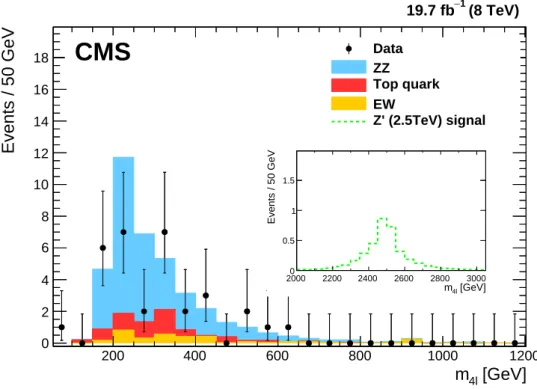
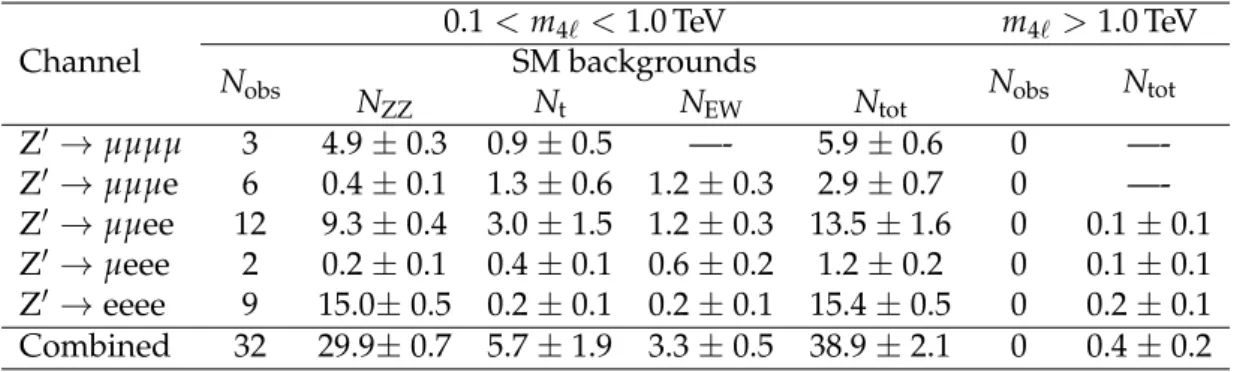
The contribution from events with more than two leptons arising from misidentified jets is ex-pected to be small because this analysis requires four isolated leptons in the final state. This background is estimated using the “misidentification rate” method described in Ref. [13]. The misidentification rate measured as a function of electron ET in the barrel and endcap is ap-plied to events with electron candidates passing the trigger but failing the full selection. The contribution from jet backgrounds estimated using this procedure is found to be negligible. Figure 2 shows the four-lepton invariant mass (m4`) distribution for selected events. The
ob-served events and estimated backgrounds are summarized in Table 1. As shown in the figure and table, the observed events are in agreement with the expected backgrounds. The table shows two different mass ranges. In the region m4` > 1 TeV, the backgrounds from SM
pro-cesses are very small, typically less than one event.
[GeV] 4l m 200 400 600 800 1000 1200 Events / 50 GeV 0 2 4 6 8 10 12 14 16 18 (8 TeV) 1 − 19.7 fb
CMS
[GeV] 4l m 2000 2200 2400 2600 2800 3000 Events / 50 GeV 0 0.5 1 1.5 Data ZZ Top quark EW Z' (2.5TeV) signalFigure 2: The m4` spectrum for the combination of the five studied channels. The points with
vertical bars represent the data with their statistical uncertainties; the histograms represent the expectations from SM processes; “Top quark” denotes the sum of the events for tt, tW, tW, ttZ processes; “EW” denotes the sum of the events from WW, WZ, WWγ, WWZ, WZZ, and ZZZ processes. The inset shows the expectation from the benchmark model for a signal at mZ0
= 2.5 TeV with mϕ =50 GeV.
6
Results
No excess of events is observed in the data sample compared to the SM expectations. Exclusion limits at 95% confidence level (CL) are calculated in the context of the benchmark model with
6 6 Results
Table 1: Summary of the observed yield and expected backgrounds for all channels, where Nobsis the number of observed events in data. The total background (Ntot) is the sum of three different backgrounds that are estimated using MC simulations; NZZrefers to the background from ZZ events; Ntis the background from tt, single top quark, and ttZ production; NEWis the background from WW and WZ, and triple gauge boson production. The quoted uncertainties are statistical only.
Channel
0.1<m4` <1.0 TeV m4` >1.0 TeV
Nobs SM backgrounds Nobs Ntot
NZZ Nt NEW Ntot Z0 →µµµµ 3 4.9±0.3 0.9±0.5 —- 5.9±0.6 0 —-Z0 →µµµe 6 0.4±0.1 1.3±0.6 1.2±0.3 2.9±0.7 0 —-Z0 →µµee 12 9.3±0.4 3.0±1.5 1.2±0.3 13.5±1.6 0 0.1±0.1 Z0 →µeee 2 0.2±0.1 0.4±0.1 0.6±0.2 1.2±0.2 0 0.1±0.1 Z0 →eeee 9 15.0±0.5 0.2±0.1 0.2±0.1 15.4±0.5 0 0.2±0.1 Combined 32 29.9±0.7 5.7±1.9 3.3±0.5 38.9±2.1 0 0.4±0.2 a Bayesian approach. The signal region (0.1 < m4` < 3.0 TeV) consists of four leptons (e or
µ) with |η| < 2.4: two leading (subleading) leptons are required to have pT > 45(30)GeV. The likelihood function is defined with a signal strength modifier, a prior probability, and a set of nuisance parameters that are used to incorporate systematic uncertainties. This method is based on interpreting the likelihood as a probability distribution, with log-normal distributions used for nuisance parameters [41]. Integrating over the latter we obtain a limit on the signal contribution.
The systematic uncertainties are dominated by the uncertainty in the background estimates and in the lepton selection efficiencies. A 30% uncertainty in the total background cross sec-tion (ZZ and tt) is used to account for uncertainties arising from PDFs and higher-order QCD corrections in the measured 8 TeV cross sections. The systematic uncertainty in the muon se-lection including reconstruction, identification, and isolation is 0.5% [26]. The uncertainties in the electron selection are 0.7% (0.6%) for electrons below 100 GeV in EB (EE) and 1.4% (0.4%) for electrons above 100 GeV in EB (EE) [13]. The uncertainties due to the lepton efficiency in both signal and background yields vary between 2.2% and 2.7% as a function of m4`. Including
the effect of the merged lepton signature, a total uncertainty of 10% is assigned for each chan-nel. The impact of the uncertainty in the electron energy scale on signal (background) yield is 1% (0.5%) [13]. Uncertainties in the muon momentum scale and mass resolutions are below 0.1% [26]. The uncertainty in the integrated luminosity is assigned to be 2.6% [42]. In this anal-ysis, the statistical uncertainties are dominant and the systematic uncertainties have a small impact on the results. We tested the robustness of the limits by doubling the values assumed for the systematic uncertainties. We observed a negligible change in the calculated limits, and conclude that the limits are insensitive to any underestimation of the systematic uncertainties. Limits on the product of cross section and branching fraction are set in the context of the bench-mark model as a function of m4`. The mass resolution of the detector is assumed to be larger
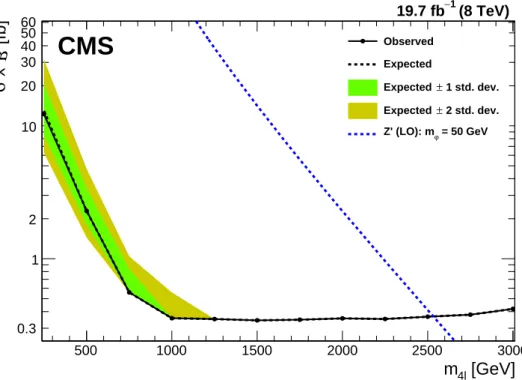
than the natural width of the Z0 resonance in all channels. In the limit calculation, we set the mass window to be six times the mass resolution centred around the signal mass point consid-ered. A counting experiment is performed for the limit calculation. Figure 3 shows the upper limit on the product of the cross section and branching fraction, for the combination of all five channels. Using the benchmark model of Ref. [22] we translate these cross section upper limits into lower limits on the Z0boson mass. For the combination of the five channels, the value ob-tained for this lower mass limit is 2.5 TeV. The black solid (dashed) line indicates the observed
7
(expected) 95% CL upper limits, the inner (outer) band indicates the±1(2)standard deviation uncertainty in the expected limits, and the blue dashed line shows the theoretical Z0cross sec-tion for mϕ = 50 GeV. This theoretical cross section is calculated under the benchmark model
assumption that the branching fractionB(ϕ→ ``0) =100%. In the region above the 1–1.5 TeV, the bands are not visible since backgrounds are negligible here.
[GeV] 4l m 500 1000 1500 2000 2500 3000 [fb] Β x σ 0.3 1 2 10 20 30 40 50 60
CMS
(8 TeV) 1 − 19.7 fb Observed Expected 1 std. dev. ± Expected 2 std. dev. ± Expected = 50 GeV ϕ Z' (LO): mFigure 3: The 95% CL upper limit on the cross section times branching fraction as a function of m4`for the combination of the five channels. The shaded green (yellow) band indicates the one
(two) sigma uncertainty in the expected limits. The blue dashed line represents the theoretical predictions for the benchmark model [22] for mϕ =50 GeV.
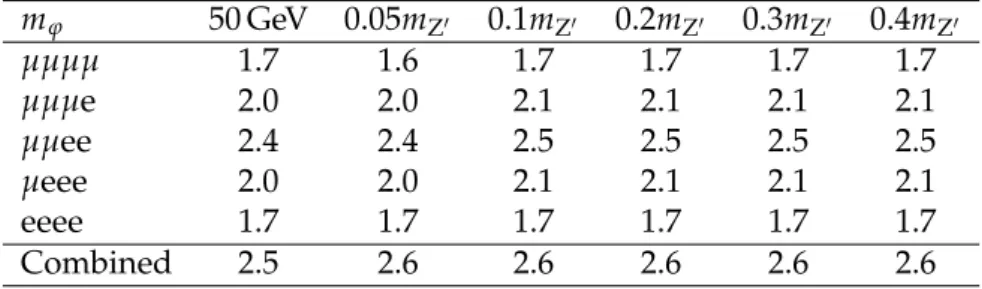
Table 2 shows the exclusion limit on mZ0for the five separate channels and for the combination.
Results are presented for the benchmark assumption mϕ = 50 GeV, and for the five different
values of the ratio mϕ/m4` assumed for the generated signal samples, taking into account the
event selection efficiencies described above. The predicted cross sections decrease as the ratio mϕ/m4`increases. The contribution of the merged lepton signature also decreases, resulting in
an overall efficiency increase. Therefore the scenarios with mϕ/m4`= 5, 10, 20, 30 and 40% of
mZ0, give slightly higher limits than the mϕ=50 GeV scenario.
7
Summary
Results have been presented from a search for heavy narrow resonances decaying into four-lepton final states via intermediate scalar particles ϕ, where the branching fraction of ϕ → ``
(` =e or µ) is set to 1. These results are based on a sample of proton-proton collision data at
√
s =8 TeV, corresponding to an integrated luminosity of 19.7 fb−1. The four-lepton invariant mass spectra are consistent with the standard model predictions. Masses of Z’ bosons have been excluded at 95% confidence level for a specific benchmark model with mϕ=50 GeV, and
for five different assumptions for the ratio mϕ/mZ0 (mϕ/mZ0 = 5, 10, 20, 30 and 40%). Five
8 7 Summary
Table 2: The 95% CL lower limits (in TeV) on mZ0 for the five separate channels and for their
combination. Results are presented for the benchmark assumption mϕ = 50 GeV, and for the
five different values of the ratio mϕ/mZ0.
mϕ 50 GeV 0.05mZ0 0.1mZ0 0.2mZ0 0.3mZ0 0.4mZ0 µµµµ 1.7 1.6 1.7 1.7 1.7 1.7 µµµe 2.0 2.0 2.1 2.1 2.1 2.1 µµee 2.4 2.4 2.5 2.5 2.5 2.5 µeee 2.0 2.0 2.1 2.1 2.1 2.1 eeee 1.7 1.7 1.7 1.7 1.7 1.7 Combined 2.5 2.6 2.6 2.6 2.6 2.6
channels, a lower limit on the Z0 mass of 2.5 TeV is obtained for the benchmark model, and 2.6 TeV for each of the models assuming a fixed ratio between mϕ and mZ0. This is the first
result to constrain a leptophobic Z0resonance in the four-lepton channel.
Acknowledgments
We congratulate our colleagues in the CERN accelerator departments for the excellent perfor-mance of the LHC and thank the technical and administrative staffs at CERN and at other CMS institutes for their contributions to the success of the CMS effort. In addition, we grate-fully acknowledge the computing centres and personnel of the Worldwide LHC Computing Grid for delivering so effectively the computing infrastructure essential to our analyses. Fi-nally, we acknowledge the enduring support for the construction and operation of the LHC and the CMS detector provided by the following funding agencies: BMWFW and FWF (Aus-tria); FNRS and FWO (Belgium); CNPq, CAPES, FAPERJ, and FAPESP (Brazil); MES (Bulgaria); CERN; CAS, MoST, and NSFC (China); COLCIENCIAS (Colombia); MSES and CSF (Croatia); RPF (Cyprus); SENESCYT (Ecuador); MoER, ERC IUT, and ERDF (Estonia); Academy of Fin-land, MEC, and HIP (Finland); CEA and CNRS/IN2P3 (France); BMBF, DFG, and HGF (Ger-many); GSRT (Greece); OTKA and NIH (Hungary); DAE and DST (India); IPM (Iran); SFI (Ireland); INFN (Italy); MSIP and NRF (Republic of Korea); LAS (Lithuania); MOE and UM (Malaysia); BUAP, CINVESTAV, CONACYT, LNS, SEP, and UASLP-FAI (Mexico); MBIE (New Zealand); PAEC (Pakistan); MSHE and NSC (Poland); FCT (Portugal); JINR (Dubna); MON, RosAtom, RAS, RFBR and RAEP (Russia); MESTD (Serbia); SEIDI and CPAN (Spain); Swiss Funding Agencies (Switzerland); MST (Taipei); ThEPCenter, IPST, STAR, and NSTDA (Thai-land); TUBITAK and TAEK (Turkey); NASU and SFFR (Ukraine); STFC (United Kingdom); DOE and NSF (USA).
Individuals have received support from the Marie-Curie programme and the European Re-search Council and EPLANET (European Union); the Leventis Foundation; the A. P. Sloan Foundation; the Alexander von Humboldt Foundation; the Belgian Federal Science Policy Of-fice; the Fonds pour la Formation `a la Recherche dans l’Industrie et dans l’Agriculture (FRIA-Belgium); the Agentschap voor Innovatie door Wetenschap en Technologie (IWT-(FRIA-Belgium); the Ministry of Education, Youth and Sports (MEYS) of the Czech Republic; the Council of Sci-ence and Industrial Research, India; the HOMING PLUS programme of the Foundation for Polish Science, cofinanced from European Union, Regional Development Fund, the Mobil-ity Plus programme of the Ministry of Science and Higher Education, the National Science Center (Poland), contracts Harmonia 2014/14/M/ST2/00428, Opus 2014/13/B/ST2/02543, 2014/15/B/ST2/03998, and 2015/19/B/ST2/02861, Sonata-bis 2012/07/E/ST2/01406; the Thalis and Aristeia programmes cofinanced by EU-ESF and the Greek NSRF; the National Priorities
References 9
Research Program by Qatar National Research Fund; the Programa Clar´ın-COFUND del Princi-pado de Asturias; the Rachadapisek Sompot Fund for Postdoctoral Fellowship, Chulalongkorn University and the Chulalongkorn Academic into Its 2nd Century Project Advancement Project (Thailand); and the Welch Foundation, contract C-1845.
References
[1] A. Leike, “The phenomenology of extra neutral gauge bosons”, Phys. Rept. 317 (1999) 143, doi:10.1016/S0370-1573(98)00133-1, arXiv:hep-ph/9805494.
[2] J. L. Hewett and T. G. Rizzo, “Low-energy phenomenology of superstring-inspired E6 models”, Phys. Rept. 183 (1989) 193, doi:10.1016/0370-1573(89)90071-9.
[3] K. R. Dienes, E. Dudas, and T. Gherghetta, “Extra spacetime dimensions and unification”, Phys. Lett. B 436 (1998) 55, doi:10.1016/S0370-2693(98)00977-0,
arXiv:hep-ph/9803466.
[4] T. Appelquist, H.-C. Cheng, and B. A. Dobrescu, “Bounds on universal extra
dimensions”, Phys. Rev. D 64 (2001) 035002, doi:10.1103/PhysRevD.64.035002, arXiv:hep-ph/0012100.
[5] L. Randall and R. Sundrum, “An Alternative to Compactification”, Phys. Rev. Lett. 83 (1999) 4690, doi:10.1103/PhysRevLett.83.4690, arXiv:hep-ph/9906064. [6] L. Randall and R. Sundrum, “A Large Mass Hierarchy from a Small Extra Dimension”,
Phys. Rev. Lett. 83 (1999) 3370, doi:10.1103/PhysRevLett.83.3370, arXiv:hep-ph/9905221.
[7] ATLAS Collaboration, “Search for new phenomena in the dijet mass distribution using pp collision data at√s =8 TeV with the ATLAS detector”, Phys. Rev. D 91 (2015) 052007, doi:10.1103/PhysRevD.91.052007, arXiv:1407.1376.
[8] ATLAS Collaboration, “Search for new phenomena in dijet mass and angular
distributions from pp collisions at√s =13 TeV with the ATLAS detector”, Phys. Lett. B
754(2016) 302, doi:10.1016/j.physletb.2016.01.032, arXiv:1512.01530. [9] CMS Collaboration, “Search for narrow resonances using the dijet mass spectrum in pp
collisions at√s=8 TeV”, Phys. Rev. D 87 (2013) 114015, doi:10.1103/PhysRevD.87.114015, arXiv:1302.4794.
[10] CMS Collaboration, “Search for Narrow Resonances Decaying to Dijets in Proton-Proton Collisions at√s=13 TeV”, Phys. Rev. Lett. 116 (2016) 071801,
doi:10.1103/PhysRevLett.116.071801, arXiv:1512.01224.
[11] ATLAS Collaboration, “Search for high-mass dilepton resonances in pp collisions at√ s =8 TeV with the ATLAS detector”, Phys. Rev. D 90 (2014) 052005,
doi:10.1103/PhysRevD.90.052005, arXiv:1405.4123.
[12] ATLAS Collaboration, “Search for high-mass new phenomena in the dilepton finale state using proton-proton collisions at√s=13 TeV with the ATLAS detector”, Phys. Lett. B
10 References
[13] CMS Collaboration, “Search for physics beyond the standard model in dilepton mass spectra in proton-proton collisions at√s=8 TeV”, JHEP 04 (2015) 025,
doi:10.1007/JHEP04(2015)025, arXiv:1412.6302.
[14] CMS Collaboration, “Search for narrow resonances in dilepton mass spectra in proton-proton collisions at√s=13 TeV and combination with 8 TeV data”, (2016). arXiv:1609.05391. Submitted to Phys. Lett. B.
[15] ATLAS Collaboration, “Search for resonances in diphoton events at√s=13 TeV with the ATLAS detector”, JHEP 09 (2016) 001, doi:10.1007/JHEP09(2016)001,
arXiv:1606.03833.
[16] CMS Collaboration, “Search for Resonant Production of High-Mass Photon Pairs in Proton-Proton Collisions at√s=8 and 13 TeV”, Phys. Rev. Lett. 117 (2016) 051802, doi:10.1103/PhysRevLett.117.051802, arXiv:1606.04093.
[17] CMS Collaboration, “Search for high-mass diphoton resonances in proton-proton collisions at 13 TeV and combination with 8 TeV search”, (2016). arXiv:1609.02507. Submitted to Phys. Lett. B.
[18] ATLAS Collaboration, “Search for resonances decaying into top-quark pairs using fully hadronic decays in pp collisions with ATLAS at√s=7 TeV”, JHEP 01 (2013) 116, doi:10.1007/JHEP01(2013)116, arXiv:1211.2202.
[19] ATLAS Collaboration, “Search for tt resonances using lepton-plus-jets events in
proton-proton collisions at√s=8 TeV with the ATLAS detector”, JHEP 08 (2015) 148, doi:10.1007/JHEP08(2015)148, arXiv:1505.0718.
[20] CMS Collaboration, “Search for anomalous tt production in the highly-boosted all-hadronic final state”, JHEP 09 (2012) 029, doi:10.1007/JHEP09(2012)029, arXiv:1204.2488.
[21] CMS Collaboration, “Search for resonant t¯t production in proton-proton collisions at√ s =8 TeV”, Phys. Rev. D 93 (2016) 012001, doi:10.1103/PhysRevD.93.012001, arXiv:1506.03062.
[22] V. Barger and H.-S. Lee, “Four-lepton resonance at the Large Hadron Collider”, Phys. Rev. D 85 (2012) 055030, doi:10.1103/PhysRevD.85.055030, arXiv:1111.0633. [23] Y. Kuno and Y. Okada, “Muon decay and physics beyond the standard model”, Rev. Mod.
Phys. 73 (2001) 151, doi:10.1103/RevModPhys.73.151, arXiv:hep-ph/9909265. [24] A. de Gouvea and P. Vogel, “Lepton Flavor and Number Conservation and Physics
Beyond the Standard Model”, Fund. Sym. in the Era of the LHC 71 (2013) 75, doi:10.1016/j.ppnp.2013.03.006, arXiv:1303.4097.
[25] D. K. Ghosh, P. Roy, and S. Roy, “Four lepton flavor violating signals at the LHC”, JHEP
05(2012) 067, doi:10.1007/JHEP05(2012)067, arXiv:1203.0187.
[26] CMS Collaboration, “Performance of CMS muon reconstruction in pp collision events at√ s =7 TeV”, JINST 7 (2012) P10002, doi:10.1088/1748-0221/7/10/P10002, arXiv:1206.4071.
References 11
[27] CMS Collaboration, “Performance of electron reconstruction and selection with the CMS detector in proton-proton collisions at√s=8 TeV”, JINST 10 (2015) P06005,
doi:10.1088/1748-0221/10/06/P06005, arXiv:1502.02701.
[28] CMS Collaboration, “The CMS experiment at the CERN LHC”, JINST 3 (2008) S08004, doi:10.1088/1748-0221/3/08/S08004.
[29] A. Belyaev, N. Christensen, and A. Pukhov, “CalcHEP 3.4 for collider physics within and beyond the Standard Model”, Comp. Phys. Commun. 184 (2013) 1729,
doi:10.1016/j.cpc.2013.01.014, arXiv:1207.6082.
[30] T. Sj ¨ostrand, S. Mrenna, and P. Z. Skands, “PYTHIA 6.4 physics and manual”, JHEP 05 (2006) 026, doi:10.1088/1126-6708/2006/05/026, arXiv:hep-ph/0603175. [31] T. Binoth, N. Kauerm, and P. Mertsch, “Gluon-induced QCD corrections to
pp→ZZ→ ```¯ 0`¯0”, (2008). arXiv:0807.0024. (2008).
[32] S. Alioli, P. Nason, C. Oleari, and E. Re, “NLO vector-boson production matched with shower in POWHEG”, JHEP 07 (2008) 060,
doi:10.1088/1126-6708/2008/07/060, arXiv:0805.4802. [33] J. Alwall et al., “MadGraph v5: going beyond”, JHEP 06 (2011) 128,
doi:10.1007/JHEP06(2011)128, arXiv:1106.0522.
[34] M. Czakon, P. Fiedler, and A. Mitov, “Total Top-Quark Pair-Production Cross Section at Hadron Colliders through O(α4
S)”, Phys. Rev. Lett. 110 (2013) 252004, doi:10.1103/PhysRevLett.110.252004, arXiv:1303.6254.
[35] J. M. Campbell, R. K. Ellis, and C. Williams, “Vector boson pair production at the LHC”, JHEP 07 (2011) 018, doi:10.1007/JHEP07(2011)018, arXiv:1105.0020.
[36] J. Pumplin et al., “New generation of parton distributions with uncertainties from global QCD analysis”, JHEP 07 (2002) 012, doi:10.1088/1126-6708/2002/07/012, arXiv:hep-ph/0201195.
[37] CMS Collaboration, “Study of the underlying event at forward rapidity in pp collisions at√s=0.9, 2.76, and 7 TeV”, JHEP 04 (2013) 072, doi:10.1007/JHEP04(2013)072, arXiv:1302.2394.
[38] CMS Collaboration, “Event generator tunes obtained from underlying event and multiparton scattering measurements”, Eur. Phys. J. C 76 (2016) 155,
doi:10.1140/epjc/s10052-016-3988-x, arXiv:1512.00815.
[39] GEANT4 Collaboration, “GEANT4 – a simulation toolkit”, Nucl. Instrum. Meth. A 506 (2003) 250, doi:10.1016/S0168-9002(03)01368-8.
[40] J. Allison et al., “GEANT4 developments and applications”, IEEE Trans. Nucl. Sci. 53 (2006) 270, doi:10.1109/TNS.2006.869826.
[41] Particle Data Group, K. A. Olive et al., “Review of Particle Physics”, Chin. Phys. C 38 (2014) 090001, doi:10.1088/1674-1137/38/9/090001.
[42] CMS Collaboration, “CMS Luminosity Based on Pixel Cluster Counting — Summer 2013 Update”, CMS Physics Analysis Summary CMS-PAS-LUM-13-001, 2013.
13
A
The CMS Collaboration
Yerevan Physics Institute, Yerevan, Armenia
V. Khachatryan, A.M. Sirunyan, A. Tumasyan
Institut f ¨ur Hochenergiephysik, Wien, Austria
W. Adam, E. Asilar, T. Bergauer, J. Brandstetter, E. Brondolin, M. Dragicevic, J. Er ¨o, M. Flechl, M. Friedl, R. Fr ¨uhwirth1, V.M. Ghete, C. Hartl, N. H ¨ormann, J. Hrubec, M. Jeitler1, A. K ¨onig, I. Kr¨atschmer, D. Liko, T. Matsushita, I. Mikulec, D. Rabady, N. Rad, B. Rahbaran, H. Rohringer, J. Schieck1, J. Strauss, W. Treberer-Treberspurg, W. Waltenberger, C.-E. Wulz1
National Centre for Particle and High Energy Physics, Minsk, Belarus
V. Mossolov, N. Shumeiko, J. Suarez Gonzalez
Universiteit Antwerpen, Antwerpen, Belgium
S. Alderweireldt, E.A. De Wolf, X. Janssen, J. Lauwers, M. Van De Klundert, H. Van Haevermaet, P. Van Mechelen, N. Van Remortel, A. Van Spilbeeck
Vrije Universiteit Brussel, Brussel, Belgium
S. Abu Zeid, F. Blekman, J. D’Hondt, N. Daci, I. De Bruyn, K. Deroover, N. Heracleous, S. Lowette, S. Moortgat, L. Moreels, A. Olbrechts, Q. Python, S. Tavernier, W. Van Doninck, P. Van Mulders, I. Van Parijs
Universit´e Libre de Bruxelles, Bruxelles, Belgium
H. Brun, C. Caillol, B. Clerbaux, G. De Lentdecker, H. Delannoy, G. Fasanella, L. Favart, R. Goldouzian, A. Grebenyuk, G. Karapostoli, T. Lenzi, A. L´eonard, J. Luetic, T. Maerschalk, A. Marinov, A. Randle-conde, T. Seva, C. Vander Velde, P. Vanlaer, R. Yonamine, F. Zenoni, F. Zhang2
Ghent University, Ghent, Belgium
A. Cimmino, T. Cornelis, D. Dobur, A. Fagot, G. Garcia, M. Gul, D. Poyraz, S. Salva, R. Sch ¨ofbeck, A. Sharma, M. Tytgat, W. Van Driessche, E. Yazgan, N. Zaganidis
Universit´e Catholique de Louvain, Louvain-la-Neuve, Belgium
H. Bakhshiansohi, C. Beluffi3, O. Bondu, S. Brochet, G. Bruno, A. Caudron, S. De Visscher, C. Delaere, M. Delcourt, B. Francois, A. Giammanco, A. Jafari, P. Jez, M. Komm, V. Lemaitre, A. Magitteri, A. Mertens, M. Musich, C. Nuttens, K. Piotrzkowski, L. Quertenmont, M. Selvaggi, M. Vidal Marono, S. Wertz
Universit´e de Mons, Mons, Belgium
N. Beliy
Centro Brasileiro de Pesquisas Fisicas, Rio de Janeiro, Brazil
W.L. Ald´a J ´unior, F.L. Alves, G.A. Alves, L. Brito, C. Hensel, A. Moraes, M.E. Pol, P. Rebello Teles
Universidade do Estado do Rio de Janeiro, Rio de Janeiro, Brazil
E. Belchior Batista Das Chagas, W. Carvalho, J. Chinellato4, A. Cust ´odio, E.M. Da Costa, G.G. Da Silveira5, D. De Jesus Damiao, C. De Oliveira Martins, S. Fonseca De Souza, L.M. Huertas Guativa, H. Malbouisson, D. Matos Figueiredo, C. Mora Herrera, L. Mundim, H. Nogima, W.L. Prado Da Silva, A. Santoro, A. Sznajder, E.J. Tonelli Manganote4, A. Vilela Pereira
Universidade Estadual Paulistaa, Universidade Federal do ABCb, S˜ao Paulo, Brazil
14 A The CMS Collaboration
P.G. Mercadanteb, C.S. Moona, S.F. Novaesa, Sandra S. Padulaa, D. Romero Abadb, J.C. Ruiz Vargas
Institute for Nuclear Research and Nuclear Energy, Sofia, Bulgaria
A. Aleksandrov, R. Hadjiiska, P. Iaydjiev, M. Rodozov, S. Stoykova, G. Sultanov, M. Vutova
University of Sofia, Sofia, Bulgaria
A. Dimitrov, I. Glushkov, L. Litov, B. Pavlov, P. Petkov
Beihang University, Beijing, China
W. Fang6
Institute of High Energy Physics, Beijing, China
M. Ahmad, J.G. Bian, G.M. Chen, H.S. Chen, M. Chen, Y. Chen7, T. Cheng, C.H. Jiang, D. Leggat, Z. Liu, F. Romeo, S.M. Shaheen, A. Spiezia, J. Tao, C. Wang, Z. Wang, H. Zhang, J. Zhao
State Key Laboratory of Nuclear Physics and Technology, Peking University, Beijing, China
Y. Ban, G. Chen, Q. Li, S. Liu, Y. Mao, S.J. Qian, D. Wang, Z. Xu
Universidad de Los Andes, Bogota, Colombia
C. Avila, A. Cabrera, L.F. Chaparro Sierra, C. Florez, J.P. Gomez, C.F. Gonz´alez Hern´andez, J.D. Ruiz Alvarez, J.C. Sanabria
University of Split, Faculty of Electrical Engineering, Mechanical Engineering and Naval Architecture, Split, Croatia
N. Godinovic, D. Lelas, I. Puljak, P.M. Ribeiro Cipriano, T. Sculac
University of Split, Faculty of Science, Split, Croatia
Z. Antunovic, M. Kovac
Institute Rudjer Boskovic, Zagreb, Croatia
V. Brigljevic, D. Ferencek, K. Kadija, S. Micanovic, L. Sudic, T. Susa
University of Cyprus, Nicosia, Cyprus
A. Attikis, G. Mavromanolakis, J. Mousa, C. Nicolaou, F. Ptochos, P.A. Razis, H. Rykaczewski
Charles University, Prague, Czech Republic
M. Finger8, M. Finger Jr.8
Universidad San Francisco de Quito, Quito, Ecuador
E. Carrera Jarrin
Academy of Scientific Research and Technology of the Arab Republic of Egypt, Egyptian Network of High Energy Physics, Cairo, Egypt
A.A. Abdelalim9,10, Y. Mohammed11, E. Salama12,13
National Institute of Chemical Physics and Biophysics, Tallinn, Estonia
B. Calpas, M. Kadastik, M. Murumaa, L. Perrini, M. Raidal, A. Tiko, C. Veelken
Department of Physics, University of Helsinki, Helsinki, Finland
P. Eerola, J. Pekkanen, M. Voutilainen
Helsinki Institute of Physics, Helsinki, Finland
J. H¨ark ¨onen, V. Karim¨aki, R. Kinnunen, T. Lamp´en, K. Lassila-Perini, S. Lehti, T. Lind´en, P. Luukka, J. Tuominiemi, E. Tuovinen, L. Wendland
15
Lappeenranta University of Technology, Lappeenranta, Finland
J. Talvitie, T. Tuuva
IRFU, CEA, Universit´e Paris-Saclay, Gif-sur-Yvette, France
M. Besancon, F. Couderc, M. Dejardin, D. Denegri, B. Fabbro, J.L. Faure, C. Favaro, F. Ferri, S. Ganjour, S. Ghosh, A. Givernaud, P. Gras, G. Hamel de Monchenault, P. Jarry, I. Kucher, E. Locci, M. Machet, J. Malcles, J. Rander, A. Rosowsky, M. Titov, A. Zghiche
Laboratoire Leprince-Ringuet, Ecole Polytechnique, IN2P3-CNRS, Palaiseau, France
A. Abdulsalam, I. Antropov, S. Baffioni, F. Beaudette, P. Busson, L. Cadamuro, E. Chapon, C. Charlot, O. Davignon, R. Granier de Cassagnac, M. Jo, S. Lisniak, P. Min´e, M. Nguyen, C. Ochando, G. Ortona, P. Paganini, P. Pigard, S. Regnard, R. Salerno, Y. Sirois, T. Strebler, Y. Yilmaz, A. Zabi
Institut Pluridisciplinaire Hubert Curien (IPHC), Universit´e de Strasbourg, CNRS-IN2P3
J.-L. Agram14, J. Andrea, A. Aubin, D. Bloch, J.-M. Brom, M. Buttignol, E.C. Chabert, N. Chanon, C. Collard, E. Conte14, X. Coubez, J.-C. Fontaine14, D. Gel´e, U. Goerlach, A.-C. Le Bihan, K. Skovpen, P. Van Hove
Centre de Calcul de l’Institut National de Physique Nucleaire et de Physique des Particules, CNRS/IN2P3, Villeurbanne, France
S. Gadrat
Universit´e de Lyon, Universit´e Claude Bernard Lyon 1, CNRS-IN2P3, Institut de Physique Nucl´eaire de Lyon, Villeurbanne, France
S. Beauceron, C. Bernet, G. Boudoul, E. Bouvier, C.A. Carrillo Montoya, R. Chierici, D. Contardo, B. Courbon, P. Depasse, H. El Mamouni, J. Fan, J. Fay, S. Gascon, M. Gouzevitch, G. Grenier, B. Ille, F. Lagarde, I.B. Laktineh, M. Lethuillier, L. Mirabito, A.L. Pequegnot, S. Perries, A. Popov15, D. Sabes, V. Sordini, M. Vander Donckt, P. Verdier, S. Viret
Georgian Technical University, Tbilisi, Georgia
T. Toriashvili16
Tbilisi State University, Tbilisi, Georgia
Z. Tsamalaidze8
RWTH Aachen University, I. Physikalisches Institut, Aachen, Germany
C. Autermann, S. Beranek, L. Feld, A. Heister, M.K. Kiesel, K. Klein, M. Lipinski, A. Ostapchuk, M. Preuten, F. Raupach, S. Schael, C. Schomakers, J.F. Schulte, J. Schulz, T. Verlage, H. Weber, V. Zhukov15
RWTH Aachen University, III. Physikalisches Institut A, Aachen, Germany
A. Albert, M. Brodski, E. Dietz-Laursonn, D. Duchardt, M. Endres, M. Erdmann, S. Erdweg, T. Esch, R. Fischer, A. G ¨uth, M. Hamer, T. Hebbeker, C. Heidemann, K. Hoepfner, S. Knutzen, M. Merschmeyer, A. Meyer, P. Millet, S. Mukherjee, M. Olschewski, K. Padeken, T. Pook, M. Radziej, H. Reithler, M. Rieger, F. Scheuch, L. Sonnenschein, D. Teyssier, S. Th ¨uer
RWTH Aachen University, III. Physikalisches Institut B, Aachen, Germany
V. Cherepanov, G. Fl ¨ugge, W. Haj Ahmad, F. Hoehle, B. Kargoll, T. Kress, A. K ¨unsken, J. Lingemann, T. M ¨uller, A. Nehrkorn, A. Nowack, I.M. Nugent, C. Pistone, O. Pooth, A. Stahl17
Deutsches Elektronen-Synchrotron, Hamburg, Germany
M. Aldaya Martin, C. Asawatangtrakuldee, K. Beernaert, O. Behnke, U. Behrens, A.A. Bin Anuar, K. Borras18, A. Campbell, P. Connor, C. Contreras-Campana, F. Costanza, C. Diez Pardos, G. Dolinska, G. Eckerlin, D. Eckstein, T. Eichhorn, E. Eren, E. Gallo19, J. Garay Garcia,
16 A The CMS Collaboration
A. Geiser, A. Gizhko, J.M. Grados Luyando, P. Gunnellini, A. Harb, J. Hauk, M. Hempel20, H. Jung, A. Kalogeropoulos, O. Karacheban20, M. Kasemann, J. Keaveney, C. Kleinwort, I. Korol, D. Kr ¨ucker, W. Lange, A. Lelek, J. Leonard, K. Lipka, A. Lobanov, W. Lohmann20, R. Mankel, I.-A. Melzer-Pellmann, A.B. Meyer, G. Mittag, J. Mnich, A. Mussgiller, E. Ntomari, D. Pitzl, R. Placakyte, A. Raspereza, B. Roland, M. ¨O. Sahin, P. Saxena, T. Schoerner-Sadenius, C. Seitz, S. Spannagel, N. Stefaniuk, G.P. Van Onsem, R. Walsh, C. Wissing
University of Hamburg, Hamburg, Germany
V. Blobel, M. Centis Vignali, A.R. Draeger, T. Dreyer, E. Garutti, D. Gonzalez, J. Haller, M. Hoffmann, A. Junkes, R. Klanner, R. Kogler, N. Kovalchuk, T. Lapsien, T. Lenz, I. Marchesini, D. Marconi, M. Meyer, M. Niedziela, D. Nowatschin, F. Pantaleo17, T. Peiffer, A. Perieanu, J. Poehlsen, C. Sander, C. Scharf, P. Schleper, A. Schmidt, S. Schumann, J. Schwandt, H. Stadie, G. Steinbr ¨uck, F.M. Stober, M. St ¨over, H. Tholen, D. Troendle, E. Usai, L. Vanelderen, A. Vanhoefer, B. Vormwald
Institut f ¨ur Experimentelle Kernphysik, Karlsruhe, Germany
C. Barth, C. Baus, J. Berger, E. Butz, T. Chwalek, F. Colombo, W. De Boer, A. Dierlamm, S. Fink, R. Friese, M. Giffels, A. Gilbert, P. Goldenzweig, D. Haitz, F. Hartmann17, S.M. Heindl, U. Husemann, I. Katkov15, P. Lobelle Pardo, B. Maier, H. Mildner, M.U. Mozer, Th. M ¨uller, M. Plagge, G. Quast, K. Rabbertz, S. R ¨ocker, F. Roscher, M. Schr ¨oder, I. Shvetsov, G. Sieber, H.J. Simonis, R. Ulrich, J. Wagner-Kuhr, S. Wayand, M. Weber, T. Weiler, S. Williamson, C. W ¨ohrmann, R. Wolf
Institute of Nuclear and Particle Physics (INPP), NCSR Demokritos, Aghia Paraskevi, Greece
G. Anagnostou, G. Daskalakis, T. Geralis, V.A. Giakoumopoulou, A. Kyriakis, D. Loukas, I. Topsis-Giotis
National and Kapodistrian University of Athens, Athens, Greece
S. Kesisoglou, A. Panagiotou, N. Saoulidou, E. Tziaferi
University of Io´annina, Io´annina, Greece
I. Evangelou, G. Flouris, C. Foudas, P. Kokkas, N. Loukas, N. Manthos, I. Papadopoulos, E. Paradas
MTA-ELTE Lend ¨ulet CMS Particle and Nuclear Physics Group, E ¨otv ¨os Lor´and University, Budapest, Hungary
N. Filipovic
Wigner Research Centre for Physics, Budapest, Hungary
G. Bencze, C. Hajdu, P. Hidas, D. Horvath21, F. Sikler, V. Veszpremi, G. Vesztergombi22, A.J. Zsigmond
Institute of Nuclear Research ATOMKI, Debrecen, Hungary
N. Beni, S. Czellar, J. Karancsi23, A. Makovec, J. Molnar, Z. Szillasi
Institute of Physics, University of Debrecen
M. Bart ´ok22, P. Raics, Z.L. Trocsanyi, B. Ujvari
National Institute of Science Education and Research, Bhubaneswar, India
S. Bahinipati, S. Choudhury24, P. Mal, K. Mandal, A. Nayak25, D.K. Sahoo, N. Sahoo, S.K. Swain
Panjab University, Chandigarh, India
S. Bansal, S.B. Beri, V. Bhatnagar, R. Chawla, U.Bhawandeep, A.K. Kalsi, A. Kaur, M. Kaur, R. Kumar, P. Kumari, A. Mehta, M. Mittal, J.B. Singh, G. Walia
17
University of Delhi, Delhi, India
Ashok Kumar, A. Bhardwaj, B.C. Choudhary, R.B. Garg, S. Keshri, S. Malhotra, M. Naimuddin, N. Nishu, K. Ranjan, R. Sharma, V. Sharma
Saha Institute of Nuclear Physics, Kolkata, India
R. Bhattacharya, S. Bhattacharya, K. Chatterjee, S. Dey, S. Dutt, S. Dutta, S. Ghosh, N. Majumdar, A. Modak, K. Mondal, S. Mukhopadhyay, S. Nandan, A. Purohit, A. Roy, D. Roy, S. Roy Chowdhury, S. Sarkar, M. Sharan, S. Thakur
Indian Institute of Technology Madras, Madras, India
P.K. Behera
Bhabha Atomic Research Centre, Mumbai, India
R. Chudasama, D. Dutta, V. Jha, V. Kumar, A.K. Mohanty17, P.K. Netrakanti, L.M. Pant, P. Shukla, A. Topkar
Tata Institute of Fundamental Research-A, Mumbai, India
T. Aziz, S. Dugad, G. Kole, B. Mahakud, S. Mitra, G.B. Mohanty, B. Parida, N. Sur, B. Sutar
Tata Institute of Fundamental Research-B, Mumbai, India
S. Banerjee, S. Bhowmik26, R.K. Dewanjee, S. Ganguly, M. Guchait, Sa. Jain, S. Kumar, M. Maity26, G. Majumder, K. Mazumdar, T. Sarkar26, N. Wickramage27
Indian Institute of Science Education and Research (IISER), Pune, India
S. Chauhan, S. Dube, V. Hegde, A. Kapoor, K. Kothekar, A. Rane, S. Sharma
Institute for Research in Fundamental Sciences (IPM), Tehran, Iran
H. Behnamian, S. Chenarani28, E. Eskandari Tadavani, S.M. Etesami28, A. Fahim29, M. Khakzad, M. Mohammadi Najafabadi, M. Naseri, S. Paktinat Mehdiabadi30, F. Rezaei Hosseinabadi, B. Safarzadeh31, M. Zeinali
University College Dublin, Dublin, Ireland
M. Felcini, M. Grunewald
INFN Sezione di Baria, Universit`a di Barib, Politecnico di Baric, Bari, Italy
M. Abbresciaa,b, C. Calabriaa,b, C. Caputoa,b, A. Colaleoa, D. Creanzaa,c, L. Cristellaa,b, N. De Filippisa,c, M. De Palmaa,b, L. Fiorea, G. Iasellia,c, G. Maggia,c, M. Maggia, G. Minielloa,b, S. Mya,b, S. Nuzzoa,b, A. Pompilia,b, G. Pugliesea,c, R. Radognaa,b, A. Ranieria, G. Selvaggia,b, L. Silvestrisa,17, R. Vendittia,b, P. Verwilligena
INFN Sezione di Bolognaa, Universit`a di Bolognab, Bologna, Italy
G. Abbiendia, C. Battilana, D. Bonacorsia,b, S. Braibant-Giacomellia,b, L. Brigliadoria,b, R. Campaninia,b, P. Capiluppia,b, A. Castroa,b, F.R. Cavalloa, S.S. Chhibraa,b, G. Codispotia,b, M. Cuffiania,b, G.M. Dallavallea, F. Fabbria, A. Fanfania,b, D. Fasanellaa,b, P. Giacomellia, C. Grandia, L. Guiduccia,b, S. Marcellinia, G. Masettia, A. Montanaria, F.L. Navarriaa,b, A. Perrottaa, A.M. Rossia,b, T. Rovellia,b, G.P. Sirolia,b, N. Tosia,b,17
INFN Sezione di Cataniaa, Universit`a di Cataniab, Catania, Italy
S. Albergoa,b, M. Chiorbolia,b, S. Costaa,b, A. Di Mattiaa, F. Giordanoa,b, R. Potenzaa,b, A. Tricomia,b, C. Tuvea,b
INFN Sezione di Firenzea, Universit`a di Firenzeb, Firenze, Italy
G. Barbaglia, V. Ciullia,b, C. Civininia, R. D’Alessandroa,b, E. Focardia,b, V. Goria,b, P. Lenzia,b, M. Meschinia, S. Paolettia, G. Sguazzonia, L. Viliania,b,17
18 A The CMS Collaboration
INFN Laboratori Nazionali di Frascati, Frascati, Italy
L. Benussi, S. Bianco, F. Fabbri, D. Piccolo, F. Primavera17
INFN Sezione di Genovaa, Universit`a di Genovab, Genova, Italy
V. Calvellia,b, F. Ferroa, M. Lo Veterea,b, M.R. Mongea,b, E. Robuttia, S. Tosia,b
INFN Sezione di Milano-Bicoccaa, Universit`a di Milano-Bicoccab, Milano, Italy
L. Brianza17, M.E. Dinardoa,b, S. Fiorendia,b, S. Gennaia, A. Ghezzia,b, P. Govonia,b, M. Malberti, S. Malvezzia, R.A. Manzonia,b,17, B. Marzocchia,b, D. Menascea, L. Moronia, M. Paganonia,b, D. Pedrinia, S. Pigazzini, S. Ragazzia,b, T. Tabarelli de Fatisa,b
INFN Sezione di Napolia, Universit`a di Napoli ’Federico II’b, Napoli, Italy, Universit`a della Basilicatac, Potenza, Italy, Universit`a G. Marconid, Roma, Italy
S. Buontempoa, N. Cavalloa,c, G. De Nardo, S. Di Guidaa,d,17, M. Espositoa,b, F. Fabozzia,c, A.O.M. Iorioa,b, G. Lanzaa, L. Listaa, S. Meolaa,d,17, P. Paoluccia,17, C. Sciaccaa,b, F. Thyssen
INFN Sezione di Padova a, Universit`a di Padova b, Padova, Italy, Universit`a di Trento c,
Trento, Italy
P. Azzia,17, N. Bacchettaa, L. Benatoa,b, D. Biselloa,b, A. Bolettia,b, R. Carlina,b, A. Carvalho Antunes De Oliveiraa,b, P. Checchiaa, M. Dall’Ossoa,b, P. De Castro Manzanoa, T. Dorigoa, U. Dossellia, F. Gasparinia,b, U. Gasparinia,b, A. Gozzelinoa, S. Lacapraraa, M. Margonia,b, A.T. Meneguzzoa,b, J. Pazzinia,b,17, N. Pozzobona,b, P. Ronchesea,b, F. Simonettoa,b, E. Torassaa, M. Zanetti, P. Zottoa,b, A. Zucchettaa,b, G. Zumerlea,b
INFN Sezione di Paviaa, Universit`a di Paviab, Pavia, Italy
A. Braghieria, A. Magnania,b, P. Montagnaa,b, S.P. Rattia,b, V. Rea, C. Riccardia,b, P. Salvinia, I. Vaia,b, P. Vituloa,b
INFN Sezione di Perugiaa, Universit`a di Perugiab, Perugia, Italy
L. Alunni Solestizia,b, G.M. Bileia, D. Ciangottinia,b, L. Fan `oa,b, P. Laricciaa,b, R. Leonardia,b, G. Mantovania,b, M. Menichellia, A. Sahaa, A. Santocchiaa,b
INFN Sezione di Pisaa, Universit`a di Pisab, Scuola Normale Superiore di Pisac, Pisa, Italy
K. Androsova,32, P. Azzurria,17, G. Bagliesia, J. Bernardinia, T. Boccalia, R. Castaldia, M.A. Cioccia,32, R. Dell’Orsoa, S. Donatoa,c, G. Fedi, A. Giassia, M.T. Grippoa,32, F. Ligabuea,c, T. Lomtadzea, L. Martinia,b, A. Messineoa,b, F. Pallaa, A. Rizzia,b, A. Savoy-Navarroa,33, P. Spagnoloa, R. Tenchinia, G. Tonellia,b, A. Venturia, P.G. Verdinia
INFN Sezione di Romaa, Universit`a di Romab, Roma, Italy
L. Baronea,b, F. Cavallaria, M. Cipriania,b, G. D’imperioa,b,17, D. Del Rea,b,17, M. Diemoza, S. Gellia,b, E. Longoa,b, F. Margarolia,b, P. Meridiania, G. Organtinia,b, R. Paramattia, F. Preiatoa,b, S. Rahatloua,b, C. Rovellia, F. Santanastasioa,b
INFN Sezione di Torino a, Universit`a di Torino b, Torino, Italy, Universit`a del Piemonte
Orientalec, Novara, Italy
N. Amapanea,b, R. Arcidiaconoa,c,17, S. Argiroa,b, M. Arneodoa,c, N. Bartosika, R. Bellana,b, C. Biinoa, N. Cartigliaa, M. Costaa,b, R. Covarellia,b, A. Deganoa,b, N. Demariaa, L. Fincoa,b, B. Kiania,b, C. Mariottia, S. Masellia, G. Mazzaa, E. Migliorea,b, V. Monacoa,b, E. Monteila,b, M.M. Obertinoa,b, L. Pachera,b, N. Pastronea, M. Pelliccionia, G.L. Pinna Angionia,b, F. Raveraa,b, A. Romeroa,b, F. Rotondoa, M. Ruspaa,c, R. Sacchia,b, V. Solaa, A. Solanoa,b, A. Staianoa, P. Traczyka,b
INFN Sezione di Triestea, Universit`a di Triesteb, Trieste, Italy
19
Kyungpook National University, Daegu, Korea
D.H. Kim, G.N. Kim, M.S. Kim, S. Lee, S.W. Lee, Y.D. Oh, S. Sekmen, D.C. Son, Y.C. Yang
Chonbuk National University, Jeonju, Korea
A. Lee
Chonnam National University, Institute for Universe and Elementary Particles, Kwangju, Korea
H. Kim
Hanyang University, Seoul, Korea
J.A. Brochero Cifuentes, T.J. Kim
Korea University, Seoul, Korea
S. Cho, S. Choi, Y. Go, D. Gyun, S. Ha, B. Hong, Y. Jo, Y. Kim, B. Lee, K. Lee, K.S. Lee, S. Lee, J. Lim, S.K. Park, Y. Roh
Seoul National University, Seoul, Korea
J. Almond, J. Kim, H. Lee, S.B. Oh, B.C. Radburn-Smith, S.h. Seo, U.K. Yang, H.D. Yoo, G.B. Yu
University of Seoul, Seoul, Korea
M. Choi, H. Kim, J.H. Kim, J.S.H. Lee, I.C. Park, G. Ryu, M.S. Ryu
Sungkyunkwan University, Suwon, Korea
Y. Choi, J. Goh, C. Hwang, J. Lee, I. Yu
Vilnius University, Vilnius, Lithuania
V. Dudenas, A. Juodagalvis, J. Vaitkus
National Centre for Particle Physics, Universiti Malaya, Kuala Lumpur, Malaysia
I. Ahmed, Z.A. Ibrahim, J.R. Komaragiri, M.A.B. Md Ali34, F. Mohamad Idris35, W.A.T. Wan Abdullah, M.N. Yusli, Z. Zolkapli
Centro de Investigacion y de Estudios Avanzados del IPN, Mexico City, Mexico
H. Castilla-Valdez, E. De La Cruz-Burelo, I. Heredia-De La Cruz36, A. Hernandez-Almada, R. Lopez-Fernandez, R. Maga ˜na Villalba, J. Mejia Guisao, A. Sanchez-Hernandez
Universidad Iberoamericana, Mexico City, Mexico
S. Carrillo Moreno, C. Oropeza Barrera, F. Vazquez Valencia
Benemerita Universidad Autonoma de Puebla, Puebla, Mexico
S. Carpinteyro, I. Pedraza, H.A. Salazar Ibarguen, C. Uribe Estrada
Universidad Aut ´onoma de San Luis Potos´ı, San Luis Potos´ı, Mexico
A. Morelos Pineda
University of Auckland, Auckland, New Zealand
D. Krofcheck
University of Canterbury, Christchurch, New Zealand
P.H. Butler
National Centre for Physics, Quaid-I-Azam University, Islamabad, Pakistan
A. Ahmad, M. Ahmad, Q. Hassan, H.R. Hoorani, W.A. Khan, A. Saddique, M.A. Shah, M. Shoaib, M. Waqas
20 A The CMS Collaboration
National Centre for Nuclear Research, Swierk, Poland
H. Bialkowska, M. Bluj, B. Boimska, T. Frueboes, M. G ´orski, M. Kazana, K. Nawrocki, K. Romanowska-Rybinska, M. Szleper, P. Zalewski
Institute of Experimental Physics, Faculty of Physics, University of Warsaw, Warsaw, Poland
K. Bunkowski, A. Byszuk37, K. Doroba, A. Kalinowski, M. Konecki, J. Krolikowski, M. Misiura, M. Olszewski, M. Walczak
Laborat ´orio de Instrumenta¸c˜ao e F´ısica Experimental de Part´ıculas, Lisboa, Portugal
P. Bargassa, C. Beir˜ao Da Cruz E Silva, A. Di Francesco, P. Faccioli, P.G. Ferreira Parracho, M. Gallinaro, J. Hollar, N. Leonardo, L. Lloret Iglesias, M.V. Nemallapudi, J. Rodrigues Antunes, J. Seixas, O. Toldaiev, D. Vadruccio, J. Varela, P. Vischia
Joint Institute for Nuclear Research, Dubna, Russia
I. Belotelov, P. Bunin, I. Golutvin, I. Gorbunov, V. Karjavin, G. Kozlov, A. Lanev, A. Malakhov, V. Matveev38,39, P. Moisenz, V. Palichik, V. Perelygin, M. Savina, S. Shmatov, S. Shulha, N. Skatchkov, V. Smirnov, N. Voytishin, A. Zarubin
Petersburg Nuclear Physics Institute, Gatchina (St. Petersburg), Russia
L. Chtchipounov, V. Golovtsov, Y. Ivanov, V. Kim40, E. Kuznetsova41, V. Murzin, V. Oreshkin, V. Sulimov, A. Vorobyev
Institute for Nuclear Research, Moscow, Russia
Yu. Andreev, A. Dermenev, S. Gninenko, N. Golubev, A. Karneyeu, M. Kirsanov, N. Krasnikov, A. Pashenkov, D. Tlisov, A. Toropin
Institute for Theoretical and Experimental Physics, Moscow, Russia
V. Epshteyn, V. Gavrilov, N. Lychkovskaya, V. Popov, I. Pozdnyakov, G. Safronov, A. Spiridonov, M. Toms, E. Vlasov, A. Zhokin
Moscow Institute of Physics and Technology, Moscow, Russia
A. Bylinkin39
National Research Nuclear University ’Moscow Engineering Physics Institute’ (MEPhI), Moscow, Russia
R. Chistov42, M. Danilov42, V. Rusinov
P.N. Lebedev Physical Institute, Moscow, Russia
V. Andreev, M. Azarkin39, I. Dremin39, M. Kirakosyan, A. Leonidov39, S.V. Rusakov, A. Terkulov
Skobeltsyn Institute of Nuclear Physics, Lomonosov Moscow State University, Moscow, Russia
A. Baskakov, A. Belyaev, E. Boos, V. Bunichev, M. Dubinin43, L. Dudko, V. Klyukhin, O. Kodolova, I. Lokhtin, I. Miagkov, S. Obraztsov, M. Perfilov, S. Petrushanko, V. Savrin, A. Snigirev
Novosibirsk State University (NSU), Novosibirsk, Russia
V. Blinov44, Y.Skovpen44
State Research Center of Russian Federation, Institute for High Energy Physics, Protvino, Russia
I. Azhgirey, I. Bayshev, S. Bitioukov, D. Elumakhov, V. Kachanov, A. Kalinin, D. Konstantinov, V. Krychkine, V. Petrov, R. Ryutin, A. Sobol, S. Troshin, N. Tyurin, A. Uzunian, A. Volkov
21
University of Belgrade, Faculty of Physics and Vinca Institute of Nuclear Sciences, Belgrade, Serbia
P. Adzic45, P. Cirkovic, D. Devetak, M. Dordevic, J. Milosevic, V. Rekovic
Centro de Investigaciones Energ´eticas Medioambientales y Tecnol ´ogicas (CIEMAT), Madrid, Spain
J. Alcaraz Maestre, M. Barrio Luna, E. Calvo, M. Cerrada, M. Chamizo Llatas, N. Colino, B. De La Cruz, A. Delgado Peris, A. Escalante Del Valle, C. Fernandez Bedoya, J.P. Fern´andez Ramos, J. Flix, M.C. Fouz, P. Garcia-Abia, O. Gonzalez Lopez, S. Goy Lopez, J.M. Hernandez, M.I. Josa, E. Navarro De Martino, A. P´erez-Calero Yzquierdo, J. Puerta Pelayo, A. Quintario Olmeda, I. Redondo, L. Romero, M.S. Soares
Universidad Aut ´onoma de Madrid, Madrid, Spain
J.F. de Troc ´oniz, M. Missiroli, D. Moran
Universidad de Oviedo, Oviedo, Spain
J. Cuevas, J. Fernandez Menendez, I. Gonzalez Caballero, J.R. Gonz´alez Fern´andez, E. Palencia Cortezon, S. Sanchez Cruz, I. Su´arez Andr´es, J.M. Vizan Garcia
Instituto de F´ısica de Cantabria (IFCA), CSIC-Universidad de Cantabria, Santander, Spain
I.J. Cabrillo, A. Calderon, J.R. Casti ˜neiras De Saa, E. Curras, M. Fernandez, J. Garcia-Ferrero, G. Gomez, A. Lopez Virto, J. Marco, C. Martinez Rivero, F. Matorras, J. Piedra Gomez, T. Rodrigo, A. Ruiz-Jimeno, L. Scodellaro, N. Trevisani, I. Vila, R. Vilar Cortabitarte
CERN, European Organization for Nuclear Research, Geneva, Switzerland
D. Abbaneo, E. Auffray, G. Auzinger, M. Bachtis, P. Baillon, A.H. Ball, D. Barney, P. Bloch, A. Bocci, A. Bonato, C. Botta, T. Camporesi, R. Castello, M. Cepeda, G. Cerminara, M. D’Alfonso, D. d’Enterria, A. Dabrowski, V. Daponte, A. David, M. De Gruttola, A. De Roeck, E. Di Marco46, M. Dobson, B. Dorney, T. du Pree, D. Duggan, M. D ¨unser, N. Dupont, A. Elliott-Peisert, S. Fartoukh, G. Franzoni, J. Fulcher, W. Funk, D. Gigi, K. Gill, M. Girone, F. Glege, D. Gulhan, S. Gundacker, M. Guthoff, J. Hammer, P. Harris, J. Hegeman, V. Innocente, P. Janot, J. Kieseler, H. Kirschenmann, V. Kn ¨unz, A. Kornmayer17, M.J. Kortelainen, K. Kousouris, M. Krammer1, C. Lange, P. Lecoq, C. Lourenc¸o, M.T. Lucchini, L. Malgeri, M. Mannelli, A. Martelli, F. Meijers, J.A. Merlin, S. Mersi, E. Meschi, F. Moortgat, S. Morovic, M. Mulders, H. Neugebauer, S. Orfanelli, L. Orsini, L. Pape, E. Perez, M. Peruzzi, A. Petrilli, G. Petrucciani, A. Pfeiffer, M. Pierini, A. Racz, T. Reis, G. Rolandi47, M. Rovere, M. Ruan, H. Sakulin, J.B. Sauvan, C. Sch¨afer, C. Schwick, M. Seidel, A. Sharma, P. Silva, P. Sphicas48, J. Steggemann, M. Stoye, Y. Takahashi, M. Tosi, D. Treille, A. Triossi, A. Tsirou, V. Veckalns49, G.I. Veres22, N. Wardle, H.K. W ¨ohri, A. Zagozdzinska37, W.D. Zeuner
Paul Scherrer Institut, Villigen, Switzerland
W. Bertl, K. Deiters, W. Erdmann, R. Horisberger, Q. Ingram, H.C. Kaestli, D. Kotlinski, U. Langenegger, T. Rohe
Institute for Particle Physics, ETH Zurich, Zurich, Switzerland
F. Bachmair, L. B¨ani, L. Bianchini, B. Casal, G. Dissertori, M. Dittmar, M. Doneg`a, C. Grab, C. Heidegger, D. Hits, J. Hoss, G. Kasieczka, P. Lecomte†, W. Lustermann, B. Mangano, M. Marionneau, P. Martinez Ruiz del Arbol, M. Masciovecchio, M.T. Meinhard, D. Meister, F. Micheli, P. Musella, F. Nessi-Tedaldi, F. Pandolfi, J. Pata, F. Pauss, G. Perrin, L. Perrozzi, M. Quittnat, M. Rossini, M. Sch ¨onenberger, A. Starodumov50, V.R. Tavolaro, K. Theofilatos, R. Wallny
22 A The CMS Collaboration
Universit¨at Z ¨urich, Zurich, Switzerland
T.K. Aarrestad, C. Amsler51, L. Caminada, M.F. Canelli, A. De Cosa, C. Galloni, A. Hinzmann, T. Hreus, B. Kilminster, J. Ngadiuba, D. Pinna, G. Rauco, P. Robmann, D. Salerno, Y. Yang
National Central University, Chung-Li, Taiwan
V. Candelise, T.H. Doan, Sh. Jain, R. Khurana, M. Konyushikhin, C.M. Kuo, W. Lin, Y.J. Lu, A. Pozdnyakov, S.S. Yu
National Taiwan University (NTU), Taipei, Taiwan
Arun Kumar, P. Chang, Y.H. Chang, Y.W. Chang, Y. Chao, K.F. Chen, P.H. Chen, C. Dietz, F. Fiori, W.-S. Hou, Y. Hsiung, Y.F. Liu, R.-S. Lu, M. Mi ˜nano Moya, E. Paganis, A. Psallidas, J.f. Tsai, Y.M. Tzeng
Chulalongkorn University, Faculty of Science, Department of Physics, Bangkok, Thailand
B. Asavapibhop, G. Singh, N. Srimanobhas, N. Suwonjandee
Cukurova University - Physics Department, Science and Art Faculty
A. Adiguzel, S. Cerci52, S. Damarseckin, Z.S. Demiroglu, C. Dozen, I. Dumanoglu, S. Girgis, G. Gokbulut, Y. Guler, I. Hos, E.E. Kangal53, O. Kara, A. Kayis Topaksu, U. Kiminsu, M. Oglakci, G. Onengut54, K. Ozdemir55, D. Sunar Cerci52, H. Topakli56, S. Turkcapar, I.S. Zorbakir, C. Zorbilmez
Middle East Technical University, Physics Department, Ankara, Turkey
B. Bilin, S. Bilmis, B. Isildak57, G. Karapinar58, M. Yalvac, M. Zeyrek
Bogazici University, Istanbul, Turkey
E. G ¨ulmez, M. Kaya59, O. Kaya60, E.A. Yetkin61, T. Yetkin62
Istanbul Technical University, Istanbul, Turkey
A. Cakir, K. Cankocak, S. Sen63
Institute for Scintillation Materials of National Academy of Science of Ukraine, Kharkov, Ukraine
B. Grynyov
National Scientific Center, Kharkov Institute of Physics and Technology, Kharkov, Ukraine
L. Levchuk, P. Sorokin
University of Bristol, Bristol, United Kingdom
R. Aggleton, F. Ball, L. Beck, J.J. Brooke, D. Burns, E. Clement, D. Cussans, H. Flacher, J. Goldstein, M. Grimes, G.P. Heath, H.F. Heath, J. Jacob, L. Kreczko, C. Lucas, D.M. Newbold64, S. Paramesvaran, A. Poll, T. Sakuma, S. Seif El Nasr-storey, D. Smith, V.J. Smith
Rutherford Appleton Laboratory, Didcot, United Kingdom
K.W. Bell, A. Belyaev65, C. Brew, R.M. Brown, L. Calligaris, D. Cieri, D.J.A. Cockerill, J.A. Coughlan, K. Harder, S. Harper, E. Olaiya, D. Petyt, C.H. Shepherd-Themistocleous, A. Thea, I.R. Tomalin, T. Williams
Imperial College, London, United Kingdom
M. Baber, R. Bainbridge, O. Buchmuller, A. Bundock, D. Burton, S. Casasso, M. Citron, D. Colling, L. Corpe, P. Dauncey, G. Davies, A. De Wit, M. Della Negra, R. Di Maria, P. Dunne, A. Elwood, D. Futyan, Y. Haddad, G. Hall, G. Iles, T. James, R. Lane, C. Laner, R. Lucas64, L. Lyons, A.-M. Magnan, S. Malik, L. Mastrolorenzo, J. Nash, A. Nikitenko50, J. Pela, B. Penning, M. Pesaresi, D.M. Raymond, A. Richards, A. Rose, C. Seez, S. Summers, A. Tapper, K. Uchida, M. Vazquez Acosta66, T. Virdee17, J. Wright, S.C. Zenz
23
Brunel University, Uxbridge, United Kingdom
J.E. Cole, P.R. Hobson, A. Khan, P. Kyberd, D. Leslie, I.D. Reid, P. Symonds, L. Teodorescu, M. Turner
Baylor University, Waco, USA
A. Borzou, K. Call, J. Dittmann, K. Hatakeyama, H. Liu, N. Pastika
The University of Alabama, Tuscaloosa, USA
O. Charaf, S.I. Cooper, C. Henderson, P. Rumerio, C. West
Boston University, Boston, USA
D. Arcaro, A. Avetisyan, T. Bose, D. Gastler, D. Rankin, C. Richardson, J. Rohlf, L. Sulak, D. Zou
Brown University, Providence, USA
G. Benelli, E. Berry, D. Cutts, A. Garabedian, J. Hakala, U. Heintz, J.M. Hogan, O. Jesus, E. Laird, G. Landsberg, Z. Mao, M. Narain, S. Piperov, S. Sagir, E. Spencer, R. Syarif
University of California, Davis, Davis, USA
R. Breedon, G. Breto, D. Burns, M. Calderon De La Barca Sanchez, S. Chauhan, M. Chertok, J. Conway, R. Conway, P.T. Cox, R. Erbacher, C. Flores, G. Funk, M. Gardner, W. Ko, R. Lander, C. Mclean, M. Mulhearn, D. Pellett, J. Pilot, S. Shalhout, J. Smith, M. Squires, D. Stolp, M. Tripathi, S. Wilbur, R. Yohay
University of California, Los Angeles, USA
R. Cousins, P. Everaerts, A. Florent, J. Hauser, M. Ignatenko, D. Saltzberg, E. Takasugi, V. Valuev, M. Weber
University of California, Riverside, Riverside, USA
K. Burt, R. Clare, J. Ellison, J.W. Gary, S.M.A. Ghiasi Shirazi, G. Hanson, J. Heilman, P. Jandir, E. Kennedy, F. Lacroix, O.R. Long, M. Olmedo Negrete, M.I. Paneva, A. Shrinivas, W. Si, H. Wei, S. Wimpenny, B. R. Yates
University of California, San Diego, La Jolla, USA
J.G. Branson, G.B. Cerati, S. Cittolin, M. Derdzinski, R. Gerosa, A. Holzner, D. Klein, V. Krutelyov, J. Letts, D. Olivito, S. Padhi, M. Pieri, M. Sani, V. Sharma, M. Tadel, A. Vartak, S. Wasserbaech67, C. Welke, J. Wood, F. W ¨urthwein, A. Yagil, G. Zevi Della Porta
University of California, Santa Barbara - Department of Physics, Santa Barbara, USA
R. Bhandari, J. Bradmiller-Feld, C. Campagnari, A. Dishaw, V. Dutta, K. Flowers, M. Franco Sevilla, P. Geffert, C. George, F. Golf, L. Gouskos, J. Gran, R. Heller, J. Incandela, N. Mccoll, S.D. Mullin, A. Ovcharova, J. Richman, D. Stuart, I. Suarez, J. Yoo
California Institute of Technology, Pasadena, USA
D. Anderson, A. Apresyan, J. Bendavid, A. Bornheim, J. Bunn, Y. Chen, J. Duarte, J.M. Lawhorn, A. Mott, H.B. Newman, C. Pena, M. Spiropulu, J.R. Vlimant, S. Xie, R.Y. Zhu
Carnegie Mellon University, Pittsburgh, USA
M.B. Andrews, V. Azzolini, T. Ferguson, M. Paulini, J. Russ, M. Sun, H. Vogel, I. Vorobiev
University of Colorado Boulder, Boulder, USA
J.P. Cumalat, W.T. Ford, F. Jensen, A. Johnson, M. Krohn, T. Mulholland, K. Stenson, S.R. Wagner
Cornell University, Ithaca, USA
24 A The CMS Collaboration
J.R. Patterson, A. Rinkevicius, A. Ryd, L. Skinnari, L. Soffi, S.M. Tan, Z. Tao, J. Thom, J. Tucker, P. Wittich, M. Zientek
Fairfield University, Fairfield, USA
D. Winn
Fermi National Accelerator Laboratory, Batavia, USA
S. Abdullin, M. Albrow, G. Apollinari, S. Banerjee, L.A.T. Bauerdick, A. Beretvas, J. Berryhill, P.C. Bhat, G. Bolla, K. Burkett, J.N. Butler, H.W.K. Cheung, F. Chlebana, S. Cihangir†, M. Cremonesi, V.D. Elvira, I. Fisk, J. Freeman, E. Gottschalk, L. Gray, D. Green, S. Gr ¨unendahl, O. Gutsche, D. Hare, R.M. Harris, S. Hasegawa, J. Hirschauer, Z. Hu, B. Jayatilaka, S. Jindariani, M. Johnson, U. Joshi, B. Klima, B. Kreis, S. Lammel, J. Linacre, D. Lincoln, R. Lipton, M. Liu, T. Liu, R. Lopes De S´a, J. Lykken, K. Maeshima, N. Magini, J.M. Marraffino, S. Maruyama, D. Mason, P. McBride, P. Merkel, S. Mrenna, S. Nahn, C. Newman-Holmes†, V. O’Dell, K. Pedro, O. Prokofyev, G. Rakness, L. Ristori, E. Sexton-Kennedy, A. Soha, W.J. Spalding, L. Spiegel, S. Stoynev, N. Strobbe, L. Taylor, S. Tkaczyk, N.V. Tran, L. Uplegger, E.W. Vaandering, C. Vernieri, M. Verzocchi, R. Vidal, M. Wang, H.A. Weber, A. Whitbeck
University of Florida, Gainesville, USA
D. Acosta, P. Avery, P. Bortignon, D. Bourilkov, A. Brinkerhoff, A. Carnes, M. Carver, D. Curry, S. Das, R.D. Field, I.K. Furic, J. Konigsberg, A. Korytov, P. Ma, K. Matchev, H. Mei, P. Milenovic68, G. Mitselmakher, D. Rank, L. Shchutska, D. Sperka, L. Thomas, J. Wang, S. Wang, J. Yelton
Florida International University, Miami, USA
S. Linn, P. Markowitz, G. Martinez, J.L. Rodriguez
Florida State University, Tallahassee, USA
A. Ackert, J.R. Adams, T. Adams, A. Askew, S. Bein, B. Diamond, S. Hagopian, V. Hagopian, K.F. Johnson, A. Khatiwada, H. Prosper, A. Santra, M. Weinberg
Florida Institute of Technology, Melbourne, USA
M.M. Baarmand, V. Bhopatkar, S. Colafranceschi69, M. Hohlmann, D. Noonan, T. Roy, F. Yumiceva
University of Illinois at Chicago (UIC), Chicago, USA
M.R. Adams, L. Apanasevich, D. Berry, R.R. Betts, I. Bucinskaite, R. Cavanaugh, O. Evdokimov, L. Gauthier, C.E. Gerber, D.J. Hofman, P. Kurt, C. O’Brien, I.D. Sandoval Gonzalez, P. Turner, N. Varelas, H. Wang, Z. Wu, M. Zakaria, J. Zhang
The University of Iowa, Iowa City, USA
B. Bilki70, W. Clarida, K. Dilsiz, S. Durgut, R.P. Gandrajula, M. Haytmyradov, V. Khristenko, J.-P. Merlo, H. Mermerkaya71, A. Mestvirishvili, A. Moeller, J. Nachtman, H. Ogul, Y. Onel, F. Ozok72, A. Penzo, C. Snyder, E. Tiras, J. Wetzel, K. Yi
Johns Hopkins University, Baltimore, USA
I. Anderson, B. Blumenfeld, A. Cocoros, N. Eminizer, D. Fehling, L. Feng, A.V. Gritsan, P. Maksimovic, C. Martin, M. Osherson, J. Roskes, U. Sarica, M. Swartz, M. Xiao, Y. Xin, C. You
The University of Kansas, Lawrence, USA
A. Al-bataineh, P. Baringer, A. Bean, S. Boren, J. Bowen, C. Bruner, J. Castle, L. Forthomme, R.P. Kenny III, A. Kropivnitskaya, D. Majumder, W. Mcbrayer, M. Murray, S. Sanders, R. Stringer, J.D. Tapia Takaki, Q. Wang