EUROPEAN ORGANIZATION FOR NUCLEAR RESEARCH (CERN)
CERN-EP/2016-013 2016/10/04
CMS-SMP-14-015
Measurement of dijet azimuthal decorrelation in
pp collisions at
√
s
=
8 TeV
The CMS Collaboration
∗Abstract
A measurement of the decorrelation of azimuthal angles between the two jets with the largest transverse momenta is presented for seven regions of leading jet trans-verse momentum up to 2.2 TeV. The analysis is based on the proton-proton collision data collected with the CMS experiment at a centre-of-mass energy of 8 TeV corre-sponding to an integrated luminosity of 19.7 fb−1. The dijet azimuthal decorrelation is caused by the radiation of additional jets and probes the dynamics of multijet pro-duction. The results are compared to fixed-order predictions of perturbative quantum chromodynamics (QCD), and to simulations using Monte Carlo event generators that include parton showers, hadronization, and multiparton interactions. Event genera-tors with only two outgoing high transverse momentum partons fail to describe the measurement, even when supplemented with next-to-leading-order QCD corrections and parton showers. Much better agreement is achieved when at least three outgoing partons are complemented through either next-to-leading-order predictions or parton showers. This observation emphasizes the need to improve predictions for multijet production.
Published in the European Physical Journal C as doi:10.1140/epjc/s10052-016-4346-8.
c
2016 CERN for the benefit of the CMS Collaboration. CC-BY-3.0 license ∗See Appendix A for the list of collaboration members
1
1
Introduction
Hadronic jets with large transverse momenta pT are produced in high-energy proton-proton
collisions when two partons interact with high momentum transfer via the strong force. At leading order (LO) in perturbative quantum chromodynamics (pQCD), two final-state partons are produced back-to-back in the transverse plane. For this case, the azimuthal angular sepa-ration between the two leading pTjets in the transverse plane,∆φdijet = |φjet1−φjet2|, equals π.
The nonperturbative effects of multiparton interactions or hadronization disturb this corre-lation only mildly, and∆φdijet ≈ πstill holds. However, the production of a third high-pT jet
leads to a decorrelation in azimuthal angle. The smallest achievable value of∆φdijet =2π/3 oc-curs in a symmetric star-shaped 3-jet configuration. Fixed-order calculations in pQCD for 3-jet production with up to four outgoing partons provide next-to-leading-order (NLO) predictions for the region of 2π/3 ≤ ∆φdijet < π. If more than three jets are produced, the azimuthal
an-gle between the two leading jets can approach zero, although very small angular separations are suppressed because of the finite jet sizes for a particular jet algorithm. The measurement of the dijet azimuthal angular decorrelation is an interesting tool to gain insight into multijet production processes without measuring jets beyond the leading two.
This paper reports the measurement of the normalized dijet differential cross section as a func-tion of the dijet azimuthal angular separafunc-tion,
1
σdijet
dσdijet
d∆φdijet
, (1)
for seven regions of the leading jet pT, pmaxT , within a rapidity region of |y| < 2.5.
Experi-mental and theoretical uncertainties are reduced by normalizing the∆φdijet distribution to the
total dijet cross section σdijet within each region of pmaxT . For the first time, azimuthal angular
separations∆φdijet over the full phase space from 0 to π are covered. Comparisons are made
to fixed-order predictions up to NLO for 3-jet production, and to NLO and LO dijet as well as to tree-level multijet production, each matched with parton showers and complemented with multiparton interactions and hadronization.
The measurement is performed using data collected during 2012 with the CMS experiment at the CERN LHC, corresponding to an integrated luminosity of 19.7 fb−1of proton-proton colli-sions at√s=8 TeV. Previous measurements of dijet azimuthal decorrelation were reported by the D0 Collaboration in pp collisions at√s = 1.96 TeV at the Tevatron [1, 2], and by the CMS and ATLAS Collaborations in pp collisions at√s =7 TeV at the LHC [3, 4].
2
The CMS Detector
A detailed description of the CMS detector, together with a definition of the coordinate sys-tem used and the relevant kinematic variables, can be found in Ref. [5]. The central feature of the CMS detector is a superconducting solenoid, 13 m in length and 6 m in inner diameter, providing an axial magnetic field of 3.8 T. Within the field volume are a silicon pixel and strip tracker, a lead tungstate crystal electromagnetic calorimeter (ECAL) and a brass and scintilla-tor hadron calorimeter (HCAL), each composed of a barrel and two endcap sections. Charged particle trajectories are measured by the tracker with full azimuthal coverage within pseudora-pidities|η| <2.5. The ECAL, which is equipped with a preshower detector in the endcaps, and
the HCAL cover the region|η| < 3. In addition to the barrel and endcap detectors, CMS has
2 3 Event reconstruction and selection
measured up to |η| < 2.4 by gas-ionization detectors embedded in the steel flux-return yoke
outside the solenoid.
3
Event reconstruction and selection
This measurement uses data samples that were collected with single-jet high-level triggers (HLT) [6]. Four such single-jet HLTs were considered that require at least one jet in the event to have pT > 140, 200, 260, and 320 GeV, respectively. All triggers were prescaled during
the 2012 run except the highest-threshold trigger. The integrated luminosity L for the four trigger samples is shown in Table 1. The trigger efficiency is estimated using triggers with lower pT thresholds. Using these four jet-energy thresholds gives 100% trigger efficiencies in
the corresponding four momentum regions 200 < pmax
T < 300 GeV, 300 < pmaxT < 400 GeV,
400< pmax
T <500 GeV, and pmaxT >500 GeV.
Table 1: The integrated luminosity for each trigger sample considered in this analysis. HLT pTthreshold (GeV) 140 200 260 320
L(fb−1) 0.06 0.26 1.06 19.7
Particles are reconstructed and identified using a particle-flow (PF) algorithm, which combines the information from the individual subdetectors [7, 8]. The four-vectors of particle candidates, reconstructed by the above technique, are used as input to the jet-clustering algorithm. Jets are reconstructed using the infrared- and collinear-safe anti-kTclustering algorithm with a distance
parameter R = 0.7 [9]. The clustering is performed with the FASTJETpackage [10] using four-momentum summation.
The reconstructed jets require small additional energy corrections to account for various recon-struction inefficiencies in tracks and clusters in the PF algorithm. These jet energy corrections [11] are derived using (1) simulated events, generated withPYTHIA 6.4.22 [12] with tune Z2* [13, 14] and processed through the CMS detector simulation based on GEANT4 [15], and (2) measurements containing dijet, photon+jet, and Z+jet events. The jet energy corrections, which depend on the η and pTof the jet, are applied to the jet four-momentum vectors as
multiplica-tive factors [16]. The overall factor is typically 1.2 or smaller, approximately uniform in η, and is 1.05 or smaller for jets having pT > 100 GeV. An offset correction is applied to take into
account the extra energy clustered into jets from additional proton-proton interactions within the same or neighbouring bunch crossings (in-time and out-of-time pileup) [11]. Pileup effects are important only for jets with low pTand become negligible for jets with pT > 200 GeV. The
current measurement is, therefore, insensitive to pileup effects on jet energy calibration. Each event is required to have at least one vertex reconstructed offline [17] with a position along the beam line that is within 24 cm of the nominal interaction point. To suppress nonphysical jets, i.e. jets resulting from noise in the ECAL and/or HCAL calorimeters, stringent criteria [18] are applied for identifying jets: each jet should contain at least two particles, one of which is a charged hadron, and the jet energy fraction carried by neutral hadrons and photons should be less than 90%. The efficiency for identifying physical jets using these criteria is greater than 99%.
The two leading jets, which define∆φdijet, are selected by considering all jets in the event with
pT > 100 GeV and an absolute rapidity|y| < 5. Events are selected in which the leading jet
pT exceeds 200 GeV and the rapidities y1 and y2 of the two leading jets lie within the tracker
3
To reduce the background from tt and heavy vector boson production, the variable E/ /T ∑ ET
is used. The sum of the transverse energies is∑ ET = ∑iEisin θi, and the missing transverse
energy E/T =
q
[∑i(Eisin θicos φi)]2+ [∑i(Eisin θisin φi)]2, where θ is the polar angle and the
sum runs over all PF candidates in the event. A noticeable fraction of high-pT jet events with
large E/T emerges from tt production with semileptonically decaying b quarks. In addition,
Z/W+jet(s) events with Z decays to neutrinos and W decays into charged leptons with neu-trinos have high E/T values. The distributions of the variable E/ /T ∑ ETare shown in Fig. 1 for
the two regions∆φdijet < π/2 (left) and π/2< ∆φdijet < π(right). The data (points) are
com-pared to simulated events (stacked), using MADGRAPH5.1.3.30 [19] matched toPYTHIA6 [12] for event generation. Although some deviations of the simulation with respect to the data are visible in Fig. 1 (cf. Ref. [20]), the distributions allow a selection criterion to be optimized with respect to the ratio of signal over background. Events with E/ /T ∑ ET >0.1 are rejected in both
regions of ∆φdijet considered in Fig. 1, which corresponds to about 0.7% of the data sample. Negligible background fractions of≈1% and≈0.1% remain for the two regions∆φdijet < π/2
and π/2<∆φdijet <π, respectively.
T E ∑ / T E 0 0.2 0.4 0.6 0.8 1 Events/Bin Width 2 10 4 10 6 10 8 10 10 10 11 10 Data QCD t t ν l → W ν ν → Z /2 π < dijet φ ∆ (8 TeV) -1 19.7 fb CMS T E ∑ / T E 0 0.2 0.4 0.6 0.8 1 Events/Bin Width 2 10 4 10 6 10 8 10 10 10 11 10 Data QCD t t ν l → W ν ν → Z π < dijet φ ∆ /2 < π (8 TeV) -1 19.7 fb CMS
Figure 1: Distribution of E/ /T ∑ ETfor data (points) in comparison with simulated jet production
and other processes with large E/ (stacked) separately for the two regionsT ∆φdijet < π/2 (left)
and π/2< ∆φdijet < π(right). The main contribution of events with large E/ in the final stateT
is caused by processes such as Z/W + jet(s) with Z→ννand W→ `ν.
4
Measurement of the dijet cross section differential in
∆φ
dijet The normalized dijet cross section differential in∆φdijet (Eq. 1) is corrected for detectorsmear-ing effects and unfolded to the level of stable (decay length cτ > 1 cm) final-state particles. In this way, a direct comparison of the measurement with corresponding results from other experiments and with QCD predictions can be made.
The unfolding method is based on the matrix inversion algorithm implemented in the software package ROOUNFOLD [21]. Unfolding uses a response matrix that maps the distribution at
particle-level onto the measured one. The response matrix is derived from a simulation that uses the true dijet cross section distribution from PYTHIA6 with tune Z2* [13] as input, and introduces the smearing effects by taking into account the∆φdijet resolution. As a cross-check,
4 5 Comparison to theoretical predictions
the response matrix was filled from event samples that have been passed through a detector simulation. No significant difference was observed. The unfolded distributions differ from the raw distributions by 3 to 4% for ∆φdijet < π/2 and by less than 3% for π/2 < ∆φdijet < π.
A two-dimensional unfolding based on the iterative D’Agostini algorithm [22], which corrects for the smearing effects by taking into account both∆φdijet and pT resolutions, gives almost
identical results.
The main systematic uncertainties arise from the estimation of the jet energy scale (JES) cali-bration, the jet pTresolution, and the unfolding correction. The JES uncertainty is estimated to
be 1.0–2.5% for PF jets, depending on the jet pT and η [11, 16, 23]. The resulting uncertainties
in the normalized∆φdijetdistributions range from 7% at∆φdijet ≈0 via 3% at π/2 to 1% at π. The jet pTresolution is determined from a full detector simulation using events generated by
PYTHIA6 with tune Z2*, and is scaled by factors derived from data [11]. The effect of the jet pT
resolution uncertainty is estimated by varying it by one standard deviation up and down, and comparing the∆φdijet distributions before and after the changes. This results in a variation in
the normalized∆φdijetdistributions ranging from 5% at∆φdijet ≈0 via 3% at π/2 to 0.5% at π.
The uncertainty in the unfolding correction factors is estimated by checking the dependence of the response matrix on the choice of the Monte Carlo (MC) generator. An alternative re-sponse matrix is built using theHERWIG++ 2.5.0 [24] event generator with the default tune of version 2.3. The observed effect is less than 1%. An additional systematic uncertainty obtained by varying the∆φdijetresolution by±10% to determine the unfolding correction factors is
es-timated to be of the order of 1%. This variation of the∆φdijet resolution by±10% is motivated
by the observed difference between data and simulation in the∆φdijetresolution. A total
sys-tematic unfolding uncertainty of 1% accounts for the choice of the MC generator in building the response matrix and the∆φdijetresolution.
The unfolded dijet cross section differential in ∆φdijet and normalized by the dijet cross
sec-tion integrated over the entire phase space is shown in Fig. 2 for seven pmaxT regions. Each region is scaled by a multiplicative factor for presentation purposes. The∆φdijet distributions
are strongly peaked at π and become steeper with increasing pmaxT . Overlaid on the data for
∆φdijet > π/2 are predictions from pQCD, presented in more detail in the next section, using
parton distribution functions (PDF) of the CT10 PDF set.
5
Comparison to theoretical predictions
5.1 Predictions from fixed-order calculations in pQCDThe theoretical predictions for the normalized dijet cross section differential in∆φdijetare based
on a 3-jet calculation at NLO. The correction of nonperturbative (NP) effects, which account for multiparton interactions (MPI) and hadronization, is studied using event samples simulated with thePYTHIA6 (tune Z2*) andHERWIG++ (tune 2.3) event generators. Small NP effects are
expected, since this measurement deals with a normalized distribution. These corrections are found to be of the order of 1%, roughly at the limit of the accuracy of the MC simulations. Therefore NP corrections are considered to be negligible and are not applied.
The fixed-order calculations are performed using the NLOJET++ program version 4.1.3 [25, 26] within the framework of theFASTNLO package version 2.3.1 [27]. The differential cross section is calculated for 3-jet production at NLO, i.e. up to terms of order α4S, with three or four partons in the final state. This calculation has LO precision in the region π/2 ≤ ∆φdijet < 2π/3 and NLO precision for 2π/3 ≤ ∆φdijet < π. The bin including∆φdijet = πis computed from the
5.1 Predictions from fixed-order calculations in pQCD 5 (rad) dijet φ ∆ 0 π/6 π/3 π/2 2π/3 5π/6 π ) -1 (rad dijet φ∆ d dijet σ d dijet σ 1 -5 10 -3 10 -1 10 10 3 10 5 10 7 10 9 10 11 10 13 10 15 10 17 10 18 10 R = 0.7 t Anti-k | < 2.5 2 | , |y 1 |y ) 12 > 1100 GeV (x10 max T p ) 10 < 1100 GeV (x10 max T 900 < p ) 8 < 900 GeV (x10 max T 700 < p ) 6 < 700 GeV (x10 max T 500 < p ) 4 < 500 GeV (x10 max T 400 < p ) 2 < 400 GeV (x10 max T 300 < p ) 0 < 300 GeV (x10 max T 200 < p CT10 NLO PDF ) π < dijet φ ∆ /3 < π NLO (2 /3) π < 2 dijet φ ∆ /2 < π LO ( (8 TeV) -1 19.7 fb CMS
Figure 2: Normalized dijet cross section differential in ∆φdijet for seven pmaxT regions, scaled
by multiplicative factors for presentation purposes. The error bars on the data points include statistical and systematic uncertainties. Overlaid on the data (points) are predictions from LO (dashed line; π/2 ≤ ∆φdijet < 2π/3) and NLO (solid line; 2π/3 ≤ ∆φdijet ≤ π) calculations
using the CT10 NLO PDF set. The PDF, αS, and scale uncertainties are added in quadrature
to give the total theoretical uncertainty, which is indicated by the downwards-diagonally (LO) and upwards-diagonally (NLO) hatched regions around the theory lines.
6 5 Comparison to theoretical predictions
NLO dijet cross section within this bin. For each region in pmaxT , the differential cross section is normalized to the dijet cross section calculated at LO for π/2 ≤ ∆φdijet < 2π/3 and at NLO, i.e. up to terms proportional to α3S, for 2π/3≤∆φdijet ≤π. The use of the LO dijet cross section
for the normalization in the region π/2≤ ∆φdijet <2π/3 leads to an improved description of the data and avoids artificially increased scale uncertainties as described in Refs. [28, 29]. Of course, this difference in normalization leads to a discontinuity proportional to σdijetNLO/σdijetLO at
∆φdijet =2π/3.
The number of quark flavours that are assumed to be massless is set to five, and the renormal-ization and factorrenormal-ization scales, µrand µf, are chosen to be equal to pmaxT . The PDF sets with
NLO evolutions used in the calculations are tabulated in Table 2. The ABM11 PDF set utilizes a fixed flavour number scheme, whereas the rest of the PDF sets use a variable flavour number scheme. The maximum number of flavours is denoted by Nf.
Table 2: The PDF sets used to compare the data with expectations, together with the corre-sponding maximum number of flavours Nf and the default values of αS(MZ).
Base set Refs. Nf αS(MZ)
ABM11 [30] 5 0.1180
CT10 [31] ≤5 0.1180
HERAPDF1.5 [32] ≤5 0.1176
MSTW2008 [33] ≤5 0.1202
NNPDF21 [34] ≤6 0.1190
The uncertainties due to the renormalization and factorization scales are evaluated by vary-ing the default choice of µr = µf = pmaxT between pmaxT /2 and 2pmaxT , simultaneously in
the differential cross section and in the total cross section, in the following six combinations:
(µr/pmaxT , µf/pmaxT ) = (1/2, 1/2), (1/2, 1), (1, 1/2), (1, 2), (2, 1), and (2, 2). The PDF
uncer-tainties are evaluated according to the prescriptions for the CT10 PDF set in Ref. [35]. The CT10 PDF set employs the eigenvector method with upward and downward variations for each eigenvector. To evaluate the uncertainty due to the value of the strong coupling constant at 68% confidence level, αS(MZ)is varied by±0.001 as recommended in Ref. [36].
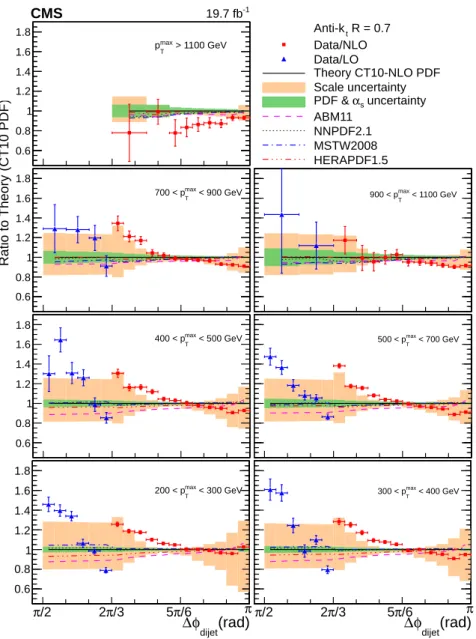
The results of fixed-order calculations with the CT10 PDF set are overlaid on the data for
∆φdijet >π/2 in Fig. 2. Figure 3 shows the ratio of the normalized dijet cross section
differen-tial in∆φdijetto theory calculated using the CT10 PDF set, together with the combined PDF and
αSuncertainty (inner band), and the scale uncertainty (outer band). Also shown are the ratios
of theory derived with the alternative PDF sets ABM11 (dashed line), HERAPDF1.5 (dashed– three-dotted line), MSTW2008 (dashed-dotted line), and NNPDF2.1 (dotted line) compared to the prediction with the CT10 PDFs.
The fixed-order calculations agree with the data for azimuthal angular separations larger than 5π/6 except for the highest pmaxT region, where they exceed the data. For smaller∆φdijetvalues
between 2π/3 and 5π/6, in particular where the estimate of the theoretical uncertainties be-comes small, systematic discrepancies are exhibited that diminish with increasing pmaxT . In the 4-jet LO region with∆φdijet <2π/3, the pattern of increasing deviations towards smaller∆φdijet
and decreasing deviations towards larger pmax
T is repeated, but with less significance because
of the larger scale uncertainty. Similar observations were made in the previous CMS measure-ment [3], which exhibited larger discrepancies in the 4-jet region due to the normalization to the NLO dijet cross section instead of a LO one.
5.1 Predictions from fixed-order calculations in pQCD 7 (rad) dijet φ ∆ /2 π 2π/3 5π/6 π 0.6 0.8 1 1.2 1.4 1.6 1.8 < 300 GeV max T 200 < p (rad) dijet φ ∆ /2 π 2π/3 5π/6 π < 400 GeV max T 300 < p 0.6 0.8 1 1.2 1.4 1.6 1.8 < 500 GeV max T 400 < p max < 700 GeV T 500 < p 0.6 0.8 1 1.2 1.4 1.6 1.8 < 900 GeV max T 700 < p max < 1100 GeV T 900 < p 0.6 0.8 1 1.2 1.4 1.6 1.8 > 1100 GeV max T
p TLEGpmaxT > 1100 GeV R = 0.7 t Anti-k Data/NLO Data/LO Theory CT10-NLO PDF Scale uncertainty uncertainty s α PDF & ABM11 NNPDF2.1 MSTW2008 HERAPDF1.5 -1 19.7 fb CMS R a ti o t o T h e o ry ( C T 1 0 P D F )
Figure 3: Ratios of the normalized dijet cross section differential in∆φdijetto LO (triangles) and NLO (squares) pQCD predictions using the CT10 PDF set at next-to-leading evolution order for all pmaxT regions. The error bars on the data points represent the total experimental uncertainty, which is the quadratic sum of the statistical and systematic uncertainties. The uncertainties of the theoretical predictions are shown as inner band (PDF & αS) and outer band (scales).
The predictions using various other PDF sets relative to CT10 are indicated with different line styles.
8 6 Summary
5.2 Predictions from fixed-order calculations matched to parton shower simu-lations
The PYTHIA6 [12], PYTHIA8 [37], andHERWIG++ [24] event generators complement LO dijet
matrix elements with parton showers to simulate higher-order processes. Both PYTHIA ver-sions, PYTHIA6 with the Z2* tune [13] andPYTHIA8 with the CUETM1 tune [14], employ pT
-ordered parton showers [38, 39], while HERWIG++ with the default tune of version 2.3 uses a coherent-branching algorithm with angular ordering of the showers [40].
The MADGRAPHprogram version 5.1.5.7 [19] supplies the results of LO matrix element
calcu-lations with two to four outgoing partons that can be matched to the implementations of parton showers, hadronization, and MPI of the event generators. In this analysis, it is interfaced with
PYTHIA6 with tune Z2* using the MLM matching procedure [41] to avoid any double counting between tree-level and parton shower generated parton configurations.
ThePOWHEGframework [42–44] provides an NLO dijet calculation [45] that can also be matched via the parton showers to event generators. Here,POWHEGis used with the CT10NLO PDF set and is interfaced to PYTHIA8 with the CUET [14] tune, which employs the LO CTEQ6L1 [35]
PDF set. Predictions with parton showers matched to a NLO 3-jet calculation using POWHEG
[46] or MADGRAPH5 AMC@NLO [47] would be even more relevant for a multijet topology.
They could not, however, be included within the timescale of this analysis. Approaching az-imuthal angular separations close to π, it might also be interesting to compare to predictions employing the technique of pT resummation [48].
In Fig. 4 the normalized dijet cross section differential in ∆φdijet is compared to the
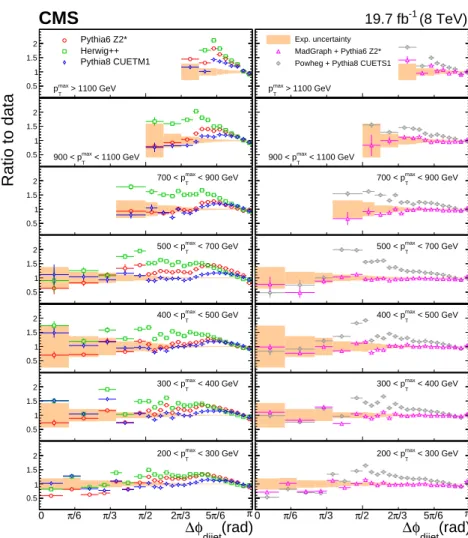
predic-tions from fixed-order calculapredic-tions supplemented with parton showers, hadronization, and MPI. The error bars on the data points represent the total experimental uncertainty, which is the quadratic sum of the statistical and systematic uncertainties. Figure 5 shows the ratios of these predictions to the normalized dijet cross section differential in∆φdijet, for the seven pmaxT
regions. The solid band indicates the total experimental uncertainty and the error bars on the MC points represent the statistical uncertainties in the simulated data.
Among the LO dijet event generators PYTHIA6, PYTHIA8, and HERWIG++, PYTHIA8 exhibits the smallest deviations from the measurements. PYTHIA6 andHERWIG++ systematically
over-shoot the data, particular around ∆φdijet = 5π/6. The best description of the measurement is given by the tree-level multiparton event generator MADGRAPH interfaced with PYTHIA6
for showering, hadronization, and MPI. The POWHEG generator (here used only in the NLO dijet mode) matched toPYTHIA8 shows deviations from the data similar to the LO dijet event generators.
6
Summary
A measurement is presented of the normalized dijet cross section differential in the azimuthal angular separation∆φdijetof the two jets leading in pTfor seven regions in the leading-jet
trans-verse momentum pmaxT . The data set of pp collisions at 8 TeV centre-of-mass energy collected in 2012 by the CMS experiment and corresponding to an integrated luminosity of 19.7 fb−1 is analysed.
The measured distributions in∆φdijetare compared to calculations in perturbative QCD for 3-jet production with up to four outgoing partons that provide NLO predictions for the range of 2π/3 ≤ ∆φdijet < π and LO predictions for π/2 ≤ ∆φdijet < 2π/3. The NLO predictions
9 (rad) dijet φ ∆ 0 π/6 π/3 π/2 2π/3 5π/6 π ) -1 (rad dijet φ∆ d dijet σ d dijet σ 1 -5 10 -3 10 -1 10 10 3 10 5 10 7 10 9 10 11 10 13 10 15 10 17 10 18 10 R = 0.7 t Anti-k | < 2.5 2 | , |y 1 |y ) 12 > 1100 GeV (x10 max T p ) 10 < 1100 GeV (x10 max T 900 < p ) 8 < 900 GeV (x10 max T 700 < p ) 6 < 700 GeV (x10 max T 500 < p ) 4 < 500 GeV (x10 max T 400 < p ) 2 < 400 GeV (x10 max T 300 < p ) 0 < 300 GeV (x10 max T 200 < p Pythia6 Z2* Herwig++ Pythia8 CUETM1 MadGraph + Pythia6 Z2* Powheg + Pythia8 CUETS1
(8 TeV)
-1
19.7 fb
CMS
Figure 4: Normalized dijet cross section differential in ∆φdijet for seven pmaxT regions, scaled
by multiplicative factors for presentation purposes. The error bars on the data points include statistical and systematic uncertainties. Overlaid on the data are predictions from thePYTHIA6, HERWIG++,PYTHIA8, MADGRAPH+PYTHIA6, andPOWHEG+PYTHIA8 event generators.
10 6 Summary (8 TeV) -1 19.7 fb
CMS
(rad) dijet φ ∆ 0 π/6 π/3 π/2 2π/3 5π/6 π 0.5 1 1.5 2 200 < pmaxT < 300 GeV (rad) dijet φ ∆ 0 π/6 π/3 π/2 2π/3 5π/6 π 0.5 1 1.5 2 200 < pmaxT < 300 GeV (rad) Dijet φ ∆ 0 π/6 π/3 π/2 2π/3 5π/6 π 0.5 1 1.5 2 < 400 GeV max T 300 < p (rad) Dijet φ ∆ 0 π/6 π/3 π/2 2π/3 5π/6 π 0.5 1 1.5 2 < 400 GeV max T 300 < p (rad) Dijet φ ∆ 0 π/6 π/3 π/2 2π/3 5π/6 π 0.5 1 1.5 2 < 500 GeV max T 400 < p (rad) Dijet φ ∆ 0 π/6 π/3 π/2 2π/3 5π/6 π 0.5 1 1.5 2 < 500 GeV max T 400 < p (rad) Dijet φ ∆ 0 π/6 π/3 π/2 2π/3 5π/6 π 0.5 1 1.5 2 < 700 GeV max T 500 < p (rad) Dijet φ ∆ 0 π/6 π/3 π/2 2π/3 5π/6 π 0.5 1 1.5 2 < 700 GeV max T 500 < p (rad) Dijet φ ∆ 0 π/6 π/3 π/2 2π/3 5π/6 π 0.5 1 1.5 2 < 900 GeV max T 700 < p (rad) Dijet φ ∆ 0 π/6 π/3 π/2 2π/3 5π/6 π 0.5 1 1.5 2 < 900 GeV max T 700 < p (rad) Dijet φ ∆ 0 π/6 π/3 π/2 2π/3 5π/6 π 0.5 1 1.5 2 < 1100 GeV max T 900 < p (rad) Dijet φ ∆ 0 π/6 π/3 π/2 2π/3 5π/6 π 0.5 1 1.5 2 < 1100 GeV max T 900 < p (rad) Dijet φ ∆ 0 π/6 π/3 π/2 2π/3 5π/6 π 0.5 1 1.5 2 Pythia6 Z2* Herwig++ Pythia8 CUETM1 > 1100 GeV max T p (rad) Dijet φ ∆ 0 π/6 π/3 π/2 2π/3 5π/6 π 0.5 1 1.5 2 Exp. uncertainty MadGraph + Pythia6 Z2* Powheg + Pythia8 CUETS1> 1100 GeV
max T
p
Ratio to data
Figure 5: Ratios ofPYTHIA6, HERWIG++, PYTHIA8, MADGRAPH + PYTHIA6, andPOWHEG +
PYTHIA8 predictions to the normalized dijet cross section differential in ∆φdijet, for all pmaxT
regions. The solid band indicates the total experimental uncertainty and the error bars on the MC points represent the statistical uncertainties of the simulated data.
11
the 4-jet region, starting at∆φdijet = 2π/3, particularly at low pmaxT . The pattern of increasing
deviations towards smaller ∆φdijet and decreasing deviations towards larger pmaxT is repeated
in the 4-jet LO region with∆φdijet <2π/3, but with less significance because of the larger scale uncertainty.
In a comparison of the normalized∆φdijetdistributions to the LO dijet event generatorsPYTHIA6,
PYTHIA8, and HERWIG++, PYTHIA8 gives the best agreement. PYTHIA6 and HERWIG++ sys-tematically overshoot the data, particularly for∆φdijet ≈ 5π/6. A good overall description of
the measurement is provided by the tree-level multijet event generator MADGRAPH in com-bination with PYTHIA6 for showering, hadronization, and multiparton interactions. The dijet NLO calculations fromPOWHEGmatched toPYTHIA8 exhibit deviations similar to the LO dijet
event generators. Improved multijet predictions can be expected from 3-jet NLO calculations matched to parton showers like fromPOWHEGor MADGRAPH5 AMC@NLO.
Similar observations were reported previously by CMS [3] and ATLAS [4], but with less signifi-cance because of the smaller data sets. The extension to∆φdijetvalues below π/2, the improved
LO description in the 4-jet region π/2≤∆φdijet <2π/3, and the comparison to dijet NLO cal-culations matched to parton showers are new results of the present analysis.
Acknowledgments
We acknowledge discussions and comparisons with P. Sun, C. P. Yuan, and F. Yuan following the approach of [48].
We congratulate our colleagues in the CERN accelerator departments for the excellent perfor-mance of the LHC and thank the technical and administrative staffs at CERN and at other CMS institutes for their contributions to the success of the CMS effort. In addition, we gratefully acknowledge the computing centres and personnel of the Worldwide LHC Computing Grid for delivering so effectively the computing infrastructure essential to our analyses. Finally, we acknowledge the enduring support for the construction and operation of the LHC and the CMS detector provided by the following funding agencies: BMWFW and FWF (Austria); FNRS and FWO (Belgium); CNPq, CAPES, FAPERJ, and FAPESP (Brazil); MES (Bulgaria); CERN; CAS, MoST, and NSFC (China); COLCIENCIAS (Colombia); MSES and CSF (Croatia); RPF (Cyprus); MoER, ERC IUT and ERDF (Estonia); Academy of Finland, MEC, and HIP (Finland); CEA and CNRS/IN2P3 (France); BMBF, DFG, and HGF (Germany); GSRT (Greece); OTKA and NIH (Hungary); DAE and DST (India); IPM (Iran); SFI (Ireland); INFN (Italy); MSIP and NRF (Re-public of Korea); LAS (Lithuania); MOE and UM (Malaysia); CINVESTAV, CONACYT, SEP, and UASLP-FAI (Mexico); MBIE (New Zealand); PAEC (Pakistan); MSHE and NSC (Poland); FCT (Portugal); JINR (Dubna); MON, RosAtom, RAS and RFBR (Russia); MESTD (Serbia); SEIDI and CPAN (Spain); Swiss Funding Agencies (Switzerland); MST (Taipei); ThEPCenter, IPST, STAR and NSTDA (Thailand); TUBITAK and TAEK (Turkey); NASU and SFFR (Ukraine); STFC (United Kingdom); DOE and NSF (USA).
Individuals have received support from the Marie-Curie programme and the European Re-search Council and EPLANET (European Union); the Leventis Foundation; the A. P. Sloan Foundation; the Alexander von Humboldt Foundation; the Belgian Federal Science Policy Of-fice; the Fonds pour la Formation `a la Recherche dans l’Industrie et dans l’Agriculture (FRIA-Belgium); the Agentschap voor Innovatie door Wetenschap en Technologie (IWT-(FRIA-Belgium); the Ministry of Education, Youth and Sports (MEYS) of the Czech Republic; the Council of Sci-ence and Industrial Research, India; the HOMING PLUS programme of the Foundation for Polish Science, cofinanced from European Union, Regional Development Fund; the OPUS
pro-12 6 Summary
gramme of the National Science Center (Poland); the Compagnia di San Paolo (Torino); MIUR project 20108T4XTM (Italy); the Thalis and Aristeia programmes cofinanced by EU-ESF and the Greek NSRF; the National Priorities Research Program by Qatar National Research Fund; the Rachadapisek Sompot Fund for Postdoctoral Fellowship, Chulalongkorn University land); the Chulalongkorn Academic into Its 2nd Century Project Advancement Project (Thai-land); and the Welch Foundation, contract C-1845.
References 13
References
[1] D0 Collaboration, “Measurement of dijet azimuthal decorrelations at central rapidities in pp collisions at√s =1.96 TeV”, Phys. Rev. Lett. 94 (2005) 221801,
doi:10.1103/PhysRevLett.94.221801, arXiv:hep-ex/0409040.
[2] D0 Collaboration, “Measurement of the combined rapidity and pT dependence of dijet
azimuthal decorrelations in pp collisions at√s=1.96 TeV”, Phys. Lett. B 721 (2013) 212, doi:10.1016/j.physletb.2013.03.029, arXiv:1212.1842.
[3] CMS Collaboration, “Dijet azimuthal decorrelations in pp collisions at√s=7 TeV”, Phys. Rev. Lett. 106 (2011) 122003, doi:10.1103/PhysRevLett.106.122003, arXiv:1101.5029.
[4] ATLAS Collaboration, “Measurement of dijet azimuthal decorrelations in pp collisions at√ s =7 TeV”, Phys. Rev. Lett. 106 (2011) 172002,
doi:10.1103/PhysRevLett.106.172002, arXiv:1102.2696.
[5] CMS Collaboration, “The CMS experiment at the CERN LHC”, JINST 03 (2008) S08004, doi:10.1088/1748-0221/3/08/S08004.
[6] CMS Collaboration, “The CMS high level trigger”, Eur. Phys. J. C 46 (2006) 605, doi:10.1140/epjc/s2006-02495-8, arXiv:hep-ex/0512077.
[7] CMS Collaboration, “Particle–flow event reconstruction in CMS and performance for jets, taus, and Emiss
T ”, CMS Physics Analysis Summary CMS-PAS-PFT-09-001, 2009.
[8] CMS Collaboration, “Commissioning of the Particle–flow Event Reconstruction with the first LHC collisions recorded in the CMS detector”, CMS Physics Analysis Summary CMS-PAS-PFT-10-001, 2010.
[9] M. Cacciari, G. P. Salam, and G. Soyez, “The anti-ktjet clustering algorithm”, JHEP 04
(2008) 063, doi:10.1088/1126-6708/2008/04/063, arXiv:0802.1189.
[10] M. Cacciari, G. P. Salam, and G. Soyez, “FastJet user manual”, Eur. Phys. J. C 72 (2012) 1896, doi:10.1140/epjc/s10052-012-1896-2, arXiv:1111.6097.
[11] CMS Collaboration, “Determination of jet energy calibration and transverse momentum resolution in CMS”, JINST 6 (2011) P11002,
doi:10.1088/1748-0221/6/11/P11002, arXiv:1107.4277.
[12] T. Sj ¨ostrand, S. Mrenna, and P. Z. Skands, “PYTHIA 6.4 physics and manual”, JHEP 05 (2006) 026, doi:10.1088/1126-6708/2006/05/026, arXiv:hep-ph/0603175. [13] CMS Collaboration, “Study of the underlying event at forward rapidity in pp collisions
at√s=0.9, 2.76, and 7 TeV”, JHEP 04 (2013) 072, doi:10.1007/JHEP04(2013)072, arXiv:1302.2394.
[14] CMS Collaboration, “Event generator tunes obtained from underlying event and multiparton scattering measurements”, Eur. Phys. J. C 76 (2016) 155,
doi:10.1140/epjc/s10052-016-3988-x, arXiv:1512.00815.
[15] GEANT4 Collaboration, “Geant4 – a simulation tool kit”, Nucl. Instrum. Meth. A 506 (2003) 250, doi:10.1016/S0168-9002(03)01368-8.
14 References
[16] CMS Collaboration, “8 TeV jet energy corrections and uncertainties based on 19.8 fb−1of data in CMS”, CMS Detector Performance Summary CMS-DP-2013-033, 2013.
[17] CMS Collaboration, “Description and performance of track and primary-vertex reconstruction with the CMS tracker”, JINST 09 (2014) P10009,
doi:10.1088/1748-0221/9/10/P10009, arXiv:1405.6569.
[18] CMS Collaboration, “Jet performance in pp collisions at√s =7 TeV”, CMS Physics Analysis Summary CMS-PAS-JME-10-003, 2010.
[19] J. Alwall et al., “MadGraph 5: going beyond”, JHEP 06 (2011) 128, doi:10.1007/JHEP06(2011)128, arXiv:1106.0522.
[20] CMS Collaboration, “Performance of the CMS missing transverse momentum reconstruction in pp data at√s=8 TeV”, JINST 10 (2015) 02006,
doi:10.1088/1748-0221/10/02/P02006, arXiv:1411.0511.
[21] T. Adye, “Unfolding algorithms and tests using RooUnfold”, (2011). arXiv:1105.1160. [22] G. D’Agostini, “A multidimensional unfolding method based on Bayes’ theorem”, Nucl.
Instrum. Meth. A 362 (1995) 487, doi:10.1016/0168-9002(95)00274-X.
[23] CMS Collaboration, “Constraints on parton distribution functions and extraction of the strong coupling constant from the inclusive jet cross section in pp collisions at√
s =7 TeV”, Eur. Phys. J. C 75 (2015) 288,
doi:10.1140/epjc/s10052-015-3499-1, arXiv:1410.6765.
[24] M. B¨ahr et al., “Herwig++ physics and manual”, Eur. Phys. J. C 58 (2008) 639, doi:10.1140/epjc/s10052-008-0798-9, arXiv:0803.0883.
[25] Z. Nagy, “Three-jet cross sections in hadron-hadron collisions at next-to-leading order”, Phys. Rev. Lett. 88 (2002) 122003, doi:10.1103/PhysRevLett.88.122003,
arXiv:hep-ph/0110315.
[26] Z. Nagy, “Next-to-leading order calculation of three-jet observables in hadron-hadron collisions”, Phys. Rev. D 68 (2003) 094002, doi:10.1103/PhysRevD.68.094002, arXiv:hep-ph/0307268.
[27] D. Britzger, K. Rabbertz, F. Stober, and M. Wobisch, “New features in version 2 of the fastNLO project”, (2012). arXiv:1208.3641.
[28] M. Wobisch and K. Rabbertz, “Dijet azimuthal decorrelations for∆φdijet<2π/3 in
perturbative QCD”, JHEP 12 (2015) 024, doi:10.1007/JHEP12(2015)024, arXiv:1505.05030.
[29] M. H. Seymour, “Jet shapes in hadron collisions: Higher orders, resummation and hadronization”, Nucl. Phys. B 513 (1998) 269,
doi:10.1016/S0550-3213(97)00711-6, arXiv:hep-ph/9707338.
[30] S. Alekhin, J. Bl ¨umlein, and S. Moch, “Parton distribution functions and benchmark cross sections at next-to-next-to-leading order”, Phys. Rev. D 86 (2012) 054009,
doi:10.1103/PhysRevD.86.054009, arXiv:1202.2281.
[31] H.-L. Lai et al., “New parton distributions for collider physics”, Phys. Rev. D 82 (2010) 074024, doi:10.1103/PhysRevD.82.074024, arXiv:1007.2241.
References 15
[32] H1 and ZEUS Collaboration, “Combined measurement and QCD analysis of the inclusive e±p scattering cross sections at HERA”, JHEP 01 (2010) 109,
doi:10.1007/JHEP01(2010)109, arXiv:0911.0884.
[33] A. D. Martin, W. J. Stirling, R. S. Thorne, and G. Watt, “Parton distributions for the LHC”, Eur. Phys. J. C 63 (2009) 189, doi:10.1140/epjc/s10052-009-1072-5,
arXiv:0901.0002.
[34] NNPDF Collaboration, “Impact of heavy quark masses on parton distributions and LHC phenomenology”, Nucl. Phys. B 849 (2011) 296,
doi:10.1016/j.nuclphysb.2011.03.021, arXiv:1101.1300.
[35] J. Pumplin et al., “New generation of parton distributions with uncertainties from global QCD analysis”, JHEP 07 (2002) 012, doi:10.1088/1126-6708/2002/07/012, arXiv:hep-ph/0201195.
[36] H.-L. Lai et al., “Uncertainty induced by QCD coupling in the CTEQ global analysis of parton distributions”, Phys. Rev. D 82 (2010) 054021,
doi:10.1103/PhysRevD.82.054021, arXiv:1004.4624.
[37] T. Sj ¨ostrand, S. Mrenna, and P. Z. Skands, “A brief introduction to PYTHIA 8.1”, Comput. Phys. Commun. 178 (2008) 852, doi:10.1016/j.cpc.2008.01.036,
arXiv:0710.3820.
[38] T. Sj ¨ostrand and P. Z. Skands, “Transverse-momentum-ordered showers and interleaved multiple interactions”, Eur. Phys. J. C 39 (2005) 129,
doi:10.1140/epjc/s2004-02084-y, arXiv:hep-ph/0408302.
[39] R. Corke and T. Sj ¨ostrand, “Interleaved parton showers and tuning prospects”, JHEP 03 (2011) 032, doi:10.1007/JHEP03(2011)032, arXiv:1011.1759.
[40] S. Gieseke, P. Stephens, and B. Webber, “New formalism for QCD parton showers”, JHEP
12(2003) 045, doi:10.1088/1126-6708/2003/12/045, arXiv:hep-ph/0310083. [41] S. Mrenna and P. Richardson, “Matching matrix elements and parton showers with
HERWIG and PYTHIA”, JHEP 05 (2004) 040,
doi:10.1088/1126-6708/2004/05/040, arXiv:hep-ph/0312274.
[42] S. Frixione, P. Nason, and C. Oleari, “Matching NLO QCD computations with parton shower simulations: the POWHEG method”, JHEP 11 (2007) 070,
doi:10.1088/1126-6708/2007/11/070, arXiv:0709.2092.
[43] S. Alioli, P. Nason, C. Oleari, and E. Re, “A general framework for implementing NLO calculations in shower Monte Carlo programs: the POWHEG BOX”, JHEP 06 (2010) 043, doi:10.1007/JHEP06(2010)043, arXiv:1002.2581.
[44] P. Nason, “A new method for combining NLO QCD with shower Monte Carlo algorithms”, JHEP 11 (2004) 040, doi:10.1088/1126-6708/2004/11/040, arXiv:hep-ph/0409146.
[45] S. Alioli et al., “Jet pair production in POWHEG”, JHEP 11 (2011) 081, doi:10.1007/JHEP04(2011)081, arXiv:1012.3380.
[46] A. Kardos, P. Nason, and C. Oleari, “Three-jet production in POWHEG”, JHEP 04 (2014) 043, doi:10.1007/JHEP04(2014)043, arXiv:1402.4001.
16 References
[47] J. Alwall et al., “The automated computation of tree-level and next-to-leading order differential cross sections, and their matching to parton shower simulations”, JHEP 07 (2014) 079, doi:10.1007/JHEP07(2014)079, arXiv:1405.0301.
[48] P. Sun, C. P. Yuan, and F. Yuan, “Transverse Momentum Resummation for Dijet Correlation in Hadronic Collisions”, Phys. Rev. D 92 (2015), no. 9, 094007, doi:10.1103/PhysRevD.92.094007, arXiv:1506.06170.
17
A
The CMS Collaboration
Yerevan Physics Institute, Yerevan, Armenia
V. Khachatryan, A.M. Sirunyan, A. Tumasyan
Institut f ¨ur Hochenergiephysik der OeAW, Wien, Austria
W. Adam, E. Asilar, T. Bergauer, J. Brandstetter, E. Brondolin, M. Dragicevic, J. Er ¨o, M. Flechl, M. Friedl, R. Fr ¨uhwirth1, V.M. Ghete, C. Hartl, N. H ¨ormann, J. Hrubec, M. Jeitler1, V. Kn ¨unz, A. K ¨onig, M. Krammer1, I. Kr¨atschmer, D. Liko, T. Matsushita, I. Mikulec, D. Rabady2, N. Rad,
B. Rahbaran, H. Rohringer, J. Schieck1, R. Sch ¨ofbeck, J. Strauss, W. Treberer-Treberspurg, W. Waltenberger, C.-E. Wulz1
National Centre for Particle and High Energy Physics, Minsk, Belarus
V. Mossolov, N. Shumeiko, J. Suarez Gonzalez
Universiteit Antwerpen, Antwerpen, Belgium
S. Alderweireldt, T. Cornelis, E.A. De Wolf, X. Janssen, A. Knutsson, J. Lauwers, S. Luyckx, M. Van De Klundert, H. Van Haevermaet, P. Van Mechelen, N. Van Remortel, A. Van Spilbeeck
Vrije Universiteit Brussel, Brussel, Belgium
S. Abu Zeid, F. Blekman, J. D’Hondt, N. Daci, I. De Bruyn, K. Deroover, N. Heracleous, J. Keaveney, S. Lowette, L. Moreels, A. Olbrechts, Q. Python, D. Strom, S. Tavernier, W. Van Doninck, P. Van Mulders, G.P. Van Onsem, I. Van Parijs
Universit´e Libre de Bruxelles, Bruxelles, Belgium
P. Barria, H. Brun, C. Caillol, B. Clerbaux, G. De Lentdecker, G. Fasanella, L. Favart, R. Goldouzian, A. Grebenyuk, G. Karapostoli, T. Lenzi, A. L´eonard, T. Maerschalk, A. Marinov, L. Perni`e, A. Randle-conde, T. Seva, C. Vander Velde, P. Vanlaer, R. Yonamine, F. Zenoni, F. Zhang3
Ghent University, Ghent, Belgium
K. Beernaert, L. Benucci, A. Cimmino, S. Crucy, D. Dobur, A. Fagot, G. Garcia, M. Gul, J. Mccartin, A.A. Ocampo Rios, D. Poyraz, D. Ryckbosch, S. Salva, M. Sigamani, M. Tytgat, W. Van Driessche, E. Yazgan, N. Zaganidis
Universit´e Catholique de Louvain, Louvain-la-Neuve, Belgium
S. Basegmez, C. Beluffi4, O. Bondu, S. Brochet, G. Bruno, A. Caudron, L. Ceard, C. Delaere, D. Favart, L. Forthomme, A. Giammanco5, A. Jafari, P. Jez, M. Komm, V. Lemaitre, A. Mertens, M. Musich, C. Nuttens, L. Perrini, K. Piotrzkowski, A. Popov6, L. Quertenmont, M. Selvaggi, M. Vidal Marono
Universit´e de Mons, Mons, Belgium
N. Beliy, G.H. Hammad
Centro Brasileiro de Pesquisas Fisicas, Rio de Janeiro, Brazil
W.L. Ald´a J ´unior, F.L. Alves, G.A. Alves, L. Brito, M. Correa Martins Junior, M. Hamer, C. Hensel, A. Moraes, M.E. Pol, P. Rebello Teles
Universidade do Estado do Rio de Janeiro, Rio de Janeiro, Brazil
E. Belchior Batista Das Chagas, W. Carvalho, J. Chinellato7, A. Cust ´odio, E.M. Da Costa, D. De Jesus Damiao, C. De Oliveira Martins, S. Fonseca De Souza, L.M. Huertas Guativa, H. Malbouisson, D. Matos Figueiredo, C. Mora Herrera, L. Mundim, H. Nogima, W.L. Prado Da Silva, A. Santoro, A. Sznajder, E.J. Tonelli Manganote7, A. Vilela Pereira
18 A The CMS Collaboration
Universidade Estadual Paulistaa, Universidade Federal do ABCb, S˜ao Paulo, Brazil
S. Ahujaa, C.A. Bernardesb, A. De Souza Santosb, S. Dograa, T.R. Fernandez Perez Tomeia, E.M. Gregoresb, P.G. Mercadanteb, C.S. Moona,8, S.F. Novaesa, Sandra S. Padulaa, D. Romero Abad, J.C. Ruiz Vargas
Institute for Nuclear Research and Nuclear Energy, Sofia, Bulgaria
A. Aleksandrov, R. Hadjiiska, P. Iaydjiev, M. Rodozov, S. Stoykova, G. Sultanov, M. Vutova
University of Sofia, Sofia, Bulgaria
A. Dimitrov, I. Glushkov, L. Litov, B. Pavlov, P. Petkov
Institute of High Energy Physics, Beijing, China
M. Ahmad, J.G. Bian, G.M. Chen, H.S. Chen, M. Chen, T. Cheng, R. Du, C.H. Jiang, D. Leggat, R. Plestina9, F. Romeo, S.M. Shaheen, A. Spiezia, J. Tao, C. Wang, Z. Wang, H. Zhang
State Key Laboratory of Nuclear Physics and Technology, Peking University, Beijing, China
C. Asawatangtrakuldee, Y. Ban, Q. Li, S. Liu, Y. Mao, S.J. Qian, D. Wang, Z. Xu
Universidad de Los Andes, Bogota, Colombia
C. Avila, A. Cabrera, L.F. Chaparro Sierra, C. Florez, J.P. Gomez, B. Gomez Moreno, J.C. Sanabria
University of Split, Faculty of Electrical Engineering, Mechanical Engineering and Naval Architecture, Split, Croatia
N. Godinovic, D. Lelas, I. Puljak, P.M. Ribeiro Cipriano
University of Split, Faculty of Science, Split, Croatia
Z. Antunovic, M. Kovac
Institute Rudjer Boskovic, Zagreb, Croatia
V. Brigljevic, K. Kadija, J. Luetic, S. Micanovic, L. Sudic
University of Cyprus, Nicosia, Cyprus
A. Attikis, G. Mavromanolakis, J. Mousa, C. Nicolaou, F. Ptochos, P.A. Razis, H. Rykaczewski
Charles University, Prague, Czech Republic
M. Bodlak, M. Finger10, M. Finger Jr.10
Academy of Scientific Research and Technology of the Arab Republic of Egypt, Egyptian Network of High Energy Physics, Cairo, Egypt
E. El-khateeb11,11, T. Elkafrawy11, A. Mohamed12, E. Salama13,11
National Institute of Chemical Physics and Biophysics, Tallinn, Estonia
B. Calpas, M. Kadastik, M. Murumaa, M. Raidal, A. Tiko, C. Veelken
Department of Physics, University of Helsinki, Helsinki, Finland
P. Eerola, J. Pekkanen, M. Voutilainen
Helsinki Institute of Physics, Helsinki, Finland
J. H¨ark ¨onen, V. Karim¨aki, R. Kinnunen, T. Lamp´en, K. Lassila-Perini, S. Lehti, T. Lind´en, P. Luukka, T. Peltola, J. Tuominiemi, E. Tuovinen, L. Wendland
Lappeenranta University of Technology, Lappeenranta, Finland
J. Talvitie, T. Tuuva
DSM/IRFU, CEA/Saclay, Gif-sur-Yvette, France
19
S. Ganjour, A. Givernaud, P. Gras, G. Hamel de Monchenault, P. Jarry, E. Locci, M. Machet, J. Malcles, J. Rander, A. Rosowsky, M. Titov, A. Zghiche
Laboratoire Leprince-Ringuet, Ecole Polytechnique, IN2P3-CNRS, Palaiseau, France
I. Antropov, S. Baffioni, F. Beaudette, P. Busson, L. Cadamuro, E. Chapon, C. Charlot, O. Davignon, N. Filipovic, R. Granier de Cassagnac, M. Jo, S. Lisniak, L. Mastrolorenzo, P. Min´e, I.N. Naranjo, M. Nguyen, C. Ochando, G. Ortona, P. Paganini, P. Pigard, S. Regnard, R. Salerno, J.B. Sauvan, Y. Sirois, T. Strebler, Y. Yilmaz, A. Zabi
Institut Pluridisciplinaire Hubert Curien, Universit´e de Strasbourg, Universit´e de Haute Alsace Mulhouse, CNRS/IN2P3, Strasbourg, France
J.-L. Agram14, J. Andrea, A. Aubin, D. Bloch, J.-M. Brom, M. Buttignol, E.C. Chabert,
N. Chanon, C. Collard, E. Conte14, X. Coubez, J.-C. Fontaine14, D. Gel´e, U. Goerlach, C. Goetzmann, A.-C. Le Bihan, J.A. Merlin2, K. Skovpen, P. Van Hove
Centre de Calcul de l’Institut National de Physique Nucleaire et de Physique des Particules, CNRS/IN2P3, Villeurbanne, France
S. Gadrat
Universit´e de Lyon, Universit´e Claude Bernard Lyon 1, CNRS-IN2P3, Institut de Physique Nucl´eaire de Lyon, Villeurbanne, France
S. Beauceron, C. Bernet, G. Boudoul, E. Bouvier, C.A. Carrillo Montoya, R. Chierici, D. Contardo, B. Courbon, P. Depasse, H. El Mamouni, J. Fan, J. Fay, S. Gascon, M. Gouzevitch, B. Ille, F. Lagarde, I.B. Laktineh, M. Lethuillier, L. Mirabito, A.L. Pequegnot, S. Perries, J.D. Ruiz Alvarez, D. Sabes, L. Sgandurra, V. Sordini, M. Vander Donckt, P. Verdier, S. Viret
Georgian Technical University, Tbilisi, Georgia
T. Toriashvili15
Tbilisi State University, Tbilisi, Georgia
I. Bagaturia16
RWTH Aachen University, I. Physikalisches Institut, Aachen, Germany
C. Autermann, S. Beranek, L. Feld, A. Heister, M.K. Kiesel, K. Klein, M. Lipinski, A. Ostapchuk, M. Preuten, F. Raupach, S. Schael, J.F. Schulte, T. Verlage, H. Weber, V. Zhukov6
RWTH Aachen University, III. Physikalisches Institut A, Aachen, Germany
M. Ata, M. Brodski, E. Dietz-Laursonn, D. Duchardt, M. Endres, M. Erdmann, S. Erdweg, T. Esch, R. Fischer, A. G ¨uth, T. Hebbeker, C. Heidemann, K. Hoepfner, S. Knutzen, P. Kreuzer, M. Merschmeyer, A. Meyer, P. Millet, S. Mukherjee, M. Olschewski, K. Padeken, P. Papacz, T. Pook, M. Radziej, H. Reithler, M. Rieger, F. Scheuch, L. Sonnenschein, D. Teyssier, S. Th ¨uer
RWTH Aachen University, III. Physikalisches Institut B, Aachen, Germany
V. Cherepanov, Y. Erdogan, G. Fl ¨ugge, H. Geenen, M. Geisler, F. Hoehle, B. Kargoll, T. Kress, A. K ¨unsken, J. Lingemann, A. Nehrkorn, A. Nowack, I.M. Nugent, C. Pistone, O. Pooth, A. Stahl
Deutsches Elektronen-Synchrotron, Hamburg, Germany
M. Aldaya Martin, I. Asin, N. Bartosik, O. Behnke, U. Behrens, K. Borras17, A. Burgmeier, A. Campbell, C. Contreras-Campana, F. Costanza, C. Diez Pardos, G. Dolinska, S. Dooling, T. Dorland, G. Eckerlin, D. Eckstein, T. Eichhorn, G. Flucke, E. Gallo18, J. Garay Garcia,
A. Geiser, A. Gizhko, P. Gunnellini, J. Hauk, M. Hempel19, H. Jung, A. Kalogeropoulos, O. Karacheban19, M. Kasemann, P. Katsas, J. Kieseler, C. Kleinwort, I. Korol, W. Lange, J. Leonard, K. Lipka, A. Lobanov, W. Lohmann19, R. Mankel, I.-A. Melzer-Pellmann,
20 A The CMS Collaboration
A.B. Meyer, G. Mittag, J. Mnich, A. Mussgiller, S. Naumann-Emme, A. Nayak, E. Ntomari, H. Perrey, D. Pitzl, R. Placakyte, A. Raspereza, B. Roland, M. ¨O. Sahin, P. Saxena, T. Schoerner-Sadenius, C. Seitz, S. Spannagel, N. Stefaniuk, K.D. Trippkewitz, R. Walsh, C. Wissing
University of Hamburg, Hamburg, Germany
V. Blobel, M. Centis Vignali, A.R. Draeger, J. Erfle, E. Garutti, K. Goebel, D. Gonzalez, M. G ¨orner, J. Haller, M. Hoffmann, R.S. H ¨oing, A. Junkes, R. Klanner, R. Kogler, N. Kovalchuk, T. Lapsien, T. Lenz, I. Marchesini, D. Marconi, M. Meyer, D. Nowatschin, J. Ott, F. Pantaleo2, T. Peiffer, A. Perieanu, N. Pietsch, J. Poehlsen, D. Rathjens, C. Sander, C. Scharf, P. Schleper, E. Schlieckau, A. Schmidt, S. Schumann, J. Schwandt, V. Sola, H. Stadie, G. Steinbr ¨uck, F.M. Stober, H. Tholen, D. Troendle, E. Usai, L. Vanelderen, A. Vanhoefer, B. Vormwald
Institut f ¨ur Experimentelle Kernphysik, Karlsruhe, Germany
C. Barth, C. Baus, J. Berger, C. B ¨oser, E. Butz, T. Chwalek, F. Colombo, W. De Boer, A. Descroix, A. Dierlamm, S. Fink, F. Frensch, R. Friese, M. Giffels, A. Gilbert, D. Haitz, F. Hartmann2, S.M. Heindl, U. Husemann, I. Katkov6, A. Kornmayer2, P. Lobelle Pardo, B. Maier, H. Mildner, M.U. Mozer, T. M ¨uller, Th. M ¨uller, M. Plagge, G. Quast, K. Rabbertz, S. R ¨ocker, F. Roscher, M. Schr ¨oder, G. Sieber, H.J. Simonis, R. Ulrich, J. Wagner-Kuhr, S. Wayand, M. Weber, T. Weiler, S. Williamson, C. W ¨ohrmann, R. Wolf
Institute of Nuclear and Particle Physics (INPP), NCSR Demokritos, Aghia Paraskevi, Greece
G. Anagnostou, G. Daskalakis, T. Geralis, V.A. Giakoumopoulou, A. Kyriakis, D. Loukas, A. Psallidas, I. Topsis-Giotis
National and Kapodistrian University of Athens, Athens, Greece
A. Agapitos, S. Kesisoglou, A. Panagiotou, N. Saoulidou, E. Tziaferi
University of Io´annina, Io´annina, Greece
I. Evangelou, G. Flouris, C. Foudas, P. Kokkas, N. Loukas, N. Manthos, I. Papadopoulos, E. Paradas, J. Strologas
Wigner Research Centre for Physics, Budapest, Hungary
G. Bencze, C. Hajdu, A. Hazi, P. Hidas, D. Horvath20, F. Sikler, V. Veszpremi, G. Vesztergombi21, A.J. Zsigmond
Institute of Nuclear Research ATOMKI, Debrecen, Hungary
N. Beni, S. Czellar, J. Karancsi22, J. Molnar, Z. Szillasi2
University of Debrecen, Debrecen, Hungary
M. Bart ´ok23, A. Makovec, P. Raics, Z.L. Trocsanyi, B. Ujvari
National Institute of Science Education and Research, Bhubaneswar, India
S. Choudhury24, P. Mal, K. Mandal, D.K. Sahoo, N. Sahoo, S.K. Swain
Panjab University, Chandigarh, India
S. Bansal, S.B. Beri, V. Bhatnagar, R. Chawla, R. Gupta, U.Bhawandeep, A.K. Kalsi, A. Kaur, M. Kaur, R. Kumar, A. Mehta, M. Mittal, J.B. Singh, G. Walia
University of Delhi, Delhi, India
Ashok Kumar, A. Bhardwaj, B.C. Choudhary, R.B. Garg, S. Malhotra, M. Naimuddin, N. Nishu, K. Ranjan, R. Sharma, V. Sharma
21
Saha Institute of Nuclear Physics, Kolkata, India
S. Bhattacharya, K. Chatterjee, S. Dey, S. Dutta, N. Majumdar, A. Modak, K. Mondal, S. Mukhopadhyay, A. Roy, D. Roy, S. Roy Chowdhury, S. Sarkar, M. Sharan
Bhabha Atomic Research Centre, Mumbai, India
A. Abdulsalam, R. Chudasama, D. Dutta, V. Jha, V. Kumar, A.K. Mohanty2, L.M. Pant, P. Shukla, A. Topkar
Tata Institute of Fundamental Research, Mumbai, India
T. Aziz, S. Banerjee, S. Bhowmik25, R.M. Chatterjee, R.K. Dewanjee, S. Dugad, S. Ganguly, S. Ghosh, M. Guchait, A. Gurtu26, Sa. Jain, G. Kole, S. Kumar, B. Mahakud, M. Maity25,
G. Majumder, K. Mazumdar, S. Mitra, G.B. Mohanty, B. Parida, T. Sarkar25, N. Sur, B. Sutar,
N. Wickramage27
Indian Institute of Science Education and Research (IISER), Pune, India
S. Chauhan, S. Dube, A. Kapoor, K. Kothekar, S. Sharma
Institute for Research in Fundamental Sciences (IPM), Tehran, Iran
H. Bakhshiansohi, H. Behnamian, S.M. Etesami28, A. Fahim29, M. Khakzad, M. Mohammadi
Najafabadi, M. Naseri, S. Paktinat Mehdiabadi, F. Rezaei Hosseinabadi, B. Safarzadeh30,
M. Zeinali
University College Dublin, Dublin, Ireland
M. Felcini, M. Grunewald
INFN Sezione di Baria, Universit`a di Barib, Politecnico di Baric, Bari, Italy
M. Abbresciaa,b, C. Calabriaa,b, C. Caputoa,b, A. Colaleoa, D. Creanzaa,c, L. Cristellaa,b, N. De
Filippisa,c, M. De Palmaa,b, L. Fiorea, G. Iasellia,c, G. Maggia,c, M. Maggia, G. Minielloa,b, S. Mya,c, S. Nuzzoa,b, A. Pompilia,b, G. Pugliesea,c, R. Radognaa,b, A. Ranieria, G. Selvaggia,b, L. Silvestrisa,2, R. Vendittia,b
INFN Sezione di Bolognaa, Universit`a di Bolognab, Bologna, Italy
G. Abbiendia, C. Battilana2, D. Bonacorsia,b, S. Braibant-Giacomellia,b, L. Brigliadoria,b, R. Campaninia,b, P. Capiluppia,b, A. Castroa,b, F.R. Cavalloa, S.S. Chhibraa,b, G. Codispotia,b, M. Cuffiania,b, G.M. Dallavallea, F. Fabbria, A. Fanfania,b, D. Fasanellaa,b, P. Giacomellia,
C. Grandia, L. Guiduccia,b, S. Marcellinia, G. Masettia, A. Montanaria, F.L. Navarriaa,b, A. Perrottaa, A.M. Rossia,b, T. Rovellia,b, G.P. Sirolia,b, N. Tosia,b,2
INFN Sezione di Cataniaa, Universit`a di Cataniab, Catania, Italy
G. Cappellob, M. Chiorbolia,b, S. Costaa,b, A. Di Mattiaa, F. Giordanoa,b, R. Potenzaa,b, A. Tricomia,b, C. Tuvea,b
INFN Sezione di Firenzea, Universit`a di Firenzeb, Firenze, Italy
G. Barbaglia, V. Ciullia,b, C. Civininia, R. D’Alessandroa,b, E. Focardia,b, V. Goria,b, P. Lenzia,b, M. Meschinia, S. Paolettia, G. Sguazzonia, L. Viliania,b,2
INFN Laboratori Nazionali di Frascati, Frascati, Italy
L. Benussi, S. Bianco, F. Fabbri, D. Piccolo, F. Primavera2
INFN Sezione di Genovaa, Universit`a di Genovab, Genova, Italy
V. Calvellia,b, F. Ferroa, M. Lo Veterea,b, M.R. Mongea,b, E. Robuttia, S. Tosia,b
INFN Sezione di Milano-Bicoccaa, Universit`a di Milano-Bicoccab, Milano, Italy
22 A The CMS Collaboration
S. Malvezzia, R.A. Manzonia,b,2, B. Marzocchia,b, D. Menascea, L. Moronia, M. Paganonia,b, D. Pedrinia, S. Ragazzia,b, N. Redaellia, T. Tabarelli de Fatisa,b
INFN Sezione di Napolia, Universit`a di Napoli ’Federico II’b, Napoli, Italy, Universit`a della
Basilicatac, Potenza, Italy, Universit`a G. Marconid, Roma, Italy
S. Buontempoa, N. Cavalloa,c, S. Di Guidaa,d,2, M. Espositoa,b, F. Fabozzia,c, A.O.M. Iorioa,b, G. Lanzaa, L. Listaa, S. Meolaa,d,2, M. Merolaa, P. Paoluccia,2, C. Sciaccaa,b, F. Thyssen
INFN Sezione di Padova a, Universit`a di Padova b, Padova, Italy, Universit`a di Trento c,
Trento, Italy
P. Azzia,2, N. Bacchettaa, L. Benatoa,b, D. Biselloa,b, A. Bolettia,b, A. Brancaa,b, R. Carlina,b, P. Checchiaa, M. Dall’Ossoa,b,2, T. Dorigoa, U. Dossellia, F. Gasparinia,b, U. Gasparinia,b,
A. Gozzelinoa, K. Kanishcheva,c, S. Lacapraraa, M. Margonia,b, A.T. Meneguzzoa,b, M. Passaseoa, J. Pazzinia,b,2, M. Pegoraroa, N. Pozzobona,b, P. Ronchesea,b, F. Simonettoa,b, E. Torassaa, M. Tosia,b, M. Zanetti, P. Zottoa,b, A. Zucchettaa,b,2
INFN Sezione di Paviaa, Universit`a di Paviab, Pavia, Italy
A. Braghieria, A. Magnania,b, P. Montagnaa,b, S.P. Rattia,b, V. Rea, C. Riccardia,b, P. Salvinia, I. Vaia,b, P. Vituloa,b
INFN Sezione di Perugiaa, Universit`a di Perugiab, Perugia, Italy
L. Alunni Solestizia,b, G.M. Bileia, D. Ciangottinia,b,2, L. Fan `oa,b, P. Laricciaa,b, G. Mantovania,b, M. Menichellia, A. Sahaa, A. Santocchiaa,b
INFN Sezione di Pisaa, Universit`a di Pisab, Scuola Normale Superiore di Pisac, Pisa, Italy
K. Androsova,31, P. Azzurria,2, G. Bagliesia, J. Bernardinia, T. Boccalia, R. Castaldia, M.A. Cioccia,31, R. Dell’Orsoa, S. Donatoa,c,2, G. Fedi, L. Fo`aa,c†, A. Giassia, M.T. Grippoa,31,
F. Ligabuea,c, T. Lomtadzea, L. Martinia,b, A. Messineoa,b, F. Pallaa, A. Rizzia,b, A.
Savoy-Navarroa,32, A.T. Serbana, P. Spagnoloa, R. Tenchinia, G. Tonellia,b, A. Venturia, P.G. Verdinia
INFN Sezione di Romaa, Universit`a di Romab, Roma, Italy
L. Baronea,b, F. Cavallaria, G. D’imperioa,b,2, D. Del Rea,b,2, M. Diemoza, S. Gellia,b, C. Jordaa, E. Longoa,b, F. Margarolia,b, P. Meridiania, G. Organtinia,b, R. Paramattia, F. Preiatoa,b, S. Rahatloua,b, C. Rovellia, F. Santanastasioa,b, P. Traczyka,b,2
INFN Sezione di Torino a, Universit`a di Torino b, Torino, Italy, Universit`a del Piemonte
Orientalec, Novara, Italy
N. Amapanea,b, R. Arcidiaconoa,c,2, S. Argiroa,b, M. Arneodoa,c, R. Bellana,b, C. Biinoa, N. Cartigliaa, M. Costaa,b, R. Covarellia,b, A. Deganoa,b, N. Demariaa, L. Fincoa,b,2, B. Kiania,b, C. Mariottia, S. Masellia, E. Migliorea,b, V. Monacoa,b, E. Monteila,b, M.M. Obertinoa,b, L. Pachera,b, N. Pastronea, M. Pelliccionia, G.L. Pinna Angionia,b, F. Raveraa,b, A. Romeroa,b, M. Ruspaa,c, R. Sacchia,b, A. Solanoa,b, A. Staianoa
INFN Sezione di Triestea, Universit`a di Triesteb, Trieste, Italy
S. Belfortea, V. Candelisea,b, M. Casarsaa, F. Cossuttia, G. Della Riccaa,b, B. Gobboa, C. La Licataa,b, M. Maronea,b, A. Schizzia,b, A. Zanettia
Kangwon National University, Chunchon, Korea
A. Kropivnitskaya, S.K. Nam
Kyungpook National University, Daegu, Korea
D.H. Kim, G.N. Kim, M.S. Kim, D.J. Kong, S. Lee, Y.D. Oh, A. Sakharov, D.C. Son
Chonbuk National University, Jeonju, Korea
23
Chonnam National University, Institute for Universe and Elementary Particles, Kwangju, Korea
S. Song
Korea University, Seoul, Korea
S. Cho, S. Choi, Y. Go, D. Gyun, B. Hong, H. Kim, Y. Kim, B. Lee, K. Lee, K.S. Lee, S. Lee, J. Lim, S.K. Park, Y. Roh
Seoul National University, Seoul, Korea
H.D. Yoo
University of Seoul, Seoul, Korea
M. Choi, H. Kim, J.H. Kim, J.S.H. Lee, I.C. Park, G. Ryu, M.S. Ryu
Sungkyunkwan University, Suwon, Korea
Y. Choi, J. Goh, D. Kim, E. Kwon, J. Lee, I. Yu
Vilnius University, Vilnius, Lithuania
V. Dudenas, A. Juodagalvis, J. Vaitkus
National Centre for Particle Physics, Universiti Malaya, Kuala Lumpur, Malaysia
I. Ahmed, Z.A. Ibrahim, J.R. Komaragiri, M.A.B. Md Ali33, F. Mohamad Idris34, W.A.T. Wan Abdullah, M.N. Yusli, Z. Zolkapli
Centro de Investigacion y de Estudios Avanzados del IPN, Mexico City, Mexico
E. Casimiro Linares, H. Castilla-Valdez, E. De La Cruz-Burelo, I. Heredia-De La Cruz35,
A. Hernandez-Almada, R. Lopez-Fernandez, A. Sanchez-Hernandez
Universidad Iberoamericana, Mexico City, Mexico
S. Carrillo Moreno, F. Vazquez Valencia
Benemerita Universidad Autonoma de Puebla, Puebla, Mexico
I. Pedraza, H.A. Salazar Ibarguen
Universidad Aut ´onoma de San Luis Potos´ı, San Luis Potos´ı, Mexico
A. Morelos Pineda
University of Auckland, Auckland, New Zealand
D. Krofcheck
University of Canterbury, Christchurch, New Zealand
P.H. Butler
National Centre for Physics, Quaid-I-Azam University, Islamabad, Pakistan
A. Ahmad, M. Ahmad, Q. Hassan, H.R. Hoorani, W.A. Khan, T. Khurshid, M. Shoaib
National Centre for Nuclear Research, Swierk, Poland
H. Bialkowska, M. Bluj, B. Boimska, T. Frueboes, M. G ´orski, M. Kazana, K. Nawrocki, K. Romanowska-Rybinska, M. Szleper, P. Zalewski
Institute of Experimental Physics, Faculty of Physics, University of Warsaw, Warsaw, Poland
G. Brona, K. Bunkowski, A. Byszuk36, K. Doroba, A. Kalinowski, M. Konecki, J. Krolikowski, M. Misiura, M. Olszewski, M. Walczak
Laborat ´orio de Instrumenta¸c˜ao e F´ısica Experimental de Part´ıculas, Lisboa, Portugal
24 A The CMS Collaboration
M. Gallinaro, J. Hollar, N. Leonardo, L. Lloret Iglesias, F. Nguyen, J. Rodrigues Antunes, J. Seixas, O. Toldaiev, D. Vadruccio, J. Varela, P. Vischia
Joint Institute for Nuclear Research, Dubna, Russia
S. Afanasiev, P. Bunin, M. Gavrilenko, I. Golutvin, I. Gorbunov, A. Kamenev, V. Karjavin, A. Lanev, A. Malakhov, V. Matveev37,38, P. Moisenz, V. Palichik, V. Perelygin, S. Shmatov, S. Shulha, N. Skatchkov, V. Smirnov, A. Zarubin
Petersburg Nuclear Physics Institute, Gatchina (St. Petersburg), Russia
V. Golovtsov, Y. Ivanov, V. Kim39, E. Kuznetsova, P. Levchenko, V. Murzin, V. Oreshkin, I. Smirnov, V. Sulimov, L. Uvarov, S. Vavilov, A. Vorobyev
Institute for Nuclear Research, Moscow, Russia
Yu. Andreev, A. Dermenev, S. Gninenko, N. Golubev, A. Karneyeu, M. Kirsanov, N. Krasnikov, A. Pashenkov, D. Tlisov, A. Toropin
Institute for Theoretical and Experimental Physics, Moscow, Russia
V. Epshteyn, V. Gavrilov, N. Lychkovskaya, V. Popov, I. Pozdnyakov, G. Safronov, A. Spiridonov, E. Vlasov, A. Zhokin
National Research Nuclear University ’Moscow Engineering Physics Institute’ (MEPhI), Moscow, Russia
A. Bylinkin, M. Chadeeva, R. Chistov, M. Danilov, V. Rusinov
P.N. Lebedev Physical Institute, Moscow, Russia
V. Andreev, M. Azarkin38, I. Dremin38, M. Kirakosyan, A. Leonidov38, G. Mesyats, S.V. Rusakov Skobeltsyn Institute of Nuclear Physics, Lomonosov Moscow State University, Moscow, Russia
A. Baskakov, A. Belyaev, E. Boos, M. Dubinin40, L. Dudko, A. Ershov, A. Gribushin, V. Klyukhin, O. Kodolova, I. Lokhtin, I. Miagkov, S. Obraztsov, S. Petrushanko, V. Savrin, A. Snigirev
State Research Center of Russian Federation, Institute for High Energy Physics, Protvino, Russia
I. Azhgirey, I. Bayshev, S. Bitioukov, V. Kachanov, A. Kalinin, D. Konstantinov, V. Krychkine, V. Petrov, R. Ryutin, A. Sobol, L. Tourtchanovitch, S. Troshin, N. Tyurin, A. Uzunian, A. Volkov
University of Belgrade, Faculty of Physics and Vinca Institute of Nuclear Sciences, Belgrade, Serbia
P. Adzic41, P. Cirkovic, J. Milosevic, V. Rekovic
Centro de Investigaciones Energ´eticas Medioambientales y Tecnol ´ogicas (CIEMAT), Madrid, Spain
J. Alcaraz Maestre, E. Calvo, M. Cerrada, M. Chamizo Llatas, N. Colino, B. De La Cruz, A. Delgado Peris, A. Escalante Del Valle, C. Fernandez Bedoya, J.P. Fern´andez Ramos, J. Flix, M.C. Fouz, P. Garcia-Abia, O. Gonzalez Lopez, S. Goy Lopez, J.M. Hernandez, M.I. Josa, E. Navarro De Martino, A. P´erez-Calero Yzquierdo, J. Puerta Pelayo, A. Quintario Olmeda, I. Redondo, L. Romero, J. Santaolalla, M.S. Soares
Universidad Aut ´onoma de Madrid, Madrid, Spain
25
Universidad de Oviedo, Oviedo, Spain
J. Cuevas, J. Fernandez Menendez, S. Folgueras, I. Gonzalez Caballero, E. Palencia Cortezon, J.M. Vizan Garcia
Instituto de F´ısica de Cantabria (IFCA), CSIC-Universidad de Cantabria, Santander, Spain
I.J. Cabrillo, A. Calderon, J.R. Casti ˜neiras De Saa, P. De Castro Manzano, M. Fernandez, J. Garcia-Ferrero, G. Gomez, A. Lopez Virto, J. Marco, R. Marco, C. Martinez Rivero, F. Matorras, J. Piedra Gomez, T. Rodrigo, A.Y. Rodr´ıguez-Marrero, A. Ruiz-Jimeno, L. Scodellaro, N. Trevisani, I. Vila, R. Vilar Cortabitarte
CERN, European Organization for Nuclear Research, Geneva, Switzerland
D. Abbaneo, E. Auffray, G. Auzinger, M. Bachtis, P. Baillon, A.H. Ball, D. Barney, A. Benaglia, J. Bendavid, L. Benhabib, G.M. Berruti, P. Bloch, A. Bocci, A. Bonato, C. Botta, H. Breuker, T. Camporesi, R. Castello, G. Cerminara, M. D’Alfonso, D. d’Enterria, A. Dabrowski, V. Daponte, A. David, M. De Gruttola, F. De Guio, A. De Roeck, S. De Visscher, E. Di Marco42, M. Dobson, M. Dordevic, B. Dorney, T. du Pree, D. Duggan, M. D ¨unser, N. Dupont, A. Elliott-Peisert, G. Franzoni, J. Fulcher, W. Funk, D. Gigi, K. Gill, D. Giordano, M. Girone, F. Glege, R. Guida, S. Gundacker, M. Guthoff, J. Hammer, P. Harris, J. Hegeman, V. Innocente, P. Janot, H. Kirschenmann, M.J. Kortelainen, K. Kousouris, K. Krajczar, P. Lecoq, C. Lourenc¸o, M.T. Lucchini, N. Magini, L. Malgeri, M. Mannelli, A. Martelli, L. Masetti, F. Meijers, S. Mersi, E. Meschi, F. Moortgat, S. Morovic, M. Mulders, M.V. Nemallapudi, H. Neugebauer, S. Orfanelli43, L. Orsini, L. Pape, E. Perez, M. Peruzzi, A. Petrilli, G. Petrucciani, A. Pfeiffer, M. Pierini, D. Piparo, A. Racz, T. Reis, G. Rolandi44, M. Rovere, M. Ruan, H. Sakulin, C. Sch¨afer, C. Schwick, M. Seidel, A. Sharma, P. Silva, M. Simon, P. Sphicas45, J. Steggemann, B. Stieger, M. Stoye, Y. Takahashi, D. Treille, A. Triossi, A. Tsirou, G.I. Veres21, N. Wardle, H.K. W ¨ohri, A. Zagozdzinska36, W.D. Zeuner
Paul Scherrer Institut, Villigen, Switzerland
W. Bertl, K. Deiters, W. Erdmann, R. Horisberger, Q. Ingram, H.C. Kaestli, D. Kotlinski, U. Langenegger, T. Rohe
Institute for Particle Physics, ETH Zurich, Zurich, Switzerland
F. Bachmair, L. B¨ani, L. Bianchini, B. Casal, G. Dissertori, M. Dittmar, M. Doneg`a, P. Eller, C. Grab, C. Heidegger, D. Hits, J. Hoss, G. Kasieczka, P. Lecomte†, W. Lustermann, B. Mangano, M. Marionneau, P. Martinez Ruiz del Arbol, M. Masciovecchio, M.T. Meinhard, D. Meister, F. Micheli, P. Musella, F. Nessi-Tedaldi, F. Pandolfi, J. Pata, F. Pauss, L. Perrozzi, M. Quittnat, M. Rossini, M. Sch ¨onenberger, A. Starodumov46, M. Takahashi, V.R. Tavolaro, K. Theofilatos, R. Wallny
Universit¨at Z ¨urich, Zurich, Switzerland
T.K. Aarrestad, C. Amsler47, L. Caminada, M.F. Canelli, V. Chiochia, A. De Cosa, C. Galloni, A. Hinzmann, T. Hreus, B. Kilminster, C. Lange, J. Ngadiuba, D. Pinna, G. Rauco, P. Robmann, D. Salerno, Y. Yang
National Central University, Chung-Li, Taiwan
M. Cardaci, K.H. Chen, T.H. Doan, Sh. Jain, R. Khurana, M. Konyushikhin, C.M. Kuo, W. Lin, Y.J. Lu, A. Pozdnyakov, S.S. Yu
National Taiwan University (NTU), Taipei, Taiwan
Arun Kumar, P. Chang, Y.H. Chang, Y.W. Chang, Y. Chao, K.F. Chen, P.H. Chen, C. Dietz, F. Fiori, U. Grundler, W.-S. Hou, Y. Hsiung, Y.F. Liu, R.-S. Lu, M. Mi ˜nano Moya, E. Petrakou, J.f. Tsai, Y.M. Tzeng