UNIVERSIDADE DA BEIRA INTERIOR Faculdade de Engenharia
Departamento de Informática
Content Storage and Retrieval
Mechanisms for Vehicular
Delay-Tolerant Networks
Bruno Miguel Correia Silva
Submitted to the University of Beira Interior in candidature for the Degree of Master of Science in Informatics Engineering
Supervised by Prof. Doutor Joel José Puga Coelho Rodrigues
Department of Informatics University of Beira Interior
Covilhã, Portugal http://www.di.ubi.pt
Acknowledgements
First of all, I would like to thank Professor Joel José Puga Coelho Rodrigues for giving me the chance to join his research group, Next Generation Networks and Applications Group (NetGNA), for all the constant words of encouragement and for supervising my Master’s Thesis. This two years were undoubtedly very important in my evolution has informatics Engineer and person as well.
I am most grateful to the University of Beira Interior, the Instituto
de Telecomunicações, Next Generation Networks and Applications Group
(NetGNA), Covilhã Delegation, Portugal in the framework of the Project VDTN@Lab, and by the Euro-NF Network of Excellence from the Seventh Framework Programme of EU, for many kinds of all the support that was given to me.
Additionally, I’d like to thank to all members of the VDTN team, but especially to my colleagues João Isento and João Dias, for all the daily support and help. Special thanks to Vasco Soares for being always thoughtful and helpful. Last but not least, to my Mother, Father, Grandmothers and Girlfriend, the most important people in my life. Thanks for all the support and help in all the hard times. They are the “pillars” of my “foundation”, all that I am and all that I have, I owe to them.
Abstract
Vehicular delay-tolerant networks (VDTNs) were proposed as a novel disruptive network concept based on the delay tolerant networking (DTN) paradigm. VDTN architecture uses vehicles to relay messages, enabling network connectivity in challenging scenarios. Due to intermittent connectivity, network nodes carry messages in their buffers, relaying them only when a proper contact opportunity occurs. Thus, the storage capacity and message retrieving of intermediate nodes directly affects the network performance. Therefore, efficient and robust caching and forwarding mechanisms are needed. This dissertation proposes a content storage and retrieval (CSR) solution for VDTN networks. This solution consists on storage and retrieval control labels, attached to every data bundle of aggregated network traffic. These labels define cacheable contents, and apply cache-control and forwarding restrictions on data bundles. The presented mechanisms gathered several contributions from cache based technologies such as Web cache schemes, ad-hoc and DTN networks. This solution is fully automated, providing a fast, safe, and reliable data transfer and storage management, while improves the applicability and performance of VDTN networks significantly. This work presents the performance evaluation and validation of CSR mechanisms through a VDTN testbed. Furthermore it presents several network performance evaluations and results using the well-known DTN routing protocols, Epidemic and Spray and Wait (including its binary variant). The comparison of the network behavior and
performance on both protocols, with and without CSR mechanisms, proves that CSR mechanisms improve significantly the overall network performance.
Keywords
Content Storage and Retrieval, Cache, Web caching, Mobile Ad-hoc Networks Caching, Vehicular Ad-hoc Networks caching, Delay-Tolerant Networks Caching, Vehicular Delay-Tolerant Networks.
Contents
Acknowledgements ...i Abstract ... iii Keywords ... v Contents ... vii List of Figures... ix List of Tables...xiii Acronyms ...xv 1. Introduction ... 1 1.1. Focus ... 1 1.2. Objectives... 5 1.3. Main Contributions ... 6 1.4. Dissertation Structure ... 62. Content Storage and Retrieval Mechanisms ... 7
2.1 Vehicular Delay-Tolerant Networks... 7
2.2.1 Web Caching Mechanisms and Schemes...11
2.2.2 Caching Schemes in Ad-Hoc Networks ...13
2.2.3 Caching Mechanisms in DTN networks...16
2.3 Content Storage and Retrieval Proposal for VDTN ...20
3. Design and Application of CSR Mechanisms on VDTNs ... 23
3.1 Conceptual Design of CSR mechanisms...23
3.1.1 Storage and Retrieval Procedures ...25
3.2 Used Technologies...28
3.3 VDTN testbed...28
4. Performance Evaluation and Validation... 33
4.1 Network Scenario ...33
4.2 Performance Analysis ...37
4.2.1 Performance Evaluation of Epidemic Routing Protocol...37
4.2.2 Performance Assessment of Spray and Wait Routing Protocol 41 4.2.3 Performance Assessment of Spray and Wait Routing Protocol in Binary Variant ...43
5. Conclusions and Future Work ... 47
5.1 Future Works ...48
List of Figures
Figure 1. Store-carry-and-forward paradigm of DTN-based networks. ... 4
Figure 2. An Illustration of typical VDTN architecture. ... 8
Figure 3. DTN and VDTN layered architectures. ... 9
Figure 4. Control information and data bundles exchange. ...10
Figure 5. A Web caching scheme with proxy cooperation. ...12
Figure 6. A cooperative caching scheme for MANETs. ...15
Figure 7. Illustrations of request and response operations between user and server. ...17
Figure 8. Illustration of request and response between user and a mobile node...18
Figure 9. Illustration of storage operations on mobile nodes can perform backup services in a server failure scenario. ...19
Figure 10. Illustration of an Application-Hint extension block for the bundle protocol. ...20
Figure 11. VDTN CSR bundle label is sent in the control channel attached to the Setup Message. ...21
Figure 12. Illustrations of CSR bundle label and CSR fragment labels scheme...21
Figure 13. Use case diagram of a VDTN mobile node and its control plane functions including the exchange of CSR bundle labels...24
Figure 14. Activity diagram of a VDTN mobile node, and its CSR mechanisms. ...25 Figure 15. Activity diagram of a mobile node, describing the control and data plane interaction, coordinated by the decision module...29 Figure 16. LEGO MINDSTORMS NXT robot with a PDA device coupled. ...30 Figure 17. Mobile node 1 interacting with mobile node 2 (a); Mobile node 1 interacting with relay node 1 (b). ...30 Figure 18. Class diagram of VDTN architecture with CSR mechanisms implemented...31 Figure 19. Illustration of the VDTN testbed with three terminal nodes, two relay nodes, and four mobile nodes...34 Figure 20. VDTN testbed laboratory scenario and the respective interactions between terminal node 1, mobile nodes 1 and 2, and relay nodes 1 and 2.34 Figure 21. VDTN testbed laboratory scenario and the respective interactions between terminal node 2, mobile nodes 3 and mobile node 4. ...35 Figure 22. VDTN testbed laboratory scenario and the respective interactions between terminal node 3, mobile nodes 3 and mobile node 4. ...35 Figure 23. Bundle delivery probability as function of number of generated bundles per minute for Epidemic protocol with and without content storage and retrieval mechanisms. ...38 Figure 24. A bundle average delay from terminal 1 to terminals 2 and 3 with and without content storage and retrieval mechanisms for Epidemic protocol. ...39 Figure 25. Bundle average delay (seconds) as function of number of generated bundles per minute for Epidemic protocol with and without content storage and retrieval mechanisms. ...40 Figure 26. Average contact duration (seconds) as function of number of generated bundles per minute for Epidemic protocol with and without content storage and retrieval mechanisms. ...40
Figure 27. Bundle delivery probability as function of number of generated bundles per minute for Spray and Wait protocol with and without content storage and retrieval mechanisms...41 Figure 28. Bundle average delay (seconds) as function of number of generated bundles per minute for Spray and Wait protocol with and without content storage and retrieval mechanisms. ...42 Figure 29. Average contact duration (seconds) as function of number of generated bundles per minute for Spray and Wait protocol with and without content storage and retrieval mechanisms. ...42 Figure 30.Bundle delivery probability as function of number of generated bundles per minute for spray and wait protocol (binary variant) with and without content storage and retrieval mechanisms. ...43 Figure 31.Bundle average delay (seconds) as function of number of generated bundles per minute for spray and wait protocol (binary variant) with and without content storage and retrieval mechanisms...44 Figure 32. Average contact duration (seconds) as function of number of generated bundles per minute for spray and wait protocol (binary variant) with and without content storage and retrieval mechanisms...45
List of Tables
Acronyms
BAD : Bundle Aggregation and De-aggregation BSC : Bundle Signaling Control
CPU : Central Processing Unit
CSR : Content Storage and Retrieval DTN : Delay Tolerant Networks FIFO : First-in-First-out
Gbytes : Giga Bytes
ICP : Internet Cache Protocol
IDE : Interface Development Environment
IEEE : Institute of Electrical and Electronics Engineers IP : Internet Protocol
ITS : Intelligent Transport System Kbytes : Kilo Bytes
MANET : Mobile Ad-hoc Network PDA : Personal Digital Assistant SDK : Software Development Kit
TTL Time-to-live
UML : Unified Modelling Language VANET : Vehicular Ad-hoc Network
1. Introduction
1.1. Focus
A weather station on top of a mountain collects data from various sensors types, such as, temperature, humidity, precipitation, and wind velocity, among others. Passing by vehicles equipped with an on-board computer collects data and distribute it through out the mountain on specific locations or to other vehicles. Vehicles disseminate data by transmitting it to other vehicles or kiosks that are in the vehicles route. This scenario perfectly illustrates an applicability of vehicular delay-tolerant networks (VDTN) [1]. VDTN appears as novel network architecture based on the concept of delay tolerant networks (DTN) [2], gathering also contributions from ad-hoc and vehicular networks, using vehicles for network connectivity.
Mobile hoc networks (MANETs) [3] are based on autonomous ad-hoc networks where mobile hosts are connected by multi-hop wireless links. MANETs does not rely on common network infrastructures and services, the network nodes perform themselves all the networking functions [4]. Typical applications of MANET include rescue operations [5], military scenarios [6], and cases in which is impossible to establish a wired backbone [7]. This communication technology can also be used for extending the coverage of current wireless networks.
Vehicular ad-hoc networks (VANETs) [8] are a subset of MANETs and an emerging topic on intelligent transportation systems (ITS) [9]. The key difference between MANETS and VANETs is the mobility of the network nodes that can be anticipated due to the roads and traffic signalization (traffic lights) and also the rapid changes on the network topology due to the vehicles velocities [10]. VANETs does not rely on fixed infrastructures because vehicles provide all network services, themselves, relaying data between them. The VANET architecture also includes ‘Infostations’ that usually are wireless access points placed in specific points of the network and connected to the Internet. They provide high bandwidth connectivity to the Internet for vehicles that are passing by. Then, vehicles will deliver and propagate data through the network [11, 12]. This data may include information about collision alerting, road conditions warnings and also Internet connectivity for several applications [13, 14] such as, eMail, Web browsing, audio and video streaming, among others. These networks are usually found in several scenarios like notification of traffic condition (jams), accident warnings, advertisements [11], and cooperative vehicle collision avoidance [15]. It may also be used to gather information collected by vehicles, such as, road pavement defects [16]. VANETs are characterized by moving vehicles and their high mobility, assuming contemporaneous end-to-end path with continuous connection among devices. But due to the vehicles velocity and limited connections capacity, traditional routing protocols are inefficient and insufficient. Without a continuous connection, the communication data gets lost everytime that a connection is broken. To answer these intermittent connection problems and the delays intolerance, it’s often used the DTNs [2].
A DTN enables communication in environments with high level of network disruption. DTN networks are presented as one solution to challenged environments characterized by intermittent connectivity, long and variable delays and with poor, sparse and none end-to-end connectivity [17]. DTN networks include storage-and-forward functions by overlaying the bundle protocol layer over the transport layer. Network nodes (mobile
and fixed) relay these bundles between gateways, and intermediate nodes store and carry bundles until a proper contact is available [18]. The bundle protocol [19] aims to resolve several DTN issues, such as intermittent connectivity, long or variable delays and high error rates. DTNs have been applied to various areas like interplanetary networks [20], underwater networks [21], wildlife tracking sensor networks [22], and networks for developing communities [23]. DTN architecture defines different types of contacts classified as opportunistic, scheduled and predicted. Vehicular Networks are an example of opportunistic contacts.
VDTN [1] proposes to resolve the communication disconnection problem. VDTN is a particular application of a mobile DTN where vehicles are opportunistically exploited to offer a message relaying service. It intends to provide low-cost connectivity in scenarios where the telecommunications infrastructure is unreliable or not available due to disconnected areas, natural disaster, or emergency situations. VDTN is a challenging topic that faces several network issues and research challenges, such as, network architecture (naming and addressing), node design (power, storage capacity, range, speed, physical link), node type (mobile, stationary), node interactions, node cooperation, network topology (known or not), mobility pattern (deterministic, stochastic, predictable, etc), scheduling, traffic (static, dynamic), routing protocols, bundle format, caching mechanisms, security, and supported applications.
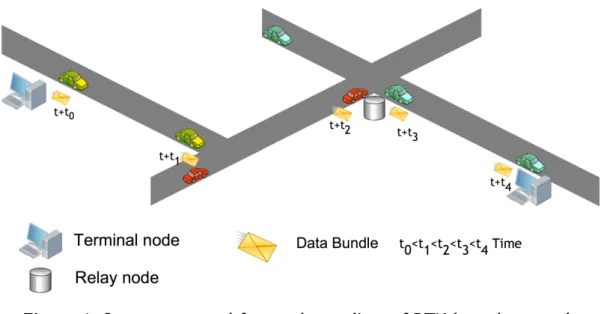
This novel network architecture also adopts a DTN store-carry-and-forward paradigm. However, it distinguishes itself from the DTN architecture by positioning the bundle layer between network and link layers. Network nodes (fixed or mobile) store data on their buffers waiting for new contact opportunities to forward data to any node that establish a proper communication opportunity. Figure 1, illustrates the interactions between nodes. Terminal nodes represent the access points to the VDTN network. Mobile nodes (e.g. vehicles) collect and disseminate traffic data. Relay nodes are fixed devices with store and forward capabilities and are located at road intersections.
Figure 1. Store-carry-and-forward paradigm of DTN-based networks.
To address the problem of intermittent connectivity, network nodes store messages on their buffers, carrying them through the network waiting for new transfer opportunities. Thus the storage capacity of the nodes directly affects the performance of the network. Therefore it’s important the incorporation of suitable network protocols using self-contained messages to improve communication that supports store-carry-and-forward operation procedures. Clearly, such procedures define the act of content storage and retrieval (CSR).
This dissertation presents a CSR solution for VDTNs, fully automated, that manages the nodes buffer and decides which data is to be stored, sent or eliminated. This solution provides a fast, safe, and reliable storage management and data transfer, improving the applicability and the performance of VDTN networks significantly. This intelligent caching and forwarding solution mainly consists in storage and retrieval control labels attached to every data bundle. The main purpose of the VDTN CSR labels is to define cacheable contents and apply them cacheable and forwarding restrictions. CSR mechanisms gathered contributions from various cache-based technologies, namely, Web–caching, ad-hoc networks caching mechanisms, and DTNs storage and forward schemes. These approaches
have similar network architectures or similar used technologies as the VDTN network architecture offering various contributions to the storage and forward proposal for VDTNs. Furthermore, this work presents the performance assessment and validation of the CSR proposal. This evaluation proves its feasibility and also presents theimpact and analysis of the proposed CSR mechanisms on the performance of the VDTN network, through a VDTN testbed. The testbed scenario considers the use of the well known DTN Epidemic and Spray and Wait (and its binary variant) routing protocols, applied to VDTNs. For comparison purposes, a network scenario with and without CSR mechanisms were considered for node’s bundle delivery probability, bundle average delay, and average contact duration.
1.2. Objectives
The main objective of this dissertation is to present a robust solution to provide a fast, safe and reliable content storage and retrievable management, improving significantly the applicability and performance of the VDTN network. To accomplish this main objective, the first major task is the revision on VDTN literature and review of the state of the art on caching and forward related projects. This review focuses on Web–caching schemes, ad-hoc networks caching mechanisms, and mainly on DTNs storage and forward solutions. The next step is the design and implementation of the CSR mechanisms for VDTNs. Beginning with its conceptual design and the construction of data control algorithms responsible for caching and forward operations. These operations define the intelligent cashing solution needed to improve the performance of our VDTN network. With the CSR proposal implemented and validated, a VDTN testbed is used for network performances and evaluations. These performance assessments prove the feasibility of the CSR mechanisms, presenting the impact and analysis on the performance of the VDTN network.
1.3. Main Contributions
This section is devoted to the scientific contributions of this dissertation to the state-of-the-art on VDTNs and caching and forward mechanisms. The main contribution is a content storage and retrieval proposal for VDTNs and its performance assessments through a VDTN testbed, which is presented in Chapters 3 and 4. This proposal was accepted for presentation at IEEE GLOBECOM 2010, Miami, Florida, USA, December 6-10, 2010.
1.4. Dissertation Structure
This dissertation is organized in 5 chapters. This chapter, the first, presents the context of the dissertation, focusing on the topic under study, the objectives, the main contributions and the dissertation structure. Chapter 2 introduces the VDTN concept and architecture describing its key features and main contributions. It elaborates on the related work about the topic, focusing on Web-caching, ad-hoc networks caching schemes and DTNs storage and forward mechanisms. Afterwards, it presents the CSR proposal for VDTN. Chapter 3, describes the proposed VDTN CSR mechanisms including its conceptual design, used technologies and presents the VDTN testbed used for the evaluation and validation of the CSR proposal. Chapter 4, focuses on the performance evaluation and validation study of the CSR mechanisms through the VDTN testbed. Finally, Chapter 5 concludes the dissertation and proposes topics for future research works.
2. Content Storage and
Retrieval Mechanisms
This chapter elaborates on content storage and retrieval (CSR) approaches available in the related literature and proposes an approach of CSR mechanisms proposal for VDTN networks. It begins by introducing the VDTN concept and architecture, including its key features and main contributions. Afterwards, the state of the art on caching and forwarding related projects is presented, namely on Web-caching, ad-hoc networks caching schemes and DTNs storage and forward mechanisms. These approaches have contributed to the construction of the CSR proposal. Finally, it proposes and describes the CSR proposal for VDTN, introducing its main features and behaviors.
2.1 Vehicular Delay-Tolerant Networks
VDTN architecture handles non-real time applications where vehicles act as the communication infrastructure for the network. A typical VDTN architecture is shown in Figure 2. It includes three types of node, terminal
nodes, relay nodes, and mobile nodes. Terminal nodes act as access points
to the VDTN network providing connection to end-users. It is assumed that at least one terminal node has direct access to the Internet, providing several services including exchanging emails, documents, voice mails,
movie, music, images etc…. Mobile nodes (e.g., vehicles) are responsible for physically carrying data between terminal nodes located at isolated points of the network. Relay nodes are devices with store-and-forward capability allowing bypassing mobile nodes to drop and pickup data. These nodes increase the number of contact opportunities in sparse scenarios, contributing to improve the delivery ratio and decrease the delivery delay. In a low node density scenario, relay nodes increase contact opportunities [24, 25]. Therefore, they contribute to improve the data bundle delivery probability and decrease their average delivery delay. The VDTN architecture has been successfully tested and validated through a creation of a VDTN testbed [26].
Figure 2. An Illustration of typical VDTN architecture.
Contrary to DTN architecture proposal, witch introduces a bundle layer between the transport and application layer, for storage and forward services the VDTN architecture proposes a bundle layer placement over the data link layer introducing an IP over VDTN approach (Figure 3). The protocol data unit at the VDTN bundle layer is called a bundle. A bundle is an aggregation of incoming IP datagrams into data bundle messages. This proposal is a key contribution of the VDTN architecture resulting in less and
more fast processing and therefore an efficient energy saving [1].
Figure 3. DTN and VDTN layered architectures.
VDTN makes use of store-carry-and-forward paradigm proposed for DTNs. This paradigm solves the problems caused by intermittency, disconnection and long delays, and can be described as follows. Using some form of persistent storage, a network node stores a bundle, while waiting for a future proper connection opportunity. When a communication opportunity occurs, the bundle is forwarded. This process is repeated and bundles are relayed hop-by-hop until eventually they reach the destination. VDTN architecture identifies two logical planes, i.e., control plane, and data plane, which are illustrated in Figure 3. Hence, the VDTN bundle layer is logically divided into two layers, the bundle signalling control (BSC) layer, and the bundle aggregation and de-aggregation (BAD) layer. The BSC layer executes the control plane functions such as signalling messages exchange, resources reservation (at the data plane) and routing. Signalling messages are used to setup a data plane connection and carry information about a node type and its speed, physical link data rate and range, energy constraints, storage capacity constraints, delivery options, security requirements, among others. The BAD layer executes the data plane functions. These functions include storage management, queuing and scheduling, traffic classification, among others. Control plane functions include an out-of-band signaling which uses a low-power, low bandwidth,
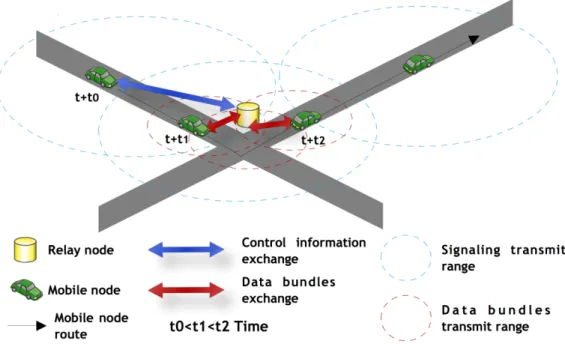
long-range link and its always active to allow node discovery. At the same time, the data plane is only active during the estimated contact duration, if there are data bundles that should be exchanged between nodes. Otherwise, the data plane link connection is not activated [1, 27]. This approach is very important for optimization of the available data plane resources (e.g. storage and bandwidth), and also allows saving power, which is very important for energy-constrained nodes such as relay nodes that usually run on solar panels or batteries [1, 28]. Figure 4, illustrates this concept. At the time t+t0, a mobile node and a relay node detect each
other and start exchanging control information through the control plane link connection. Through the routing information, both nodes determine which bundles should be forwarded. Then, the data plane connection is configured and activated on both nodes at the time t+t1. Data bundles are
exchanged until the time t+t2. At the instant that nodes leave the data
plane link range of each other, the data plane connection is deactivated. The separation of control and data planes is a key contribution of the VDTN layered architecture. This concept is similar to the principle presented in [29] for Optical Burst Switching networks.
2.2 Caching and Forward Related Approaches for
VDTNs
Several cache-base approaches such as, Web-caching, ad-hoc networks caching schemes and DTNs storage and forward mechanisms, addresses analogous issues to VDTN networking (i.e., terminal’s latency, connectivity, energy constraints and overall network performance). The study of these caching and forward related approaches has offered several contributions to the design of the CSR solution applied to the VDTN architecture.
2.2.1 Web Caching Mechanisms and Schemes
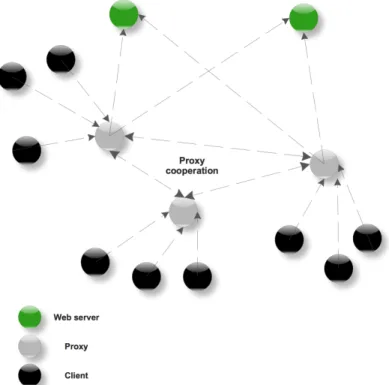
Over the last years several types of networks but especially the World Wide Web (WWW) have exponentially grown the number of its users. The convergence of wireless communications and the Internet results in mobile Internet, where users easily access the Web almost, anytime and anywhere. These conditions result in bigger user latency and network traffic congestion motivating the implementation of intelligent caching schemes. Caching mechanisms are applied on several network architectures and communication technologies in order to reduce latency, reduce bandwidth usage and server load. Cache in its definition is basically a fast and temporary storage buffer. Duplicated cached data can be accessed in the future rather than the original data, saving computational resources. An analogous technology is a proxy server [30]. A proxy server act as intermediate for a client request and seeks the response in other servers or in a local cache. A caching proxy server improves the service by providing a fastest response and retrieving content stored in previous requests [31]. Figure 5, illustrates a generic web caching system including proxy cooperation.
Figure 5. A Web caching scheme with proxy cooperation.
Web caching protocols have proven to be the ideal solution to these specific network problems [32]. Thus was born the concept of network cooperative cache [33]. Web cooperative cache schemes are used by many public organizations (e.g. IRCache [34], NLANR [35]). Cooperative cache is based on a hierarchical approach similar to the Internet Cache Protocol (ICP) [36]. The first hierarchical approach was proposed in the Harvest
project [37]. Other related approaches are Access Driven cache [38], Adaptive web caching [39], Cachemesh [40], Geographical push caching
[41], etc… Cooperative cache schemes basically introduce a cache on every network node. Afterwards all caches emit a request for missing objects to a cache at its hierarchy’s upper level. This process is repeated until the request is found or it reaches the roots cache. Finally, as it returns to the requester, the object is copied in all caches.
2.2.2 Caching Schemes in Ad-Hoc Networks
Ad-hoc networks [42] consists on wireless networks nodes cooperating to forward traffic between themselves. Ad-hoc networks topology raises several fundamental research issues that are still being debated. One of these issues is the most appropriate caching strategy, since network nodes have limited store capability and several energy constraints. In [33] is proposed a caching solution to improve mobile performance focusing on terminal’s latency, connectivity and energy constraints. Upon a request, each node uses local statistics of every interaction that identify mobile terminals that have most likely stored the requested data. It also uses a list of known mobile terminals and a routing table in order to find all nodes that are in inferior range to the next base station. Afterwards mobile terminals are contacted from the closest one to the farthest, until a hit message is received or there are no more mobile terminals to contact. To minimize network load and energy consumption, this approach uses timeouts instead of miss messages to notify mobile terminals that a request object was not cached.
A cooperative cache protocol for ad hoc networks was proposed in [43]. It presents an efficient approach to save energy consumption and minimize network load. The proposal presents three distinct cache protocols: CacheData, CachePath and HybridCache. In the CachePath protocol, when two nodes communicate they exchange requesters’ node identification related to data that they carry. It also caches the distance between themselves and the source and destination (path) of the requested data. Therefore, when another node issues the same request, the request will be redirect to the node with the id cached previously. In the
CacheData protocol, instead of paths, router nodes frequently caches
accessed passing-by data for future requests. The HybridCache protocol use both CacheData and CachePath protocols.
Marco Fiore et al proposes in [44] a cooperative caching algorithm called Hamlet. This caching strategy works independently on each network node deciding which contents are cacheable and for how long. These caching decisions are taken according to a probabilistic estimate of what nearby nodes may have stored on their caches and with the intention of differentiate its own stored content from the others. Hamlet can be applied to any content distribution system where network nodes can overhear query/response messages, estimate its distance in hops from the query source node and the responding node, identify the version of the transmitting information and associate a specific drop time to each item on its cache. Cooperative Web cache strategies are also applied to mobile terminals that interact via ad-hoc networks.
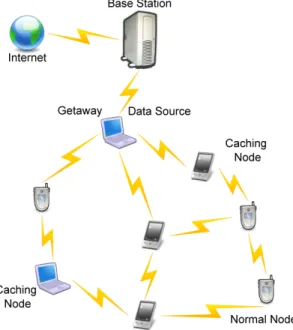
MANETs are autonomous Ad-hoc networks consisting on mobile hosts connected by multi-hop wireless links [3]. MANETs network architecture raises several research issues such as, intermittent network connections, power supply and limited computing resources. These issues directly affect the data availability and access efficiency of network nodes [45]. Cooperative cache solutions help saving energy, time and bandwidth by localizing communications, improving data availability and access efficiency. A cooperative caching service for MANETs is presented in [45] and illustrated in Figure 6. This proposal addresses two important issues in cooperative caching - cache resolution and cache management. Cache resolution concerns the decision mechanisms of the mobile device to find the requested data from the user. For this purpose, historical profiles and forwarding nodes are used to induce less communication cost. Cache management determines which data will be placed on/purged from the local cache. This management decreases significantly the number of cached copies between nodes, allowing a bigger distinctive data storage and improving the network performance [45].
Figure 6. A cooperative caching scheme for MANETs.
A cooperative caching scheme for MANETs is also proposed in [46]. This proposal includes a distributed application software that implements ad-hoc cooperative Web caching among mobile terminals. This approach aims to improve Web latency among mobile terminals, optimizing their energy consumption and also to increase data accessibility. It introduces a local caching strategy that is adaptive according to the capacity of the terminal. Every cached document is weighted according to its probability of being retrieved in the future and the energy cost associated with getting remotely the document. Documents with the lowest weights are removed from cache. The value of a document weigh is computed according to its
Popularity, AccessCost and Coherency values. Popularity value indicates
the probability of future access according to the number of times the document has already been requested since it has been cached. AccessCost value estimates the energy cost of getting the document remotely in case of being removed from cache. Coherency value balances the lifetime of a document and the energy remaining on the terminal. This value favors energy saving over the accuracy of the document.
Vehicular ad-hoc networks (VANETs) are a subset of MANETs where vehicles deliver and propagate data throughout the network. Due to network architecture similarities, caching and retrieval mechanisms in VANETS are very similar or identical to the ones used in MANETs [8]. Ott et al presents in [47] the thru Internet project architecture. The
Drive-thru Internet project consists on the use of IEEE 802.11 [48] access points
that provide several Internet services for moving vehicles in challenged environments with intermittent connectivity. To resolve the disconnection problem this approach introduces the concept of Performance Enhancing
Proxies (PEPs). PEPs [49] are usually network agents designed to improve
end-to-end communication, breaking one connection into multiple connections. PEPs are commonly used to improve Transport Control Protocol (TCP) performance over a satellite link. Drive-thru enhancing
proxies are placed in a fixed network managed by a Drive-thru service provider and are used as fixed points to relay mobile node requests to and
from the Internet. Afterwards, they cache the requested data (e.g Mail services, web browsers) waiting for a new communication opportunity to forward it [13].
2.2.3 Caching Mechanisms in DTN networks
DTN network architecture is characterized by intermittently connected links and long variable latency. The bundle protocol uses persistent storage to resolve most of these issues [19]. DTN nodes store data permanently in a local storage unit. This data is transmitted when a contact opportunity occurs and in case of transmission failure it may be retransmitted several times. Since data must be moved from buffer to the storage unit and again back to buffer, persistence storage can result in bigger processing delays and therefore increasing the node’s connection times. Since end-to-end path between client and server may not exist,
adequated caching and retrieval mechanisms become even more important. One example where DTNs are perfectly adequated is in highly disconnected networks such as largely-disconnect villages. Cooperative caching and data prefetching techniques in such scenario are presented in [50]. This proposal addresses the usability of limited computer networks in remote villages, concerning webpages requests and specialized education applications. This approach uses collaborative caching allowing computers within a village to access webpages stored on other connected machines. It also introduces a
predictive prefetching technique that delivers to a client or even to a
village, webpages that have not yet been requested on the assumption that they will be requested in a near future. The advantage of this approach is that storage functions do not rely only on one single proxy server eliminating single points of failure and optimizing significantly the power consumption. Ott et al [51, 52] proposes a distributed caching scheme for DTN including application hints to messages to perform intelligent caching, to act as distributed storage or to forward content. The authors present application scenarios for DTN applications like HTTP [53] or email [23], considering content retrieval and caching scenarios and content storage
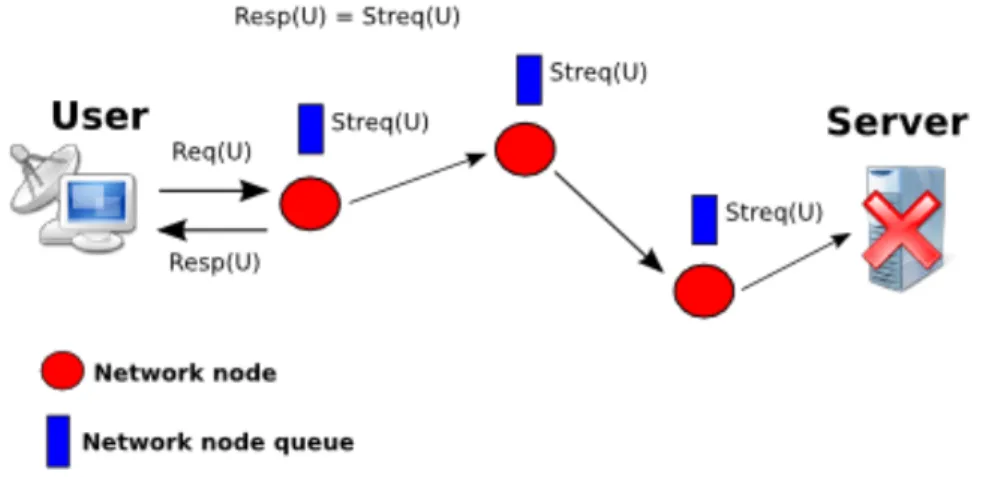
and retrieval scenarios. Figure 7, illustrates the content retrieval and caching scenario, a user acts as a requester. The request is assumed to be a
web resource. The user sends a request (Req) for resource (U), which travels through mobile nodes until it reaches a server. The server will then send a response (Resp) that travels all the way back to the user.
Figure 7. Illustrations of request and response operations between user and server.
On its way to retrieve the response (Resp(U)), the resource will be cached on every node until it reaches the requester. The request or the response may be replicated in various mobile nodes depending on the used routing algorithm. The replica stays stored on the node until the time to live (TTL) expires or the response gets to the requester or a more recent response replaces it. If another user issues a request for the same resource (Req2 (U)), this request may cross nodes that have already a replicated response (Resp). In this case the node will create a new response (Resp2
(U)) from its queued (Resp (U)) and replies it to the user, acting as an
implicit cache. Therefore, nodes must be able to identify the resource to match both requests (req2 (U)) and (Resp1 (U)) and determine if the response is still the most recent one. This principle is illustrated in Figure 8.
Figure 8. Illustration of request and response between user and a mobile node.
In the content storage and retrieval scenario, a user requests storage (streq) of a resource (U) to a server (Figure 9). The storage request (streq (U)) travels trough the nodes until it reaches the server. On its path, the resource (U) will be replicated along the nodes. While stored/queued, the resource (U) is available to any requester that is interested in it. The nodes must identify the local copy of the resource and create the response from previous storage requests (streq (U)). This mechanism may act as data backup for stored resources, in case of any hardware loss or failure.
Figure 9. Illustration of storage operations on mobile nodes can perform backup services in a server failure scenario.
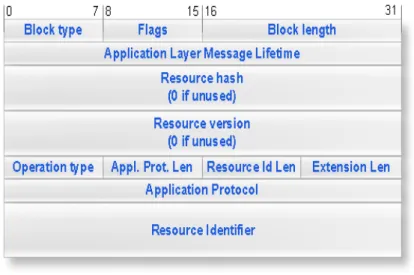
These scenarios clearly present a distributed caching strategy in DTN nodes. In order to improve this distributed caching scheme, the authors proposed in [54] a logic module for storage and retrieval operations. This module allows cache lookups for stored resources in the queue and cache retrieval for passing requests. Such procedures require additional information about their bundle payloads. For this purpose
application-hints extension blocks [52] for the bundle protocols were also presented.
The application-hint illustrated in Figure 10, contains several cache control fields. Among others, the Application protocol field shows the application protocol to perform proper resource matching. Resource identifier identifies the carried resource. Operation type indicates if the resource is a request, a response, an unconfirmed event, or an unknown operation type. These distinctions allow different storage policies. In case of bundle fragmentation, the application hint must be copied to all fragments.
Figure 10. Illustration of an Application-Hint extension block for the bundle protocol.
2.3 Content Storage and Retrieval Proposal for
VDTN
The VDTN CSR proposal assumes the inclusion of CSR control labels attached to every bundle of aggregated network traffic (data bundles). When network nodes interact, they first exchange control information, e.g. a setup message that furnishes information such as, among others, about bundles that they are carrying and their storage and energy constraints, node coordinates, velocity and destination. The bundle CSR label is sent also in the control channel and it is attached to the bundle setup message, as shown in Figure 11. The main purpose of these labels is to define cacheable and retrieval contents, and apply them caching and forward restrictions in order to improve network performance significantly, through elimination of all redundant information. Moreover, it also improves data transfers between nodes (data channel).
Figure 11. VDTN CSR bundle label is sent in the control channel attached to the Setup Message.
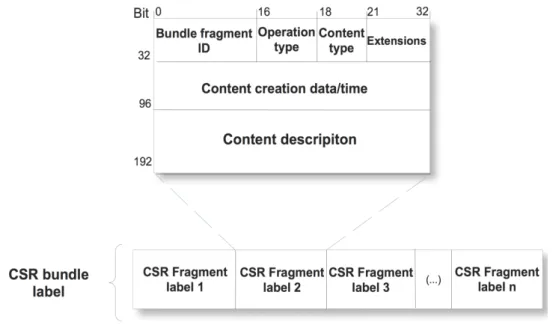
A VDTN data bundle is created by an aggregation of network IP traffic. Network traffic has different sources, sizes, destinations, and priorities. These properties directly affect the nodes buffer management, and therefore, the network performance. For each VDTN data bundle of aggregated network traffic, two different CSR control labels were created (Figure 12). The CSR Bundle label is applied to the VDTN bundle and contains for all aggregated network contents, their respective CSR bundle
fragment label. The CSR bundle fragment label is applied to a single
bundle fragment that contains network traffic.
Figure 12. Illustrations of CSR bundle label and CSR fragment labels scheme.
For each bundle and fragment a CSR control label is applied. A CSR bundle label contains at least one CSR bundle fragment label. Each fragment label contains specific control fields that define if the content is to be cached or retrieved, as can be seen and described in Table 1. These control fields are the basis of the CSR operations.
Table 1. CSR CONTROL LABEL FIELDS
CSR control field Description Size
Bundle fragment
label ID Identifies the bundle label 16 bits Content creation
data/time
Data and the time of creation or last
modification of the respective content 64 bits Operation type Specifies the operation for the respective content (i.e., request, response, storage) 2 bits
Content type Type of the respective content (i.e., text, image, video) 3 bits
Content description
Describes the bundle content (i.e., www.content.com, image.png,
sensordata32.txt, file.mp3)
96 bits
3. Design and Application of
CSR Mechanisms on VDTNs
This chapter presents the design and implementation of the CSR proposal for the VDTN architecture. It starts presenting the conceptual design of the CSR proposal, presenting UML diagrams of the main actions and procedures of a VDTN node with CSR mechanisms. The main storage and retrieval procedures are also presented including pseudo code of its key operations. Afterwards it presents the used technologies for the implementation of the CSR proposal. Finally, presents and describes the VDTN testbed used for implementation of CSR mechanisms.
3.1 Conceptual Design of CSR mechanisms
Stationary and mobile nodes share the same control and data plane, so CSR procedures will also be similar on all network nodes. Since vehicles are the network infrastructure of VDTN, the following UML [55] diagrams present the actions of a VDTN mobile node and its CSR mechanisms. The use case diagram of a VDTN mobile node and its control plane functions including the exchange of CSR bundle labels is presented in Figure 13. While traveling along its path, a mobile node searches for other network
nodes using its control plane functions. This connection is always active and its operations are always under execution. When a mobile node finds another node, and a proper contact opportunity is established, both exchange control information. In this control information, along with the signaling message (setup message), CSR bundle labels are exchanged. The setup message information is used to decide whether this contact opportunity should be considered or ignored, and to configure data plane connection. If a data plane transmission is possible, the node executes the CSR mechanisms deciding which data is to be stored or retrieved.
Figure 13. Use case diagram of a VDTN mobile node and its control plane functions including the exchange of CSR bundle labels.
The activity diagram of a VDTN mobile node, and its CSR mechanisms is presented in Figure 14. Through the signaling message, a contact opportunity is considered and the data plane is to be configured. Therefore, the mobile node starts its CSR mechanisms. After exchanging CSR bundle labels the node starts the CSR matching procedures. Through these matching operations, the node selects cacheable and forwarding data bundles to be sent and received from the other node. As soon as the matching process ends, data bundles that are sent as cacheable or
retrievable are selected and exchanged when the data plane is connected and ready for data exchange.
Figure 14. Activity diagram of a VDTN mobile node, and its CSR mechanisms.
3.1.1 Storage and Retrieval Procedures
CSR mechanisms allow that a given node may select bundles to be considered for storing and/or retrieving. After nodes exchange their CSR
bundle labels, each one has access to the list of bundle fragments that the
other node is carrying. A node only process bundles containing fragments that have ‘Storage’, ‘Response’, and ‘Request’ as content ‘Operation
type’. Storage type contents, are automatically selected for being stored,
comparing only if a bundle with the same content is not already stored in the buffer node. The basic pseudo code used for implementing this matching principle is presented as follows.
/*Terminology CSR_BL = CSR Bundle Label CSR_FL = CSR Fragment Label */ 1. BEGIN 2. Foreach CSR_FL in CSR_BL 3. Foreach Operation_type in CSR_FL 4. Read Operation_type 5. if Operation_type is Storage and CSR_FL.Content is not stored Add to store/receive list (CSRL_BL) else if Visitor_node_type is mobile node and Visitor_node_route includes CSR_BL.Destination Add to store/receive list (CSR_BL) else continue. 6. END
If the bundle has responses or requests, first it compares if a possible corresponding request or response is stored. If yes, the bundle is selected to be stored or retrievable (sent or received). If no, but at least one of the communicating nodes is mobile, the destination node is matched with the mobile node route information, comparing the nodes that it already visited and may visit. In this case, the bundle is selected to be stored or retrievable so that mobile node carries it to the destination. When CSR negotiation ends, all selected bundles are exchanged between nodes in a list of stored and retrieved data, as well as their respective CSR bundle labels. The basic operations for these matching principles in pseudo code are presented as follows.
/*Terminology CSR_BL = CSR Bundle Label CSR_FL = CSR Fragment Label */ 1. BEGIN 2. Foreach CSR_FL in CSR_BL 3. Foreach Operation_type in CSR_FL 4. Read Operation_type 5. If Operation_type is Response if corresponding Request is stored Add to store/receive list (CSR_BL) else if Visitor_node_type is mobile node and Visitor_node_route includes CSR_BL.Destination Add to store/receive list (CSR_BL) else continue. 6. if Operation_type is Request if corresponding Response is stored Add to store/receive list (CSR_BL) else if Visitor_node_type is mobile node and Visitor_node_route includes CSR_BL.Destination Add to store/receive list (CSR_BL) else continue. 7. END
3.2 Used Technologies
For construction and implementation of the above-described CSR operations, it was used C# language. C# programming language [56], and deployed in the network nodes. They were developed using the .Net Compact Framework version 3.5 [57] for running in the PDA’s Windows Mobile 6.1 [58], and using the .NET Framework for running in the desktop’s and laptop’s Windows Vista operating system. The .Net Framework contains a collection of libraries, which allow developers to run applications and services in Windows Platform. Microsoft Visual Studio 2008 Professional Edition [59] is a powerful IDE that contains a lot group of applications developed by Microsoft Corporation, to software development. Supports C#, J#, Visual Basic, and others.
3.3 VDTN testbed
A VDTN testbed [26] was used for performance evaluation and analysis of VDTN network with and without CSR mechanisms. This testbed implements the VDTN architecture demonstrating the applicability of VDTNs in several scenarios (e.g. interconnection of isolated regions) [26]. Figure 15, illustrates an activity diagram of a mobile node, which represents a workflow of stepwise activities and actions describing control plane and data plane interaction, coordinated by the decision module. This activity diagram is equal for all network nodes, and represents the concept of control plane and data plane separation with out-of-band signaling. Each network node autonomously manages its control plane and data plane link connections. Nodes are always searching for new contact opportunities, using their control plane link connection (low-power, low bandwidth, long-range), which is always active. A decision module is responsible for processing the control information exchanged at a new contact opportunity to decide whether to accept the contact, and for determining the amount
of time that lasts the contact [27]. Then, the data plane link connection (high-power, high bandwidth, short-range) is activated, and remains in this state only during the estimated period of time that lasts the contact. Nodes use its data plane link to exchange data bundles. The bundle signaling control layer executes the control plane functions, such as, signaling messages exchange, resources reservation (at the data plane) and routing.
Figure 15. Activity diagram of a mobile node, describing the control and data plane interaction, coordinated by the decision module.
The VDTN testbed used for the network performance evaluations and analysis was created for a laboratory environment. It consists in computers/laptops, portable digital assistants (PDAs), and robots. Desktop and laptop computers are used to emulate the terminal nodes and the relay nodes. Mobile nodes are emulated through LEGO MINDSTORMS NXT robots [60]. A mobile node is shown in Figure 16. As may be seen, each robot carries a PDA having data-networking and storage capabilities. All network nodes support bluetooth [61] and IEEE 802.11b/g [48] technologies. These technologies are used to support the VDTN out-of-band signaling with the separation between control and data planes. While the bluetooth connection is used to exchange signaling information, the 802.11 is used to the transmission of data bundles.
Figure 16. LEGO MINDSTORMS NXT robot with a PDA device coupled.
Figure 17, presents an interaction between two mobile nodes (a) and a mobile node with a relay node (b). It is important to notice that LEGO NXT robots, which represent the mobile nodes (e.g. vehicles), are programmed with several mobility models (e.g. random movement across roads, bus movement), introducing different movement patterns.
This VDTN testbed includes three terminal nodes, four mobile nodes and two relay nodes. Terminal nodes are placed at different points (edges)
Figure 17. Mobile node 1 interacting with mobile node 2 (a); Mobile node 1 interacting with relay node 1 (b).
of the laboratory. Terminal nodes acts as network access points, and it is assumed that one of them is connected to the Internet. Mobile nodes follow different pre-defined paths in order to emulate bus routes. Mobile node 1 follows a yellow path, mobile node 2 and 4 follow a black path and mobile
node 3 a white path. Mobile nodes move around the network following their
paths and collecting traffic messages with the purpose of replicate these messages through the network. Relay nodes are placed on the intersections of mobile nodes paths in order to increase contact opportunities, collecting and transfer bundles from communications with mobile nodes.
Figure 18, illustrates the class diagram for the VDTN architecture development. The highlighted classes represent the classes used in the implementation of the CSR. This diagram represents the structure and relations between all classes and serves as model for the objects. In the diagram shown below, attributes and methods where omitted to improve its readability.
Figure 18. Class diagram of VDTN architecture with CSR mechanisms implemented.
4. Performance Evaluation
and Validation
This chapter focuses on the performance evaluation and validation of the CSR mechanisms. Using a described network scenario, firstly it presents the validation and feasibility of the proposal and the performance assessments for Epidemic and Spray and Wait (normal and binary variant) protocols. These evaluations include the comparison between protocols and their impact on the performance of a VDTN network, with and without CSR mechanisms. This study was conducted through the above-presented VDTN testbed.
4.1 Network Scenario
The network scenario includes three terminal nodes, four mobile nodes and two relay nodes. Each mobile node follows its own route as illustrated in Figure 19. Relay nodes are placed in the paths intersection helping the mobile nodes to bypass data along the network. In the presented application scenario, terminal node 1 furnishes several services to the network, answering the requests issued by terminal nodes 2 and 3. These services include text, image and video files. Terminal node 1 also generates data bundles with temperature of its computer CPU to be delivered and stored on terminal nodes 2 and 3. It is assumed that during
data transfer between nodes, there is no bundle fragmentation. Incomplete or loss transfers are considered as a failed data exchange and re-transmitted in a next contact opportunity.
Figure 19. Illustration of the VDTN testbed with three terminal nodes, two relay nodes, and four mobile nodes.
Figures 20,21 and 22 present the VDTN testbed laboratory scenario and all the above-mentioned interactions and behaviors.
Figure 20. VDTN testbed scenario and the respective interactions between terminal node 1, mobile nodes 1 and 2, and relay nodes 1 and 2.
Figure 21. VDTN testbed scenario and the respective interactions between terminal node 2, mobile nodes 3 and mobile node 4.
Figure 22. VDTN testbed scenario and the respective interactions between terminal node 3, mobile nodes 3 and mobile node 4.
The performance of the VDTN testbed was evaluated with a bundle generation at every 15, 30 and 60 seconds. Dropping policies assume a first-in, first-out (FIFO) queue where bundles are deleted when their buffer reaches maximum capacity. For dropping purposes, a time-to-live (TTL) field was also included, and bundles are deleted when it expires. TTL changes between 5 and 15 minutes, along tests. Performance metrics considered in this study are the bundle delivery probability, and the bundle average delay (in seconds) that consists in the time between bundle creation and delivery and the average contact duration (seconds) between nodes. In the context of this work, the VDTN testbed has a limited and challenged scenario with low number of network nodes and messages directly. These aspects may affect the network behavior and its performance.
The following two well-known DTN routing protocols are considered: Epidemic [62] and Spray and Wait (including its binary variant) [63]. Epidemic is a flooding based routing protocol where network nodes exchange all the data that they do not have. In an infinite buffer space environment, this protocol performs better than all the other ones. It has the best delivery and latency ratios providing an optimal routing solution. However, in an environment with limited resources, the overall performance severely decreases, due to the flooding that wastes unmeasured network resources. Spray and Wait protocol creates a number of copies N to be exchanged (“sprayed”) per message. A network node forwards de N copies to the first different nodes encountered. Then, it “waits” until one of the network nodes reaches the destination. In a large range of scenarios, Spray and Wait presents better overall network performance than epidemic routing, especially in average message delay and number of transmissions per message delivered [63]. In the binary variant, a node A that has more than 1 message copies encounters a node B that does not have any copy. Then node A forwards to node B the number of N/2 message copies and keeps the rest of the messages. A node with 1 copy left, only forwards it to its final destination.
For assessments and validation purposes of the CSR proposal the following worst-case scenario was assumed: A contact between a relay node with 2 GBytes of stored data and a mobile node. It is assumed that a source node generates one fragment with 2028 KBytes every 7 seconds, and an average number of 4 fragments per bundle. A new VDTN data bundle is generated every 30 seconds (following time based assembly algorithm)[]. The size of a CSR bundle fragment label is 192 bits (equivalent to 0,096 KBytes per bundle fragment). Therefore, it is estimated that 2 GBytes of data in the relay node stores an average of 256 bundles with 8192,12 KBytes of size (data and labels) each one. Then for each 2GBytes of data, 24,576 Kbytes are CSR labels. Through the VDTN testbed it was measured that 1 KB takes approximately 0,11 seconds to be transferred. Therefore, CSR labels of 2 Gbytes of stored data, take approximately 2,64 seconds to be transferred, resulting in very low overhead. This overhead time is perfectly adequated to the speed of any moving vehicle in the VDTN network and, therefore, proves the feasibility of the proposed CSR mechanisms.
4.2 Performance Analysis
This section presents the VDTN network behavior and performance with and without CSR mechanisms. It presents a performance evaluation on both above-mentioned routing protocols, Epidemic and Spray and Wait (including its binary variant).
4.2.1 Performance Evaluation of Epidemic Routing Protocol
Figure 23 shows the bundle delivery probability as function of number of data bundles generated per minute. As may be seen, CSR mechanisms clearly improve the network performance presenting better results on the three different input traffic loads. With the increase of
generated bundles per minute, the bundle delivery probability decreases, as expected. However, with CSR mechanisms, Epidemic protocol increases the bundle delivery probably in 17%, 20% and 22%, respectively, improving the delivery probability on all traffic loads. This network behavior results from the better performance of relay nodes and also from the decreasing number of exchanged bundles per contact, by eliminating redundant data.
Figure 23. Bundle delivery probability as function of number of generated bundles per minute for Epidemic protocol with and without content
storage and retrieval mechanisms.
Figure 24 depicts a data bundle average delay (in seconds) from terminal 1 to terminals 2 and 3. Without CSR mechanisms, bundles that where previously requested or responded are not considered cacheable in any relay node and then, they have to be carried again all around the network until the destination is reached. With CSR mechanisms, these requests and replies are stored in relay nodes, which eventually are closer to destination nodes (terminal nodes), decreasing the average delay. An example is a bundle stored in relay node 2 containing a content previously requested by terminal node 3. If terminal node 2 issues a request for the same content, then mobile node 3 encounters it in relay node 2 instead of
!" #!" $!" %!" &!" '!" (!" )!" #" $" %"
Bundle delivery probability (%)
Number of generated bundles per minute
Without CSR mechanisms With CSR mechanisms
sending a request all around the network that “hopefully” reaches terminal
node 1. With CSR mechanisms on relay node 1, it decreases the data bundle
average delay approximately in 123 seconds to terminal node 2 and 120 seconds to terminal node 3. On relay node 2, which is the closest one to the terminal nodes, CSR mechanisms decreases the data bundle average delay approximately in 187 seconds to terminal node 2 and 195 seconds to terminal node 3.
The bundle average delay improves the network performance significantly with CSR mechanisms. Figure 25, presents the bundle average delay (in seconds) as function of number of generated bundles per minute with and without content storage and retrieval mechanisms. The bundle average delay benefits from CSR mechanisms, decreasing the delay in 80, 106 and 116 seconds, respectively. These performance improvements also benefits from the relay nodes storage and forwarding procedures presented on Figure 24. Relay nodes store previous requested bundles that are forwarded every time that the same requests are issued from terminal nodes, that eventually are closer to the relay node than the source node.
Figure 26 presents the average contact duration between nodes as function of number of generated bundles per minute. Due to vehicles mobility, contact between nodes must be brief and fast to guarantee that if
0 50 100 150 200 250 300 350 400 450
Terminal node 2 Terminal node 3
Bundle aver
age delay (seconds)
No CSR mechanisms
CSR mechanisms on relay node 1 CSR mechanisms on relay node 2
Figure 24. A bundle average delay from terminal 1 to terminals 2 and 3 with and without content storage and retrieval mechanisms for
not all, the biggest amount of data is exchange. CSR mechanisms clearly improve this performance metric through the selection of specific cacheable and forwarding contents eliminating redundant data. These procedures eliminate all the exchanged traffic waste, saving contention resources (e.g. buffer space) that also directly affect the bundle delivery probability.
Figure 25. Bundle average delay (seconds) as function of number of generated bundles per minute for Epidemic protocol with and
without content storage and retrieval mechanisms.
Figure 26. Average contact duration (seconds) as function of number of generated bundles per minute for Epidemic protocol with and
without content storage and retrieval mechanisms.
0 100 200 300 400 500 600 700 1 2 3
Bundle average delay (seconds)
Number of generated bundles per minute
Without CSR mechanisms With CSR mechanisms !" #" $!" $#" %!" %#" &!" $" %" &"
Average contact duration (seconds)
Number of generated bundles per minute
Without CSR mechanisms With CSR mechanisms
4.2.2 Performance Assessment of Spray and Wait Routing Protocol
Figure 27, shows the bundle delivery probability as function of number of generated bundles per minute for Spray and Wait protocol. It is expected that network performance with Spray and Wait routing protocol may be better than Epidemic in all performance metrics. However, as may be seen Epidemic presents a better performance. Nevertheless, CSR mechanisms increase significantly the bundle delivery probability for all input loads. Figure 28, presents the bundle average delay as function of number of generated bundles per minute for Spray and Wait protocol. It is shown that Spray and Wait performs better than Epidemic. With CRS mechanisms, the average delay decreases 124, 163 and 180 seconds for each class of input traffic load, respectively. In the Spray and Wait protocol this metric reduces even more the time that a bundle is carried through the network, reducing also the contention and waste of resources (buffer space). 0 10 20 30 40 50 60 70 1 2 3
Bundle delivery probability (%)
Number of generated bundles per minute
Without CSR mechanisms With CSR mechanisms
Figure 27. Bundle delivery probability as function of number of generated bundles per minute for Spray and Wait protocol with and