Received: 26 October 2009 / Accepted: 10 December 2009 / Published (online): 01 March 2010
Can 8-weeks of training affect active drag in young swimmers?
Daniel A. Marinho 1,2 , Tiago M. Barbosa 2,3, Mário J. Costa 2,3,4, Catarina Figueiredo 1,2, Victor M. Reis 2,4, António J. Silva 2,4 and Mário C. Marques 1,2
1 University of Beira Interior, Sport Sciences Department, Covilhã, Portugal, 2 Research Centre in Sports, Health and
Human Development,Vila Real, Portugal, 3 Polytechnic Institute of Bragança, Sport Department, Bragança, Portugal, 4 University of Trás-os-Montes and Alto Douro, Sport, Health and Exercise Department, Vila Real, Portugal.
Abstract
The aim of this study was to assess the effects of 8-weeks of training on active drag in young swimmers of both genders. Eight girls and twelve boys’ belonging to the same swimming team and with regular competitive participation in national and regional events for the previous two seasons participated in this study. Active drag measurements were conducted in two differ-ent evaluation momdiffer-ents: at the beginning of the season and after 8 weeks of training (6.0 ± 0.15 training units per week, 21.00 ± 3.23 km per week and 3.50 ± 0.23 km per training unit). The maximal swimming velocity at the distance of 13 m, active drag and drag coefficient were measured on both trials by the method of small perturbations with the help of an additional hydrody-namic body. After 8 weeks of training, mean active drag (drag force and drag coefficient) decreased in girls and boys, although no significant differences were found between the two trials. It seems that 8 weeks of swimming training were not sufficient to allow significant improvements on swimming technique.
Key words: Swimming, children, technique, drag, training effects.
Introduction
Swimming is characterized by the intermittent application of a propulsive force to overcome a velocity-dependent water resistance (i.e., hydrodynamic drag) (Marinho et al., 2009a). Hydrodynamic drag is the force that a swimmer has to overcome in order to maintain his movement through water and is influenced by velocity, shape, size and the frontal surface area (Kjendlie and Stallman, 2008). Theoretical calculations (e.g., Larsen et al., 1981; Massey, 1989), numerical solutions (e.g., Marinho et al., 2009a; 2009b; Silva et al., 2008) and experimental ap-proaches (e.g., Hollander et al., 1986; Rennie et al., 1975; Taiar et al., 1999) have been used to study hydrodynamics in human swimming. Theoretical calculations are based on the application of the fluid mechanics basis and of the Newtonian equations to determine the hydrodynamic forces, whereas numerical simulations consisted of the computational modeling of the water flow around the human body. Concerning experimental approaches, sev-eral attempts have been made to apply technology to determine this force (Hollander et al., 1986; Kolmogorov and Duplishcheva, 1992). First trials used measurement techniques determining the resistance of swimmers glid-ing passively through the water. For example, Dubois-Reymond (1905) measured resistance with a
dynamome-ter, towing people behind a rowing boat, whereas Lil-jestrand and Strenstrom (1919) towed swimmers by means of a windlass on shore. Amar (1920) and Kar-povich (1933) used measurement techniques to determine the drag of swimmers gliding passively through the water. However, it was hypothesized that the movements neces-sary to create propulsion could induce additional drag (Toussaint et al., 2004). In fact, during swimming, the body is never in a stable prone position, since some pro-pulsive forces are generated. Thus, one of the most impor-tant parameters in the swimming hydrodynamics scope is to determine the drag of a body that is actively swimming. This assumption resulted in attempts to determine the drag of a person who is actively swimming. Indeed, pas-sive drag is lower than active drag for the same subject (Kjendlie and Stallman, 2008).
Aiming to achieve this goal, techniques to assess active drag were developed by several research groups in the 70s, based on interpolation techniques (e.g., Clarys and Jiskoot, 1975; di Prampero et al., 1974). These meth-ods involved indirect calculations based upon changes in oxygen consumption, as additional loads were placed on the swimmer. Later on, Hollander et al. (1986) developed the MAD-system (measurement of active drag), relying on the direct measurement of the push-off forces while swimming the front crawl stroke only with arms. In the 90s, Kolmogorov and Duplishcheva (1992) designed another method to determine the active drag: the velocity perturbation method, also known as the method of small perturbations. In this approach, subjects swim a lap twice at maximal effort: (i) free swimming; and (ii) swimming while towing a hydrodynamic body that creates a known additional drag. For both trials, the average velocity is calculated. Under the assumption that in both swims the power output to overcome drag is maximal and constant, drag force can be determined taking into account the difference in swimming velocity. In contrast to the inter-polation techniques and the MAD-system, that required heavy and costly experimental procedures, the velocity perturbation method just required the use of the hydrody-namic body device and a chronometer to assess active drag. Additionally, this approach can be applied to meas-ure active drag in all four competitive strokes. Other methods are only applicable to the front crawl (e.g., the MAD-system, Hollander et al., 1986) and the swimmer presents some segmental constrains, since legs are not taken into account as they are hold by a pull-buoy. There-fore, the velocity perturbation method seems to represent
a simple and reliable procedure to assess active drag in young swimmers. In fact, the research in competitive young swimmers is much reduced in comparison to the one established in adult swimmers. This lack of investiga-tion in children is due to financial coasts but also to ethi-cal issues (Barbosa et al., 2009a). Assessments in young swimmers must be less expensive, less invasive, less complex and less time consuming in comparison to the ones carried-out in adult swimmers. Nevertheless, several assessments tests are performed by young swimmers’ coaches. There are testing batteries suggesting procedures for data collection, their analysis and interpretation for young swimmers, including anthropometric, energetic and hydrodynamic procedures (e.g., Carzola, 1993; Barbosa et al., 2009b; Costill et al., 1992; Costa et al., 2009; Silva et al., 2007). Hydrodynamic variables in young swimmers analyses usually included vertical buoyancy and prone gliding after wall push-off since these protocols are very simple to be applied in large samples (e.g., Barbosa et al., 2009b; Carzola, 1993; Silva et al., 2007). However, active drag seems to be an important variable to be analyzed in swimming since active drag is significantly dependent on swimming technique (Kjendlie and Stallman, 2008; Tous-saint et al., 1988). Swimming with lower drag at any given velocity reduces the energy cost of swimming, and the movements do not contribute to excessive or unneces-sary drag (Millet and Candau, 2002). Indeed, Termin and Pendergast (2001) reported that lateral body movements or excessive kicking movements may reduce the stream-line of the body and thus, increase hydrodynamic drag. Arellano et al. (2006) also hypothesized that elite swim-mers might be able to generate a vortex with their hands, which would help the body to better slip through the wa-ter, thus lowering active drag. In this sense, active drag, using the velocity perturbation method, can be considered a practical and useful parameter to assess changes in swimming technique due to training process.
The training process can only be improved if one can also improve the methodology used to evaluate each component of the sport performance (Marinho et al., 2006). Moreover, it is not always clear the effects of train-ing in performance or the required temporal period to allow a training load to positively affect performance. In young swimmers, this training control and evaluation should also be a main concern of coaches. For instance, Wakaysohi et al. (1993), Maclaren and Coulson (1999), and Marinho et al. (2009c) reported significant improve-ments on the aerobic capacity of young swimmers after 12 weeks of training, and Reis and Alves (2006) verified the same effect after 9 weeks of training. Unfortunately, to the authors’ best knowledge, few studies with a longi-tudinal character were conducted attempting to under-stand the effects of training on active drag in young com-petitive swimmers (e.g. Kolmogorov et al., 2000). Hence, the aim of this study was to assess the effects of 8 weeks of swimming training on active drag in young swimmers
of both genders.
Methods
Participants
Eight girls and twelve boys belonging to the same swim-ming team participated in this study. In Table 1, the mean and standard deviation values of their age, height, body mass and personal record of the 100 m freestyle event in short course are presented. Although there were differ-ences in the 100 m freestyle performance, there were no differences in the anthropometrical parameters between boys and girls. All participants have been trained by the same coach and for the same club for the previous two seasons. Both boys and girls were in Tanner stages 1-2. The participants’ parents provided their written informed consent and the procedures were approved by the institu-tional review board.
Procedures
Active drag measurements were conducted in two differ-ent momdiffer-ents: (i) at the beginning of the season; and (ii) after 8 weeks of training. This 8 week period corre-sponded to the general period of preparation of the first macro cycle of training, comprising the months of Octo-ber and NovemOcto-ber. The end of this first macro cycle coin-cided to the participation in the Age-Group Regional Swimming Championship in December. The main aim of this general period of preparation were to develop aerobic capacity and aerobic power and to improve swimming technique in the four strokes and to enhance starts and turns skills. During this 8 week period the subjects per-formed 48 training units, corresponding to a mean value of 6.0 ± 0.15 training units per week. The swimmers per-formed 168 km, corresponding to a mean value of 21.00 ± 3.23 km per week and 3.50 ± 0.23 km per training unit. They performed 20.80 km at an intensity corresponding to their aerobic capacity (2.60 ± 1.02 km per week) and 7.2 km at an intensity corresponding to their aerobic power (1.44 ± 0.28 km per week). The remaining training com-prised low aerobic tasks (136.50 km) and velocity training (3.50 km). Technical training was performed during the aerobic tasks, including practicing technical drills in each stroke. Dry-land training consisted of two sessions per week of 20 minutes of overall physical condition. The principal exercises were, respectively, abdominals, push-ups, spinal rector, and stretching routines. Subjects per-formed 3 sets of 15-20 repetitions for abdominals and spinal erector, and 3-4 sets of 10-12 for push-ups. On completion, all swimmers then performed 3-4 stretching exercises for lower an upper extremities. Rest intervals of 2 minutes were permitted between sets and between cate-gories.
The velocity perturbation method with the help of an additional hydrodynamic body was used to determine active drag in front crawl swimming (Kolmogorov and Table 1. Mean (±SD) of age, height, body mass and personal record of the 100 m freestyle event in short course of the sample.
Age (years old) Height (m) Body mass (kg) 100 m personal record (s)
Total (n = 20) 12.20 (.70) 1.51 (.08) 41.76 (8.98) 74.24 (2.98)
Girls (n = 8) 11.63 (.52) 1.52 (.08) 40.50 (8.98) 77.74 (2.76)
Boys (n = 12) 12.58 (.51) 1.51 (.11) 41.79 (6.07) 71.90 (3.12) *
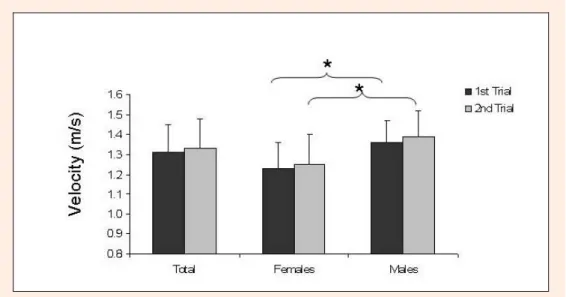
Figure 1. Mean and standard deviation values of swimming velocity for the total sample and for girls and boys in both trials. * p < 0.05.
Duplishcheva, 1992; Kolmogorov et al., 1997). Active drag was calculated from the difference between the swimming velocities with and without towing the pertur-bation buoy. To ensure similar maximal power output for the two sprints, the swimmers were instructed to perform maximally at both trials. Both trials were conducted in a 25 m indoor swimming pool.
Active drag was calculated as (Kolmogorov and Duplisheva, 1992): 3 3 2 b b b v v v v D D − = (1)
Where D is the swimmer’s active drag at maximal velocity, Db is
the resistance of the perturbation buoy and, vb and v are the
swim-ming velocities with and without the perturbation device, respec-tively.
The drag of the perturbation buoy was calculated from the manufacturer’s calibration of the buoy-drag characteristics and its velocity (Kolmogorov and Du-plisheva, 1992). Drag coefficient (CD) was calculated
according to equation 2: 2 2 Sv D CD
ρ
= (2)Where ρ is the density of the water and S is the projected frontal surface area of the swimmers.
Frontal surface area was estimated using Clarys’s prediction (Clarys, 1979), according to equation 3:
10000 2 377 50 3 93 6. BM . H . S= + − (3)
Where BM is the body mass and H is the swimmers’ height. Each swimmer performed two maximal 25 m front crawl swim with an underwater start with and without the perturbation device. Subjects performed the bouts alone without any other swimmer in the same swim lane to reduce the drafting or pacing effects. Swimming velocity was assessed during 13 m (between 11 m and 24 m from
the starting wall). The time spent to cover this distance was measured with a chronometer (Golfinho Sports MC 815, Aveiro, Portugal) by an expert evaluator.
Statistical analysis
Normality of distribution was checked by Shapiro-Wilk tests (SPSS 12.0, Lead Tools, 2003). The values of drag, drag coefficient and maximal velocity are presented as mean ± standard deviation. Comparisons between the first and second trials were conducted using Wilcoxon test. Friedman test was used to analyse differences between girls and boys. The statistical significance was set at p ≤ 0.05.
Results
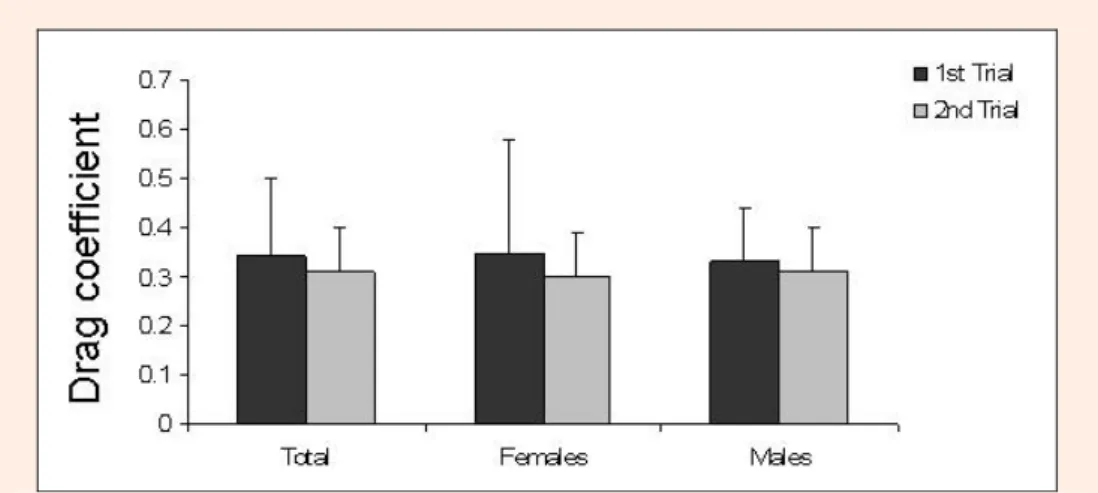
In Figures 1, 2, and 3, the values of swimming velocity, drag force and drag coefficient for the total sample and for girls and boys in both trials are presented.
As one can notice, although no significant differ-ences were obtained, swimming velocity increased be-tween the two trials (total: 1.31 ± 0.14 vs. 1.33 ± 0.15 m/s; girls: 1.23 ± 0.13 vs. 1.25 ± 0.15; boys: 1.36 ± 0.11 vs. 1.39 ± 0.13; p > 0.05), corresponding to a 1.53 ± 0.07 % increase for the total sample. Additionally, after 8 weeks of training, mean active drag (drag force and drag coefficient) decreased in girls and boys, although no sig-nificant differences were found between the two trials (total: 34.66 ± 16.84 N vs. 32.81 ± 12.60 N, 0.34 ± 0.16 vs. 0.31 ± 0.09; girls: 29.18 ± 15.24 N vs. 27.50 ± 10.36 N, 0.35 ± 0.23 vs. 0.30 ± 0.09; boys: 38.30 ± 17.49 N vs. 36.35 ± 13.12 N, 0.33 ± 0.11 vs. 0.31 ± 0.09; p > 0.05). These differences corresponded to a 5.34 ± 0.46 % and 8.82 ± 0.83 % decrease for the total sample, considering the drag force and drag coefficient, respectively.
Moreover, there were no significant differences between boys and girls in both testing trials for the variables ana-lysed, although girls tended to have lower active drag values (p > 0.05). Girls presented lower swimming ve-locities than boys in both moments (first trial: 0.15 ± 0.06 m·s-1 of difference; second trial: 0.13 ± 0.05 m·s-1; p <
Figure 2. Mean and standard deviation values of drag force for the total sample and for girls and boys in both trials.
Discussion
The purpose of this study was to assess the effects of 8 weeks of training on active drag in young swimmers of both genders. Main data was that no significant differ-ences were found in active drag between the two evalua-tion moments.
This paper reports only to freestyle. Freestyle is one of the swim strokes with more competitive events and that some coaches present more training routines and drills. However, since it is possible to apply the velocity perturbation method to all competitive strokes, it seems interesting to enlarge this study to all of them and to ver-ify the changes in active drag for butterfly, backstroke and breaststroke after a training period. Although the interest-ing approach of the velocity perturbation method to de-termine active drag in swimming, this approach requires the calculation of the frontal surface area of the swim-mers. The Clarys’s prediction equation (Clarys, 1979) was developed based upon few Dutch adult/Olympic swimmers. Thus, it raises the question whereas this equa-tion can be applied to nowadays swimmers and, espe-cially, if it can be applied to young swimmers. Further-more, the quality of the Clarys’s prediction equation was not very high (R2 ≈ 0.70). Therefore, future studies should
focus on this issue, attempting to developed better
predic-tion equapredic-tion to determine the swimmers’ frontal surface area. Another important concern of this method is related to the sources of systematic errors, as described by Havriluk (2007), using frequency distributions and meta-analytic procedures. However, one should be aware that the simplicity of the variables used to calculate this pa-rameter remains as one of the main reasons to be usually used in swimming research (e.g. Kjendlie et al., 2004; Kjendlie and Stallman, 2008; Toussaint et al., 1988).
Drag force values of the current study were very similar to values found in other experiments conducted with children, using the velocity perturbation method (e.g. Kjendlie and Stallman, 2008) and the MAD-system (e.g. Toussaint et al., 1990). These values were quite lower than the ones presented by adults, as expected (e.g. Hui-jing et al., 1988, Toussaint et al., 2004, using the MAD-system; Zamparo et al., 2009, using the method of di Prampero et al., 1974). Regarding drag coefficient, some controversy still remains. Kjendlie and Stallman (2008) found drag coefficient values higher than the ones verified in the current study (0.66 ± 0.14) using a similar sample. Kolmogorov and Duplisheva (1992), using the velocity perturbation method, reported similar values for this vari-able (drag coefficient: 0.28 ± 0.09). However, Havriluk et al. (2007) stated that drag coefficient values allow deter-mining the effects of performance factors, although this
finding was only reported for passive drag assessments. Thus, additional research is required regarding this issue in order to clarify it.
It seems that 8 weeks of swimming training (48 training units, 3.50 ± 0.23 km per training unit) were not enough to allow significant improvements on swimming technique. Moreover, there was a non-significant increase in swimming performance (total: 1.31 ± 0.14 vs 1.33 ± 0.15 m·s-1, girls: 1.23 ± 0.13 vs. 1.25 ± 0.15 m·s-1; boys:
1.36 ± 0.11 vs. 1.39 ± 0.13 m·s-1; p > 0.05) and also
non-significant differences in the subjects’ anthropometrical profile between the two evaluation moments (height: 1.51 ± 0.08 vs. 1.52 ± 0.09 m; body mass: 41.76 ± 8.98 vs. 41.58 ± 7.67 kg). These findings are important since ve-locity, height and body mass could influence hydrody-namic drag (Equations 1, 2 and 3).
Non-significant differences were obtained in drag force and drag coefficient after 8 weeks of training, al-though a slightly decrease were obtained in these vari-ables. These results can be due to several reasons: (i) the heterogeneity of the sample, since it comprised swimmers of different skill level of the same club; (ii) the small period of training and; (iii) other factors that can influence technique. Indeed, it seems interesting to analyse this changes in drag parameters associated to other technical variables. In the future, it could be of much importance to analyze hydrodynamic drag using the velocity perturba-tion method, measuring stroke rate, stroke length and stroke index as well. These biomechanical parameters are often used on a regular basis by coaches to analyse swimming technique and can give new insights about training progress (Craig and Pendergast, 1979; Costill et al., 1985). Moreover, it could be interesting to include also the analysis of intra cyclic variations of velocity, since this variable plays an important role in swimming economy and, thus in swimming technique (Barbosa et al., 2008; Seifert et al., 2008).
As shown by Kolmogorov et al. (2000), different physiological training sets can lead to different changes in hydrodynamic characteristics of swimming technique. Kolmogorov et al. (2000) have shown that in swimmers at the age of 14-16 years a large amount of swimming exer-cises in the training categories of aerobic power (metabo-lism at the level of maximal oxygen up-take), anaerobic capacity (metabolism at the level of lactate tolerance) and anaerobic power (metabolism at the level of peak lactate production) increases hydrodynamic characteristics of swimming technique. However, these parameters were decreased in the categories of aerobic metabolism (mini-mum aerobic metabolism and anaerobic threshold). These considerations could advertise coaches to the effects of training in swimming technique. Nevertheless, the find-ings of Kolmogorov et al. (2000) should be read with careful, since they were obtained after a period of training of 2.5 years, varying the total volume of training from 75-100 km (beginning of the project) to 150-180 km per month (end of the project), values significantly higher than the ones performed by the swimmers of the current study. On the other hand, in the current study, the major part of the training comprised aerobic tasks, representing the anaerobic training a very small component during the
8-weeks of preparation. These swimmers were young swimmers of 11-13 years old and the research was per-formed during the first general period of preparation, where anaerobic training loads usually represent a small part of the training process. Indeed, Latt et al. (2009) demonstrated that the development of sport-specific tech-nical skills is the most important part during the early years of swimming training in young swimmers. There-fore, it is preferable to underline the findings of Havriluk (2006) who demonstrated that a relatively short duration of carefully targeted instruction could make a meaningful improvement in technique and performance in young competitive swimmers. A one-week of intervention, in-cluding three classrooms and five poolside instructional sessions with technique feedback and specific visual and kinaesthetic cues, allowed decreasing active drag coeffi-cient and to increase swimming velocity. Hence, one can recommend that specific training sets concerning tech-nique correction and improvement in young swimmers might be a main aim during training planning in swim-ming.
During the 8-weeks of training of our sample the anaerobic tasks only represented 2 % of the overall train-ing volume. Maglischo (2003) suggested that lactate tol-erance and lactate production training should be used sparingly. However, one should be aware that anaerobic training tasks could enhance the swimmers’ hydrody-namic profile (Kolmogorov et al., 2000). Furthermore, Erlandson et al. (2008) stated that to be successful at the international level of swimming competition, intensive training must begin before puberty. Hence, it seems very interesting to keep developing this study during the train-ing season, analystrain-ing the effects of different traintrain-ing loads on hydrodynamic drag. For instance, the changes on hydrodynamic drag after the specific preparation period, in which training tasks became more similar to swimming events demands, i.e., more anaerobic tasks, can represent an interesting development on this field. Associated to this concern, the effects of the tapering period on hydro-dynamic performance can also represent an important issue to be addressed in the future (e.g., Mujika and Padilla, 2000; Mujika, 2009).
Furthermore, there were no differences between boys and girls concerning active drag. A possible expla-nation may be related to the similar values of body mass and height in boys and girls found in this study. However, girls tended to have lower drag values than boys, which can be related to the lower velocities achieved by the first ones. Once again, more research is needed with a larger sample to understand the differences between swimmers of both genders. For instance, one can speculate if the differences in active drag between boys and girls can reveal differences between the swimmer’s underwater motions (Deschodt and Rouard, 1999). Moreover, both boys and girls swimmers presented the same tendency in active drag decrease between the two evaluation mo-ments. These data supported the findings of Boussaidi et al. (2003), reporting the same global response to exercise in boys and girls, although Boussaidi et al. (2003) only studied metabolic adaptations.
Conclusion
In the present research, 8 weeks of swimming training were not sufficient to allow significant improvements on swimming technique. In competitive swimming, training distance is usually given priority in relation to technique instruction. However, considering the data of this study, it seems that specific training sets and drills concerning technique correction and improvement in young swim-mers might represent a main aim during training planning and perhaps training time allocation should be reconsid-ered.
Acknowledgments
The authors would like to thank the swimmers who participated in this study.
References
Amar, J. (1920) The human motor. G. Routledge & Sons, Ltd, London. Arellano, R., Terres-Nicol, J.M. and Redondo, J.M. (2006) Fundamental
hydrodynamics of swimming propulsion. Portuguese Journal of Sport Sciences 6, 15–20.
Barbosa, T.M., Keskinen, K.L., Fernandes, R.J. and Vilas-Boas, J.P. (2008) The influence of stroke mechanics into energy cost of elite swimmers. European Journal of Applied Physiology 103, 139-149.
Barbosa, T.M., Costa, M.J., Marinho, D.A., Coelho, J., Moreira, M. and Silva, A.J. (2009a) Modelling the links between age-group swimming performance, energetic and biomechanic profiles. Pediatric Exercise Science, in press.
Barbosa, T.M., Marinho, D.A., Costa, M., Coelho, J., Cruz, A., Marques, M.C. and Silva, A.J. (2009b) Path-flow analysis model for anthropometric, hydrodynamic and biomechanical variables in age-group swimmers. Journal of Sports Science and Medicine 8(Suppl. 11), 183.
Boussaidi, L., Petibois, L., Melin, A.M. and Cazorla, G. (2003) Adaptations métaboliques à l'entraînement en début de saison de natation. Différences en fonction du sexe. Science et Sports
18(1), 16-19. (In French: English abstract).
Carzola, G. (1993) Tests Spécifiques d’évaluation du Nager. Editions Vigot, Paris.
Clarys, J.P. (1979) Human morphology and hydrodynamics. In: Swim-ming III. Eds: Terauds, J. and Bedingfield, E.W. Baltimore: University Park Press. 3-41.
Clarys, J.P. and Jiskoot, J. (1975) Total resistance of selected body positions in the front crawl. In: Swimming II. Eds: Clarys, J.P. and Lewillie, L. Baltimore: University Park Press. 110-117. Costa, A.M., Silva, A.J., Louro, H., Reis, V.M., Garrido, N.D., Marques,
M.C. and Marinho, D.A. (2009) Can the curriculum be used to estimate critical velocity in young competitive swimmers? Journal of Sports Science and Medicine 8, 17-23.
Costill, D., Kovaleski, J., Porter, D., Fielding, R. and King, D. (1985) Energy expenditure during front crawl swimming: predicting success in middle-distance events. International Journal of Sports Medicine 6, 266-270.
Costill, D., Maglischo, E. and Richardson, A. (1992) Swimming. Hand-book of Sports Medicine and Science. Blackwell Scientific Pub-lications, Oxford.
Craig, A.B. and Pendergast, D. (1979) Relationships of stroke rate, distance per stroke and velocity in competitive swimming. Medicine and Science in Sports and Exercise 11, 278-283. Deschodt, V.J. and Rouard, A.H. (1999) Influence du sexe sur les
paramètres cinématiques de nage chez les crawleurs de haut niveau. Science et Sport 14, 39-44. (In French: English abstract).
Di Prampero, P.E., Pendergast, D.R., Wilson, D.W. and Rennie, D.W. (1974) Energetics of swimming in man. Journal of Applied Physiology 37, 1-5.
Dubois-Reymond, R. (1905) Zum physiologie des schwimmens. Archive fur Anatomie und Physiologie (Abteilung Physiologie) 29, 252-279.
Erlandson, M.C., Sherar, L.B., Mirwald, R.L., Maffulli, N. and Baxter-Jones, A.D. (2008) Growth and maturation of adolescent female
gymnasts, swimmers, and tennis players. Medicine and Science in Sports and Exercise 40(1), 34-42.
Havriluk, R. (2006) Magnitude of the effect of an instructional interven-tion on swimming technique and performance. Portuguese Journal of Sport Sciences 6(Suppl. 2), 218-220.
Havriluk, R. (2007) Variability in measurement of swimming forces: a meta-analysis of passive and active drag. Research Quarterly for Exercise and Sports 78, 32-39.
Hollander, A.P., de Groot, G., van Ingen Schenau, G.J., Toussaint, H.M., de Best, H., Peeters, W., Meulemans, A. and Schreurs, A.W. (1986) Measurement of active drag forces during swim-ming. Journal of Sports Sciences 4, 21-30.
Huijing, P., Toussaint, H., Mackay, R., Vervoon, K., Clarys, J. and Hollander, P. (1988) Active drag related to body dimensions. In: Swimming Science V. Eds: Ungerechts, B., Wilke, K. and Reis-chle, K. Champaign, Illinois: Human Kinetics Books. 31-37. Karpovich, P.V. (1933) Water resistance in swimming. Research
Quar-terly 4, 21-28.
Kolmogorov, S.V. and Duplisheva, A. (1992) Active drag, useful me-chanical power output and hydrodynamic force coefficient in different swimming strokes at maximal velocity. Journal of Biomechanics 25, 311-318.
Kolmogorov, S.V., Rumyantseva, O., Gordon, B. and Cappaert, J. (1997) Hydrodynamic characteristics of competitive swimmers of different genders and performance levels. Journal of Applied Biomechanics 13, 88-97.
Kolmogorov, S., Lyapin, S., Rumyantseva, O. and Vilas-Boas, J.P. (2000) Technology for decreasing active drag at the maximal swimming velocity. In: Proceedings of XVIII International Symposium on Biomechanics in Sports – Applied Program: Ap-plication of Biomechanical Study in Swimming. Eds: Sanders, R. and Hong, Y. Hong Kong: The Chinese University Press. 39-47.
Kjendlie, P.L., Ingjer, F., Stallman, R. and Stray-Gundersen, J. (2004) Factors affecting swimming economy in children and adults. European Journal of Applied Physiology 93, 65–74.
Kjendlie, P.L. and Stallman, R. (2008) Drag characteristics of competi-tive swimming children and Adults. Journal of Applied Biome-chanics 24, 35-42.
Larsen, O.W., Yancher, R.P. and Baer, C.L. (1981) Boat design and swimming performance. Swimming Technique 18(2), 38-44. Latt, E., Jurimae, J., Haljaste, K., Cicchella, A., Purge, P. and Jurimae,
T. (2009) Physical development and swimming performance during biological maturation in young female swimmers. Col-legium Antropologicum 33(1), 117-122.
Liljestrand, G. and Strenstrom, N. (1919) Studien uber die physiologie des schwimmens. Skandinavisches Archiv fur Physiologie 39, 1-63.
Maclaren, D.P. and Coulson, M. (1999) Critical swim speed can be used to determine changes in training status. In: Biomechanics and Medicine in Swimming VIII. Eds: Keskinen, K.L., Komi, P.V. and Hollander, A.P. Jyvaskyla: Grummerus Printing. 227-232. Maglischo, E.W. (2003) Swimming fastest. The essential reference on
technique, training, and program design. Human Kinetics Pub-lishers. Champaign, Illinois.
Marinho, D., Vilas-Boas, J.P., Keskinen, K., Rodríguez, F., Soares, S., Carmo, C., Vilar, S. and Fernandes, R. (2006) Behaviour of the kinematic parameters during a time to exhaustion test at VO2max in elite swimmers. Journal of Human Movement Stud-ies 51, 1-10.
Marinho, D.A., Reis, V.M., Alves, F.B., Vilas-Boas, J.P., Machado, L., Silva, A.J. and Rouboa, A.I. (2009a) The hydrodynamic drag during gliding in swimming. Journal of Applied Biomechanics
25(3), 253-257.
Marinho, D.A., Rouboa, A.I., Alves, F.B., Vilas-Boas, J.P., Machado, L., Reis, V.M. and Silva, A.J. (2009b) Hydrodynamic analysis of different thumb positions in swimming. Journal of Sports Science and Medicine 8(1), 58-66.
Marinho, D.A., Silva, A.J., Reis, V.M., Costa, A.M., Brito, J.P., Ferraz, R. and Marques, M.C. (2009c) Changes in critical velocity and critical stroke rate during a 12 week swimming training period: a case study. Journal of Human Sports and Exercise 4(1), 48-56.
Massey, B.S. (1989) Mechanics of Fluids. Chapman & Hall, London. Millet, G.P. and Candau, R. (2002) Facteurs mécaniques du coût
énergétique dans trois locomotions humaines. Science et Sports
Mujika, I. and Padilla, S. (2000) Detraining: loss of training-induced physiological and performance adaptations. Part I: short term insufficient training stimulus. Sports Medicine 30(2), 79-87. Mujika, I. (2009) Tapering and peaking for optimal performance.
Hu-man Kinetics Publishers. Champaign, Illinois.
Reis, J. and Alves, F. (2006) Training induced changes in critical veloc-ity and v4 in age group swimmers. Portuguese Journal of Sport Sciences 6(Suppl. 2), 311-313.
Rennie, D.W., Pendergast, D.R. and di Prampero, P.E. (1975) Energetics of swimming man. In: Swimming II. Eds: Clarys, J.P. and Lewillie, L. Baltimore: University Park Press. 97-104.
Seifert, L., Toussaint, H.B., Schnitzler, C., Alberty, M., Chavallard, F., Lemaitre, F., Vantorre, J. and Chollet, D. (2008). Effect of ve-locity increase on arm coordination, active drag and intra-cyclic velocity variations in front crawl. In: The Book of Proceedings of the 1st International Scientific Conference of Aquatic Space Activities. Eds: Nomura, T. and Ungerechts, B.D. Tsukuba: University of Tsukuba. 254-259.
Silva, A.J., Costa, A.M., Oliveira, P.M., Reis, V.M., Saavedra, J., Perl, J., Rouboa, A. and Marinho, D.A. (2007) The use of neural network technology to model swimming performance. Journal of Sports Science and Medicine 6, 117-125.
Silva, A.J., Rouboa, A., Moreira, A., Reis, V., Alves, F., Vilas-Boas, J.P. and Marinho, D. (2008) Analysis of drafting effects in swim-ming using computational fluid dynamics. Journal of Sports Science and Medicine 7(1), 60-66.
Taiar, R., Sagnes, P., Henry, C., Dufour, A.B. and Rouard, A.H. (1999) Hydrodynamics optimization in butterfly swimming: position, drag coefficient and performance. Journal of Biomechanics 32, 803-810.
Termin, B. and Pendergast, D.R. (2001) Training using the stroke fre-quency-velocity relationship to combine biomechanical and metabolic paradigms. Journal of Swimming Research 14, 9-17. Toussaint, H.M., de Groot, G., Savelberg, H.H.,Vervoom, K, Hollamier,
A.P. and van Ingen Schnau, G.J. (1988) Active drag related to velocity in male and female swimmers. Journal of Biomechan-ics 21, 435-438.
Toussaint, H.M., de Looze, M., van Rossem, B., Leijdekkers, M. and Dignum, H. (1990) The effect of growth on drag in young swimmers. International Journal of Sports Biomechanics 6, 18– 28.
Toussaint, H.M., Roos, P.E. and Kolmogorov, S. (2004) The determina-tion of drag in front crawl swimming. Journal of Biomechanics
37, 1655-1663.
Wakayoshi, K., Yoshida, T., Ykuta, Y., Mutoh, Y. and Miyashita, M. (1993) Adaptations to six months of aerobic swim training. Changes in velocity, stroke rate, stroke length and blood lactate. International Journal of Sports Medicine 14(7), 368-372. Zamparo, P., Gatta, G., Pendergast, D., Capelli, C. (2009) Active and
passive drag: the role of trunk incline. European Journal of Ap-plied Physiology 106(2), 195-205.
Key points
• The velocity perturbation method seems to be a good, simple and reliable approach to assess active drag in young swimmers.
• Eight weeks of swimming training were not suffi-cient to allow significant improvements on swim-ming hydrodynamics.
• There were no differences between boys and girls concerning active drag. A possible explanation may be related to the similar values of body mass and height in boys and girls found in this study.
• Specific training sets concerning technique correc-tion and improvement in young swimmers might be a main aim during training planning.
AUTHORS BIOGRAPHY
Daniel A. MARINHO Employment
Professor at the Department of Sport Sciences of the University of Beira Inte-rior) and Member of the Research Centre in Sports, Health and Human Develop-ment, Portugal.
Degree
PhD
Research interests
The biomechanical and physiological determinant factors of the sports ance, specially the swimming perform-ance.
E-mail: [email protected]
Tiago M. BARBOSA Employment
Professor at the Department of Sport Sciences of the Polytechnic Institute of Bragança and Member of the Research Centre in Sports, Health and Human De-velopment, Portugal.
Degree
PhD
Research interests
The biomechanical and physiological determinant factors of the sports perform-ance.
E-mail: [email protected]
Mario J. COSTA Employment
Assistant Professor at the Department of Sport Sciences of the Polytechnic Institute of Bragança, Portugal. Degree PhD Research interests Swimming biophysics. E-mail: [email protected] Catarina FIGUEIREDO Employment
Master Degree student at the Department of Sport Sciences of the University of Beira Interior, Portugal.
Degree BSc Research interests Swimming evaluation. E-mail: [email protected] Victor M. REIS Employment
Associated Professor at the Department of Sport Sciences of the University of Trás-os-Montes and Alto Douro and Member of the Research Centre in Sports, Health and Human Development, Portugal.
Degree
PhD
Research interests
The physiological and biomechanical indicators of energy cost during physical activities.
António J. SILVA Employment
Associated Professor at the Department of Sport Sciences of the University of Trás-os-Montes and Alto Douro and Member of the Research Centre in Sports, Health and Human Development, Portugal.
Degree
PhD
Research interests
The physiological and biomechanical indicators of energy cost during physical activities, namely in swimming.
E-mail: [email protected]
Mário C. MARQUES Employment
Associated Professor of the Department of Sport Sciences of the University of Beira Interior and Member of the Research Centre in Sports, Health and Human De-velopment, Portugal.
Degree
PhD
Research interests
The performance evaluation.
E-mail: [email protected] Daniel A. Marinho
Universidade da Beira Interior, Departamento de Ciências do Desporto, Rua Marquês d'Ávila e Bolama. 6201-001 Covilhã, Portugal