Technology Experience Caf´
e — Enabling
Technology–Driven Social Innovation for an
Ageing Society
Johannes Tr¨oger1, Jo˜ao Mariano2, Sibila Marques2, Joana Mendon¸ca2, Andrey
Girenko1, Jan Alexandersson1, Bernard Stree3, Michele Lamanna4, Maurizio
Lorenzatto4, Louise Pierrel Mikkelsen5, and Uffe Bundg˚ard-Jørgensen5
1 DFKI – German Research Center for Artificial Intelligence, Saarbr¨ucken
Email: <first>.<last>@dfki.de, Web: http://www.dfki.de
2 ISCTE – Instituto Universit´ario de Lisboa, CIS-IUL, Lisboa
Email: <first> <last>@iscte.pt, Web: http://www.cis.iscte-iul.pt
3
CEA – Commissariat `a l’´energie atomique et aux ´energies alternatives, Grenoble Email: [email protected]
4
CITTA DI TORINO, Torino Email: <first>.<last>@comune.torino.it
5
InvestorNet-Gate2Growth, Copenhagen Email: [email protected], [email protected]
Abstract. Effective technology innovation process management in the context of active healthy ageing has the potential to improve older adults’ quality of life, allowing them to maintain their independence and age in their own homes for longer. But as older adults significantly differ from the general population in technology use and its impact on their quality of life, tools are needed that (1) involve this target group into the in-novation process, as well as (2) capture the diverse needs of technology for various stakeholders involved in this process, are needed. This paper presents the framework called Technology Experience Caf´e (TEC), de-veloped within the European project SIforAGE, answering exactly this need. Detailed information on the methodology and its implementation in five sites, in four different countries across Europe, focusing on par-ticipating stakeholders, general design of the TEC, and used evaluation tools, is provided. Preliminary results show, that (1) the target group’s perception of the TEC as a framework was thoroughly positive and TECs had a positive impact on older adults’ technology related attitudes and (2) that stakeholders’ benefits affiliated with their involvement in the TECs are manifold. Implications and limitations are discussed.
Keywords: Social innovation, Innovation process management, Tech-nology acceptance, Older adults, Productive interactions
1
Introduction
The world’s population is ageing faster than ever. The number of persons at the age of 60+ has increased substantially in recent years in most countries and
regions, and that growth is projected to accelerate in the coming decades; glob-ally, this figure is expected to more than double by 2050 and more than triple by 21006. According to the European Commission’s report on Population ageing
in Europe, the shift in age composition and decline in population growth is even more accentuated in Europe compared to other continents7. This demographic
change presents new societal challenges which set a new policy context for the upcoming decades, especially in the domain of health and well-being. Address-ing this challenge, the introduction of innovative technology in the context of active healthy ageing has the potential to improve quality of life of older adults, allowing them to maintain their independence and age in their own homes for longer [12]. However, older adults significantly differ from the general popula-tion in terms of technology use and, consequently, its impact on their quality of life. This imposes a serious challenge on the management of the technology innovation process, within the scope of the aforementioned societal challenge. Succeeding in this process, it has been argued that new emerging trends in inno-vation management have to be taken into consideration: users should be involved in the process of innovation during all stages and technology providers should not innovate in isolation, but as part of a societal system of different very het-erogeneous stakeholders [10]. Consequently, there is a growing need for tools for the technology innovation process that are (1) geared towards the specificities of involving older adults in this innovation process and (2) effectively involve all stakeholders by a systemic approach.
This paper presents the Technology Experience Caf´e (TEC), an evidence-based tool aiming to involve older adults in research, technology development and innovation activities, within the scope of innovation process management in a systemic fashion. TEC was an important component of the international project SIforAGE – Social Innovation on Active and Healthy Ageing for Sus-tainable Economic Growth8, which promotes active and healthy ageing through research and innovative products for longer and better lives. Subsequently spe-cific challenges of involving older adults in technology innovation activities are discussed and a methodological overview of TEC as a framework, as well as its implementation in five events across four countries is provided. The results are presented and discussed according to the above-mentioned requirements.
2
Technology Innovation Process for Older Adults
Involving older users in the technology innovation process represents a challenge in itself, as they face age-related declines in perceptual, cognitive and motor
6 https://esa.un.org/unpd/wpp/publications/files/key findings wpp 2015.pdf;
ac-cessed: 2016-12-12
7 https://ec.europe.eu/research/social-sciences/pdf/policy reviews/kina26426enc.pdf;
accessed: 2016.12.12
8 The SIforAGE consortium comprised many different partners with complementary
backgrounds and expertise at the European and International levels, working to-gether for a society for all ages — http://www.siforage.eu.
skills which affect their interaction with technology [11]. This significantly re-strains technical innovations’ perceived usefulness and the perceived ease of use, preventing the acceptance of novel technical solutions by this group. In addi-tion, attitudinal factors, such as self-efficacy and anxiety have been found to underlie age differences in technology use [6]. Reviewing this body of research, it can be argued, that in order to understand older adults’ adoption of innovative technology, holistic models need to combine individual characteristics and so-cial contexts of use [9]. Taking this into account, the TEC framework promotes multiple factors positively affecting older adults’ engagement with technology: i ) supportive environments, ii ) social support and iii ) consideration of individual characteristics.
Supportive Environments Studies suggest that the environment in which older users engage with technology has important implications for their user experience. Environments which allow for training and experimenting, such as guided courses or simulations, should be organised in sensitive settings, with adequate support for learning, since older adults need considerably more support than younger adults [2,15].
Social Support To provide adequate social support, older adults’ efforts, learning to use innovative technology, should be valued [3]. Positive reinforce-ment and encouragereinforce-ment has shown to enhance learning [4]. Positive role models also help to overcome potential negative attitudes held by older adults towards technology [3]. Older technology literates who have positive attitudes towards technology can be used as role models for older learners. Video-based instruc-tions provided by role models have been found to enhance knowledge acquisition among older adults learning the use of technological [8]. Similarly, there is evi-dence that even social comparisons with younger adults can improve older adults’ performance, as long as it is within a positively stereotyped domain, like solving crosswords [14].
Individual Characteristics Adaptations that minimise the individual ef-fects of age-related decline on interactions with technology are important tools to improve user experience [4]; increased font size and contrast are valuable adaptations for the visually impaired elderly. Similarly, larger and simpler key-boards, touch screens and other alternative input devices may also be used to accommodate older adults’ motor limitations.
The development of the TEC framework within the SIforAGE project was based on this comprehensive evidence, considering the full complexity of prop-erly involving older users in the process of innovation management for societal change.
3
Technology Experience Caf´
e as a Framework
The following section provides detailed information on the methodology of TEC and how it was implemented in five sites in four different countries across Europe, focusing on i ) participating stakeholders, ii ) the general design of the TEC, iii )
the used evaluation tools, across all five TECs within the SIforAGE project, respectively.
3.1 Participating Stakeholders
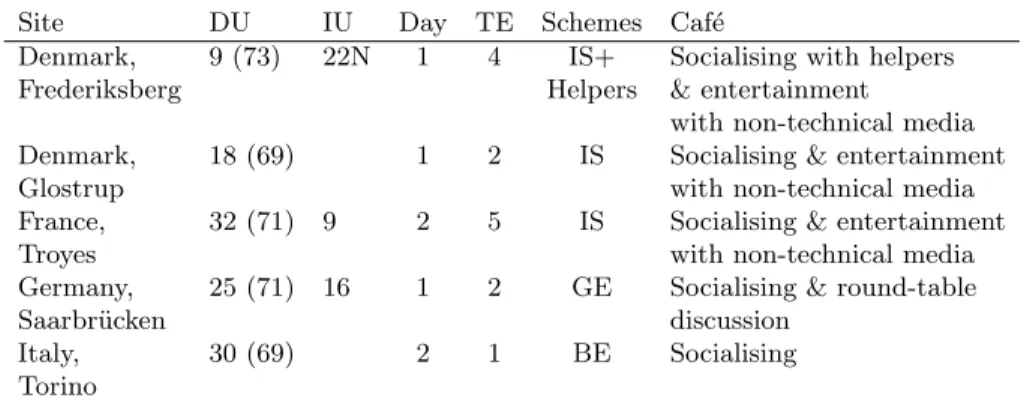
TECs allows for a dialogue between older adults and various stakeholders on a wide range of issues related to science and technology. In addition to older adults themselves, this includes R&D stakeholders, representatives of a broader public participants — such as family members and societal institutions — public health and care services, NGOs or associations of older people, and also enterprises — such as manufacturers, providers, insurers, distribution or marketing companies. The concrete set of stakeholders varied across all five venues, see Table 1. This is due to the fact that each TEC’s effectiveness, in terms of objectives, hinges on the presence of the appropriate set of stakeholders. Particular TEC objectives can be related to presented technologies’ particular stage within the innovation cycle, as well as scientific and/or economic goals of participating stakeholders. The following section contains an overview of the involved stakeholders’ profiles.
Table 1. Overview of the site-specific variations of the TEC-design elements; DU=Direct Users, IU=Indirect Users (median of age), N=Nursing Students, TE=Technology experience stations, IS=Individual Schedule, GE=Group Experience, BE=Blended Experience.
Site DU IU Day TE Schemes Caf´e
Denmark, 9 (73) 22N 1 4 IS+ Socialising with helpers
Frederiksberg Helpers & entertainment
with non-technical media Denmark, 18 (69) 1 2 IS Socialising & entertainment
Glostrup with non-technical media
France, 32 (71) 9 2 5 IS Socialising & entertainment
Troyes with non-technical media
Germany, 25 (71) 16 1 2 GE Socialising & round-table
Saarbr¨ucken discussion
Italy, 30 (69) 2 1 BE Socialising
Torino
Direct Users They were approached according to a definition of the target audience: Senior citizens, age 55/60/65 or older, with no or minor health-related limitations, allowing active and independent participation in the TEC activities. The Danish TEC had a broader target audience including persons with mild health-related limitations requiring support of their caregivers.
Indirect Users Entities benefiting from data provided or actions stimulated by the technology during its usage by the direct user; whose activity consists in helping the direct users in their daily life, partially or totally, within a profes-sional or voluntary activity, such as helpers, relatives, caregivers or
practition-ers. This also includes persons who coordinate and/or fund activities of care and home services, such as local, regional or national authorities, caregiving companies, NGOs, insurers, banks, or charities.
Technology Representatives These are: scientists presenting new tech-nologies in the context of scenarios and collecting opinions aiming at directing scientific endeavours, technology developers presenting prototypic solutions and collecting feedback within the UCD development cycle, providers, manufactur-ers, and marketing agents presenting early-on-the-market products and collecting feedback for designing marketing strategies, and middle-man entities organising TECs on behalf of the above mentioned groups of technology representatives, compare also the paragraph on Technology Experience Stations.
3.2 TEC Design
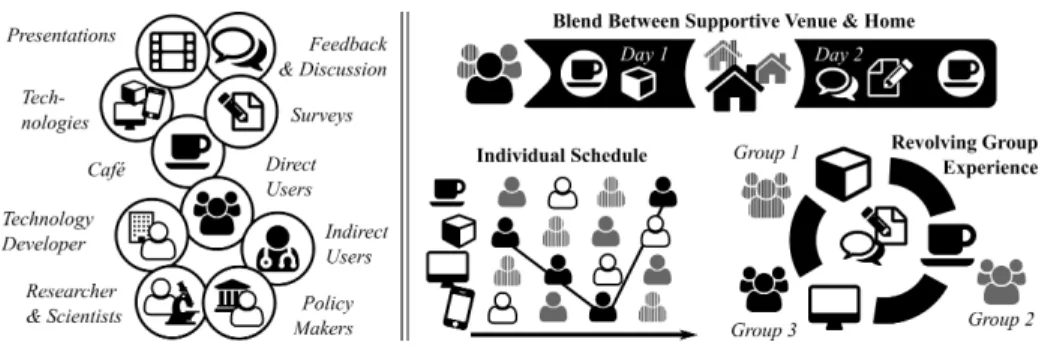
Fig. 1. The left panel presents the variety of activities and stakeholders encompassed by the central component — the caf´e; the right panel presents the three different experience schemes implemented over the fives sites.
Similar to the involved set of stakeholders, each TEC’s design depends on the objectives and the available resources and facilities. Across all five TECs, typical elements included: ii .a) plenaries, ii .b) technology experience stations, ii .c) experience schemes, ii .d ) social spaces — caf´es and ii .e) supporting ser-vices. Beyond that, the TEC events differed in the way these key elements were organised; overall some events were organised on two succeeding days and some were held in one day, compare Table 1.
Plenaries These were held as general meetings, briefing participants on the event, expected outcomes and organisation. Plenaries may include introductory presentations and also other stakeholders’ presentations. They are typically held at the beginning — briefing — and at the end — debriefing — of the event.
Technology Experience Stations One of the main goals of TECs is to provide users with the opportunity to interact with a particular technology, preferably to try it in a realistic scenario and, with the support of qualified
personnel to receive explanations and consultations. Within SIforAGE, all TECs contained more than one technology, providing several stations; time allocated to each station depends on the nature of the technology and the scenario. In general, the pace of acquainting with any new technology has to be taken into consideration. According to the afore-mentioned adaptation for older adults’ individual characteristics, software and hardware adaptations were used during the TECs to accommodate potential age-related declines in perceptual, cognitive, and motor abilities, see Section 2.
The following technologies could be experienced at the five sites: Denmark, Frederiksberg — DukaBOX, InCare, Brain+ & Who am I?; Denmark, Glostrup — El-pris tavlen & E-box; France, Troyes — ARPEGE, Mobile application eval-uation, EELEO, Robot, Social TV; Germany, Saarbr¨ucken — Smartphone In-Door Navigation, Intelligent Speaking Kitchen; Italy, Torino — Torino Facile.
Experience Schemes Ranging from group-experimentation to assisted sin-gle person experimentation, different schemes were implemented. Again, the de-cision upon the experience scheme depends on the technology experience stations and their tasks, the outcome, feedback the technology representatives opt for, as well as the direct users’ abilities and profiles. In the Danish and French TECs, the direct users followed an individual schedule to experience all demonstrated technologies in an Individual Experience set-up together with the respective tech-nology representative. In the Danish TEC in Frederiksberg, the direct users’ profile required additional assistance whereby helpers facilitated the technology experience towards an Individual Assisted Experience; one helper accompanied one direct user during all technology experience stations. In the German TEC, direct users where split into three groups which allowed for a revolving Group Experience Scheme. In this scheme, they stayed within one group and rotated from one technology experience station to the next thereby jointly reflecting on the technologies. The group also spent the break — the caf´e — together. As in the Torino TEC, direct users experienced only one technology, the experience scheme was changed towards a Blended Experience. Hereby the TEC workshop atmosphere was blended with the direct users’ personal life. In the two-day TEC, direct users were given the opportunity to sign up for a platform, self test it in the scaffolded venue environment, receive demonstrations of the systems’ capa-bilities and ask questions. Most importantly, at the end of the first day, there were given a technology-specific task as homework. This private experience with the technology was then discussed in the subsequent session and enriched with dedicated exercises. This blended experience scheme has also proven to be very powerful in mobisaar, a German active healthy ageing project; therefore, this scheme helps to accompany and keep a fixed user base in lasting operational tests of technology demonstrators with Technology Readiness Level (TRL)9 of six or higher [1,15].
Caf´es This constitutes the social aspect in SIforAGE and represents one of the most important features of TECs, being a social place where people meet technology and technology meets people in a casual way. Above all, the caf´e
9
allows people to meet people; by mentioning people, representatives of all dis-cussed stakeholder groups are comprised. To facilitate this social aspect, nice environments, small food, soft drinks, and non-technical entertainment was and should be foreseen. Caf´es also serve a far more practical goal which was especially relevant for the direct users in SIforAGE: Even healthy older adults get tired and distracted faster than younger users which can lead to loss of motivation, as well as biased or even unusable evaluation results. Within this line of thoughts, the caf´e also represents a technology-distant space were users can reflect on their technology experiences amongst themselves or moderated by skilled facilitators; this transforms the caf´e into an additional valuable source for feedback and a tool in the UCD process. Building upon its beneficial effect on older adults’ per-formance, the French TEC provided crosswords in the caf´e section to activate positive stereotypes [14].
Supporting Services Overarching the technology stations, the experience schemes and the caf´e, all TECs provided comprehensive support to all partici-pants on any issue throughout the event. This was organised in the form of a help desk and local supporters at the TEC venue, ensuring that no older participant was left unattended at both the technology stations and inbetween the session, including also the evaluation.
3.3 Evaluation Tools
All TECs comprised two main phases of evaluation: iii .a) the evaluation of the technology during or immediately after experience at the stations and iii .b) the framing evaluation; the French TEC even featured a framing pre-post-test evaluation design. The evaluation of the technology during experience is highly dependent on the technology itself and the goal of its representatives, considering also the respective TRL. Therefore, multiple technology representatives used tailored surveys for their technologies. Conversely, the framing assessment was independent from the technologies and standardised across all five TECs. These dedicated surveys covered the following dimensions: iii .b.1 ) perceived usefulness and perceived ease of use, iii .b.2 ) stereotypes of the elderly in combination with technology, iii .b.3 ) demographic information, iii .b.4 ) previous experience with technology, iii .b.5 ) feedback on the TEC and demographic profiles. Given their conceptual complexity, the first two dimensions stated are shortly introduced.
Technology Acceptance Model (TAM) Introduced in 1986 [7] its basic assumption is: An individual’s behaviour intention to use a system is determined by perceived usefulness, defined as the extent to which a person believes that using the system will enhance their performance, and perceived ease of use, defined as the extent to which a person believes that using the system will be free of effort. TAM-2 marks an extension in terms of social influence and cognitive processes [16] and also comes in a modified version evaluating the acceptance and characteristics of technology for older users, which was used within the SIforAGE TECs [17].
Stereotypic Perceptions This is commonly identified as one of the main barriers to technology use by older adults. Critically, the associated societal
phenomenon of Ageism10has shown to be internalised by older adults themselves
[4]. This effect turns into a barrier when it comes to technology, as the elderly might be convinced that they are too old to learn using computers even before attempting to do so [3]. In order to measure the impact of ageing stereotypes, items measuring stereotype threat, stigma consciousness, stereotype content, in general and specifically related with the use of technology by older people, were included in the questionnaire.
Each TEC contained an upfront available Informed Consent (IC) ensuring ethical issues handling in-line with the EU legislations on private data han-dling. Each IC contained the event’s objectives, activities and procedures users will be involved in, the intended use of the results, the arrangements concern-ing audio/video recordconcern-ing and other issues accordconcern-ing to national regulations or practices.
4
Results
In line with the overall scope of this paper, this section will provide results, from all five conducted TECs, on (1) older adults perception on the TEC as a framework, as well as the TECs’ impact on technology related attitudes and (2) on other stakeholders’ benefits affiliated with their involvement in the TECs.
Table 2. Older adults’ perceptions of the TEC conducted in France (n=22), Germany (n=25), and Italy (n=30); median (range) values ranging from 1=”strongly disagree” to 7=”strongly agree”.
Statement Median (Range)
Italy France Germany The overall TEC experience was pleasant 7 (2) 7 (1) 6 (3) The TEC was conducted in an easy way 7 (2) 7 (2) 6 (5) The quality of the provided instructions was good 7 (3) 7 (1) 6 (3) The chosen technology evaluation methods were adequate 7 (3) 6.5 (2) 6 (4) I learned new ways of interacting with technology 7 (3) 6 (4) 5.5 (6) I learned new things about the tested technologies 7 (3) 7 (3) 6 (5) Participation improved my technology knowledge 6.5 (3) 7 (3) 6 (5) Participation was very useful for me 7 (2) 7 (2) 6 (4)
4.1 Feedback and Impact on Technology Attitudes
Due to organisational issues, the two TECs held in Denmark did not include standardised questionnaires in the post-evaluation, compare section 3.3. There-fore, older adults’ perception, is only reported for France, Italy and Germany;
10
in France, not all direct users filled out the post-experimentation surveys: 22 of 32 participants. Descriptive statistics indicate that the TECs were positively perceived across the three evaluated sites, Italy, France and Germany, compare Table 2.
Qualitative analysis of the post-survey’s open feedback section underlines this result. Respectively, participants across all four countries consistently expressed their positive reception. They enjoyed participating in TEC characterising it as an entertaining and pleasant experience: ”I really liked the event. The pre-sentation was perfect and I really enjoyed my time. Keep it up!” (60 years-old participant, Germany) TECs were also very often described as interesting, infor-mative, and useful for them: ”I appreciated this meeting which interested me a lot.” (90 years-old participant, France) ”It is useful to know how the citizens can benefit from the services and what the difficulties are.” (65 years-old participant, Italy) Others highlighted the importance of involving older users themselves in the innovation process: ”It is nice you are asking people directly.” (63 years-old participant, Denmark) Some were inclined to participate in similar initiatives in the future: ”Interesting! I would like to participate in further studies as well. Thank you for this opportunity!” (67 years-old participant, Germany) However, some participants also expressed difficulties while participating: ”It is difficult to answer precisely some of the questions.” (80 years-old participant, Denmark) The pre-post-test evaluation setup in France allowed for a comparison of direct users’ perceived usefulness, perceived ease of use and perceived stereo-types in combination with technology, before and after the technology experi-mentation. One-tailed t-tests were conducted, showing significant increases on the TAM-2 sub-scales intention to use technologies (T(21) = -1.92, p = .038), perceived usefulness (T(21) = -1.96, p = .064) and self-efficacy (T(21) = -2.05, p = .052), as well as a significant decrease in stigma consciousness (T (21) = -1.90, p = .072).
4.2 Benefits for the Technology Innovation Process
Indirect Users The broad involvement of indirect users in the TECs becomes very evident in the case of Turin: indirect users from multiple organisations (Σ=11) attended, including NGOs (N=1), trade unions (N=1), organisations representing older people (N=3), local authorities and policy makers (N=3), foundations for regional development (N=1) and associated European projects (N=1). Within the scope of the innovation process management, involving local authorities and policy makers, as well as foundations for regional development is especially interesting. In the case of Turin, they stated that their participation was for conceptualising new tools for decision-makers responsible for the defi-nition and implementation of municipal policies for the older people. They also explicitly aimed at developing new models of collaboration, knowledge transfer and projects clustering, in order to align the region as a hub of technology and innovation.
As a result of the German TEC, the research institution DFKI gained new in-sights from the round-table discussions, setting of an innovation project funded
by the German Federal Ministry of Education and Research (BMBF) – Di-DiER11. Similarly the Portuguese research institution ISCTE-IUL used the lessons
learned from the TECs to successfully include the topic Positive Role Models and Facilitators for Older Adults’ Use of Technology into their nationally funded re-search roadmap.
Technology Providers Across the five TECs, the presented technologies (Σ=14) can be categorised as follows: scientific tools (N=1), prototypes under development (N=4) and early-on-the-market products (N=9). When subscrib-ing to the event, technology providers had to state their expected outcome. Revealing that the main reasons for participating were indeed to receive feed-back from direct users and collect requirements for new products (N=5), to test or benchmark close-to-market products with target users (N=3), to use the TEC as dissemination and marketing platform (N=4), and to network with important stakeholders and policy makers (N=2).
5
Discussion and Conclusion
This paper set out to present the Technology Experience Caf´e, a tool aiming at involving older adults in the innovation process in a systemic way. Concretely, the TEC framework is presented as a tool for the technology innovation process that is (1) geared towards the specificities of involving older adults in this in-novation process and (2) effectively involve all stakeholders through a systemic approach. The preliminary results show that, across four countries in five TECs, (1) older adults, direct users, positively perceived the TECs and in one site evi-dentially changed their attitude towards technology after participation and (2) a broad variety of stakeholders were effectively involved, ranging from technology providers to policy makers.
Positive Perception and Change in Attitude The post-TEC survey results of three out of four sites illustrate well that the TEC framework was perceived throughout positively. The descriptive statistics are also reflected in the comments and feedback. Most promisingly, the TEC in France demonstrates how the proposed format can significantly affect older adult attitudes towards innovative technology. The 22 direct users significantly changed their attitudes towards innovative technology after participating in the TEC, reporting a higher intention to use technology in every day life, perceiving innovative technology as more useful, feeling more self-efficient when using technology and thereby also lowering the consciousness of technology related stigma according to their age. Especially the latter shows how tools like TECs can positively influence a phenomenon like ageism, by changing internalised beliefs in older adults and thereby shaping also their societal perception [4].
Innovation Process Management and Social Impact Assessment Ac-cording to the SIAMPI project [5], which aims at narrowing the gap between technology research and social impact, so called Productive Interactions are a
11
powerful indicator for innovation’s social impact; ”exchanges between researchers and stakeholders in which knowledge is produced and valued that is both scien-tifically robust and socially relevant.” [13, p. 212] Within this scope, TECs can clearly be classified as productive interactions which are a blend of direct interac-tions — aiming at behavioural change through direct contact between users and other stakeholders — and indirect interactions — aiming at technology uptake and dissemination through exhibitions, demonstrators and other media. Tech-nology providers from the private sector attending the TECs stated explicitly that they aimed at retrieving requirements and feedback through face-to-face interaction with target users, as well as using the venue for marketing and dis-semination. From a broader perspective, the participation of local authorities and policy makers serves even more directly as evidence for the capabilities of the TEC framework in the sense of strategic innovation process management.
Conclusion The presented framework called Technology Experience Caf´e, very promisingly, answers the growing need for tools for the technology innova-tion process that are (1) geared towards the specificities of involving older adults in this innovation process and (2) effectively involve all stakeholders through a systemic approach. Results have shown, that TECs can be a powerful tool to address the serious societal challenge, imposed on the process of technology in-novation management. By involving older adults in this process during all stages and rendering technology innovation as part of a system of different, very hetero-geneous stakeholders, TECs can play an important role in the arena of technol-ogy driven innovation for active healthy ageing in a demographically changing society.
Future Work Though very promising, the here reported work has some limitations. The fact that methodology and especially evaluation tools were not consistent over all five TECs represents a major flaw in terms of the results’ generalisability; mainly regarding positive perception and change in attitude of direct users. The fact that experience schemes differed across all TECs can be also seen as a methodological weakness, but on the other hand provides a variety of very practically oriented scenarios and best practices. Nevertheless, in order to better accomplish the goal of evaluating the impact of technology on market, as well as society, more effort has to be spent on incorporating tools for social impact assessment within the TECs themselves but also, more importantly, in their follow-up.
Acknowledgements The underlying research is partly funded by the SIforAGE and the mobisaar project. SIforAGE is a Seventh Framework Programme collab-orative project funded by the European Commission, grant agreement number: 321482. mobisaar is an InnovaKomm framework project funded by the German BMBF under the support code 16SV7431.
References
1. Alexandersson, J., Banz, D., Bieber, D., Britz, J., Rekrut, M., Schwarz, K., Spanachi, F., Thoma, M., Tr¨oger, J.: Oil in the machine: Technical support for
a human-centred service system for public transport. In: Ambient Assisted Living, pp. 157–167. Springer (2015)
2. Blaˇzun, H., Saranto, K., Rissanen, S.: Impact of computer training courses on reduction of loneliness of older people in finland and slovenia. Computers in Human Behavior 28(4), 1202–1212 (2012)
3. Broady, T., Chan, A., Caputi, P.: Comparison of older and younger adults’ atti-tudes towards and abilities with computers: Implications for training and learning. British Journal of Educational Technology 41(3), 473–485 (2010)
4. Chaffin, A.J., Harlow, S.D.: Cognitive learning applied to older adult learners and technology. Educational Gerontology 31(4), 301–329 (2005)
5. Commission, E.: Social impact assessment methods for research and funding instru-ments through the study of productive interactions between science and society. http://www.siampi.eu/ (2012), accessed: 2016-12-14
6. Czaja, S.J., Charness, N., Fisk, A.D., Hertzog, C., Nair, S.N., Rogers, W.A., Sharit, J.: Factors predicting the use of technology: findings from the center for research and education on aging and technology enhancement (create). Psychology and aging 21(2), 333–352 (2006)
7. Davis Jr, F.D.: A technology acceptance model for empirically testing new end-user information systems: Theory and results. Ph.D. thesis, Massachusetts Institute of Technology (1986)
8. Gramß, D., Struve, D.: Instructional videos for supporting older adults who use interactive systems. Educational Gerontology 35(2), 164–176 (2009)
9. Lee, C., Coughlin, J.F.: Perspective: older adults’ adoption of technology: an in-tegrated approach to identifying determinants and barriers. Journal of Product Innovation Management 32(5), 747–759 (2015)
10. Ortt, J.R., Smits, R.: Innovation management: different approaches to cope with the same trends. International journal of technology management 34(3-4), 296–318 (2006)
11. Rogers, W.A., Stronge, A.J., Fisk, A.D.: Technology and aging. Reviews of human factors and ergonomics 1(1), 130–171 (2005)
12. Soar, J.: The potential of information and communication technologies to sup-port ageing and independent living. annals of telecommunications - annales des t´el´ecommunications 65(9), 479–483 (2010)
13. Spaapen, J., Van Drooge, L.: Introducing ’productive interactions’ in social impact assessment. Research Evaluation 20(3), 211–218 (2011)
14. Swift, H.J., Abrams, D., Marques, S.: Threat or boost? social comparison affects older people’s performance differently depending on task domain. The Journals of Gerontology Series B: Psychological Sciences and Social Sciences 68(1), 23–30 (2013)
15. Tr¨oger, J., Alexandersson, J., Britz, J., Rekrut, M., Bieber, D., Schwarz, K.: Board games and regulars’ tables – extending user centred design in the mobia project. In: International Conference on Human Aspects of IT for the Aged Population. pp. 129–140. Springer (2016)
16. Venkatesh, V., Davis, F.D.: A theoretical extension of the technology acceptance model: Four longitudinal field studies. Management Science 46(2), 186–204 (2000) 17. Wong, A.M., Chang, W.H., Ke, P.C., Huang, C.K., Tsai, T.H., Chang, H.T., Shieh, W.Y., Chan, H.L., Chen, C.K., Pei, Y.C.: Technology acceptance for an intelligent comprehensive interactive care (icic) system for care of the elderly: A survey-questionnaire study. PloS ONE 7(8), 1–7 (2012)