ISSN: 1646-8929
IETWorking PapersSeries No. WPS010/2010
Agn Paliokait (email: [email protected])
Networking as a Route for Corporate Foresight in SMEs
IET
Research Centre on Enterprise and Work Innovation Centro de Investigação em Inovação Empresarial e do Trabalho
Faculdade de Ciências e Tecnologia Universidade Nova de Lisboa
2
Agn Paliokait
NETWORKING AS A ROUTE FOR CORPORATE
FORESIGHT IN SMES
1Working paper
Monte de Caparica, 2010
1
Paper presented at the 1st Winter School of PhD Programme on Technology Assessment on the December 6th and 7th, 2010, at the Universidade Nova de Lisboa campus of Caparica (Portugal). A final version was developed for the unit “Project III” of the same PhD programme on
3
Table of Contents
Table of Contents ... 3
Abstract ... 4
1.The Concept of Corporate Foresight and relevance for Lithuanian SMEs ... 5
Corporate Foresight in SMEs ... 9
Relevance to Lithuanian SMEs ... 12
2. Routes for enhancing corporate foresight in SMEs ... 15
2.1. Route 1: Formalised Structure of Corporate Foresight ... 16
2.2. Route 2: Culture ... 18
2.3. Route 3: Networks ... 19
Benefits associated with SME networks ... 19
Granovetter’s weak tie theory ... 22
Hypotheses ... 23
2.4. Value associated with Corporate Foresight ... 24
3. Discussion and conclusions ... 25
4
Abstract
Purpose. In this paper, I argue that corporate foresight can play the important role not
only for large multinational companies, but also for small and medium sized enterprises (SMEs). Rohrbeck et al (2010) proposed that effective corporate foresight can be organized without a process model but with certain capabilities and activities. In this paper it is hypothesized that the latter approach could be suitable for SMEs. Furthermore, it is hypothesized that organizational future orientation of an SME can be also enhanced by engaging in networks with other stakeholders. Therefore, the paper aims to explore the different routes to enhance corporate foresight capabilities in SMEs. The fundamental research question addressed in this paper is: what are the key corporate foresight capabilities and how can these capabilities be built in small and medium sized enterprises (SMEs) to enhance strategic thinking and future orientation in these companies? More specific objectives are:
(1) To establish what the key capabilities within the corporate foresight practices are; (2) To establish what kind of value contributions can be expected from corporate
foresight;
(3) Based on research results, to propose a benchmarking framework of CF capabilities with a distinction between different routes SMEs can take for achieving higher value associated with CF.
(4) To propose how the variables in the networking route could be measured.
The analysis in this paper is comprised of three main parts. The first part is to formally establish the need for corporate foresight capabilities in the Lithuanian high technology SMEs. The second part, which is the crux of this paper, is to propose the benchmarking framework for corporate foresight in SMEs, following three different routes: structural approach, cultural approach, networking approach. The third part provides conclusions and discussion.
Keywords: Corporate foresight, networking, SMEs, weak signals, weak tie networks,
strong tie networks, Lithuania.
5
1.
The Concept of Corporate Foresight and
relevance for Lithuanian SMEs
Corporate foresight has its roots in the futures research discipline. The term “future research” is used as a term to describe the whole range of research conducted to help organizations, individuals, and governments explore, prepare for, and respond to changes in the environment. Many scholars have aimed to differentiate terms used in this broad field (e.g., Van Duin, 2008; Rohrbeck, 2010). Due to the cross-functional character of corporate foresight in a corporate context, the research on it has typically been followed by scholars from different research disciplines, including strategic management, technology management, and innovation management. Several scholars define foresight as an ability, while others define it as a process, which allows identifying future developments in science, technology, economy, and society systematically before these developments become trends; it involves methods and techniques to gather, assess, and interpret relevant information and to support decision-making (Coates, 1985; Martin, 1995; Cuhls, 2003; Porter, et al. 2004, Reger 2001). In this paper I follow the understanding of corporate foresight as ability, without a particular emphasis on processes or other structural elements of a foresight system: Corporate Foresight (CF) is an ability that includes any structural or cultural element that enables the company to detect discontinuous change early, interpret the consequences for the company and formulate effective responses, while at the same maintaining a high-quality, coherent and functional forward view. Overall, the assumption of corporate foresight is that earlier detection of external changes will allow the company to create a temporal competitive advantage (Tsoukas and Shepherd, 2004) and increase overall competitiveness (Lackman et al., 2000).
Evolution of concept
While the argument about general ignorance towards radical changes is much older, Igor Ansoff was the first to observe the inherent ignorance of companies towards changes in the environment, resulting in a frequent missing of opportunities and threats. Such changes can be identified and anticipated by scanning for so-called weak signals
6
Equally important was the notion of discontinuities that was introduced by Ansoff and later developed further by Christensen under the term of disruption (Ansoff, 1980). Discontinuities are characterised as major shifts that can become threats or opportunities depending on the perspective and on the reaction by management. The original research stream founded by Ansoff by the name of strategic issue management was followed up under the name of environmental scanning (Ansoff, 1980). It can be concluded that the research stream on environmental scanning has produced the foundation for corporate foresight by developing the concept of weak signals and identifying the environment as the source of future-oriented information. A recent study by Danneels showed that environmental scanning positively influences the ability of a firm to build new competencies (Danneels, 2008) thus building the basis for considering environmental scanning vital to managing discontinuous change. Empirical evidence was collected that indicates that high-performing companies scan more frequently, use a larger variety of information sources, and tailor their scanning systems to fit the context of the company (Daft et al., 1988, Yasai-Ardekani and Nystrom, 1996).
A further development was made with the integration of the discussion on how organizations create sense from gathered information (Daft & Weick, 1984) and how they use weak signals as a basis for decision making. In the 70s a parallel research stream was developed under the term of forecasting. It explored new methods for using past data to predict future directions of change (Godet, 1979; Wilson, 1973). This research was further driven by the emergence of national (macro level) foresight programs aimed at advising policy makers on which technology to invest in (Blind et al., 1999). The terms future studies or future research have been used in a broader sense for any research aimed at identifying ways to make sense of or predict future directions (Gordon et al., 2005; Slaughter, 1998). The investigation of the future from a company (micro level) perspective was further developed under the term of strategic foresight and also sometimes referred to as corporate foresight (Becker, 2002; Ruff, 2006).
A large set of future-oriented techniques and methods have been developed and applied: roadmaps and scenarios are by far the most popular ones. But there are many others, e.g., Delphi, relevance trees, cross impact analysis, simulation modelling and systems dynamics, and game theory. The latest concept of Organizational Future Orientation (OFO) introduced by Rohrbeck in 2010 integrates both research on foresight methods and research on corporate foresight as a process (implying that there is a corporate foresight function, possibly also a corporate foresight unit). Moreover, according to Rohrbeck (2010) ability of organizational future orientation can be build upon a corporate foresight unit, that utilizes foresight methods, but also including the possibility that a firm builds its future orientation upon other means, such as encouraging all employees to look for external change and empowering them to respond to this change with individual initiative, possibly through corporate venturing schemes.
7
company’s own innovation capacity, so did the future research activities. In the 50s up to the 80s future research aimed particularly at forecasting future developments by using s-curves, mathematical modelling, and Delphi studies. In the 1990s, the limitations of forecasting became apparent, and future research moved away from attempting to predict the future toward identifying possible, probable, plausible, and preferable futures (Rohrbeck, 2010).
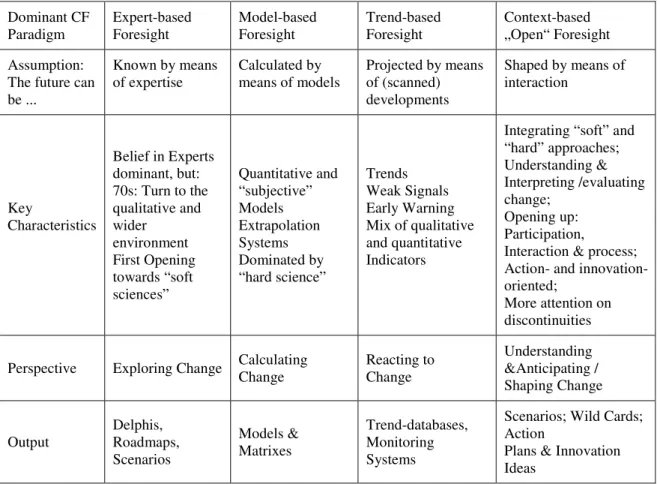
Contemporary research on corporate foresight claims that corporate foresight is represented by four different modes (Daheim and Uertz, 2008): (1) the expert-based foresight emphasizes knowability by expertise; (2) model-based foresight that aims at calculating change by using quantitative and “subjective” models and matrices; (3) trend-based foresight aims to react to change and emphasizes projectability by development; its main characteristics are trends, weak signals, early warnings, development of trend-databases and monitoring systems. Scholars claim that nowadays the latter is a predominant mode of foresight activities at corporate level (Daheim and Uertz, 2008). The fourth stream views organizational foresight as the interaction between the way people simultaneously construe and are constrained by the temporal structures that are both enacted and changed through practice (Cunha, 2004). This rather pro-active (“shape the future”) than reactive approach that relates to the concept of “open” (“collaborative”, “participatory”) foresight is named to be the next generation of corporate foresight (Daheim and Uertz, 2008), see Table 1.
Table 1. Development of approaches to corporate foresight
Dominant CF Paradigm Expert-based Foresight Model-based Foresight Trend-based Foresight Context-based „Open“ Foresight Assumption:
The future can be ...
Known by means of expertise
Calculated by means of models
Projected by means of (scanned) developments
Shaped by means of interaction
Key
Characteristics
Belief in Experts dominant, but: 70s: Turn to the qualitative and wider environment First Opening towards “soft sciences” Quantitative and “subjective” Models Extrapolation Systems Dominated by “hard science” Trends Weak Signals Early Warning Mix of qualitative and quantitative Indicators
Integrating “soft” and “hard” approaches; Understanding & Interpreting /evaluating change; Opening up: Participation,
Interaction & process; Action- and innovation-oriented;
More attention on discontinuities
Perspective Exploring Change Calculating Change Reacting to Change Understanding &Anticipating / Shaping Change Output Delphis, Roadmaps, Scenarios Models & Matrixes Trend-databases, Monitoring Systems
Scenarios; Wild Cards; Action
Plans & Innovation Ideas
8
Corporate Foresight is an emerging research field with growing activities among the scientific community. At least 15 major journal exist which frequently publish articles related to CF; there are at least 10 highly relevant conferences related to CF held regularly. However, more than half of the identified journal articles are written from a macro perspective. Even though there has been significant interest in corporate foresight activities, few empirical studies address this phenomenon. Another major shortcoming in the existing body of knowledge is that empirical research on corporate foresight has been mostly carried out in large companies that have higher probability of having institutionalized corporate foresight processes. Studies sheding light on the actual performance of foresight for and in European business were produced by Reger (2001), Müller (2006), Van der Duin (2006), Schwarz (2006), Daheim and Uertz (2006, 2008) and Rohrbeck (2007, 2009, 2010). Small and medium sized enterprises (SMEs) are “a white spot in corporate foresight research” (Jannek & Burmeister, 2008). The foresight needs and activities of SMEs have stayed below the radar, even though the value of SMEs’ contribution to employment, value creation, and innovation is well recognized. Looking at above-mentioned factors illustrates the dilemma: small and medium sized enterprises are not familiar with this crucial field of business strategy.
For this paper, the analysis of past literature on corporate foresight provides some important insights:
(1) Firstly, there is a trend toward more collaborative approach in corporate foresight at micro level. Corporate foresight research has adopted the paradigm that participation is crucial to the usage of the foresight insights. In order to ensure the success of foresight activities, experts, decision makers and other stakeholders need to be integrated into the process (Barker and Smith, 1995; Rohrbeck, 2010, Daheim and Uertz, 2008). In addition, it has been argued that the dominant logic in organizations hinders the acknowledgement of change and hinders acceptance of alternative development paths. The task, therefore, of corporate foresight would be to create doubt about basic assumptions in the firm by running participatory foresight exercises (Blackman and Henderson, 2004). Additional benefits of using participatory methods to explore possible futures arise from the process itself. It has been shown that the process of scenario planning can play the role of strategic conversation and enhance organizational learning (Chermack et al., 2006; Rohrbeck, 2010).
(2) Secondly, evidence demonstrates that there is not necessarily a specific corporate foresight department or unit in the corporate landscape (Becker, 2002; Daheim and Uertz, 2008; Rohrbeck, 2010). Rohrbeck et al (2010) proposes that effective corporate foresight can also be organized without a process model but with certain capabilities and activities. In the research carried out by Rohrbeck (2010), it was proved by one of the case studies at an US-based multinational energy systems manufacturer in Europe (further on referred to as „Enerco“). In this research it is hypothesized that the latter approach could be suitable for SMEs willing to enhance their organizational future orientation.
9
to move closer to theory development, a common framework with its constituting elements is needed. Such a framework can be an important step for developing testable constructs and hypotheses and thus can lead the transition to deductive research. Rohrbeck (2010) proposed a maturity model that allows assessing the strength of the future orientation of an organisation and includes criteria to measure the ability of horizon scanning systems to trigger actions. According to the research by Rohrbeck et al (2007, 2010) successful corporate foresight – and hence making use of the gained insights from foresight – depends on capabilities such as culture (e.g. willingness to share), organization (e.g. integration of foresight activities within processes of innovation management or strategic management), method sophistication, information usage (e.g. sources and scope), and people & networks (especially the internal communication and the use of internal and external networks). Study by Rohrbeck and the maturity model provides valuable insights. However, the study is based on case studies and survey that explored corporate foresight practices in large companies. How SMEs could benefit from these practices remains a conundrum.
Corporate Foresight in SMEs
To define a small and medium sized enterprise, a definition of SME by the European Commission is applied in this paper: “The category of micro, small and medium-sized enterprises (SMEs) is made up of enterprises which employ fewer than 250 persons and which have an annual turnover not exceeding 50 million euro, and/or an annual balance sheet total not exceeding 43 million euro” (Extract of Article 2 of the Annex of Recommendation 2003/361/EC). According to the new definition, the self-employed, family firms, partnerships and associations regularly engaged in an economic activity may be considered as enterprises. Small enterprises are defined as enterprises which employ fewer than 50 persons and whose annual turnover or annual balance sheet total does not exceed 10 million euro. Micro enterprises are defined as enterprises which employ fewer than 10 persons and whose annual turnover or annual balance sheet total does not exceed 2 million euro.
10
and monitor their environments continuously in order to maintain their competitiveness and being able to develop new promising technologies and use them to move into new business fields. Chances can also arise out of discontinuities if an enterprise is able to identify them and react faster than its competitors. According to Rohrbeck (2010), a need to build corporate foresight abilities might come from:
(a) a certain nature of the corporate or innovation strategy, for example aiming to be "aggressively growth oriented"; or pursuing an innovation leader strategy;
(b) a high complexity of the environment; a particularly volatile environment; speed of change of market (Rohrbeck, 2010; Rollwagen, Hofmann, & Schneider, 2008). (c) In addition, it is worth mentioning that the primary goal of corporate foresight is
producing a long-term strategic vision, ideas for product innovations or a scenario for communication purposes. Therefore, the need is high in industries with a focus on long-term orientation – in industries characterised by long product cycles and high development costs, such as the chemical and automotive industry, which have to constantly monitor and react to the innovation activities of their competitors.
These drivers seem to be applicable to both large and small companies. The study by Daheim and Uertz (2006) proves that since SMEs operate in highly competitive and dynamic markets, it is assumed that their foresight requirements are substantial. New trends in the world economy put higher pressure for SMEs to engage in foresight activities, especially due to the globalization. Large companies have new possibilities, new markets, and more freedom to do business. Liberalisation is leading to the more intensive flow of capital and large corporations make use of new conditions; they are creating regional and local networks of cooperating companies, mainly small and medium sized ones. Networks are created by suppliers, who are providing to large corporations flexibility in the accommodation to the regional demand. Large multinational corporations are bringing into the relation with SME´s new quality standards. For small and medium sized companies it means higher pressure to fulfil expectations of large multinational corporations (MNC) and the driving force for them is to penetrate to networks with new innovative products and services, which could be achieved by technology innovation, management innovation. The more a small and medium sized company is willing to change, the more it depends on foresight knowledge to provide security for investment decisions.
Dasheim and Uertz in their study also proved that SMEs do carry out certain foresight activities and have certain corporate foresight capabilities:
- 85% of the surveyed German SMEs regularly monitored developments in their markets and industries;
- 29% frequently and 61% sometimes scanned markets and industries they were not competing in for new developments;
- 74% of the SMEs surveyed regularly monitored issues, trends and new technologies considered relevant for their business (sometimes: 26%);
- additionally, 30% often scanned their environments for new issues, trends and technologies whose relevance cannot yet be assessed (sometimes: 60%) (Jannek and Burmeister, 2007).
11
sometimes: 51%); (b) desk research, e.g. internet and media analysis (regularly: 40%, sometimes: 47%), and (c) expert interviews (regularly: 32%, sometimes: 54%). These methods are not only used most often but also considered the most important ones. In contrast, more complex foresight methods, for instance expert Delphi surveys and the scenario-method are less relevant and in some cases even unknown (Jannek & Burmeister, 2007). Foresight processes in SMEs, according to Jannek & Burmeister (2007), were mostly carried out by top management, and also individual employees. In many cases, the sales department and individual clients were also involved. Foresight was mainly used for strategic planning and to identify new innovation fields. The same study (the only study carried out about corporate foresight in SMEs) indicated that problems related to CF occurred when foresight knowledge has to be transformed into practical knowledge and ideas for new products and strategies. This transfer as well as budget and manpower constraints are also bottlenecks for the implementation of a more complex foresight approach. Due to the complexity foresight studies require substantial source of financial means, which cannot be covered by SME´s themselves. Jannek & Burmeister (2007) propose that SME executives have to broaden their foresight horizons and draw on more elaborate foresight methods better suited to their needs. For the highly dynamic markets and business environments they operate in, trend analysis, roadmapping and scenarios to explore alternative futures could be more appropriate. Additionally, simulation techniques may be useful in SME business contexts strongly driven by third parties (e.g. clients, competitors, policymakers). Foresight training courses in these more elaborate methods are also essential. In addition, Corporate Foresight is one option to extend the scope of SMEs. Even though most SMEs are B2B suppliers, end consumers and social changes may have a considerable impact on their business. SME managers should therefore revaluate the importance of this sphere.
The research results outlined are only a first step in the exploration of SMEs’ foresight needs and activities. Past research provides these important insights:
(1) First of all, requirements for corporate foresight activities are substantial in SMEs, however these needs are so far underestimated in the foresight community. For a deeper understanding, benchmarking frameworks of corporate foresight activities and capabilities in SMEs could be developed, and SMEs with best practice CF activities identified. Therefore, the research community would do well to realize the specific needs and capabilities required at SMEs, and the constraints they are confronted with.
12
hypothesized in this research that networking could be a way forward for corporate foresight in SMEs.
Relevance to Lithuanian SMEs
SMEs had played a pivotal role in Lithuanian economy. Comparing with other Baltic States, Lithuanian companies grew mach faster and go beyond the average productivity growth of Central European countries focusing more on entering new markets. The role of SMEs has become even more important in the period of economic crisis, as small business is more flexible to admit market changes. Still, it is a discussion point in terms of economic slump as large enterprises clearly have the advantage of mass production in capital-intensive processes and high volume products, but smaller enterprises have an advantage in niche markets and geographically restricted markets (Bernatonyte, Vilke, & Volochovic, 2009). Furthermore, with increasing economic growth, rising standards of living and increasing factor costs, many traditional Lithuanian manufacturing companies face the risk of failure. While many larger companies are capable of producing high quality goods requiring appropriate technologies and have even begun to transfer a portion of their manufacturing to other geographically close, lower-cost countries (Russia, Belarus, the Ukraine), many small and medium sized enterprises (SMEs) are still in a state of uncertainty (Mockaitis, 2006). SMEs are inherently constrained by their capacity to grow and they usually face much stronger business challenges relative to their large counterparts. More importantly, and this is particularly important in the globalisation era, is the challenge of an increase in the threat of survival that comes from much tougher competition among firms in a globalised business environment (Harvie, 2010).
There are approximately 37 SMEs per 1000 inhabitants in Lithuania, which is slightly
13
Table 2. Structure of SMEs in Lithuania and EU-27
Number of enterprises Number of persons employed Value added (billion EUR)
Value % EU-27 Value % EU-27 Value % EU-27
Micro 113,840 88,4 91,8 217,485 22,8 29,7 2 11,6 21,0
Small 12, 021 9,3 6,9 241,469 25,3 20,7 3 23,2 18,9
Medium 2,613 2,0 1,1 252,582 26,5 17,0 4 29,2 18,0
SMEs 128,474 99,7 99,8 711,536 74,6 67,4 9 64,0 57,9
Large 347 0,3 0,2 242,271 25,4 32,6 5 36,0 42,1
Total 128,821 100.0 100.0 953,807 100.0 100.0 13 100.0 100.0
Data refer to the non-financial business economy (NACE C-I, K) and represent estimates for 2008. The estimates have been developed by EIM Business and Policy Research, based on 2006 Eurostat Structural Business Statistics figures2.
Figure 1. Numbers of SMEs in Lithuania and EU-27
2
14
Figure 2. Employment in SMEs in Lithuania and EU-27
The contribution of Lithuanian SMEs exceeds that of their EU peers, driven by the small and medium segments. Value added of SMEs grew with 151 %, which is more than five times faster than the EU average growth of 28 % during the period between 2002 and 2008.
Figure 3. Value added created by SMEs in Lithuania and EU-27
15
Overall, it may be concluded that the importance of the SME sector in the Lithuanian economy is very high and still increasing. Share of GDP created by SMEs increased by 18,7% in 2002-2008 up to the 81,3%, while value added created by SMEs as compared to the total value added increased by 7,1% up to 64,1% in 2009. According to the results of multifactor regressive analysis forecast for 2010 by Bartkus et.al (2010), the share of GDP produced by small and medium sized companies, despite the effects of financial and economic crisis, will be increasing, up to 79,66% (Bartkus, 2010). Over the long run, underlying structural determinants of the earlier growth trend in the number of enterprises in the EU, including the Internet revolution, the growth of the services sector and institutional developments favouring self-employment, are expected to remain relevant in the coming years. When economic growth seriously picks up again, the number of SMEs is expected to resume its upward development (European Commission, 2009).
2. Routes for enhancing corporate foresight in SMEs
The following analysis provides propositions for the conceptual framework for benchmarking corporate foresight capabilities in SMEs. In the past, corporate foresight research was often based on processes and fixed structures. It was assumed that specialized units within the organization collect data by using specific methods like scenario analyses and roadmapping. Then recommendations for following processes (e.g. innovation management, strategy process) were derived from analyzed collected data. In his cross-case analysis, Rohrbeck (2010) identified two directions for building high corporate foresight ability:
(1) The structured approach, in which corporate foresight is a task that is executed according to a process by dedicated units and in which the response to discontinuous change is achieved by linking the foresight process to other corporate functions through follow-up processes. The structural approach is composed of the dimensions on information usage, method sophistication, people, and elements of organizational capabilities (Rohrbeck, 2010).
(2) The cultural approach builds on involving a much larger proportion of employees and making them accountable for detecting and responding to weak signals on discontinuous change. The organizational reaction is not triggered by dedicated foresight and follow-up processes but through traditional processes such as new business development processes and corporate entrepreneurships, in which individual employees are motivated to take the initiative to explore new business fields (Rohrbeck, 2010).
16
SMEs can overcome their budget-related difficulties in clustering and engaging in meso level foresight initiatives.
Figure 1. Hypothesised approaches (routes) to corporate foresight in SMEs
Route 3: Networks Route 2: Culture
Route 1: Structure
E lements of networks:
1. Strong tie networks: suppliers, partners, clients
2. Weak tie networks: associations,
universities
3. Intermediar y sources: brochures, TV, etc. 4. Geo graphical scope El ements of culture:
1. Willingness to share accross functions. 2. Readiness to listen to scouts and ext ernal sources. 3. Opennesss of
organization.
4. Informal diffusion of insights.
5. Wilingness to test and challenge basic
assumptions. 6. Incentives.
En ci ronment Scanni ng:
1. Scope. 2.Reach. 3.Time horizon. 4.Sources.
Method sop histication:
5.Int egrat ion capacity. 6.Communication capacity.7. Fit with problem and cont ext.
Usage and commun ication:
8.Mode. 9.Integration with other processes. 10.Formal diffusion of insi ghts. 11.Accountability. 12.Top Management Invol vement.
If corporate foresight abilities can be built with either cultural, structural or networking elements, then the overall corporate foresight ability of a firm can be represented in a diagram with three axes: the culture axis, on which all elements of the cultural approach are scored, the structure axes, on which all elements of the structural approach are scored, and the networking axes. Combining the three axes creates a corporate foresight ability index with three dimensions. In practice, companies using either of the dominant approaches may still benefit from the elements of the other dimensions.
2.1. Route 1: Formalised Structure of Corporate Foresight
The characteristics of this route refer to the operational in-house capabilities of corporate foresight – a formalised process installed in a company. Following this route means that the company has the capacity to carry out environmental scanning and interpretation using the common methods of corporate foresight in-house. Previous empirical research related to this route was completed only for large companies by Reger (2001), Müller (2006), Van der Duin (2006), Schwarz (2006), Daheim and Uertz (2006, 2008) and Rohrbeck (2007, 2009, 2010). The clusters of characteristics in this route would include:
17
(1) Mode, scope, depth and reach of environmental scanning - the dimension that has been studied most frequently by corporate foresight researchers. It describes the kind of information that is gathered and fed into a corporate foresight process. Becker has assessed the scope, time horizon and sources in his study of 18 interviews with European multinational companies. Before him Jain assessed scope and usage of information in a survey of Fortune 500 companies. Rohrbeck (2010) also added reach that describes the depth to which companies scan their environment. Depth can be described by differentiating between current business, adjacent businesses, and white spaces. White spaces are areas that currently seem to have no relevance to the company but which could breed disruptive changes which are difficult to perceive and prepare for.
(2) Method sophistication would describe ability to systematically interpret information using methods associated with corporate foresight. Past research was focused primarily on establishing knowledge about method usage (Jain, 1984) and giving recommendations to managers on which method to choose and in which context (Lichtenthaler, 2005; Porter et al., 2004). Other scholars work on enhancing individual methods, such as: (a) the scenario technique (Chermack, 2005; Mietzner and Reger, 2005; Van der Heijden, 2005); (b) Delphi technique (Ament, 1970; Ono and Wedemeyer, 1994; Rowe and Wright, 1999; Rowe et al., 2005); (c) Cross-impact analysis (Gordon and Hayward, 1968; Weimer-Jehle, 2006); (d) Backcasting (Quist and Vergragt, 2006); (e) Gaming (Helmer, 1972; Watman, 2003; Oriesek and Friedrich, 2003; Schwarz, 2009). In his study Rohrbeck (2010) aims to find measures that capture the capability of the overall method portfolio.
18
It can be expected that institutionalisation of foresight approaches is resourceful, hence the preliminary hypothesis is formulated that:
Hypothesis 1: Larger companies tend to have higher institutionalisation of foresight
capabilities in-house.
As well, the context characteristics of a company can be related to the usage of institutionalisation of foresight in-house:
Hypothesis 2: The more dynamic the internal and external environment of the
company, the more dynamic its view on strategy, and the more it will use advanced methods of futures research in its strategy process.
On the other hand, theoretical approaches that recommend a sophisticated formal process are perceived not to work. A standardized approach implies difficulties in detecting disruptive changes, as the instrument does not know what to look for. The human component is most important when dealing with early awareness. It is essential to use structured communication processes and networking activities (Steger 2006).
Hypothesis 3: The more developed are information usage and communication capacity
characteristics, the higher value achieved.
2.2. Route 2: Culture
19
Overall, the dimension “culture” can be seen as an important enabler for corporate foresight systems as well as to some extent a substitute for formal processes. For example, it can be argued that if a company manages to encourage (through cultural means) its employees to be open to external information and to diffuse it effectively throughout the company, then it can be expected that this will support strongly its ability to retain a competitive advantage in times of discontinuous change.
Hypothesis 4: The more developed are the cultural characteristics, the higher the value
characteristics associated with foresight.
2.3. Route 3: Networks
Networking as a route for corporate foresight in Lithuanian SMEs is a focal point of this paper. Hence, it is elaborated in more detail in this paper. Considering the great need for effective and efficient communication in a corporate foresight system, it can be expected that there is a need for strong internal and external networks.
Networks are often described as nodes and branches where the enterprises form the nodes and the relationships between the enterprises form the branches. Small and medium-sized enterprises, because of their limited resources, use a variety of sources and are linked to different networks to obtain the information they need to develop their strategy and then to gradually organize their environment. Among other things, networks keep them up-to-date with changes in the economy and allow them to take advantage of opportunities to innovate, thus remaining ahead of their competitors. One of the aims of this paper is to explore how structural features of SMEs networks – strong ties, diversity of ties and content of ties – interact with features associated with corporate foresight (structured and cultural routes to foresight) to generate value associated with corporate foresight. Therefore, the paper addresses the network theory.
Benefits associated with SME networks
20
success or even the survival of SMEs. The most important benefits that SMEs can gain from the collaboration in innovation networks are (1) an exchange of knowledge and competencies (Eisenhardt and Schoonhoven, 1996; Powell et al., 1996), (2) reduction of financial (Bygrave, 1987) and other risks (Gemünden et al., 1992; Ragatz et al., 1997; Levinthal, 1988), (3) support for or even improved access to new markets and technologies (Grandori and Soda, 1995; Perez Perez and Sanchez, 2002), and (4) protection of intellectual property rights (Liebeskind et al., 1996; see also Arrow, 1962; Levin et al., 1987).
According to the study by the Observatory of European SMEs, half of the European SMEs co-operate with other SMEs. In the top-ranking group (Italy and four of the Nordic countries Denmark, Norway, Finland and Iceland) more than half of the enterprises engage in co-operation. Portugal has the lowest incidence of cooperation with less than one in six SMEs engaged in co-operation. Cultural factors seem to influence thetendency to co-operate (Observatory of European SMEs, 2003). The most frequent motives for SME co-operation is access to new and larger markets, broader supply of products, access to know-how and technology, additional production capacity and reduced costs. The smallest enterprises most frequently mentioned access to new and larger markets as reason for cooperating, while the largest enterprises gave preference to cost reduction. Access to labour and access to capital were seldom mentioned as a reason for co-operation. The literature on SME co-operation discusses a number of objectives, which can be grouped in four categories:
(1) Need to secure resources, e.g. labour and capital; SMEs are, as all enterprises, constrained by scarce resources. The smaller they are, the more these scarce resources limit the scope as well as the volume of the tasks they can successfully perform. The need to secure resources is often given as a main motive for SME co-operation (Isaksen, 1993).
(2) Reduced transaction costs; Transaction costs are the costs involved in establishing a transaction: ex ante costs to search for the product/service, and to establish the transaction; the costs of the transaction itself (contract/agreement), as well as the costs involved in monitoring and enforcing the contract. Co-operation may reduce uncertainty and thereby reduce transaction costs (Camagni, 1993) - benefits that are impossible to measure.
(3) Efficient access to markets; Market access has been found to be an important reason for SME co-operation. It would be expected that SMEs in countries with small domestic markets and/or long distances to large markets should have higher
tendency for co-operation than in countries with large domestic markets. It should
be expected that technology intensive industry sectors have highest tendency for
co-operation (SME Observatory, 2003).
(4) Learning and access to technology. Well-chosen partnerships make it possible to bypass slow and costly efforts to build one's own capabilities and access to new opportunities (Morgan, 1997).
Networks can be differentiated according to the following characteristics (Hämäläinen and Schienstock, 2000):
21
goods and vertical networks comprise firms complementary and interlinked through a network of suppliers, service and customer relations.
(2) Geographic scope. Networks can be local, regional, national, international or global. (3) Organizational structure. Networks can be informal, flexible and trust-based, or
formal and structure based (Lundval and Borras, 1997).
(4) Duration. Project teams may have collaborations with short term goals; alliances, international networks and similar collaborations usually have long term goals. (5) Boundaries. Networks differ in their degree of openness, e.g. access to network can
be restricted and exit costs may be high. However, in general networks are open constructs (OECD, 2000).
(6) Architecture and balance of power. In principle, networks are defined as associations with equal rights. However, power relationships between participants can be asymmetric (OECD, 2000).
(7) Stability and trust. In general, networks are a structure of loosely linked actors, so that it is easy for new members to join and for established partners to leave. The memberships thus can change quite rapidly and the relationships can be relatively unstable (OECD, 2000). For our research, characteristics 1 to 4 seem to be the most important.
A network can consist of various network partners. Research has identified a large variety of activities carried out by SMEs in innovation networks with different partners:
(1) Inter-firm cooperation: complementors, but also competitors, collaborate to carry out basic research. In addition, such partnerships can solve interface problems when a new technology penetrates a market (Gemünden et al., 1996). Suppliers can provide production facilities or new component and system technologies which improve the technological know-how of the innovating firm.
(2) Academia: As a result of network collaboration, SMEs can gain access to university resources, such as testing equipment, academic courses or conferences (e.g. Gemünden et al., 1996). Another form of collaboration is the development of joint prototypes. Network collaboration with academia also frequently results in the acquisition of highly-educated scientists and industrial PhD students. Additionally, academic or semi-academic institutions often play an important role to constitute and/or govern innovation networks and to acquire subsidies (e.g. Carpinetti et al., 2007). Empirical studies progressively indicate that firms that regularly collaborate with academia seem to have a higher radical innovation output, while incremental innovators tend to collaborate regularly with customers as innovation partners (Biemans, 1991; Gemünden et al., 1996) and firms that have products/services new to a specific market are more likely to collaborate with suppliers and consultants (see e.g. Baiman and Rajan, 2002; Ragatz et al., 1997).
(3) Customers: Most of all, customer involvement can lead to product innovations by providing user know-how and performing prototype tests (user-driven innovation), as well as by defining the new requirements in the market place (Gemünden et al., 1996).
22
Granovetter’s weak tie theory
In SMEs, innovation is generated by all kinds of accumulated complex information, often driven by clients and changes in raw material supplies, or intuition, the organization’s knowledge and know-how (Pacitto et al. 2002). Such information is complemented or enriched by networks that may be linked to environmental scanning systems, usually informal in nature in SMEs (Julien et al. 1999). Granovetter’s (1973, 1982) sociological theory identifies two main types of networks, namely strong tie networks and weak tie networks. Granovetter proposed that weak rather than strong ties are appropriate for access to new information and weak signals. He associated strong (weak) ties with a dense (sparse) structure. In frequent and intense interaction between many actors, in a dense structure, much of the information circulating in the system is redundant.
There are several types of networks in the small business sector, namely personal, business and information networks. Personal networks, which are specific to an individual entrepreneur, are generally composed of one or two friends, key staff members and one or two colleagues from school or university (Birley et al. 1991, Julien 1995). Business networks are composed of sources with which the firm currently does business, including suppliers, equipment providers, distributors, transporters and so on. Information networks, unlike personal and business networks, may provide weak or strong signals. They complement the information obtained from the other networks to support the firm’s ongoing development. Information sources can be divided into personal and impersonal, and again into formal and informal sources. Research has shown that small business managers turn most frequently to informal personal sources from their personal networks. These sources include clients, staff members, salespeople and suppliers (Julien 1995). Formal sources provide raw information that must be sorted and interpreted. They include specialized publications, brochures and catalogues, business magazines, government publications and other reports. Among weak signal sources, some are related more specifically to new technologies. Such sources are located principally in research and educational communities and government organizations. They are composed mainly of research centres and universities, scientific advisors and other related public organizations (Smeltzer et al. 1991). Generally speaking, they are entities with which the entrepreneur has little contact, because of their hermetic language and very different concerns, but they can nevertheless provide a lot of new information (Ansoff 1975, Hansen 1999). They are particularly important in that they help entrepreneurs think beyond what is known and spot new opportunities (Hills et al. 1999).
23
According to the Julien, Andriambeloson and Ramangalahy (2004), three different types of networks (strong signal, weak signal and intermediary) are composed of a certain number of information sources all translating the same concept:
(1) Sources making up the strong signal networks: clients, suppliers, subcontractors, financial institutions, competitors, strategic alliances;
(2) Intermediary sources making up the other formal and informal information networks: specialized publications, brochures, catalogues, newspapers, TV, radio, fairs and exhibitions;
(3) Sources making up the weak signal networks: Government agencies, other consultants, universities, colleges, industrial research centres, local associations of companies and business people, technology consultants, standardization agencies, sector-based associations (such as national or European technology platforms).
Each source would be measured on a 4-point ordinal scale ranging from 1 (never any contact) to 4 (always in contact).
Hypotheses
Strong tie networks tend to be composed of the same type of people, and the information they can provide is often redundant or repetitive. They are therefore not a significant channel for new ideas, but serve instead, as said earlier, to confirm the opinions of their members and, in the case of entrepreneurs, to consolidate their business decisions. In contrast, weak tie networks are composed of people who are not used to working together. They facilitate the circulation of new ideas, and hence innovation, precisely because of these personal differences (Fine and Kleinman 1979). Ansoff (1975) said that, in such a case, although the signals may be ambiguous, fragmentary or uncertain, they can nevertheless be anticipatory in that they call existing knowledge into question or add new elements leading to innovation. Based on the above observations, the following two hypotheses are proposed.
Hypothesis 5: Weak tie networks are more likely than strong tie networks to provide
access to weak signals and consequently to trigger value associated with foresight.
Given the specific context of Lithuanian SMEs – small domestic market, extremely closed research and innovation community, the following hypothesis is also proposed:
Hypothesis 6: Involvement in international weak tie networks (e.g. European
Technology Platforms) are more likely than involvement in national networks to provide access to weak signals and consequently to trigger value associated with foresight.
24
Hypothesis 7: Better developed cultural characteristics of the firm have positive effect
on the impact of networks generally providing weak signals.
2.4. Value associated with Corporate Foresight
What could be the value of conducting corporate foresight for a small and medium sized enterprise? Past research provides important insights. Foresight is believed to having a positive impact on innovation success (Brown and Eisenhardt, 1997). In general, a benefit is seen as soon as the results from the foresight activities are used for decision-making. Furthermore, the early warning provided and the created awareness of opportunities is a great benefit as such (Ashton, 1991). Bürgel et al. (2005) consider foresight activities being successful, if due to those earnings are made or loss is prevented, new successful projects and programmes are initiated, decision-making is enabled, communication is improved, business units and customers are satisfied, and/ or a corporate R&D strategy is supported. It has been shown that there may be several internal stakeholders that can be expected to profit from corporate foresight, particularly as regards the improvement in strategic decision making (Nick, 2008), or by exploring new markets (Slaughter, 1997) and new products and services (Becker, 2002). Slaughter (1996) and Davison (2001)suggest to monetarily estimating foreseen threats, to compare it to the costs of the foresight activities and therewith to calculate the cost savings created by foresight. The output of CF activities is suggested to be measured by objective fulfilment, decision-maker satisfaction, and prediction accuracy, and money made/saved. Rauscher (2004) differentiates the monetarily assessment of opportunities and risks, and of the reactions to them. Rauscher chose the shareholder value for measuring the contribution of CF.
More recently, Davis established a set of impacts on the basis of expert interviews. These impacts are still on different levels and thus difficult to relate to the activities in corporate foresight, but they help show that corporate has the potential to provide a wide range of benefits. The impacts identified by Davis are (1) broadening the horizon of top management, (2) identifying influencing factors on current and future business, (3) enhancing market understanding, (4) enhancing strategic focus and guidance, and (5) intensifying internal networks (Davis, 2008). The mentioned approaches of measuring value creation are some of the few discussed in literature. There is definitely a need for further research on this topic.
Adapting the future orientation maturity model by Rohrbeck (2010), operationalisation of value variables is structured into three categories:
(1) Reduction of uncertainty category refers to these characteristics: (a) early warning (early identification of major discontinuous change in three past years); (b) challenging basic assumptions and dominant business logic; (c) improve decision making due to horizon scanning (i.e. horizon scanning results are used to backup decisions regularly and have contributed to improve decision making);
25
years); (b) react to external threats (i.e. in the past three years multiple threats were discovered early and led to projects designed to identify countermeasures); (c) support to strategic decision making (i.e. horizon scanning influenced the strategic policies of the organisation); (d) effects on marketing and sales (i.e. horizon scanning contributed to enhancing the image of the organisation towards its stakeholders);
(3) Influencing others (other companies, national governments, other stakeholders) to act. Previous research has emphasized that the future is uncertain and not predetermined; this means that it is constructed by individual actions (Blass, 2003). This category is broken to these characteristics: (a) influencing other companies (i.e. in the past three years we achieved to influence other companies on multiple occasions); (b) influencing national governments; (c) influencing other stakeholders).
3. Discussion and conclusions
26 H7
H1 H2
H4
H6 H3
H5
Figure 2. Conceptual Framework
In my analysis, I am interested not only in the existence of certain foresight capabilities in Lithuanian SMEs; I am also interested if the clusters of capabilities are inter-related. Therefore, a list of hypotheses is preliminary formulated.
Hypothesis 1: Larger companies tend to have higher institutionalisation of foresight
capabilities in-house.
Hypothesis 2: The more dynamic the internal and external environment of the
company, the more dynamic its view on strategy, and the more it will use advanced methods of futures research in its strategy process.
Hypothesis 3: The more developed are information usage and communication capacity
characteristics, the higher value achieved.
Hypothesis 4: The more developed are the cultural characteristics, the higher the value
characteristics associated with foresight.
Hypothesis 5: Weak tie networks (e.g. collaboration with academia) are more likely
than strong tie networks to provide access to weak signals and consequently to trigger value associated with foresight.
Hypothesis 6: Involvement in international weak tie networks (e.g. European
Technology Platforms) are more likely than involvement in national networks to provide access to weak signals and consequently to trigger value associated with foresight.
Hypothesis 7: Better developed cultural characteristics of the firm have positive effect
on the impact of networks generally providing weak signals.
Further research will be conducted to test and validate the proposed framework in Lithuanian SMEs.
R2. CULTURAL CHARACTERISTICS
R1. STRUCTURAL CHARACTERISTICS
(institutionalised CF)
R3. NETWORK CHARACTERISTICS (strong
/ weak tie networks)
CONTEXT AND GENERAL FIRM CHARACTERISTICS
27
References
Ansoff, I. H. (1975): Managing Strategic Surprise by Response to Weak Signals, California
Management Review, vol. 18, no. 2
Ansoff, I.H. (1980): Strategic issue management, Strategic Management Journals 1
Ashton, W. B./ Stacey, G. S. (1995): Technical intelligence in business: Understanding
technology threats and opportunities; In: International Journal of Technology Management;
10; 1
Bartkus, E. V. (2010). Smulkaus ir vidutinio verslo pletros prognozes Lietuvoje ekonomines krizes pradzioje., 187
Bernatonyte, D., Vilke, R., & Volochovic, A. (2009). Regional peculiarities of developments of Lithuanian SME.
Becker, P. 2003. Corporate foresight in Europe: a first overview. European Commission
Community Research Working Paper, Luxembourg.
Bernhardt, D. (1994): I want it fast, factual, actionable. Tailoring competitive intelligence to
executives’ needs; In: Long Range Planning; 27.
Burmeister K., Jannek K. (2007): Corporate foresight in small and medium-sized
enterprises. Foresight Brief No.101
[http://www.z-punkt.de/fileadmin/be_user/D_Publikationen/D_Fachartikel/EFMN_Brief_101_Corporate_Foresight_SME.pdf]
Camagni, R. (1993). Inter-Firm Industrial Networks: The Costs and benefits of
Cooperative Behaviour. Journal of Industry Studies. 1 (1)
Coates, J. F./ Mahaffie, J. B./ Hines, A. (1994): Technological-Forecasting - 1970-1993; In:
Technological Forecasting and Social Change; 47; 1.
Cuhls, K. (2003): From forecasting to foresight processes - New participative foresight
activities in Germany; In: Journal of Forecasting; 22
Cunha, J.V., Cunha, M.P. & Faia-Correia, M. (2001): Scenarios for improvisation: Long range
planning redeemed. Journal of General Management, 27(2)
Cunha, Miguel Pina E. (2004): Time Travelling, Organisational Foresight as Temporal
Reflexivity, in Tsoukas, Shepherd (eds): Managing the Future Foresight in the Knowledge
Economy, Blackwell Publishing 2004.
D’Aveni, R.A. (1994): Hypercompetition: Managing the dynamics of strategic maneuvering.
Free Press, New York.
Day G.S., Schoemaker P.J.H. (2004): Driving through the fog: managing at the edge,
28
Da Costa, O., P. Warnke, F. Scapolo, and C. Cagnin. (2006): Contribution of the FORLEARN
project to the study of foresight impact on policy-making. Paper presented at the
International Seminar on ‘Future-Oriented Technology Analysis (FTA)’, Seville, 28–29
September 2006. Brussels: European Commission.
Daheim, C. and Gereon Uerz, G. (2008): Corporate foresight in Europe: from trend based logics
to open foresight. Technology Analysis & Strategic Management, Vol. 20, No. 3
A. De Geus, The living company, Harvard Business School Press, Boston, Mass, 1997.
Drucker, P.F. (1997): The future that has already happened. Harvard Business Review, 75(5).
Dunn Mark G., Norburn David, Birley Sue (1994): The Impact of Organizational Values, Goals,
and Climate on Marketing Effectiveness, Journal of Business Research, Jun94, Vol. 30
Issue 2
Eisenhardt, K. M. (1989): Building Theories from Case Study Research.” Academy of
Management Review, Vol. 14, Iss. 4
Eisenhardt K.M., Martin J.A. (2000): Dynamic capabilities: what are they? Strategic Management Journal 21
European Commission (2005). Report on European Technology Platforms and Joint Technology Initiatives: fostering public-private R&D partnerships to boost Europe’s industrial competitiveness
European Commission (2008). Evaluation of the European Technology Platforms (ETPs).
European Commission (2009). European SMEs under Pressure. Annual Report on EU
SMEs
Fonseca, J. (2002): Complexity and innovation in organizations. Routledge, London.
Fuller and Peter de Smedt (2008): Modernisation of foresight methodology: Reflexivity and the
social construction of knowledge, A note to authors in COSTA22
Gibbons et al (1994): The New Production of Knowledge: The dynamics of science and
research in contemporary societies. Sage Publications, London.
Georghiou, L. (2001): Third Generation Foresight: Integrating the Socio-economic
Dimension, in: Technology Foresight – the approach to and potential for New
Technology Foresight, Conference proceedings, NISTEP Research Material.
Georghiou, L.; Harper, J.; Keenan, M.; Miles, I.; Popper, R. (2008): The Handbook of
Technology Foresight - Concepts and Practice, Edward Elgar, 456
Gilad, Benjamin (2004): Early Warning: Using Competitive Intelligence to Anticipate
Market Shifts, Control Risk, and Create Powerful Strategies, Amacom, New York
29
Godet M. (1997): Scenarios and Strategies. A Toolbox for Problem Solving. Cahiers du
LIPS, Special Issue; Paris.
Harvie, C. (2010). Firm Characteristic Determinants of SME Participation in Production Networks.
Hamel, G. & Prahalad, C.K. (1994): Competing for the Future, Boston, Harvard
Business School Press
Isaksen, A., (1993). Specialized production areas in the Nordic Countries. Uppsala,
Graphic Systems, Stockholm, 1993.
Jannek, K., & Burmeister, K. (2008). Corporate Foresight in Small and Medium-Sized Enterprises SMEs. Foresight, (101), 1-4.
Julien, Andriambeloson, Ramangalahy (2004). Networks, weak signals and technological innovations among SMEs in the land-based transportation. equipment sector. Entrepreneurship and regional development, 16
Kesting, P. (2007). HRM implications for network collaboration of small and medium sized companies.
Ketels, C. H. M. (2003). The Development of the cluster concept – present experiences and further developments. Strategy, 1-25.
Karp, T. (2004): Building Foresight Abilities in Organisations-A Future Opportunity for
Futures Studies Futures Research Quarterly: Summer 2004, Volume 20, Number 2
Lado Nora, Maydeau-Olivares Albert and Rivera Jaime (1998): Measuring market orientation in
several populations – A structural equations model. European Journal of Marketing, Vol.
32
D. Levinthal, Surviving Schumpeterian environments: an evolutionary perspective, Ind.
Corp. Change 1 (January 1, 1992) 427–443.
Loveridge, Denis (2003): Foresight. Programme of Policy Research in Engineering,
Science and Technology (PREST), University of Manchester
Martin, B. R. (1995): Foresight in Science and Technology; In: Technology Analysis & Strategic
Management; 7; 2
Martin, Ben and John Irvine (1989): Research Foresight: Priority-setting in science,
Pinter Publishers: London and New York 48
R.C. May, W.H. Stewart, R. Sweo, Environmental scanning behavior in a transitional
economy: evidence from Russia, Acad. Manage. J. 43 (Jun 2000)
Mendonça, Sandro; Cunha, Miguel Pina e; Jari Kaivo-oja; Frank Ruff (2004): Wild
cards, weak signals and organisational improvisation, Futures 36.
Mintzberg H. (1994): The Rise and Fall of Strategic Planning. Prentice Hall
30
Mockaitis, A. I. (2006). The internationalisation efforts of Lithuanian firms – strategy or luck? Economic Policy.
Müller, A. 2006: Strategic foresight in companies. An international survey on trends
and futures research processes. Unpublished paper. Available at
http://www.strategicforesight.ch
Neef, A.; Daheim, C. (2005): Corporate Foresight – The European Experience. In:
Wagner, Cynthia G. (ed.): Fore-sight, Innovation, and Strategy – Toward a Wiser
Future. World Future Society
Ohmae, K. (1982): The Mind of the Strategist, McGraw-Hill, New York.
Penrose, E. (1959): The Theory of the Growth of the Firm, Wiley, New York.
Scott G. (2001): Strategic planning for high-tech product development. Technology Analysis &
Strategic Management 3
Slaughter, R. A. (1996): Foresight beyond strategy: Social initiatives by business and
government; In: Long Range Planning; 29; 2
Porter ME. (1996): What Is strategy? In Porter ME. (ed). On Competition, Harvard
Business School: Boston. MA.
Porter, A. L., et al. (2004): Technology futures analysis: Toward integration of the field
and new methods; In: Technological Forecasting and Social Change; 71; 3
Patton, K. M. (2005): The role of scanning in open intelligence systems; In:
Technological Forecasting & Social Change; 72; 9
Porter A. L. et. al (2004): Technology futures analysis: toward integration of the field
and new methods, Technological Forecasting & Social Change 71
Reger, G. (2001): Technology foresight in companies: From an indicator to a network
and process perspective; In: Technology Analysis & Strategic Management; 13; 4
Rohrbeck, R./ Arnold, H. M./ Heuer, J. (2007): Strategic Foresight in multinational enterprises –
a case study on the Deutsche Telekom Laboratories; In: ISPIM-Asia 2007; New Delhi.
Rohrbeck, R. / H. G. Gemünden (2007): The road ahead for research on strategic foresight:
Insights from the 1st European conference on Strategic Foresight, 1st European Conference
on Strategic Foresight; Berlin, Germany
Rohrbeck, R., Hölzle K. and H.G. Gemünden (2009): Opening up for competitive advantage –
How Deutche Telekom creates an open innovation ecosystem. R&D Management, 39(4)
Rohrbeck (2010): Chapter 5.8: Involving Every Employee to Manage Discontinuous Change”,
In: Rohrbeck, R. 2010. Corporate Foresight: Towards a Maturity Model for the Future
31
Rohrbeck, R., & Gemünden, H. G. (2010): Corporate Foresight: It‘s Three Roles in Enhancing
the innovation capacity of the firm. Technological Forecasting and Social Change, In
Press, Corrected Proof.
Rohrbeck, R. (2010): Harnessing a network of experts for competitive advantage – Technology
scouting in the ICT industry. R & D Management, 40(20)
Rollwagen, I., Hofmann, J., & Schneider, S. (2008). Improving the business impact of foresight. Technology Analysis & Strategic Management, 20(3)
Ruff, F. (2006): Corporate foresight: integrating the future business environment into innovation
and strategy; In: International Journal of Technology Management; 34; 3-4
Schoemaker, P. (1995): Scenario planning: a tool for strategic thinking, Sloan Management
Review, Winter
Schwarz, J.O. (2006): The Future of Futures Studies: A Delphi Study with a German
Perspective.Aachen: Shaker.
Teece D.J., Pisano G., Shuen A. (1997): Dynamic capabilities and strategic
management, Strategic Management Journal 18
Tsoukas, H./ Shepherd, J. (2004): Coping with the future: developing organizational
foresightfulness - Introduction; In: Futures; 36; 2
Van der Duin, P. (2006). Qualitative futures research for innovation. Delft: Eburon Academic
Publishers.
Van der Heijden, Kees (1996): Scenarios: The Art of Strategic Conversation, Wiley, Chichester,
UK.
Von Hippel, E. (1988): Lead users. A source of novel product concepts. Management Science
32.
Weick, K. E. (1993): The collapse of sensemaking in organizations: The Mann Gulch disaster.