eISSN: 2237-2083
DOI: 10.17851/2237-2083.26.4.1601-1646
Prosody and Processing: Comprehension and Production
of Topic-Comment and Subject-Predicate Structures
in Brazilian Portuguese
Prosódia e processamento: compreensão e produção de
estruturas de tópico e de sujeito no português brasileiro
Andressa Christine Oliveira da SilvaUniversidade Federal de Juiz de Fora, Juiz de Fora, Minas Gerais / Brasil [email protected]
Aline Alves Fonseca
Universidade Federal de Juiz de Fora, Juiz de Fora, Minas Gerais / Brasil [email protected]
Abstract: This paper explores the influence of prosody in the processes of comprehension and production of sentences in Brazilian Portuguese with topic-comment syntactic structure and sentences with subject-predicate syntactic structure, in active or passive voice. Three experimental activities were carried out, one production task and two comprehension tasks. Experiment 1 consisted of a perception task with the ABX technique, and it aimed to test if hearers recognize prosodic differences between topicalized Determinant Phrases (DPs) and DPs in subject position. Experiment 2 consisted of a sentence elicitation task with Cross-modal naming technique and it aimed to investigate whether Portuguese native speakers produce a subject-predicate structure or a topic-comment structure in contexts that favor the occurrence of these syntactic structures in speech. Experiment 3 consisted of a comprehension task with Self-paced listening and reading technique and it aimed to investigate whether prosodic characteristics of a DP, in topic or subject position, can guide hearers during the processing in order to distinguish between these two syntactic categories. From the comprehension/perception perspective, the results of the experiments 1 and 3 indicated that speakers recognize the prosodic differences between the topicalized DPs and the subject DPs, and use such characteristics during linguistic processing. From
the production perspective, the results of experiment 2 revealed that speakers are able to produce sentences consistent with topic-comment and subject-predicate syntactic structures when the context favors the occurrence of one of them. Nevertheless, the results also reveal a preference for the subject-predicate structure over the topic-comment structure in BP.
Keywords: prosody-syntax; topic-comment; subject-predicate.
Resumo: Este trabalho investiga a influência da prosódia nos processos de compreensão e produção de sentenças com elementos topicalizados, do tipo tópico-comentário, e sentenças com a estrutura de sujeito-predicado, na voz ativa ou passiva, do Português Brasileiro. Aplicaram-se três atividades experimentais, uma tarefa de produção e duas de compreensão. O Experimento 1 consistiu em um teste de percepção com a técnica ABX, cujo objetivo foi testar se ouvintes reconhecem as diferenças prosódicas entre
Determinant Phrases (DPs) topicalizados e DPs em posição de sujeito não topicalizado.
O Experimento 2 consistiu em um teste de elicitação de frases com imagens do tipo
Cross-modal naming, cujo objetivo foi investigar se em contextos que favorecem a
ocorrência de estruturas de sujeito ou de estruturas topicalizadas, os falantes produzem frases consistentes com tais estruturas sintáticas. O Experimento 3 consistiu em uma tarefa de compreensão, com a técnica Self-paced listening and reading, cujo objetivo foi investigar se as características prosódicas de um DP, em posição de tópico ou de sujeito, conseguem guiar o processamento linguístico dos ouvintes na distinção entre essas duas categorias sintáticas. Na compreensão/percepção, os resultados dos experimentos indicaram que os falantes reconhecem as diferenças prosódicas entre os DPs topicalizados e os DPs em posição de sujeito, e utilizam tais características durante o processamento linguístico. Na produção, os resultados revelaram que os falantes produzem frases consistentes com estruturas sintáticas de tópico e de sujeito quando o contexto favorece o aparecimento delas, entretanto, apontam para uma preferência da estrutura de sujeito como default no PB.
Palavras-chave: prosódia-sintaxe; tópico-comentário; sujeito-predicado.
Submitted on December 10th, 2017 Accepted on February 27th, 2018 1 Introduction
This work presents the research findings of a master’s dissertation (SILVA, 2017) that explored sentences in Brazilian Portuguese (hereafter BP) formed by the topic-comment syntactic structure, which presents the
internal argument of the verb at left-edge of the clause, and sentences formed by the subject-predicate syntactic structure in active or passive voice, as in the examples shown below:
(1) Topic-Comment
[A mochila vermelha]Topic[Ana comprou no shopping]Comment [The red backpack]Topic [Ana bought (it) in a shopping mal]Comment [A menina]Topic[a tia levou no shopping]Comment
[The girl]Topic [the aunt took (her) to the shopping mall]Comment (2) Subject-Predicate: Passive Voice
[A mochila vermelha]Subject[foi comprada no shopping]Predicate [The red backpack]Subject [was bought in a shopping mall]Predicate (3) Subject-Predicate: Active Voice
[A menina]Subject[esperou o pai na portaria]Predicate [The girl]Subject [waited for her dad at the entrance]Predicate
One of the reasons to choose the topics as object of study is the fact that these syntactic structures present particular prosodic characteristics (MORAES; ORSINI, 2003), which distinguish them from the subject-predicate structure. The position of the topic is at the beginning of the sentence, it announces what the theme of the statement is. The comment brings what is said about the topicalized element. When the topic is moved to the beginning of the sentence it leaves the root sentence1 and forms a single intonational phrase, or IP (see Prosodic
Hierarchy of NESPOR; VOGEL, 2007). A topic-comment sentence tends to be formed by two IPs and between the topic and the comment there is usually the occurence of a pause. The subject-predicate structure, on the other hand, tends to form only one IP, which does not favor the occurrence of pauses between the elements.
The second reason to explore the topics is the fact that there are few studies in BP that investigate these constructions through an 1 The root sentence is understood as a single [NP VP]-structure without extrapositions
experimental perspective (KENEDY, 2011, 2014; SILVA, 2015), in order to identify how speakers process these structures. Most of the researches in BP study these constructions by using spoken corpora and they explore mainly their discursive and syntactic characteristics over their prosodic aspects.
The third reason is due to the fact that there are few studies in the prosody-syntax interface that investigate whether prosodic information can also guide the processing of syntactic structures without interpretative ambiguities. In Psycholinguistics, many studies in the prosody-syntax interface have investigated the role of prosody in the disambiguation of syntactic structures (CARLSON et al., 2001; CLIFTON JR. et al., 2002; FRAZIER et al., 2003; among others).
Finally, there is also an uncertainty in the linguistic literature about the status of BP in the typology of languages proposed by Li and Thompson (1976). There are linguists who claim that spoken BP is both subject-prominent and topic-prominent (PONTES, 1987; ORSINI, 2003; among others) and there are other linguists who claim that spoken BP is a subject-prominent language (KENEDY, 2011, 2014; among others).
Considering the reasons presented previously, the main goal of this research is to investigate the role of prosody in the processes of comprehension and production of topic-comment and subject-predicate structures through experimental evidences. As specific objectives, we intend to: (i) analyze the prosodic characteristics present in topic-comment structures and those present in subject-predicate structures; (ii) verify if native BP speakers recognize prosodic differences between a DP in the position of topic and a DP in the position of non-topicalized subject; (iii) identify whether there is a preference in spoken language for one of the two structures; (iv) investigate whether the prosodic characteristics of a topic DP or a subject DP are sufficient and informative to guide the linguistic processing towards the distinction between these two syntactic categories; (v) verify if hearers recognize when there is a mismatch between the prosodic structure and the syntactic structure in topic-comment sentences and in subject-predicate sentences. In order to fulfill these objectives, three experimental tasks were designed: a perception task with ABX technique, a production task with Cross-modal naming technique and a comprehesion task with Self-paced listening and reading techniques.
2 Theoretical background
In a classic study in the descriptive literature about topics, Li and Thompson (1976) claimed that every language has the topic-comment construction; however, languages differ in relation to the strategies used to construct sentences. The researchers analyzed spoken corpora of several languages taking into account the strategies in the construction of sentences according to the prominence of the notions of subject and topic. They found out four basic types of languages:
(i) Languages that are subject-prominent. (ii) Languages that are topic-prominent.
(iii) Languages that are both subject-prominent and topic-prominent. (iv) Languages that are neither subject-prominent nor
topic-prominent.
(Adapted from LI; THOMPSON, 1976, p. 459) In type (i) languages, English for instance, the grammatical relation subject-predicate plays a major role. In type (ii) languages, such as Chinese, the basic structure of sentences favors the grammatical relation of topic-comment. In type (iii) languages, Japanese for instance, there are two sentence construction strategies that are equally important, both topic-comment and subject-predicate. In type (iv) languages, such as Tagalog, the notions of topic and subject have merged to such an extent that it is no longer possible to distinguish them in any type of sentence.
The authors outlined seven differences between subjects and topics in terms of properties they do not share. They are summarized below:
(a) Definite: The topic must be definite while the subject need not be definite, it might be indefinite.
(b) Selectional relations: The topic need not have a selectional relation with any verb in a sentence, that is, it need not be an argument of a predicative constituent. The subject, on the other hand, is always selectionally related to some predicate in the sentence.
(c) Verb determines “Subject” but not “Topic”: A correlate of the fact that a subject is selectionally related to the verb is the fact that, with certain qualifications, it is possible to predict what the subject of any given verb will be. The topic, on the other hand, is not determined by the verb; topic selection is independent of the verb. Discourse may play a role in the selection of the topic.
(d) Functional role: The functional role of the topic is constant across sentences. It specifies the domain within which the predication holds. Thus, the topic is the “center of attention”; it announces the theme of the discourse. This is why the topic must be definite. Looking at the functional role of the subject, on the other hand, reveals two facts. First, some NPs do not play any semantic role in the sentence at all; that is, in many subject-prominent languages, sentences may occur with “empty” subjects. Second, in case the subject NP is not empty, the functional role of the subject can be defined within the confines of a sentence as opposed to a discourse.
(e) Verb-agreement: The verb in many languages shows obligatory agreement with the subject of a sentence. Topic-agreement, however, is very rare. Topics are much more independent of their comments than are subjects of their verbs.
(f) Sentence initial position: Although the surface coding of the topic may involve sentence position as well as morphological markers, it is worth noting that the surface coding of the topic in all the languages involve the sentence-initial position. Subject, on the other hand, is not confined to the sentence-initial position. The reason that the topic but not the subject must be in sentence-initial position may be understood in terms of discourse strategies.
(g) Grammatical processes: The subject but not the topic plays a prominent role in such processes as reflexivization, passivization, Equi-NP deletion, verb serialization, and imperativization. These processes are concerned with the internal syntactic structure of sentences. Since the topic is syntactically independent in the sentence, it does not play a role in the statement of these processes.
The researchers emphasize that these seven criteria are not intended to constitute a definition of the notion of subject or topic, but are designed to serve as guidelines for distinguishing topics from subjects. Overall, these criteria point out that the topic is a discourse notion, whereas the subject is more related to a sentence-internal notion. The topic can be understood best in terms of discourse and extra-sentential considerations, while the subject can be best understood in terms of functions within the sentence structure.
Besides the characteristics that differentiate the topic from the subject, Li and Thompson also present some characteristics that are typical of topic-prominent languages:
(a) Surface coding: In topic languages, there is a surface coding for the topic, such as a morphological marker, for instance.
(b) The passive construction: Among topic languages, passivization either does not occur at all, or appears as a marginal construction, rarely used in speech, or carries a special meaning.
(c) “Dummy” subjects: “Dummy” or “empty” subjects, such as the English it and there, the German es, the French il and ce, are not found in topic languages.
(d) “Double subject”: Topic languages are famous for their pervasive so-called “double subject” construction. Such sentences are the clearest cases of topic-comment structures.
(e) Controlling co-reference: The topic typically controls co-referential constituent deletion.
(f) V-final languages: Topic languages tend to be verb-final languages.
(g) Constraints on topic constituent: In topic-comment languages, there are no constraints on what may be the topic.
(h) Basicness of comment languages: In topic languages, the topic-comment sentence can be considered to be part of the repertoire of basic sentence types.
Li and Thompson state that in the search for linguistic universals the typology of languages proposed by them can really serve as a description of strategies for achieving this goal.
Turning to BP, the pioneering work of Pontes (1987) seeks to identify which type of language spoken BP is in Li and Thompson’s typology. According to her, BP has always been considered a subject-prominent language in linguistic literature, however, she emphasizes that studies about spoken BP were scarce. When she observed the spontaneous and colloquial language in ordinary usage, it was verified that topic-comment structures are widely recurrent in spoken language. She also points out that these constructions are of different types. Pontes claims that NPs with different functional roles can constitute a topic in BP: indirect object, direct object, adjuncts, complements, subjects. According to her, the most frequent type of topic construction in spoken BP is “Books, they are on the table” (1987, p. 12), which can occur with or without a pause after the topic NP.
Pontes explored spoken data in order to classify BP in Li and Thompson’s typology. She analyses her database according to the seven criteria to differentiate topic from subject and the typical characteristics of languages with prominence of topics. Examples for all the seven criteria were found. Regarding the typical characteristics of topic languages, the researcher found out that BP, with the exception of the surface coding feature, presents all the other characteristics of topic-prominent languages. One aspect noticed by her in the database was the occurrence of a co-referential pronoun to refer to the topic, also known as pronoun copy. The presence of the pronoun copy is much greater when the topic is identical to the subject of the comment sentence than when it refers to other elements of the sentence. She points out that the greater incidence may be due to the difficulty in distinguishing whether the subject, when in sentence-initial position, is also a topic or only a subject. However, she affirms that this is not the only function of the pronoun copy. In other cases, the presence of this pronoun can be accounted by the distance between the topic/subject and the verb to which it is attached. Due to the necessity for making clearer what the referent is, the speaker would use this pronoun copy. On the other hand, in the examples of sentences in which the topic refers to other constituents, the occurrence of this pronoun is less frequent. It appears in cases of difficulty to identify the referent, to give emphasis or to contrast. Pontes emphasizes that in coloquial BP
the verbal inflection forms are diminishing and, consequently, it becomes more difficult to identify the referent, since a certain verbal inflection can refer to different people in discourse. In these cases, the pronoun copy would help to identify the referent.
There was another aspect explored by Pontes (1987), which was related to the nature of topic constructions. She claims that Ross (1967) established a distinction between the topic constructions that are generated by Left Dislocation (LD) and those that are generated by Topicalization (TOP) in American English. In the former there is the occurrence of a pronoun copy, for instance “The man my father works with, he’s going to tell the police that…” (O homem que trabalha com
meu pai, ele vai dizer à polícia que…). In the later the pronoun-copy
does not appear, such as in “Beans I don’t like” (Feijões eu não gosto). In BP, however, Pontes states that it is difficult to apply this distinction since it is possible to omit the pronoun. Overall, pronoun omission in BP is always possible if there is no impairment of meaning. Therefore, the fact that the pronoun is optional makes it difficult to identify if it is a TOP construction or an LD construction with elided pronoun. The author analyzes several examples in her database in order to reach a possible distinction between LD and TOP, but she does not find a conclusion that there would be a difference between the two constructions in BP. She points out that it is tempting to make distinctions between the two constructions, for clear cases, in the following way:
TABLE 1 – Topicalization and Left Dislocation features (PONTES, 1987, p. 82)
Topicalization features Left Dislocation features
No pause Pause
No pronoun copy Pronoun copy
Contrastive Non-constrastive
Definite NPs or Indefinite NPs Definite NPs
Pontes argues, however, that due to the cloudiness of the phenomenon, it would be premature to decide on the distinction between the two types of construction until the conditions of pronominalization as well as elision of pronouns in BP are more explored. A broader study
about topic constructions in speech could also be helpful to clarify the phenomenon.
Overall, all the aspects investigated in her dataset suggest to Pontes that BP should be considered at least a type (iii) language in Li and Thompson’s typology, in which both subject-predicate and topic-comment constructions are prominent.
In relation to the current research, the type of topic-comment construction adopted varies according to the experimental aims, that is, they could present features of the two types of topic constructions defined by Pontes (1987). For experiments 1 and 3, stimuli were designed with the features of both TOP and LD; there was the topicalization of the internal argument of the verb of the comment sentence, without the occurrence of a pronoun copy, but with the occurrence of a pause between the topic and the comment. In experiment 2, stimuli could match the features of both TOP and LD, depending on partipants’ production choices.
With regard to prosodic aspects, the research conducted by Callou
et al. (1993) was one of the first works in BP to explore the topics in the
prosody-syntax interface. In that work, the authors observed syntactic and prosodic features present in TOP, LD and subject-predicate constructions in spoken data. The analyses reavealed that the most frequent prosodic pattern for TOP is rising intonation, while for LD a balanced distribution of the patterns was observed. In proportional terms, the falling intonation was more frequent for LD than for TOP. In relation to pause, TOP and LD constructions present similar distribution of long pauses and average pauses. Regarding the micropauses, TOP presented a greater occurrence of them over LD. Although there was no marked polarization in all observed cases, TOP and LD differed in relation to the direction of the melody curve. However, the distinction between the two constructions was less marked when the intonational curve was treated separately from the pause. The authors found out that prosody was only distinctive when the opposition was made between topic-comment and subject-predicate structures.
In summary, they concluded that prosody could not clearly distinguish TOP from LD, since the diversity of patterns found for TOP – intonational curve and pause – was also found for LD. They also affirm that the lack of a pattern that only occurs with topic-comment leads them to believe that focus marking in this type of construction is little used. Therefore, the distinction between TOP and LD would have
complementary distribution, based on a grammatical conditioning, and not on a prosodic one.
Orsini (2003) also conducted a research about topics in the prosody-syntax interface. Her work explored two main aspects, the syntactic and discursive features of topic structures and their prosodic features. She found out four types of topic construction strategies in the spoken corpora, however, our work is going to focus only on TOP and LD constructions. The database revealed that there were more TOP constructions than LD constructions. Regarding prosodic analyses, the author found out three distinct prosodic patterns. The subject-predicate sentences presented mostly the prosodic pattern H* L+H* H%, which was also observed in most topicalization constructions, regardless of the syntactic value of the topic. The LD constructions presented mostly the intonational pattern H* L+H* L% followed by a pause. When the topic presented contrastive value, in both TOP and LD constructions the prosodic pattern L* H*+H H% was observed. No pause was found between the topic and the comment. The author points out that these three prosodic patterns are not exclusive for topic construction strategies because they also occurred with the four types of topic construction strategies. Therefore, there are no exclusive intonational patterns and there are no topic construction strategies that reveal categorical intonational patterns.
In summary, Orsini concluded that intonational patterns differentiate TOP structures from LD structures, however, she did not detect any significant prosodic features that differentiate subject-predicate sentences from topicalization sentences. She also points out that the results are in line with Callou et al. (1993), in the sense that there is no exclusive intonational pattern for each topic construction strategy. On the other hand, this result points to the existence of three distinct and systematic prosodic patterns, which leads her to defend that BP reveals two independent modules – one syntactic and one prosodic – that interact with one another. Orsini, in the same line as Pontes (1987), also claims that BP should be considered a type (iii) language in Li and Thompson’s typology.
With regard to sentence processing, three researches are outlined here, the works of Kenedy (2011, 2014) and the work of Silva (2015). Kenedy (2011, 2014) points out that it is relevant to approach the cognitive processing of topic-comment structures as opposed to
subject-predicate structures through an experimental perspective, since there are few studies in BP that explore these constructions in experimental tasks. He claims that most researches have investigated the BP status in Li and Thompson’s typology (1976) based on spoken data. The author believes that this type of methodology is limited, since the results could be strongly biased by the subjects’ sociocultural profile and/or by the textual genre under investigation. The experimental methodolgy, on the other hand, could indicate interesting results about the typological status of BP, since the tests are carried out in controlled laboratory situations and the results are submitted to reliable statistical tests. Therefore, Kenedy (2011, 2014) conducted three experimental activities in total: a self-paced reading task, a self-paced listening and a speeded judgment task, to compare the processing of topic-comment structures against subject-predicate structures.
In the self-paced reading task, the author explored sentences that presented as first segments initial DPs, which could be interpreted initially as a topic or as a subject. Only when participants had read the second segment, which presented a VP, they could attribute to the sentence a mental representation of topic structure or subject structure. It is worth mentioning that this type of topic structure explored by Kenedy (2011, 2014) is classified as topic-subject by some authors, such as Orsini (2003) and Callou et al. (1993). In this type of construction, the topic is reanalyzed as a subject, and the verb agreement is established, which contributes to the maintenance of the SVO canonical order of BP. The results of this experiment indicated that participants spent more time reading the critical segment (the VP) of the sentences in the topic condition compared to the sentences in the subject condition. Therefore, the topic structure was cognitively more costing to process than the subject structure. For Kenedy, this result contradicts the hypothesis that BP is a language with prominence of topics.
A self-paced listening experiment was designed to verify if the absence of prosody influenced the results of the reading task. The same stimuli explored in the previous task were used in this task. For topic stimuli, there were two types of condition, one with prosody typical of a topic structure and another with prosody typical of a subject structure. The results indicated that participants had spent more time listening to the critical fragment of the topic condition with no specific melodic contour than to the subject condition. On the other hand, when the topic
condition presented typical melodic contour of topicalization, reponse times decreased considerably if compared to the other topic condition, and they are also similar to the average reponse times of the subject condition. Kenedy points out that the results of this experiment do not invalidate the hypothesis that BP is a language with prominence of topics, because when the topic structures had specific prosodic cues, they presented reaction times similar to those observed for the subject condition.
The speeded judgment task was designed to explore the phenomenon of anaphoric co-reference. The aim was to verify what the preference of Brazilian speakers is when they have to assign a lexical pronoun or an empty category to a nominal constituent that occupies either the topic position or the subject position in a sentence. In this task, subjects had to read a set of sentences and after reading each sentence, they had to rank the sentence read as acceptable or unacceptable. The results of this experiment showed that participants prefer DPs in topic position to take up a null anaphor, while DPs in the subject position should be taken up by a full pronominal anaphor. Regarding reaction times, the results indicated that the topic conditions demanded more time on the judgment than the subject conditions. The author argues that together these results also refute the hypothesis that BP is a language with prominence of topics.
Overall, the results of the three tasks revealed that it is cognitively more costly for speakers to process the topic-comment structures over the subject-predicate structures. For the researcher, this result counters the claim that BP is a subject-prominent and topic-prominent language (PONTES, 1987; ORSINI, 2003).
Silva (2015) explored in the prosody-syntax interface whether prosody is able to guide the syntactic processing of topic-comment and subject-predicate structures. She conducted two production tasks and three comprehension tasks.
The first production task consisted of naive subjects reading sentences aloud for recording. First, participants had to read a sentence without having read it beforehand. Then they should read that same sentence again two more times. The experimenter analyzed just the first and third readings. The number of times each sentence was read with either the prosody of topic or the prosody of subject was counted. The results indicated that in the first reading, in which participants did not know the meaning of the sentences, they preferred mainly the prosody
of subject. On the other hand, in the last reading, in which participants already knew the meaning of the sentences, most sentences with topic structure were read with the prosody of topic. Therefore, these results point out that the prosody of the subject structure seems to be the default in BP, whenever there is no previous knowledge of the sentence. Regarding the intonational characteristics, in the first reading of the sentence with topic structure, a prosody of subject was found, with the L+H* L% pattern. In the third reading, a topic prosody was found, with the H+L* H% pattern in the topicalized constituent. The second production task also consisted of reading sentences aloud for recording; however, it was done by a participant who knew the aims of the research. This task was conducted in order to verify if there are any prosodic differences between topic-comment sentences and subject-predicate sentences. In the topic structure, there was an IP boundary signaled by a long pause after the topicalized constituent, lengthening of the stressed syllable of the topicalized constituent and a descending melodic contour at the end of the sentence. In the subject structure, there was a boundary between the name and the verb, signaled by a shorter pause, there was lengthening of the stressed syllable of the name in the subject position, and a descending melodic contour signaling the end of the sentence. The results revealed that there are different prosodic structures depending on the type of syntactic structure.
The comprehension tasks consisted of a speeded judgment experiment and two self-paced listening experiments. They were designed in order to find out how hearers perceive the prosodic cues and how such cues can guide the sentence processing. The speeded judgment task sought to verify the naturalness of topic-comment sentences and subject-predicate sentences recorded both in the cooperating prosody version and in the baseline prosody version. In this task, after listening to each of the sentences participants had to judge them as: (a) unnatural; (b) not very natural; or (c) natural. The results showed that participants preferred the topic sentences in the cooperating prosody version than in the baseline version. The author claims that this result is due to the fact that the topic structure is more marked and more context-dependent.
In the first self-paced listening task, the topic and the subject sentences were presented in the cooperating prosody version. The aim was to evaluate if hearers would be able to perceive a mismatch between the prosodic structure and the syntactic structure, that is, the
initial constituent of the topic sentences were replaced with the initial constituent of the subject-predicate sentences and vice versa. Topic and subject conditions in which prosody and syntax matched were also presented. The results indicated that participants only indentified a mismatch in topic conditions with incongruence between prosody and syntax. The author states that because the topic structure is more marked and more discourse dependent, it would also sound more natural with a more prominent prosody than with a neutral subject prosody. In the case of the subject-predicate structure, she believes that because it is the default in BP, it does not suffer as much influence from the prosodic information as the topic structure does. In the second self-paced listening experiment, Silva explored only the sentences in the baseline version, in order to investigate whether in the absence of relevant prosodic cues, hearers processed the structure preferentially as subject-predicate or as topic-comment. In this task, the two conditions had similar syntactic and prosodic structures up to the second segment. Only when they had listened to the third segment the ambiguity could be solved. The results indicated that the reaction times of the third segments were higher in the topic condition than in the subject condition. The researcher concludes that the baseline prosody leaded hearers to perceive the ambiguous structure preferentially as subject-predicate. When they encountered the topic structure a strangeness occured, being necessary to reanalyze the sentence. This reanalysis manifested itself in the larger reaction times observed in the topic condition.
To summarize, the results of the production experiments revealed that there are acoustic cues that differentiate the two types of structure. In addition, they also suggested that there is a preference for subject-predicate prosody when the participant is unaware of the full meaning of the sentences. In the comprehension tasks, she found out that prosody can guide the parser in the formulation of the syntactic structure, providing cues for the construction of the syntactic structure in the course of sentence processing.
3 Experiment 1: ABX task
The ABX task consists in presenting three auditory stimuli A, B and X. Stimuli A and B differ by some quantitatively difference, and stimulus X can be matched to either A or B (BOLEY; LESTER, 2009).
In this research, the experiment was designed to investigate whether speakers perceive prosodic differences between topicalized DPs and subject DPs and whether they are also able to match these DPs to sentences that present DPs with the same prosodic characteristics. 3.1 Materials
Stimuli were constructed according to a design 2x2: (i) type of syntactic structure: topic-comment syntactic structure and subject-predicate syntactic strucuture; and (ii) initial DP size: seven-syllable DP and ten-syllable DP. This design permitted the construction of four conditions, which were named as: Topic Condition (TC), Subject Condition (SC), Long Topic DP Condition (LTC), and Long Subject DP Condition (LSC).
The topic-comment sentences had an initial DP (with seven or ten syllables), which was the internal argument of the verb of the comment sentence. The comment sentence had a proper noun (feminine or masculine), a verb followed by another DP or a Prepositional Phrase (PP); both DP and PP could have syntactic function of indirect object or adjunct. The subject-predicate sentences, which were in passive voice, had an initial DP (with seven or ten syllables) followed by the passive structure (be + past participle) and a PP. Although the passive structure could be considered a type of topicalization in the literature (PERINI, 2010), it was used in order to keep the linguistic material similar to the linguistic material of the topic-comment sentences. Examples of the four conditions are shown below:
(4) Topic Condition (TC): O álbum de retratos, Alice guardou na gaveta.
The portrait album, Alice kept in the drawer.
(5) Subject Condition (SC): O álbum de retratos foi guardado na gaveta.
The portrait album was kept in the drawer.
(6) Long Topic DP Condition (LTC): O álbum de retratos da festa, Alice guardou na gaveta.
(7) Long Subject DP Condition (LSC): O álbum de retratos da festa foi guardado na gaveta.
The party portrait album was kept in the drawer.
Sixteen sentences for each condition were constructed, sixty-four in total. The sentences were recorded by a female native speaker of BP, with training in ToBI analysis and experience recording experimental sentences. After the recording, the software Praat (BOERSMA; WEENICK, 2008) was used to isolate the initial DPs of the stimuli. There was a 100-millisecond manipulated pause after the initial DPs in Topic Conditions – TC and LTC. The initial DPs in Subject Conditions – SC and LSC – did not present pauses.
Besides the stimuli, additional twenty-eight sentences were created. Those sentences presented different types of syntactic structures. Four of them were chosen to compose the training session. They were recorded in two versions: in the first version, the sentences were read with a baseline prosody, whereas in the second version, one of the constituents of those sentences was read with focus. Subsequently, the constituent, which was read with neutral prosody in the first version and read with focus in the second version, was isolated.
3.1.1 Prosodic characteristics of stimuli
The prosodies will be described using the ToBI transcription system (PIERREHUMBERT, 1980; BECKMAN; PIERREHUMBERT, 1986) and according to Prosodic Phonology Theory (NESPOR; VOGEL, 2007).
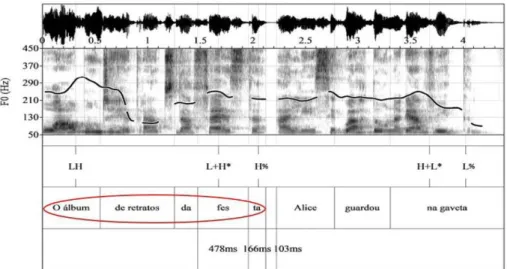
The topicalized DPs were within a single intonational phrase (IP) and they showed a pre-nuclear accent LH on the first phonological word and a pitch accent L+H* on the last phonological word. A high boundary tone H% was also found. The comment sentences, which were within the second IP, showed a pitch accent H+L* on the last phonological word and a final low boundary tone L%. These prosodic characteristics are typical of broad-focus statements in BP (FROTA et
al., 2015). Regarding durational measuraments, the last phonological
word of topicalized DPs showed lengthening of the nuclear and the post-nuclear syllables (FONSECA, 2012). Between the topicalized DP and the comment sentence there was a 100-millisecond manipulated pause. Spectrograms of stimuli in Topic Conditions (Figures 1 and 2) are shown
below. The red circles represent the DPs that were isolated to compose stimuli A and B in the task.
FIGURE 1 – Long Topic DP Condition (LTC): pitch track for item
The party portrait album, Alice kept in the drawer
FIGURE 2 – Topic Condition (TC): pitch track for item
The sentences in Subject Conditions were within a single IP and showed typical characteristics of broad-focus statements. The Long Subject DP Condition (LSC) showed a pitch accent H+L* on the last phonological word of the initial DP and also on the last word of the utterance. A final low boundary tone L% was also found. The Subject Condition (SC) showed a pitch accent H+L* only on the last word of the utterance and a final low boundary tone L%. Concerning durational measurements, differently from the Topic Conditions (Figures 1 and 2), the last word of the initial DPs did not show lengthening of the nuclear and the post-nuclear syllables. Although the Long Subject DP Condition showed a pitch accent on the last word of the initial DP, there are no acoustic cues of lengthening or pause that characterize this DP as a single IP. The initial DPs of the Subject Conditions (LSC and SC) are within a phonological phrase (ip). Spectrograms of stimuli in Subject Conditions (Figures 3 and 4) are shown below. The red circles represent the DPs that were isolated to compose stimuli A and B in the task.
FIGURE 3 – Long Subject DP Condition (LSC): pitch track for item
FIGURE 4 – Subject Condition (SC): pitch track for item
The portrait album was kept in the drawer
3.2 Procedures
This experiment was carried out on a personal laptop running DMDX software (FORSTER; FORSTER, 2002). Participants were seated at a desk in a quiet room in front of a laptop. They wore headphones to hear each experimental item and they also held a joystick, which was used to choose between stimuli A and B. The experimental items were counterbalanced so each participant heard an equal number of trials in each condition, in an individually-randomized order. The correct responses to the questions, A or B, were also counterbalanced.
Firstly, the sentence in one of the four conditions (stimulus X) was played through headphones. After that, the word SOUND A appeared on the left side of the screen and the initial DP was played in one of the prosodic versions, topic or subject. Subsequently, the word SOUND B appeared on the right side of the screen and the other DP was played in another prosodic version. After hearing stimuli A and B, participants read the following question on the screen: Which stimulus is contained in the
sentence? SOUND A or SOUND B? The participants were to choose the
DP (Sound A or Sound B) that matched acoustically the initial DP of the sentence (Stimulus X) that they had previously heard. Participants were instructed to press the button on the left of the joystick (marked with a
sticker with the letter A written on it) for the answer on the left side of the screen, or a button on the right (marked with a sticker with the letter B written on it) for the answer on the right side. The computer recorded response times and response choices. Each subject saw an equal number of items in each condition over the experiment in a Latin-square design. Each experimental session lasted between 15 and 20 minutes.
3.3 Participants
The participants were 24 native Brazilian Portuguese speakers (19 female and 6 male) who reported normal hearing and vision. The mean age of the sample was 33.3 years old. Subjects were high school students at the Educational Project for Young People and Adults (EJA). Some students were from John XXIII Application School and others were from Federal Institute of the Southeast of Minas Gerais (Campus Juiz de Fora). The participants signed a term of consent and volunteered to take part in the experiment. For task performance, subjects were equally divided into four groups.
3.4 Results and discussion
A table with the percentages of correct responses, incorrect responses and missed responses for each experimental condition is shown below:
TABLE 2– Response Percentages of ABX task
Response Percentages
Condition responses Correct
(%) Incorrect responses (%) Missed responses (%)
Long Topic DP Condition 70,8 21,9 7,3
Topic Condition 69,8 26,0 4,2
Long Subject DP Condition 77,1 18,8 4,2
Subject Condition 65,6 27,1 7,3
The database indicate that DPs were correctly matched to stimulus X most of the time, approximately 70 % of accuracy. The rate of missed responses was disregarded, leaving out rates of correct responses and incorrect responses at 75% and 25%, respectively. The rates of correct responses and incorrect responses were submitted to a binomial non-parametric statistical test, which revealed that there was significant statistical difference between the two rates (p <0.001).
A graph of the average response times (RTs) subjects spent to choose a correct reponse or an incorrect reponse is included below. The results of Graph 1 indicate that participants spent more time when they had chosen an incorrect response.
GRAPH 1 – Response time averages (ms) by choice of Correct Response and Incorrect Response
RT averages were submitted to a t-Student statistical test for paired samples, which indicated a significant difference between RTs of correct reponses and RTs of incorrect responses: t(360) = -57,456; p <0.001. RT averages by each condition were also analyzed – see Graph 2 below. ANOVA post-hoc Bonferroni did not reveal any statistical diferences between the four conditions.
GRAPH 2 – Response time averages (ms) per condition
To summarize, the results of Table 1 indicate that hearers are able to perceive prosodic differences between topicalized DPs and non-topicalized subject DPs, since there was approximately 70% accuracy. The results of Graph 1, which showed slower RTs for choices of incorrect responses, suggest that participants did not respond at random. These slower RTs may be signaling that subjects had chosen an incorrect reponse because they were facing difficulties in auditory recognition. The results of Graph 2, which point to similarity of RTs per experimental condition, suggest that there was no condition that was more difficult to understand. Therefore, it is possible to conclude that hearers are able to perceive prosodic differences between topicalized DPs and non-topicalized DPs in subject position.
4 Experiment 2: Cross-modal naming with pictures
This experiment was designed to elicit topic-comment sentences and subject-predicate sentences in contexts created to favor the occurrence of such syntactic structures in speech. Cross-modal naming task is a type of on-line experiment that is used to measure processing at the point of syntactic disambiguation. In these tasks, participants listen to an auditory fragment followed by a visual target that is either an appropriate or an
inappropriate continuation of the sentence fragment. Subjects are required to name the visual target as quickly as they can and then use the target to complete the sentence. Completions are to ensure that participants are able to integrate the auditory fragment and the visual target, and to indicate the final structure and interpretation. Naming times are measured in order to reflect the easiness or the difficulty of integrating the visual target and the auditory fragment together into a sentence (TYLER; MARSLEN-WILSON, 1977; MARSLEN-WILSON et al., 1992; KJEELGARD; SPEER, 1999; BLODGETT, 2004).
For the current research, the cross-modal naming task was adapted by using pictures instead of auditory materials. Participants visualized a picture that favored the speech production of an animate DP or an inanimate DP. Following the picture, they visualized the target word that favored either the construction of a topic-comment syntatic structure or the construction of a subject-predicate syntactic structure. Subjects were required to produce aloud the beginning of a sentence by integrating the picture and the visual target and then complete the rest of the sentence with some idea, so that the whole sentence was meaningful.
Animate DPs and inanimate DPs were chosen as objects of investigation because it is argued in the linguistics literature that there is a relation between animacy and agentivity. According to Lima Júnior and Côrrea (2015), speakers tend to place thematic roles of agent in the subject position. The role of agent is usually attributed to an animate constituent (FERREIRA, 1994). According to these authors, speakers tend to manifest a preference for active sentences with animate subject as opposed to passive ones, for example. Based on these studies, it is hypothesized that in the current task it will be easier for participants to create subject DPs in conditions that the picture favors an animate DP and it will be easier to create topic DPs in conditions that the picture favors an inanimate DP.
Therefore, this experiment was designed to achieve three goals: (i) to investigate whether in contexts that favor the production of subject-predicate structures and topic-comment structures participants are able to produce sentences consistent with such syntactic structures; (ii) second, to identify whether there is a default preference in speech for one of the two structures; (iii) to verify if animacity is a factor that influences the choice of the syntactic constructions.
4.1 Materials
Stimuli were constructed according to a design 2x2: (i) DP type favored by the picture: animate DP or inanimate DP; (ii) type of visual target word that follows the picture: subject pronoun or linking verb. This design allowed the construction of four conditions, which were named as: Animate Topic DP, Animate Subject DP, Inanimate Topic DP and Inanimate Subject DP. The Topic Conditions differed from the Subject Conditions just in relation to the type of visual target. For the Topic Conditions, the visual target word was the subject pronoun‘he’ (ele), ‘she’ (ela) or ‘it’ (ele/ela). The type of subject pronoun that appeared after the picture – he, she or it – was chosen in order to match in genre to the element biased by the picture. These subject pronouns also allowed participants the possibility of using the initial DP as a referent in their sentences. For the Subject Conditions, the visual target word was the linking verb ‘was’ (era, foi).
Four stimuli for each condition were constructed, sixteen in total. An example of each condition is shown below:
(8) Animate Topic DP: Picture (Animate DP) + Pronoun (‘she’ or ‘he’)
+ ELA (SHE)... Possible DP: A garota de bolsa vermelha… (The girl with the red purse…)
(9) Animate Subject DP: Picture (Animate DP) + Verb (‘was’)
+ ERA (WAS)... Possible DP: O cachorro magro…(The skinny dog…)
(10) Inanimate Topic DP: Picture (Inanimate DP) + Pronoun (‘it’)
+ ELE (IT)...
Possible DP: O álbum de retratos…(The portrait album…) (11) Inanimate Subject DP: Picture (Inanimate DP) + Verb (‘was’)
+ FOI (WAS)...
Possible DP: A parede da sala…(The living room wall…) In addition to the experimental stimuli, twelve other sentences were created. These sentences presented DPs or PPs that could be easily elicited through the pictures. Regarding the syntactic structure, the pictures were followed by a linking verb such as ‘is’ (está/fica), or by subject pronouns such as ‘I’ (eu) or ‘you’ (você). Among these twelve sentences, two of them were chosen to compose the training session. Some examples are shown below:
(12) Sentence 5: Picture + Verb
+ FICA (IS)...
Possible DP: O tênis de couro…(The leather shoe…) (13) Sentence 7: Picture + Pronoun
+ VOCÊ (YOU)...
Possible PP: Na padaria…(At the bakery…)
4.2 Procedures
This experiment was carried out on a personal laptop running DMDX software. The computer recorded the sentences produced by participants and their RTs right from the beginning of utterance of the sentence created. The experimental items were counterbalanced so each participant visualized an equal number of trials in each condition, in an individually-randomized order.
Subjects were individually placed in a quiet room. They were seated at a desk in front of a laptop. The experimental session began with instructions. Participants were told to look at a picture on the screen of the laptop that was immediately followed by the presentation of the visual target word that could continue the sentence. The presentation of the picture lasted for 250ms and so did the presentation of the visual target word. After the presentation, subjects were asked to integrate the picture
and the target word in order to create the beginning of a sentence. They were also asked to complete the rest of the sentence with their ideas, but the sentence should make sense. When the participants had already formed a complete sentence, they should say it aloud for recording. Each subject saw an equal number of trials in each condition over the experiment in a Latin-square design. Each experimental session lasted between 15 to 20 minutes.
4.3 Participants
The participants were 18 native Brazilian Portuguese speakers (11 female and 7 male) who reported normal hearing and vision. The mean age of the sample was 19 years old. Subjects were undergraduate students at Federal University of Juiz de Fora. The participants signed a term of consent and volunteered to take part in the experiment. For task performance, subjects were equally divided into two groups.
4.4 Results and discussion
Graph 3 presents the types of syntactic structures of the sentences produced by participants in conditions Animate Subject DP and Inanimate Subject DP. It is worth mentioning that in the caterogy ‘other types of topics’ we grouped sentences that presented topic DPs with syntactic function of adjuncts or adverbs. On the other hand, in the category ‘other types of syntactic structures’ we grouped relative sentences, conjoined sentences, exclamatives and questions.
GRAPH 3 – Syntactic structure of the sentences produced by participants for the conditions of Subject DP
Condition Animate Subject DP received more subject-predicate responses (around 86%) as expected. It is also possible to notice that this condition did not present missed responses. Regarding condition Inanimate Subject DP, there were more subject-predicate responses (around 55%) as it was expected. However, there was a high percentage of sentences with subject passive voice. It seems that the factor animacity influenced participants’ syntactic choices. This result is in line with what is claimed by Lima Júnior and Côrrea (2015) and Ferreira (1994), speakers tend to place in the subject position an animate constituent with thematic role of agent. Thus, participants may have found it difficult to create a subject-predicate sentence in active voice with an inanimate DP.
Graph 4 presents the types of syntactic structures of the sentences produced by participants in conditions Animate Topic DP and Inanimate Topic DP. In the caterogy ‘Topic DP’ we grouped the productions in which there was topicalization of the subject of the comment sentence and the productions in which there was the topicalization of the object of the comment sentence.
GRAPH 4 – Syntactic structure of the sentences produced by participants for the conditions of Topic DP
The conditions Animate Topic DP and Inanimate Topic DP presented respectively 41.67% and 38.88% of responses with topic-comment structure. Overall, the results indicate that the context was able to increase the reponses with topic-comment structure, but this syntactic structure was not unanimously chosen, since different types of structure occurred. Furthermore, the Topic Conditions presented highest rates of missed responses, the condition Animate Topic DP was the condition that presented the highest rate of missed responses, around 19%. It seems that the factor animacity was also influent, since the condition Animate Topic DP presented 32.1% of responses with subject-predicate structure. Participants may have found difficult to create a topic-comment sentence and decided to ignore the subject pronoun and replace it with a verb, or to put it in another position in the sentence. This result is also in line with the claims made by Lima Júnior and Côrrea (2015) and Ferreira (1994). One result was puzzling though; it was expected that pictures in condition Inanimate Topic DP would facilitate production of topic DPs, but this did not happen, since there are more sentences with topic-comment structure in Animate Topic DP. A possible explanation is that when participants visualized a personal pronoun after the picture, they promptly associated it with the subject of the sentence, which was the animate DP biased by the picture. Thus, they used the subject pronoun to refer to the subject of the sentence.
If both graphs are to be compared, one interesting result is the fact that in Subject Conditions no productions with topic-comment structure are seen, whereas in Topic Conditions, productions with the subject-predicate structure occurred. These results suggest that speakers seem to prefer the subject-predicate structure as the default syntactic structure in BP. Participants only produced sentences with topic-comment structure when there was a bias favoring the occurrence of such structure, that is, when the visual target word was a subject pronoun.
Here are some examples of the sentences produced by participants: (14) Condition Animate Topic DP
Production of Topic DP sentence type, by subject S2INFO7:
(15) Condition Inanimate Topic DP
Production of Topic DP sentence type, by subject S2INFO5:
A mochila vermelha, ela usou para ir ao trabalho. (The red
backpack, she wore [it] to go to work) (16) Condition Animate Subject DP
Production of Subject-Predicate sentence type, by subject S1INFO2:
O cachorro era de rua. (The dog was living on the street)
(17) Condition Inanimate Subject DP
Production of Subject-Predicate sentence type, by subject S1INFO9:
O filme foi excelente. (The movie was great)
Production of Subject Passive Voice sentence type, by subject S2INFO4:
A foto foi revelada. (The photo was developed)
The average RTs participants spent after they had visualized the picture and the visual target word to start saying their sentences aloud were also analyzed. Graph 5 shows the average RTs of each condition. Overall, this graph shows longer RTs to create sentences in Topic Conditions as opposed to Subject Conditions. We submitted average RTs of the four conditions to the ANOVA post-hoc Bonferroni test and no significant differences between them were found.
GRAPH 5 – Average RTs (ms) of the four conditions
Therefore, in Graph 6 the average RTs were grouped according to the visual target word: the category Pronoun contained the conditions Animate Topic DP and Inanimate Topic DP; whereas the category Verb contained the conditions Animate Subject DP and Inanimate Subject DP.
The data concerning the average RTs were analyzed by means of ANOVA. Within-subjects ANOVA and within-items ANOVA with two conditions of animacity (animate x inanimate) and two conditions of visual target word (pronoun x verb) were conducted. In the within-subjects analysis there was no main effect of animacity type F(1,127) = 1.080, p = 0.301, but there was a main effect of visual target word type F(1,127) = 6,446, p = 0.012. There was no main effect of interaction between animacity type and visual target word type F(1,127) = 0.026, p = 0.873. Within-items analysis showed similar results, there was no main effect of conditions animacity type F(1,127) =2.846, p = 0.094, but there was a main effect of visual target word type F(1,127) =5,748, p = 0.018. There was no main effect of interaction between the animacity type and the visual target word type F(1,127) = 0.031, p = 0.861.
In summary, the results indicate that participants faced more difficulty to create sentences in Topic Conditions, in which the picture was followed by a subject pronoun, than to create sentences in Subject Conditions, in which the picture was followed by a verb. One evidence of this difficulty was the longer RTs found in Topic Conditions. The rates of production with the target syntactic structure also point to this difficulty, since the production rates in Topic Conditions, 41.67% in Animate Topic DP and 38.88% in Inanimate Topic DP, were lower than the rates of production found in Subject Conditions, 86.11% in Animate Subject DP and 55.56% in Inanimate Subject DP. This difficulty may have been due to the fact that the topic-comment structures are considered as specific constructions in BP and, thus, they could be more dependent on the discursive context. Subject-predicate structures, on the other hand, may have been easier to produce because they are more recurrent in speech. Therefore, although participants had produced more topic-comment sentences when the experimental conditions biased the occurrence of this structure, productions with subject-predicate structure were shown to be preferred. In BP, the subject-predicate structure seems to be the default. 5 Experiment 3: Self-paced listening and reading
This experiment was designed to verify whether prosodic characteristics of a DP in topic position or in non-topicalized subject position are informative for hearers to distinguish between these two syntactic categories. It also aims to verify whether participants are able
to perceive when there is a possible mismatch between prosody of the initial DP and the word (name or verb) that comes next in the sentence.
According to Rayner and Clifton (2002), self-paced task is an online experiment that allows researchers to verifiy how long it takes a subject to read or listen to a particular input. The experimenter is able to control the amount of input that participants can read or listen to (word-by-word, phrase-by-phrase), depending on the study object under investigation. Participants determine the rate at which the material is presented. The task involves pressing a particular button to read or listen to segment-by-segment. When subjects have understood the segment, they push a button and the next segment is presented. After the presentation of the whole sentence, a question appears on the screen in order to verify participants’ understanding of the sentence and also to keep their attention on the task. The program in which the task is carried out records the time to read or listen to each segment. The reading task can present a cumulative design or a non-cumulative design. In a cumulative design, words that have been revealed are kept on screen until the end of the whole presentation, whereas in a non-cumulative design words that have already been read disappear when the participant presses the button to reveal the next segment. This methodological difference also depends on the interests of the research. According to Garrod (2006), this technique has been widely used to investigate syntactic analysis, speech comprehension processes and the resolution of anaphora especially. Self-paced is advantageous because it gives a good indication of when the participant encounters some difficulty in comprehesion.
For the current research, a self-paced task that combined listening and reading was designed. The first segment was auditory and the other segments were written. That is, participants listened to the first segment that contained the initial DP with prosody of topic or prosody of subject. After listening to that segment, they pressed the button to read the other segments that gave continuity to the sentence. After the whole presentation of the experimental item, they pressed the button to read the comprehension question. The segment that appeared after the auditory stimulus (the topicalized DP or the subject DP) was considered the critical segment of the sentences, since it was the point of a possible mismatch between prosody and syntax. This type of design was chosen due to the possibility of controlling the size of segments – a factor that could influence the response times – and minimizing coarticulation effects
between the DP and the word that followed it in Subject Conditions. Sentences in Topic Conditions did not show coarticulation effects, since there was a pause between the initial DP and the following word. However, the sentences in Subject Conditions showed such effect due to the lack of a pause. It was necessary to record these sentences with the same linguistic input after the initial DP in order to neutralize the coarticulation. After the initial DP a verb that was initiated by a voiceless plosive consonant was revealed, which allowed a micropause to occur. The presence of this micropause facilitated the isolation of the initial DPs in Praat.
5.1 Materials
Stimuli were constructed according to a design 2x2x2: (i) type of syntactic structure: topic-comment or subject-predicate; (ii) initial DP size: seven-syllable DP or four-syllable DP; (iii) congruence between prosody of the initial DP and target word that gives continuity to the syntactic structure: congruent or incongruent. This design allowed the construction of eight conditions. Both the Topic Conditions and the Subject Conditions were initiated by the same type of DPs, which were different just in regard to prosody. Short DPs contained four syllabes, whereas long DPs contained seven syllables. All congruent topic-comment sentences contained an initial DP, a noun, a direct verb and a PP. All congruent subject-predicate sentences contained an initial DP, a direct verb, an object and a PP. With respect to incongruence, the Incongruent Topic Conditions contained the initial DP with topic prosody and the syntactic structure of the subject-predicate sentences. That is, after the initial topic DP a verb appeared, which was incongruent with topic prosody. The Incongruent Subject Conditions contained the initial DP with baseline subject prosody and the syntactic structure of topic-comment sentences. That is, after the initial subject DP a noun, which was incongruent with subject prosody, appeared.
Therefore, this self-paced study contained eight conditions. The sentences were broken up into four segments, as shown by the slashes:
(18) Condition Short Topic DP – Congruent
L+H* H% H+L* L%
O gerente/ o dono / demitiu / sem motivo.
The manager/ the boss / fired (him) / without any reasons. (19) Condition Short Topic DP – Incongruent
L+H* H% H+L* L%
O gerente/ delegou / tarefas / ao garçom.
The manager / delegated / duties / to the waiter. (20) Condition Short Subject DP – Congruent
H+L* L%
O gerente / delegou / tarefas / ao garçom.
The manager / delegated / duties / to the waiter. (21) Condition Short Subject DP – Incongruent
H+L* L%
O gerente / o dono / demitiu / sem motivo.
The manager / the boss / fired (him) / without any reasons. (22) Condition Long Topic DP – Congruent
LH L+H* H% H+L* L%
O gerente do bistrô / o dono / demitiu / sem motivo.
The bistro manager / the boss / fired (him) / without any reasons. (23) Condition Long Topic DP – Incongruent
LH L+H* H% H+L* L%
O gerente do bistrô / delegou / tarefas / ao garçom. The bistro manager / delegated / duties / to the waiter.
(24) Condition Long Subject DP – Congruent
H+L* L%
O gerente do bistrô/ delegou / tarefas / ao garçom.
The bistro manager / delegated / duties / to the waiter. (25) Condition Long Subject DP – Incongruent
H+L* L%
O gerente do bistrô / o dono / demitiu / sem motivo.
The bistro manager / the boss / fired (him) / without any reasons. Ninety-six stimuli were elaborated in total, that is, there were twelve sentences for each condition. The sentences were recorded by the same native BP speaker who recorded stimuli for Experiment 1. After the recording, the software Praat was used to isolate the initial DPs of the stimuli. There was a manipulated pause of about 100ms after the initial DPs in Topic Conditions. The initial DPs in Subject Conditions did not present pauses.
In addition to experimental items, thirty sentences were elaborated. Some initial DPs of these sentences were recorded with baseline prosody, while other initial DPs were recorded with focus. Four sentences, among these thirty-one, were chosen to appear in the practice round.
5.2 Procedures
This experiment was conducted using DMDx software on a personal laptop. Subjects were individually taken to a quiet room. They were seated at a desk in front of the laptop. Each experimental session began with instructions followed by a short practice round to familiarize them with the task. In the practice, they were exposed to four unrelated sentences and they answered a comprehension question after each sentence. Each trial began when a participant pressed a particular button of the joystick. The auditory segment was played through headphones. They were to press the button of the joystick again when they had heard and understood the segment. The following segments were all written. Thus, they pressed the button again to read the second segment of the sentence, pressed it again to see the third segment, and pressed it again
when they were done reading the sentence. They were instructed to read at a comfortable pace that allowed them to comprehend the sentences. After the presentation of each item, a yes/no comprehesion question appeared on the screen. They also pressed one of the joystick buttons to answer these questions. DMDx recorded response times (RTs) of the segments as well as the answers to the comprehension questions and RTs to answer them. The items appeared in individually randomized order such that no consecutive trials were of the same type. Each subject saw an equal number of items in each condition over the experiment in a Latin-square design. Each session lasted between 15 to 20 minutes. 5.3 Participants
The participants were 24 native Portuguese-speaking adults (19 female and 5 male) who reported normal hearing and vision. The mean age of the sample was 23,3 years old. Subjects were undergraduate students at Federal University of Juiz de Fora. They all signed a term of consent and volunteered to take part in the experiment. For task performance, subjects were equally divided into four groups.
5.4 Results and Discussion
The software DMDx recorded RTs for the four segments of each sentence. However, just the second segments of the sentences were analyzed because they were the critical ones. In congruent conditions, the second segment should indicate that prosody of the initial DP matched the target word, a noun in Topic Conditions and a verb in Subject Conditions. In incongruent conditions, the second segment should indicate that the prosody of the initial DP did not match the target word, a noun in Subject Conditions and a verb in Topic Conditions. For the analysis, any RTs under 200 ms or over 3500 ms were disregarded.
Graph 7 shows average RTs of the second segment of each condition and Graph 8 shows average RTs of the second segment considering the two large groups, congruent conditions and incongruent conditions. Both graphs indicate that incongruent conditions presented slower reading times in comparison to congruent conditions. In Graph 7, it is possible to notice that the Incongruent Subject Conditions presented the greatest RTs.
GRAPH 7 – Average RTs (ms) of the critical segment of each experimental condition
GRAPH 8 – Average RTs (ms) of critical segment: group of congruent conditions and group of incongruent conditions
Average RTs of congruent conditions and incongruent conditions were submitted to within-subjects ANOVA and within-items ANOVA with 2x2x2 design (type of DP size: long DP and short DP x two types of syntactic structure: topic and subject x two types of prosody: congruent and incongruent). Within-subjects analysis did not reveal main effects