Evaluating physical activity in dementia: a systematic review of outcomes to inform the development of a core outcome set
Ana-Carolina Gonçalves1,2, Joana Cruz3,4,5 Alda Marques3,4 Sara Demain1, Dinesh Samuel1
1. Faculty of Health Sciences, University of Southampton, Southampton, SO17 1BJ, UK;
2. Solent NHS Trust, UK;
3. Lab 3R - Respiratory Research and Rehabilitation Laboratory, School of Health Sciences (ESSUA), University of Aveiro, Portugal
4. Institute for Research in Biomedicine (iBiMED), University of Aveiro, Portugal.
5. School of Health Sciences, Polytechnic Institute of Leiria, Leiria, Portugal
Acknowledgements: The searches for this literature review were conducted under the advice of Nicola Hunt, Health Sciences librarian at the University of Southampton. This work was partially supported by Fundo Europeu de Desenvolvimento Regional (FEDER) through Programa Operacional Competitividade e Internacionalização (COMPETE) and Fundação para a Ciência e Tecnologia (FCT) under the project UID/BIM/04501/2013.
Corresponding author
(Please note that it was not possible to indicate this in the online submission, as the corresponding author is automatically linked to the 1st author)
Dr Dinesh Samuel,
Email: [email protected]
Phone: 00442380598925
Faculty of Health Sciences, Building 45
ABSTRACT
Background: Physical activity is recommended for people living with dementia, but evidence for the positive effects of physical activity is limited by the use of heterogeneous outcomes and measurement tools. This systematic literature review aimed to summarise previously reported outcomes and identify the measurement tools used most frequently in physical activity interventions for people with dementia. Methods: Literature searches were conducted in April 2015, on Delphis and Medline. Qualitative, quantitative and mixed methods studies reporting on any type of physical activity, in any setting, across types of dementia, stages of disease progression and published from 2005 onwards were included. A content analysis approach was used to report on the frequency of reported outcomes and measurement tools. Results: The 130 included studies reported on 133 different outcome domains and 267 different measurement tools. “Functional abilities and independence” (n=69), “Global cognitive function” (n=65), “Balance” (n=43), “Global behavioural symptoms of dementia” (n=42) and “Health related quality of life” (n=40) were the most frequently reported outcome domains. “Enjoyment” was the outcome most frequently sought by patients and carers. Conclusion: The need for the development and implementation of a Core Outcome Set has been reinforced. Ahead of the completion of the Core Outcome Set, researchers and clinicians are advised to measure the impact of physical activity interventions on these frequently reported outcome domains.
Keywords: Physical activity; Dementia; Outcomes; Measurement tools; Core Outcome Set; Systematic review; Older people.
Key Points:
• Research into physical activity for people with dementia is heterogeneous, limiting guidance to practice;
• This literature review summarises the outcomes and measurement tools used in the past 10 years of research;
• Clinicians and researchers are encouraged to continue to assess the impact of physical activity on Functional independence;
• Researchers should prefer measurement tools frequently used in previous research – these tools can be found in this review;
• The effects of physical activity in people with severe dementia are under-researched.
BACKGROUND
Dementia is predicted to affect 42.3 million people worldwide by 2020 [1]. Physical activity is defined by The World Health Organisation as “any body movement produced by skeletal muscles that requires energy expenditure”, including therefore not only formal exercise but also any activity involving body movement. Physical activity is recommended for people with dementia by several international agencies [2-5],as there is promising evidence of its benefits. However, the use of heterogeneous outcomes leads to a need for caution in the interpretation of these results [3]. Two recent literature
reviews [3, 6] reported important limitations in their statistical analyses due to a lack of consistent use of measurement tools. This heterogeneity adds to an already diverse area of research, as physical activity is a broad concept, and interventions tend to vary in type of activity, intensity, setting, type of dementia and stage of disease progression. The use of inconsistent outcomes and measurement tools hinders the effective synthesis of evidence [7] making it difficult to compare interventions and therefore delaying the development of clear clinical guidelines.
The development of Core Outcome Sets has been suggested as a solution to this heterogeneity. A Core Outcome Set is an agreed minimum collection of outcomes to be used as standard in a particular pathological condition or type of intervention [8-12]. The use of Core Outcome Sets allows direct comparison of the effects of different interventions, minimising the risk of outcome reporting bias and increasing the power of meta-analysis [9, 12, 13], from which clearer clinical guidance can be generated [14].
The present systematic literature review is the first phase of the development of a Core Outcome Set, to evaluate physical activity interventions for people with any type of dementia, across stages of disease progression and in different settings. This review aims to i) list all the outcomes reported in physical activity research in the last 10 years ; and ii) identify the most frequently reported measurement tools for each of the identified outcomes.
METHODS
A systematic literature review was conducted. The review protocol is available on request.
Registration:
The overall Core Outcome Set is registered with the Core Outcome Measures in Effectiveness Trial initiative, available at: http://www.comet-initiative.org/studies/details/708?result=true.
Eligibility criteria
Design: Any study design describing a physical activity intervention, or exploring patients’, relatives’, carers’ or professionals’ views on physical activity was included. Study protocols, pilot or feasibility studies were also included. Literature reviews were not included, but their reference lists were screened and considered according to the eligibility criteria. Single experimental case studies, surveys, cross-sectional studies or studies not published in a peer-reviewed journal were excluded.
Study participants: Studies including people with any type of dementia, at any stage of disease progression, formal and informal carers and/or health care professionals working with people with dementia were included. Interventions including only carers of people with dementia were excluded.
Intervention: Interventions with at least one component of physical activity, in any setting, were included. Qualitative studies exploring participants’ views on physical activity were also included.
Comparators: Having a comparator or control group was not a requirement for inclusion; when available, outcomes used as comparators were considered for data analysis.
Language and date of publication: Studies written in English, Portuguese and Spanish published from 1st of January 2005 onwards were included.
Information sources
The search strategy was developed with the advice of a health sciences librarian. The searches were initially conducted in Delphis, a single interface integrating the providers: Medline, Psycinfo, CINAHL, Web of Science, Scopus and ScienceDirect. To ensure literature saturation, a subheading search was then performed on Medline - the database that had generated the greatest number or records in the Delphis search.
Search strategy
A full detail of the search strategy can be found in appendix 1 (tab 1), available from the journal website.
Selection criteria
The selection process (screening and eligibility) was completed by one researcher; other authors were consulted in cases of uncertainty. To guarantee consistency, a random sample of 10% of abstracts were independently screened by a second author.
Risk of bias
The quality of included papers was assessed using the Mixed Methods Assessment tool – version 2011 [15]. This tool was designed for the appraisal of studies included in complex, mixed studies reviews. For the purpose of this review, the quality of the included studies was used purely as an indicator of the quality of the evidence in the field, not as an exclusion criterion and it did not influence data analysis.
Data collection process
A pre-developed standardised form was used, to extract the following data: paradigm and study design; country; stage of disease progression; intervention outcomes and measurement tools. Outcomes were defined as any effect (positive or negative) of physical activity, which had been measured or described as a result of a physical activity intervention. Outcomes were identified from the methods, results and discussion sections of the included papers. To avoid double counting of outcomes, multiple publications of the same study were analysed as one (i.e., protocol and pilot of the same study).
Data analysis
NVivo (NVivo qualitative data analysis Software; QSR International Pty Ltd. Version 10, 2014) was used for data management.
From verbatim outcomes to outcome domains: Content analysis [16] was used to quantify the number of studies referencing each outcome domain. Firstly, outcomes were extracted verbatim. One author, with clinical experience in promoting physical activity in dementia care, grouped verbatim outcomes with the same semantic meaning, into outcome domains. For instance, the verbatim outcomes “Functional independence”, “Ability to develop basic activities of daily living” and “Functional performance” were grouped into the outcome domain “Functional abilities and independence”. The total number of studies allocated to each outcome domain was then counted.
From outcome domains to themes: Four authors individually organised the outcome domains into broader themes. Any discrepancies were resolved through group discussion until full consensus was achieved. For instance, the outcome domains “Keep fit and active”, “Levels of physical activity” and “Levels of restricted physical activity” were listed under the theme: “Levels of physical activity”.
Appendix1 (tab 3), aids transparency by presenting all verbatim outcomes, their groupings into outcome domains and organisation into themes. The analysis and presentation of results followed the guidance provided by the PRISMA statement [17], with the necessary adaptations for a mixed studies review.
RESULTS
The searches were conducted in April 2015. The PRISMA flowchart is presented in Figure 1. A total of 4828 records were identified, from which 130 studies were included in the final analysis.
Study selection
The screening of 10% of the abstract by a second author revealed good consistency in the use of the eligibility criteria. Of the 500 abstracts screened by both authors, 468 were screened equally by both authors. Of the remaining 32 abstracts, 15 were not considered clear enough by one of the authors and the full texts were considered to make a decision; 17 were screened contradictorily by both authors – nine would have been only included by the first author and eight only by the second author. Measurement of agreement using Cohen’s Kappa was 0.69. Disagreements were resolved through consensus and the eligibility criteria were reviewed to ensure clarity.
Study characteristics
The 130 included studies were conducted in 22 countries; 113 studies used quantitative methods, nine qualitative and eight used mixed methods. The overall quality of the studies was considered good (Mixed Methods Assessment tool average score: 65%). Appendix 1 (tab 10), presents the quality assessment of each of the included papers. Most interventions took place in the community (n=70) or in institutional settings (n=43). Studies including only people with severe dementia (n=5) were all performed in nursing homes. A large number of interventions were multimodal or complex interventions (n=60) and were delivered in groups (n=62). Table 1 presents further details on the description of the interventions, settings and participants from the included studies.
Outcomes reporting positive effects of physical activity for people with dementia
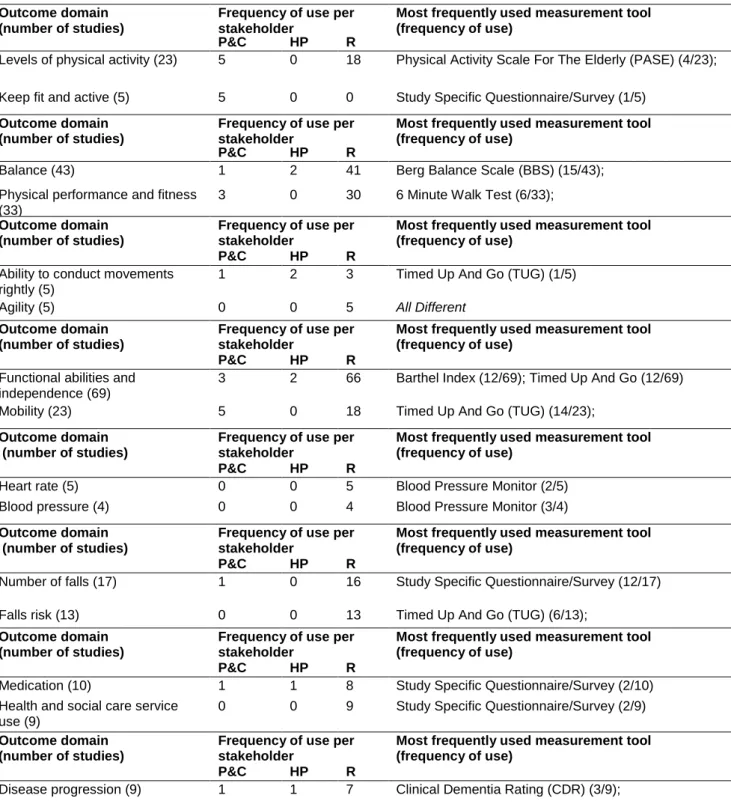
A total of 133 positive outcome domains, organised into 17 themes, and measured by 267 different measurement tools were identified. A considerable number of outcome domains (36 out of 133) were reported only once. Each study incorporated an average 9.49 different outcome domains. Table 2 lists the themes, outcome domains and the most frequently used measurement tool per domain. Due to space restrictions, only the two most frequently reported outcome domains per theme are listed in Table 2. The complete table, including the all the 133 positive outcome domains and the three most frequently used measurement tools per outcome domain, can be found in appendix 1 (tab 2).
The most frequently reported outcome domains were “Functional abilities and independence” (n=69), “Global cognitive function” (n=65), “Balance” (n=43), “Global behavioural symptoms of dementia” (n=42) and “Health related quality of life (n=40)”. In qualitative studies, “Enjoyment” was the outcome most frequently reported by patients and carers (n=22). Outcomes such as “Mobility”, “Health related quality of life”, all outcome domains under the themes “Social interaction” and “Carer outcomes” were not reported in patients with severe dementia. Outcomes such as “Fatigue management” and “Sense of normality” have been identified as important by patients in qualitative studies, but never objectively measured. Other outcomes, such as “Balance”, although frequently measured (n=43) were identified by only one carer in qualitative studies.
Most frequently reported measurement tools
The most frequently reported measurement tools in the included studies were Mini Mental State Examination as a measure of “Global cognitive function” (used in 43 of the 65 studies reporting on this domain); the Berg Balance Scale, as a measure of “Balance” (15 of the 43 studies) and the Timed Up And Go as an assessment of “Mobility” (14 out of 23 studies). Conversely, some measurement tools, such as the Timed Up And Go, were used to measure multiple outcome domains (in this instance “Ability to conduct movements rightly”, “Motor skills”, “Functional gait”, “Mobility” and “Falls risk”). See Table 2 and appendix 1 (tab 2) for further details. Appendix 1 (tabs 4 to 6) also offers an interactive overview of themes, outcomes and measurement tools per setting and stage of disease progression and across the last 10 years of research.
Outcomes reporting negative effects (or adverse/side effects) of physical activity for people with dementia
A total of 31 adverse effects were reported. “Falls during the activity” was the most common (n=15). Most studies (n=82) did not mention the occurrence of adverse effects. Negative outcomes, or adverse effects are also detailed in the appendix 1 (tab 9).
DISCUSSION
The present systematic literature review is the first phase in the development of a Core Outcome Set to assess physical activity interventions for people living with dementia. It identified 133 outcome
domains, measured by 267 different measurement tools. Ahead of the establishment of the Core Outcome Set, this review provides valuable information for researchers designing studies investigating physical activity interventions for people with dementia. Researchers may choose to focus either on the most frequently reported outcomes and measurement tools, enabling the comparison of novel interventions against the current evidence, or explore outcomes where research is still lacking.
Functional abilities and independence (n=69), was frequently measured by the Barthel Index (n=12) and the Timed Up And Go (n=12). This outcome domain was reported in all stages of dementia and by all stakeholder groups (patients and carers, health professionals and researchers). A recent Cochrane review highlighted the positive influence of physical activity on this outcome domain [3]. The available international guidance also directs professionals to promote independence in people with dementia through physical activity [2-4].
Global cognitive function (n=65), was most commonly measured by the Mini-Mental State Examination (n=43), but with inconclusive results. Researchers have hypothesised that physical activity improves cognition, through physiological mechanisms, such as an increase in blood supply to the brain, synaptogenesis and reduced inflammation [157], nevertheless some uncertainty remains about the impact of physical activity on cognition. A recent Cochrane review was inconclusive in supporting this hypothesis, due to the important heterogeneity of the included studies [3]. Qualitative studies reporting the perspectives of patients also reflect uncertainly about the impact on cognition, with some patients report that they have been able to “think more deeply” [129] as a result of physical activity, whilst others reported no changes in this domain [53].
Balance (n=43), measured using Berg Balance Scale in 15 studies, was linked to a reduction in the risk of falling in 12 studies [25, 29, 34, 46, 60, 64, 69, 85, 103, 109, 111, 117]. This is important due to the well-known health and economic burden of falls in older people [158]. Nevertheless, “Balance” and “Falls risk” are often “researcher led” outcome domains; only one qualitative study (with carers) [34] identified “Balance”, and none reported a reduction in “Falls risk” as desirable outcomes. Examples of outcomes reported by participants as meaningful include “Sense of self”, “Social interaction”, “Fatigue management” and “Enjoyment”. These outcomes are yet to be objectively measured in quantitative studies.
Global behavioural symptoms of dementia (n=42) was measured using the Neuropsychiatric Inventory in 13 studies. Recent literature has correlated the presence of behavioural symptoms with quality of life in people with dementia [159, 160], carer burden [161] and perceived reasons for institutionalisation [162]. The presence of these symptoms was also linked to an increased risk of psychotropic medication misuse [163], hence the importance of managing behavioural symptoms through non-pharmacological interventions, such as physical activity [164]. However, a recent Cochrane review found limited evidence for the effectiveness of physical activity in this domain [3], with some of the included studies showing conflicting results or positive results not maintained post-intervention. Future studies using this outcome should report the duration of the impact on these symptoms.
Health related quality of life (n=40), most frequently measured using the Quality Of Life In Alzheimer’s Disease Questionnaire (n=19), concurs with the guidance given by the National Institute for Health and Care Excellence on promoting activities that people living with dementia enjoy [2]. Better quality of life can also be linked to a decrease in depression, also prevalent among people living with dementia [165]. The availability of measures of quality of life suitable for completion by a proxy may also account for its common use in research.
Outcomes where research is lacking
Very little is known regarding effects of physical activity for people with severe dementia. Research is lacking in relation to multiple settings and numerous outcome domains, namely “Mobility”, “Health related quality of life”, “Social interaction” and all the outcome domains related to carers. Carer related outcomes deserve particular attention in future research due to the known correlation between severity of cognitive impairment and carer burden [161].
Heterogeneous measurement tools
In line with previous literature reviews [3, 6], substantial heterogeneity was identified in the use of measurement tools. It is important to emphasise that whilst “the three most commonly used measurement tools” per outcome domain were identified, the psychometric properties of the instruments were not considered. The most appropriate measurement tools for each of the outcomes included in the Core Outcome Set will be determined in the final phase of its development.
Limitations
Several limitations need to be acknowledged. Due to limited time and resources, language filters (English, Portuguese and Spanish) were added to the initial searches. The inclusion of papers written in three different languages implies that a large proportion of the available literature would have been screened. Yet, the number of papers missed due to the use of the language filter is unknown. The data analysis process was conducted by a single researcher. Whilst it is possible that other researchers would have defined the outcome domains differently, this risk was minimised by presenting appendix 1, to ensure transparency of the process.
CONCLUSION
Research into physical activity for people living with dementia is common and necessary. However the considerable heterogeneity in the outcomes sought and the tools used hinders the development of definitive clinical guidance, reinforcing the need for a Core Outcome Set. The present systematic literature review not only forms the first phase of development of a Core Outcome Set, but also offers useful information for interventions being currently designed. “Functional abilities and independence” is the outcome domain i) most frequently reported across stages of dementia; ii) most frequently shown to improve; and iii) reported as important by patients and carers as well as health professionals and
researchers. Thus, clinicians and researchers are encouraged to continue to evaluate this outcome domain when developing Physical activity interventions for people with dementia. Other frequently reported outcomes are “Global cognitive function”, “Balance”, “Global behavioural symptoms of dementia” and “Health related quality of life”, but the evidence of benefit is less conclusive in these domains.
CONFLICTS OF INTEREST
The authors have no conflicts of interest to declare.
DECLARATIONS OF SOURCES OF FUNDING: NONE
REFERENCE LIST
PLEASE NOTE: The very long list of papers included in this review has meant that a the reference list of included papers had to be presented separately, in appendix 1 (tab 11) , wich is avaliable from the jounral website. The references used to support this review are listed here and are represented by bold type throughout the text.
2. National Institute for Health and Care Excellence, Dementia: supporting people with dementia and their carers in health and social care. NICE guideline, 2006. Dementia (CG42): p. 1-54.
3. Forbes, D., S.C. Forbes, C.M. Blake, E.J. Thiessen, and S. Forbes, Exercise programs for people with dementia (Review). Cochrane Database of Systematic Reviews, 2015. 4: p. 1-80.
4. Miskovski, K., The benefits of physical activity and exercise for people living with dementia, Policy Research and Information Department Alzheimer’s Australia NSW, 2014. p. 1-33.
5. Physical Activity Guidelines Advisory Committee, Physical Activity Guidelines Advisory Committee Report, 2008., S.o.H.a.H. Services, 2008: Washington, DC: U.S. p. section 8.
6. Rao, A.K., A. Chou, B. Bursley, J. Smulofsky, and J. Jezequel, Systematic review of the effects of exercise on activities of daily living in people with Alzheimer's disease. Am J Occup Ther, 2014. 68(1): p. 50-56.
7. Macefield, R.C., M. Jacobs, I.J. Korfage, et al., Developing core outcomes sets: methods for identifying and including patient-reported outcomes (PROs). Trials, 2014. 15(49): p. 1-12.
8. Hopkins, J., N. Howes, K. Chalmers, et al., What are important outcomes of bariatric surgery? An in-depth analysis to inform the development of a core outcome set and a comparison between the views of surgeons and other health professionals (the BARIACT study). The Lancet, 2015. 385: p. Poster 30.
9. Williamson, P.R., D.G. Altman, J.M. Blazeby, et al., Developing core outcome sets for clinical trials: issues to consider. Trials, 2012. 13(132): p. 1-8.
10. Clarke, M. and P. Williamson, Core outcome sets and trial registries. Trials, 2015. 16(216): p. 1-6.
11. Idzerda, L., T. Rader, P. Tugwell, and M. Boers, Can we decide which outcomes should be measured in every clinical trial? A scoping review of the existing conceptual frameworks and processes to develop core outcome sets. J Rheumatol, 2014. 41(5): p. 986-993.
12. Sinha, I., Outcomes in clinical trials in children with asthma. 2011, University of Liverpool.
13. MacLennan, S., H.J. Bekema, P.R. Williamson, et al., A core outcome set for localised prostate cancer effectiveness trials: protocol for a systematic review of the literature and stakeholder involvement through interviews and a Delphi survey. Trials, 2015. 16(76): p. 1-10.
14. Tugwell, P., M. Boers, P. Brooks, et al., OMERACT: an international initiative to improve outcome measurement in rheumatology. Trials, 2007. 8(38): p. 1-6.
15. Pluye, P., M.P. Gagnon, F. Griffiths, and J. Johnson-Lafleur, A scoring system for appraising mixed methods research, and concomitantly appraising qualitative, quantitative and mixed methods primary studies in Mixed Studies Reviews. Int J Nurs Stud, 2009. 46(4): p. 529-46.
16. Elo, S. and H. Kyngas, The qualitative content analysis process. J Adv Nurs, 2008. 62(1): p. 107-15.
17. Moher, D., A. Liberati, J. Tetzlaff, D.G. Altman, and T.P. Group, Preferred Reporting Items for Systematic Reviews and Meta-Analyses: The PRISMA Statement. PLoS Medicine, 2009. 6(7): p. 1-6.
157. Lautenschlager, N.T., K. Cox, and E.V. Cyarto, The influence of exercise on brain aging and dementia. Biochim Biophys Acta, 2012. 1822(3): p. 474-81.
158. National Institute for Health and Care Excellence, Falls: Assessment and prevention of falls in older people. 2013, NICE clinical guideline 161.
159. Beerens, H.C., S.M. Zwakhalen, H. Verbeek, D. Ruwaard, and J.P. Hamers, Factors associated with quality of life of people with dementia in long-term care facilities: a systematic review. Int J Nurs Stud, 2013. 50(9): p. 1259-70.
160. Mjorud, M., J. Rosvik, A.M. Rokstad, M. Kirkevold, and K. Engedal, Variables associated with change in quality of life among persons with dementia in nursing homes: a 10 months follow-up study. PLoS One, 2014. 9(12): p. 1-17.
161. Reed, C., M. Belger, G. Dell'agnello, et al., Caregiver Burden in Alzheimer's Disease: Differential Associations in Adult-Child and Spousal Caregivers in the GERAS Observational Study. Dement Geriatr Cogn Dis Extra, 2014. 4(1): p. 51-64.
162. Stephan, A., B. Afram, J. Koskenniemi, et al., Older persons with dementia at risk for institutionalization in eight European countries: a cross-sectional study on the perceptions of informal caregivers and healthcare professionals. J Adv Nurs, 2014. 0(0): p. 1-13.
163. Cerejeira, J., L. Lagarto, and E.B. Mukaetova-Ladinska, Behavioral and psychological symptoms of dementia. Front Neurol, 2012. 3(73): p. 1-21.
164. Thune-Boyle, I.C., S. Iliffe, A. Cerga-Pashoja, D. Lowery, and J. Warner, The effect of exercise on behavioral and psychological symptoms of dementia: towards a research agenda. Int Psychogeriatr, 2012. 24(7): p. 1046-57.
165. Curran, E.M. and S. Loi, Depression and dementia. The Medical Journal of Australia, 2012. 1(4): p. 40-4.
Fig.1. PRISMA flow chart: number of records identified, screened, excluded (with reasons) and included in the present literature review. Sc re e n in g In cl u d e d El ig ib ili ty Id e nti fic a tio n
Records identified through database searching
(n = 4846)
Additional records identified through other sources
(n = 22)
Total of records identified (n=4868) of which duplicates (n = 637) were removed Records screened (n = 4231) Records excluded (n = 3814)
Full-text articles assessed for eligibility
(n = 417)
Full-text articles excluded, with reasons: (n =277) Literature reviews and guidelines:
146
Gray literature, thesis and single case studies: 33 Studies including not only people
with dementia: 61 Interventions with no report on outcomes of physical activity: 35
Doubled records: 2 Records included:
(n = 140) Corresponding to
Table 1 – Characteristics of the included studies
Legend: n – number of studies (please note that some studies were described in multiple publications and therefore the multiple reference can be linked to the same study).
Study characteristics Reference
Stage of Disease progression
All stages (n=26) [18-44]
Mild to moderate (n=72) [1, 45-123]
Moderate to Severe (n=19) [124-143]
Severe (n=5) [144-148]
Stage not specified (n=8) [149-156]
Setting Community (n=70) [19, 20, 24-27, 31, 32, 34, 36, 37, 40, 41, 45-47, 50, 52-55, 58, 72-74, 76-78, 80-84, 87-100, 104, 109-123, 125, 127, 128, 139-141, 149-153, 155, 156] Institution (n=43) [21, 22, 28-30, 33, 35, 38, 39, 42-44, 48, 59-61, 66-68, 71, 101-103, 105, 107, 108, 124, 126, 129-133, 135-138, 142-148, 154] Hospital (n=7) [18, 23, 49. 51, 56, 57, 63] Not specified (n=10) [62, 64, 65, 69, 70, 75, 79, 85, 52, 134] Delivery Group intervention (n=62) [18, 21, 24, 26, 27, 36-40, 46, 47, 49, 50, 52-54, 56, 61-63, 66, 70, 75, 78, 79, 81, 84, 87, 89, 91, 92, 94-96, 98, 99, 102-104, 107-109, 112, 113, 115, 118-120, 122, 123 -132, 135, 136, 138, 141, 143, 146, 150, 151, 153] Individual intervention (n= 27) [1, 43-45, 48, 51, 55, 57, 59, 64, 65, 68, 71, 74, 76, 77, 80, 93, 101, 110, 117, 137, 142, 144, 145, 147, 154, 156]
Intervention including dyads (n=14) [19, 20, 31, 32, 72, 83, 88, 100, 106, 111, 133, 139, 140, 155] A combination of delivery options
(n= 14)
[25, 28, 34, 41, 42, 58, 60, 86, 90, 97, 105, 114, 116, 121, 148, 149]
Not specified (n= 13) [22, 23, 29, 30, 33, 35, 67, 69, 73, 82, 85, 134, 152]
Aerobic (e.g. walking, dancing, cycling, ball games) (n= 33)
[19, 21, 28, 30-32, 48, 50, 51, 53, 64, 65, 67, 70, 74, 76, 80, 93, 97, 101, 108, 113, 120, 124, 129, 131, 133, 134, 140, 149, 151, 154-156]
Strength and balance (e.g. yoga, tai chi, resistance and balance training) (n=27)
[1, 24-27, 34, 61, 64, 66, 71, 72, 78, 82, 84, 87, 98, 99, 110, 117, 118, 127, 132, 135, 137, 141, 150, 153]
Functional activities (e.g. gardening, activities of daily living) (n= 9)
[35, 38, 42, 49, 68, 91, 104, 136, 144]
Multimodal interventions (n=60) [18, 20, 22, 23, 29, 33, 36, 37, 39, 41, 43, 44-48, 52, 54-60, 62,
63, 69, 73, 75, 77, 79, 81, 83, 85, 86, 88-90, 92, 94-96, 100, 103, 105-107, 109, 111, 112, 114-116, 119, 121-123, 125, 126, 128, 130, 138, 139, 142, 143, 145-148, 152]
Hand motor activity (n= 1) [102]
Table 2 – Short list of outcome domains and measurement tools organised by themes. Due to space restrictions only the two most frequently reported outcome domains per theme, and the most frequently reported measurement tool per outcome domain are presented in this table. Please refer to appendix 1 (tab 2), available from the journal website, to access the full table.
Legend: P&C: patients and carers; HP: health professionals; R: researchers; NA: Not applicable, used when the outcome domain was not objectively measured; "Study Specific Questionnaire/Survey", refers to data collection tools designed specifically for a particular study.
Outcome domain (number of studies)
Frequency of use per stakeholder
Most frequently used measurement tool (frequency of use)
P&C HP R
Levels of physical activity (23) 5 0 18 Physical Activity Scale For The Elderly (PASE) (4/23);
Keep fit and active (5) 5 0 0 Study Specific Questionnaire/Survey (1/5)
Outcome domain (number of studies)
Frequency of use per stakeholder
Most frequently used measurement tool (frequency of use)
P&C HP R
Balance (43) 1 2 41 Berg Balance Scale (BBS) (15/43);
Physical performance and fitness (33)
3 0 30 6 Minute Walk Test (6/33);
Outcome domain (number of studies)
Frequency of use per stakeholder
Most frequently used measurement tool (frequency of use)
P&C HP R
Ability to conduct movements rightly (5)
1 2 3 Timed Up And Go (TUG) (1/5)
Agility (5) 0 0 5 All Different
Outcome domain (number of studies)
Frequency of use per stakeholder
Most frequently used measurement tool (frequency of use)
P&C HP R
Functional abilities and independence (69)
3 2 66 Barthel Index (12/69); Timed Up And Go (12/69)
Mobility (23) 5 0 18 Timed Up And Go (TUG) (14/23);
Outcome domain (number of studies)
Frequency of use per stakeholder
Most frequently used measurement tool (frequency of use)
P&C HP R
Heart rate (5) 0 0 5 Blood Pressure Monitor (2/5)
Blood pressure (4) 0 0 4 Blood Pressure Monitor (3/4)
Outcome domain (number of studies)
Frequency of use per stakeholder
Most frequently used measurement tool (frequency of use)
P&C HP R
Number of falls (17) 1 0 16 Study Specific Questionnaire/Survey (12/17)
Falls risk (13) 0 0 13 Timed Up And Go (TUG) (6/13);
Outcome domain (number of studies)
Frequency of use per stakeholder
Most frequently used measurement tool (frequency of use)
P&C HP R
Medication (10) 1 1 8 Study Specific Questionnaire/Survey (2/10)
Health and social care service use (9)
0 0 9 Study Specific Questionnaire/Survey (2/9)
Outcome domain (number of studies)
Frequency of use per stakeholder
Most frequently used measurement tool (frequency of use)
P&C HP R
Brain volumes, physiology and imaging (5)
0 0 5 Magnetic Resonance Imaging (MRI) (3/5);
Outcome domain (number of studies)
Frequency of use per stakeholder
Most frequently used measurement tool (frequency of use)
P&C HP R
Global cognitive function (65) 3 0 62 Mini-Mental State Examination (MMSE) (43/65);
Executive function (18) 0 0 18 Stroop Test (5/18);
Outcome domain (number of studies)
Frequency of use per stakeholder
Most frequently used measurement tool (frequency of use)
P&C HP R
Expression and communication (6)
2 3 1 Study Specific Questionnaire/Survey (1/6)
Language ability (6) 0 0 6 Verbal Fluency Test (VF) (2/6)
Outcome domain (number of studies)
Frequency of use per stakeholder
Most frequently used measurement tool (frequency of use)
P&C HP R
Global Behavioural symptoms of dementia (42)
0 1 41 Neuropsychiatric Inventory (NPI) (14/42);
Depression (33) 1 0 32 Cornell Scale For Depression In Dementia (CSDD)
(12/33);
Outcome domain (number of studies)
Frequency of use per stakeholder
Most frequently used measurement tool (frequency of use)
P&C HP R
Enjoyment (22) 12 2 10 NA
Affective function (9) 0 1 8 Apparent Affect Rating Scale (AARS) (3/9)
Outcome domain (number of studies)
Frequency of use per stakeholder
Most frequently used measurement tool (frequency of use)
P&C HP R
Health related quality of life (40) 1 0 39 Quality Of Life In Alzheimer’s Disease (QoL-AD) Scale
(8/40);
Sense of wellbeing (11) 2 1 9 All Different
Outcome domain (number of studies)
Frequency of use per stakeholder
Most frequently used measurement tool (frequency of use)
P&C HP R
Global social interaction (16) 7 3 7 Holden Communication Scale (1/16)
Opportunity to leave the house (3)
2 0 1 NA
Outcome domain (number of studies)
Frequency of use per stakeholder
Most frequently used measurement tool (frequency of use)
P&C HP R
Institutionalisation (7) 1 0 6 Study Specific Questionnaire/Survey (1/7)
Stay at home for as long as possible (2)
0 0 2 NA
Outcome domain (number of studies)
Frequency of use per stakeholder
Most frequently used measurement tool (frequency of use)
P&C HP R
Adherence (30) 2 0 28 Study Specific Questionnaire/Survey (24/30);
Outcome domain (number of studies)
Frequency of use per stakeholder
Most frequently used measurement tool (frequency of use)
P&C HP R
Carer burden (33) 3 0 30 Zarit Caregiver Burden Inventory (ZBI) (7/33);
Carer quality of life (6) 0 0 6 Quality Of Life In Alzheimer’s Disease (QoL-AD) Scale