Institutional quality, firm performance and
business groups: evidence from emerging
economies
Dissertation
Master in International Business
Liliana Gavazzi Santos
Institutional quality, firm performance and
business groups: evidence from emerging
economies
Dissertation
Master in International Business
Liliana Gavazzi Santos
Master’s Dissertation under the supervision of Professor João Carvalho Santos, and Professor Nuno Reis, Escola Superior de Tecnologia e Gestão of the Polytechnic Institute
of Leiria.
iii
Originality and Copyright
This dissertation original, prepared solely for this purpose, with all authors whose studies and publications contributed to the elaboration.
Partial reproductions of this document will be authorized provided that reference is made to the cycle of studies under which the study was carried out, namely, Master Course in International Business, in the academic year 2018 / 2019, of the Higher School of Technology and Management of the Polytechnic Institute of Leiria, Portugal, as well as the date of the public tests aimed at the evaluation of these works.
iv This page was intentionally left blank
v
Dedication
vi This page was intentionally left blank
vii
Acknowledges
First, I would like to thank all the people who have, somehow, contributed in this long journey to the realization of this dissertation.
To my professor, João Santos, for all the availability, support granted along not only for the accomplishment of the dissertation but also throughout the master.
To my professor, Nuno Reis, for all the patience, constant contribution and sharing of knowledge that so much enriched this dissertation.
To my parents, for being my greatest support, without them, none of this would be possible. To my boyfriend for all the support and encouragement.
To my friends, for helping me not giving up. Thank you all.
viii This page was intentionally left blank
ix
Resumo
As empresas enfrentam inúmeros desafios ao realizar suas operações de negócios sendo um dos maiores desafios lidar com as condições do ambiente institucional. Neste estudo analiso como a qualidade do ambiente institucional influencia a performance das empresas em economias emergentes. Mais precisamente, este estudo desenvolve um modelo conceitual abrangente de seis relações hipotéticas entre a qualidade das três dimensões institucionais propostas por Scott (1995) (regulatória, normativa e cognitiva) e a performance das empresas. Além disso, também examina o efeito moderador da afiliação do grupo na performance das empresas quando a qualidade institucional é baixa. O modelo é concebido através de uma regressão linear usando uma amostra de 5.166 empresas de 19 economias emergentes para testar as hipóteses teóricas. Os resultados indicam que menor qualidade regulatória e normativa levará a menor performance das empresas. Os resultados também mostram que o efeito moderador da afiliação de grupo tem um impacto positivo na performance das empresas somente quando a qualidade regulatória do ambiente institucional é baixa. Considerando o efeito das instituições e afiliação de grupo na performance, este estudo contribui para a nossa compreensão de como as empresas de países com menor qualidade institucional, que estão mais sujeitas a enfrentar dificuldades, se podem preparar construindo uma teoria específica do contexto.
Palavras-chave: teoria institucional; desempenho da empresa; grupos empresariais; economias emergentes
x This page was intentionally left blank
xi
Abstract
Firms face numerous challenges while doing their business operations and one of the biggest challenges is to deal with the conditions of the institutional environment. In this study I analyse how the quality of the institutional environment influences firm performance in emerging economies. More exactly, this study develops a comprehensive conceptual model of six hypothesized relationships between the quality of the three institutional dimensions proposed by Scott (1995) (regulatory, normative and cognitive) and firm performance. Besides, it also examines the moderating effect of group affiliation on firm performance when institutional quality is low. The model is designed through a linear regression using a sample of 5.166 firms from 19 emerging economies to test the theoretical hypotheses. The findings indicate that lower regulatory and normative quality will lead to lower firm performance. The results also show that the moderating effect of group affiliation has a positive impact on firm performance only when regulatory quality of the institutional environment is low. Considering the effect of institutions and group affiliation on performance, this study contributes to our understanding of how firms from countries with lower institutional quality, that are more likely to face difficulties, can prepare themselves by building a theory that is context-specific.
Key-words: Institutional theory; firm performance; business groups; emerging economies
xii This page was intentionally left blank
xiii
Index
ORIGINALITY AND COPYRIGHT iii
DEDICATION v
ACKNOWLEDGES vii
RESUMO ix
ABSTRACT xi
LIST OF FIGURES xv
LISTS OF TABLES xvii
LISTS OF ACRONYMS xix
INTRODUCTION 1
LITERATURE REVIEW 5
2.1. Institutional environment in Emerging Markets 9 2.2. Firm performance in Emerging markets 12 2.3. Business Groups in Emerging Markets 13
CONCEPTUAL FRAMEWORK 17
3.1. Regulatory environment and firm performance 17 3.2. Normative environment and firm performance 18 3.3. Cognitive environment and firm performance 19 3.4. Moderating effect of business group affiliation 20
METHOD 25
4.1. Data and Sample 25
4.2. Variables 26 4.2.1. Dependent Variable 26 4.2.2. Independent Variables 26 4.2.3. Moderating Variable 27 4.2.4. Control Variables 27 4.3. Procedure 31 RESULTS 33 DISCUSSION 41 CONCLUSION 45
xiv
7.1. Limitations and Future Research 46
7.2. Managerial Implications 47
REFERENCES 49
xv
List of figures
xvi This page was intentionally left blank
xvii
Lists of tables
Table 1 - Three Pillars of Institutions ... 8
Table 2 - Differences between developed markets and emerging markets ... 11
Table 3 - Description of the variables ... 30
Table 4 - Descriptive Statistics ... 33
Table 5 - Correlation Matrix ... 34
Table 6 - OLS Regression Results ... 36
Table 7 - Hypotheses confirmation ... 39
xviii This page was intentionally left blank
xix
Lists of acronyms
BG Business Groups
CQ Cognitive Quality
IB International Business
MSCI Morgan Stanley Capital Index
NQ Normative Quality
OLS Ordinary Least Square RQ Regulatory quality
xx This page was intentionally left blank
Institutional quality, firm performance and business groups: evidence from emerging economies
1
Introduction
Firms face numerous challenges in their business operations, challenges that might be facilitated or not, depending on the institutional environment in which they are inserted which have the greatest effect on firm’s strategy and performance (Gaur, Kumar & Singh, 2014). Institutions can be considered as “the rules of the game “, divided in formal -such as rules that human beings create or informal institutions - norms or codes of behaviour (North, 1990). Scott (1995) proposed that the institutional framework would be divided in three domains: regulatory, normative and cultural-cognitive that together with associated activities and resources they would provide meaning to life. Institutions decrease the transaction and information costs by reducing ambiguity and creating an unchanging structure to facilitate interactions, express and enforce property rights; and regulate the degree of competitions by defining the terms of market entry (Rodríguez-Pose, 2013). They also act as an influence on human behaviour since they include what a person can do or not and in under what conditions the individual can take certain actions (North,1990).
Emerging economies are developing countries that are trying to transform their economies into efficient market economies (Ferreira, Serra & Reis, 2011) however they present an institutionally underdeveloped environment (Wu et al., 2016). Khanna & Palepu (1997) presented three main sources for market failures: information problems; misguide regulations and inefficient judicial systems. Other problems that contribute to the instability of the institutional environment like lack of transparency, higher administration charges and high government intervention makes emerging economies riskier and more uncertain (Xu & Meyer, 2013). In emerging markets, the institutions that affect firms operations are not stable (Young et al., 2008) Besides that, the formal institutions that exist in emerging economies generally do not encourage mutually beneficially impersonal exchange between economic actors which has as consequence, formal institutions end up being replaced by informal institutions (Rodríguez-Pose, 2013) .When looking at the excessively imperfect conditions in these emerging markets it seems crucial to relate existing theories on firm performance to the institutional environment (Young et al., 2008). While the quality of the institutions differs even in developed economies, firms performing in emerging economies face several
Institutional quality, firm performance and business groups: evidence from emerging economies
2 institutional voids (El Ghoul, Guedhami & Kim, 2017) requiring managers to adopt certain business strategies.
One of the most common strategies used to face institutional deficiencies is to join a business group (Doh et al., 2017). Khanna and Rivkin (2001, p. 47-48) define business groups as ”a set of firms which, though legally independent are bound together by a constellation of formal and informal ties and are accustomed to taking coordinated action”. Their presence is notorious in many countries across the globe especially in emerging economies like India, Taiwan, Russia, and countries in Latin America and even in Japan (Carney et al., 2011). Previous research has highlighted that business groups are context dependent (Gaur & Kumar, 2009), which means that their benefits might function in some contexts and in others probably not. In emerging economies, business groups are “safe havens” since they can simulate the institutions that are needed for firms to succeed (Khanna & Palepu, 2000).
Previous studies on emerging economies and institutions have highlighted the major market failures (Khanna and Palepu, 1997; Xu and Meyer, 2013), others demonstrate the importance of business groups in such institutional contexts (Khanna & Palepu, 2000; Gaur & Kumar, 2009; Karabag & Berggren, 2014). However, to the best of my knowledge, there are not many studies that evidence the effect of the low quality of the three dimensions of the institutional environment on firm performance, generating two main research questions in this study. First, is to find how the quality of the institutional environment (regulatory, normative and cognitive) impact firm performance and second in which way being a part of a business group can moderate the relationship between institutional quality and firm performance.
This study uses ordinary least squares (OLS) controlling for firm-level using data from an Enterprise Survey of the World Bank, World Bank Developed Indicators and Hofstede Insights, as well as country-level characteristics using data from the World Governance Indicators. Although my perspective on institutional quality offers a new perspective within this research stream, my starting point is identical to existing literature. I hypothesise that firms operating in countries with better institutions will outperform firms operating in countries where institutional quality is lower. The test of the hypotheses is made using a sample with crucial information from a period between 2007 and 2016 composed by 5166 firms from 19 emerging economies.
Institutional quality, firm performance and business groups: evidence from emerging economies
3 The contribution of this study is that managers can gain further insights from institutional theories. By taking a closer interest in the different elements of the institutional environment we can understand how the institutional quality has an impact on firm performance for standalone companies and for companies that are business group affiliated. This study contributes a to the existing literature about the relationship between institutional environment and firm performance by demonstrating that in emerging markets the lower is regulative or normative quality the lower is firm’s performance. It also contributes to the existing literature about group affiliation as an effective strategy to overcome challenges in emerging markets by demonstrating that the relationship between low regulatory quality and firm performance can be positively moderated if firms instead of operating alone become group affiliated to a business group.
The study is divided in seven chapters as follows. The next chapter addresses the literature review over the significant themes under analysis: institutional environment; institutional environment in emerging economies; firm performance in emerging economies and business groups in emerging economies. The third chapter continues with the development of hypotheses. In the fourth chapter, the methodology includes presentation of the data, sample, variables and modelling procedure. The fifth chapter demonstrates the results of the tests of the hypotheses. The sixth chapter t involves a discussion of the results linking back to the theory exposed on the literature review. The dissertation concludes with a framework of final remarks.
Institutional quality, firm performance and business groups: evidence from emerging economies
Institutional quality, firm performance and business groups: evidence from emerging economies
5
Literature Review
Institutions are often described as the “rules of the game” in a society or more properly, they are “the humanly constructed constraints that shape human interaction” (North, 1990, p.3). They can be considered as formal; such as rules that human beings create or informal such as norms or codes of behaviour (Rodríguez-Pose, 2013). They act as an influence on human behaviour since they include what a person can do or not and in under what conditions the individual can take certain actions (North,1990). Institutions decrease the transaction and information costs by reducing ambiguity and creating an unchanging structure to facilitate interactions, express and enforce property rights; and regulate the degree of competitions by defining the terms of market entry (Rodríguez-Pose, 2013). One thing that all the definitions of institutions have in common are constrains and this constrains should be reasonably stable or durable, as a result, this durability can be used as an historical instrument for the institutional quality of today (Glaeser et al., 2004)
Institutions focal purpose is to reduce uncertainty and provide meaning by conditioning the codes and norms of behaviour and defining the limits of what is legitimate. (Peng et al., 2009). They not only influence the firm strategies and performance, but they can also influence the evolution of resources and capabilities, for instance, networking competences are more likely to be developed in countries where transactions are based on network relationships (Li & Sun,2017). Institutions affect the encouragements faced by agents and consequently the efficacy of alternative governance structures, they affect the efficiency of markets which in turn will influence firm’s strategies in case of the existence of institutional voids, and they also affect the rules of competition and the level of uncertainty (Meyer & Peng, 2016). The existence of strong institutions also helps to reduce informational asymmetries, that is one of the reasons of institutional voids, by providing information about business partners and their possible behaviour otherwise firms will face more risky partnerships and concentrate more resources seeking for information (Meyer et al., 2009). From an organizational perspective, the main objective is to examine which strategies firms must apply to gain legitimacy in a given institutional environment, especially when firms are in under such institutional pressures (Kostova & Zaheer, 1999). This concerns specifically firms that operate in multiple institutional environment, since the institutional environment might represent a barrier for firms to gain legitimacy.
Institutional quality, firm performance and business groups: evidence from emerging economies
6 The institutional environment of a country can be characterized by their economic, financial, political, administrative, cultural and demographic environment, their knowledge and global connectedness and finally their geographic position (Berry, Guillén & Zhou, 2010). Others proposed that the institutional environment is divided in two types of institutions, higher order institutions referring to political institutions and lower order institutions referring to economic institutions (Freytag & Voll, 2013). Scott (1995) proposed that the institutional framework would be divided in three domains: regulatory, normative and cultural-cognitive that together with associated activities and resources they would provide meaning to life. Each one of these elements have their own importance and sometimes one might be more relevant that the other but mostly they work in combination.
Regulatory institutional pillar
The regulatory institutional pillar consists in a combination of laws and rules that are the base of organizational and industry action as well as provides stability and adequate incentives for minimizing risk, uncertainty and corruption (Rodríguez-Pose, 2013). Regulatory processes involves not only the capacity to establish rules but also inspect others’ conformity to them and manipulate the penaltiest and rewards if needed in order to guidance future behaviour (Scott, 1995). The regulatories institutions define in a coercive mode what is and what is not authorized which means that firms have the obligation to follow the regulations and should be aware of governance imperfections (Hernandez & Nieto, 2015). The instability of regulatory institutions can become a source of uncertainty for firms (Xu & Meyer, 2013) and thus affect their moves, unlike informal institutions, a change in the regulatory environment is more rapid and can affect business actions faster (Hernandez & Nieto, 2015).
Previuous studies have found that regulatory sistems are fundamental for business operations and the lack of them can affect firms negativaly (Stone, Levy & Paredes, 1996; Ogus, 2002; Li & Zahra, 2012). For example, Brazil and Chile are both emerging economies but Brazil has a complex legal and regulatory environment while Chile has some regulatory and legal reforms that seek to facilitate market efficiency (Stone, Levy & Paredes, 1996) Consequently, Chilean business transactions will benefit from legal integrity and consistency of enforcement while Bazilean transactions will be higher due to more complicated regulations and conflict resolution which implies somewhat poor quality of the regulatory environment for business in Brazil (Stone, Levy & Paredes, 1996). Regulatory
Institutional quality, firm performance and business groups: evidence from emerging economies
7 institutions as a set of economic, political and contractual rules can help to reduce the transaction costs arising from information assymetry and potential oportunism (Li & Zahra, 2012).
Normative Institutional Pillar
Some theorists view the regulatory institutional pillar as the primary base of institutions while others consider that institutions rest primarily on the normative pillar (Scott, 1995). The normative institutional pillar consists in a set of values, norms and beliefs representing the informal rules that are socially enforced (Mahmoud, 2014). The normative structures not only define the goals and objectives but also the best way to chase them (Palthe, 2014) They can describe what kind of behaviour an individual should have in a certain situation and the confrontation of normative systems induces strong feelings that are usually associated with the trespassing of norms, they can include shame or disgrace and in the case of those who have an exemplar behaviour, feelings of respect and honour. These feelings somehow, provide powerful inducements to comply with prevailing norms. (Scott, 1995).
The normative institutions vary from one country to another and this will also be reflected in firms. For example, although Europe and United States may appear to have similar contexts, in European countries social responsibility is said to be naturally understood as the incorporation of socially responsible practices into the diverse activities of business and wealth construction, while philanthropic model prevails whereby wealth is first formed and then directed through foundations into social causes (Blasco & Zolner, 2010).
Cognitive Institutional Pillar
The cognitive institutional pillar can be defined as the social conception of actors in creating a shared frame of reference or categories in which to understand, or make sense of the world (Scott, 1995). It is a knowledge that is taken-for-granted, for example, some things are not questioned because they are already perceived as true as if they were a part of the common sense (De la Torre-Castro & Lindstrom, 2010). The cognitive domain differs from the normative because while the norms and values refer to classifying the role of institutions the cognitive domain is about authenticating “what counts as what “or “true” or “false” (De la Torre-Castro & Lindstrom, 2010). For instance, cognitive system may worry about how
Institutional quality, firm performance and business groups: evidence from emerging economies
8 knowledge is shaped or shared and may differ significantly between countries (Alexander, 2012). Organizational decision makers are based on their discernment of reality so over time they develop this cognitive map that is taken for granted and reflect the problems and the solutions that they use to make decisions in difficult situations (Ang, Benischke & Doh, 2015).
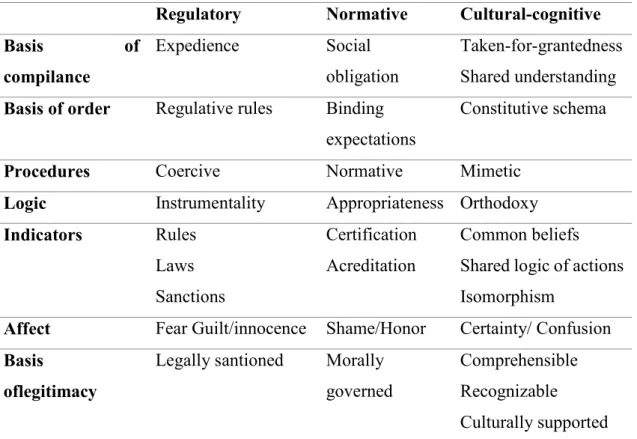
The following table 1 represents the differencies between the three domains of the institutional environment proposed by Scott (1995):
Table 1 - Three Pillars of Institutions
Regulatory Normative Cultural-cognitive Basis of compilance Expedience Social obligation Taken-for-grantedness Shared understanding
Basis of order Regulative rules Binding expectations
Constitutive schema
Procedures Coercive Normative Mimetic
Logic Instrumentality Appropriateness Orthodoxy
Indicators Rules Laws Sanctions Certification Acreditation Common beliefs Shared logic of actions Isomorphism
Affect Fear Guilt/innocence Shame/Honor Certainty/ Confusion
Basis
oflegitimacy
Legally santioned Morally governed
Comprehensible Recognizable
Culturally supported Source: Adapted from Scott (1995).
Firms are like institutions, they also contribute to build a structure of human interaction, by including, political, economic, social frames and educational frames (North, 1990). Each firm has incorporated its own institutional environment which involves systems and practices resulting from the past and the exterior institutional environment that is also shared with other firms. Internal and external institutional environment can both impact organization’s actions (Lu, 2002). DiMaggio & Powell (1983) prove that every organization is shaped by technical and institutional forces. They describe how the mechanisms by which institutional effects are disseminated by the organizational field, presenting three
Institutional quality, firm performance and business groups: evidence from emerging economies
9 mechanisms of institutional isomorphic change: coercive, mimetic and normative. The institutional environment forces firms to become more similar with each other by changing their structure and characteristics so that they can be compatible with the institutional setting. Firms are influenced by normative pressures, sometimes coming from an external factor such as the state, other times arising from within the organization itself (Zucker, 1987). The institutional development will affect firm’s entry strategies as well as manager’s necessity to find local resources will influence the entry strategies in different ways in different institutional environments (Meyer et al., 2009). Thus, the success of an organization is positively related with the degree in which an organization can successfully navigate in the external context where it is incorporated (Humphreys, 2010).
2.1.
Institutional environment in Emerging Markets
The institutional context is an important factor for firms to succeed since they not only influence the human behaviour (North, 1990) but they also have an impact on the strategies of the firms and management decisions (Ahlstrom et al., 2014; Meyer et al., 2009; Xu and Meyer, 2013), their behaviour (DiMaggio and Powell, 1983) and the resources evolution and capability (Peng et al., 2009). Emerging economies’ institutional environment is quite particular and the literature about it is extensive (Khanna & Palepu, 1997; Gaur & Kumar, 2009; Meyer et al., 2009; Xu & Meyer, 2013) since they provide a big source of investigation between the institutional environment with firm’s strategies and performance (Ahlstrom, 2014). They generate opportunities for firms and businesses scholars as well, so researchers have been interested in exploring and continuing their theories about the challenges that firms suffer when internationalizing into those markets, challenges that local firms must face and the challenges that firms from emerging economies face when internationalizing into other countries (Xu & Meyer, 2013). To understand the effects of operating in an emerging market, we need to understand also what is indeed and emerging market.
Countries that are characterized as being emerging markets usually are developing countries that are trying to transform their economies into efficient market economies and are recognized by the following characteristics: lower than average per capita income, higher rate of growth; higher volatility and instability; transitional economy: the government tries to create a structure of a market economy through decent economic reforms; higher than average levels of return (Ferreira, Serra & Reis, 2011). Khanna & Palepu (1997) characterize
Institutional quality, firm performance and business groups: evidence from emerging economies
10 emerging markets using a criterion of how well an economy supports buyers and sellers come together. Most economies provide a set of institutions that enables the relationship between buyers and sellers, although in many developing countries is not that easy due to their market failures (Young et al., 2014). Khanna & Palepu (1997) presented three main sources for market failures: information problems – managers need solid information to access to the products and services that they buy and the investments that they do, without it they are hesitant to do business; misguide regulations- in emerging economies there are some restrict laws that prevent firms to lay off workers, which is good because it provides stability to the society but firms are less capable to hold the opportunities when compared with advanced economies; and for last, inefficient judicial systems – firms will be hesitant to do business when there are no strong judicial systems to enforce contracts between partners in a consistent and expectable way.
In emerging economies, markets are less efficient due to the lack of transparency, they suffer from more information problems and higher monitoring and administration charges; governments not only set rules but they interfere with firm’s behaviours, some firms are state-owned or state-controlled; firms rely more on networks to interact with each other’s; risk and uncertainty are more high due to the instability of the institutional environment (Xu & Meyer, 2013). In emerging economies, the institutions that influence the firm operations are not stable (Young et al., 2008). Besides that, the formal institutions that exist in emerging economies generally do not encourage mutually beneficially impersonal exchange between economic actors which has as consequence that the firms rely more on the informal institutions. For example, in the case of corporate governance, emerging economies absence of effective and foreseeable rule of law which characterized them for having a weak governance environment (Young et al., 2008). This does not particularly mean that emerging economies have no law, it means that the formal institutions are inefficient or are not operating as they should (Young et al., 2014) resulting in a corporate governance shaped by the informal institutions, such as relational ties, business groups, family connections and government contacts (Ahlstrom et al., 2014; Young et al., 2008).
The local context matter and there are significant differences between developed and emerging markets, for example, the regulatory environment in emerging economies from Easter Europe is characterized for being predominantly vertical orientated and state centred that permeates the business task through excessive regulation also the radical economic reforms leads to higher unemployment levels (Manolova, Eunni & Gyoshev, 2008). The lack
Institutional quality, firm performance and business groups: evidence from emerging economies
11 of institutions to protect property rights, fair competition and financial discipline increases the risk which in turn makes business costlier. Relatively to the cognitive environment, they claim that managers with a socialist ancestry may possess higher education achievements but also possess lower levels of management capacity which makes it irrelevant or insufficient to guarantee short term venture survival in an environment that is constantly changing (Manolova, Eunni & Gyoshev, 2008). The differences between advanced economies and emerging are notorious, for example, while most emerging markets have few business schools and littles training, in United States it is easier to find high skilled managers, they have many business schools and consulting firms offering talent thus forming a high number of managers with capabilities (Khanna & Palepu, 1997). Contrary to advanced economies, emerging markets not only suffer from much more state intrusion in their business operations but also firms have difficulty in foreseeing the activities of regulatory bodies (Khanna & Palepu, 1997). Despite the extensive government intervention, emerging economies lack instruments to implement contractual agreements, while in developed countries firms can work together under contractual agreements because they know that courts will defend them in case the partner break their contract (Khanna & Palepu, 1997).
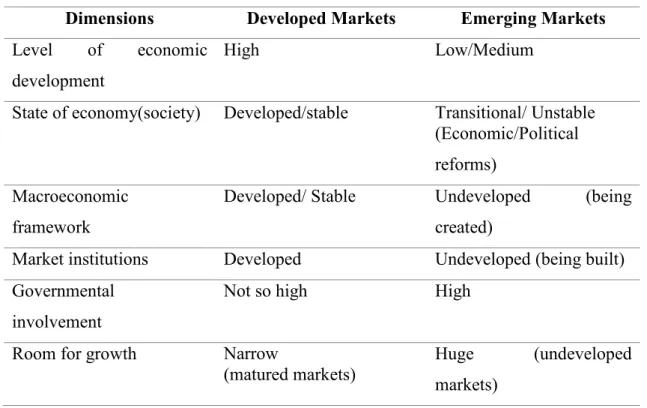
The following table demonstrates the main differences between developed and emerging markets:
Table 2 - Differences between developed markets and emerging markets
Dimensions Developed Markets Emerging Markets
Level of economic development
High Low/Medium
State of economy(society) Developed/stable Transitional/ Unstable (Economic/Political reforms)
Macroeconomic framework
Developed/ Stable Undeveloped (being created)
Market institutions Developed Undeveloped (being built) Governmental
involvement
Not so high High
Room for growth Narrow
Institutional quality, firm performance and business groups: evidence from emerging economies
12 Labour Market Many business scholars
and consulting firms offering talent
Few business scholars and little training; management talent scarce
Contract Enforcement predictable unpredictable
Source: Adapted from: Khanna and Palepu (1997); Adapted and translated from: Ferreira, Serra & Reis (2011).
Connecting institutional theory with emerging economies, home country institutions and institutional changes, format the behaviour of firms that perform in emerging economies, generating an advantage or disadvantage when performing in overseas markets (Xu & Meyer, 2013). The weak institutional environment of emerging economies not only affect local firms but also foreign entrants that might want to do business in emerging economies Xu & Meyer (2013). Foreign entrants are more likely to choose a joint venture than acquisition as an entry mode because emerging economies are can lead to smaller, more unstable and less liquid stock markets (Meyer et al., 2009). This concludes that the characteristics of the institutional environment of emerging economies has impact on firms, whether in their strategies or in their performance.
2.2.
Firm performance in Emerging markets
Firm performance in emerging economies has been a target of numerous studies (Khanna & Palepu, 1997; Karabag & Berggren, 2014), because several reasons can affect performance. Whether if it is something to do with the country, where the firm is operating or if it is even the strategy or the structure of the firm (Karabag & Berggren, 2014), so we can assume that performance is a very ambiguous subject. This study investigates how the quality of the institutional environment affects firm performance, so it is important to do a previous review on the existing literature about firm performance in emerging economies since the sample of this study is composed by emerging economies.
In emerging economies, researchers have found that industry structure and firm strategy have impact firm performance (Karabag & Berggren, 2014). In developed markets focused strategies may work well but may be wrong for emerging markets Khanna & Palepu, (1997). Emerging economies have less suffer from market failures which includes uncertain government behaviour leading to possible obstructions of any firm’s operations, deficiencies
Institutional quality, firm performance and business groups: evidence from emerging economies
13 in areas of human capital meaning that firms will battle to find employees with high skills and communicating with clients becomes more difficult (Meyer & Peng, 2016).
Firms are “planted” in country specific institutional arrangements, a weak institutional environment will affect firm performance negatively (Chen, 2015). In fact, the presence of institutional voids or market failures make transactions more difficult and costlier, becoming one of the reasons why firms have the propensity to belong to a larger network or a business groups in emerging markets (Gaur & Kumar, 2009). Strong economic institutions allow firms to benefit from access human capital and technology and skills, also, firms will suffer from less interference of the government in their behaviour (Li & Sun, 2017). This would translate, that a firm in a well-established institutional environment can operate more efficiently and competitively when compared with firms that are in a weak institutional environment (Li & Sun, 2017).
Institutional effects also have an impact the persistence of good or bad performance. Chacar & Vissa (2005) found that poor performance of the firms will persist longer in emerging economies than in developed economies. It seems that in emerging economies the inflexibility of the labour market frequently imposes legal constraints on managers and owners in their effort to take required action to regain profitability Chacar & Vissa (2005). Such institutional constrains are likely to intensify the power of dependent actor, such as employees, who benefit more from the maintenance of an organization independently of its performance Chacar & Vissa (2005). Poorly developed markets for corporate control, larger information asymmetry between buyers and sellers, non-executive directors in emerging markets are likely to have less power and legitimacy to supervise and discipline managerial action also lead to poor firm performance (Meyer & Peng, 2016). Additionally, the reputation associated with failure and bankruptcy of emerging economies (Young et al., 2014) will only aggravate the reasons mention above for the persistence of poor firm performance.
2.3.
Business Groups in Emerging Markets
Business groups are an organizational form in which a set of legally independent firms are bound together through formal and informal ties and are prepared to take coordinated action (Khanna & Rivkin, 2001). Ties in business groups are frequently incorporated in pre-existing social structures such as families and ethnicity that provide
Institutional quality, firm performance and business groups: evidence from emerging economies
14 customs and a moral basis that are a part of group coordination and transactions. This characteristic is what differentiates groups from other structural forms like alliances, conglomerates and holding firms (Chang, Chung & Mahmood, 2006). Some studies have revealed that financial, legal and human resources voids will not affect firm performance the same way and because of that, business groups will perform better than standing alone firms when operating in emerging markets due to the benefits they bring to affiliated firms (Khanna & Palepu, 1997; 2000). However, Khanna & Rivkin (2006) have found that other reasons like owner overlap, indirect equity holders and direct interlock can be a strong delineator of group boundaries instead of a family connection. Business groups have an important role in some countries although there are significant differences between them as well as their designation, for instance, in Japan we have the keiretsu, in China the chaebol, business houses in India, the bumiputera groups of Malaysia and Indonesia, also in Russia, the oligarchic financial-industry groups (Carney, 2008).
Groups also appear to have other differences in the level of diversification, vertical integration, in their involvement in banking and financial services, family control and in their political importance. Khanna &Yafeh (2007) have found that groups in Chile are more diversified than groups in South Korea, groups in India are way less vertically integrated than groups in Philippines, also groups in Philippines tend to be much more involved in banking and financial services than in Thailand. In some groups there is a higher family involvement than in others and while in some countries groups might represent a politically significant strength, in others the relationship between groups and the government tend to be more unstable. The differences between business groups around the world are a few but it is like Khanna & Palepu (1997, p.46) claimed “not every group adds value in the same way and no group can hope to fill every institutional void.”
The benefits and damages of business groups have been a target of several studies forming a deep division among investigators about the economic benefits of group affiliation (Karabag & Berggren, 2014). A proper example of that are some studies that characterize business groups as “paragons or parasites” (Khanna & Yafeh, 2007) or “heroes and villains” (Claessens, Djankov & Lang, 2000). Khanna &Yafeh (2007) have found that the portion of firms classified by domestic sources as a part of a business group is extensive, oscillating from about a fifth in Chile and two-thirds in Indonesia, also in the other countries of their study, groups tend to be quite large and economically significant. They also argue that, although groups may have a positive effect in underdeveloped economies, they can also
Institutional quality, firm performance and business groups: evidence from emerging economies
15 damage social welfare because of rent seeking and monopoly power. It is difficult to confirm whether groups are “parasites” or “paragons”, it depends on the country and maybe of the period.
The literature about business groups is broad and although most of the studies argue that business groups serve has a “safe haven “in the absence of institutions. Khanna & Palepu (2000) argue that there is no a priori theoretical reason to concentrate on market failures to explain the existence of business groups because groups can also mitigate problems in product markets, labour markets and in cross-border markets for technology (Khanna & Palepu, 1997). The benefits of business groups have been pointed out by other studies (Gaur, Kumar & Singh, 2014). Khanna & Rivkin (2001) examine the effects of group affiliation in 14 emerging markets and found that affiliates perform better than non-affiliates in six countries and worse in only three, the other five had no differences in profitability. Chang & Choi (1988) have also emphasised the importance of business groups reporting that thirty of the largest business groups in Korea represent 40,7% of the total value of shipments in the manufacturing sector and that business groups which have a multidimensional structure had better economic performance results, since this structure would help to overcome transaction costs due to organizational failures. Chu (2009) investigated the profitability of affiliated firms in Taiwan and found out that the size of the business group matter, in fact, when affiliated with small and medium-sized groups, their performance decreased but on the other hand when affiliated with the largest business groups, member firms indeed show improved stock market performance.
Despite the advantages, group affiliation also presents some disadvantages. For instance, Gaur & Kumar (2009) defend that the benefits of groups affiliation are context-dependent. Firms benefit from groups affiliation due to market failures, absence to institutions or the presence of government support but when the context changes, group affiliation may no longer bring benefits moreover it can represent a liability when operating in a developed country (Gaur & Kumar, 2009). Buysschaert et al. (2008) research has revealed that the benefits of group affiliation are lower in developed markets than in emerging economies since developed economies are characterized by strong institutional framework, the costs of being in a business group, such as misallocation of capital by strong subsidiaries subsidizing weaker institutions or the phenomenon “tunnelling”- a process where leading stakeholders transfer incomes from outlying to principal firms in which they hold relatively superior equity ownership -, would be much higher.
Institutional quality, firm performance and business groups: evidence from emerging economies
16 The effects of groups affiliation seem to be context dependent, in advanced economies like U.S, the institutional framework is characterized by well-functioning capital, workforce and product markets which means that is easier for firms to access to information, raise capital, gain costumer approval and play the “rules of the game”. In this environment, is less likely for firm to benefit from group affiliation (Khanna & Palepu ,1999). On the other hand, business groups are a common presence in emerging economies (Khanna & Rivkin, 2001). Emerging markets lack of for regulative, normative e cognitive institutions required for efficient market-based exchange (Gaur & Kumar,2009). In such circumstances, business group ties are advantageous because they offer a haven from market failures and offer access to resources that are inaccessible to stand-alone firms (Carney et al., 2011)
The access to institutions in emerging economies is poor since most of them are developing countries so firms might be unable to raise the necessary financing and without stronger educational institutions, they might have troubles to hire skilled employees in management, communicating with clients becomes more tough when the substructure is poor (Khanna & Palepu, 1997). However, business groups can simulate internally the functions provided by market institutions in developed countries (Khanna & Palepu, 1999). For example, in India the biggest business groups have built autonomous industrial cities implementing their own necessary infrastructure such as roads, telecommunications, electrical power, schools and medical facilities (Carney, 2008). This seems to agree with what Khanna & Palepu (1999) claim, business groups serve as intermediaries between entrepreneurs and imperfect markets, for instance, they can use their extensive scope to soften out the income flows and by thus assure the access to internal finance in a context where external finance is even more costly than in developed economies, groups also facilitate the access to technology for member firms. From a transaction costs perspective, business groups also help to develop managerial talent and improve the lack of lack of skilled labour and comparing it with stand-alone firms, business groups do it more efficiently due to transaction recurrence (Chang & Choi, 1988).
The advantages and disadvantages of business groups appear to be many, also, their success and purpose seem to be context dependent. The prior literature about business groups shows that in many emerging economies they are a common organizational strategy used by firms to overcome the institutional voids, so I will test to see if in a context where the institutional environment is weak, such as emerging economies, firms that are group affiliated can improve their performance when compared with standalone firms.
Institutional quality, firm performance and business groups: evidence from emerging economies
17
Conceptual Framework
The literature review shows us that the institutional environment is important for companies to do business; in fact, it is acceptable to affirm that countries with strong formal and informal institutions create more robust environments for firm performance (LiPuma, Newbert & Doh, 2013). This means that the “rules of the game” will affect the “players of the game”.
3.1.
Regulatory environment and firm performance
Emerging economies are more likely to suffer from high levels of regulatory volatility which might be reflected on regular and unpredicted changes in government policies, government interference in business and inadequate means to enforce laws and contracts (Hernandez & Nieto, 2015). A change in the regulatory environment is faster than in the normative or cognitive environment, so it is more difficult for firms to be prepared to these changes that will have an impact on firm’s decisions exposing them to more risks (Hernandez & Nieto, 2015; Meyer & Peng, 2016). Researchers have found that rules and laws, more exactly the legal framework of a given country can shape the transactions costs in some markets and influence investor’s strategic choices and firm’s performance (Li & Sun, 2017).
Political institutions encourage rule of law, without it there would be no transparency and law enforcement which would lead that contractual agreements are not so protected and thus the risks and costs of doing business will increase, it would also lead to poor enforcement intellectual property rights (Meyer & Peng, 2016). Strong property rights are an encouragement for firms to innovate and operate competitively, therefore property rights are a crucial factor for a positive firm performance (Li & Sun, 2017). The performance of firms, special the new ones and the smaller ones, will be affected by the institutional quality of the environment where they are inserted, which include consistent transparent regulation, a well-developed and fair legal system, low levels of bureaucracy and easy access to financial services (LiPuma, Newbert & Doh, 2013).
The quality of the regulatory environment is reflected by of how well the legal systems work in order to encourage transparency, strong property rights and protection of
Institutional quality, firm performance and business groups: evidence from emerging economies
18 contractual agreements. Emerging economies are characterized by the lack of transparency misguide regulations and. inefficient judicial systems which mean the quality of the regulatory environment has low quality, this will translate in a decrease of firm performance when comparing with advanced economies since in this environment firms will not entirely take advantage of the opportunities to invest (Bulow, 2015).
Hypothesis 1: In emerging economies, the lower the quality of the regulatory
environment the lower is firms’ performance.
3.2.
Normative environment and firm performance
The normative and cultural cognitive environment refer to informal institutions. These informal aspects in a country can be reflected on the level of corruption, the responsiveness of political systems to economic challenges, transparency in governance, the importance of business networks and connections and culture (Gaur, Delios & Singh, 2007). Norms exist on the society level, however, they are incorporated by individuals, and individuals’ behaviour is mutually persuaded by norms. Corruption is one of the most serious threats to society and is a behaviour of public officials, which differs from the norms (Chabova, 2017). In developing countries where the laws and public system lack of fairness and does not assure equal access to services it is more favourable to be corrupt while in countries that are democratic and have a strong regulatory environment it is more favourable to be honest (Chabova, 2017). Firms from developed countries are more likely to have a corporate culture of transparency due to their norms and believes and that’s why foreign -owned firms in Moscow are less likely to misrepresent their employees’ salaries due to this transparency (Zhao, Teng & Wu, 2018).
The new institutional economic sociology claims that individuals perform in a context-bounded rationality, shaped by tendencies, networks, norms, cultural values and institutional environment (Hechavarria & Reynolds, 2009). Culture is a part of the normative environment since is it is a set common norms, beliefs and behaviours and thus the normative environment of a country will affect manager’s behaviour in different ways (Hechavarria & Reynolds, 2009). People will act according with their values and norms, for example, a culture that encourages entrepreneurial behaviours tends to develop innovation while cultures that encourages conformism has less probability to encourage such behaviours (Hechavarria & Reynolds, 2009). In order for firms’ normative environment to provide
Institutional quality, firm performance and business groups: evidence from emerging economies
19 sustained competitive advantages and thus ,contribute to greater financial performance, certain requirements must be satisfied; the norms and values must be relevant, it must allow a firm to do things and behave in ways that lead to high sales, reduce costs high margins or in other ways add financial value to firms (Adekunle & Jude, 2014).
The informal institutions such as unwritten rules and norms of behaviour will shape the process through which firms will gain legitimacy from the local community to boost their probability of survival and growth over time (Roxas & Chadee, 2012). Norms and conducts of behaviour influence people which in turn will influence the way people act within an organization, the quality of the normative institutional environment will impact firm performance, such as, firms acting in environments with lower normative institutional quality will decrease their performance.
Hypothesis 2: In emerging economies, the lower the quality of the normative
environment the lower is firms’ performance.
3.3.
Cognitive environment and firm performance
The cognitive environment assumes what is taken for granted in an individual’s mind as if it is something that is a part of the common sense that is not questioned (Scott, 1995). Cognition incorporates the intellectual processes through which information is collected, changed, stored, recovered, and used (Adekunle & Jude, 2014). Cognition maps of human beings are a significant predictor of behaviour, since these maps are created through culture and the social environment which helps us to understand the differences in individual’s behaviour between countries (Busenitz & Lau, 1996). In business, also the way of how people think will influence their behaviour within an organization, for example, some decisions of stating a new venture are influenced by the way of how the managers remark and interpret the countries’ environment (Busenitz & Lau, 1996). Manager’s perceptions of the environment where they form business might play a key role in the firm’s chances of success (Hechavarria & Reynolds, 2009).
Every country has their own culture and culture affects how people behave, so it is expected that different cultures will affect people in a different way (Busenitz & Lau, 1996). Studies have discovered that in China, managers appreciated participative decision making much more than Hong Kong managers and that in turn Hong Kong managers prefer internal competition and individual risk-taking initiative, consequently leading to essentially
Institutional quality, firm performance and business groups: evidence from emerging economies
20 dissimilar ways in which business opportunities are examined and explored (Busenitz & Lau, 1996). The quality of the cognitive environment will depend on what people believe and the kind of knowledge people have that is a part of the common sense or what is taken for granted, which will affect what managers believe what is right or wrong for the organization affecting also the performance of the organization itself.
Hypothesis 3: In emerging economies, the lower the quality of the cognitive
environment the lower is firms’ performance.
3.4.
Moderating effect of business group affiliation
The regulatory environment plays an important role for firms to succeed but this environment is not always the most favourable. In countries with too many state interventions sometimes it is difficult for firms to regulate their workforce to altering their economic condition, by implementing inflexible labour regulation the government may prevent firms to lay of their employees and labour unions may insist on job security in the absence of government-provided unemployment assistance (Khanna and Palepu, 1997).
Business groups can be a major help to overcome these inflexibilities since they can create extensive internal markets of their own, for example, if the prospects of an affiliated are falling its employees can move to another group company that is on the rise (Manikandan & Ramachandran, 2015). In addition to the excessive government intervention, in emerging economies, firms also have difficulties in predicting the actions of the regulatory system (Meyer & Peng, 2016). For example, in India the law sometimes establishes criteria of for various business decisions, so Indian bureaucrats have a lot of discretion in how they apply the rules (Khanna and Palepu, 1997). In cases like this business groups serve as an intermediary when their singular firms need to deal with the regulatory bureaucracy.
The strength of the regulatory environment also includes the formal protection for property rights and contract, including efficient government regulation and courts. The credibility of the judicial systems makes it easy for everyone but that not always happen, if the regulatory environment does not include formal protection for property rights and contract, firms will face more difficulties to resolve disputes trough judicial systems (Khanna & Palepu, 1997). In many Asian countries the organization of firms into business groups is due to the lack of regulatory institutions that can guarantee business transactions (Estrin & Prevezer, 2011). Business groups interchanging repeatedly with one another create markets
Institutional quality, firm performance and business groups: evidence from emerging economies
21 for capital, high skilled employers, technology, and other resources that are expensive or unreachable through market contracting (Estrin & Prevezer, 2011. Group reputation replaces for underdeveloped legal and regulatory instruments that leave smaller investors susceptible to expropriation risks and information asymmetries (Khanna and Palepu, 2000; Manikandan & Ramachandran, 2015), so I proposed that being a part of a business groups will moderate the effect of low regulatory quality in emerging economies on firm performance:
Hypothesis 4: In emerging economies, business group affiliation will moderate the
effect of regulatory quality on firm performance, such as firm that are affiliated to a business group will perform better than standalone firms.
The normative environment is composed by unwritten rules and norms of behaviour that will shape the process through which firms will gain legitimacy from the local community to boost their probability of survival and growth over time (Roxas & Chadee, 2012). The quality of the normative institutional environment will depend of these unwritten rules and norms of behaviour and it can be reflected on the level of corruption, the responsiveness of political systems to economic challenges, transparency in governance, the importance of business networks and connections and culture (Gaur, Delios & Singh, 2007). High levels of corruption, lack of transparency in governance leads to lower quality of the normative environment consequently affecting firm’s legitimacy and performance so it is important for firms to have strong business networks and connections (Meyer & Peng, 2016). For firms from emerging economies it is difficult and expensive to gain legitimacy in foreign countries due to the weak country-of-origin effects and absence of any prior recognition (Gaur and Kumar, 2009).
Under these conditions, the predominance of business groups in emerging markets helps firms overcome some of the challenges they face. Firms which are group affiliated have better access to the information, knowledge and resources implanted in the social relationships of family and business groups (Chung & Luo, 2013). Firms inserted in strong social networks operate distinctively with regard to the low quality of the normative environment, since these networks offer benefits to the affiliated firm such as quality real-time information, joint problem solving, learning and reciprocal assistance when comparing with stand-alone firms. A second important theory emerging from sociology highlights solidarity norms and codes of behaviour in business groups proposing that business groups might generate a “moral community” within which there is less probability of opportunistic
Institutional quality, firm performance and business groups: evidence from emerging economies
22 behaviour which should affect positively the performance of group affiliated members (Khanna and Palepu, 2000), so I propose that group affiliation can moderate positively the effect of lower normative institutional quality on firm performance:
Hypothesis 5: In emerging economies, business group affiliation will moderate the
effect of normative quality on firm performance, such as firm that are affiliated to a business group will perform better than standalone firms.
In the beginning, the idea of cognitive maps was mostly viewed as an individual-level concept, however, some scholars have discussed that the individuals of the same firm may share the same cognitive maps (Grewatsch & Kleindienst, 2017). Members of the same functional area or community of practice have identical experiences and interpret those experiences identically (Mitchell & Nicholas, 2006). Firms belonging to a business group may face identical problems, so it is easier for them to find the solutions once they share the same cognitive maps.
Being a part of a business group generates a greater opportunity of management turnover since an extensive portion of new top managers comes from other group members; and usually managers become more experienced subsequently (Shi, 2015). The connection between several distinct areas of the group represents an opportunity of exchange of knowledge that is exclusive to each area (Mitchell & Nicholas, 2006). Business groups not only provide more tacit knowledge and capabilities to affiliates but also group affiliated firms tend to be more autonomous than subsidiaries or multidivisional firms since they are legally distant from each other (Mukherjee, Makarius & Stevens, 2018).
In some countries where goals are unclear or when the institutional environment generates representative uncertainty, firms may shape themselves to other firms since problematic search may yield a feasible solution with little expenditure (DiMaggio & Powell, 2000). Firms belonging to a business groups may imitate other firms from the same group by sharing the same cognitive maps which would be an advantage when facing problems. Besides, belonging to a business groups will lead to mutual trust and routine interactions between the members of the group allowing them to share available information within the group (Chung & Luo, 2013). I proposed that in emerging economies when the quality of the cognitive environment is low being a part of a business groups will lead to better performance than acting alone.
Institutional quality, firm performance and business groups: evidence from emerging economies
23
Hypothesis 6: In emerging economies, business group affiliation will moderate the
effect of cognitive quality on firm performance, such as firm that are affiliated to a business group will perform better than standalone firms.
The hypotheses above mention are schematically represented in the figure below:
Figure 1- Conceptual Model
Institutional quality, firm performance and business groups: evidence from emerging economies
24 This page was intentionally left on blank
Institutional quality, firm performance and business groups: evidence from emerging economies
25
Method
4.1.
Data and Sample
This study uses a sample of business groups and stand-alone firms, from a period of 2007 to 2016, that are listed on the Enterprise Survey from the World Bank Group. The Enterprise Survey is a firm-level survey of an illustrative sample of an economy's private segment. The surveys cover an extensive range of business environment themes including access to finance, corruption, substructure, crime and disorder, competition, and performance measures. The World Bank collects enterprise data to evaluate manager’s consciousness of business environment to develop a better insight about firm behaviour and performance. The World Bank Enterprise Survey also has available information about firm’s attributes as well as group affiliation, human resources practices, technological innovation and other management proceedings, besides, it also provides information about the control variables.
The sample is composed by 5.166 observations from 19 emerging economies represented in table 8: Brazil, Chile, China, Colombia, Czech Republic, Egypt, Hungary, India, Indonesia, Malaysia, Mexico, Morocco, Peru, Philippines, Poland, Russia, South Africa, Thailand, and Turkey. These emerging economies where chosen from the MSCI (Morgan Stanley Capital International) Emerging Market Index which captures the large and mid-capitalization emerging markets equities.
The reasons why I choose emerging economies to conduct this study are: first, emerging markets are characterized by the lack of institutions and market failures (Khanna & Palepu, 2000) which turns them into a favourable sample to investigate if the firm performance is associated with poor institutions. Second, once business groups are a response to market failures (Gaur & Kumar, 2009) by simulating internally the functions provided by market institutions in developed countries (Khanna & Palepu, 1999), they are mostly common in emerging economies than in developed economies which turns emerging economies an appropriate sample to test the moderating effect of group affiliation. Third and last, emerging markets are target of several studies (Chacar & Vissa 2005; Chang, Chung & Mahmood, 2006; Freytag & Voll, 2013; Xu & Meyer, 2013; Manolova, Eunni & Gyoshev, 2008) since they motivate the growth in the global economies because they are devoting in more productive capacity.
Institutional quality, firm performance and business groups: evidence from emerging economies
26
4.2.
Variables
4.2.1. Dependent Variable
Firm performance. This study focuses on the relationship between firm performance and the institutional environment in Emerging economies. Firm performance is main research question within the field of International Business (IB) and as a result, performance is a crucial dependent variable of interest to IB scholars (Li & Sun, 2017). Firms operating in countries with weaker institutions will be affected in their performance negatively when compared with firms operating in countries with stronger institutions. Following extant research (Gaur and Kumar, 2009; Li & Sun, 2017) I present the sales of current year to measure firm performance, more exactly the ln of the sales, using the data from the Enterprise Survey from the World Bank.
4.2.2. Independent Variables
Regulatory Quality. The independent variable Regulatory Quality capture of how strong the regulatory institutions are, of how well the laws are being enforced. Is measured trough one of the World-Wide Governance indicators from the World Bank Group. The World’s bank governance indicators have been implemented from several studies since the six indicators (Voice & Accountability, Political Stability and Lack of Violence, Government Effectiveness, Regulatory Quality, Rule of Law, and Control of Corruption) cover 209 countries and regions starting from year 1996 (Ang, Benischke, & Doh, 2015). I choose the indicator regulatory quality which according with the world Bank captures perceptions of the aptitude of the government to articulate and implement sound policies and regulations that allow and encourage private sector development (Kaufmann, Kraay & Mastruzzi, 2011). The measurement of this variable is made by using the standard normal units of the governance indicators, ranging from -2,5 to 2,5 governance performance to define regulatory and normative quality, with the higher values indicating a better governance performance (Kaufmann et al., 2011). To avoid using negative values that could make the results confusing, I transformed this variable and re-computed the scale from -2,5 to 2,5 to 0 to 5. Normative Quality. The normative institutional pillar consists in a set of values, norms and beliefs that are represented in the form of national culture in each country (Scott, 2001). The beliefs reside on the importance of “group” against “individual” in society that govern actions, also the importance of consistently applied rules versus personal relationships or mutuality (Alexander, 2012). Collective responsibility, trustworthiness and mutual