Physiological performance during storage of corn seed treated
with insecticides and fungicide
1Cristiane Deuner
2*, Karla Crystina Rosa
3, Géri Eduardo Meneghello
2,
Carolina Terra Borges
2, Andréia da Silva Almeida
2, Alberto Bohn
2ABSTRACT – The goal of storage is to maintain the characteristics that seeds have immediately after processing; however, when this is over longer periods, storage may cause loss in quality. The aim of this study was to evaluate the effect of treatment with insecticide and fungicide on corn seeds harvested in kernel form and in the ear over the time of storage in two environments for 360 days. The seeds were subjected to the following treatments: T1 - control; T2 - Deltamethrin + Pirimiphos-methyl + Fludioxonil; T3 - Deltamethrin + Pirimiphos-Pirimiphos-methyl + Fludioxonil + Thiamethoxam; T4 – Thiamethoxam, and T5 - Fenitrothion. They were then placed in paper bags and stored in two environments, in a cold room with an average temperature of 16 °C and RH of 60% and in a non-controlled environment (an average room temperature of 25 ºC and RH of 70%) located in the municipality of Pelotas, RS, Brazil. Every four months (0, 120, 240 and 360 days), seed germination and vigor was evaluated by the first count of germination test and cold test. Reduction in germination and vigor of corn seeds, conditioned by the insecticides and fungicide used in the seed treatment, vary according to the product and the time over which the seeds remain stored. The seeds harvested in the ear show lower loss of physiological quality than those harvested in kernel form.
Index terms: Zea mays L., germination, vigor, seed treatment.
Desempenho fisiológico durante o armazenamento de sementes de milho
tratadas com inseticidas e fungicida
RESUMO - O armazenamento tem por objetivo manter as características que as sementes possuem imediatamente após o beneficiamento, porém, quando por períodos mais extensos, o mesmo pode causar perdas na qualidade das mesmas. O objetivo neste trabalho foi avaliar o efeito do tratamento com inseticida e fungicida sobre sementes de milho colhidas a granel e em espiga durante o armazenamento em dois ambientes por 360 dias. As sementes foram submetidas aos tratamentos: T1- testemunha; T2- Deltamethrin + Pirimifós-metílico + Fludioxonil; T3- Deltamethrin +Pirimifós-metílico + Fludioxonil + Tiametoxam; T4- Tiametoxam e T5- Fenitrothion. Em seguida, foram acondicionadas em sacos de papel e armazenadas em dois ambientes: câmara fria com temperatura média de 16 °C e UR de 60% e em ambiente não controlado (câmara com temperatura média de 25 ºC e UR de 70%, localizada no município de Pelotas-RS). A cada quatro meses (0; 120; 240 e 360 dias) foi avaliada a germinação e o vigor das sementes, pelos testes de primeira contagem de germinação e teste de frio. A redução da germinação e do vigor de sementes de milho, condicionada pelos inseticidas e fungicida utilizados no tratamento das sementes, varia em função do produto e do tempo em que as sementes permanecem armazenadas. As sementes colhidas em espiga apresentam menor perda da qualidade fisiológica em relação às colhidas a granel.
Termos para indexação: Zea mays L., germinação, vigor, tratamento de sementes.
1Submitted on 11/12/2013. Accepted for publication on 02/19/2014. 2Faculdade de Agronomia Eliseu Maciel, FAEM, UFPel, Caixa Postal 354, 96010-900 - Pelotas, RS, Brasil.
3Helix Sementes Ltda., 38703-900 - Patos de Minas, MG, Brasil. *Corresponding author: <[email protected]>
Introduction
Corn (Zea mays L.) is one of the most important cereal crops and is currently the most highly produced grain in the world (38.1%), followed by wheat (29.1%), and rice (20.8%) (Companhia Nacional de Abastecimento - CONAB, 2013).
(CONAB, 2013). For the 2013/14 harvest season, the estimate is that 78,783 million tons of corn grain will be produced, which corresponds to 40% of the total grain harvest, which is 195,906 million tons. As for the production of seed corn, the effective demand in the 2012/13 crop season was 282,352 thousand tons (ABRASEM, 2013).
One of the most delicate steps in the production of corn seeds is harvest because this should occur as near as possible to physiological maturity (Peske et al., 2012). Seeds may be harvested in a manual or mechanical manner. Manual collection leads to less damage to the ear, as well as manual shelling; however, the yield from harvest is very low, requiring a great deal of labor, which increases costs, and it is more appropriate for small properties and highly sloped land (Pimentel and Fonseca, 2011). Delayed harvest may lead to losses in the physiological quality and health of the seeds; therefore, harvest should occur at the appropriate time, as near as possible to physiological maturity, for maximum reduction of possible losses (Henning et al., 2011), and this is only made viable in a technical way through harvest in the ear. Mechanical harvest may be made by removing the ears with husk, the ears without husk, or the material already shelled from the field. In mechanized harvest with shelling, suitable machine adjustment is important to reduce quantitative and qualitative losses; i.e., loss of grains or mass of grains, strictly speaking, and reduction in quality from cracking and breakage of the grain, as well as the occurrence of diseases (Pimentel and Fonseca, 2011). An additional negative aspect of mechanized harvest is emphasized by Gomes et al. (2009) upon reporting that the damage caused to seeds by mechanized operations during production may have a negative effect on the quality of the material obtained.
Physiological maturity is seen as the ideal time, from the physiological point of view, to harvest the seeds; however, at that time, the seeds have high moisture content (30 - 40%), making it difficult to remove the seeds from the cob; removal may result in crushing them. To avoid this physical damage to seeds during harvest of the kernels, i.e., the material is already shelled from the ear, harvest is recommended when grain moisture is from 18 to 26% (Fancelli and Dourado Neto, 2000). Another option is harvesting whole ears, without removing the husk and the cob, when the seeds still have around 30% moisture and dry them artificially before shelling (Rosa et al., 2002). That will reduce the risk of seeds from being contaminated by diseases at the end of the cycle (Ferreira et al., 2013) since the seeds are removed from the field earlier, near physiological maturity.
Another important factor to consider is storage. Although the goal is to maintain the quality of the biological product
during the period of storage (Villela and Peres, 2004), over longer periods of time, storage may cause loss in seed quality, which is intensified in environments without control of temperature and relative air humidity, thus leading to degenerative changes. This may be minimized when the seeds are stored in adequate conditions (Santos et al., 2004). As a rule, corn seeds remain under storage for more than six months before being used in the next crop season and often in warehouses that do not have temperature and moisture control.
One of the biggest problems of prolonged storage is in regard to storage pests, such as weevils, which lead to qualitative and quantitative losses in seeds and grains (Antonello et al., 2009). In this respect, it is of utmost importance to prevent attack from pests through the application of insecticides and to maintain the seeds at a lower temperature to avoid insect proliferation and maintain seed quality.
In addition to the advantage of combating insects, fungi and nematodes, using treated or protected seeds is of great importance since the seeds constitute a vehicle for bearing technology. Nevertheless, applying products such as fungicides, insecticides, nematicides, hormones and stains to seeds may increase the risks of reducing the physiological quality of seeds to a greater or lesser extent depending on the agent used. Thus, it is necessary to perform specific studies on seed treatments with products of the most advanced technology in regard to storage (Peske and Baudet, 2006).
Therefore, the aim of this study was to evaluate the effect of treatment with insecticides and fungicide on corn seeds harvested in kernel form and in the ear over the storage period in two different environments.
Materials and Methods
This study was developed in the Seed Analysis Teaching Laboratory (Laboratório Didático de Análise de Sementes-LDAS) of the Plant Science Department of the Eliseu Maciel School of Agronomy at the Universidade Federal de Pelotas (UFPel), Pelotas, RS, Brazil. Commercial hybrid corn seeds were used, harvested in kernel form and in the ear.
to a drying chamber with temperatures from 36 to 40 ºC, until reaching 12% moisture. After drying, the ears were mechanically shelled and went through pre-cleaning, followed by classification and the gravity table. Finally, the seeds were subjected to chemical treatment.
The chemical treatments consisted of insecticides, and the commercial products contained the following active ingredients in their formulations: Deltamethrin, concentration of 25 g.L-1 (2.5% m/v), rate of 1.4 L / 15 t-1;
Pirimiphos-methyl, concentration of 500 g.L-1 (50.0% m/v), rate of 1.4
L / 15 t-1; Fenitrothion, concentration of 500 g.L-1 (50%
m/v), rate of 0.02 L.t-1; and Thiamethoxam, concentration of
700 g.kg-1 (70% m/m), rate of 0.12 L / 0.02 t-1. A fungicide
was also used, containing Fludioxonil at a concentration of 25 g.L-1 (2.5% m/v) and rate of 0.097 L.t-1. These products
constituted five seed treatments: T1 – without treatment; T2 - Deltamethrin + Pirimiphos-methyl + Fludioxonil; T3 - Deltamethrin + Pirimiphos-methyl + Fludioxonil + Thiamethoxam; T4 – Thiamethoxam; and T5 - Fenitrothion. The seeds were then placed in paper bags and sent to the LDAS of the Department of Plant Science of the Eliseu Maciel School of Agronomy, UFPel, Pelotas, RS, Brazil, where they were stored in two environments - in a cold room with an average temperature of 16 °C and RH of 60%, and in a non-controlled environment (storeroom with an average temperature of 25 ºC and RH of 70%).
At the beginning and at every 120 days of storage (0, 120, 240 and 360 days), seed germination and vigor were evaluated by the first count of germination test and cold test.
Germination: carried out by sowing 200 seeds per treatment, divided into four replications of 50 seeds. Evaluations were made at four and seven days after sowing, according to the Rules for Seed Testing (Brasil, 2009). The results were expressed in percentage of normal seedlings.
First count of germination: made together with the germination test evaluated on the fourth day after sowing, according to Brasil (2009).
Cold test: conducted with four replications of 50 seeds per treatment. The same procedure as the germination test was adopted; however, the rolls were kept for seven days at a temperature of 10 °C and were then taken to the germinator at a temperature of 25 °C, where they remained for four days, at which time the percentage of normal seedlings was evaluated (Barros et al., 1999).
The experiment was conducted under a completely randomized design in the factorial arrangement of 2 forms of harvesting x 5 seed treatments x 4 evaluation times, with four replications, for a total of 40 treatments and 160 experimental units.
The data were subjected to analysis of variance to test
main effects and interactions of the factors and the F test was done with a 5% significance level. The mean values of the qualitative factors were compared by the Tukey test at 5% probability and polynomial regression for the quantitative factor of time of evaluation, choosing the significant regression model of highest degree, with a coefficient of determination above 70%.
Results and Discussion
Through analysis of variance of germination, significant interaction was seen, with distinct behavior being observed among the variables analyzed for the factors of manner of harvest and type of storage.
In regard to germination, a significant difference was observed among the chemical treatments for the seeds harvested in kernel form and stored in a non-controlled environment after 240 days of storage; and treatment 3 (Deltamethrin + Pirimiphos-methyl + Fludioxonil + Thiamethoxam) showed the greatest reduction in percentage of germination (Table 1).
Table 1. Mean values of germination test (GER) of corn seeds subjected to different treatment with insecticides and fungicide during storage.
Harvest Storage Time (days) T1 T2 T3 T4 T5
Kernel Climate-controlled
0 90 91 90 88 92
120 80 92 89 91 93
240 88 88 79 85 86
360 86 90 73 79 86
Mean 88a 90a 82b 86ab 89a
CV(%) 6.02
Kernel Environment
0 92a 90a 91a 89a 92a
120 96a 89a 89a 86a 92a
240 85ab 88a 75b 78ab 88a
360 70b 87a 56c 74b 79b
Mean 86 88 78 82 88
CV(%) 6.80
Ear Climate-controlled
0 96 97 98 99 97
120 98 96 99 98 97
240 94 93 93 93 95
360 95 94 91 91 95
Mean 96 95 95 95 96
CV(%) 2.98
Ear Environment
0 98 96 96 96 98
120 95 94 96 96 98
240 91 94 87 92 92
360 91 92 90 92 90
Mean 94 94 92 94 94
CV(%) 3.59
*Mean values followed by the same letter in the row do not differ among themselves by the Tukey test at 5% probability.
y = 0.022 x+91.07 R² = 84
30 40 50 60 70 80 90 100
0 120 240 360
GER (
%
)
Storage time (days)
GER
30 40 50 60 70 80 90 100
0 120 240 360
GER (
%
)
Storage time (days)
T1
T2
T3
T4
T5 y=NS
y=NS
y=NS
y=NS
y=NS
y = -0.0003x2+ 0.0483x + 92.55 R²= 98
y = -0.0003x2+ 0.0044x + 91.27 R² = 100
y = -0.0442x + 89.45 R² = 97 y = -0.0367x + 94.1 R² = 82 30
40 50 60 70 80 90 100
0 120 240 360
GER (
%
)
Storage time (days)
T1 T2
T3 T4
T5 y=NS
30 40 50 60 70 80 90 100
0 120 240 360
GER (
%
)
Storage time (days)
T1
T2
T3
T4
T5 y=NS
y=NS
y=NS
y=NS
y=NS
D A
B
C
Comparing the chemical treatments in each period of storage, it may be observed that for the first count of germination test (Table 2), the treatments did not show a difference for the seeds harvested in the ear and stored in a cold room. The seeds harvested in kernel form and kept in a climate-controlled environment, for their part, showed
a significant difference only after 360 days of storage, and treatments 3 (Deltamethrin + Pirimiphos-methyl + Fludioxonil + Thiamethoxam), 4 (Thiamethoxam) and 5 (Fenitrothion) had results lower than the others. Thus, the importance of temperature and moisture control during seed storage may be seen.
Table 2. Mean values of the First Count of Germination (FCG) of corn seeds subjected to different treatments with insecticides and fungicide during storage.
Harvest Storage Time (days) T1 T2 T3 T4 T5
Kernel Climate-controlled
0 80a 85a 82a 76a 86a
120 84a 86a 83a 87a 87a
240 75a 82a 76a 77a 82a
360 70a 77a 58bc 67ab 55c
Mean 77 82 74 77 77
CV(%) 7.38
Kernel Environment
0 86a 81a 87a 81a 85a
120 90a 82ab 78b 77b 90a
240 64ab 66a 54b 66a 67a
360 53bc 67a 43c 56ab 56ab
Mean 73 74 65 70 74
CV(%) 8.08
Ear Climate-controlled
0 86 87 84 91 87
120 89 94 95 93 89
240 73 84 86 86 87
360 70 71 69 70 71
Mean 79a 84a 83a 85a 83a
CV(%) 6.57
Ear Environment
0 86ab 87a 87a 87a 77b
120 91a 91a 90a 91a 89a
240 72b 81ab 78ab 83a 71b
360 60b 78a 62b 59b 67b
Mean 77 84 79 80 76
CV(%) 6.63
*Mean values followed by the same letter in the row do not differ among themselves by the Tukey test at 5% probability.
There was a difference over the storage period for all the treatments (Figures 2A, B, C, D); however, in the seeds harvested in the ear and stored in a cold room, the treatments showed the same behavior (Figure 2C), fitting a quadratic equation, showing stability up to the time of 120 days and more intense reduction after this period. Chemical treatment 3 (Deltamethrin + Pirimiphos-methyl + Fludioxonil + Thiamethoxam) was that which had the greatest negative effect, showing a percentage of germination less than 50% at 360 days after storage (Figure 2B). In general, the results of chemical treatment 2 (Deltamethrin + Pirimiphos-methyl + Fludioxonil) were better than the other treatments, in regard to first count of germination.
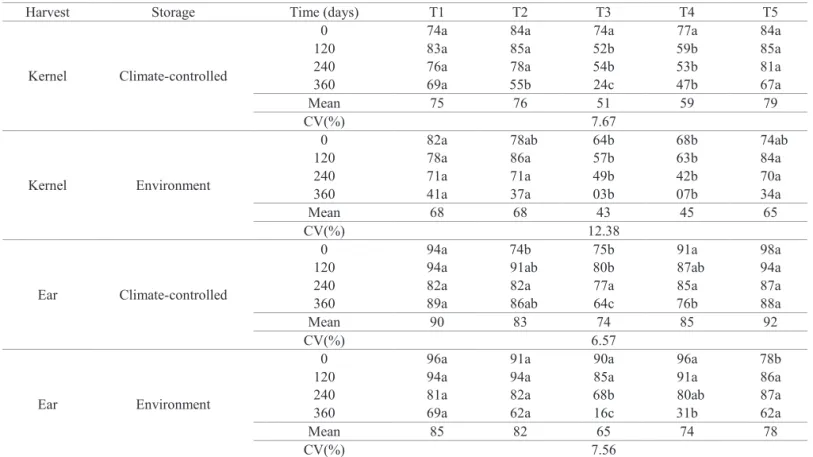
In regard to vigor, evaluated by the cold test, a difference was seen among the chemical treatments for all the periods and locations of storage and forms of harvest (Table 3), except at time zero for the seeds harvested in kernel form and kept in a climate-controlled
y = -0.0004x2+ 0.0578x + 86.97 R² = 97
y = -0.0320x + 90.01 R² = 70
y = -0.0004x2+ 0.0734x + 86.97 R² = 100
y = -0.0005x2+ 0.1200x + 86.13 R² = 97
y = -0.0004x2+ 0.0885x + 78.26 R² = 77
20 30 40 50 60 70 80 90 100
0 120 240 360
F
C
G
(
%
)
Storage time (days)
T1 T2 T3 T4 T5
D
y = -0.0325x + 82.85 R² = 71 y = -0.0245x + 86.55 R² = 84
y = -0.0003x2+ 0.0556x + 81.42 R² = 100
y = -0.0004x2+ 0.1047x + 76.57 R² = 89
y = -0.0005x2+ 0.0952x + 85.17 R² =98
20 30 40 50 60 70 80 90
0 120 240 360
FCG (%)
Storage time (days)
T1 T2 T3 T4
T5
A
y = -0.0003x2- 0.0131x + 88.17 R² = 90
y = -0.0477x + 82.4 R² = 74 y = -0.1287x + 88.3 R² = 97
y = -0.0733x + 82.95 R² = 97 y = -0.00027x2+ 0.01x + 86.45 R² = 89
20 30 40 50 60 70 80 90 100
0 120 240 360
F
C
G
(
%
)
Storage time (days)
T1 T2 T3 T4 T5
B
y = -0.0003x2+ 0.0851x + 86.68
R² = 100
20 30 40 50 60 70 80 90
0 120 240 360
FCG (%)
Storage time (days) PCG
C
FCG
Figure 2. A: First count of germination (FCG) of corn seeds harvested in kernel form and stored in a cold chamber storage; B: FCG of corn seeds harvested in kernel form and stored in a non-controlled environment; C: FCG of corn seeds harvested in the ear and stored in a cold chamber storage; D: FCG of corn seeds harvested in the ear and stored in a non-controlled environment.
Table 3. Mean values of the Cold Test (CT) of corn seed subjected to different treatments with insecticides and fungicide during storage.
Harvest Storage Time (days) T1 T2 T3 T4 T5
Kernel Climate-controlled
0 74a 84a 74a 77a 84a
120 83a 85a 52b 59b 85a
240 76a 78a 54b 53b 81a
360 69a 55b 24c 47b 67a
Mean 75 76 51 59 79
CV(%) 7.67
Kernel Environment
0 82a 78ab 64b 68b 74ab
120 78a 86a 57b 63b 84a
240 71a 71a 49b 42b 70a
360 41a 37a 03b 07b 34a
Mean 68 68 43 45 65
CV(%) 12.38
Ear Climate-controlled
0 94a 74b 75b 91a 98a
120 94a 91ab 80b 87ab 94a
240 82a 82a 77a 85a 87a
360 89a 86ab 64c 76b 88a
Mean 90 83 74 85 92
CV(%) 6.57
Ear Environment
0 96a 91a 90a 96a 78b
120 94a 94a 85a 91a 86a
240 81a 82a 68b 80ab 87a
360 69a 62a 16c 31b 62a
Mean 85 82 65 74 78
CV(%) 7.56
The percentage of normal seedlings after carrying out the cold test (Figures 3A, B, C and D) showed a difference for all the treatments, except in T1 (control) and T2 (Deltamethrin + Pirimiphos-methyl + Fludioxonil), in the corn harvested in the ear and stored in a cold room (Figure 3C). The treatments containing the insecticide thiamethoxam (T3 and T4) showed
greater reduction in seed vigor over the storage period in relation to the others, especially in the seeds kept in a non-controlled environment, with reduction greater than 50%. Comparing the treatments in this condition of storage by the results, greater toxicity was seen in the products for treatments T3 and T4, as may be observed already in the first evaluations.
Figure 3. A: Cold test (CT) of corn seeds harvested in kernel form and stored in a cold chamber storage; B: CT of corn seeds harvested in kernel form and stored in a non-controlled environment; C: CT of corn seeds harvested in the ear and stored in a cold chamber storage; D: CT of corn seeds harvested in the ear and stored in a non-controlled environment.
y = -0.0003x2 + 0.0781x + 74.87 R² = 85
y = -0.0004x2 + 0.0717x + 83.6 R² = 99
y = -0.1233x + 73.2 R² = 86
y = 0.0002x2 - 0.1542x + 76 R² = 99
y = -0.0003x2 + 0.0479x + 83.75 R² = 99
0 10 20 30 40 50 60 70 80 90 100
0 120 240 360
C
T
(%)
Storage time (days)
T1 T2 T3 T4 T5 A
y = -0.0005x2 + 0.05416x + 81 R² = 98
y = -0.0007x2 + 0.1458x + 78.25 R² = 100
y = -0.0007x2 + 0.0810x + 62.22 R² = 97
y = -0.0005x2 + 0.0156x + 67.62 R² =100
y = -0.0008x2 + 0.1695x + 74.1 R² = 100
0 10 20 30 40 50 60 70 80 90 100
0 120 240 360
C
T (
%
)
Storage time (days)
T1 T2 T3 T4 T5 B
y = -0.0003x2 + 0.0938x + 74.62 R² = 98
y = -0.0362x + 91.28 R² = 87
y = -0.0310x + 97.56 R² = 91 0 10 20 30 40 50 60 70 80 90 100
0 120 240 360
C
T
(%)
Storage time (days)
T1 T2 T3 T4 T5 y=NS y=NS C
y = -0.0002x2 - 0.0049x + 96.17 R² = 100
y = -0.0005x2 + 0.0913x + 90.18 R² = 100
y = -0.0009x2 + 0.1539x + 87.36 R² = 96
y = -0.0009x2 + 0.1521x + 92.72 R² = 94
y = -0.0006x2 + 0.1887x + 76.46 R² = 88
0 10 20 30 40 50 60 70 80 90 100
0 120 240 360
C
T
(%)
Storage time (days)
T1 T2 T3 T4 T5 D
In a study carried out in corn seeds treated with insecticides containing the active ingredients fipronil, thiamethoxam and imidacloprid + thiodicarb, Salgado and Ximenes (2013) observed that, even in the absence of interaction, the seeds treated with thiamethoxam had germination of 92.7%. The other seeds, including the control, maintained germination above 94% on the tenth day of storage in a cold room, suggesting that the metabolites produced by the metabolization of this product may be more toxic than those of the other products.
In contrast, Dan et al. (2011) observed that the treatment of soybean seeds with the insecticides thiamethoxam and fipronil promoted adequate levels of germination and vigor, but with a short period of storage, seven days. Grisi et al. (2009) also did not find any change in the vigor and emergence of sunflower seeds treated with thiamethoxam and fipronil. Horii and Shetty (2007) reported that some insecticides might exhibit determined physiological effects beyond the protective effect, assisting in the initial growth
and development of the plants. An increase in the physiological potential was seen by Almeida et al. (2011) in rice seeds and by Almeida et al. (2012) in oat seeds treated with thiamethoxam.
Wendling and Nunes (2009) observed that the hybrid corn seeds Prezotto PRE 22T10 treated with imidacloprid + thiodicarb and stored for up to 30 days showed germination equivalent to the control, and when stored for 40 days, showed significantly lower values, and, consequently, they recommend that the treatment be performed as near as possible to the sowing day. Krohn and Malavasi (2004), evaluating soybean seeds treated with the fungicides carbendazim + thiram and stored for up to 210 days in paper bags in an environment whose temperature ranged from 20 – 25 °C, observed that the seeds that were treated for a period greater than 120 days had lower performance in comparison to seeds treated in the other times (90 and 30 days before sowing and sowing date).
and stored in a non-controlled environment shows that there was a difference among the treatments in all the tests analyzed (Figures 1B, 2B and 2C), except for T2 (Deltamethrin + Pirimiphos-methyl + Fludioxonil) in the germination variable (Figure 1B). Among the treatments tested, T3 (Deltamethrin + Pirimiphos-methyl + Fludioxonil + Thiamethoxam) and T4 (Thiamethoxam) (Figure 1B), in addition to leading to generally lower physiological quality than the others, showed germination below the minimum standard required for commercialization, which, according to Brazilian legislation is 80% (Brasil, 2005) at 240 days of storage.
Among the storage environments, it may be seen that although the expression of vigor of the treated seeds did not increase when compared to the untreated seeds, a positive effect was observed by control of their storage environment. Studying storage of soybean seeds for eight months, Forti et al. (2010) observed a greater reduction in physiological potential in seeds stored in a non-controlled environment and less reduction for those stored in a climate-controlled environment. In contrast, Rosa et al. (2012), evaluating seeds of three corn hybrids, observed that there was a reduction in the vigor of seeds treated with thiamethoxam, both in a conventional environment and in a cold room at the end of 180 days of storage.
Seed deterioration is an inevitable and progressive process which brings about a decrease in vigor and viability. Nevertheless, it is possible to retard its progress by suitable storage practices, such as temperature and moisture control, to reduce the metabolic activity of the seeds and avoid the rise of fungi and insects. This fact is related to the differences found in the physiological quality of the seeds among the environments evaluated in this study.
In general, seed treatment, apart from the storage condition, did not ensure maintenance of the physiological quality of the seeds (Figures 3A, B, C and D) since the results obtained by treatments T3 (Deltamethrin + Pirimiphos-methyl + Fludioxonil + Thiamethoxam) and T4 (Thiamethoxam) were less than the control (T1); and treatments T2 (Deltamethrin + Pirimiphos-methyl + Fludioxonil) and T5 (Fenitrothion) were not different from it. Bittencourt et al. (2000) found similar results upon studying the effect of systemic insecticides applied on corn seeds, concluding that the storage of seeds treated with these insecticides reduced germination and vigor. Evaluating the physiological quality of soybean seeds treated with the insecticides thiamethoxam, fipronil, imidacloprid, imidacloprid + thiodicarb, carbofuran and acephate under the effect of storage, Dan et al. (2010) observed a reduction in the physiological quality of the seeds brought about by the insecticides, which intensified with prolongation of the storage period, therefore recommending that the insecticide treatment of the soybean seeds be performed close to sowing time.
Among the harvest methods, it is seen that the seeds harvested in the ear showed better physiological quality than those harvested in kernel form. These results may be explained by the fact that harvesting in the ear is performed nearer (30% moisture) to the point of physiological maturity of the seeds, at which point they have greater vigor, as well as having remained for less time exposed to inclement weather, diseases and insect attack.
Conclusions
Reduction in the physiological quality of corn seeds varies according to the product, storage environment and time in which the seeds remain in storage. There is greater reduction as the storage period advances, especially in a non-controlled environment.
Seeds harvested in the ear exhibit less loss in physiological quality in relation to those harvested in kernel form.
References
ABRASEM – Associação Brasileira de Sementes e Mudas. 2013. http:// www.abrasem.com.br/category/estatisticas/# Acessed on: Feb.06th 2014. ALMEIDA, A.S.; VILLELA, F.A.; MENEGHELLO, G.E.; LAUXEN, L.R.; DEUNER, C. Desempenho fisiológico de sementes de aveia-preta tratadas com tiametoxam. Semina: Ciências Agrárias, v.33, n.5,
p.1619-1628, 2012. http://www.uel.br/revistas/uel/index.php/semagrarias/article/ viewFile/7502/11541
ALMEIDA, A.S.; CARVALHO, I.L.; DEUNER, C.; TILLMANN, M.A.A.; VILLELA, F.A. Bioativador no desempenho fisiológico de sementes de arroz. Revista Brasileira de Sementes, v. 33, n.3, p. 501-510, 2011. http:// dx.doi.org/10.1590/S0101-31222011000300013.
ANTONELLO, L.M.; MUNIZ, M.B.; BRAND, S.C.; VIDA, M.D.; GARCIA, D.; RIBEIRO, L.; SANTOS, V. Qualidade de sementes de milho armazenadas em diferentes embalagens. Ciência Rural, v.39, n.7, p. 2191-2194, 2009. http://dx.doi.org/10.1590/S0103-84782009005000157
BARROS, A.S.R.; DIAS, M.C.L.L.; CÍCERO, S.M.; KRZYZANOWSKI, F.C. Testes de frio. In: KRZYZANOWSKI, F.C.; VIEIRA, R.D.; FRANÇA-NETO, J.B. (Ed.). Vigor de sementes: conceitos e testes. Londrina: ABRATES, 1999. p.1-15
BITTENCOURT, S.R.M.; FERNANDES, M.A.; RIBEIRO, M.C.; VIEIRA, R.D. Desempenho de sementes de milho tratadas com inseticidas sistêmicos.
Revista Brasileira de Sementes, v.22, n.2, p. 86-93. 2000. http://www.abrates. org.br/revista/artigos/ 2000/v22n2/artigo12.pdf
BRASIL. Padrões para produção e comercialização de sementes de soja. 2005.<http://www.agricultura.pr.gov.br/arquivos/File/PDF/padroes_soja. pdf> Acessed on: Jan.31th 2014.
BRASIL. Ministério da Agricultura, Pecuária e Abastecimento. Regras para análise de sementes. Ministério da Agricultura, Pecuária e Abastecimento.
CONAB. Companhia Nacional de Abastecimento. Acompanhamento da safra brasileira de grãos: décimo segundo levantamento, setembro 2013. Brasília: CONAB, 2013. 30p.
DAN, L.G.M.; DAN, H.A.; BARROSO, A.L.L.; BRACCINI, A.L. Qualidade fisiológica de sementes de soja tratadas com inseticidas sob efeito do armazenamento. Revista Brasileira de Sementes, v.32, n.2, p. 131-139, 2010. http:// www.scielo.br/scielo.php?pid=s0101-31222010000200016&script=sci_arttext DAN, L.G.M.; DAN, H.A.; BRACCINI, A.L.; ALBRECHT, L.P.; RICCI, T.T.; PICCININ, G.G. Desempenho de sementes de soja tratadas com inseticidas e submetidas a diferentes períodos de armazenamento. Revista Brasileira de Ciências Agrárias, v.6, n.2, p.215-222, 2011. http://www. agraria.pro.br/sistema/index.php?journal=agraria&page=article&op =viewArticle&path%5B%5D=agraria_v6i2a939
FANCELLI, A.L.; DOURADO NETO, D. Produção de milho. Guaíba: Agropecuária, 2000. 360p. http://www.scielo.br/scielo.php?script=sci_ nlinks&ref=000090&pid=S0100-204X2006 00050000300009&lng=en FERREIRA, V.F.; OLIVEIRA, J.A.; FERREIRA, T.F.; REIS, L.V.; ANDRADE, V; NETO, J. C. Quality of maize seeds harvested and husked at high moisture levels. Journal of Seed Science, v.35, n.3, p.276-277, 2013. http://www.scielo.br/pdf/jss/v35n3/01.pdf
FORTI, V.A.; CICERO, S.M.; PINTO, T.L.F. Avaliação da evolução de danos por “umidade” e redução do vigor em sementes de soja, cultivar TMG 113RR, durante o armazenamento, utilizando imagens de raios X e testes de potencial fisiológico. Revista Brasileira de Sementes, v.32, n.3 p.123-133, 2010. http://www.scielo.br/pdf/rbs/v32n3/v32n3a14.pdf
GOMES, D.P.; KRONKA, A. Z; BARROZO, L.M.; SILVA, R.P.; SOUZA, A.L.; SILVA, B.M.S.; PANIZZI, R.C. Efeito da colhedora, velocidade e ponto de coleta na contaminação de sementes de soja por fungos. Revista Brasileira de sementes, v.31, n.3, p.160-166, 2009. http://dx.doi.org/10.1590/S0101-31222009000300018.
GRISI, P.U.; SANTOS, C.M.; FERNANDES, J.J.; SÁ JÚNIOR, A. Qualidade das sementes de girassol tratadas com inseticidas e fungicidas. Bioscience Journal, v.25, n.4, p.28-36, 2009. http://www.scielo.br/scielo.php?script=sci_ nlinks&ref=000119&pid=S0101-312220100002000 1600015&lng=en HENNING, F.A.; JACOB JUNIOR, E.A.; MERTZ, L.M.; PESKE, S.T. Qualidade sanitária de sementes de milho em diferentes estádios de maturação. Revista Brasileira de Sementes, v.33, n.2, p.316-321, 2011. http:// dx.doi.org/10.1590/S0101-31222011000200014
HORII, P.M.; SHETTY, K. Enhancement of seed vigor following insecticide and phenolic elicitor treatment. Bioresource Technology, v.98, n.2, p.623-632, 2007. http://www.scielo.br/scielo.php?script=sci_nlinks&ref=000121& pid=S0101-312220100002000 1600016&lng=en
KROHN, N.G.; MALAVASI, M.M. Qualidade fisiológica de sementes de soja tratadas com fungicidas durante e após o armazenamento. Revista Brasileira de Sementes, v. 26, n.2, p.91-97, 2004. http://www.scielo.br/pdf/ rbs/v26n2/24494.pdf
PESKE, S.T; BAUDET, L.M. Beneficiamento de sementes. In: PESKE, S.T.; LUCCA-FILHO, O.A.; BARROS, A.C.S.A. Sementes: fundamentos científicos e tecnológicos. Pelotas: UFPel, 2006, 472p.
PESKE, S.T.; BARROS, A.C.S.A.; SCHUCH, L.O.B. Produção de sementes. In: PESKE, S.T.; VILLELA, F.A.; MENEGHELLO, G.E. Sementes:
fundamentos científicos e tecnológicos. Pelotas: UFPel, 2012. p. 14-103.
PIMENTEL, M.A.G.; FONSECA, M.J.O. Cultivo do milho: Sistema de Produção. EMBRAPA, Versão Eletrônica - 7ª ed, 2011. <http:// s i s t e m a s d e p r o d u c a o . c n p t i a . e m b r a p a . b r / F o n t e s H T M L / M i l h o / CultivodoMilho_7ed/colsecagem.htm> Accessed on: Feb 15th. 2013. ROSA, S.D.V.F.; VON PINHO, E.V.R.; VIEIRA, M.G.G.C.; VEIGA, R.D. Efeito do tamanho da amostra sobre alguns parâmetros físicos de espiga de milho e da qualidade fisiológica das sementes. Ciência Agrotécnica, v.26, n.1, p.57-65, 2002. http://biblioteca.cefetbambui.edu.br/cgibin/wxis. exe?IsisScript=phl82/003.xis&bool=exp&opc=decorado&exp=MILHO%20 EM%20ESPIGA&tmp=/tmp/file4UXIHb
ROSA, K.C.; MENEGHELLO, G.E.; QUEIROZ, E.S.; VILLELA, F.A. Armazenamento de sementes de milho híbrido tratadas com tiametoxam.
Informativo ABRATES, v.22, n.3, p.60-65, 2012. http://www.abrates.org.br/ portal/images/Informativo/v22_n3/01._Karla_Armazenamento.pdf
SALGADO, F.H.M.; XIMENES, P.A. Germinação de sementes de milho tratadas com inseticidas. Journal of Biotecnology and Biodiversity, v.4, n.1, p.49-53, 2013. http://revista.uft.edu.br/index.php/JBB/article/ viewArticle/429
SANTOS, C.M.R.; MENEZES, N.L.; VILLELA, F.A. Alterações fisiológicas e bioquímicas em sementes de feijão envelhecidas artificialmente. Revista Brasileira de Sementes, v.26, n.1, p.110-119, 2004. http://www.scielo.br/ scielo.php?script=sci_arttext&pid=S0101-31222004000100017
SOARES, A.M.S.; MACHADO, O.L.T. Defesa de plantas: sinalização química e espécies reativas de oxigênio. Revista Trópica, v.1, n.1, p.9-19, 2007. http://www.ccaa.ufma.br/revistatropica/Artigos_nr1/biologia/ DefesaDePlantasSinalizacaoQuimicaEEspeciesReativasDeOxigenio_ bio_Ar.pdf
USDA – United States Departament of Agriculture. <http://www.usdabrazil. org.br/home/> Accessed on: Oct. 02nd 2013.
VILLELA, F.A.; PERES, W.B. Coleta e beneficiamento e armazenamento. In: FERREIRA, A.G.; BORGHETTI, F. (ed). Germinação do básico ao aplicado. São Paulo: Artmed, 2004, cap.17, p.265-271.