1 Recebido para publicação em 20.10.2010 e aprovado em 12.5.2011.
2 Professor, Universidade Federal Rural do Semi-Árido – UFERSA, Caixa Postal 137, 59600-970 Mossoró-RN, Brazil. CNPq fellow, <[email protected]>; 3 Doctorate program student, Universidade Federal de Viçosa, 36570-000 Viçosa-MG, Brazil, <[email protected]>; 4 Universidade do Estado do Rio Grande do Norte – UERN, Caixa Postal 70, 59610-090 Mossoró-RN, <[email protected]>; 5 M.Sc., Program Student, UFERSA, <[email protected]>; 6 M.Sc., Program Student, UFERSA, <[email protected]>.
CORN GROWTH AND YIELD IN COMPETITION WITH WEEDS
1Crescimento e Rendimentos do Milho em Competição com Plantas Daninhas
SILVA, P.S.L.2, SILVA, P.I.B.3, SILVA, K.M.B.4, OLIVEIRA, V.R.5 and PONTES FILHO, F.S.T.6
ABSTRACT - Although labor is intensive, evaluating the growth of crops may allow a better understanding of crop performance, including the reasons why certain cultivars can compete better with weeds. This study aims at evaluating growth, green ear yield, and grain yield in corn when in competition with weeds. Cultivars AG 1051 and BRS 106 were grown with (two hoeings, at 20 and 40days after sowing) or without weed control. In order to evaluate crop growth, six collections of the above-ground part and the root system of corn were performed, every 15 days, with the first collection made 30days after sowing. A randomized complete block design was adopted, with split-split plots (weed control in plots, cultivars in subplots, and collections in sub-subplots) and ten replicates. Eighteen weed species were found in the experiment area. Increased values of corn leaf area, above-ground part and root system, due to plant age function, were smaller in non-hoed plots than in hoed plots and were dependent upon cultivar. The lack of weed control increased dry matter of weeds above-ground part and decreased green ear yield and grain yield. Cultivar AG 1051 had higher increases in leaf area, above-ground part of the plant and root system, due to plant age function, and controlled weeds better than cultivar BRS 106. In addition, cultivar AG 1051 was superior to other cultivars with respect to most traits used for green corn yield and grain yield assessment.
Keywords: Zea mays, green corn, grain yield, dry matter.
RESUMO- A avaliação do crescimento das culturas, embora trabalhosa, pode possibilitar o melhor entendimento do desempenho das culturas, inclusive das razões pelas quais determinadas cultivares são capazes de competir melhor com as plantas daninhas. O trabalho teve como objetivo avaliar o crescimento e os rendimentos de espigas verdes e de grãos do milho, em competição com plantas daninhas. As cultivares AG 1051 e BRS 106 foram cultivadas com duas capinas (aos 20 e 40dias após a semeadura) e sem controle de plantas daninhas. Para avaliação do crescimento da cultura, foram realizadas seis coletas da parte aérea e do sistema radicular do milho, de 15 em 15dias, a primeira sendo efetuada 30 dias após a semeadura. Utilizou-se o delineamento de blocos completos casualizados, com parcelas sub-subdivididas (controle de plantas daninhas nas parcelas, cultivares nas subparcelas e coletas nas sub-subparcelas) e dez repetições. Dezoito espécies de plantas daninhas ocorreram na área experimental. Os aumentos da área foliar, da parte aérea e do sistema radicular do milho, em função da idade, foram menores em parcelas não capinadas do que nas parcelas capinadas e dependeram das cultivares. A falta de controle das plantas daninhas aumentou a matéria seca da parte aérea das plantas daninhas e reduziu os rendimentos de espigas verdes e de grãos. A cultivar AG 1051 apresentou maiores aumentos da área foliar, da parte aérea da planta e do sistema radicular, em função da idade da planta, e controlou melhor as plantas daninhas, que a cultivar BRS106. Além disso, a cultivar AG 1051 foi superior à outra cultivar, quanto à maioria das características utilizadas na avaliação do rendimento de milho verde e quanto ao rendimento de grãos.
INTRODUCTION
Corn is exploited all over Brazil mainly for the production of green corn and dry grain. The grain in green ears have moisture contents varying from 70 to 80% and are frequently used as human food. Dry grain have moisture contents around 15 to 20% and are used as human and animal foods. Green ear yield and grain yield losses caused by weeds may reach 60% (Silva et al., 2004a) and 80% (Silva et al., 2004b), respectively.
Green ear yield and grain yield are usually evaluated without considering crop growth. However, although labor-intensive, evaluating corn growth has theoretical and practical implications. For this reason, in some cases (Aflakpui et al., 2002) the researcher is not concerned about evaluating economic yield, focusing on crop growth alone. By evaluating growth, information can be obtained in order to enable a better understanding of crop performance. For example, growth analysis was employed to identify potential causes of losses in corn grain yield due to interference with weeds (Evans et al., 2003). On the other hand, growth evaluation may even indicate the reasons why certain cultivars can compete better with weeds (Fleck et al., 2003; Lamego et al., 2005).
We found a small number of studies in the consulted literature dealing with the relation between reduced growth due to competition with weeds and green ear yield. Observed growth values for corn above-ground part and root system were 30% smaller in non-hoed plots as compared with hoed ones, implying reductions in the numbers of marketable green ears, both unhusked and husked (Silva et al., 2009). Brassica kaber decreased the growth and weight of marketable sweet corn ears; there was a negative correlation between corn yield losses and B. kaber biomass (Davis & Liebman, 2001). On the other hand, many studies have demonstrated that reduced corn growth due to weeds is associated with reduced grain yield (Evans et al., 2003; Lum et al., 2005; Silva et al., 2009; Silwana & Lucas, 2002).
Losses in corn green ear yield and grain yield in relation to growth as a consequence of weeds are due to several causes. Weeds
delay corn female flowering and maturation and reduce corn leaf area, biomass, plant height, and biomass partitioning (Evans et al., 2003). The presence of Setaria viridis. Beauv. reduced the rate of appearance of leaves, leaf area index, growth rate, plant height and dry matter of the above-ground part in corn (Cathart & Swanton, 2004). Besides reducing corn leaf area and biomass, infection with
Striga hermonthica also reduced the photosynthesis rate of both young and adult corn leaves (Aflakpui et al., 2002). In plots without weed control, corn showed smaller leaf area index (Lum et al., 2001) and lower plant height (Silwana & Lucas, 2002).
The objective of this work was to evaluate grain and green ear growth and yield in two corn cultivars when in competition with weeds.
MATERIAL AND METHODS
The experiment was conducted at the Rafael Fernandes Experimental Farm (latitude -5° 3’ 38", longitude -37° 23’ 46" W, and 18 m elevation), in the period from September 2006 to January 2007. According to Gaussen’s bioclimatic classification, the climate in the Mossoró region is classified as type 4ath, or distinctly xerothermic, which means tropical hot with a pronounced, long dry season, lasting from seven to eight months and with a xerothermic index between 150 and 200. The bioclimate in the region is a BSwh, that is, hot, with heavier precipitations delayed toward the fall (Köppen, 1948). The mean minimum temperature in the region is 32.1 o
C and the maximum is 34.5 o
C, with June and July being the coolest months, while the mean annual precipitation is around 825 mm.
The experimental soil, classified as Arenic Hapludult according to the Brazilian Soils Classification System (Embrapa, 1999a) and as Ferric Lixisol according to the Soil Map of the World (FAO, 1998), was tilled by means of two harrowings and fertlized with 30 kg N (ammonium sulfate), 60 kg P2O5 (single
superphosphate), and 30 kg K2O (potassium
taken from the experimental soil (Embrapa, 1999b) indicated: pH = 6.4; Ca = 1.80 cmolcdm
-3
; Mg = 0.60 cmolc dm
-3
; K = 0.14 cmolc dm -3
; Na = 0.04 cmolc dm
-3
; Al = 0.00 cmolc dm -3
; P = 38 mg dm-3
; Org. Mat. = 1.40 g kg-1
.
Seeding was performed on 9/18/2006, and four seeds/pit were used. The spacing between rows was 1.0 m, and pits on each row were spaced by 0.4 m. Thinning was performed 15 days after planting, leaving the two more vigorous plants in each pit. Therefore, after thinning the programmed population, 50 thousand plants ha-1
were kept in the experiment. Two deltamethrin sprays (250 mL ha-1
) were performed at 7 and 14 days after seeding, respectively, in order to control the fall armyworm (Spodoptera frugiperda
Smith), the main corn pest in the region. A sidedressing application with 30 kg ha-1
N (ammonium sulfate) was made at 20 and 40 days after seeding.
Cultivars AG 1051 and BRS 106 were grown with two hoeings, (at 20 and 40 days after sowing) or without weed control. In order to evaluate crop growth, six collections of corn plants, were performed every 15 days, until 105 days after seeding, with the first collection made 30 days after sowing. Therefore, the experiment consisted of three treatment groups. A randomized complete block design was adopted, with split-split plots (weed control in plots, cultivars in subplots, and collections in sub-subplots) and ten replicates. Each experimental unit consisted of three 6.0 m -long rows. The area employed for evaluation (usable area) was considered as that occupied by the 5.2 m in the central row.
Leaf area was evaluated using three plants from each experimental unit, at 30, 45, 60, 75, and 90 days after sowing, with a model 3100 LICOR (LI-COP, Inc. Lincoln) automatic leaf area integrator. Green matter and dry matter of the root system and the above-ground part were evaluated using ten plants from five pits, at six different ages (from 30 to 105 days after sowing). The root system was collected with a straight shovel by cutting the soil vertically between rows and between pits of the same row at a 25 cm depth. The roots were washed and the excess water was discarded. The above-ground part included stem, leaves,
tassels, and ears (if they existed). The materials were weighed, ground in a forage grinder, homogenized, sampled (samples weighed around 500 g) and placed in a forced air circulation oven adjusted at 70 o
C until constant weight was achieved.
Four green corn harvests were performed, at intervals of two or three days; the first harvest was accomplished 68 days after planting and the last was made 75 days after planting. Green corn yield was evaluated by the total number and weight of unhusked green ears, and by the number and weight of both unhusked and husked marketable ears. The marketable unhusked ears were considered when with a length equal to or above 22 cm and without blemishes or evident markings of attack by diseases or pests. The marketable husked ears were considered when with a length equal to or above 17 cm that showed health and grain set suitable for commercialization.
Ripe ears were harvested at 105 days after planting. The following parameters were evaluated: number of ears ha-1
(based on ears harvested from the usable area), number of kernels ear-1
(in ten ears), 100-kernel weight (based on 10 samples), grain yield (based on harvested ears), number of kernel rows (in ten ears), and kernel size (in 20 kernels, measured with a digital caliper rule).
Weed composition and dry biomass of the above-ground part were evaluated at 105 days after sowing. The weeds were collected from a 1.0 m2
area (four 0.25 m2
subsamples, obtained with a 0.5 x 0.5 m wooden frame laid randomly at four places in the usable area of each plot). Dry biomass was obtained in a similar way to corn dry biomass. Based on the floristic composition of weeds and their distribution in the experimental field, we calculated the occurrence index, defined as the number of plots where a given species occurred divided by the total number of plots (40, if only plots harvested in the last sampling are considered; 2 cultivars, 2 weed control methods x 10 replicates).
with a backpack sprayer, and the other operations were accomplished by hand.
The data were submitted to analysis of variance, using a software developed by the Universidade Federal de Viçosa (SAEG, 1997), while regression analyses were made with a software developed by Jandel (1992). The data were submitted to the variance homogeneity test prior to the statistical analyses (Bartlett, 1937). Since count data tend to follow the Poisson distribution, counts were submitted to the square root transformation prior to being analyzed (Bartlett, 1947). The regression equations were selected based on the following criteria: phenomenon biological, equation simplicity, and equation parameters testing, by Student’s test at a 5% probability.
RESULTS AND DISCUSSION
Eighteen weed species occurred in the experiment area, and some were more frequent than others (Table 1). The Commelina benghalensis species occurred in 90% of the experimental plots, while species such as
Spigelia anthelmia, Turnera ulmifolia, and
Waltheria indica occurred in only 3% of the plots. It is important to highlight that more species must have occurred in the field, but they were not included because sampling was conducted at the end of the crop cycle. The distribution of weeds in the experimental field was not uniform (Table 2). For example, the species Cenchrus equinatus and Digitaria sanguinalis tended to occur more in plots to the right of the experiment area.
Weed control and cultivars had effects on dry matter weight of weeds above-ground part. Hoed plots had weeds with smaller growth than non-hoed plots (Table 3). Weed growth in plots of cultivar AG 1051 was smaller than the growth observed in plots cultivated withcultivar BRS 106, suggesting a higher competitive ability of cultivar AG 1051 towards weeds (Table 3). The influence of corn cultivars over the number of weeds m-2
depended on whether hoeings were performed or not. When weeds were hoed, the cultivars did not differ with regard to number of weeds m-2
(Table 3). When no hoeing was performed, a smaller number of plants was observed in plots of cultivar AG 1051 (Table 3). Therefore, cultivar
AG 1051 controlled weeds better than other cultivars. Regardless of cultivar, hoed plots were inferior to non-hoed ones with regard to number of weeds m-2
.
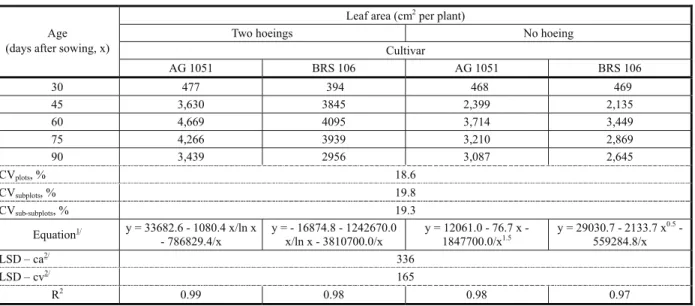
There were effects of weed control (D), cultivars, plant age (I), and of the D x I interaction on leaf area. Cultivar AG 1051 had higher leaf area than cultivar BRS 106 at most ages (Table 4). Such higher leaf area in cultivar AG 1051 relative to other cultivars may have contributed to reduce dry matter of the above-ground part and the number of weeds previously reported, possibly because of greater shading. The D x I interaction occurred due to the fact that increased leaf area due to plant age was higher in hoed plots than in non-hoed ones (Table 4). The leaf area in both cultivars in hoed and non-hoed plots at 75 and 90 days were smaller than those obtained in the samplings made at 45 and 60 days (Table 4). This was certainly due to leaf losses that occurred in the field, during collection, and transport, which take place more easily as plants become older, since senescent leaves dry out and are shed more easily.
The increases in dry matter of the root system and corn plants above-ground part, due to plant age function, were higher in cultivar AG 1051 than in cultivar BRS 106, both with and without hoeing. Nevertheless, increases in those traits in both cultivars in hoed plots were different from those observed in non-hoed plots. In other words, there was an effect of weed control (D), cultivars (C), plant age (I), and of the D x C, D x I, and C x I interactions (Table 4).
Table 1 - Main species of weeds observed in plots cultivated with two corn cultivars, with or without hoeing
No Botanical name Occurrence index1/ (%) N
o Botanical name Occurrence index1/ (%)
1 Acanthospernum hispidumL. 8 10 Ipomoea asarifolia(Desr.) Roem. et Schult. 18
2 Alternanthera tenellaColla 48 11 Ipomoeasp. 3
3 Cenchrus echinatusL. 25 12 Merremia aegyptia(L.) Urban 28
4 Chamaesyce hirta(L.) Millsp. 5 13 Panicum maximumJacq. 33
5 Commelina benghalensisL. 90 14 Phyllanthus amarusSchumach. et Thonn 10
6 Cucumis anguriaL. 63 15 Senna obtusifolia(L.) Irwin et Barneby 5
7 Dactyloctenium aegyptium(L.) P. Beauv. 10 16 Spigelia anthelmiaL. 3
8 Desmanthus virgatus(L.) Willd. 8 17 Turnera ulmifoliaL. 3
9 Digitaria sanguinalis(L.) Scop. 23 18 Waltheria indicaL. 3
1/ Occurrence index = number of plots where a given species occurred/total number of plots in the experiment (40).
Table 2 - Distribution of weeds (numbers in boldface correspond to those in Table 1) in plots cultivated with two corn cultivars (AG 1051 and BR 106), with or without hoeing
Block Weed control method
No hoeing With hoeing
AG 1051 BR 106 BR 106 AG 1051
10
5, 6, 12 2, 5, 6, 13, 15 2, 5, 14 1, 2, 3, 5, 9
No hoeing With hoeing
BR 106 AG 1051 AG 1051 BR 106
9
5, 6, 10, 13 5, 10, 13 5, 6 1, 5, 6, 7, 16
With hoeing No hoeing
BR 106 AG 1051 BR 106 AG 1051
8
2, 5, 6 2, 4, 5, 10 3, 5, 6, 10, 13 5, 6, 12, 13
With hoeing No hoeing
BR 106 AG 1051 BR 106 AG 1051
7
2, 5 5, 10 3, 6, 8, 12, 13 5, 6, 12, 13
No hoeing With hoeing
BR 106 AG 1051 AG 1051 BR 106
6
2, 5, 6, 12, 13 5, 12 5, 8, 14 2, 5, 6, 9
With hoeing No hoeing
BR 106 AG 1051 AG 1051 BR 106
5
2, 5 2, 3, 5, 6, 8 2, 3, 5, 6 2, 5, 6, 9
With hoeing No hoeing
AG 1051 BR 106 BR 106 AG 1051
4
2, 5, 14 2, 3, 5, 6, 7, 9, 10, 12 3, 5, 6, 7 3, 5, 6, 9
With hoeing No hoeing
BR 106 AG 1051 AG 1051 BR 106
3
4, 5, 6 5, 6, 9, 1011, 14, 18 2, 5, 12, 13, 15 5, 6, 13
No hoeing With hoeing
AG 1051 BR 106 AG 1051 BR 106
2
5, 12 12, 13 1, 2, 5, 6, 9 2, 3, 7, 9
No hoeing With hoeing
AG 1051 BR 106 AG 1051 BR 106
1
Table 3 - Mean dry matter weight of the above-ground part and number of weeds in plots cultivated with two corn cultivars, with or without hoeing
Dry matter of weeds above-ground part Number of weeds m-2
Cultivar
Two hoeings g m-2 Cultivar g m-2 Two hoeings
AG 1051 BRS 106
Yes 161.0 b AG 1051 277.4 b Yes 45.4 Ab 56.2 Ab
No 435.8 a BRS 106 319.4 a No 92.9 Ba 137.7 Aa
CVplots, % 21.0 - - - 8.0
CVsubplots, % - 21.0 - - 10.0
Means followed by the same lower case letter, in the column, and by the same upper case letter in the row are not different from one another at a 5% probability, by Tukey’s test.
Table 4 - Mean leaf area values for two corn cultivars, with or without weed control, evaluated at different plant ages
Leaf area (cm2per plant)
Two hoeings No hoeing Cultivar
Age (days after sowing, x)
AG 1051 BRS 106 AG 1051 BRS 106
30 477 394 468 469
45 3,630 3845 2,399 2,135
60 4,669 4095 3,714 3,449
75 4,266 3939 3,210 2,869
90 3,439 2956 3,087 2,645
CVplots, % 18.6
CVsubplots, % 19.8
CVsub-subplots, % 19.3
Equation1/ y = 33682.6 - 1080.4 x/ln x - 786829.4/x
y = - 16874.8 - 1242670.0 x/ln x - 3810700.0/x
y = 12061.0 76.7 x -1847700.0/x1.5
y = 29030.7 - 2133.7 x0.5 -559284.8/x
LSD – ca2/ 336
LSD – cv2/ 165
R2 0.99 0.98 0.98 0.97
1/ All regression equation coefficients were significant at a 5% probability by the t test. 2/ LSD – ca and LSD – cv = minimum significant
difference by Tukey’s test, at a 5% probability, to test hoeings and cultivars at each age, respectively.
number of ears (Table 6), again indicating a higher competitive ability of this cultivar toward weeds. In general, these results agree with those obtained by other authors (Silva et al., 2004a).
With reference to the number of mature ears, the behavior of cultivars was similar to the behavior observed on the total number of green ears (Table 5). In other words, there were effects of cultivars (C), weed control (D), and of the C x D interaction (Table 7). With respect to grain yield and its components (except for number of mature ears) and to other traits relative to ears and grain there were effects of C and D only. The lack of hoeing reduced all those traits, except for 100-kernel weight and grain thickness (Table 7). Cultivar
AG 1051 was superior to cultivar BRS 106 with regard to grain yield and its components and to other traits relative to ears and grain, except for 100-kernel weight and grain thickness (Table 8). Decreased grain yield due to lack of weed control, such as observed in this investigation has been found by other authors (Silva et al., 2004a).
P
la
n
ta
D
an
in
h
a,
V
iç
o
sa
-M
G
, v
. 2
9
, n
. 4
, p
. 7
9
3
-8
0
2
, 2
0
1
1
7
9
9
g
row
th
a
n
d
y
ie
ld
in
c
omp
et
iti
on
w
ith
w
ee
d
s
Dry matter of root system, y (kg ha-1) Dry matter of the above-ground part, y (kg ha-1)
Two hoeings No hoeing Two hoeings No hoeing
Cultivar Age
(days after sowing, x)
AG 1051 BRS 106 AG 1051 BRS 106 AG 1051 BRS 106 AG 1051 BRS 106
30 101 105 86 90 504 528 418 442
45 583 469 546 433 2,789 2,429 2,361 2,032
60 820 626 665 471 4,914 4,285 4,341 3,713
75 876 712 683 519 9,306 7,910 6,572 5,176
90 765 584 646 465 10,300 9,651 7,604 6,950
105 780 676 638 535 11,960 10,750 9,653 8,440
CVplots, % 21.5 23.7
CVsubplots, % 21.9 17.6
CVsub-subplots, % 18.9 17.1
Equation1/ y = -31.08 x +428.33
x0.5– 39427.83/x y
2= -605135.62 +
24970.81 x – 147.32 x2 y = - 26.3 x + 358.9x0.5– 32227.1/x y
2= - 365581.7 +
15197.7 x – 89.86 x2 y
0.5= - 57.86 + 3.05
x – 0.014 x2 ln y = -0.076 x +1.687 x0.5 y = 105.7 x –15230.7/x0.5 ln y = -0.069 x +1.591 x0.5
LSD – ca2 33.7 384.4
LSD – cv2 31.9 264.8
R2 0.99 0.98 0.98 0.93 0.99 0.99 0.99 0.99
1/ All regression equation coefficients were significant at a 5% probability by the t test. 2/ LSD – ca and LSD – cv = minimum significant difference by Tukey’s test, at a 5% probability, to
test hoeings and cultivars at each age, respectively.
Table 6 - Mean number and total weight of ears, number of unhusked green ears and marketable husked green ear weight of two corn cultivars, with or without hoeing1/
Total no. of ears ha-1 Total ear weight (kg ha-1) Noof marketable unhusked ears ha-1 Marketable husked green ear weight (kg ha-1)
Cultivar Two hoeings
AG 1051 BRS 106 AG 1051 BRS 106 AG 1051 BRS 106 AG 1051 BRS 106
Yes 46,875 bA 52,500 aA 14,279 aA 11,787 bA 43,750 aA 44,444 aA 8,433 aA 3,949 bA
No 45,139 aA 41,723 aB 7,338 aB 7,418 aB 33,854 aB 21,250 bB 2,128 aB 1,244 bB
CVplots, % 13.6 14.1 14.0 25.6
CVsubplots, % 11.3 15.5 10.5 21.1
competition between roots, would induce stomatal closure, reducing photosynthesis (Silva et al., 2004c) and, consequently, reducing stems, leaves, and ears growth.
Above the soil surface, competition for light between corn and weeds occurs, but, apparently, such competition does not take place directly by photon flux density (Rajcan & Swanton, 2001), since the most weeds height is lower than corn height. However, even without casting shade over corn plants, weeds influence corn growth via the radiation reflected by them. Plants absorb red light radiation (660-670 nm) and reflect far-red radiation (730 to 740 nm). The FR/R ratio plays
an important role in the induction of many morphological changes in plant architecture (stem elongation, apical dominance, reduced branching, thinner leaves, leaf area distribution, etc.) (Ballaré et al., 1990; Ballaré, 1999). Additionally, weeds would influence the photosynthetic activity of corn via leaf area reduction, observed both in this study and by other authors (Silva et al., 2009), caused by weed root interference over corn roots. Another way by which weeds would influence growth of corn plants above-ground part would be via emission of biogenic volatile organic compounds. These compounds may act both as allelochemicals and as signals for detection of neighboring plants (Kegge & Pierik, 2009).
Table 7 - Mean weight of unhusked green ears and number of marketable husked green ears of two corn cultivars, with or without hoeing
Two hoeings
Weight of marketable unhusked ears
(kg ha-1)
No. of marketable
husked ears ha-1 Cultivar
Weight of marketable unhusked ears
(kg ha-1)
No. of marketable husked ears ha-1
Yes 12,227 a 31,133 a AG 1051 10,833 a 30,052 a
No 6,174 b 14,896 b BRS 106 7,567 b 15,976 b
CVplots, % 17.3 17.8 - -
-CVsubplots, % - - - 12.6 23.2
Means followed by the same letter are not significantly different at a 5% probability, by Tukey’s test.
Table 8 - Mean number of mature ears ha-1, grain yield, number of kernels ear-1, 100-kernel weight, number of kernel rows per ear and kernel size of corn cultivars, with or without hoeing
Number of ears ha-1
Cultivar Kernel size (mm)
Two hoeings
AG 1051 BRS 106
Grain yield (kg ha-)
Number of kernels ear-1
100-kernel weight (g)
No. of kernel rows ear-1
Length Width Thickness
Yes 48,150 Ba 56,939 Aa 6,602 a 368.2 a 29.7 a 13.3 a 11.6 a 9.0 a 4.0 a
No 45,875 Aa 49,165 Ab 4,223 b 276.6 b 27.8 a 12.5 b 11.0 b 8.8 b 3.9 a
CVplots, % 12.6 12.7 15.4 9.1 4.1 4.5 2.6 16.7
Means followed by the same lower case letterand by the same upper case letter in the column do not differ from one another at a 5% probability, by Tukey’s test.
Table 9 - Grain yield, number of kernels ear-1, 100-kernel weight, number of kernel rows per ear, and corncob length and diameter of corn cultivars
Kernel size (mm)
Cultivar Grain yield
(kg ha-)
Number of kernels ear-1
100-kernel weight (g)
No. of kernel
rows ear-1 Length Width Thickness
AG 1051 6007 a 368.2 a 29.2 a 14.5 a 11.9 a 9.1 a 4.0 a
BRS 106 4819 b 274.9 b 28.3 a 11.3 b 10.7 b 8.7 b 3.9 a
CVsubplots, % 13.4 16.3 10.0 4.7 7.1 2.4 13.9
It can be concluded that eighteen weed species occurred more frequently in the experiment area, with a non-uniform distribution.Increased values of corn leaf area, above-ground part and root system, due to plant age function, were smaller in non-hoed plots than in hoed plots, and were dependent upon cultivar. The lack of weed control increased dry matter of weeds above-ground part and decreased green ear yield and grain yield. Cultivar AG 1051 had higher increases in leaf area, above-ground part of the plant and root system, due to plant age function, and controlled weeds better than cultivar BRS 106. In addition, cultivar AG 1051 was superior to other cultivars with respect to most traits used for green corn yield and grain yield assessment.
LITERATURE CITED
AFLAKPUI, G. K. S.; GREGORY, P. J.;
FROUD-WILLIAMS, R. J. Growth and biomass partitioning of maize during vegetative growth in response to Striga hermonthica infection and nitrogen supply. Exper. Agric., v. 38, n. 1, p. 265-276, 2002.
BALLARÉ, C. L. Keeping up with the neighbours:
phytochrome sensing and other signaling mechanisms. Trends Plant Sci., v. 4, n. 1, p. 97-102, 1999.
BALLARÉ, C. L.; SCOPEL, A. L.; SANCHEZ, R. A. Far-red radiation reflected from adjacent leaves: an early signal of competition in plant canopies. Science, v. 247, n. 4940, p. 329-331, 1990.
BARTLETT, M. S. Some examples of statistical methods of research in agriculture and applied biology. J. Roy Stat. Soc., v. 4, n. 1, p. 137-183, 1937.
BARTLETT, M. S. The use of transformations. Biometrics, v. 3, n. 1, p. 39-52, 1947.
CARRUTHERS, K. et al. Intercropping corn with soybean, lupin and forages: weed control by intercrops combined with interrow cultivation. Eur. J. Agron., v. 8, n. 2, p. 225-238, 1998.
CATHCART, R. J.; SWANTON, C. J. Nitrogen and green foxtail (Setaria viridis) competition effects on corn growth and development. Weed Sci., v. 52, n. 6, p. 1039-1049, 2004.
DAVIS, A. S.; LIEBMAN, M. Nitrogen source influences wild mustard growth and competitive effect on sweet corn. Weed Sci., v. 49, n. 4, p. 558-566, 2001.
EVANS, P. S. et al. Influence of nitrogen and duration of weed interference on corn growth and development. Weed Sci., v. 51, n. 3, p. 456-566, 2003.
EMPRESA BRASILEIRA DE PESQUISA AGROPECUÁRIA – EMBRAPA. Centro Nacional de Pesquisa do Solo. Sistema brasileiro de classificação de solos. Brasília: Serviço de Produção de Informação, 1999a. 412 p.
EMPRESA BRASILEIRA DE PESQUISA AGROPECUÁRIA – EMBRAPA. Centro Nacional de Pesquisa do Solo. Manual de análises químicas de solos, plantas e fertilizantes. Brasília: 1999b. 370 p.
FAO. Soil map of the world; revised legend. Rome: UNESCO, 1998. 119 p.
FLECK, N. G. et al. Características de plantas de cultivares de arroz irrigado relacionadas à habilidade competitiva com plantas concorrentes. Planta Daninha, v. 21, n. 1, p. 97-104, 2003.
JANDEL. Jandel TBLCURVE. Table Curve 3.0. Curve fitting software. Corte Madera: Jandel Scientific, 1992.
KÖPPEN, W. Climatologia; com un estudio de los climas de la tierra. México: Fondo de Cultura Economica, 1948. 478 p.
KEGGE, W.; PIERIK, R. Biogenic volatile organic compounds and plant competition. Trends Plant Sci., v. 15, n. 3, p. 126-132, 2009.
LAMEGO, F. P. et al. Tolerância à interferência de plantas competidoras e habilidade de supressão por cultivares de soja -I. Resposta de variáveis de crescimento. Planta Daninha, v. 23, n. 3, p. 405-414, 2005.
LUM, A. F.; CHIKOYE, D.; ADESIYAN, S. O. Control of Imperata cylindrica (L.) Raeuschel (speargrass) with
nicosulfuron and its effects on the growth, grain yield and food components of maize. Crop Protec., v. 11, n. 6, p. 1586-1601, 2001.
RAJCAN, I.; SWANTON, C. J. Understanding maize-weed competition: resource competition, light quality and the whole plant. Field Crops Res., v. 71, n. 2, p. 139-150, 2001.
SAEG. Sistemas para análises estatísticas, 7.0. Viçosa, MG: Fundação Arthur Bernardes, UFV/DBG, 1997.
SCHENK, H. J. Root competition: beyond resource depletion. J. Ecol., v. 94, n. 4, p. 725-739, 2006.
SILVA, P. S. L. S.; SILVA, E. S.; MESQUITA, S. S. X. Weed control and green ear yield in maize. Planta Daninha, v. 22, n. 1, p. 137-144, 2004a.
SILVA, P. S. L. et al. Growth and yield of corn grain and green ear in competition with weeds. Planta Daninha, v. 27, p. 947-955, 2009. (Número Especial)
SILVA, A. A.; VARGAS, L.; WERLANG, R. C. Manejo de plantas daninhas na cultura do milho. In: GALVÃO, J.C.C.; MIRANDA, G.V. Tecnologias de produção do milho. Viçosa, MG: Universidade Federal de Viçosa, 2004c. p. 269-310.
SILWANA, T. T.; LUCAS, E. O. The effects of planting combinations and weeding on the growth and yield of component crops of maize/bean and maize/pumpkin intercrops. J. Agric. Sci., v. 138, n. 2, p. 193-200, 2002.
SREENIVAS, G.; SATYANARAYANA, V. Nutrient removal by weeds and maize. Indian J. Agron., v. 41, n. 1,