ABSTRACT
BACKGROUND AND OBJECTIVES:Osteoarthritis is an in-lammatory and degenerative joint disease, causing pain, muscu-loskeletal disorders and impact on functionality, daily life activi-ties and quality of life. he action of physical agents by means of deep heating seems to be an alternative to treat such disease. his study aimed at verifying the efects of deep heating on os-teoarthritis patients.
CONTENTS: A systematic review was carried out in Medline, Scielo and LILACS databases as from keywords “Osteoarthritis”, “Induced Hyperthermia”, “Physiotherapy” and “Ultrasound”, and other keywords such as “Deep heat”, “Microwaves” and Short-waves”, in Portuguese, English and Spanish, in the pe-riod from January 2005 to January 2016, and 986 articles were found. Initially, 16 potentially relevant articles were selected for the study and, after a judicious qualitative analysis, nine com-plete articles meeting inclusion criteria were selected.
CONCLUSION: Physical deep heating physical agents (ultra-sound, short-waves diathermy and microwaves) were beneicial to manage pain and other variables in individuals with osteoar-thritis in diferent levels of severity, especially in the long term. However, these efects are better observed when applied simulta-neously with kinesiotherapy.
Keywords:Induced hyperthermia, Osteoarthritis, Pain, Physio-therapy, Ultrasound.
Effects of deep heating to treat osteoarthritis pain: systematic review
Efeitos do calor profundo no tratamento da dor na osteoartrite: revisão sistemática
Matheus Santos Gomes Jorge1, Caroline Zanin2, Bruna Knob3, Lia Mara Wibelinger4
1. Universidade de Passo Fundo, Faculdade de Educação Física e Fisioterapia, Bolsista Pro-bic/Fapergs, Soledade, RS, Brasil.
2. Universidade de Passo Fundo, Faculdade de Educação Física e Fisioterapia, Bolsista Pibic/ CNPq, São Jorge, RS, Brasil.
3. Universidade de Passo Fundo, Faculdade de Educação Física e Fisioterapia, Bolsista Pibic/ UPF, Chapada, RS, Brasil.
4. Universidade de Passo Fundo, Faculdade de Educação Física e Fisioterapia, Passo Fundo, RS, Brasil.
Submitted in July 14, 2016.
Accepted for publication in January 20, 2017. Conlict of interests: none – Sponsoring sources: none.
Correspondência to: BR 285, Bairro São José 99052-900 Passo Fundo, RS, Brasil. E-mail: [email protected]
© Sociedade Brasileira para o Estudo da Dor
RESUMO
JUSTIFICATIVA E OBJETIVOS: A osteoartrite é uma doença articular inlamatória e degenerativa, que provoca dor, agravos osteoarticulares e impacto na funcionalidade, nas atividades de vida diária e na qualidade de vida. A ação de agentes físicos por meio do calor profundo parece ser uma alternativa no tratamen-to dessa doença. O objetivo deste estudo foi veriicar os efeitratamen-tos do calor profundo em indivíduos com osteoartrite.
CONTEÚDO: Realizou-se uma revisão sistemática nas bases de dados Medline, Scielo e LILACS, a partir dos descritores “Osteo-artrite”, “Hipertermia Induzida”, “Fisioterapia” e “Ultrassom” e outras palavras-chaves como “Calor profundo”, “Micro-ondas” e “Ondas curtas”, nas línguas portuguesa, inglesa e espanhola, no período de janeiro de 2005 a janeiro de 2016. Encontraram-se 986 artigos. Inicialmente, 16 artigos potencialmente relevantes foram selecionados para o estudo, e, após uma análise qualitativa criteriosa, selecionaram-se 9 artigos completos que preencheram os critérios de inclusão exigidos.
CONCLUSÃO: Os agentes físicos em forma de calor profundo (ultrassom, diatermia por ondas curtas e micro-ondas) ofertam benefícios no manuseio da dor e outras variáveis em indivíduos com osteoartrite em diferentes graus de acometimento, especial-mente no longo prazo. Contudo, esses efeitos são mais bem ob-servados quando aplicados em concomitância à cinesioterapia. Descritores: Dor, Fisioterapia, Hipertermia induzida, Osteoar-trite, Ultrassom.
INTRODUCTION
Osteoarthritis (OA) is a degenerative inflammatory joint disease resulting from chondrocytes and synoviocytes-me-diated responses, in addition to presenting higher serum and synovial inflammatory cytokine levels as compared to individuals not affected by the disease1-3.
OA is multifactorial and involves changes in osteoarticu-lar alignment causing joint instability4. This is the most common form of arthritis, being considered one of the ten more disabling diseases in developed countries and one of the most prevalent rheumatic diseases among the elderly5-7.
Although able to affect any body region, it preferably af-fects joints supporting major weight loads and requiring frequent use, such as the knees3. Clinical results show increased joint volume due to synovitis caused by syno-vial effusion or thickening, pain at rest, morning stiff-ness, deformities, instabilities, movements limitation,
incapacity and muscle weakness8-10. Pain intensity may vary from no pain to individuals’ immobilization and physical incapacity2.
In this sense, physiotherapy attempts to attenuate OA-induced injuries and adverse effects of drugs11. In addi-tion to kinesiotherapy, some physical resources, such as deep heating involving tools such as ultrasound (US), short-waves diathermia (SWD) and microwaves (MW), have been used with analgesic and anti-inflammatory ac-tion12,13, and have shown good results with regard to pain and functionality of OA patients13.
This study aimed at reviewing in the literature sources documenting the effects of deep heating on pain manage-ment of OA individuals.
CONTENTS
A systematic search was carried out looking for articles published in journals indexed in Medline, Scielo and LILACS databases. Descriptors used for search were ac-cording to Health Science Descriptors, as from the pri-mary descriptor “osteoarthritis” crossed with secondary descriptors such as “induced hyperthermia”, “physio-therapy” and “ultrasound”. In addition, the following keywords were used: “deep heating”, “microwaves” and “short waves”. A search was also carried out with varia-tions of these words in Portuguese and Spanish.
Included in the study were randomized clinical trials; studies carried out exclusively with humans; studies with pain evaluation as outcome, being or not followed by oth-er variables, such as mobility, joint movement amplitude, muscle strength, gait velocity, functionality, incapacity and/or quality of life; studies found in full and available for free; studies in Portuguese, English or Spanish; stud-ies published between January 2005 and December 2015.
Exclusion criteria were unfinished studies, studies in-volving individuals submitted to some surgical proce-dures due to OA or those not complying with mentioned criteria.
Initially, titles and abstracts were identified and indepen-dently evaluated by a reviewer, to select those meeting eligibility criteria. Potentially relevant studies were kept for further analysis of the full text.
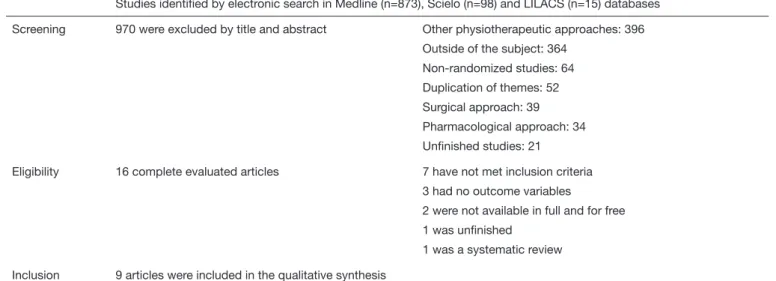
Table 1 shows the strategy for studies search and selec-tion.
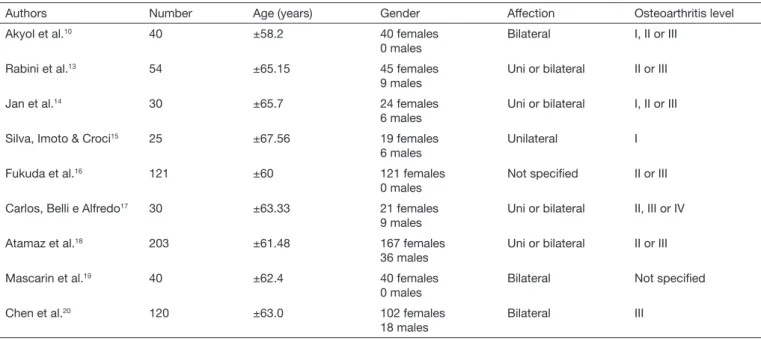
Among selected studies, four involved the use of SWD, four the use of US (continuous or pulsed) and one in-volved MW. Sample size of included studies has varied from 25 to 203 OA individuals, being that 100% had knee joint affected. Most samples were predominantly fe-males and elderly. All studies had comparison between at least two groups.
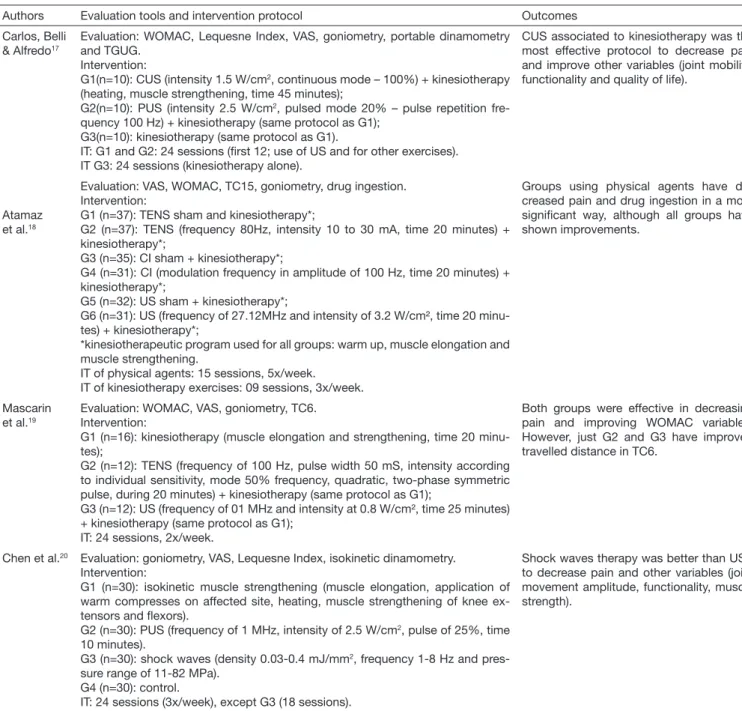
Table 2 shows sample characterization of included stud-ies. Table 3 shows used evaluative tools and intervention protocols, as well as outcomes found in included studies. Selected studies suggest a limitation of the subject pro-posed by this review, since in a period of tem years, just nine studies have contemplated the effects of deep heat-ing on pain management of OA patients, accordheat-ing to required criteria. It is possible to observe that scientific interest on the subject seems to be recent, because seven studies were carried out in the last five years.
However, included studies have shown that heating tools are beneficial for pain management of OA patients. Al-though they do not stand out with regard to conven-tional kinesiotherapy, they may complement treatment when used simultaneously with physical exercises. Such measures were of major interest for managing OA-in-duced impacts and complications, especially with regard to pain.
Table 1. Studies search and selection
Studies identiied by electronic search in Medline (n=873), Scielo (n=98) and LILACS (n=15) databases
Screening 970 were excluded by title and abstract Other physiotherapeutic approaches: 396 Outside of the subject: 364
Non-randomized studies: 64 Duplication of themes: 52 Surgical approach: 39 Pharmacological approach: 34 Uninished studies: 21
Eligibility 16 complete evaluated articles 7 have not met inclusion criteria 3 had no outcome variables
2 were not available in full and for free 1 was uninished
1 was a systematic review
Table 2. Sample characterization of recruited studies on deep heating effects for osteoarthritis pain management
Authors Number Age (years) Gender Affection Osteoarthritis level Akyol et al.10 40 ±58.2 40 females
0 males
Bilateral I, II or III
Rabini et al.13 54 ±65.15 45 females
9 males
Uni or bilateral II or III
Jan et al.14 30 ±65.7 24 females
6 males
Uni or bilateral I, II or III
Silva, Imoto & Croci15 25 ±67.56 19 females
6 males
Unilateral I
Fukuda et al.16 121 ±60 121 females
0 males
Not speciied II or III
Carlos, Belli e Alfredo17 30 ±63.33 21 females
9 males
Uni or bilateral II, III or IV
Atamaz et al.18 203 ±61.48 167 females
36 males
Uni or bilateral II or III
Mascarin et al.19 40 ±62.4 40 females
0 males
Bilateral Not speciied
Chen et al.20 120 ±63.0 102 females
18 males
Bilateral III
Table 3. Evaluative tools, intervention protocols and outcomes of studies on the effect of deep heating on osteioarthritis pain ma-nagement
Authors Evaluation tools and intervention protocol Outcomes Akyol
et al.10
Evaluation: WOMAC, VAS, isokinetic dynamometry, SF-36, TC6, Beck inventory.
Intervention:
G1 (n=20): kinesiotherapy (muscle strengthening on isokinetic dynamometer) + SWD (frequency 27,12 MHz, intensity according to patients’ sensitivity, time of 20 minutes);
G2 (n=20): kinesiotherapy (same protocol as G1); IT: 12 sessions, 3x/week, 4 weeks.
SWD has no additional signiicant effect on pain and other variables (functionality, stiffness, depression, gait velocity, muscle strength and quality of life).
Rabini et al.13
Evaluation: WOMAC, BMRC, VAS. Intervention:
G1 (n=27): MW (potency of 40W, temperature of 38°C, time of 30 minutes). G2 (n=27): hot compresses (temperature of 38°C, time of 30 minutes). IT: 12 sessions, 3x/week, to 4 weeks.
MW has decreased pain and improved other variables (muscle strength and physi-cal function) with long term beneits.
Jan et al.14 Evaluation: ultrasound, VAS.
Intervention:
G1 (n=11): SWD (intensity tolerated by patient, time of 20 minutes);
G2 (n=10): SWD (same protocol as G1) + drugs (non-steroid anti-inlammatory drugs);
G3 (n=9): control.
IT: 30 sessions, 3x to 5x/ week, up to 8 weeks.
SWD has signiicantly decreased pain and synovial thickness.
Silva, Imoto & Croci15
Evaluation: sphygmomanometer, VAS, goniometry, Lequesne index. Intervention:
G1(n=9): SWD (20 minutes, without specifying parameters) + kinesiotherapy (wi-thout speciication);
G2(n=6): criotherapy (20 minutes) + kinesiotherapy (without speciication); G3(n=9): kinesiotherapy (without speciication);
IT: 10 sessions, 2x/week.
Most adequate protocol for improving pain was that of G2. Both protocols were effec-tive in improving functionality, joint move-ment amplitude and lexibility, while only G3 has improved muscle strength.
Fukuda et al.16
Evaluation: KOOS questionnaire; Intervention:
G1 (n=35): control.
G2 (n=23): placebo (19 minutes).
G3 (n=32): pulsed low dose SWD (power 14,5W, time 19 minutes; total energy 17 kJ);
G4 (n=31): pulsed high dose SWD (power 14,5W, time 38 minutes; total energy 33kJ).
IT: 9 sessions, 3x/week.
Pulsed SWD is an effective method to de-crease pain and improve other variables (functionality and quality of life) in the short term.
DISCUSSION
OA is a disease causing more persistent musculoskeletal pain and may afect one out of ive individuals, especially females and the elderly, causing chronic pain and incapacity especially on the knees5,21, which can be observed in selected studies, since in 100% of the reviewed content, samples had knee OA (levels from I to IV, with predominance of level III among
studies), and in eight out of nine studies mean age was above 60 years, characterizing predominantly elderly samples. Interaction of factors such as disease worsening, pain, associ-ated comorbidities, psychological and social factors, decreased aerobic work and lower limbs muscle weakness are determin-ing factors for physical incapacity in OA individuals15. Functional impairment may negatively interfere with quality of life of these people, especially if they are old aged, females Table 3. Evaluative tools, intervention protocols and outcomes of studies on the effect of deep heating on osteioarthritis pain manage-ment – continuation
Authors Evaluation tools and intervention protocol Outcomes Carlos, Belli
& Alfredo17
Evaluation: WOMAC, Lequesne Index, VAS, goniometry, portable dinamometry and TGUG.
Intervention:
G1(n=10): CUS (intensity 1.5 W/cm2, continuous mode – 100%) + kinesiotherapy
(heating, muscle strengthening, time 45 minutes);
G2(n=10): PUS (intensity 2.5 W/cm2, pulsed mode 20% – pulse repetition
fre-quency 100 Hz) + kinesiotherapy (same protocol as G1); G3(n=10): kinesiotherapy (same protocol as G1).
IT: G1 and G2: 24 sessions (irst 12; use of US and for other exercises). IT G3: 24 sessions (kinesiotherapy alone).
CUS associated to kinesiotherapy was the most effective protocol to decrease pain and improve other variables (joint mobility, functionality and quality of life).
Atamaz et al.18
Evaluation: VAS, WOMAC, TC15, goniometry, drug ingestion. Intervention:
G1 (n=37): TENS sham and kinesiotherapy*;
G2 (n=37): TENS (frequency 80Hz, intensity 10 to 30 mA, time 20 minutes) + kinesiotherapy*;
G3 (n=35): CI sham + kinesiotherapy*;
G4 (n=31): CI (modulation frequency in amplitude of 100 Hz, time 20 minutes) + kinesiotherapy*;
G5 (n=32): US sham + kinesiotherapy*;
G6 (n=31): US (frequency of 27.12MHz and intensity of 3.2 W/cm², time 20 minu-tes) + kinesiotherapy*;
*kinesiotherapeutic program used for all groups: warm up, muscle elongation and muscle strengthening.
IT of physical agents: 15 sessions, 5x/week. IT of kinesiotherapy exercises: 09 sessions, 3x/week.
Groups using physical agents have de-creased pain and drug ingestion in a more signiicant way, although all groups have shown improvements.
Mascarin et al.19
Evaluation: WOMAC, VAS, goniometry, TC6. Intervention:
G1 (n=16): kinesiotherapy (muscle elongation and strengthening, time 20 minu-tes);
G2 (n=12): TENS (frequency of 100 Hz, pulse width 50 mS, intensity according to individual sensitivity, mode 50% frequency, quadratic, two-phase symmetric pulse, during 20 minutes) + kinesiotherapy (same protocol as G1);
G3 (n=12): US (frequency of 01 MHz and intensity at 0.8 W/cm², time 25 minutes) + kinesiotherapy (same protocol as G1);
IT: 24 sessions, 2x/week.
Both groups were effective in decreasing pain and improving WOMAC variables. However, just G2 and G3 have improved travelled distance in TC6.
Chen et al.20 Evaluation: goniometry, VAS, Lequesne Index, isokinetic dinamometry.
Intervention:
G1 (n=30): isokinetic muscle strengthening (muscle elongation, application of warm compresses on affected site, heating, muscle strengthening of knee ex-tensors and lexors).
G2 (n=30): PUS (frequency of 1 MHz, intensity of 2.5 W/cm2, pulse of 25%, time
10 minutes).
G3 (n=30): shock waves (density 0.03-0.4 mJ/mm2, frequency 1-8 Hz and
pres-sure range of 11-82 MPa). G4 (n=30): control.
IT: 24 sessions (3x/week), except G3 (18 sessions).
Shock waves therapy was better than USP to decrease pain and other variables (joint movement amplitude, functionality, muscle strength).
and symptomatic. OA knee pain prevalence is high (32.2% for males and 58.0% for females) which increases in up to ive times the risk of poorer lower limbs function22,23.
Lequesne and WOMAC indices are speciic and reliable tools for OA evaluation15. It was observed that studies have used such protocols, being that ive have used WOMAC in-dex10,13,17-19, three have used Lequesne index15,17,20 and one has used the KOOS questionnaire, a scale of 11 questions to evaluate pain and functionality16.
In this sense, induced hyperthermia seems to be a strategy to manage OA pain since it is a conservative, low cost and non-invasive therapy24, which has led to the choice of this therapy as the target of our study.
Four recruited studies10,15,17,18 have used physical agents as aid or intervention to physical exercises (kinesiotherapy). It was observed that groups adopting deep heating as treatment strategy have improved pain and other evaluated variables, without the adverse efects of individuals submitted to in-tervention protocols. From these, one has compared the ac-tion of physical agents and their placebos and has observed improved pain and functionality, movement amplitude and functional independence, without statistically signiicant dif-ference among groups18. However, intervention groups have presented lower drug ingestion, indicating higher impact on OA treatment.
So, it is possible to observe the importance of conventional kinesiotherapy to decrease pain and improve other variables of knee OA individuals, being that physical agents may act as optimizers of the physiotherapeutic protocol. In addition, such resources decrease the use of drugs by OA patients and their possible adverse efects.
Studies suggest that US is beneicial to treat knee OA, because it is a safe strategy, decreases pain and improves physical func-tions, regardless of the mode (continuous or pulsed). Treat-ment duration should be adapted to speciic needs of each individual25.
Two studies19,20 have compared the efects of deep heating (US) and conventional kinesiotherapy or even other non-thermal physical agents. heir results show beneits with re-gard to pain, functionality, movement amplitude, functional independence19 and muscle strength20, without signiicant diference among approaches19. However, it is worth high-lighting that such experiments were carried out just with US and in one of them US with kinesiotherapy has been superior in the distance travelled by the individual19. he other has shown just immediate US efects20, which is in disagreement with most authors, since they report deep heating as therapy with long term beneits.
MW is a noninvasive method increasing in vivo temperature of internal tissues (±0.2°C), in a depth of 3 to 7cm26. Its prop-erties are beneicial to treat OA, since joint heat stimulation increases chondrocytes metabolism and partially generates cartilaginous matrix24.
A study has compared MW therapy (deep heating) with the use of hot compresses (supericial heat) and has concluded that deep approach has signiicant efect on pain, stifness,
physical limitation and muscle strength in knee OA individu-als13, in the long term, since such disease is chronic and gener-ates severe pain.
SWD aims at decreasing pain in the clinical practice10. SW therapy in low (power of 14.5W; duration 19 minutes; total energy 17kJ) or high doses (power of 14.5W; duration 38 minutes; total energy 33kJ) is beneicial for pain relief and increased muscle strength in the long term, especially in low doses16. It may decrease joint inlammatory process, being or not associated to drugs14.
Two recruited studies14,16 have evaluated the efects of deep heating exclusively with physical agents, observing positive efects on evaluated variables, such as those measured by WOMAC index, pain, joint movement amplitude or muscle strength. However, authors are not sure about its isolated ef-icacy.
CONCLUSION
Physical agents in the form of deep heating (US, SWD and MW) are beneficial to manage pain and other variables such as muscle strength, joint movement amplitude, func-tionality, stiffness, daily life activities and quality of life in individuals with different levels of OA, especially in the long term. However, it has to be highlighted that such ef-fects are better observed when applied simultaneously with kinesiotherapy.
REFERENCES
1. Sohn DH, Sokolove J, Sharpe O, Erhart JC, Chandra PE, Lahey LJ, et al. Plasma proteins present in osteoarthritic synovial luid can stimulate cytokine production via Toll-like receptor 4. Arthritis Res her. 2012;14(1):7.
2. Wibelinger LM, Batista JS, Vidmar MF, Kayser B, Pasqualotti A, Schneider RH. Efeitos da isioterapia convencional e da wiiterapia na dor e capacidade funcional de mulheres idosas com osteoartrite de joelho. Rev Dor. 2013;14(3):196-9.
3. Duarte VS, Santos ML, Rodrigues KA, Ramires JB, Arêas GP, Borges GF. Exercícios físicos e osteoartrose: uma revisão sistemática. Fisioter Mov. 2013;26(1):193-202. 4. Coelho Cde F, Leal-Junior EC, Biasotto-Gonzalez DA, Bley AS, de Carvalho Pde T,
Politti F, et al. Efectiveness of phototherapy incorporated into an exercise program for osteoarthritis of the knee: study protocol for a randomized controlled trial. Trials. 2014;15:221.
5. Cunha-Miranda L, Faustino A, Alves C, Vicente V, Barbosa S. Avaliação da magni-tude da desvantagem da osteoartrite na vida das pessoas: estudo MOVES. Rev Bras Reumatol. 2015;55(1):22-30.
6. Bijlsma JW, Berenbaum F, Lafeber FP. Osteoarthritis: an update with relevance for clinical practice. Lancet. 2011;377(9783):2115-26.
7. Guermazi A, Niu J, Hayashi D, Roemer FW, Englund M, Neogi T, et al. Prevalence of abnormalities in knees detected by MRI in adults without knee osteoarthritis: population based observational study (Framingham Osteoarthritis Study). BMJ. 2012;345:e5339.
8. Rezend MU, Campos GC. Is osteoarthritis a mechanical or inlammatory disease? Rev Bras Ortop. 2013;48(6):471-4.
9. Fellet A, Fellet AJ, Fellet L. Osteoartrose: uma revisão. Rev Bras Med. 2007;64(1):55-61. 10. Akyol Y, Durmus D, Alayli G, Tander B, Bek Y, Canturk F, et al. Does short-wave dia-thermy increase the efectiveness of isokinetic exercise on pain, function, knee muscle strength, quality of life, and depression in the patients with knee osteoarthritis? A randomized controlled clinical study. Eur J Phys Rehabil Med. 2010;46(3):325-36. 11. Johnsen SP, Larsson H, Tarrone RE, McLaughlin JK, Friis S, Sorensen HT, et al.
Risk of hospitalization for myocardial infarction among users of refecoxib, cele-coxib, and other NSAIDs: a population-based case-control study. Arch Intern Med. 2005;165(9):978-84.
12. Ovanessian V, Cazarini Júnior C, Cunha RA, Carvalho NA, Fukuda TY. Use of difer-ent doses of pulsed short waves in the treatmdifer-ent of patidifer-ents with osteoarthritis of the knee. Rev Cienc Med Campinas. 2008;17(3-6):149-55.
patients with knee osteoarthritis: a double-blind randomized clinical trial. Eur J Phys Rehabil Med. 2012;48(4):549-59.
14. Jan MH, Chai HM, Wang CL, Lin YF, Tsai LY. Efects of repetitive shortwave dia-thermy for reducing synovitis in patients with knee osteoarthritis: an ultrasonographic study. Phys her. 2006;86(2):236-44.
15. Silva AL, Imoto DM, Croci AT. Estudo comparativo entre a aplicação de crioterapia, cinesioterapia e ondas curtas no tratamento da osteoartrite de joelho. Acta Ortop Bras. 2007;15(4):204-9.
16. Fukuda TY, Alves da Cunha R, Fukuda VO, Rienzo FA, Cazarini C Jr, Carvalho Nde A, et al. Pulsed shortwave treatment in women with knee osteoarthritis: a multicenter, randomized, placebo-controlled clinical trial. Phys her. 2011;91(7):1009-17. 17. Carlos KP, Belli BS, Alfredo PP. Efeito do ultrassom pulsado e do ultrassom contínuo
associado a exercícios em pacientes com osteoartrite de joelho: estudo piloto. Fisioter Pesqui. 2012;19(3):275-81.
18. Atamaz FC, Durmaz B, Baydar M, Demircioglu OY, Iyiyapici A, Kuran B, et al. Com-parison of the eicacy of transcutaneous electrical nerve stimulation, interferential currents, and shortwave diathermy in knee osteoarthritis: a double-blind, randomized, controlled, multicenter study. Arch Phys Med Rehabil. 2012;93(5):748-56. 19. Mascarin NC, Vancini RL, Andrade ML, Magalhães EP, Lira CA, Coimbra IB. Efects
of kinesiotherapy, ultrasound and electrotherapy in management of bilateral knee os-teoarthritis: prospective clinical trial. BMC Musculoskelet Disord. 2012;22(13):182.
20. Chen TW, Lin CW, Lee CL, Chen CH, Chen YJ, Lin TY, et al. he eicacy of shock wave therapy in patients with knee osteoarthritis and popliteal cyamella. Kaohsiung J Med Sci. 2014;30(7):362-70.
21. Marley J, Tully MA, Porter-Armstrong A, Bunting B, O’Hanlon J, McDonough SM. A systematic review of interventions aimed at increasing physical activity in adults with chronic musculoskeletal pain protocol. Syst Rev. 2014;3:106.
22. Muraki S, Akune T, Oka H, En-yo Y, Yoshida M, Saika A, et al. Association of radiograph-ic and symptomatradiograph-ic knee osteoarthritis with health-related quality of life in a population-based cohort study in Japan: the ROAD study. Osteoarthr Cartil. 2010;18(9):1227-34. 23. Kim IJ, Kim HA, Seo YI, Jung YO, Canção YW, Jeong JY, et al. Prevalence of knee pain
and its inluence on quality of life and physical function in the Korean elderly popula-tion: a community based cross-sectional study. J Korean Med Sci. 2011;26(9):1140-6. 24. Takahashi KA, Tonomura H, Arai Y, Terauchi R, Honjo K, Hiraoka N, et al. Hyper-thermia for the treatment of articular cartilage with osteoarthritis. Int J Hipertermia. 2009;25(8):661-7.
25. Zhang C, Xie Y, Luo X, Ji Q, Lu C, He C, et al. Efects of therapeutic ultrasound on pain, physical functions and safety outcomes in patients with knee osteoarthritis: A systematic review and meta-analysis. Clin Rehabil. 2015. [Epub ahead of print]. 26. Zampeli E, Raftakis I, Michelongona A, Nikolaou C, Elezoglou A, Toutouzas K, et al.