320
Hypoesthesia, pain and disability of upper limb after adjuvant
radiotherapy for breast cancer*
Hipoestesia, dor e incapacidade no membro superior após radioterapia adjuvante no
tratamento para câncer de mama
Thaysa Samanta Bezerra
1, Mariana Tirolli Rett
2, Andreza Carvalho Rabelo Mendonça
3, Dayane Evellyn
dos Santos
1, Vanessa Miranda Prado
4, Josimari Melo DeSantana
5*Received from the OncoHematos Physical Therapy Service, Beneficence Foundation Surgery Hospital (FBHC) in partnership with the Urgency Hospital of Sergipe (HUSE) and the Federal University of Sergipe (UFS). Aracaju, SE.
1. Physical Therapist by the Federal University of Sergipe (UFS). Aracaju, SP, Brazil. Assistant Professor, Physical The-rapy Course, Federal University of Sergipe (UFS
2. Assistant Professor, Physical Therapy Course, Federal University of Sergipe (UFS). Aracaju, SE, Brazil.
3. Master Student of the Post-Graduation Program in Health Sciences, Federal University of Sergipe (UFS). Aracaju, SE, Brazil.
4. Physical Therapist of the Onco Hematos Clinic. Aracaju, SE, Brazil.
5. Assistant Professor of the Physical Therapy Course, profes-sor of the Post-Graduation Program in Physiological Sciences ando f the Post-Graduation Program in Health Sciences, Fede-ral University of Sergipe (UFS). Aracaju, SE, Brazil.
Correspondence to:
Prof. Mariana Tirolli Rett, M.D.
Rua Claudio Batista s/n – Bairro Santo Antonio 49060-100 Aracaju, SE
Phones: (79) 8104-3005 - (79) 2105-1804 E-mail: [email protected], [email protected]
SUMMARY
BACKGROUND AND OBJECTIVES: Surgery and radiotherapy (RT) may induce upper limb (UP) pain, functional disorder and daily life activities impairment.
This study aimed at evaluating and comparing superi -cial sensitivity (SS) on the dermatome corresponding to the intercostobrachial sensory nerve (ICBN), pain and disability of UL ipsilateral to surgery before and after adjuvant RT.
METHOD: Twenty females submitted to surgery in-cluding axillary lymphadenectomy (AL) were evaluated before and immediately after adjuvant RT (25-30 ses-sions). The following tools were used to evaluate SS, pain and disability: esthesiometry, McGill Pain Ques-tionnaire (MPQ), Pain Rating Index and shoulder dis-ability (SPADI). Two measures were obtained from
MPQ: number of words chosen (NWC) and pain rating index (PRI). Wilcoxon Signed Rank Test for paired sam-ples was used for intragroup comparison, considering
signiicant p < 0.05.
RESULTS: There has been signiicant SS decrease after
RT by increased esthesiometer pressure from 1.9 ± 0.2 to 2.8 ± 0.2 (p = 0.004) indicating hypoesthesia. There has been no difference in contralateral UL. NWC and PRI
scores have signiicantly increased (p = 0.005 and p = 0.006) after RT. There has been signiicant total SPADI
score increase after RT (p = 0.0001), with increased dis-ability from 24.6 ± 5.7 to 39.2 ± 5.7 (p = 0.001) and pain from 26.3 ± 6.4 to 48.4 ± 7.1 (p = 0.001).
CONCLUSION: Hypoesthesia was identiied in the
ICBN pathway, in addition to UL pain and disability af-ter adjuvant RT.
Keywords: Breast cancer, Hypoesthesia, Mastectomy, Pain, Physical therapy, Radiation therapy.
RESUMO
JUSTIFICATIVA E OBJETIVOS: Tratamento cirúr-gico e radioterapia (RT) podem provocar dor no membro superior (MS), distúrbio funcionale prejuízo nas ativi-dades de vida diária. O objetivo deste estudo foi avaliar e
comparar a sensibilidade supericial (SS) no dermátomo
correspondente ao nervo sensitivo intercostobraquial (NICB), a dor e a incapacidade do MS homolateral à cirurgia antes e após RT adjuvante.
Duas medidas foram obtidas através do MPQ: número de palavras escolhidas (NWC) e índice de dor (PRI). Para comparação intragrupo, adotou-se teste de Wilcox-on Signed Rank Test para amostras pareadas, p < 0,05. RESULTADOS: Após a RT houve redução signiicativa
da SS pelo aumento da pressão exercida pelo estesiômet-ro de 1,9 ± 0,2 para 2,8 ± 0,2 (p = 0,004) indicando hi-poestesia. No MS contralateral não houve diferença.
Es-cores do NWC e do PRI aumentaram signiicativamente
(p = 0,005 e p = 0,006) após a RT. Observou-se aumento
signiicativo do escore total do SPADI após a RT (p =
0,0001), com aumento da incapacidade de 24,6 ± 5,7 para 39,2 ± 5,7 (p = 0,001) e a dor de 26,3 ± 6,4 para 48,4 ± 7,1(p = 0,001).
CONCLUSÃO: Foi identiicada hipoestesia no trajeto
do NICB, dor e incapacidade no MS após a RT adjuvante.
Descritores: Dor, Fisioterapia, Hipoestesia, Mastecto-mia, Neoplasias da mama, Radioterapia.
INTRODUCTION
Breast cancer (BC) is the tumor of highest incidence among females being in Brazil the major cause of death by malignant diseases among females. For 2012 it is es-timated that there will be 52680 new BC cases1. In spite of the evolution in diagnosis and the possibility of using the sentinel lymphnode technique, radical or conserva-tive surgical treatments still prevail. Axillary lymphad-enectomy (AL) is most commonly used for disease stag-ing and orientation about the choice of adjuvant therapy. In addition to surgery, complementary treatments such as chemotherapy (CT), radiation therapy (RT) and/or hormonotherapy may be used.
Although BC surgery brings several beneits, there
may be complications, such as local infections, skin necrosis, scar complications, movement amplitude dis-orders, lymphedema, functional changes, nervous in-juries, pain and sensitivity disorders in the upper limb (UL) ipsilateral to the operated breast. It is believed
that AL is one of the major justiications for postopera -tive complications and morbidities, exactly due to the resection of lymphnodes, the location and extension of the surgical approach1-5.
RT may be used as adjuvant or neoadjuvant therapy for surgery. It is a method that destroys local tumor cells with ionizing radiation beams produced by devices or emitted by natural radioisotopes. A pre-calculated radia-tion dose, expressed in centigray (cGy) or gray (Gy) is applied for a certain time and in a certain volume of tis-sue4,5. Radiation also affects normal tissues causing side effects such as pain, fatigue, sensory and skin changes,
such as radiodermitis. Approximately 90% of patients may experience some dose-dependent skin reaction4,5. RT-induced skin changes may interfere with the
super-icial sensitivity (SS) of the irradiated region, but it is
believed that the major cause of sensory changes is total or partial injury of the sensory intercostobrachial nerve
(ICBN) during surgery6. ICBN is derived from lateral
cutaneous branches of the second and third intercostal nerves and its injury is responsible for frequent com-plaints of discomfort or unpleasant sensation, that is, it may induce disesthesia of the postero-medial border of upper arm, axilla and/or chest wall of the affected side. In the literature as well as in the clinical practice, sev-eral females may complain of hypoesthesia, anesthesia, burning, punctiform pain and even hyperesthesia6,7. The association of factors triggered by surgical treat-ment and RT may negatively interfere in the daily life of these females, causing UL pain, functional disorder and impairment of their daily activities8,9, in addition to the possibility of such symptoms getting worse after RT7. Clinical complaint of sensitivity changes is very com-mon, but many professionals do not value it, because it is a persistent symptom caused by sensory nerve injury. Recognizing the different aspects of sensitivity, in addi-tion to the presence of some type of disability is indeed important for future healing and preventive actions to decrease physical, emotional and social impact of BC and its adjuvant treatments.
This study aimed at evaluating and comparing supericial
sensitivity in the dermatome corresponding to ICBN, as well as pain and disability of the upper limb ipsilateral to surgery in females submitted to axillary lymphadenec-tomy before and after RT.
METHOD
This was an observational and longitudinal study car-ried out from August to October 2011, in the Radiation Therapy and Physical Therapy Sector of the Urgency
Hospital of Sergipe (HUSE) and in the Beneicence
Foundation Surgery Hospital (FBHC), Aracaju, SE, and all participants have signed the Free and Informed Con-sent Term.
ICBN pathway, orthopedic changes, those having under-gone UL physical therapy during the research period and
those with understanding dificulties or mental confusion
to perform physical tests and answer to questionnaires. Initially, personal and oncologic information was col-lected with the following information: age, marital sta-tus, profession, body mass index (BMI), associated dis-eases, surgical history (type and time elapsed after sur-gery, side, adjuvant treatment and associated diseases), among others.
RT was performed during ive or six weeks (depending
on the dose) with daily applications on breast or breast-plate, and axilla and clavicular fossa, however in lower doses. Before starting RT and in the last session,
super-icial sensitivity (SS) on ICBN pathway on upper limbs
(UULL)10 was evaluated, upper limb pain was character-ized by McGill pain Questionnaire (MPQ)11 and UL dis-ability was evaluated by the Shoulder Pain and Disdis-ability Index (SPADI)12. Final evaluations were carried out in the last or one before last session due to practical service questions and the availability of patients’ transportation. SS was evaluated by a esthesiometer made up of pairs of six Semmer Weinstein (Sorri®) monoilaments with increasing tensile strengths, previously calibrated in a precision ana-lytic scale (CKA®). Pressure strength values in grams (g)
after calibration where attributed to each ilament as fol -lows: green (0.05 g), blue (0.2 g), violet (2.6 g), dark red (3.6 g), orange (9.4 g) and magenta red (107.9 g).
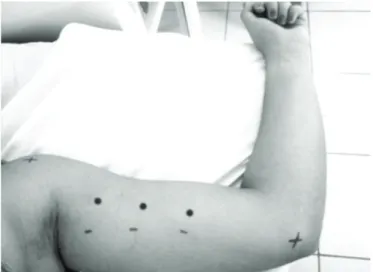
The third violet ilament (2.6 g) was considered as nor -mality value after calibration based on the control limb. Above this value, sensitivity was considered decreased, and below this value, sensitivity was considered pre-served. The following markings were made to stand-ardize the esthesiometric test: the distance between the coracoid process and the medial epicondyle was divided in three equal spaces, considering three points: proximal (P1), distal (P2) and medium (P3), which corresponds to the medium point between P1 and P2. As from P1, a point was marked 3 cm below toward the posterior arm; as from P3, a point was marked at 2.5 cm; and as from P2, another point was marked at 2 cm. Esthesiometry was performed exactly on those points (Figure 1). To evaluate SS, patients remained with their eyes closed and in the supine position, with the shoulder abducted 90
degrees, external rotation and with the forearm lexed in 90 degrees. The monoilament was perpendicularly ap
-plied to skin, mildly pressing until the initial ilament
curvature, and then it was removed. Measure was dupli-cated and incremental with regard to pressure,
consider-ing as skin sensory threshold the ilament where patients
reported feeling the touch. Measure was repeated twice
and result was recorded as from the sum and the mean. Both UULL were evaluated, being the ipsilateral to sur-gery considered affected and the contralateral adopted as control limb. The lower the sensitivity, the higher the pressure, thus higher value in grams of the esthesiomet-ric measurement.
The ICBN dermatome also involves the axillary region, but this region was not evaluated because complaints of discomfort are in general related to UL and also to mas-tectomy scar, which may prolong to the axilla impairing sensory response.
The Brazilian version of McGill Pain Questionnaire (Br-MPQ) was used in the form of interview to characterize pain. Br-MPQ has two indices: number of words chosen (NWC) and pain report index (PRI), being made of 68 descriptors distributed in four categories (sensory, affec-tive, evaluative and mixed) and of 20 subcategories. Each subcategory has from 2 to 5 words. Females were oriented to choose between zero and 20 words for each subcategory most similar to their perceived pain. Each chosen word has a value and the sum of them generates total PRI. Additionally for each PRI category a score may be calculated. NWC refers to the number of selected de-scriptors on the tool corresponding to words chosen to ex-plain pain, with a minimum value of zero and maximum of 20. For both, PRI and NWC, the higher the score the more severe the pain.
Shoulder Pain and Disability Index (SPADI) question-naire was also applied as interview and the Brazilian version consists of 13 items distributed in the disability
scale (eight items) and the pain scale (ive items), being
each item scored from zero to 10. Final score varies be-tween zero and 100 and the higher the score, the worse the shoulder disorder12.
Figure 1 – Points to evaluate supericial sensitivity on the dermatome
Data were analyzed by the BioEstat 5.0 program and results were described in absolute frequencies, percent-ages, means and standard deviation of means. Wilcoxon Signed Rank Test for paired samples was used to
com-pare supericial sensitivity and shoulder pain and dis -ability questionnaire scores before and after RT, with
signiicance level of 95% (p < 0.05).
This study was approved by the Ethics Committee for Research with Human Beings, Teaching Hospital, Feder-al University of Sergipe (CAAE 0087.0.107.000-2011).
RESULTS
Participated in this study 25 females but ive were dis -continued from the study for interrupting RT by medical orientation. From 20 included females, mean age was
52.7 ± 11.2 years, mean BMI was 26.2 kg/m2 ± 2.7, 13
females were married, four single and three widows. With regard to occupation, six were housewives, two
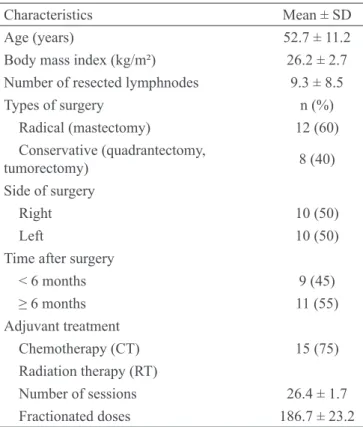
were peasants, ive were retired and seven had differ -ent activities (autonomous). Most preval-ent surgery was mastectomy (60%) and the number of RT sessions has varied from 25 to 30. Mean fractionated doses were 186.7 ± 23.2 cGy, varying between 100 and 215 cGy. Mean total RT dose corresponded to 4947cGy ± 734.8, varying from 2500 to 6020 cGy (Table 1).
Before RT, supericial sensitivity on the ICBN pathway
corresponded to 1.9 ± 0.2 g on the ipsilateral limb and 1.0 ± 0.2 g on the contralateral limb, both within criteria
adopted as normality (third ilament – 2.6 g). After RT there has been signiicant supericial sensitivity decrease
in all evaluated points on the ipsilateral limb, shown by increased esthesiometer pressure from 1.9 ± 0.2 g to 2.8 ± 0.2 g (p = 0.004), indicating hypoesthesia. There has
been no signiicant difference in SS of contralateral UL
when measures before and after RT were compared.
Pain evaluated by Br-MPQ has shown, in general, that
total PRI and NWC have signiicantly increased (p =
0.006 and p = 0.005, respectively) after RT (Table 3).
Sensory PRI and PRI have also shown signiicant in -crease (p = 0.014 and p = 0.043). In the sensory cat-egory, major descriptors were: pain “that comes and goes”, “spread in circles”, “stings like a needle prick”, “lacerating”, “pinching”, “jerking”, “heating”, “itch-ing”, “tingl“itch-ing”, “numb” and “hurting”. In the
affec-tive category, distributed in ive sub-categories, most
mentioned were: “tiring”, “frightful”, “punishing” and “nagging”. In the evaluative category, with just one sub-category, most common descriptors were: “mild” and “annoying”. In the mixed category, with four sub-categories, major descriptors were: “tight”, “increases and decreases” and “stressing”. After RT, in addition to mentioned descriptors, the following sensations were emphasized: “pulsing”, “radiating”, “stinging”, “pressing” (sensory), “dull” (affective) and “stabbing” (mixed).
With regard to SPADI (Graph 1) there has been
sig-niicant total score increase after RT (p = 0.001). Table 1 – General and clinical-surgical characteristics of patients
(n = 20).
Characteristics Mean ± SD
Age (years) 52.7 ± 11.2
Body mass index (kg/m²) 26.2 ± 2.7 Number of resected lymphnodes 9.3 ± 8.5
Types of surgery n (%)
Radical (mastectomy) 12 (60) Conservative (quadrantectomy,
tumorectomy) 8 (40)
Side of surgery
Right 10 (50)
Left 10 (50)
Time after surgery
< 6 months 9 (45)
≥ 6 months 11 (55)
Adjuvant treatment
Chemotherapy (CT) 15 (75) Radiation therapy (RT)
Number of sessions 26.4 ± 1.7 Fractionated doses 186.7 ± 23.2
Table 2 – Supericial sensitivity on upper limbs ipsilateral and con -tralateral to surgery before and after radiation therapy (n = 20).
Supericial
Sensitivity Before After p Ipsilateral limb
Point 1 1.9 ± 0.2 2.8 ± 0.2 0.004* Point 2 1.9 ± 0.2 2.8 ± 0.2 0.004* Point 3 1.9 ± 0.2 2.8 ± 0.2 0.004* Control limb
Point 1 1.1 ± 0.2 1.0 ± 0.2 0.499 Point 2 1.1 ± 0.2 1.0 ± 0.2 0.674 Point 3 1.1 ± 0.2 1.0 ± 0.2 0.612
Calibration of each filament with precision analytic scale (CKA®): Green (0.05 g), blue (0.2 g), violet (2.6 g), dark red (3.6 g), orange (9.4 g) and magenta red (107.9 g).
Disability score has signiicantly increased from 24.6
± 25.7 to 39.2 ± 25.4 (p = 0.001) and pain score has increased from 26.3 ± 28.5 to 48.4 ± 31.7 (p = 0.001)
Table 3 – Pain index and number of words chosen from the McGill pain questionnaire before and after RT (n = 20).
Before After p PRI
Sensory 6.7 ± 1.7 11.5 ± 1.5 0.014* Affective 2.0 ± 0.6 3.7 ± 0.6 0.043* Evaluative 1.2 ± 0.6 1.3 ± 0.3 0.443 Mixed 1.1 ± 0.1 2.2 ± 0.4 0.072 Total 11.1 ± 2.9 19.4 ± 2.2 0.006* NWC 6.1 ± 1.5 11.1 ± 1.1 0.005*
Values in mean ± standard-deviation, *p < 0.05 = Wilcoxon
Signed Rank Test; PRI = Pain Report Index; NWC = number of words chosen.
Graph 1 – Comparison of disability, pain and total score before and after radiation therapy. Values in mean ± standard error; Wilcoxon Signed Rank Test, p = 0.001 in all comparisons.
Before
After
Disability Pain Total
DISCUSSION
Surgery is still the primary BC treatment, especially in more advanced staging. In our sample, 60% were sub-mitted to radical techniques, such as mastectomy with AL. Lymphnodes resection is still the procedure induc-ing more postoperative complications, especially related to sensory disorders, pain and decreased UL mobility4,6. Our study has observed that before RT, females had
al-ready decreased supericial sensitivity on the affected
UL as compared to contralateral limb, which has already been evidenced by the literature using esthesiometry3,10. However this is expected since surgery itself may deter-mine such change6,7.
There has been hypoesthesia on the ICBN pathway of the UL ipsilateral to irradiated region, as compared to values of the same limb before RT and to
contralat-eral UL. Since adjuvant RT should be used in all ive working days of the week for ive to six weeks, it is
common the presence of skin reactions in the
irradi-ated area, associirradi-ated to neuropathies caused by ibro -sis and local nervous tissue ischemia10. This may ex-plain decreased SS immediately after the RT period. It is worth highlighting that, although 15 females were also submitted to CT, the literature is clear in stating that CT does not interfere with ICBN pathway sen-sitivity because it is a systemic therapy unrelated to localized sensory lesions13.
UL pain may start immediately after surgery and may last for long periods3. RT may inluence pain onset and persistence, generating chronic presentations4,5,9. So, as observed in our study, UL pain was a symptom present
soon after surgery, with signiicant increase of intensity
immediately after RT when measured by MPQ.
ICBN is a predominantly sensory nerve and this
justi-ies the fact that females have chosen words represent -ing sensations such as: “pulsat-ing”, “radiat-ing”, “st-ing- “sting-ing”, “pressing” (sensory category), “dull” (affective category) and “stabbing” (mixed category). In general, pain may be induced by surgery, by scars, by skin re-actions and by fear of adequately moving UL. In our study, movement amplitude was not considered a vari-able, because all females had to have minimum shoulder abduction amplitude in 90 degrees, external rotation and
forearm lexed in 90 degrees to be submitted to RT.
Together with increased pain intensity, this study has observed increased functional disability, showing worsening of upper limb functionality after RT. Ac-cording to SPADI, activities with the highest level of
dificulty and pain severity were “placing something in
a high shelf with the affected arm” and “when trying to touch the back of the neck with the affected arm”, spectively. The same was reported by other studies
re-ferring marked disability, especially during lexion and
abduction movements of the affected shoulder after BC treatment, especially when associated with RT5,14. In general, this shows that RT physically triggers slow scar repair and marked tissue necrosis, substantially impairing UL function4,5,7,9.
During initial evaluation, nine females were pain-free; however after RT only two did not report pain,
which was conirmed by inal PRI, NWC and SPADI pain scale results. As to SPADI disability scale, ive
patients had initial scores of zero and only one
re-mained with this result after RT. Such indings conirm
the possibility of physical-functional complications potentiated by RT7,14.
be-tween six and 12 months, when evaluating 347 patients after surgery and adjuvant RT in 94% of them. Approxi-mately 12% had lymphedema, 39% have reported pain and 50% had movement amplitude limitations. In spite of losses in quality of life (QL) and of daily activities re-striction, most females have not shared with health pro-fessionals their arm morbidity. This indicates the need for strategies to follow up patients under BC treatment, with objective measures to evaluate and treat UL mor-bidities, especially those negatively impacting function-ality and daily life activities.
A study15 has followed 55 females in two groups, one
control and one with kinesiotherapy during RT to check the effect of physical therapy on QL. Although
without signiicant differences in some evaluated as -pects, the group submitted to supervised exercises
for BC was beneited after RT and six months later.
The importance of physical therapy in the follow up of females being treated with RT has also been
shown14, being exercises valid to improve movement
amplitude8,14, QL15, and to decrease fatigue and pain14 during and after RT.
It was possible to observe that hypoesthesia, pain and disability are present in females submitted to AL and that these may worsen after RT. Since participants were evaluated immediately after RT, no long term inference was possible. Follow ups including a physical therapy protocol and larger sample size could contribute for the assistance to these females, for oncology health ser-vices and for professionals involved with functional recovery.
CONCLUSION
There has been ICBN pathway hypoesthesia, worsening of pain and disability of upper limb ipsilateral to BC sur-gery immediately after adjuvant RT.
ACKNOWLEDGMENTS
To patients participating in this study, to FBHC, to the Ministry of Education – MEC, to the Special
Inclu-sion Program in Scientiic Initiation – PIIC/POSGRAP/
PROEST/UFS and to the Institutional Initiation to Ex-tension Scholarship Program – PIBIX.
REFERENCES
1. Silva RCF, Hortale VA. Rastreamento do câncer de mama no Brasil: quem, como e por quê? Rev Bras Cancerol. 2012;58(1):67-71.
2. Nogueira EA, Bergmann A, Paixão E, et al. Alter-ações sensitivas, tratamento cirúrgico do câncer de mama e nervo intercostobraquial: revisão de litera-tura. Rev Bras Cancerol. 2010;56(1):85-91.
3. Pimentel MD, Santos LC, Gobbi H. Avaliação clínica da dor e sensibilidade cutânea de pacientes submetidas à dissecção axilar com preservação do nervo intercostobraquial para tratamento cirúr-gico do câncer de mama. Rev Bras Ginecol Obstet. 2007;29(6):291-6.
4. Lee TS, Kilbreath SL, Refshauge KM, et al. Prog-nosis of the upper limb following surgery and ra-diation for breast cancer. Breast Cancer Res Treat. 2008;110(1):19-37.
5. Reidunsdatter RJ, Rannestad T, Frengen J, et al. Early effects of contemporary breast radiation on health-related quality of life - predictors of radiother-apy-related fatigue. Acta Oncol. 2011;50(8):1175-82. 6. Torresan RZ, Santos CC, Conde DM, et al. Preservação do nervo intercostobraquial na lin-fadenectomia axilar por carcinoma de mama. Rev Bras Ginecol Obstet. 2002;24(4):221-6.
7. Levangie PK, Drouin J. Magnitude of late ef-fects of breast cancer treatments on shoulder func-tion: a systematic review. Breast Cancer Res Treat. 2009;116(1):1-15.
8 Harrington S, Padua D, Battaglini C, et al. Com-parison of shoulder flexibility, strength, and function between breast cancer survivors and healthy partici-pants. J Cancer Surviv. 2011;5(2):167-74.
9. Thomas-Maclean RL, Hack T, Kwan W, et al. Arm morbidity and disability after breast cancer: new direc-tions for care. Oncol Nurs Forum. 2008;35(1):65-71. 10. Ornelas FA, Rodrigues JR, Uemura G. Avaliação convencional e estesiômetro: resultados controver-sos na avaliação sensitiva no câncer de mama. HU Rev. 2010;36(2):137-45.
11. Costa AIS, Chaves MD. Dor em pacientes
on-cológicos sob tratamento quimioterápico. Rev Dor. 2012;13(1):45-9.
12. Martins J, Napoles BV, Hoffman CB, et al. Versão Brasileira do Shoulder Pain and Disability Index: tradução, adaptação cultural e confiabilidade. Rev Bras Fisioter. 2010;14(6)527-536.
2008;49(3):443-50.
15. Oliveira MMF, Souza GA, Miranda MS, et al. Exercícios para membros superiores durante radi-oterapia para câncer de mama e qualidade de vida. Rev Bras Ginecol Obstet. 2010:32(3)133-8.
Submitted in July 03, de 2012.
Accepted for publication in September 28, 2012.
Conlict of interests: None – Sponsorship Sources: Spe
-cial Inclusion Program in Scientiic Initiation – PIIC,