(1) Faculdade de Odontologia de Bauru da Universidade de São Paulo, Bauru, São Paulo, Brasil.
(2) Associação de Pais Amigos dos Excepcionais de São Paulo, APAE, Bauru, São Paulo, Brasil. (3) Faculdade de Ciências Médicas da
Universidade Estadual de Campinas – Unicamp, Campinas, São Paulo, Brasil. (4) Departamento de Fonoaudiologia da
Faculdade de Odontologia de Bauru, Universidade de São Paulo - USP, Bauru, São Paulo, Brasil.
Source: FAPESP, modalidade de bolsa de iniciação cientíica, processo nº 2011/22051-0
Conlict of interest: non-existent
Suggestive signs of stress in school children
with learning disabilities
Sinais sugestivos de estresse infantil em escolares
com transtorno de aprendizagem
Janaína Borba Garbo Santos(1)
Thaís dos Santos Gonçalves(2)
Ricardo Franco de Lima(3)
Patrícia de Abreu Pinheiro Crenitte(4)
Received on: December 17, 2015 Accepted on: May 16, 2016
Mailing address:
Patrícia de Abreu Pinheiro Crenitte Departamento de Fonoaudiologia da FOB – USP
Alameda Dr. Octávio Pinheiro Brisolla, 9-75, Vila Universitária
Bauru – SP – Brasil CEP: 17012-901
E-mail: [email protected]
ABSTRACT
Purpose: to compare suggestive signs of stress in children with learning disorders (with and without speech-language intervention) and in children without learning problems, and to identify suggestive signs of stress among groups according to the gender of the participants.
Methods: the study included 25 children with learning disorder. Of these children, 10 were diagnosed, but without intervention and 15 children were receiving speech-language intervention. Also 25 children without any learning problems participated in the study. In all groups, a children’s stress scale was
applied.
Results: it was observed that 43% of children with learning problems without intervention, 56% of chil
-dren with learning problems in intervention and 83% of chil-dren without learning problem, showed war
-ning signs for child stress. These differences were not statistically signiicant. In addition, ware not found differences between genders.
Conclusion: in all groups, there was a high frequency of warning signs for child stress, showing that this may not be a determining factor in academic achievement in the study sample.
Keywords: Stress, Psychological; Learning; Learning Disorders
RESUMO
Objetivo: comparar sinais sugestivos de estresse entre crianças com transtornos de aprendizagem (com
e sem intervenção fonoaudiológica) e em crianças sem qualquer diiculdade escolar, além de veriicar
sinais sugestivos de estresse entre os grupos de acordo com o sexo dos participantes.
Métodos: participaram do estudo 25 crianças com transtorno de aprendizagem, 10 com diagnóstico, porém sem intervenção e 15 em intervenção fonoaudiológica, e 25 crianças sem queixas de aprendiza
-gem. Em todos os grupos foi aplicada uma escala de estresse infantil.
Resultados: observou-se que 43% das crianças com transtorno de aprendizagem sem intervenção, 56% das crianças com transtorno de aprendizagem em terapia e 83% das crianças sem o transtorno, apre
-sentaram sinais de alerta. Estas diferenças não foram estatisticamente signiicantes. Também não foi encontrada esta diferença entre os sexos.
Conclusão: nos dois grupos houve alta frequência de sinais de alerta para o estresse infantil, mostrando que este pode não ser um fator determinante no desempenho escolar na amostra estudada.
INTRODUCTION
Several factors may inluence childhood scholar development, so dificulties in this process can be
caused due to aspects of organic, intellectual/cognitive and emotional origin. By observing more closely the behavior of children with learning disorders, the inter-active dynamic between the neurobiological, social
and educational factors that inluence the learning
process should be considered. It is then necessary to distinguish, when possible, those factors that can be indicators of a learning disorder. The children’s stress can be considered an aggravating factor of such
dificulties, since it has direct inluence on the child’s
behavior and can thus contribute to their school failure. For the DSM-V1, the term Speciic Learning Disorder
refers to learning dificulties and the use of academic
skills, indicated by the presence of at least one of the following symptoms that have persisted for at least 6 months (although targeted interventions to these
dificulties): reading words inaccurately or slowly and with effort; dificulties to understand the meaning of what is read; dificulties in orthography; dificulties
with written expression (e.g. commits multiple errors in grammar or punctuation in the sentences, inadequate organization of paragraphs and written expression of
ideas without clarity); dificulties to master the number sense, numerical facts or calculation, and dificulties
in reasoning. According to the manual, such learning
dificulties start up during the school years, but do
not show through until the demands by the affected academic skills exceed the limited capabilities of the
individual. Still, learning dificulties cannot be explained
by intellectual disabilities, visual acuity or uncor-rected hearing problems, other mental or neurological
disorders, psychosocial adversity, lack of proiciency in
academic instruction language or inadequate educa-tional instruction.
It is observed that children with learning disorders maybe at high risk for developing mental disorders, as they tend to have low self-concept, high locus of external control, they are less socially accepted and more anxious than their peers without learning disabil-ities2. One of these mental disorders that has become
present in the lives of these children is child stress, which directly affects the entire scholar and cognitive development process.
Stress can be characterized as “a set of reactions we have when something happens that frightens us, annoys us extremely when excited or make us happy”3. It can be considered that any situation, good
or bad, which leads to a human’s homeostasis loss and enables an adaptation, it creates stress, but that is only harmful if there is a individual’s predisposition3. Stress
develops when the requirements become superior to the individual’s ability to overcome them, making it impossible to resist and to create strategies to deal with them4. For some authors5, child stress is similar to the
adult in many aspects, such as dificulties of interaction
and socialization, and can have serious consequences if it is excessive.
Another factor affected by stress and directly
inluences the children’s school performance is the
decrease in memory, both short and long term. The presence of acute stress actives the release of corti-cotropin hormone (CRH), which affects the process by which the brain collects and stores the received
infor-mation, causing signiicant changes in neuroplasticity
process6. Still, for the authors, stress enhances synaptic
plasticity and neurons function of the amygdala, which affects differently the hippocampus and prefrontal cortex. These factors may contribute to over activation of the neural circuitry that controls fear, anxiety and emotion. It can also generate a state of depression7.
Previous studies that investigated the presence of signs of stress in children with learning problems found an association between the presence of stress and poor school performance8-11. On the other hand, other
studies have not found this association12,13, since there
were no statistically signiicant differences in childhood
stress indicators between the groups with and without learning disorders.
Still, according to the literature, girls have a higher susceptibility to show signs of stress when compared to boys9,14-16. Other authors17 found no statistically
signif-icant differences between the sexes, although they have found a prevalence of signs of stress in females.
After reviewing the literature, it can be considered that there is a relationship between childhood stress and school failure in children with learning disorders, as well as a higher incidence in females. However, this matter is still poorly addressed in national and inter-national literature and deserves greater attention from researchers, since the consequences of emotional problems such as stress, have been suggested as
aggravating academic dificulties faced by individuals
with a learning disorder. Thus, the objective of this study was to compare the level of suggestive signs of stress in children with learning disorders (with and without speech-language intervention) and in children
the level of stress among groups according to the participants’ gender.
METHODS
All procedures were submitted and approved by the Research Ethics Committee at the home institution, under protocol number 002/2012. This work is an observational research, case-control desing.
Participants
Participants were 50 children of both sexes, aged between 8 and 12, students from 3rd to 7th year of elementary school, divided into the following groups: • GI: 25 children with learning disorder, which 10 had
the diagnosis of speciic learning disability (SLD),
but did not initiate the intervention (GIA) and 15 were receiving speech-language intervention (GIB). • GII: 25 children without reading and writing learning
complaint, which is the control group.
Children from both cited groups GI and GII were
matched according to age. In the irst group, 44% (11) was made up of girls and 56% (14) of boys. In the second group, 48% (12) were girls and 52% (13) were
boys.
The inclusion criteria in the group with learning disabilities (GI) were: (a) Authorization of participation by parents or responsible for signing the Terms of
Free and Clariied Consent Term (TFCC), according
to the National Council of Health 196/969; (b) be aged between 8 and 12 years old and be enrolled in primary education; (c) normal visual and auditory acuity; (d) Provide Intelligence Quotient (IQ) within the normal range, i.e.,> 80; (e) do not make use of psychotropic
medication and did not ile a complaint of another
neurological condition, according to parents’ reports; (f) For GI A group: to receive interdisciplinary diagnosis at the Clinical School of the home institution and not be receiving therapeutic intervention; (G) For GI B group: to have interdisciplinary diagnosis of SLD, evidenced by the interdisciplinary evaluation of the Clinic School at home institution and be receiving therapeutic inter-vention at the the same location.
In GI A and GI B groups, children were excluded whom: (a) presented other diagnoses: genetic syndromes, neurological or neuropsychiatric
condi-tions, such as attention deicit disorder or attention deicit hyperactivity disorder (ADD/ ADHD); (b)
presented other diagnoses of learning disabilities:
mixed disorder of scholastic skills, school dificulties
of pedagogical origin; (c) had cognitive inability to respond to the proposed test;
For the group of children without learning disabilities (GII) the following inclusion criteria were considered: (a) parental authorization by signing the consent form; (b) to be aged 8 to 12 years and be in elementary school; (c) to be nominated by teachers for not complaining
of dificulties in learning and not having school perfor -mance below expectations; (d) do not make use of psychotropic medication, does not present any type of sensory impairment, neurological and developmental delay, according to parents’ reports.
They were excluded from the GII: (a) Children with a
history of school failure; (b) children who had dificulties
in reading and writing, according to results of clinical assessment.
Local
The application range at the GIA and GIB was conducted at the Clinic of Speech Pathology and Audiology from the home institution. Data collection in the GIA occurred at the Clinic of Diagnosis, after receiving the diagnosis of SLD. The School Clinic receives referrals of children and young people with
learning dificulties complaints, among other dificulties,
for the interdisciplinary assessment, diagnosis and intervention. Participants of GIB were in therapeutic intervention at the Written Language Clinic, also in School Clinic from the home institution where data were collected. For GII, data collection was carried out at the participants’ school, which is municipal and located in the interior of São Paulo state, in an appropriate room
granted by school oficials.
Procedures
The children from both groups were submitted to the Child Stress Scale (CSS) developed by Lipp and Lucarelli18. The scale consists of 35 items with Likert
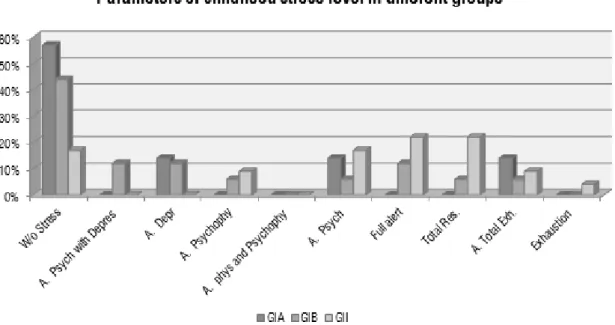
process (GIB), it was observed in 44% of children. On the other hand, only 17% of children without SLD (GII)
showed no sign of stress. Thus, most children without learning disorder, as well as those just diagnosed with SLD and those who were in the intervention showed some warning signs for stress. It is observed in Figure
1 that 22% of children without SLD demonstrated full alertness and total resistance, and 17% presented
alertness on psychological reactions. In the group with
the disorder, 14% of children in GIA and 12% of GIB presented alert on depression, and 12% of the GIB
children presented alert on psychological reactions with depressive component. In short, for the group without disorder, the psychological reactions were a more frequent warning sign. In the group with SLD, the most common warning signs for the GIA were for depression and psychological reactions, and for the GIB the most frequent warnings were psychological reactions with depressive component.
Figure 1 shows the alert reactions to the different dimensions of CSS, in different groups.
Despite noting differences between the groups regarding the stress level, the comparative statistical
analysis showed no statistically signiicant difference
in the analyzed parameters. For this, the level of stress among the three groups was compared, also, separating the groups between: GIA compared to GII, GIB compared with GII, GIA added with GIB and compared with GII, as shown in Table 1.
The stress level among boys and girls was also compared, considering the total sample, not being
noticed statistically signiicant difference between the
genders, although the number of girls with any warning signs is higher than boys (Table 2).
ill any part of a circle if the exposed situation never happens; ill a quarter of this circle when it happens
a bit; two quarters when it happens sometimes; three quarters when almost always happens and the whole circle when it always happens.
Each child was given a pen and a form of the scale, and a demonstration by the researchers the correct way to answer each question.
The calculation of the response was made by counting the points assigned to each item; each quarter circle completed by the child is equivalent to
one point. For inal analysis, the test was divided into
4 phases: Alert, being the transient stress (total score range between 39.6 and 59.5); Resistance, charac-terized by an excess of stress sources in the child’s life (total score range above 59.5 to 79.4); Near-exhaustion, being a very serious stage of stress (total score range above 79.4 points to 99.3, 7 or more items have circles completely painted in of full scale) and Exhaustion, the most severe phase of stress (total score above 99.3 points, independently of the score in the others criteria regarding the different stress factors).
Data analysis
The comparative statistical analysis was performed between groups and genders. The statistical
Chi-Square test iwas used, adopting the signiicance level of 5%.
RESULTS
It was observed that 57% of children with SLD
Subtitle:
W/o Stress – without stress
A. Psych with Depres – Alert in psychological reaction with depressive component A. Depr – Alert in reaction with depressive component
A. Psychophy – Alert in psychophysiological reaction
A. phys and Psychophy – Alert in physical reaction with psychophysiological component A. Psych – Alert in psychological reactions
Full alert – Full alert
Total Res. – Total resistance A. Total Exh. – Almost total exhaustion
Exhaustion - Exhaustion
Figure 1. Comparison of the presence of suggestive signs of stress between groups (GIA - children with learning disorder who has never
received speech therapy; GIB - children with learning disorder in speech therapy and GII - children without learning problems)
Table 1. Comparison between groups in relation to stress level
Stress level parameters GIA (n=7) GIB (n=16) GII (n=23)
GIA X GIB X GII (p value*)
GIA X GII (p value*)
GIB X GII (p value*)
GIA + GIB X GII (p
value*)
No stress 57% 44% 17% 0.147 0.073 0.143 0.063
Psychological alert with
depressive component 0% 12% 0% 0.141 ---- 0.082 0.148
Alert in depressive
component 14% 12% 0% 0.241 0.065 0.225 0.148
Alert in
Psychophysiologic 0% 6% 9% 0.716 0.419 0.778 0.550
Alert in physical and
psychophysiological 0% 0% 0% 0.352 0.419 0.226 0.148
Alert in Psychological 14% 6% 17% 0.646 0.356 0.791 0.550
Full alert 0% 12% 22% 0.407 0.177 0.820 0.437
Total Resistance 0% 6% 22% 0.198 0.177 0.187 0.080
Almost total exhaustion 14% 6% 9% 0.370 0.666 0.226 0.550
Exhaustion 0% 0% 4% 0.600 0.575 0.395 0.312
*p value considered = <0.05 (chi-square test)
Subtitle: GIA - children with speciic learning disorder who has never received language intervention; GIB - children with speciic learning disorder in
DISCUSSION
Given the obtained results in this study in which
there were no statistically signiicant differences in
the stress level among children with and without SLD, nor between boys and girls, these results were also observed in previous studies12,13,17.
In a study12, besides not showing statistically
signif-icant difference in the stress level among students with
and without learning dificulties in 3rd and 4th grade, the authors found 23.3% of the samples were at risk for
emotional and health problems. Students with learning disabilities, when compared with the subgroup without school problems, reported more physical illnesses and symptoms, headache complaints, mainly, and behaviors indicative of stress, anxiety and depression, more often fears and nightmares. In our study, we also observed warning depression signs in the group
with SLD (14% in diagnostic process and 12% in inter -vention). The greater or lesser probability of depression appearance is seen as the result of a series of environ-mental conditions interaction, particularly stress, loss and individual predispositions19.
A study13 that evaluated 342 children at a school in
São Paulo also found no statistically signiicant differ -ences between the groups with and without school failure, corroborating the results of our study. Although,
only 30% of the studied children showed stress signs, and of these, 38.2% were indicated as having poor
school performance. Yet, when the authors studied the childhood stress from the average school performance achieved by children, it could be seen that children with stress had a worse performance when compared
to children without stress. Thus, the study showed the
inluence of stress in school performance.
By researching young adults and college students with high and low academic achievement, some authors20,21 also found no signiicant correlations
between performance and stress level experienced by graduate students, but the authors related the academic
qualiications of students with other variables, such as
behavior patterns and age.
On the other hand, unlike this research, some studies indicate the relationship between stress level and low academic performance, and they are described below.
In the study conducted by Stasiak and Weber8, 39
children from the elementary school were evaluated and these authors reported the psychophysiological factors as a higher factor that interferes with learning, such as colleague’s bad behavior, or even teacher disincentives; what differs from the results found in our study, in which that most frequent warning signs for the group with no intervention disorder was for depression and psychological reactions (such as anxiety, tension and anguish), and from the group in intervention, the most frequent warnings were psychological reactions with depressive component and alert to depression.
The study conducted by Pacanaro22 found that
40% of the sample with learning dificulties showed high stress levels, and the dificulty of learning can be
a contributing factor to increased stress, although the majority of the sample did not show suggestive stress signs. Another study9 that related stress and school,
conducted with 158 students from 1st to 4th grade, with
and without learning dificulties, found a high frequency of stress symptoms (55% of the sample), particularly
Table 2. Comparison between boys and girls in relation to stress level
Stress level parameters Boys
(n=24)
Girls
(n= 22) P value*
No stress 50% 27% 0.686
Psychological alert with depressive component 4% 0% 0.166
Alert in depressive component 8% 0% 0.166
Alert in Psychophysiologic 8% 4% 0.603
Alert in physical and psychophysiological 4% 4% 0.950
Alert in Psychological 4% 9% 0.499
Full Alert 8% 18% 0.892
Total Resistance 8% 18% 0.322
Almost total exhaustion 0% 13% 0.061
Exhaustion 4% 0% 0.333
among the weakest students (67%), more frequently
among girls, predominantly cognitive symptoms (getting worried about bad things that can happen, be
afraid and desire to cry). Students classiied as weak showed dificulty paying attention and felt sad. Still,
when analyzing the level of stress among older children and young people, one study10 found that a large part
out of 341 analyzed adolescents presented median
stress levels, highlighting the academic dificulty as a major inluencer of the observed stress.
In our study, 83% of children without learning
complaints have some warning stress sign, compared
to 43% of the group with SLD in the evaluation process and 56% in the intervention process, therefore, we
cannot attribute the stress as a contributing factor for learning problems. In this regard, some authors23,24
reported that stress does not always have negative effects. For them, stress is part of life, and when well managed can have a positive effect, and when poorly managed or ignored can be destructive. The results of a study25 suggest that stress levels during emotional
learning tasks operate as a switch, determining the memory destination. On the other hand, the information from this study about the high frequency of warning stress signs among children with adequate school
performance elicits the relection that such children
could present even better results, further developing their potential in the absence of stressors. Another study26 investigated the stress and malnutrition effect
on learning in rats. The results showed no effects of isolated stress on learning, however, in previously undernourished rats, an episode of acute stress, before the execution of learning tasks and spatial memory, positively affects the acquisition of learning. On the other hand, the information from our study of high frequency of stress warning signs among children with
adequate school performance elicits the relection that
such children could present even better results, further developing their potential in the absence of stressors.
Regarding comparisons between the genders, one study14 indicated the difference between boys and girls
in stress event, pointing the female as the one with a higher incidence of symptoms, even considering the
social and cultural aspects. Pacanaro and Nucci17
did not identify statistically signiicant differences
in stress responses between male and female with the 106 students of 4th grade students of public and private school, although there was stress prevalence in females.
A survey16 observed relationship between emotional
problems (including stress) with school performance, also pointing to a higher prevalence of stress and anxiety in female gender, which also points out another study5 with 883 children from private, municipal and
state schools, which showed that 18.2% had stress
levels, also with a higher prevalence in females.
These results corroborate the data from our study, which found a higher frequency of warning stress signs
in female gender, although no statistically signiicant
difference was observed.
Researchers15 observed the presence of stress
symptoms in 255 schoolchildren aged 7 to 14 years old, from three different types of schools (municipal, private and philanthropic particular confessional). The authors analyzed the difference in stress levels between schools, gender and grade, and found that the type of school had a strong association with the students’ stress level and the number of girls with
stress was signiicantly higher than boys, which differs
from the results of our study. The authors concluded that schools have an important role in childhood stress and it is possible within a school to present low stress levels, depending on the characteristics thereof.
Some studies with school age children have shown
high prevalence of stress, ranging from 30% to 60%5,9,
which corroborates our study, and it was observed a high frequency of warning signs for the group with SLD
(43% in a diagnosis process and 56% in the intervention
process) and especially for the group without learning
complaints (83%).
In the period of intellectual, emotional and affective development, children are faced with numerous gener-ating stress situations and, most often, do not yet have the ability to deal with these situations. However, for some authors27, not all children undergoing the same
stress level develop stress symptoms and various social support forms that the child receives directly
inluence the stress level in childhood.
A survey conducted among 66 schoolchildren with pronounced stress symptoms showed that, according to the complaints cited by children, parents and teachers have a great impact on the development of childhood stress15. Other authors12 also found
that school and familiar context events could hinder academic performance.
However, a good academic performance can bring different consequences for the child: it helps children improve their self-esteem; however, if parents or other
same school performance may also constitute a factor that makes the child more vulnerable. Still, stressful experiences related to school environment, such as those that occur in tests situations, competitions,
conlicts with peers or teachers, can lead to unhealthy
results such as phobias, somatic complaints and depressive episodes28. Thus, as much strenuous and
clever the child is, he will hardly perform well in school during a stress crisis, because the symptoms directly
inluence school performance29.
A study30 investigated the effect of an intervention
program in math skills in children with dyscalculia. There was a reduction of stress level, attention problems and anxiety to the extent that there was an increase in math grades. The authors reported that higher than expected emotional problems were observed for this group.
Thus, a speciic intervention in children with problems
in mathematics showed positive effect on stress level of these children. Although the cited study has stimulated mathematical abilities, this data does not support the
present study, since there was no statistically signiicant
difference between the group with learning disorder who has never received speech-language intervention, group in intervention and the group without learning problems, demonstrating that the intervention with the reading and writing skills did not provide differences in the stress level of the studied individuals.
Regarding school environment, behavior and teacher’s attitudes in with the student are paramount, because the teacher can project in students their
own complexes, emotional, marital, social dificulties,
and repeat with the child their own experiences of misplaced or suffered education31. These events can
cause confusion in the student in the learning process and the school can become a stress source32.
Thus, all these above mentioned factors may be related to the high frequency of warning signs in our study, for all studied groups, and they need to be addressed in future studies, in order to reduce this incidence, since stress can cause serious damage in the academic and social life of these children, as previ-ously discussed.
Still, for the teenager who has affectionate and close family relationships, are better able to cope with stressful experiences than those without such support, and family support constitutes the most important protective factor in adolescence19.
As previously discussed, several studies indicate differences in stress levels between genders. To know about stress factors between boys and girls is
fundamental to provide better learning conditions in schools, respecting the gender differences. It is also important to know these differences and what causes high levels of stress between genders, to be possible to develop in schools a guidance of parents and teachers in order to promote mental health and psychological well-being of children in development, respecting their particularities17.
Thus, further research is needed, with larger samples of students in order to investigate and under-stand the different causes of stress in school and family
environment, and its inluence on academic perfor -mance, also arousing the professionals’ views that working in the diagnosis and intervention of learning problems, in order to minimize the symptoms and provide protective factors for this emotional issue. Such information are relevant for the promotion of institu-tional policies that enable better conditions for students to develop their academic potential and a better quality of life.
CONCLUSION
In this study, no statistically signiicant differences
were observed for stress signs among children with and without SLD, although there was a high frequency of warning signs in all studied groups. This difference was also observed between boys and girls in the sample. Thus, the need for further research with emphasizes on larger samples, to determine whether the emotional
factors such as stress, actually have an inluence on the
school performance of children with learning disorder.
REFERENCES
1. Donald W, Black,JEG. Guia Para o DSM-5: Complemento essencial para o Manual Diagnóstico e Estatístico de Transtornos Mentais. São Paulo:Artmed; 2015.
2. Lima R, Salgado C, Ciasca S. Associação da dislexia do desenvolvimento com comorbidade emocional: um estudo de caso. Rev CEFAC. 2011;13(4):756-62.
3. Lipp MEN, Souza EAPS, Romano ASF, Colovan MA. Como enfrentar o stress infantil. São Paulo: Editor Ícone; 1991.
5. Sbaraini CR, Schermann LB. Prevalence of childhood stress and associated factors: a study of schoolchildren in a city in Rio Grande do Sul State, Brazil. Cad. Saúde Pública. 2008;24(5):1082-8. 6. Korosi A, Baram TZ. Plasticity of the stress response
in early life: mechanisms and signiicance. Dev
Psychobiol. 2010; 52(7):661-70.
7. Pittenger C, Duman RS. Stress, depression, and neuroplasticity: a convergence of mechanisms. Neuropsychopharmacol. 2008;33:88-109.
8. Stasiak CR, Weber LND. Percepção do estresse pelas crianças do primeiro ano do ensino fundamental. Impulso. 2013;23(56):35-45.
9. Tanganelli MSL, Lipp MEN. Sintomas de estresse na rede pública de ensino. Estud. psicol. 1998;15(3):17-27.
10. Caires S, Silva C. Fatores de stress e estratégias de coping entre adolescentes no 12º ano de escolaridade. Estud Psicol. 2011;28(3):295-306.
11. Bartholomeu D, Sisto F, Rueda, F. Diiculdades
de aprendizagem na escrita e características emocionais de crianças. Psicol. estud. 2006;11(1):139-46.
12. Enumo SR, Ferrão E, Ribeiro M. Crianças com
diiculdades de aprendizagem e a escola: emoções
e saúde em foco. Estud Psicol. 2006;23(2):139-49. 13. Lemes S, Fisberg M, Rocha G, Ferrini L, Martins G,
Siviero K, Ataka M. Stress Infantil e Desempenho escolar – Avaliação de crianças de 1ª a 4ª série de uma escola pública do município de São Paulo. Estud. Psicol. 2003;20(1):5-14.
14. Calais SL, Batista LM, Lipp MEN. Diferenças de sexo e escolaridade na manifestação de
stress em adultos jovens. Psicol Relex Crít.
2003;16(2):257-63.
15. Lipp MEN, Arantes JP, Buriti MS, Witzig T.
O estresse em escolares. Psicol. Esc. Educ. 2002;6(1):51-6.
16. Bartholomeu D, Sisto FF, Marin Rueda FJ.
Diiculdades de aprendizagem na escrita e
características emocionais de crianças. Psicol Estud. 2006;11(1):139-46.
17. Pacanaro SV, Di Nucci EP. Stress Infantil: Uma comparação entre meninos e meninas do ensino fundamental. Argumento. 2005;13:65-76
18. Lipp MEN, Lucarelli MDM. Escala de Stress Infantil - ESI (manual). São Paulo: Casa do Psicólogo; 1998.
19. Steinberg L. Adolescence. 5th ed. Boston:
McGraw-Hill; 1999.
20. Pérez MA, Martín A, Borda M, del Río C. Estrés y rendimiento académico en estudiantes universitarios. Cuad. Med. Psicosom. Psiquiatr. Enlace. 2003;67-68:26-33.
21. Polo A, Hernández JM, Pozo C. Evaluación del estrés académico en estudiantes universitarios. Ansiedad Estrés. 1996;2(3):159-72.
22. Pacanaro SV. Stress infantil e diiculdades de
aprendizagem: um estudo com crianças em idade escolar [trabalho de conclusão de curso]. Campinas (SP): Pontifícia Universidade Católica de Campinas; 2005.
23. Ramos M. Desaiar o desaio – Prevenção do stress
no trabalho. Lisboa: Editora RH; 2001.
24. Hargreaves, G. Gerir o Stress: Manual de
Auto-Formação. Lisboa: Livros e Livros; 2001.
25. Pedraza LK, Sierra RO, Boos FZ, Haubrich
J, Quillfeldt JA, de Oliveira Alvares L. The dynamic nature of systems consolidation: Stress during learning as a switch guiding the rate of the hippocampal dependency and memory quality. Hippocampus. 2015 Sep 15 [Epub ahead of print].
26. Vales LDFM, Fukuda, MTH, Almeida, SS.
Effects of acute stress on learning and memory
processes of malnourished rats. Psicol Relex Crít.
2014;27(4):784-93.
27. Bugental DB, Johnston C. Parental and child cognitions in the context of the family. Annu Rev Psychol. 2000;51:315-44.
28. Carson DK, Bittner MT. Temperament and
school-aged children’coping abilities and responses to stress. J Genet Psychol. 1994;155:289-302. 29. Tricolli VAC. A criança e a escola. In: Lipp MEN,
editor. Crianças estressadas: causas, sintomas
e soluções. 4ª ed. Campinas: Papirus, 2003. p.
123-46.
30. Lambert K, Spinath B. Changes in psychological stress after interventions in children and adolescents with mathematical learning disabilities. Z Kinder Jugendpsychiatr Psychother. 2013;41(1):23-34. 31. Patto MHS. A produção do fracasso escolar:
história de submissão e rebeldia. São Paulo: Casa do Psicólogo; 2000.
32. Bignotto MM, Tricoli VAC. A inluência do
meio ambiente e das práticas parentais na vulnerabilidade ao stress. In: Lipp MEN, editor.
Mecanismos Neuropsicoisiológicos do Stress: Teoria e Aplicações Clínicas. São Paulo: Casa do