THE INTERVENING VARIABLES IN THE PRODUCTION
OF CONSONANT CLUSTERS BY SYLLABIC ANALYSIS
As variáveis intervenientes na produção do onset complexo
mediante uma análise silábica
Carolina Lisbôa Mezzomo(1), Diéssica Zacarias Vargas (2),
Lilian Kopp Cuti(3), Silvana Gonçalves Lopes(4)
(1) Speech Language Pathologist, Assistant Professor from the Speech Language Pathology course, Federal Univer-sity of Santa Maria – UFSM, Santa Maria, RS, Brazil; PhD in Applied Linguistics from the Catholic University of Rio Grande do Sul, Porto Alegre, RS, Brazil.
(2) Speech Language Pathologist; Master by the Postgradu-ate Program in Human Communication Disorders from the Federal University of Santa Maria, UFSM, Santa Maria, RS, Brazil.
(3) Undergraduate student from the Speech Language Patho-logy Course at the Federal University of Santa Maria, UFSM, Santa Maria, RS, Brazil.
(4) Undergraduate student from the Speech Language Patho-logy Course at the Federal University of Santa Maria, UFSM, Santa Maria, RS, Brazil.
Study carried out at the Federal University of Santa Maria – UFSM, Santa Maria RS, Brazil.
Conlict of interest: non-existent
INTRODUCTION
The phonological acquisition, along with the other modules of language development occurs throughout childhood, with the overall maturity of the child, including acquisitions and simultaneous developments1,2.
In most children, the domain of the standard phonological system is reached spontaneously in
a continuously and gradually way from four or ive
years old. Although this domain occurs in a very similar way among children, it is found that acquisi-tion is nonlinear and there are individual variaacquisi-tions – such as the age of acquisition and the repair stra-tegies used2,3.
ABSTRACT
Purpose: to verify and to compare the repair strategies and the inluence of linguistic (syllabic and prosodic) and extralinguistic variables in the production of consonant clusters by children with typical
and atypical phonological development. Method: it was analyzed the speech of 48 children, 24 with typical phonological development and 24 with atypical phonological development, similar in relation to
sex, and age between 2:6 to 5:5;29 (typical group) and 5:0 to 7:11;29 (atypical group). The samples
were collected transversely, based on the instrument Avaliação Fonológica da Criança.It was analyzed the words presented as target consonant clusters, with a corpus of 278 words of typical development
and 460 of atypical development. The correct production, C2 deletion, C1 deletion, syllable deletion, epenthetic, metathesis and idiosyncrasies were considered as variants of the dependent variable. The
extralinguistic factors such as age, sex and development type, and linguistic variables the number of syllables, next precedent syllabic context, the position in the word, the complexity of the onset in the
syllable and metrical foot were considered as independent intervening variables. The speech data were statistically analyzed through VARBRUL. Results: the statistical program selected as signiicant for
the correct production and other types of repair strategies in the consonant clusters the variables sex, age, development type, position in the word, metrical foot and precedent syllabic context. Conclusion:
it was found that the linguistic and extralinguistic variables signiicantly inluence the production of
consonant clusters in children with both developments. The most widely used repair strategy was the deletion of C2.
children do not know or whose production does not dominate. In the case of CO as aforesaid, simpli-fying the feature is most often adopted. Besides this,
it is mentioned as an example of repair strategies on
target CO syllable omissions (e.g. plástico – [´tSiku]),
epentheses (e.g. bruxa – [bu’4uSa]), coalescence/ fusion (e.g. cravo – [´davu]), compensatory lengthe-ning (e.g. planta – [´pã:nta]) and metatheses (e.g. prato – [‘pa4tu])3.
Studies have shown that extralinguistic and linguistic variables can inluence the segmental
phonological acquisition. Linguistic variables cons-titute up to factors such as previous and following
context, tone and number of syllables. Regarding the extralinguistic variables, research on the subject
refers to factors such as age or gender, verifying
that these may or may not inluence the phonolo -gical domain of BP12, 13.
There were found studies in the literature
mentioning the inluence in the ield of segmental
phonology, however, there are few studies that
verify the inluence of syllabic or prosodic variables
in the acquisition of a particular template (template syllabic), independent segments that occupy it10,14.
Therefore, this study aims to check and compare
the repair strategies and the inluence of linguistic variables (syllabic and prosodic) and extralinguistic
in the production of the syllable with CO in children with typical and atypical phonological development.
METHOD
This research presents a transversal, explora -tory and quantitative character. The sample was comprised of data from 48 children, divided into two groups: typical and atypical acquisition, each group consisting of 12 girls and 12 boys, monolingual speakers of BP.
To make up the database used in this study, after parental consent by signing the free and informed consent and oral assent of the children, these were submitted to speech screening, receiving a diag-nosis of phonological disorder or typical phonolo-gical acquisition.
To be part of the sample, participants should not be receiving or have undergone any type of speech therapy and should not present hearing loss and changes evident in the neurological, cognitive and psychological aspects.
Speech samples were collected based on the instrument “Phonological Assessment of Child – Avaliação Fonológica da Criança: AFC”15, in which it uses the spontaneous nomination of 125 words
represented through ive themed designs, or toys
that reproduce the list of AFC (in the case of the younger children). A recording of the speech sample The domain of the phonological system of a
language is when a child can establish it in a consis-tent way with the target-adult of the community in which the child is. The maturation of phonological knowledge results in the establishment of a system consistent with this input3,4.
When there is dificulty in the eligibility of the
received input, occurs what is called
phonolo-gical disorder, i.e., it is dificult to properly use the
language sounds of contrastive form5.
The main difference between the typical and atypical acquisition, or normal deviant is in the timing and time of development. In typical acquisi-tion there are variaacquisi-tions that occur within a pattern of rapid and dynamic change to the phonological system to stabilize. In the atypical acquisition, however, its changes remain the same for a longer period of time, causing a delay in the stability of the phonological system which consequently prevents the production of correct speech6.
The Brazilian Portuguese phonological system
(BP) consists of 19 consonants (/p, b, t, d, k, g, s,
z, S, Z, m, n, J, l, L, r, R/) and 7 vowels (/a, e, E, i, o, O, u/)), and when combined they form sylla-bles and words. The syllable may be comprised of three components: onset, nucleus, and coda, the core being a mandatory element. The possible syllabic structures in Portuguese are V, CV, CCV, CVC, CCVC, VCC, VGC, CVCC, CVGC, and the
maximum possibility is CCVCC6,7.
The CV structure is the irst to be acquired during
the process of phonological acquisition. Studies4, 8 refer to the following order of acquisition syllable: CV, V> CVV> CVC> CCV.
The complex onset (CO) has the possibility of 8
obstruents consonants (/p, b, t, d, k, g, f, v/) occupy the position C1 and two liquid consonants (/l, r/) the C2 position. The possibilities of initial onset with
liquid /l/ can be /pl, bl, gl, l, kl/, and the liquid /r/ can
be /pr, br, tr, dr, kr, gr, fr/. In medial onset, with /l/ the
possibilities are /pl, bl, tl, kl, gl, l/, and with /r/ is /pr,
br, tr, dr, kr, gr, fr, vr/. This structure, for the highest
degree of complexity, is the last to be acquired in
the BP, but on the acquisition way there is no inter-mediate stages, i.e., the child passes through the
simpliication of OC to the correct prodution6,9,10. The CO domain occurs around the age of ive, indepen -dent from the segments that compose it. Further-more, in the presence of phonological structure it appears as the most affected structure6,9.
locked with complex coda and simple onset (e.g.
monstro), syllable locked with complex coda and
without onset (e.g. instrumento), syllable locked and CO (e.g. prostrado), syllables without onset (e.g. atriz) and syllables without onset and simple coda (e.g. astronauta). The variable following syllabic context was analyzed for variations zero/null (e.g. livro), open syllable and simple onset (e.g. trigo), syllable locked with simple coda and simple onset (e.g. pretos), syllables without onset (e.g. triagem), syllables without onset and simple coda (e.g. triân-gulo), syllable locked with simple coda and CO (e.g. imprópria).
In the condition of position in the word, the words are categorized as at the initial position (e.g. preto), medial (e.g. cabrito) and inal (e.g., compra). The
complexity of the onset in the very syllable had its classiication as a complex onset with no coda (e.g.
prato), CO with simple coda (e.g. branco), CO with locked coda (e.g. transporte).
For the position as the foot metric of the accent it
was assigned variants such as extrametric syllable
(e.g. (pál.pe).bra), head of the metrical foot (e.g. (fral.da), the weak part of the metrical foot (e.g. : (li. vro), outside the metrical foot (e.g., trans.(por.te)). It
was also considered the extralinguistic variable type of development with typical and atypical variations.
Speech samples which were collected and analyzed in this study are part of the database of two
research projects of the institution, both approved by
the Ethics Committee in Research of the institution
under numbers 064/2004 and 046/02, respectively.
The statistical program used was Computa-tional Package VARBRUL17 for Windows known as Varbwin18. This program has been widely used, with data from language acquisition because it provides frequencies and probabilities of the studied pheno-mena, in addition to select the relevant variables in the process of phonological acquisition3. The program makes the probabilistic analysis in binary form, assigning relative weights to variants of the independent variables, to both variations (producing correct and incorrect) the linguistic phenomenon in question, represented by the dependent variable. We emphasize that the Varbwin assigns values of
signiicance to linguistic and extralinguistic varia -bles through the interaction between them (e.g. gender versus age; tonicity versus number of sylla-bles). Thus, this software does not assign p-value to
variants contained within a variable. For example, the Varbwin does not generate a signiicant value
in the comparison between male and female. For these variants, it was assigned relative weights. The relative weights or probabilities of occurrence of the studied phenomenon (CO acquisition) will be removed from the statistical interaction that will from each child was transcribed by the researcher
through the restrict phonetic transcription, and then
reviewed by two judges, scholars of the last year of
Speech Language Pathology.
For this study, only words that had targeted CO were gathered, being as criterion, a correct perfor-mance of CO by two children, of two consecutive age groups. The criterion to consider the acquired phoneme was 80% correct performance of CO16. In
the group of children with typical development, the
corpus consisted of 278 words, and in the group of children with atypical development the corpus was
composed of 460 words, totaling 738 words.
After gathering the CO words, the words were coded according to their production. This coding was done by typing in the form of Microsoft Access program and served as input for the statistical program. It was considered intervening variables for the realization of the statistical analysis both the linguistic variables: syllabic repair strategies
(dependent variable), tonicity, number of syllables, syllabic contexts preceding and following, position in the word, complexity of the syllable itself and posi-tion on the metrical foot accent. The extralinguistic
variables considered were gender, age and type of development.
For both groups, the variants considered as dependent variable: correct production of the syllable independent of segmental accuracy (e.g. cravo – [‘kravo], [ka:vu], [klavu]), deletion of C2 (e.g. : bloco – [‘bOku]), deletion of C1 (e.g. claro [´laro]), deletion of syllables (e.g. plástico – [´tSiku]),
epen-theses (e.g. bruxa – [bu’4uSa]), metathesis (e.g. prato – [‘pa4tu]) and other forms of production, such as compensatory lengthening and idiosyncratic substitutions.
For the analysis of variable age of both groups it
was considered six age groups. The typical acqui
-sition group comprises children aged 2:6 to 5:5, 29,
and atypical acquisition comprises children aged
5:0 to 7:11; 29. In both groups there is the counting of age groups every 6 months, two boys and two
girls in each age group. As to the variable gender, the analysis included 12 girls and 12 boys in each group, as previously mentioned.
Regarding the variable tonicity, considered variants were: tonic (e.g. professora), pre--tonic (e.g. trator), tonic (e.g. prato), postpre--tonic (e.g. livro) and post post-tonic (e.g. pálpebra). The
number of syllables was analyzed as monosyllabic (e.g., cru), disyllable (e.g. trigo), trisyllable (e.g. criança) and polysyllabic (e.g. triângulo).
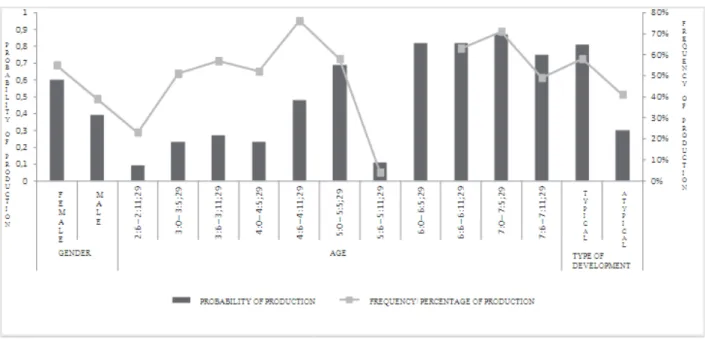
of correct production in the age group 7:0 –7:5 29.
As for the variable type of development, the results showed a higher probability of correct production in typical development. In regards to gender, it was found that the female variant has a greater like-lihood of correct production (Figure 1).
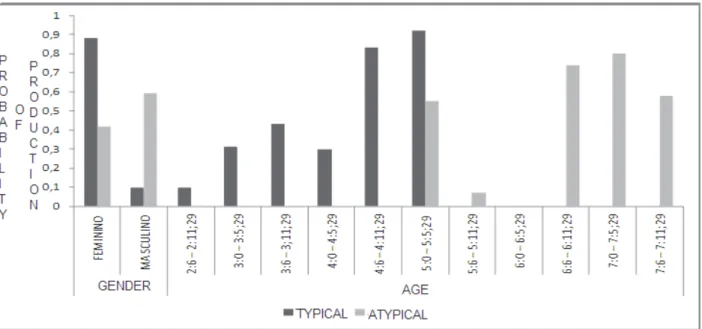
In the statistical analysis involving typical and atypical data isolated, it turns out that both for the normal development and for the atypical develop-ment, the age and gender extralinguistic variables proved to be signiicant. In relation to gender in typical development, it was found that girls are more likely to correct production. In the atypical develo-pment, the more likely correct production variation has occurred in males.
contain, together, all variables selected as signiicant
by the program. Thus, probabilistic values between
.50 and .59 are considered neutral, the acquisition of
the phonemes in the CO. Values which were equal
or higher than .60 will be considered favorable and
lower values below .50 are considered unfavorable to the studied phenomenon.
RESULTS
The statistical program, analyzing typical and atypical data together, revealed as statistically
signi-icant variables for the correct production of the CO,
the variables age, gender and type of development. When analyzing age, there was a higher probability
Legend: Statistical program: VARBRUL; Signiicance: 5% (p <0.05)
Figure 1 – Relevant variables to the correct production of the complex onset in single group
When analyzing the age variable in typical deve-lopment it was observed a higher probability of correct production gradually with age, being more
favoring the age period 5:0 – 5:5 29. In atypical
development, the probability of correct produc-tion was not increasing age, and the age range of
7:0 –7:5; 29, was most likely to correct production
29. As for the variable development type, the results demonstrated a greater probability of deletion of the C2 in thenatypical development. As for the gender variable, it was found that the male variant has a higher probability of deletion of C2 (Figure 3). By analyzing the repair strategy of deletion of
C2, the results of the statistical analysis, considering
one group (typical and atypical), showed that the
age, type of development and gender were signii -cant. In the analysis of the age variable, there was a higher probability of deletion of C2 aged 6:0 – 6:5 Legend: Statistical program: VARBRUL; Signiicance: 5% (p <0.05)
Figure 2 – Comparison of the signiicant variables to the correct production of the complex onset in
typical and atypical development
Legend: Statistical program: VARBRUL; Signiicance: 5% (p <0.05)
of C2 in the initial age group (between ages 2:6 –
2:11, 29). In atypical development, the probability
of C2 deletion occurred in middle age range of 6:0
– 6:5; 29.
The linguistic variable position in the word, selected as favoring the deletion of C2 in typical development, was most likely to occur when the CO occupies the medial position (e.g. quebrado). In the development of atypical syllable position in relation to the foot metric showed favoring the C2 deletion occurring when it occupies the “head” of the metric foot (Figure 4).
As statistically signiicant variables for the dele-tion of the C2 of the CO in typical development were
selected extralinguistic variables gender and age, and linguistic variable position in the word. In the atypical development selected variables were age, sex and metrical foot.
In regard to gender in typical development, it was found that the variant has a higher probability male
deletion of C2 unlike what was observed in atypical development in which most likely occurs in the C2
female deletion variant.
In the analysis of the age variable, the typical development showed higher probability of deletion
Legend: Statistical program: VARBRUL; Signiicance: 5% (p <0.05)
Figure 4 – Comparison of statistically signiicant variables in the deletion of C2 in typical and atypical development
Regarding the dependent variable metathesis,
the joint data analysis of typical and atypical develo
-pment, as a single group, there was the inluence of
the variables following syllabic context, age and type of development in the production of this resource.
In variable following syllabic context it was
observed that the complex onset is more likely to
be targeted of metathesis when followed by syllable locked with simple coda and simple onset.
Referring to age, the age of 5:6 – 5:11; 29
METATHESIS
VARIABLES VARIABLES
BOTH DEVELOPMENT TYPICAL DEVELOPMENT
RELATIVE
WEIGHT FREQUENCY %
RELATIVE
WEIGHT FREQUENCY %
GENDER FEMALE
MALE - - - - - - .33 .68 2/146 6/132 1 5 AGE
4:0 – 4:5;29 4:6 – 4:11;29 5:0 – 5:5;29 5:6 – 5:11;29 7:0 – 7:5;29
.44 .24 .32 .80 .63 4/52 2/51 2/124 2/91 1/92 8 4 2 2 1 .64 .37 .51 - - 4/52 2/51 2/42 - - 8 4 5 - - TYPE OF DEVELOPMENT TYPICAL ATYPICAL .84 .27 8/278 3/460 3 1 - - - - - - FOLLOWING SYLLABIC CONTEXT ZERO/NULL
OPEN SYLLABLE AND SIMPLE ONSET
SYLLABLE LOCKED IN CODA SIMPLE AND SIMPLE ONSET
.30 .49 .85 1/210 3/400 7/110 0 1 6 - .30 .87 - 1/118 7/55 - 1 13
SIGNIFICANCE 0,015 0,029
Table 1 – Variables statistically signiicant in achieving the metathesis in the target with onset
complex in single group and typical development
Legend: Statistical program: VARBRUL; Signiicance: 5% (p <0.05); – variables not selected as statistically signiicant
VARIABLES VARIABLES ATYPICAL DEVELOPMENT
RELATIVE WEIGHT FREQUENCY %
GENDER FEMALE
MALE .43 .57 7/245 10/215 3 5 AGE
5:0 – 5:5;29 5:6 – 5:11;29
6:0 – 6:5;29 6:6 – 6:11;29 7:6 – 7:11;29
.29 .84 .44 .33 .48 1/82 12/91 1/49 1/75 2/71 1 13 2 1 3 SIGNIFICANCE P<0,015
Table 2 – Variables statistically signiicant in the production of idiosyncrasies on target with selected complex onset for the group with atypical development
Legend: Statistical program: VARBRUL; Signiicance: 5% (p <0.05) In round individual statistic, considering the typical development, the selected variables were
signiicant as following syllabic context, gender and
age, in order of statistical signiicance, respectively.
Regarding variable following syllabic context, it was found that the metathesis is most likely to occur when the CO is followed by syllable locked with simple coda and simple onset. It was also observed a higher probability to utilize the metathesis in the
male variant and age group between 4:0 and 4:5;
29.
It was not possible to separate analysis of the metathesis resource of atypical data, due to limited number of occurrences.
In round involving idiosyncratic substitutions in atypical development it was selected variables age
and gender as statistically signiicant. The age range
of 5:6 – 5:11, 29 was the most favoring to the reali -zation of idiosyncrasies, as well as males (Table 2). It was not possible to make the analysis of idio-syncratic substitutions in the data of the single group (typical and atypical), due to the non-occurrence of these substitutions in typical development.
In igure 5, it is seen the distribution of the
0% 10% 20% 30% 40% 50% 60% 70% 80% 90% 100%
5
7
,5
5
%
3
9
,2
0
%
0
,3
5
%
2
,8
7
%
4
0
,8
9
%
5
4
,1
3
%
0
,2
1
%
0
,6
5
%
3
,6
9
%
0
,4
3
%
TÍPICOS ATÍPICOS
Figure 5 – Comparison of the percentages of correct production and repair strategies in typical and atypical phonological development
It was also observed that the atypical develop-ment uses a greater number of repair strategies (n = 5) compared to typical group (n = 3), being the
idio-syncrasies and deletion of the syllable of exclusive
use from the atypical group. The other strategies were common to both types of development, with only differences in frequency of occurrence.
Due to the restricted number of occurrences of the variable epentheses, the same has not been selected by the VARBRUL computer program as
statistically signiicant. Regarding the variable dele -tion of C1, it is stressed that there was no occurrence in the studied groups.
DISCUSSION
The discussion will be held in accordance with the repair strategies used by children with typical and atypical phonological development of speech, checking the similarities and differences found from the analysis of the selected variables and
consi-dered statistically signiicant at VARBRUL program.
Analyzing typical and atypical data together as a
single group, the statistically signiicant variables for
the correct production of the CO was age, gender and type of development. The variable age had a higher probability of correct production at the age of
7:0 to 7:5, 29, belonging to atypical data, demons -trating that in the phonological disorder there is a
signiicant delay in phonemic acquisition when
compared to the normal development6. This fact was also veriied when the program selected the
variable typical development.
In regards to gender in both developments, it was found that the female variant is more likely to correct production and is compatible with a study10
that talks about the dificulty in the phonological
acquisition in males.
Both for normal development and for atypical
development, the extralinguistic variables gender
and age proved to be signiicant for the correct production of the CO. In typical development, girls were more likely to correct production, agreeing with
the indings of a study on phonological acquisition19.
In another study10, mentioned earlier, the author said that speech disorders are more prevalent in male children, which agrees with the analysis of atypical development.
As the child’s age advances, it tends to stabilize
the correct production; it means that the phono-logical system gets closer to the adult20.21. It was proved correct when analyzing the variable age in
typical development, as there was a greater beneit
for correct production gradually with increasing age. In the atypical development, the probability of correct production did not occur gradually with age, showing that children with phonological disorders
exhibit instability in correct production CO9. Corre
ct pro ducti
on
c2De letion
Epen tese
metat ese
Idiosyn crasie
s
Syllab le de
letion
The medial position was veriied as favoring the
deletion of C2 in typical group. In a survey27 about simple onset and coda, it was found that this same
position was identiied as favoring the strategy of
semivocalization of liquid and the omission of the coda, respectively.
Regarding the dependent variable metathesis,
in the joint data analysis of typical and atypical deve
-lopment, as a single group, there was the inluence
of the variables following syllabic context, age
and type of development in the production of this resource. In the group with typical development it was selected in addition to the variables following syllabic context and age, the gender variable. This
extralinguistic variable showed that boys use more
this feature. This gender difference is consistent with a study that says that there are differences in verbal abilities between boys and girls. It is observed in general that the girls speak earlier and with greater grammatical accuracy, being more precise in language skills28.
Regarding to the variable following syllabic context, it was found that the metathesis is most likely to occur when the CO is followed by syllable lock ((C) VC) with simple coda and simple onset (e.g. pretos). This variant was not exclusive of typical group, suggesting that actually sets the variable favoring the production of metathesis in different types of development is the variable age.
The age in the typical was the most relevant age
group before the single group, conirming that the
use of metathesis takes place in separate periods of developments, namely the use of metathesis typically developing in the group can be considered a stage prior to the complete acquisition of the
complex structure and atypical development group
may be regarded as a repair strategy performed in the inability of the target.
The variable type of development was always selected when the typical and atypical data ran together, showing no difference between the types of development.
Moreover, it was not possible to analyze the strategy metathesis in the group of children with atypical development for the low number of occur-rences. This fact disagrees with a comparative study between children with typical and atypical phonolo-gical development in which only the atypical group performed the repair strategy metathesis26.
The idiosyncrasies strategy occurred only in the group with atypical development, with low
frequency for the selected extralinguistic variables
(gender and age). The variant male and the group
age 5:6 – 5:11, 29 (irst track with atypical data) are
more favorable to the realization of idiosyncrasies. This way, atypical is characterized by the presence In phonological disorder, the most affected
structure as to the correct production is usually the CO6, 9, agreeing with the indings that the highest
probability of correct production occurred in typical development.
By analyzing the repair strategy deleting of C2
of the OC in single group (typical and atypical), the variables age, type of development and gender
were signiicant for the realization of this strategy. In
the analysis of the age variable, the highest proba-bility of C2 deletion occurred between the ages of
6:0 to 6:5, 29, belonging to the atypical develop -ment, and this development was also selected as
the most favorable to use the strategy. It is expected
that as the age increases, there is less occurrence in the use of strategies22 and it is noted that in the studied corpus the selected age belongs to the atypical group. The occurrence of this strategy is
similar in both groups, conirming what the literature
says that in the atypical development there is higher frequency in the use of this resource when trying to produce the target syllable, with no continuous pattern acquisition6.21.
In regards to the gender variable, the literature
is not speciic in addressing the inluence of this
variable on deletion of C2 strategy, reporting higher
rates of phonological disorders in children of the male gender23, 24, was found in this study that the
male variant has a higher probability of deletion of C2. As inluential variables for the deletion of C2
in typical development, selected variables were:
the extralinguistic variables gender and age, and linguistic variable position in the word. In the atypical
development, there is the inluence of the variables
age, sex and metrical foot. Age proved to be favo-rable to the deletion of C2 whereas in earlier ages
there is a high incidence of this strategy, reducing the aging years to complete acquisition of CO21. However, in the case of phonological disorder, this linearity did not occur in the acquisition, as peaks were observed in the use of this strategy. In rela-tion to gender, in typical development a higher occurrence of the studied strategy occurred in boys, and in contrast, the most atypical occurrence was observed in girls. As previously mentioned, the literature states that in males occur more cases of phonological disorders, but it is also observed in another study25, there may be a higher prevalence of speech disorders in female children.
phonological disorders could not properly do it until
the expected age, producing the same repair strate -gies that younger children do in normal phonological acquisition.
The repair strategies, syllable deletion and
idio-syncrasies were of exclusive use of the atypical
group. This data of idiosyncrasies corroborates with other studies29, 30.
CONCLUSION
It was found, from the results of this study, that
the selected extralinguistic variables gender, age
and type of development, and the linguistic varia-bles position in the word, syllable metrical foot and
following syllabic context inluenced the production
of OC in the analyzed corpus. It is noteworthy that as the data were obtained with a small sample; it was not possible to complete their generalization.
It was observed that there are differences in speech development in children typical and atypical in regard to the production of OC, as the variable type of development was selected in every round statistics on which the data were analyzed as a single group. However, considering the separate
analysis of the two corpus, the extralinguistic varia -bles (age and gender) were similar to the correct production and other types of strategies used in the two types of phonological development – typical and
atypical, inluencing both in production and in the
correct use of repair strategies.
The intention of this study is to contribute to the
existing bases for the elaboration and implemen -tation of a more effective therapy in children with atypical development of speech. At the moment prosodic variables and syllabic favoring the correct production of the OC are known, they aid in the choice of target words, putting the best OC in the
context of production, seeking to shorten the thera -peutic process.
of distinct features in the phonological system and can use unique processes or idiosyncratic, such as
slurred speech beyond ive years of old29,30 which corroborates the indings of this research.
Still, in this study, it was possible to analyze the
percentages of correct production and repair strategies in typical and atypical phonological development. In typical development there is a higher percentage of correct production, whereas atypical development in the deletion of C2 showed a higher percentage. It was found that, as mentioned above, given the impossibility of performing the CO children prefer to produce only the obstruent of this onset, or use the strategy of deletion of C213.
Thus, it was found that in the course of
acqui-ring the complex onset, deletion of C2 was the repair strategy more frequent in children with typical and atypical development26.
In a study31 on the repair strategy of epentheses it was observed both in typical phonological develo-pment as in the speech of children with phonological evolutive disorder, this type of resource. The author also raises the hypothesis that an attempt would be that the epentheses would be a tentative of organi-zation of the phonological system, mainly in typical phonological development, as this acquisition is governed by syllable structure. The results of this research are in the mentioned study31, in which both groups used this feature in equal percentages.
Although with a reduced number of occurrences, it was observed that in the atypical development, there was also, as the typical group, the occurrence
of metathesis. This inding agrees with the one
obtained in another study that observed a very low productivity of metathesis strategy for children with disorder6.
It was noticed that atypical development uses a greater number of repair strategies in relation to the group with typical development. According to a previous study data32, due to the
REFERENCES
1. Pagan LO, Wertzner HF. Análise acústica das consoantes líquidas do Português Brasileiro em crianças com e sem transtorno fonológico. Rev. soc.bras.fonoaudiol. [periódico na internet]. 2007.
[acesso em 2011 Abril 15], 12(2):106-13. Disponível em: http://www.scielo.br/scielo.php?pid=S1516-80342007000200007&script=sci_arttext
2. Mota HB, Silva APS, Mezzomo CL. Mudanças
fonológicas na terapia de sujeitos com desvio fonológico utilizando ‘contraste’ e ‘reforço’ do traço [voz]. Letras de Hoje [periódico na internet]. 2008. [acesso em 2011 Abril 16],43:7-14. Disponível em: http://revistaseletronicas.pucrs.br/ojs/index.php/ fale/article/view/5603
3. Lamprecht RR. Antes de mais nada. In: Lamprecht R.R. (Org.). Aquisição fonológica do português:
peril de desenvolvimento e subsídios para terapia.
Porto Alegre: Artmed; 2004.p.17-32.
4. Lamprecht RR. A aquisição da fonologia do
português na faixa etária dos 2:9 – 5:5. Letras Hoje.1993;28(2):99-117.
5. Mota HB, Kaminski TI, Nepomuceno MRF,
Athayde ML. Alterações no vocabulário expressivo
de crianças com desvio fonológico. Rev.soc.bras.
fonoaudiol. [periódico da internet] 2009. [acesso
em 2011 Abril 17],14(1):41-7. Disponível em: http://
www.scielo.br/scielo.php?script=sci_arttext&pid= S1516-80342009000100009
6. Ribas LP. Onset complexo nos desvios
fonológicos: descrições, implicações para a teoria, contribuições para a terapia. [tese] Porto Alegre (RS): Pontifícia Universidade Católica do Rio
Grande do Sul; 2006.
7. Levelt C, Schiller N, Levelt W. The acquisition of syllable types. Language Acquisition. 2000;
8(3):237-64.
8. Keske-Soares, M, Blanco APF, Mota HB. O desvio fonológico caracterizado por índices de substituição
e omissão. Rev.soc.bras.fonoaudiol.2004; 9(1):
10-8.
9. Ribas LP. Sobre a aquisição do onset complexo.
In.: LAMPRECHT, R.R. (Org.). Aquisição Fonológica
do Português: peril de desenvolvimento e subsídios para terapia. Porto Alegre: Artmed, 2004.p.151-64.
10. Galea DES. Percurso da aquisição dos Encontros Consonantais, Fonemas e Estruturas Silábicas em
crianças de 2:1 a 3:0 anos de idade. 2008. 226 f. [tese]. São Paulo (SP): Faculdade de Filosoia,
Letras e Ciências Humanas da Universidade de São Paulo; 2008.
11. Giacchini V, Mota HB, Mezzomo CL. Diferentes modelos de terapia fonoaudiológica nos casos de
simpliicação do onset complexo com alongamento
compensatório. Rev. CEFAC. [periódico da
RESUMO
Objetivo: veriicar e comparar as estratégias de reparo e a inluência das variáveis linguísticas (silá
-bicas e prosódicas) e extralinguísticas na produção da sílaba com Onset Complexo em crianças com
desenvolvimento fonológico típico e atípico. Método: foi analisada a fala de 48 crianças, 24 com desenvolvimento fonológico típico e 24 com desenvolvimento fonológico atípico, equiparados em
relação ao sexo, entre 2:6 a 5:5;29 (grupo típico) e 5:0 a 7:11;29 (grupo atípico). As amostras foram
coletadas transversalmente, com base no instrumento Avaliação Fonológica da Criança. Foram
ana-lisadas palavras que apresentaram como alvo o onset complexo, com um corpus de 278 palavras
do desenvolvimento típico e 460 do desenvolvimento atípico. Foram consideradas como variantes
da variável dependente a produção correta,apagamento de C2, apagamento de C1, apagamento de sílaba, epêntese, metátese e idiossincrasias. Como variáveis independentes intervenientes
conside-raram-se os fatores extralinguísticos idade, sexo e tipo de desenvolvimento e as variáveis linguísticas tonicidade, número de sílabas, contexto silábico seguinte e precedente, posição na palavra, complexi
-dade do onset na própria sílaba e pé métrico. Os dados de fala foram analisados estatisticamente por
meio do VARBRUL. Resultado: o programa estatístico selecionou como signiicante para a produção
correta e para os outros tipos de estratégias de reparo do onset complexo as variáveis sexo, idade, tipo de desenvolvimento, posição na palavra, pé métrico e contexto silábico seguinte. Conclusão: veriicou-se que as variáveis linguísticas e extralinguísticas inluenciam signiicantemente na produ
-ção do onset complexo em crianças com ambos os desenvolvimentos. A estratégia de reparo mais
utilizada foi apagamento de C2.
DESCRITORES: Transtornos do Desenvolvimento da Linguagem; Desenvolvimento da Linguagem;
21. Mota HB. Aquisição segmental do Português:
um modelo implicacional de complexidade de traços. Letras de Hoje.1997;32(4):23-47.
22. Ribas LP. Onset complexo: características da aquisição. Letras de Hoje.2003; 38(2):23-31.
23. Ckmann A, Dores A, Vidor D, Lima P, Isolan R,
Agustini R. A inluência do tratamento fonoaudiológico
na aquisição das líquidas não-laterais do português.
Letras de Hoje.2001;36(3):729-34.
24. Wertzner HF, Oliveira M. Semelhanças entre
os sujeitos com distúrbio fonológico. Pró-Fono R.
Atual. Cient.2002;14(2):143-52.
25. Shevell M, Majnemer A, Webster RL, Platt RW,
Birnbaum R. Outcomes at school age of preschool children with developmental language impairment.
Ped. Neurol.2005;32(4):264-9.
26. Rechia IC, Ramos APS, Mezzomo CL. Processos de apagamento na fala de sujeitos com dispraxia
verbal. Rev. CEFAC. [periódico da internet] 2010.
[acesso em 2011 Maio 26],12(2):421-6. Disponível em: http://www.scielo.br/pdf/rcefac/v12n3/40-09.pdf 27. Baesso SJ. O uso de estratégias de reparo nos constituintes coda e onset complexo por crianças
com aquisição fonológica normal e desviante. [dissertação] Santa Maria (RS):Universidade
Federal de Santa Maria; 2009.
28. Shaywitz BA, Shaywitz SE, Pugh KR, Constable
RT, Skudlarski P, Fulbright RK et al. Sex differences
in the functional organization of the brain for
language. Nature. 1995;373(6515):607-9. Comment in: Nature. 1995;373(6515):561-2.
29. Ramalho MSSC. Desvios fonológicos em pré-escolares no município de Porto Velho –
Rondônia : um estudo transversal. [dissertação] Brasília (DF): Universidade de Brasília, Faculdade de Ciências da Saúde, 2011.
30. Pagliarin KC, Keske-Soares M. Abordagem contrastiva na terapia dos desvios fonológicos: considerações teóricas. Rev. CEFAC.[periódico da internet] 2007. [acesso em 2011 Out.
23], 9(3):330-8. Disponível em: http://www. scielo.br/scielo.php?script=sci_arttext&pid= S1516-18462007000300006
31. Ramos-Pereira A, Henrich V, Ribas LP. Dados
com epêntese em alvos com onset complexo
na aquisição fonológica: argumentos a favor do desenvolvimento silábico. Rev. Verba Volant . [periódico da internet] 2010. [acesso em 2011 Nov. 03],1(1). Disponível em: http://letras.ufpel.edu.br/ verbavolant/ananda.pdf
32. Attoni TM, Albiero JK, Berticelli A, Keske-Soares
M, Mota HB. Onset complexo pré e pós-tratamento
de desvio fonológico em três modelos de terapia fonológica. Rev. soc. bras. fonoaudiol. [periódico da internet] 2010. [acesso em 2011 Nov. 03],
15(3)395-400. Disponível em: http://www.scielo.
brscielo.php?script=sci_arttext&pid=S1516-80342010000300014&lng=en&nrm=iso&tlng=pt internet] 2011.[acesso em 2011 Abril
17],13(1):57-64. Disponível em: http://www.scielo.br/scielo. php?pid=S1516-18462011000100008&script=sci_ arttext
12. Hahn LH, Quednau LR. A lateral pós-vocálica no português de Londrina: análise variacionista
e estrutura silábica. Letras de Hoje. [periódico da
internet] 2007. [acesso em 2011 Abril 17],42(3):100-13. Disponível em: http://revistaseletronicas.pucrs.
br/ojs/index.php/fale/article/view/2794
13. Athayde M, Baesso JS, Dias RF, Giacchini V, Mezzomo CL. O papel das variáveis
extralinguísticas idade e sexo no desenvolvimento
da coda silábica. Rev.soc.bras.fonoaudiol.
[periódico da internet] 2009. [acesso em 2011 Abril 17],14(3):293-9. Disponível em: http://www. scielo.br/scielo.php?script=sci_arttext&pid=S1516-80342009000300003&lng=en&nrm=iso&tlng=pt
14. Ribas LP. Aquisição das líquidas por crianças com desvio fonológico: Aquisição silábica ou segmental? .Rev. Letras (UFSM).[periódico da
internet] 2008. [acesso em 2011 Abril 17],36:129-49. Disponível em: http://w3.ufsm.br/revistaletras/ artigos_r36/artigo6.pdf
15. Yavas M, Hernandorena CLM, Lamprecht RR. Avaliação fonológica da criança. Porto Alegre: Artes
Médicas, 1991.
16. Mezzomo CL. Aquisição da coda no Português
Brasileiro por crianças com desenvolvimento fonológico normal. 2003. [tese] Porto Alegre (RS): Pontifícia Universidade Católica do Rio Grande do Sul; 2003.
17. Cedergren HJ, Sankoff, D. Variable rules:
performance as a statistical relection of competence. Language. 1974;50(2):333-55.
18. Amaral L. Criando um formulário no Microsoft
Access. Pelotas: UFPel, 1998.
19. Cavalheiro LG. A prevalência do desvio fonológico em crianças de 4 a 6 anos de escolas
públicas municipais de Salvador-BA. 2007. [dissertação] Santa Maria (RS): Universidade Federal de Santa Maria; 2007.
20. Hernandorena CLM. Relações implicacionais na aquisição da fonologia. Letras de
Hoje.1996;31(2):67-79.
Received on: December 08, 2011 Accepted on: February 13, 2012
Mailing Address:
Silvana Gonçalves Lopes
Rua Justino Couto,260 Ap.216
Santa Maria – RS
CEP: 97070-500