THE PRODUCTION OF THE COMPLEX ONSET:
ACQUISITION GUIDED BY THE SYLLABLE OR SEGMENT?
A produção do onset complexo: aquisição guiada pela sílaba
ou pelo segmento?
Silvana Gonçalves Lopes(1), Roberta Freitas Dias(1), Carolina Lisbôa Mezzomo(2)
(1) Programa de Pós-Graduação em Distúrbios da
Comuni-cação Humana, Universidade Federal de Santa Maria - UFSM, Santa Maria, RS, Brasil.
(2) Curso de Fonoaudiologia da Universidade Federal de
Santa Maria - UFSM, Santa Maria, RS, Brasil. Assistance source: CAPES scholarship
Research performed at Universidade Federal de Santa Maria – UFSM – Santa Maria (RS), Brasil, with scholarship by Coor-denação de Aperfeiçoamento de Pessoal de Nível Superior – CAPES.
Conlict of interest: non-existent
and running of human minds1. One of the aspects
that are involved in the dominion of that skill is regarded to the language phonological system, or the inventory of sounds and the rules to match them
in signiicant units2.
The language acquisition occurs gradually, with the settlement and productive use of different units by children, showing, gradually, the development of the target language3. When that development occurs
in typical way, there are variations into a pattern of fast and dynamic change, until the stabilization of the phonological system. On the other hand, when there are no important changes in relation to the variation, there is some delay in the settlement of all elements of the phonological system, obstructing correct speech productions, without apparent reason. So, it is observed the “phonological disorder”4.
INTRODUCTION
Acquiring and using complexes and dynamic
systems of conventional symbols to communicate and to think is related to a skill which is called language, which emerges through organization
ABSTRACT
Purpose: to compare and analyze the inluence of the characteristics of the complex onset segments
in the correct production in children with typical and atypical phonological development. Methods:
it was analyzed the speech data of 88 children, 44 with typical phonological development and 44 atypical, aged between 2:6 to 5:3 and 5:3 to 8:0, respectively. With a corpus of 524 words in typical
development and 1310 in atypical. The dependent variable had variants: correct production of complex onset, simpliication for Consonant¹-Vowel with and without change of obstruent, simpliication for Consonant²-Vowel, obstruent change, substitution of liquid cluster, epenthesis, metathesis and others, as compensatory lengthening. Extralinguistic variables were: gender, age and type of development
and the linguistic: tone, number of syllables, syllable preceding context and ensuing; position in the word, type of liquid complex onset; articulatory point, loudness and obstruent class. The statistical
analysis was by computational package VARBRUL. Result: the statistical program selected for all groups at least one of the variables: articulatory point, loudness and class of obstruent. The type of
liquid cluster was signiicant for the unique group and atypical and type of development, to produce correct and simplify Consonant¹-Vowel with obstruent change. Conclusion: the linguistic variables
related to obstruent and liquid cluster were signiicant to the production of Consonant-Consonant-Vowel. The variable type of development was also relevant. Showing the evidence that the acquisition of complex onset can be guided by segment and there is a difference between typical and atypical
children.
This transversal research is exploratory and
quantitative, with analysis of data of 88 children, 44 with typical and 44 with atypical phonological devel-opment. Both groups consisted of 22 girls and 22 boys, monolingual BP speakers.
After the authorization of the children’s respon-sible people through the signature of the free consent term and through their oral consent, the infants were submitted to speech-language screening, with diagnosis of phonological disorder or typical phonological acquisition. So, the participants who did not present hearing loss and alterations in their neurological, cognitive, psychological aspects and the ones who were not patients of speech-language therapy were selected to be part of the sample.
The data was obtained through speech samples, collected based on the instrument Children’s Phonological Assessment – CPA8, which consists of ive thematic pictures (toilet, kitchen, living room,
vehicles and zoological). That tool is favorable for spontaneous naming for all contrastive phones of Brazilian Portuguese, in all words and syllable positions.
The survey of the words was performed in the same way for both groups. Thus, all the words, in the speech recordings of all children, with the CO with /l/ (lateral liquid) and with /r/ (non lateral liquid) targets were part of the sample. In the group of children with typical development, the corpus
consisted of 524 words, 46 with /l/ complex onset and 478 with /r/ complex onset, and in the group of
children with atypical phonological development, the
corpus consisted of 1310 words, 194 with complex onset with /l/ and 1116 with complex onset with /r/,
a total of 1834 words. It is emphasized that the word corpus of each group was different, because it was considered the data of evocation (through the CPA) as well as spontaneous speech. After that
procedure, the data was codiied and organized
in tables, according to the group and investigated variables.
The same variables were considered for both groups. So, for the performance of the statistical analysis of the dependent variable (CO correct production versus CO incorrect production), it was
considered: correct production of the complex
onset (cobra – [‘kobra] (snake), blusa – [‘bluza]
(blouse)); simpliication for C1V (cobra – [‘koba], blusa – [‘buza]); simpliication for C2V (zebra – [‘zera], claro – [‘laro] (clear)); simpliication for C1V with obstruent change (bruxa – [‘pu’a] (witch), placa – [‘kaka] (sign)); obstruent change (bruxa – [‘prua], lauta – [‘plawta] (lute)); substitution of the
cluster liquid (braço – [‘blaso] (arm), bloco – [‘broco] (block)); epenthesis (prato – [pa’ratu] (plate), blusa – [bu’luza]); metathesis (preto – [‘pertu] (black), placa The ways children cover during the process of
phonological system acquisition, typical or atypical, has been studied by several authors2-4. Those
inves-tigations are related as to segments, as to syllable structures and they have aroused some questions about that course, top-down (syllable guided) or bottom-up (segment guided)4,5.
In the present study, it was analyzed the acqui-sition of the C1C2V syllable structure, where the irst
consonant must be an obstruent (/p,b,t,d,k,g,f,v/) and the second is completed by the segments /l/ or /r/ in Brazilian Portuguese (BP). This is the last
template to be acquired, because of its complexity6,7.
In typical speech data, there are evidences that
those segments ill the complex onset (CO), simul -taneously6. In the same way, the author retakes
that investigation, using atypical data, considering the possibility that such acquisition comes from a top-down process. The hypothesis of the author for atypical data is based on the fact that the phoneme /r/ presents different age of acquisition for each syllable position in BP. This segment is acquired in medial and coda when children are 3:10, followed by
simple onset, with 4:2, and complex onset with 5:0.
Those data evidence that the /r/ stability depends on the syllable position4.
It is believed that as the correct production of the
complex onset, as the repair strategies used during its acquisition may be inluenced by linguistic and extralinguistic variables, such as type of cluster
liquid (lateral or non lateral), obstruent character-istics (sonority, point and class) and the type of phonological development (typical or atypical), the gender (male or female), respectively. To investigate the role of the type of obstruent and liquid of the linguistic consonant cluster during its acquisition, typical or atypical, may contribute, through analysis of the data which will be presented in this study, with the discussion about the process of acquisition of that structure, top-down or bottom-up. Besides, that data may help the clinic speech-language therapist in the evaluation and in the therapeutic process of patients with phonological disorders.
So, this research had the purpose of comparing
and analyzing if the characteristics of the complex
onset segments (type of liquid and obstruent charac-teristics) interfere in its correct production in children with typical and atypical phonological development.
METHODS
First, the analyzed data were classiied and
categorized according to the CO production, as correct or incorrect. This categorization was typed
in two forms in the program Microsoft Ofice Access
2003, considering the type of production: correct or incorrect.
After the organization of the forms, they were statistically analyzed through the statistical program
VARBRUL, separately. The program provides
frequencies and probabilities and it selects the relevant variables in the process of phonological acquisition among the studied data11.
The probabilistic analysis is performed in binary way, through statistical calculations. The program attributes relative weighs to the variants of the independent variables, regarding both variants of the researched linguistic phenomena, represented by the dependent variable (correct or incorrect CO production).
Six basic programs are part of the VARBRUL program: CHECKTOK, READTOK, MAKECELL and IVARB or TVARB or MVARB. From those, the four irst mentioned were used in the present research.
The irst step to use that program was the organi
-zation of two iles with data, one for the correct CO
production and another for incorrect CO production, which were corrected by the CHECKTOK. To perform this procedure, it was provided information regarding the codes which were used for each variables factor. The information were transferred,
through data typing, to a speciication ile, and
corrected by the CHECKTOK.
After that step, the READTOK made some transformation in the data which were corrected by the CHECKTOK, generating new data with some
changes and grouping, in an occurrence ile, several corrected iles. Thus, it reached the grouping and
the total of identical sequences.
The data generated by the READTOK were
received by a third program, the MAKECELL, which prepares the data to be executed by the IVARB.
The IVARB makes a probabilistic analysis in
binary way, through statistical calculations. This program attributes relative weighs to the variants of the independent variables. In this case, it is in relation to the correct and incorrect CO production.
The IVARB works with error of 5%, and any factor with signiicance lower than that value was not statistically expressive. In the present study, all the
results were presented, regardless if they present or not statistical relevance.
It is important to highlight that the VARBRUL attributed signiicance values to the linguistic and extralinguistic variables, through interaction between
them (CO formed with /l/ versus CO formed with /r/ and typical versus atypical development). So, the – [‘pawka]) and the other forms of production which
were classiied as “others”, such as compensatory
lengthening.
The independent linguistic variables were tonicity
(pretonic; tonic and post-tonic, such as dragão
(dragon), loresta (forest), braço (arm), placa (sign), livro (book), amplo (broad), number of syllables
(monosyllables; disyllable; trisyllable and
polysyl-lable). For example, cruz (cross), lor (lower), prato (plate), placa (sign), estrela (star), loresta (forest),
professora (teacher), bicicleta (bike), precedent syllable context (zero; consonant (coda); glide; coronal vowel; dorsal vowel; labial vowel, such as grama (grass), blusa (blouse), estrela (star), ex
cla-mação (exclamation), poltrona (couch), templo (temple), pedra (stone), bicicleta (bike), teatro (theater), atleta (athlete), cobra (snake), nublado (cloudy), following syllable context (coronal vowel; dorsal vowel; labial vowel. For instance, fraco (weak), placa (sign), fruta (lute), lor (lower), tigre (tiger),
lecha (arrow), word position (initial onset; medial onset, such as franja (fringe), loresta (forest), igreja (church), bicicleta (bike), obstruent class (fricative; plosive – livro (book), flauta (lute), vidro (glass),
pluma (plume)), type of complex onset liquid (lateral liquid or non lateral liquid – prato (plate), planeta (planet)), obstruent point (labial; coronal; dorsal, such as preto (black), placa (sign), trator (tractor), atleta (athlete), gripe (lu), claro (clear)), obstruent sonority (voiceless or voiced. For example, prego
(spike), braço (arm), clube (club), globo (globe)). In this study, however, because of its purposes, only data regarding obstruent class, point and sonority
will be explored, as well as type of onset liquid. The analyzed extralinguistic variables were
gender, age and type of development (typical and atypical). The variable gender consisted of 22 girls and 22 boys in each group. In the variable age, it was used the interval of three months between the
initial and the inal age of each group, a total of
twenty-two age groups. Each age group consisted of two girls and two boys. In the group with typical phonological acquisition, the age varied between 2:6 and 5:3, and in the group with atypical acquisition, the age varied between 5:3 to 8:0 (the age groups include the month until the 29th day, such as 2:6 to
2:8;29). However, it was decided to use the other
form to facilitate the text reading). From those extra -linguistic variables, only the type of development will be investigated in the present study.
The statistical program VARBRUL9 in Windows environment, the Varbwin10, was used for the
point and class, as well as the extralinguistic
variable type of phonological development, typical or atypical, would be selected as signiicant in this
study.
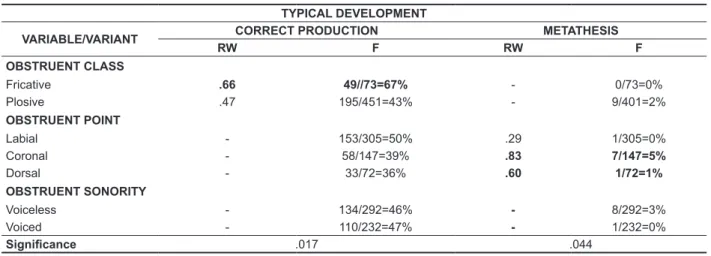
The statistical results related to the linguistic
characteristics of the complex onset obstruent in the typical development expressed that only for
the correct production and for the metathesis those factors were relevant (Table 1).
In the correct production, it was selected only the variable obstruent class, in which there was
higher statistical probability when the C¹ consonant
was constituted by a fricative. It means that the
complex onsets with fricatives would be easier to be
produced and that the segmental quality is important for the correct production of that syllabic structure. In the metathesis, it was observed that the selected variable was the obstruent point, with higher
occur-rence relative weigh when the complex onset is
formed by a coronal or dorsal obstruent. Thus, this phonological process would not be favored by the labial articulation point in words such as braço (arm). In both types of production the variable obstruent sonority was not selected.
VARBRUL does not attribute p value to the variants into a variable, it does not generate signiicance value, for example, in the comparison between
typical and atypical phonological development. For these variants, it attributes relative weigh.
The relative weighs or probability of occur-rence of this study come from the statistical
interaction, containing all signiicant selected variables, with a margin of error of 5%. The values
of relative weigh under .50 were considered as not favorable, the values between .50 and .59 were considered as neutral, and the values higher than .60 were considered as favorable for the studied phenomenon.
RESULTS
The statistical program VARBRUL performed all
the possibilities of the dependent variable (correct production, C1V simpliication, C2V simpliication,
C1V simpliication with obstruent change, obstruent
change, substitution of the cluster liquid, epenthesis, metathesis, etc.), in order to verify if the linguistic variables type of cluster liquid, sonority, obstruent
Table 1 – Probability and frequency of correct production and metathesis occurrence by children with typical development, in relation to the complex onset obstruent characteristics.
TYPICAL DEVELOPMENT
VARIABLE/VARIANT CORRECT PRODUCTION METATHESIS
RW F RW F
OBSTRUENT CLASS
Fricative .66 49//73=67% - 0/73=0%
Plosive .47 195/451=43% - 9/401=2%
OBSTRUENT POINT
Labial - 153/305=50% .29 1/305=0%
Coronal - 58/147=39% .83 7/147=5%
Dorsal - 33/72=36% .60 1/72=1%
OBSTRUENT SONORITY
Voiceless - 134/292=46% - 8/292=3%
Voiced - 110/232=47% - 1/232=0%
Signiicance .017 .044
Statistical program: Varbrul; Signiicance: 5% (p<0.05)
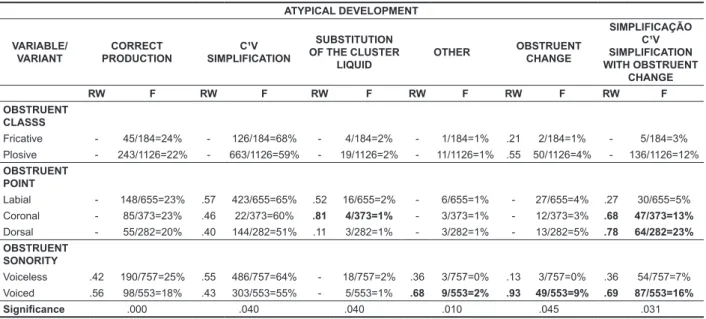
obstruent sonority, but it is possible to notice that the children present higher probability of correct production with voiced phonemes. In the strategies
of obstruent change, the simpliication of C¹V with
obstruent change and in the strategy called “other”, it
was veriied that the voiced phonemes also present higher probability to be produced in complex onsets.
Most frequencies of occurrence happened when
the complex onset presented as articulation point a
coronal consonant in the strategy of liquid cluster substitution and a coronal or dorsal consonant in the
C¹V simpliication with obstruent change.
In the atypical development, it is perceived that the aspects related to the cluster obstruent were statistically relevant to the correct production and to the several repair strategies. However, the obstruent class was not selected in any type of production (Table 2). It means that as for the correct production, as for the occurrence of repair strategies (phonological processes) the fact that the obstruent is plosive (bruxa - witch) or fricative (fruta - fruit) interferes in the occurrences.
In the correct production, it is observed that the relative weigh was neutral in relation to the variable
Table 2 – Probability and frequency of occurrence of correct production, C¹V simpliication, with and
without obstruent change, substitution of the cluster liquid, other and obstruent change by children with phonological disorders in relation t the complex onset obstruent characteristics
ATYPICAL DEVELOPMENT
VARIABLE/ VARIANT
CORRECT PRODUCTION
C¹V SIMPLIFICATION
SUBSTITUTION OF THE CLUSTER
LIQUID
OTHER OBSTRUENT
CHANGE
SIMPLIFICAÇÃO C¹V SIMPLIFICATION WITH OBSTRUENT
CHANGE
RW F RW F RW F RW F RW F RW F
OBSTRUENT CLASSS
Fricative - 45/184=24% - 126/184=68% - 4/184=2% - 1/184=1% .21 2/184=1% - 5/184=3%
Plosive - 243/1126=22% - 663/1126=59% - 19/1126=2% - 11/1126=1% .55 50/1126=4% - 136/1126=12%
OBSTRUENT POINT
Labial - 148/655=23% .57 423/655=65% .52 16/655=2% - 6/655=1% - 27/655=4% .27 30/655=5%
Coronal - 85/373=23% .46 22/373=60% .81 4/373=1% - 3/373=1% - 12/373=3% .68 47/373=13%
Dorsal - 55/282=20% .40 144/282=51% .11 3/282=1% - 3/282=1% - 13/282=5% .78 64/282=23%
OBSTRUENT SONORITY
Voiceless .42 190/757=25% .55 486/757=64% - 18/757=2% .36 3/757=0% .13 3/757=0% .36 54/757=7%
Voiced .56 98/553=18% .43 303/553=55% - 5/553=1% .68 9/553=2% .93 49/553=9% .69 87/553=16%
Signiicance .000 .040 .040 .010 .045 .031
Statistical program: Varbrul; Signiicance: 5% (p<0.05)
Legend: RW: relative weigh; F: frequency; -: categorical values does not present relative weighs
In the analysis of the whole group (typical and atypical data), in relation to the linguistic variables,
it was veriied that the statistical program selected
the following variables: obstruent class, obstruent point and obstruent sonority. The highest relative
weighs were observed when the irst consonant of the complex onset consisted of a coronal
obstruent in the substitution of the cluster liquid (/
treze/→[‘tleze] (thirteen)) and by a coronal or dorsal in the C¹V simpliication with obstruent change (/ grama/→[‘dama] (grass)). The last mentioned
strategy had as relevant factor the sonority, with the voiced obstruent with the highest relative weigh (Table 3). It means that onset may present more
possibilities to be simpliied and its obstruent to be
probability that the complex onset is target of cluster
liquid substitution when it is formed by the phoneme /l/. This fact suggests that for the occurrence of
this process (/prato/ →[´platu] (plate)), the liquid segmental characteristic is a signiicant factor.
In Table 4, which consisted of the analysis about
substitution of the cluster liquid, it was veriied
that the selected variable was the type of cluster liquid. This phenomenon was selected in the single group and in the atypical development, with higher
Tabela 3 – Probabilidade e frequência de ocorrência de produção correta, simpliicação de C¹V, substituição da líquida do encontro e simpliicação de C¹V com mudança de obstruinte no grupo
único em relação às características da obstruinte do onset complexo SINGLE GRUP (TYPICAL AND ATYPICAL)
VARIABLE/ VARIANT
CORRECT
PRODUCTION C¹V SIMPLIFICATION
CLUSTER LIQUID SUBSTITUTION
C¹V SIMPLIFICATION WITH OBSTRUENT
CHANGE
RW F RW F RW F RW F
OBSTRUENT CLASS
Fricative - 94/257=37% - 148/257=58% .29 6/257=2% - 5/257=2%
Plosive - 438/1577=28% - 895/1577=57% .54 30/1577=2% - 139/1577=9%
OBSTRUENT POINT
Labial - 301/960=31% .54 563/960=59% .56 23/960=2% .30 33/960=3%
Coronal - 142/58=27% .49 299/518=58% .76 8/518=2% .69 47/518=9%
Dorsal - 89/356=25% .41 181/356=51% .10 5/356=1% .74 64/356=18%
OBSTRUENT SONORITY
Voiceless .53 324/1049=31% .53 626/1049=60% - 28/1049=3% .37 54/1049=5%
Voiced .46 208/785=26% .46 417/785=53% - 8/785=1% .67 90/785=11%
Signiicance .021 .016 .046 .000
Statistical program: Varbrul; Signiicance: 5% (p<0.05)
Legend: RW: relative weigh; F: frequency; -: categorical values does not present relative weighs
Table 4 – Variable substitution of the complex onset liquid in the single and atypical groups SUBSTITUTION OF THE COMPLEX ONSET LIQUID
VARIABLE/ VARIANT
SINGLE GRUP ATYPICAL
PR F PR F
TYPE OF CLUSTER LIQUID
Lateral .93 19/243=8% .96 17/195=9%
Non lateral .40 17/1591=1% .36 6/1115=1%
Signiicance .046 .040
Statistical program: Varbrul; Signiicance: 5% (p<0.05) Legend: RW: relative weigh; F: frequency
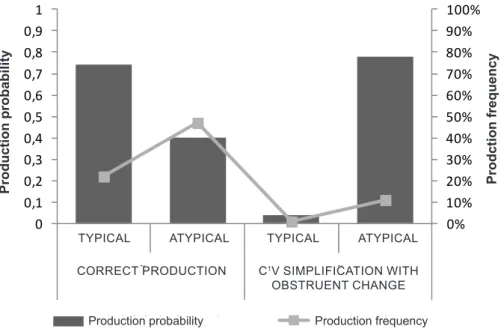
Another important factor in the study was the variable type of development, because it was detected that there is difference between typical and atypical children regarding correct production and
C¹V simpliication with obstruent change.
DISCUSSION
The data which were investigated and compared in this study showed that the obstruent and type
of liquid that constitute the complex onset were important factors for the CCV structure acquisition.
In the correct production performed by the children with typical phonological development, only
the C¹ obstruent class was relevant. The fricatives
presented higher probability of occurrence when the obstruent was voiced. Some studies observe13,15 data in relation to the complex onset obstruent in
the compensatory strengthening, but there are no reports about their sonority.
In the C¹V simpliication with obstruent change
in atypical data and in the single group (typical
and atypical), it was veriied that the sonority and the obstruent point were the signiicant selected
variables, where the voiced phoneme and the coronal or dorsal obstruents obtained higher performance probability. This data disagrees with a recent study in which the repair strategies in the
constituents of the complex onset were analyzed. The authors veriied that for the strategy C¹V in
cases of phonological disorders, the voiceless labial plosive obstruent was favorable for that process16. Even so, it is veriied that there is inluence of the complex onset obstruent in the correct production
of the structure.
In the substitution of the cluster liquid in atypical data and in the single group, it is perceived that the coronal obstruent is favorable for the occurrence of this strategy. The study of Baesso et al.16 shows
that the strategy alteration of the liquid feature
of the complex onset for the group with disorders
presented relevant results when the obstruent
was illed in by voiced and voiceless labial plosive and voiceless dorsal plosive. This fact conirms
that children with phonological disorders try to produce consonant clusters through substitution of the second consonant, instead of omitting it. It lateral liquid is favorable for the correct production
when the CCV complex structure presents the voiceless labiodentals fricative in C¹ position12 .
It is highlighted that in that type of development
the characteristics of the irst complex onset
consonant were important only for the correct production and for the use of metathesis. Children with typical phonological development and the older ones, usually, use the metathesis strategy in a more productive way, when compared with the other
studied group. It would be explained considering that
those children would have already overcome in part
their dificulties with that segment, so, they would
take their components, not only delete them13,14. In
the present study, the use of the repair strategy in the typical development was favored by the coronal or dorsal obstruent, in crescent order of probability of occurrence.
Although it is observed that the correct production relative weigh in atypical data was neutral in relation to the variable obstruent sonority, there is higher probability of voiced phonemes correct production. Despite some studies do not verify only that type of variant, there are evidences that voiceless and voiced labial plosives would favor the correct
production of the complex onset obstruent, in that
type of development (children with phonological disorders)13 .
The strategy compensatory strengthening,
commonly used in complex onset simpliication by
children with atypical phonological development
and classiied as “other” in the present study,
Statistical program: Varbrul; Signiicance: 5% (p<0.05)
Figure 1 – Relevant dependent variables to the type of development in complex onset 0% 10% 20% 30% 40% 50% 60% 70% 80% 90% 100% 0 0,1 0,2 0,3 0,4 0,5 0,6 0,7 0,8 0,9 1
TÍPICOS ATÍPICOS TÍPICOS ATÍPICOS
PRODUÇÃO CORRETA SIMPLIFICAÇÃO C1V COM
MUDANÇA DE OBSTRUINTE
Fr eq uê nc ia d e pr od uç ão Pr ob ab ili da de d e pr od uç ão
Probabilidade de produção Frequênciade produção
Pr o d u c ti o n p ro b a b il ity Pr o d c ti o n fr e q u e n c y
CORRECT PRODUCTION C1V SIMPLIFICATION WITH
OBSTRUENT CHANGE
Production probability Production frequency
CONCLUSION
According to the statistical results which were found in this study, it was possible to observe
that, in the complex onset acquisition by children
with typical and atypical speech acquisition, the
segmental complex onset variables were signiicant
to its production and to the use of repair strategies. Some variables are highlighted, such as the linguistic variables related to obstruent sonority, point and class structural characteristics. In the same way, the
type of cluster liquid was considered an inluent point which characterizes the complex onset acquisition.
Finally, the variable type of development performed
an important role in the complex onset target during
the phonological acquisition, showing that there is difference in the acquisition of the segments that constitute that structure between children with typical and atypical speech development. So, it is possible to infer, through the studied elements, that
there are clues that the complex onset acquisition
might be guided by the segment (bottom-up). The analysis of the features regarded the obstruent and
the type of liquid shows that the CCV structure may
depend on the stability of its segments.
ACKNOWLEDGEMENT
To the Conselho Nacional de Desenvolvimento
Cientíico e Tecnológico (CNPq) for the support to
the development of this research. also demonstrates that they use that strategy more
eficiently than children with typical phonological
development, and they would present skills of input, cognitive and articulation more developed because of their more advanced age16.
Also regarding the strategy substitution of
the cluster liquid, it is veriied that there is high
probability of occurrence of that strategy when the segment which is the second consonant of the
complex onset consists of a lateral liquid. The values
which were found for the single group and for the atypical cases were close to 1, what indicates that this variant usually occurs when the factor type of cluster liquid is present. Some studies2,17,18 mention that in phonological disorders the complex onset, in
this type of repair strategy, also had the lateral liquid as favorable, what shows that there is no order to acquire that structure and it may present
sociolin-guistic inluence. Ribas4, in her study about liquids
with atypical data, noticed that there was indication that the phonological acquisition seems not to depend on the stability of segments in the phono-logical system, but on the construction of syllabic structures before the segments stability in slots.
The type of development (typical or atypical) was selected in two analyzes of the dependent variables:
correct production and C1V simpliication with
obstruent change. The results agree with a study19
which mentions that there is no difference between children with typical and atypical development in
the acquisition of the complex onset. Children with typical development produce more correctly CCV and the strategy complex onset simpliication is
6. Ribas LP. Onset complexo: características da aquisição. Letras de Hoje. 2003;38(2):23-31. 7. Mezzomo CL, Quintas VG, Savoldi A, Bruno LB.
Aquisição da coda: um estudo comparativo entre dados transversais e longitudinais. Rev Soc Bras Fonoaudiol. [periódico da internet]. 2010. [acesso em 23 nov. 2012].15(3):401-7. Disponível em: http:// www.scielo.br/pdf/rsbf/v15n3/15.pdf
8. Yavas M, Hernandorena CLM, Lamprecht RR.
Avaliação fonológica da criança. Porto Alegre: Artes Médicas, 1991.
9. Cedergren HJ, Sankoff, D. Variable rules: performance as a statistical relection of competence. Language. 1974;50(2):333-55.
10. Amaral L. Criando um formulário no Microsoft
Access. Pelotas: UFPel, 1998.
11. Lamprecht RR. Antes de mais nada. In: Lamprecht R.R. (Org.). Aquisição fonológica do português: peril de desenvolvimento e subsídios
para terapia. Porto Alegre: Artmed; 2004.p.17-32.
12. Staudt LB, Fronza CA. O onset complexo na
aquisição da fala: um estudo longitudinal com base na teoria da otimidade. Anais do IX Encontro do
CELSUL Palhoça, SC, out. 2010 Universidade do
Sul de Santa Catarina.
13. Giacchini V, Mota HB, Mezzomo CL. Diferentes
modelos de terapia fonoaudiológica nos casos de
simpliicação do onset complexo com alongamento REFERENCES
1. Ferraz I, Pocinho M, Fernandes T. O Treino da consciência fonológica em crianças com problema
da fala e da linguagem. Rev Port Diic Aprend.
2011;1(1):1-19.
2.Vitor RM, Cardoso-Martins C. Desenvolvimento
fonológico de crianças pré-escolares da Região Noroeste de Belo Horizonte. Psicol Rev. [periódico da internet]. 2007 [acesso em 01 nov. 2011].13(2):383-98. Disponível em: http:// p e p s i c . b v s a l u d . o r g / s c i e l o . p h p ? s c r i p t = s c i _
arttext&pid=S1677-11682007000200011&lng=pt&n
rm=iso
3. Toreti G, Ribas L. Aquisição fonológica: descrição
longitudinal dos dados de fala de uma criança com
desenvolvimento típico. Letrônica. 2010;3(1):42-61. 4. Ribas LP. Aquisição das líquidas por crianças com desvio fonológico: Aquisição silábica ou segmental? Rev Letras (UFSM). [periódico da internet]. 2008.
[acesso em 03 nov. 2011].36:129-49. Disponível
em: http://coralx.ufsm.br/revistaletras/artigos_r36/
artigo6.pdf
5. Freitas MJ. Os segmentos que estão nas sílabas
que as crianças produzem: localidade silábica e hierárquica de aquisição. In: XIII Encontro Nacional da Associação Portuguesa de Linguística, 1997, Lisboa. Actas. Lisboa, 1997, p.313.
RESUMO
Objetivo: comparar e analisar a inluência das características dos segmentos do onset complexo na
produção correta em crianças com desenvolvimento fonológico típico e atípico. Métodos: analisou--se dados de fala de 88 crianças, 44 com desenvolvimento fonológico típico e 44 atípico, com idades entre 2:6 a 5:3 e 5:3 a 8:0, respectivamente. Com um corpus de 524 palavras no desenvolvimento
típico e 1310 no atípico. A variável dependente teve as variantes: produção correta do onset com
-plexo , simpliicação para Consoante1-Vogal com e sem mudança de obstruinte, simpliicação para
Consoante2-Vogal, mudança de obstruinte, substituição da líquida do encontro, epêntese, metátese e
outros, como alongamento compensatório. As variáveis extralinguísticas foram: gênero, idade e tipo de desenvolvimento e as linguísticas: tonicidade; número de sílabas; contexto silábico precedente e seguinte; posição na palavra; tipo de líquida do onset complexo; ponto, sonoridade e classe da obs-truinte. A análise estatística foi feita por meio do pacote computacional VARBRUL. Resultado: o
pro-grama estatístico selecionou para todos os grupos pelo menos uma das variáveis: ponto, sonoridade e classe da obstruinte. O tipo da líquida do encontro foi signiicante para o grupo único e atípicos e o tipo de desenvolvimento, para a produção correta e simpliicação de Consonte1-Vogal com mudança
de obstruinte. Conclusão: as variáveis linguísticas relacionadas à obstruinte e à liquida do encontro foram signiicantes à produção de Consoante-Consoante-Vogal. A variável tipo de desenvolvimento também foi relevante. Mostrando evidências que a aquisição do onset complexo pode ser guiado pelo segmento e que há diferença entre crianças típicas e atípicas.
(ahead of print) [acesso em 26 nov. 2012]. Disponível em: http://www.scielo.br/scielo.php?script=sci_
arttext&pid=S1516-18462012005000084&lng=en&
nrm=iso
17. Giacchini V, Mota HB, Mezzomo CL.Variáveis
relevantes no processo terapêutico para a
aquisição do onset complexo na fala de crianças
com desvio fonológico. Rev CEFAC. 2012. (ahead of print). [acesso em 25 nov. 2012] Disponível em: http://www.scielo.br/scielo.php?script=sci_
arttext&pid=S1516-18462012005000049&lng=en&
nrm=iso
18. Ribas LP. Onset complexo nos desvios
fonológicos: descrições, implicações para a teoria, contribuições para a terapia. [tese] Porto Alegre (RS): Pontifícia Universidade Católica do Rio Grande do Sul; 2006.
19. Mezzomo CL, Vargas DZ, Cuti LC, Lopes SG. As variáveis intervenientes na produção do onset complexo mediante uma análise silábica. Rev
CEFAC. 2012. No prelo. compensatório. Rev. CEFAC. [periódico da internet]
2011. [acesso em 17 Abr. 2011],13(1):57-64. Disponível em: http://www.scielo.br/scielo.
php?pid=S1516-18462011000100008&script=sci_ arttext
14. Ferrante C, Borsel JV, Pereira MMB. Análise
dos processos fonológicos em crianças com desenvolvimento fonológico normal. Rev Soc Bras Fonoaudiol. [periódico da internet]. 2009. [acesso em 25 nov. 2012]. 14(1):36-40. Disponível em: http://www.scielo.br/pdf/rsbf/v14n1/08.pdf
15. Mezzomo CL, Mota HB, Dias RF, Giacchini V. O
uso da estratégia de alongamento compensatório em crianças com desenvolvimento fonológico normal e
desviante. Letras de Hoje. [periódico da internet]
2008. [acesso em 25 nov. 2012]. 43(3):35-41. Disponível em: http://revistaseletronicas.pucrs.br/
ojs/index.php/fale/article/viewFile/5607/4080
16. Baesso JS, Mota HB; Mezzomo CL, Luiz SW. O
uso de estratégias de reparo no constituinte onset
complexo: desenvolvimento fonológico normal e
desviante. Rev CEFAC. [periódico da internet]. 2012.
Received on: November 29, 2012 Accepted on: August 07, 2013
Mailing address:
Silvana Gonçalves Lopes
R. Justino Couto, 260 Ap.216, Patronato Santa Maria – RS - Brasil
CEP: 97070-500