DOI: 10.1590/1518-8345.0745.2705 www.eerp.usp.br/rlae
Liberato ACS, Rodrigues RCM, São-João TM, Alexandre NMC, Gallani MCBJ. Satisfaction with medication in
coronary disease treatment: psychometrics of the Treatment Satisfaction Questionnaire for Medication Rev.
Latino-Am. Enfermagem. 2016;24:e2705. [Access ___ __ ____]; Available in: ____________________. DOI:
http://dx.doi.org/10.1590/1518-8345.0745.2705
Satisfaction with medication in coronary disease treatment:
psychometrics of the Treatment Satisfaction Questionnaire for
Medication
Ana Carolina Sauer Liberato
1Roberta Cunha Matheus Rodrigues
2Thaís Moreira São-João
3Neusa Maria Costa Alexandre
2Maria Cecília Bueno Jayme Gallani
4Objective: to psychometrically test the Brazilian version of the Treatment Satisfaction Questionnaire for Medication – TSQM (version 1.4), regarding ceiling and loor effect, practicability, acceptability, reliability and validity. Methods: participants with coronary heart disease (n=190) were recruited
from an outpatient cardiology clinic at a university hospital in Southeastern Brazil and interviewed
to evaluate their satisfaction with medication using the TSQM (version 1.4) and adherence using
the Morisky Self-Reported Measure of Medication Adherence Scale and proportion of adherence.
The Ceiling and Floor effect were analyzed considering the 15% worst and best possible TSQM
scores; Practicability was assessed by time spent during TSQM interviews; Acceptability by
proportion of unanswered items and participants who answered all items; Reliability through the Cronbach’s alpha coeficient and Validity through the convergent construct validity between the TSQM and the adherence measures. Results: TSQM was easily applied. Ceiling effect was found in the side effects domain and loor effect in the side effects and global satisfaction domains. Evidence of reliability was close to satisied in all domains. The convergent construct validity was partially supported. Conclusions: the Brazilian TSQM presents evidence of acceptability and
practicability, although its validity was weakly supported and adequate internal consistency was
observed for one domain.
Descriptors: Nursing; Patient Satisfaction; Medication Adherence; Coronary Disease;
Psychometrics.
1 Doctoral student, University of Washington, Seattle, USA.
2 Associate Professor, Faculdade de Enfermagem, Universidade Estadual de Campinas, Campinas, SP, Brazil.
3 Professor, Faculdade de Enfermagem, Universidade Estadual de Campinas, Campinas, SP, Brazil.
Introduction
Satisfaction is a patient reported outcome that
considers the patients’ evaluation of aspects of the
medical treatment and health care systems(1). The
interest in these types of measures has increased
over the past decades, since patients have come to
be considered as “consumers” and not just as passive
receivers of health services(2).
While patient satisfaction with treatment includes
the assessment of doctor-patient interaction, as well as
other concomitant therapies, patient satisfaction with
drug therapy is related only to medications(2).
The satisfaction with medication can be deined as the patient’s evaluation on the process of taking
the medications and the associated results of its use(2).
Patients’ satisfaction with their medication has been
demonstrated to predict the continuation on drug
treatment, as well as adherence to correct and consistent
use of drug therapy over time(3).
Prior studies in cardiology showed that patients
who were more than 80% adherent to the protocol
prescription had better clinical outcomes than those who
were nonadherent(4). Among the factors that possibly
inluence the medication adherence construct, the patient satisfaction with drug therapy stands out(2).
Adherence to long-term drug therapy has proven
to be essential for prevention and control of Coronary
Heart Disease (CHD). Studies suggest that adherence
to drug treatment over time results in the reduction
of new ischemic events(5) and optimization of survival
and health-related quality of life of patients with CHD(6).
Moreover, the international literature indicates poor
adherence to the pharmacological treatment among
these patients(4).
Considering the clinical relevance of knowing patients’
satisfaction with treatment, researchers have developed
a wide-ranging questionnaire, aimed at measuring
satisfaction with medication. The Treatment Satisfaction
Questionnaire for Medication version 1.4 (TSQM) is a
generic and broad-based outcome of patient satisfaction
with medication, which has been validated among
individuals with different chronic disease conditions(3).
The validity and reliability of the TSQM have
been demonstrated in English, Spanish, Arabic and
French, providing a robust tool to assess patients’
satisfaction with the drug treatment to treat a variety
of disease conditions(3,7-9). Until this moment, the TSQM
(version 1.4) had not been tested or validated for
patients with CHD.
No other psychometrically validated treatment
satisfaction with medication measures are available for
use with patients with Brazilian Portuguese as their native
language. In addition, it has been demonstrated that
patient satisfaction with medication predicts medication
adherence(3), so that satisied patients are expected to
be more adherent to prescribed therapeutic regimens(2).
It is also important to highlight that, if nurses evaluate
patient satisfaction, it will be possible to prevent
dissatisfaction and, consequently, non-adherence,
making possible disease control and improvements in
their quality of life(6).
Given the importance of providing a reliable and
valid tool for measuring patient satisfaction in relation to drug therapy for the Brazilian scientiic community, the aim of this study was to psychometrically test the
Brazilian version of the TSQM (version 1.4) when applied to participants with CHD, speciically verifying the practicability, acceptability, reliability, ceiling and loor effects and construct validity of the Brazilian version of
the TSQM (version 1.4).
Methods
Study design and participants
A methodological study design was used to reach
the research goals. The study was conducted at an
outpatient clinic specialized in cardiology, at a teaching
hospital in a large urban center in Southeastern Brazil.
Participants were recruited by convenience, on the
day of their regular consultation with the cardiologist,
when they were invited to participate in the research.
Their agreement was formalized by signing the consent
form (consent rate was 100%). The sample comprised
participants with CHD aged over 18 years, with unstable
angina and/or myocardial infarction. Additional inclusion
criteria were: to be able to effectively communicate
verbally and be a current user of at least two life-saving
drugs for treatment of CHD for a full month prior to
study enrollment.
Sample size
The sample size was determined based on
preliminary data, considering the following: Pearson correlation coeficient r=0.60 expected between measures of self-reported adherence and satisfaction with drug use, precision of 0.3 and a signiicance level of 5% (α=0.05)(10). A sample size of at least 86
participants was determined. Data from 190 participants
were gathered during the data collection period.
Data collection
One researcher collected the data between June
2010 and May 2011 through structured interviews and
Sociodemographic and clinical data were gathered
using a validated questionnaire(11). Subsequently, a
structured interview was conducted in order to measure
satisfaction with the drug therapy by the application
of the TSQM (version 1.4). Medication adherence was
measured by the Morisky Self-Reported Measure of
Medication Adherence and by quantifying the proportion
of adherence.
Data analysis
Data were analyzed using the SPSS Statistics -
version 20 (IBM software), for the following analyses:
Ceiling and Floor effects: The participants’ 15% worst results of the scale were considered the loor effect and, for the 15% best possible results, the ceiling
effect(12) was evaluated.
Practicability: Assessed by the time spent during
TSQM interviews.
Acceptability: Assessed by the proportion of unanswered items and participants who answered all
items.
Reliability: The internal consistency was evaluated
through Cronbach’s alpha, and consistency for Cronbach’s
alpha was considered to be higher than 0.70(13).
Validity: The Pearson correlation coeficient was applied to test the convergent construct validity between
the scores of the Brazilian TSQM and the score on the
Brazilian Morisky Self-Reported Measure of Medication
Adherence and the proportion of drug adherence. Signiicant correlations close to 0.30 were considered satisfactory, despite a small practical value; coeficients from 0.30 up to 0.50 were considered moderate and coeficients superior to 0.50 were considered strong(14).
A signiicance level of 0.05 (p-value) was adopted.
Questionnaires
Treatment Satisfaction Questionnaire for Medication
– TSQM (version 1.4)
The TSQM (version 1.4) is a questionnaire that
measures the satisfaction with the drug therapy,
considering the last two or three weeks or since the last
time the patient took the medication. It is suggested that
TSQM should be applied as a self-reported measure(3)
but, in this study, the TSQM was applied as part of an
interview for the participants to easily comprehend the
questions. There are 14 questions, distributed over
4 domains: effectiveness, side effects, convenience
and global satisfaction. Responses were measured
through a Likert-type scale of 5 or 7 points, and one
dichotomous response (question 4). The TSQM (version
1.4) domain scores were calculated as recommended
by the instrument’s authors, which is described in detail
elsewhere(15-16). The score ranges from 0 to 100 in each
domain and, the higher the score, the greater the patient
satisfaction with medication(3).
Treatment satisfaction was assessed using the
Brazilian version of the TSQM (version 1.4), and the
copyright was obtained from Quintiles Strategic Research
Services. The version 1.4 was translated into Brazilian Portuguese by qualiied translators of the Center on Outcomes Research and Education of the United States
(CORE)(17). The method requires two forward translations
into the Portuguese language by native speakers.
Reconciled versions of the two forward translations were
done by a third independent translator who was a native
Portuguese speaker, a back-translation of the reconciled version by a native English speaker luent in Portuguese and three reviews by native speaking linguists or
health-related researchers. After the translation, the
TSQM Brazilian version was linguistically validated in a
Brazilian sample. These data is not published, however, it is available on a certiicate offered by Quintiles.
Morisky Self-Reported Measure of Medication Adherence Scale
Consists of a short questionnaire aimed at assessing
factors related to adherence, developed by Morisky
and collaborators(18). It consists of four questions with
the answers measured in a Likert-type scale ranging
from 1 to 4(19). The sum of responses of the four items
generates a score that ranges from four to eighteen,
considering that the lower the score, the more favorable
for adherence to drug use.
Proportion of medication adherence
This instrument identiies and quantiies the drugs in current use, in order to provide the proportion
(%) of drug adherence. It comprises four variables:
1) Description of the name and dosage of all drugs
prescribed; 2) Description of the form of use of each
drug according to the prescribed dose during the last
24 hours, 3) during the last week and 4) during the last
month(19).
Adherence was calculated based on missed doses
over the last month, reported by the patient using
the following calculation: [(prescribed doses - missed
doses) / prescribed dose] x 100%(20). Participants were
considered adherent if a percentage of consumption of
prescribed drugs higher or equal to 80% was obtained(4).
For individuals who used more than one drug, the
proportion of the use was calculated for each drug
and then the average percentage of adherence of all
Ethical considerations
The investigation conforms to the principles
outlined in the Declaration of Helsinki and complies with
resolution 196/96. The Faculty of Medical Science Ethics
Committee from University of Campinas approved this
study (Protocol: 2010/07332-0).
Results
Sociodemographic and clinical data
The study sample consisted of 190 participants.
The sample was composed mainly of men (63.2%) with
a mean age of 60.2 (SD 10) years, whites 135 (71.1%),
with companion 135 (71.1%), professionally active 59
(31%), with 5.4 (SD 4) years of study (Table 1).
The majority 112 (58.9%) of the participants was
diagnosed with Acute Coronary Syndrome with
ST-segment elevation. Most presented dyslipidemia 184
(96.8%), hypertension 172 (90.5%) and diabetes 85
(44.7%). A large percentage 125 (65.8%) was composed
of smokers. For many, chest pain 103 (54.2%), dyspnea
93 (48.9%) and lipothymia 88 (46.3%) were experienced
over the last month. The mean number of symptoms
in the sample was 2.4 (SD 1.5). Most participants
126 (66.3%) had been submitted to clinical treatment
and intervention (Myocardial Revascularization and/or
percutaneous angioplasty) (Table 2).
Table 1 - Sociodemographic characteristics of participants with coronary heart disease (n=190), Campinas, SP, Brazil,
2010-2011
Sociodemographic Variables n (%) Mean (SD*) Range Median
Gender
Male 120 (63.2)
Education (years) 5.4 (4) 0-20 4
Age (years) 60.2 (10) 28-87 59.5
Marital Status
With companion 135 (71.1)
Race
Caucasoid 135 (71.1)
Professional Status
Active 59 (31)
Inactive 109 (57.3)
Housewife 22 (11.6)
Monthly income (US$)†
Family 921.4 (665.1) 0-3,447.1 734.5
*SD = Standard Deviation; †Dollar exchange rate: 1.77 on 07/12/2011.
Table 2 - Clinical characteristics of participants with coronary heart disease (n=190), Campinas, SP, Brazil, 2010-2011
Clinical Variables n (%) Mean (SD*) Range Median
Acute Coronary Syndrome (ACS - n=189)
ST-segment elevation 112 (58.9)
Unstable angina 40 (21.1)
Non ST-segment elevation 37 (19.5)
Years since the last ischemic event 8.3 (4.9) 3-27 6
Number of previous MI 1.4 (1.4) 0-10 1
Associated conditions
Dyslipidemia 184 (96.8)
Hypertension 172 (90.5)
Diabetes Mellitus 85 (44.7)
Number of clinical conditions 4 (1.7) 1-15 4
Smoking (current and past) 125 (65.8)
Symptoms over the last month
Chest pain 103 (54.2)
Dyspnea 93 (48.9)
Clinical Variables n (%) Mean (SD*) Range Median
Lipothymia 88 (46.3)
Number of symptoms over the last month 2.4 (1.5) 0-6 2
Treatment of ACS
Clinical 61 (32.1)
Clinical and chirurgical 126 (66.3)
*SD: Standard Deviation; †Left Ventricular Ejection Fraction, ‡LVEF≤58.0%.
Table 3 - Descriptive analyses of medication adherence and satisfaction. Campinas, SP, Brazil, 2010-2011
Variables n % Mean (SD*) Range Median
Satisfaction Measure
TSQM (version 1.4)
Effectiveness 189 67.7 (8) 27.8-88.9 66.7
Side Effects 190 93.5 (16.9) 12.5-100 100
Convenience 190 66.3 (9.5) 33.3-100 66.7
Global satisfaction 190 69.2 (12.6) 14.3-100 71.4
Adherence Measures
Morisky Self-Reported Scale 190 5.8 (2.2) 4-15 5
Adherence proportion
Life-savings drug adherence†
Beta-blockers 143 94.4 (16) 0-100 100
Adherent 88.8
Antiplatelet 170 92.5 (24.1) 0-100 100
Adherent 90.6
Statins 127 95.5 (16.3) 0-100 100
Adherent 91.8
Life-savings drugs (associated)‡ 190 94.2 (13) 0-100 100
Adherent 87.9
Drugs for symptom relief§
Nitrate 45 88.4 (25.5) 0-100 100
Adherent 84.4
Diuretic 90 96.7 (12.4) 13-100 100
Adherent 93.3
Digitalis 7 36.1 (47.7) 0-100 0
Adherent 28.6
Drugs for symptom relief (associated)§ 190 93.1 (14.1) 0-100 100
Adherent 86.3
*SD: Standard Deviation; †Individuals who presented adherence ≥80% were considered adherent; ‡Drug therapy related to the reduction of morbidity and
mortality in coronary heart disease - life-saving therapy - converting enzyme inhibitor (ACEI) or angiotensin receptor antagonists (ARBs), beta-blockers, antiplatelet agents and statins; §Drugs used for symptoms relief in coronary heart disease: digoxin, diuretics and nitrates.
Table 2 - (continuation)
Practicability, acceptability and ceiling/loor effects
Regarding the acceptability, only 4 items were not
answered among the participants enrolled (Question
2 – 1 time not answered; question 11 – 3 times not
answered; question 12 – 7 times not answered; question
13 – 2 times not answered). As for the practicability,
the TSQM demonstrated average application time of 4.6
(SD 2) minutes. Descriptive data of the measures of the
TSQM, the Morisky Self-Reported Measure of Medication
Adherence Scale and the proportion of adherence are
Considering that the scores of the Brazilian TSQM
ranged from 0 up to 100 in each domain and that,
the higher the score, the greater the satisfaction with
the drug therapy. Higher scores were found in the
side effects 93.5 (SD 16.9) domain and lower scores
were reported in the convenience 66.3 (SD 9.5),
effectiveness 67.7 (SD 8) and global satisfaction 69.2
(SD 2.6) domains (Table 3). Regarding self-reported
measures of adherence, participants with a proportion
of adherence larger than 80% were consider adherent;
for the life-saving medications, the adherence was
94.2 (SD 13) and, for symptoms-relief medication,
the score was 93.1 (SD 12.1). Analyses of the Morisky
Self-Reported Measure of Medication Adherence also
demonstrated the presence of factors related to the
adherence in the sample with 5.8 (SD 2.2).
The analyses of the ceiling and loor effects provide evidence that there was ceiling effect in
the side effects (90.5%), convenience (14.2%),
effectiveness (15.8%) and global satisfaction (25.8%)
domains. The loor effect was discreetly observed in the side effects (0.5%) and global satisfaction (1.1%)
domains.
Reliability Analyses
Evidences of internal consistency were observed in
TSQM (version 1.4), as the Cronbach’s alpha (α) was
satisfactory for side effects α=0.71 domain and close to
satisfactory for the effectiveness α=0.69; convenience α=0.67 and global satisfaction α=0.69 domains.
Validity
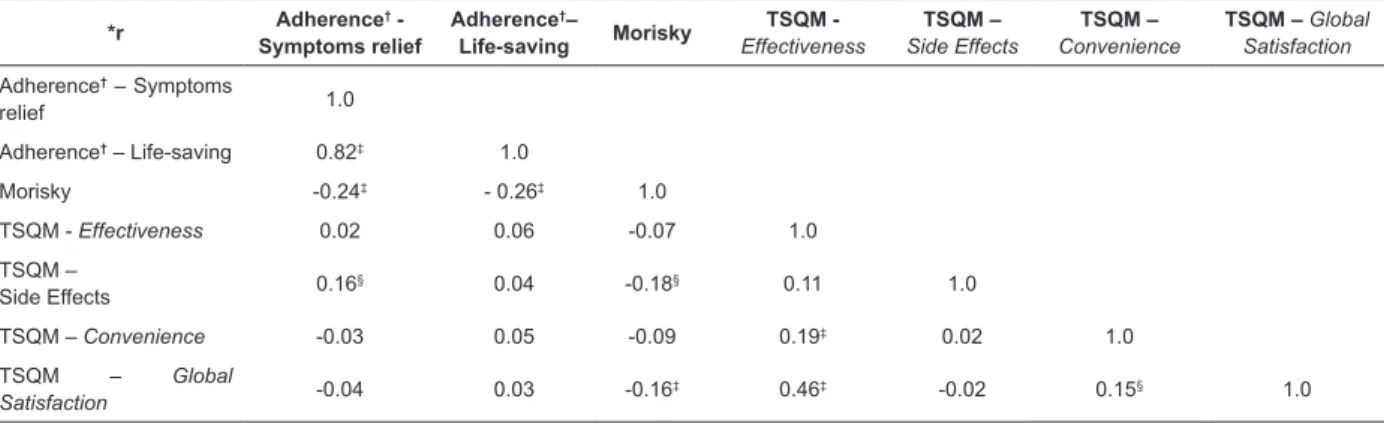
Contrary to the assumptions previously established, signiicant correlations were small or not found between the scores of TSQM (version 1.4) and the scores on the
Brazilian version of the Morisky Self-Reported Measure of
Medication Adherence and the proportion of adherence
(Table 4).
Table 4 - Pearson’s correlation coeficients between TSQM (version 1.4) and adherence measures. Campinas, SP, Brazil, 2010-2011
*r Adherence
†
-Symptoms relief
Adherence†–
Life-saving Morisky
TSQM - Effectiveness
TSQM – Side Effects
TSQM – Convenience
TSQM – Global Satisfaction
Adherence† – Symptoms
relief 1.0
Adherence† – Life-saving 0.82‡ 1.0
Morisky -0.24‡ - 0.26‡ 1.0
TSQM - Effectiveness 0.02 0.06 -0.07 1.0
TSQM –
Side Effects 0.16
§ 0.04 -0.18§ 0.11 1.0
TSQM – Convenience -0.03 0.05 -0.09 0.19‡ 0.02 1.0
TSQM – Global
Satisfaction -0.04 0.03 -0.16
‡ 0.46‡ -0.02 0.15§ 1.0
*r = Pearson’s correlation coeficients; †Proportion of adherence; ‡p<0.01; §p≤0.05.
Discussion
The indings suggest the practicability and acceptability of the Brazilian’s TSQM, evidenced by the
short average time of application (4.6 minutes) with
99.5% of the items answered. In the original study(3),
the mean time for application of the instrument was not
reported.
Although most of the participants responded to all items, some dificulty was observed in understanding question 4, which belongs to the side effects domain,
with regard to the meaning of the terms “secondary”
and “collateral”, used for translating the expression
“side effects” in Brazilian Portuguese, as well as
for understanding the terms “convenient” and
“inconvenient”, listed in question 11, which belong to
the convenience domain. These items need revision in
order to optimize the instrument for promoting better
comprehension in a population with few years of study
and low socioeconomic level(21).
The results also indicated the presence of a minor
ceiling effect in the effectiveness (15.8%), convenience
(14.2%), global satisfaction (25.8%) domains and
90.5% in the side effects domain. It is also important
to highlight that 81.1% of the participants reported no
side effects. The score differences might be due to a
systematic bias, such as social desirability affecting all
items (the often unconscious desire to give a positive
image to others by giving responses that correspond to
socially admitted opinions)(22). The social desirability bias
can be changed according to the way the questionnaire
It is noteworthy that the ceiling effect occurs when
a percentage of the sample scores the highest possible
level of the measure, which impedes the detection of
changes in situations of improvement of the health status. The loor effect occurs when a percentage of the sample scores the lowest possible level of the measure,
which impedes the detection of changes in situations of
worsening of the health status(10).
The detection of these effects may indicate the
impaired responsiveness of the instrument - the ability
of the instrument to measure the magnitude of the
change in a clinical condition over time(23). Therefore,
the Brazilian TSQM (version 1.4) can be considered
potentially responsive regarding the measure of worsening of the health status, since a small loor effect was evidenced. Nevertheless, the current data
suggest that there may not be a limitation regarding
the detection of improvement of the health status; the
ceiling effect was detected in the side effects domain
(90.5%). This is expected, however, when considering
the scoring technique of this domain(15-16). Other studies
reported issues regarding the distribution of the scores and ceiling and loor effects are addressed in the TSQM (version 1.4), with evidence of ceiling effect in the side
effects and convenience domains(3,22).
Possible reasons for the occurrence of inadequate
distribution of the scores were evaluated by removing
respondents who infrequently reported occurrence of
side effects, which resulted in a normal distribution of scores, suggesting that respondents were satisied with drug treatment when side effects were infrequent(3). The
authors highlight that such indings should not be treated as a simple response bias, but as a result of a complex
interaction between the feasibility, alternative treatments
effectiveness and respondent’s health status over time(3).
In the present study, the reliability analysis was
satisfactory, or close to it. The internal consistency of items, estimated by Cronbach’s alpha coeficient, was demonstrated previously in the original study(3), in which
the Cronbach’s alpha coeficient ranged from 0.86 up to 0.90. Other studies that applied the TSQM to assess the
satisfaction with drug treatment had similar results(22,24).
As opposed to the previously established hypotheses, the TSQM presented no signiicant correlations with the measures of adherence to drug
use (Table 4). The lower the Morisky score, the higher
the favorability to adherence and, regarding the TSQM,
the higher the score, the better the patient satisfaction,
so a negative correlation is expected between these
questionnaires. Nevertheless, values closer to one
are still expected, not considering the sign. The lack of signiicant correlations between the measure of
satisfaction (TSQM) and the adherence measures can
be explained by the TSQM not including constructs
such as medical care and treatment impact, relevant
aspects pertaining to the construct of satisfaction,
which can predict treatment adherence(9). Other studies
evaluated the correlation between patient satisfaction
and medication adherence, and found a correlation(22,25).
However, none of them correlated TSQM (version 1.4)
and the 4-item Morisky Self-Reported Measure of
Medication Adherence. Instead, it was common to use
the 8-item Morisky scale. It is important to highlight that
the 8-item Morisky Medication Adherence scale is not
available in Brazilian Portuguese.
Adherence consists of a complex measure for
which there is no gold standard. In the present
study, adherence was assessed by two instruments
as recommended elsewhere(26), in order to respect its
aspects and maximize its accuracy. Even though the
Morisky Self-Reported Measure of Medication Adherence
is widely used, its reliability varies among different
samples(19). Future studies could consider objective
measures of adherence (such as direct observation of
medication intake or use of biological markers), and
the Morisky self-reported measure would increase the
accuracy of the adherence measure.
In the future, health care providers in the ield of chronic diseases have to focus their attention on the
aging population, their prevalence will be much more
frequent, as well as the necessity of continuous and
persistent medication treatment(3). It is known that patient
satisfaction inluences the health behavior and would be crucial in this process of treatment in patients with
chronic diseases, mainly in patients with CHD, in which
the treatment adherence reduces the number of ischemic
events and improves quality of life. Nurses as health
educators would be pivotal in educating patients about the
self-management of diseases, thus increasing the patient
satisfaction and achieving high adherence rates(25).
Further studies are recommended in order to
deeply evaluate the psychometric performance of the TSQM, aimed at conirming its validity, sensitivity and the structure of the factors. The results of this study
present relevant implications for nurses and other
health professionals, since they support a stronger
evaluation of a questionnaire that can be used to assess
the effectiveness of interventions to improve patients’
satisfaction with their drug treatment.
Limitations
One of the limitations were the interview technique
in which the instruments were applied, including TSQM
self-reported measure is recommended, and interviews
can lead to social desirability. Even without testing
the cognitive function or levels of comprehension, the
low levels of study and family income motivated this
approach, as the majority of the Brazilian population
was considered.
As for the construct validity, it is important to
highlight that there is no gold standard for an adherence
measurement and, on top of that, adherence can be
deceptive – in order to achieve more precise results, we
have applied two questionnaires to measure this construct.
Conclusion
The results of this study indicate that the Brazilian
TSQM (version 1.4) is a questionnaire with easy
application, with evidence of acceptability and potential
sensitivity in detecting worsening regarding patients’
satisfaction with their medication, evidenced by the low loor effect, as well as the limitation in detecting improvement regarding patient satisfaction by the inding of a substantial ceiling effect in the side effects domain. Construct validity was weakly supported, since small signiicant correlations were observed with the general measure of satisfaction and adherence.
In the era of patient safety, nurses play a pivotal
role as they not only provide direct health care to
patients, but also regarding their health education and
behavior. Patients who perceive their medication to be
ineffective, laden with side effects, or too inconvenient to
use are less likely to take their medication as prescribed.
Thus, dissatisfaction with medication may affect the
effectiveness of treatment and result in treatment
failure. Nurses may conduct regular evaluation of patient
satisfaction by applying the TSQM, which aids the health
team to monitor individuals whose current experiences
may increase the risk of low medication adherence.
Further studies are recommended in order to conirm the structure of the factors (factor analysis) of the Brazilian version of the TSQM and its validity, as well
as to investigate its sensitivity and responsiveness.
Acknowledgements
To Dr. Mark J. Atkinson (Department of Medicine,
University of California) for his valuable comments and
suggestions to improve the quality of the paper and
Quintiles Inc. for the kind permission to use TSQM.
References
1. Manary MP, Boulding W, Staelin R, Glickman SW. The
patient experience and health outcomes. N Engl J Med.
2013;368(3):201-3.
2. Shikiar R, Rentz AM. Satisfaction with medication: An
overview of conceptual, methodologic, and regulatory issues. Value in Health. 2004;7(2):204-15.
3. Atkinson MJ, Sinha A, Hass S, Colman SS, Kumar RN, Brod M, et al. Validation of a general measure of treatment satisfaction, the Treatment Satisfaction
Questionnaire for Medication (TSQM), using a national
panel study of chronic disease. Health Qual Life
Outcomes. 2004;2:12.
4. Bitton A, Choudhry NK, Matlin OS, Swanton K, Shrank
WH. The impact of medication adherence on coronary
artery disease costs and outcomes: a systematic review.
Am J Med. 2013;126(4):357.e7-.e27.
5. Naderi SH, Bestwick JP, Wald DS. Adherence to drugs
that prevent cardiovascular disease: meta-analysis on
376,162 patients. Am J Med. 2012;125(9):882-7.e1.
6. Hawkes AL, Patrao TA, Atherton J, Ware RS, Taylor CB,
O’Neil A, et al. Effect of a telephone-delivered coronary
heart disease secondary prevention program (proactive
heart) on quality of life and health behaviours: primary
outcomes of a randomised controlled trial. Int J Behav
Med. 2013;20(3):413-24.
7. Asadi-Lari M, Tamburini M and Gray D. Patients’ needs,
satisfaction, and health related quality of life: Towards
a comprehensive model. Health Qual Life Outcomes.
2004;2:32.
8. Delestras S, Roustit M, Bedouch P, Minoves M, Dobremez V, Mazet R, et al. Comparison between two generic questionnaires to assess satisfaction with
medication in chronic diseases. PLoS One. [Internet].
2013 [Acesso 15 dez 2014];8(2):E56247. Disponível
em: http://www.ncbi.nlm.nih.gov/pubmed/23437104 9. Ruiz MA, Pardo A, Rejas J, Soto J, Villasante F, Aranguren JL. Development and validation of the
“Treatment Satisfaction with Medicines Questionnaire” (SATMED-Q). Value Health. 2008;11(5):913-26.
10. Bennet SJ, Oldridge NB, Eckert GJ, Embree JL,
Browning S, Hou N, et al. Discriminant properties of
commonly used quality of life measures in heart failure.
Qual Life Res. 2002;11(4):349-59.
11. Mendez RD, Rodrigues RC, Cornélio ME, Gallani MC,
Godin G. Development of an instrument to measure
psychosocial determinants of physical activity behavior
among coronary heart disease patients. Rev Esc Enferm
USP. 2010;44(3):584-96.
12. Albert N. Improving medication adherence in
chronic cardiovascular disease. Crit Care Nurse.
2008;28(5):54-64.
13. Kwon JW, Moon JY, Kim SH, Song WJ, Kim MH, Kang
MG, et al. Reliability and validity of a korean version
of the leicester cough questionnaire. Allergy Asthma
Received: Feb. 25th 2015 Accepted: Aug. 18th 2015
Copyright © 2016 Revista Latino-Americana de Enfermagem
This is an Open Access article distributed under the terms of the Creative Commons (CC BY).
This license lets others distribute, remix, tweak, and build upon your work, even commercially, as long as they credit you for the original creation. This is the most accommodating of licenses offered. Recommended for maximum dissemination and use of licensed materials.
Corresponding Author: Ana Carolina Sauer Liberato Rua Armando Fabri, 184 Jardim Guarujá
CEP: 18050-609, Sorocaba, SP, Brazil E-mail: [email protected]
14. Hung MC, Lu WS, Chen SS, Hou WH, Hsieh CL, Wang JD. Validation of the EQ-5D in Patients with Traumatic Limb Injury. J Occup Rehabil. 2015;25(2):387-93.
15. Bhalerao MS, Bolshete PM, Swar BD, Bangera TA, Kolhe VR, Tambe MJ, et al. Use of and satisfaction with complementary and alternative medicine in four chronic
diseases: a cross-sectional study from India. Natl Med J
India. 2013;26(2):75-8.
16. Atkinson MJ, Kumar R, Cappelleri JC, Hass SL.
Hierarchical construct validity of the treatment
satisfaction questionnaire for medication (TSQM version II) among outpatient pharmacy consumers. Value in Health. 2005;8:S9-S24.
17. Bonomi AE, Cella DF, Hahn EA, Bjordal K,
Sperner-Unterweger B, Gangeri L, et al. Multilingual translation
of the Functional Assessment of Cancer Therapy (FACT)
quality of life measurement system. Qual Life Res.
1996;5(3):309-20.
18. Morisky DE, Green LW, Levine DM. Concurrent
and predictive validity of a self-reported measure of
medication adherence. Med Care. 1986;24(1):67-74.
19. Lourenço LB, Rodrigues RC, Ciol MA, São-João TM,
Cornélio ME, Dantas RA, et al. A randomized controlled
trial of the effectiveness of planning strategies in the
adherence to medication for coronary artery disease. J
Adv Nurs. 2014;70(7):1616-28.
20. Ventura-Cerdá JM, Mínguez-Gallego C, Fernández-Villalba EM, Alós-Almiñana M, Andrés-Soler J. Simpliied scale for medication adherence related problems in
anti-retroviral therapy. Farm Hosp. 2006;30(3):171-6.
21. Nakajima KM, Rodrigues RC, Gallani MC, Alexandre
NM, Oldridge N. Psychometric properties of MacNew Heart
Disease Health-related Quality of Life Questionnaire:
Brazilian version. J Adv Nurs. 2009;65(5):1084-94. 22. Regnault A, Balp MM, Kulich K, Viala-Danten M. Validation of the Treatment Satisfaction Questionnaire for Medication in patients with cystic ibrosis. Journal of Cystic Fibrosis. 2012;11(6):494-501.
23. Liang MH. Longitudinal construct validity:
establishment of clinical meaning in patient evaluative
instruments. Med Care. 2000;38(9 Suppl):II84-90. 24. Trujols J, Iraurgi I, Siñol N, Portella MJ, Pérez V, Pérez de Los Cobos J. Satisfaction with methadone as
a medication: psychometric properties of the Spanish
version of the treatment satisfaction questionnaire for
medication. J Clin Psychopharmacol. 2012;32(1):69-74.
25. Zyoud SH, Al-Jabi SW, Sweileh WM, Morisky DE.
Relationship of treatment satisfaction to medication adherence: indings from a cross-sectional survey among hypertensive patients in Palestine. Health Qual
Life Outcomes. [Internet] 2013 [Acesso 26 jun 2015];
2013;11:191. Disponível em: http://www.hqlo.com/
content/11/1/191.
26. Wu JR, Moser DK, Chung ML, Lennie TA. Objectively
measured, but not self-reported, medication adherence
independently predicts event-free survival in patients