Acta Limnologica Brasiliensia, 2017, vol. 29, e107 http://dx.doi.org/10.1590/S2179-975X5817 ISSN 2179-975X on-line version
This is an Open Access article distributed under the terms of the Creative Commons Attribution License, which permits unrestricted use, distribution, and reproduction in any medium, provided the original work is properly cited.
Intra-annual variation in planktonic ciliate species composition
(Protista: Ciliophora) in different strata in a shallow floodplain lake
Variação intra-anual na composição de espécies de ciliados planctônicos
(Protista: Ciliophora) em diferentes estratos de uma lagoa rasa de planície de inundação
Gustavo Mayer Pauleto1, Felipe Rafael de Oliveira1, Bianca Trevizan Segovia1, Bianca Ramos Meira1, Fernando Lansac-Tôha1, Paulo Roberto Bressan Buosi1
and Luiz Felipe Machado Velho1,2*
1 Núcleo de Pesquisas em Limnologia, Ictiologia e Aquicultura – NUPÉLIA, Programa de Pós-graduação em Ecologia de Ambientes Aquáticos Continentais – PEA, Universidade Estadual de Maringá – UEM, Av. Colombo, 5790, CEP 87020-900, Maringá, PR, Brazil
2 Programa de Pós-graduação em Tecnologias Limpas – PPGTL, Instituto Cesumar de Ciência Tecnologia e Inovação – ICETI, Centro Universitário Cesumar – UniCesumar, Av. Guedner, 1610, CEP 87050-390, Maringá, PR, Brazil
*e-mail: [email protected]
Cite as: Pauleto, G.M. et al. Intra-annual variation in planktonic ciliate species composition (Protista: Ciliophora) in different strata in a shallow floodplain lake. Acta Limnologica Brasiliensia, 2017, vol. 29, e107.
Abstract:Aim: We aimed to evaluate the variation in planktonic ciliate species composition in different strata of the Guaraná Lake, encompassing high and low water periods, at the Upper Paraná River floodplain.
Methods: Samplings were collected monthly between March 2007 and February 2008, from the epilimnion, metalimnion and hypolimnion. Ciliates samples were filtered using a plankton net of 10µm mesh size and identified in vivo under an optical microscope. Results: Among 112 species identified, 13 were found exclusively during the high water periods and 39 during the low water period. Results of nonparametric extrapolation indices evidenced that the observed richness represented between 70% and 90% of the estimated richness. Regarding the variation in species composition, Beta1 index showed that the alteration in composition between strata during the low water period was slightly greater than that registered during high waters. Cluster analysis evidenced a higher dissimilarity in ciliate species composition between periods than among the different strata. The greatest variation in species composition was verified during the distinct hydrological periods, whereas no significant differences were observed for the different strata analysed. Conclusions: We found that in the pelagic compartment, ciliate species composition changed significantly between hydrological periods, and a higher similarity in species composition among strata was observed during the high water period. Therefore, alterations in the vertical distribution seem to be related to the homogenizing effect of the floods in the water column stability.
Keywords: protist; plankton; species richness; diversity; freshwater.
Distinct ciliate communities are found in specific compartments within the same environment (Finlay & Esteban, 1998b; Zingel & Ott, 2000) showing clear patterns of vertical distribution (Mieczan, 2008). Oligotrichs usually dominate in the epilimnion in lakes of temperate regions, although individuals belonging to Prostomatida, Peritrichia and Haptorida are also frequently found in this water layer. Scuticuciliates, prostomatids and haptorids are usually more numerous in the intermediate layer (metalimnion) and scuticuciliates, heterotrichs and prostomatids are more representative in the hypolimnion (Mieczan, 2008; Zingel & Ott, 2000). On the other hand, in tropical lakes, which are usually shallower than temperate lakes, studies approaching ciliate vertical distribution are still scarce. Thus, we evaluated the variation in ciliate species composition in different strata and two hydrological periods in the Guaraná Lake, at the Upper Paraná River floodplain.
We hypothesized that planktonic ciliate species composition would be different among strata of the water column, considering that the lower strata would be more dissimilar due to the contribution of species associated with the sediment (not typically planktonic). Moreover, we predict that species composition among strata during high waters would be more similar than during low waters, based on seasonal alterations determined by the hydrological regime and considering that the flood pulse is the main factor structuring ciliate communities.
2. Material and Methods
2.1. Study area
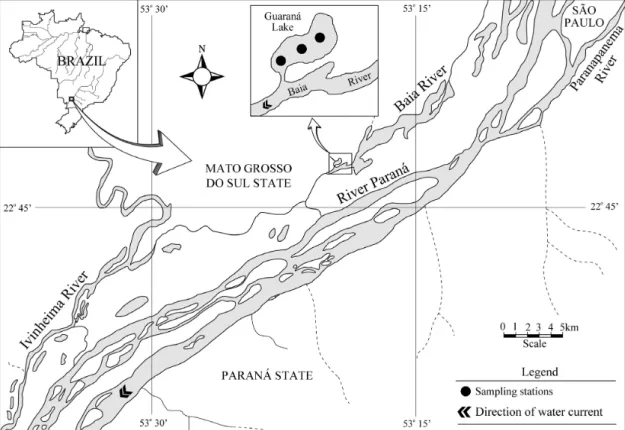
Guaraná lake (22º43’S-53º18’W) is located in the Upper Paraná River floodplain, Brazil (Figure 1). This lake has 4.2 ha area and 3.2 m mean depth, it is usually covered by floating aquatic macrophytes
1. Introduction
River-floodplain systems are characterized by a great diversity of water bodies, including lotic, semi-lotic and lentic environments (Junk et al., 1989). This great environmental diversity, together with the connectivity among those habitats, and the exchange of organisms between the river and the adjacent floodplain, provide a high biodiversity, due to periods of low and high waters that result in a unique environmental condition, determined by the flood pulses (Neiff, 1990). The hydrological connectivity resulting from the flood pulse act as a homogenizing factor in the habitats of the Upper Paraná River floodplain (Thomaz et al., 2007). In fact, several studies show the importance of the flood pulse in structuring aquatic communities in floodplains (Algarte et al., 2009; Arrieira et al., 2017; Lansac-Tôha et al., 2009; Train & Rodrigues, 2004).
Ciliates are important components of food webs in floodplain environments, acting as a link between bacteria and flagellates and higher trophic levels (Azam et al., 1983; Segovia et al., 2015), besides feeding on phytoplankton organisms (Sherr & Sherr, 2002). However, as opposed to temperate regions, where temperature is the main factor structuring ciliate communities (Graham et al., 2004; Müller et al., 1991), in floodplain habitats of tropical regions the hydrological regime constitutes the major force influencing those protists (Pauleto et al., 2009). This temporal alteration of the hydrological regime provides the occurrence of species that are adapted to this condition, which is facilitated by mechanisms to persist in the environment during unfavorable periods (Lytle & Poff, 2004). For example, ciliate encystment allows some species to tolerate physical and chemical stresses and reduce their metabolic losses and risk of predation (Taylor, 1981).
com auxílio de microscópio óptico. Resultados: Dentre as 112 espécies de ciliados identificadas, 13 foram encontradas exclusivamente no período de águas altas e 39 espécies no período de águas baixas. Os resultados do índice de extrapolação não paramétrica evidenciaram que a riqueza observada representou entre 70% e 90% da riqueza estimada para o ambiente. A variação da composição de espécies, quantificada pelo índice Beta1, indicou que a alteração da composição entre as profundidades nas águas baixas foi ligeiramente maior do que a registrada nas águas altas. A análise de Cluster evidenciou uma maior dissimilaridade na composição de espécies de ciliados entre os períodos do que entre as amostras das diferentes profundidades. As maiores diferenças na composição de espécies foram verificadas para os distintos períodos hidrológicos, enquanto que não foram observadas diferenças significativas em relação aos diferentes estratos da coluna de água. Conclusões: Verificou-se que, no compartimento pelágico a composição de espécies da comunidade de ciliados planctônicos mudou significativamente entre os períodos hidrológicos, e que uma maior similaridade na composição de espécies entre os estratos foi observada durante o período de águas altas. Dessa forma, alterações na distribuição vertical da composição podem estar relacionadas ao efeito homogeneizador das inundações na estabilidade da coluna de água.
(mainly Eichhornia crassipes (Mart.) Solms., E. azurea (Swartz) Kunth., Pistia stratiotes Linnaeus). It is connected to the Baía River by a 70m length channel (UEM, 2002). Mean values of some abiotic variables registered in our study were as follows: water temperature 25 °C, dissolved oxygen 5mg/L, pH 6.32, chlorophyll-a 10.85 µg/L, total phosphorus 32.3 µg/L, total nitrogen 1mg/L (see egovia et al., 2014 for a detailed table with all abiotic variables during high and low water periods). 2.2. Sampling and laboratory analysis
Sampling was performed in the Guaraná Lake from March 2007 to February 2008. Two-liter water samples were taken at three sampling sites in three different depths: epilimnion (approximately 20cm below the water/air interface), metalimnion (determined as the half of the total depth of the water column at the time of sampling) and hypolimnion (approximately 20 cm above the substrate), since thermal stratification was not observed in any occasion.
Samples were stored in 5 L bottles, kept cool and transported to the laboratory. Afterwards, samples were concentrated from 5 L to 100 ml using a plankton net of 10 µm mesh size. We counted the ciliates according to the live counting technique
proposed by Madoni (1984), in which 10 replicates of 100 µl drops are counted per sample, under an optical microscope (Olympus CX-41), within a maximum period of 6 hours after sampling. Species were identified according to specialized bibliography: Corliss (1979), Dragesco & Dragesco-Kernéis (1986), Edmondson (1959), Foissner et al. (1991, 1992, 1994, 1995, 1999), Foissner & Berger (1996) and Patterson (1992).
2.3. Data analyses
Samples were categorized in two hydrological periods according to the average depth registered throughout the study period (Figure 2). We considered the months which exceeded the average depth (March, April and December 2007; January and February 2008) as high water period, whereas the other months were considered as low water period (May to November 2007).
We used a nonparametric procedure for the extrapolation of the species accumulation curve, based on incidence data: Jackknife 1, Jackknife 2 and Bootstrap, to estimate ciliate species richness and analyse which portion of the expected total species richness was registered in our study. Estimators were calculated using software EstimateS (Colwell, 2006).
Ciliate species were arranged according to their preferential habits (following Berger & Foissner, 2003) as planktonic (adapted to the pelagic compartment) or non-planktonic (associated to a substrate, from the littoral or benthic zones). The frequency of occurrence of ciliate species was calculated through the percentage of samples in which those species occurred (Fr=n*100/N, where n = species occurrence in the analysed samples and N = total number of analysed samples). According to their frequency of occurrence, species were then grouped in: constant (76% to 100% of samples), frequent (51% to 75% of samples), accessory (26% to 50% of samples) and accidental (less than 25% of samples) species.
Nonmetric multidimensional scaling (MDS) was performed to summarize patterns in species composition, based on Jaccard distance. Significant differences were tested through a Permutational Multivariate Analysis of Variance (PERMANOVA) determined by 999 permutations. MDS and PERMANOVA were performed in software R (R Core Team, 2013) using “vegan” package (Oksanen et al., 2016).
We used Beta 1 diversity index (Harrison et al., 1992) to quantify the turnover in ciliate species composition regarding the vertical distribution and hydrological periods, which was estimated through the expression: β-1 = {[(S/α)–1]/(N-1)}×100, where S is the total number of ciliate species registered in each sampling site, α is the mean number of species found in the samples and N is the number of sampling units.
Cluster analysis (Hammer et al., 2001), based on Jaccard similarity coefficients, were performed to verify similarities in vertical and temporal distributions of ciliate species. Cophenetic Correlation Coefficient was calculated to estimate the representativeness of the dendrograms relative to the original data.
3. Results
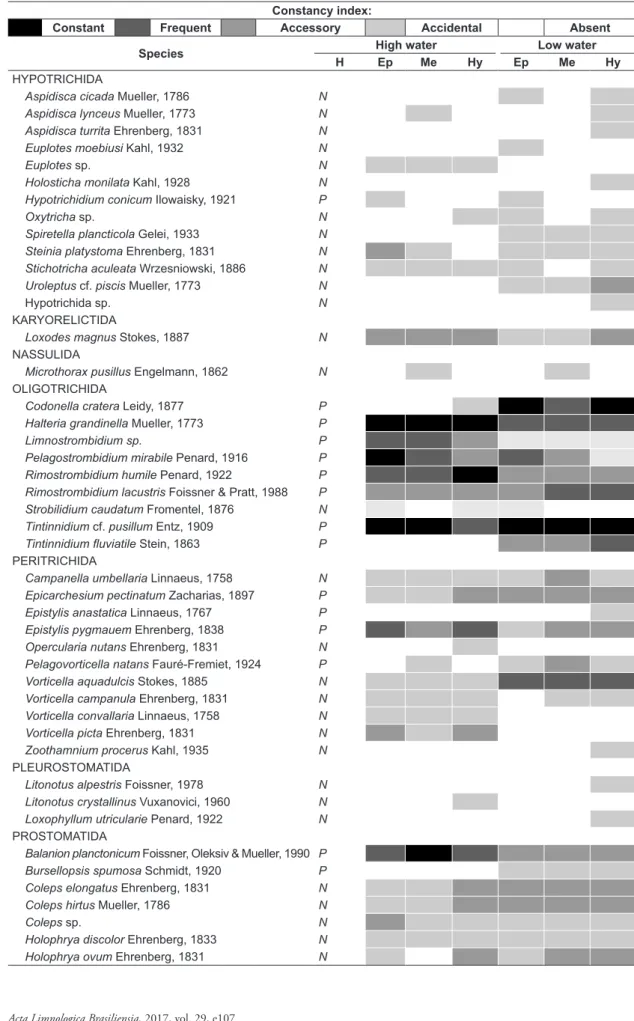
In our study, 112 ciliate species were identified (Table 1). Nonparametric extrapolation indices results showed that the observed richness represented between 70% and 90% of the estimated richness. Bootstrap (124 species) was the index that better reflected the observed species richness (Figure 3).
Among the identified species, 13 were registered only during the high water period, whereas 39 species where registered only during the low water period. Nine species occurred exclusively at the epilimnion,
four species only at the metalimnion and 21 species were registered only at the hypolimnion.
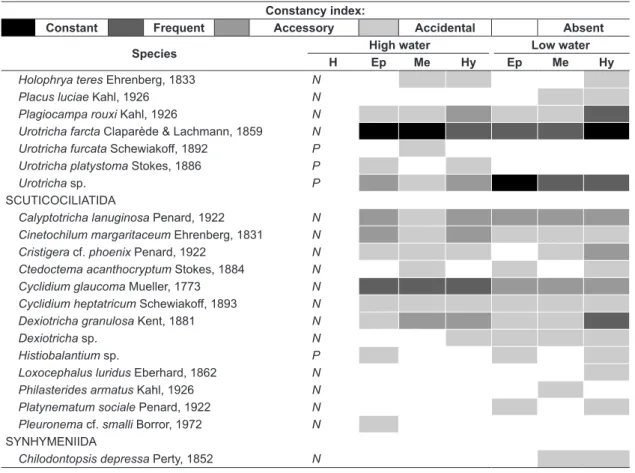
A total of 32 species were registered in all strata and both hydrological periods. Halteria grandinella Mueller, 1773, Urotricha farcta Claparède & Lachmann, 1859 and Tintinnidium cf. pusillum Entz, 1909, were registered in over 50% of the samples in each stratum, both during high and low water periods (Table 1).
Ciliate species belonging to 14 orders were identified. Heterotrichida, Hymenostomatida and Prostomatida showed the highest number of species (14 species each), followed by Haptorida, Hypotrichida and Scuticociliatida (13 species each), and Peritrichida (11 species). However, considering only frequent or constant species, Oligotrichida, Prostomatida (eight species each) and Peritrichida (six species) showed the highest number of species (Table 1).
Considering the number of ciliate species in each of the analysed months, Prostomatida, Oligotrichida
Figure 2. Average water depth registered at the Guaraná Lake during the study period (black dots = mean, bar = standard error).
Table 1. List of ciliate species registered in distinct strata (Ep = Epilimnion; Me = Metalimnion; Hy = Hypolimnion) in two hydrological periods (High water and Low water) at Guaraná Lake (H = Preferential Habitat; P = planktonic species and N = non-planktonic species).
Constancy index:
Constant Frequent Accessory Accidental Absent
Species High water Low water
H Ep Me Hy Ep Me Hy
COLPODIDA
Colpoda steinii Maupas, 1883 N
Cyrtolophosis mucicola Stokes, 1885 N
Platyophrya vorax Kahl, 1926 N
CYRTOPHORIDA
Chlamydonella alpestris Foissner, 1979 N
Odontochlamis alpestris Foissner, 1981 N
HAPTORIDA
Actinobolina sp. P
Askenasia volvox Eichwald, 1852 P
Chaenea stricta Dujardin, 1841 N
Didinium nasutum Mueller, 1773 N
Dileptus anastatica N
Enchelys gasterosteus Kahl, 1926 N
Enchelys sp. N
Lacrymaria olor Mueller, 1786 N
Lagynophrya acuminata Kahl, 1935 P
Mesodinium pulex Claparède & Lachmann, 1859 P
Monilicaryon monilatus Stokes, 1886 N
Paradileptus ellephantinus Svec, 1897 P
Spathidium sp. N
HETEROTRICHIDA
Bursaridium pseudobursaria Fauré-Fremiet, 1924 P
Caenomorpha medusula Perty, 1852 N
Caenomorpha uniserialis Levander, 1894 N
Climacostomum virens Ehrenberg, 1838 P
Condylostoma sp. N
Linostomella vorticella Ehrenberg, 1833 P
Phyalina sp. N
Spirostomum minus Roux, 1901 N
Spirostomum teres Claparède & Lachmann, 1858 N
Stentor coeruleus Pallas, 1766 N
Stentor muelleri Ehrenberg, 1831 N
Stentor multiformis Mueller, 1786 N
Stentor niger Mueller, 1773 N
Stentor roeselii Ehrenberg, 1835 N
HYMENOSTOMATIDA
Dexyostoma campylum Stokes, 1886 N
Disematostoma buetschilii Lauterborn, 1894 P
Epenardia myriophilii Penard, 1922 N
Frontonia acuminata Ehrenberg, 1833 N
Frontonia leucas Ehrenberg, 1833 N
Lembadion lucens Maskell, 1887 N
Ophryoglena sp.A N
Ophryoglena sp.B N
Paramecium bursaria Ehrenberg, 1831 P
Paramecium caudatum Ehrengerb, 1833 N
Paramecium putrinum Claparède & Lachmann, 1859 N
Stokesia vernalis Wenrich, 1929 P
Tetrahymena pyriformis Ehrenberg, 1830 N
Table 1. Continued...
Constancy index:
Constant Frequent Accessory Accidental Absent
Species High water Low water
H Ep Me Hy Ep Me Hy
HYPOTRICHIDA
Aspidisca cicada Mueller, 1786 N
Aspidisca lynceus Mueller, 1773 N
Aspidisca turrita Ehrenberg, 1831 N
Euplotes moebiusi Kahl, 1932 N
Euplotes sp. N
Holosticha monilata Kahl, 1928 N
Hypotrichidium conicum Ilowaisky, 1921 P
Oxytricha sp. N
Spiretella plancticola Gelei, 1933 N
Steinia platystoma Ehrenberg, 1831 N
Stichotricha aculeata Wrzesniowski, 1886 N
Uroleptus cf. piscis Mueller, 1773 N
Hypotrichida sp. N
KARYORELICTIDA
Loxodes magnus Stokes, 1887 N
NASSULIDA
Microthorax pusillus Engelmann, 1862 N
OLIGOTRICHIDA
Codonella cratera Leidy, 1877 P
Halteria grandinella Mueller, 1773 P
Limnostrombidium sp. P
Pelagostrombidium mirabile Penard, 1916 P
Rimostrombidium humile Penard, 1922 P
Rimostrombidium lacustris Foissner & Pratt, 1988 P
Strobilidium caudatum Fromentel, 1876 N
Tintinnidium cf. pusillum Entz, 1909 P
Tintinnidium fluviatile Stein, 1863 P
PERITRICHIDA
Campanella umbellaria Linnaeus, 1758 N
Epicarchesium pectinatum Zacharias, 1897 P
Epistylis anastatica Linnaeus, 1767 P
Epistylis pygmauem Ehrenberg, 1838 P
Opercularia nutans Ehrenberg, 1831 N
Pelagovorticella natans Fauré-Fremiet, 1924 P
Vorticella aquadulcis Stokes, 1885 N
Vorticella campanula Ehrenberg, 1831 N
Vorticella convallaria Linnaeus, 1758 N
Vorticella picta Ehrenberg, 1831 N
Zoothamnium procerus Kahl, 1935 N
PLEUROSTOMATIDA
Litonotus alpestris Foissner, 1978 N
Litonotus crystallinus Vuxanovici, 1960 N
Loxophyllum utricularie Penard, 1922 N
PROSTOMATIDA
Balanion planctonicum Foissner, Oleksiv & Mueller, 1990 P
Bursellopsis spumosa Schmidt, 1920 P
Coleps elongatus Ehrenberg, 1831 N
Coleps hirtus Mueller, 1786 N
Coleps sp. N
Holophrya discolor Ehrenberg, 1833 N
and Scuticociliatida showed the greater number of species. Haptorida and Peritrichida also showed a high number of species (Figure 4).
Regarding the distinct strata, Prostomatida showed the highest number of species in each vertical compartment, especially at the metalimnion. Scuticociliatida, Haptorida and Oligotrichida were also important in all strata, whereas Nassulida occurred only at the metalimnion, Pleurostomatida occurred only at the hypolimnion, and Synhymeniida was absent at the epilimnion (Figure 5).
Over 70% of the ciliate species (82 species) could be considered non-planktonic and associated with some type of substrate, whereas only 26.8% (30 species) are truly planktonic. Thus, there was a dominance of non-planktonic species, mainly in March and May, when those organisms represented over 66% of the total species number. (Figure 6).
Considering the two hydrological periods, non-planktonic species remained dominant, mainly during the low water period when 71 non-planktonic species (71.7%) and 28 planktonic species (28.3%) were registered. In the same way, during the high water period 49 non-planktonic (67.1%) and 24 planktonic (32.9%) species were found (Figure 7A).
Regarding the vertical distribution of the preferential habitat, a greater number of non-planktonic species was registered in all strata. The highest relative contribution of non-planktonic species percentage was found in the hypolimnion (70 species, corresponding to 72.2% of total species), followed by the epilimnion (54 species, or 67.5% of total species) and metalimnion (47 species, equivalent to 65.3% of total species) (Figure 7B).
Table 1. Continued...
Constancy index:
Constant Frequent Accessory Accidental Absent
Species High water Low water
H Ep Me Hy Ep Me Hy
Holophrya teres Ehrenberg, 1833 N
Placus luciae Kahl, 1926 N
Plagiocampa rouxi Kahl, 1926 N
Urotricha farcta Claparède & Lachmann, 1859 N
Urotricha furcata Schewiakoff, 1892 P
Urotricha platystoma Stokes, 1886 P
Urotricha sp. P
SCUTICOCILIATIDA
Calyptotricha lanuginosa Penard, 1922 N
Cinetochilum margaritaceum Ehrenberg, 1831 N
Cristigera cf. phoenix Penard, 1922 N
Ctedoctema acanthocryptum Stokes, 1884 N
Cyclidium glaucoma Mueller, 1773 N
Cyclidium heptatricum Schewiakoff, 1893 N
Dexiotricha granulosa Kent, 1881 N
Dexiotricha sp. N
Histiobalantium sp. P
Loxocephalus luridus Eberhard, 1862 N
Philasterides armatus Kahl, 1926 N
Platynematum sociale Penard, 1922 N
Pleuronema cf. smalli Borror, 1972 N
SYNHYMENIIDA
Chilodontopsis depressa Perty, 1852 N
Ciliate species turnover indicated that the alteration in composition among strata was slightly higher during the low water period (26%) than in the high water period (20.2%) (Figure 8A). Considering the turnover in composition in each stratum between hydrological periods, changes were more pronounced. Higher turnover rate was registered in the hypolimnion (33.8%), followed by the metalimnion (26.3%) and the epilimnion (21%) (Figure 8B).
Cluster analysis (Cophenetic Correlation Coefficient = 0.87) showed a higher dissimilarity in ciliate species composition between hydrological periods than among strata. Therefore, the analysis distinguished two groups coinciding with the hydrological periods. Moreover, there was a higher similarity between the epilimnion and the metalimnion (0.64) during the low water period, and a higher similarity between the metalimnion
and the hypolimnion (0.71) during the high water period (Figure 9).
MDS results showed that sampling units were separated only regarding the two hydrological periods, but not regarding the different strata (Figure 10). PERMANOVA statistically confirmed significant differences in ciliate composition between the hydrological periods (Pseudo-F=4.0236; p<0.001), whereas no significant differences were found in the pairwise comparison between epilimnion and metalimnion (Pseudo-F=0.31467; p=0.996), between epilimnion and hypolimnion
(Pseudo-F=0.80554; p=0.713) nor between
metalimnion and hypolimnion (Pseudo-F=0.6299; p=0.903).
4. Discussion
The high number of ciliate species registered in the Guaraná Lake not only exceeds the gamma diversity found in freshwater environments both in Brazil (Bossolan & Godinho, 2000; Cardoso, 2007; Dias et al., 2008; Gomes & Godinho, 2003)
Figure 5. Composition by order (%) registered in the distinct strata in the Guaraná Lake. Epi=Epilimnion, Meta=Metalimnion, Hypo=Hypolimnion.
Figure 6. Species richness of planktonic and non-planktonic ciliates, analysed monthly at Guaraná Lake.
and other regions of the globe (Carrick, 2005; Mayer et al., 1997; Muki et al., 2005; Song, 2000a; Wiackowski et al., 2001), but is also similar to the number of species found by Madoni & Braghiroli (2007) in six sampling sites in an Italian river system, and by Pfister et al. (2002) in 58 north German lakes of distinct trophic status.
Previous samplings performed by Pauleto et al. (2009) in the Guaraná Lake found only 36 ciliate species, however, their sampling design was different: one sample was taken during the high water and one during the low water period. Meanwhile, in our study, in which samplings were performed monthly during a whole year at this same lake, 112 ciliate species were found. This supports the idea that long-term approaches with high sampling effort are necessary in order to determine the total diversity of dynamic environments, which encompasses both active and passive diversities (Finlay & Esteban, 1998a).
Our results evidenced the great biodiversity of floodplain lakes which is, in part, determined by the contribution of non-planktonic organisms from the littoral region and the sediment (Lansac-Tôha et al., 2009). Indeed, non-planktonic ciliates constituted most of the species richness registered in the pelagic compartment of Guaraná Lake. Ciliate species richness is, in general, favoured by the occurrence of macrophyte banks (Song, 2000b), especially the more diverse ones, which support higher species richness and abundance of non-planktonic organisms (Karus et al., 2014), contributing to the increment of species of the planktonic community.
Figure 8. Beta1 diversity index showing species turnover (%) among strata during two hydrological periods (A) and between hydrological periods in the distinct strata (B). Epi=Epilimnion, Meta=Metalimnion, Hypo=Hypolimnion.
Figure 9. Cluster analysis based on ciliate species occurrence in distinct strata (Epi=epilimnion, Meta=metalimnion, Hypo=hypolimnion) in two hydrological periods (High water and Low water periods) at Guaraná Lake.
Figure 10. Multi-dimensional scaling (MDS) plot
The massive contribution of non-planktonic organisms in the pelagic compartment was also observed in studies approaching the zooplankton community in the Upper Paraná River floodplain (Alves et al., 2010; Bonecker et al., 1998; Lima et al., 1998), which evidenced that the faunal exchange between lake compartments occurred mainly during floods due to greater habitat connectivity, leading to the presence of both planktonic and non-planktonic species within the community.
Most of the truly planktonic species are, in general, cosmopolitan, and are thus commonly registered in lake habitats (Pfister et al., 2002). Although Urotricha farcta typically inhabits mainly the benthic compartment, it is also found in the pelagic region of lakes and rivers of reduced water flow rates (Berger & Foissner, 2003). Organisms belonging to this genus, despite their small size, are efficient predators and highly adaptable and tolerant, and are one of the few to be present even in extremely acidic lakes (pH = 3.0) (Packroff, 2000).
Halteria grandinella and Tintinnidium cf. pusillum, besides other species that were common in our study, such as Rimostrombidium humile and Pelagostrombidium mirabile, belong to the order Oligotrichida and are characteristic of the pelagic compartment of lentic environments (Mieczan, 2007; Müller, 1989). These organisms are filter-feeders and feed on bacteria and/or small sized algae, besides being totally adapted to the pelagic environment (Foissner & Berger, 1996). We found a high number of species belonging to Prostomatida and Scuticociliatida, which are important in the metalimnion and the hypolimnion of stratified lakes (Zingel, 2005), reinforcing the influence of littoral and benthic regions in ciliate species composition of the pelagic compartment of the lake. The constant presence of those ciliate orders, which are mostly omnivorous or bacterivorous, suggests a continuous input of organic matter from the marginal zone to the central region of the lake, facilitated in environments with reduced dimensions such as the Guaraná Lake.
We found a greater turnover in species composition of the distinct strata during low waters than during high waters. Similarly, the greater temporal turnover found at the hypolimnion suggests the development of a distinctive community at the bottom of the lake at certain stages of the year. These findings are corroborated by the Cluster results (see Figure 10), which indicates the lowest similarity between samples from the hypolimnion and the other strata during the low water period. During low
waters, the wind action is more pronounced because lakes are shallower, inducing water circulation and destratification (Thomaz et al., 2004), which lead to a higher similarity in the ciliate species composition between the epilimnion and metalimnion strata. Meanwhile, in the hypolimnion we found the highest number of exclusive ciliate species, which indicates that a unique community was formed in this water layer. On the other hand, during high waters, there is a relatively stable thermal stratification (Thomaz et al., 2004), which likely resulted in the distinction of the epilimnion from the other two water layers.
Although we found differences in ciliate species composition among strata, a higher dissimilarity was found between hydrological periods in Guaraná Lake. In fact, the flood pulse is recognized as the main factor structuring aquatic communities (Junk et al., 1989; Neiff, 1990), and was also found to be the major factor influencing the ciliate community in the Upper Paraná River floodplain lakes (Pauleto et al., 2009).
In summary, our hypotheses were corroborated, since we found that, in the pelagic compartment, ciliate species composition changed significantly between hydrological periods, and a higher similarity in species composition among strata was observed during the high water period. Therefore, alterations in the vertical distribution seem to be related to the homogenizing effect of the floods in the water column stability.
Acknowledgements
We would like to thank CNPq/PELD for the financial support and Nupélia/PEA/UEM for logistical support. We would also like to thank CAPES, CNPq for master and doctoral fellowships.
References
ALGARTE, V.M., SIQUEIRA, N.S., MURAKAMI, E.A. and RODRIGUES, L. Effects of Hydrological regime and connectivity on the interannual variation in taxonomic similarity of periphytic algae. Brazilian Journal of Biology = Revista Brasileira de Biologia, 2009, 69(2), 609-616. Supplement. PMid:19738967. http://dx.doi.org/10.1590/S1519-69842009000300015.
ARRIEIRA, R.L., SCHWIND, L.T.F., BONECKER, C.C. and LANSAC-TÔHA, F.A. Temporal dynamics and environmental predictors on the structure of planktonic testate amoebae community in four Neotropical floodplains. Journal of Freshwater Ecology, 2017, 32(1), 35-47. http://dx.doi.org/10.1080/027 05060.2016.1236758.
AZAM, F., FENCHEL, T., FIELD, J.G., GRAY, J.S., MEYER-REIL, L.A. and THINGSTAD, F. The ecological role of water-column microbes in the sea.
Marine Ecology Progress Series, 1983, 10(3), 257-263. http://dx.doi.org/10.3354/meps010257.
BERGER, H. and FOISSNER, W. Illustrated guide and ecological notes to ciliate indicator species (Protozoa, Ciliophora) in running waters, Lakes, and Sewage Plants. In: C. STEINBERG, W. CALMANO, H. KLAPPER and R. WILKEN, eds.
Handbuch angewandte limnologie. Landsberg am Lech: Verlagsgesellschaft. Erg.Lfg., 2003, pp.1-160. BONECKER, C.C., LANSAC-TÔHA, F.A. and
ROSSA, D.C. Planktonic and non-planktonic rotifers in two environments of the Upper Paraná River floodplain, State of Mato Grosso do Sul, Brazil.
Brazilian Archives of Biology and Technology, 1998, 41(4), 447-456. http://dx.doi.org/10.1590/S1516-89131998000400009.
BOSSOLAN, N.R.S. and GODINHO, M.J.L. Abundância numérica e composição do protozooplâncton na lagoa do Infernão, SP. In: J.E. SANTOS and J.S.R. PIRES, eds. Estudos integrados em ecossistemas: estação Ecológica de Jataí. São Carlos: Rima, 2000, pp. 523-536.
CARDOSO, L. Protozooplâncton e Rotífera. In: F.G. BECKER, R.A. RAMOS and L.A. MOURA, eds.
Biodiversidade das regiões da Lagoa do Casamento e dos Butiazais de Tapes, Planície Costeira do Rio Grande do Sul. Brasília: Ministério do Meio Ambiente, 2007, pp. 130-143.
CARRICK, H.J. An under-appreciated component of the biodiversity in plankton communities: the role of protozoa in Lake Michigan (a case study).
Hydrobiologia, 2005, 551(1), 17-32. http://dx.doi. org/10.1007/s10750-005-4447-0.
COLWELL, R.K. EstimateS: statistical estimation of species richness and shared samples [online]. 2006 [viewed 10 Mar. 2017]. Available from: http://viceroy.colorado. edu/estimates/.
CORLISS, J.O. The ciliated protozoa – Characterization, Classification and Guide to the Literature. Oxford: Pergamon Press, 1979.
DIAS, R.J.P., WIELOCH, A.H. and D’AGOSTO, M. The influence of environmental charcteristics on the distribution of ciliates (Protozoa, Ciliophora) in an urban stream of southeast Brazil. Brazilian Journal of Biology = Revista Brasileira de Biologia, 2008, 68(2), 287-295. PMid:18660956. http://dx.doi. org/10.1590/S1519-69842008000200009.
DRAGESCO, J. and DRAGESCO-KERNÉIS, A.
Ciliés libres de l’Afrique intertropicale. Introducion à la connaissance et à l’étude des ciliés. Paris: ORSTOM, 1986, 562 p. Faune Tropicale, vol. 26.
EDMONDSON, W.T. Fresh-water biology. New York: John Wiley & Sons, 1959.
FINLAY, B.J. and ESTEBAN, G.F. Planktonic ciliate species diversity as an integral component of ecosystem function in a freshwater pond. Protist, 1998a, 149(2), 155-165. PMid:23196165. http:// dx.doi.org/10.1016/S1434-4610(98)70020-3. FINLAY, B.J. and ESTEBAN, G.F. Freshwater protozoa:
biodiversity and ecological function. Biodiversity and Conservation, 1998b, 7(9), 1163-1186. http://dx.doi. org/10.1023/A:1008879616066.
FOISSNER, W. and BERGER, H. A user-friendly guide to the ciliates (Protozoa, Ciliophora) commonly used by hydrobiologists as bioindicators in rivers, lakes and waste waters, with notes on their ecology. Freshwater Biology, 1996, 35(2), 375-482.
FOISSNER, W., BERGER, H. and KOHMANN, F. Taxonomische und ökologische Revision der Ciliaten des Saprobiensystems – Band II: Peritrichia, Heterotrichida, Odontostomatida. München:
Informationsberichte des Bayer. Landesamtes für Wasserwirtschaft, 1992, 5/92, 1-502.
FOISSNER, W., BERGER, H. and KOHMANN, F. Taxonomische und ökologische Revision der Ciliaten des Saprobiensystems – Band III: Hymenostomata, Prostomatida, Nassulida. München: Informationsberichte des Bayer.Landesamtes für Wasserwirtschaft, 1994, 1/94, 1-548.
FOISSNER, W., BERGER, H. and SCHAUMBURG, J. Identification and ecology of limnetic plankton ciliates. munich: informationsberichte des bayer.
Landesamtes für Wasserwirtschaft., 1999, 3/99, 1-793. FOISSNER, W., BLATTERER, H., BERGER, H. and KOHMANN, F. Taxonomische und ökologische Revision der Ciliaten des Saprobiensystems – Band I: Cyrtophorida, Oligotrichida, Hypotrichia, Colpodea. München: Informationsberichte des Bayer. Landesamtes für Wasserwirtschaft. Heft., 1991, 1/91, 1-478. FOISSNER, W., BLATTERER, H., BERGER, H. and
KOHMANN, F. Taxonomische und ökologische Revision der Ciliaten des Saprobiensystems – Band IV: Gymnostomatea, Loxodes, Suctoria. München:
Informationsberichte des Bayer. Landesamtes für Wasserwirtschaft, 1995, 1/95, 1-540.
GOMES, E.A.T. and GODINHO, M.J.L. Structure of the protozooplankton community in a tropical shallow and eutrophic lake in Brazil. Acta Oecologica, 2003, 24(1), 153-161. http://dx.doi.org/10.1016/ S1146-609X(03)00039-0.
of Phytoplankton and Planktonic Protozoan Communities in a Northern Temperate Humic Lake: Diversity in a Dinoflagellate Dominated System. Microbial Ecology, 2004, 48(4), 528-540. PMid:15696386. http://dx.doi.org/10.1007/ s00248-004-0223-3.
HAMMER, Ø., HARPER, D.A.T. and RYAN, P.D. Past: Paleontological Statistics softwafre package for education and data analysis. Palaeontologia Electronica, 2001, 4, 1-9.
HARRISON, S., ROSS, S.J. and LAWTON, J.H. Beta diversity on geographic gradients in Britain. Journal of Animal Ecology, 1992, 61(1), 151-158. http://dx.doi. org/10.2307/5518.
JUNK, W.J., BAILEY, P.B. and SPARKS, R.E. The flood pulse concept in river-floodplain systems. In: D.P. DODGE, ed. Proceedings of the International Large River Symposium. Ottawa: Department of Fisheries and Oceans, 1989, pp. 110-127, vol. 106.
KARUS, K., FELDMANN, T., NÕGES, P. and ZINGEL, P. Ciliate communities of a large shallow lake: Association with macrophyte beds. European Journal of Protistology, 2014, 50(4), 382-394. PMid:25129837. http://dx.doi.org/10.1016/j. ejop.2014.05.002.
LANSAC-TÔHA, F.A., BONECKER, C.C., VELHO, L.F.M., SIMÕES, N.R., DIAS, J.D., ALVES, G.M. and TAKAHASHI, E.M. Biodiversity of zooplankton communities in the Upper Parana River Floodplain: interannual variation from long-term studies. Brazilian Journal of Biology = Revista Brasileira de Biologia, 2009, 69(2, Suppl), 539-549. PMid:19738961. http://dx.doi.org/10.1590/S1519-69842009000300009.
LIMA, A.F., LANSAC-TÔHA, F.A., VELHO, L.F.M. and BINI, L.M. Environmental influence on planktonic cladocerans and copepods in the floodplain of the Upper River Paraná, Brazil.
Studies on Neotropical Fauna and Environment, 1998, 33(2), 188-196. http://dx.doi.org/10.1076/ snfe.33.2.188.2165.
LYTLE, D.A. and POFF, N.L. Adaptation to natural flow regimes. Trends in Ecology & Evolution, 2004, 19(2), 94-100. PMid:16701235. http://dx.doi. org/10.1016/j.tree.2003.10.002.
MADONI, P. and BRAGHIROLI, S. Changes in the ciliate assemblage along a fluvial system related to physical, chemical and geomorphological characteristics. European Journal of Protistology, 2007, 43(2), 67-75. PMid:17222541. http://dx.doi. org/10.1016/j.ejop.2006.09.004.
MADONI, P. Estimation of the size of freshwater ciliate populations by a sub-sampling technique.
Hydrobiologia, 1984, 111(1), 201-206. http://dx.doi. org/10.1007/BF00007200.
MAYER, J., DOKULIL, M.T., SALBRECHTER, M., BERGER, M., POSCH, T., PFISTER, G., KIRSCHNER, A.K.T., VELIMIROV, B., STEITZ, A. and ULBRICHT, T. Seasonal successions and trophic relations between phytoplankton, zooplankton, ciliate and bacteria in a hypereutrophic shallow lake in Vienna, Austria. Hydrobiologia, 1997, 342/343, 165-174. http://dx.doi. org/10.1023/A:1017098131238.
MIECZAN, T. Size spectra and abundance of planktonic ciliates within various habitats in a macrophytes-dominate lake (Eastern Poland). Biologia, 2007, 62(2), 189-194. http://dx.doi.org/10.2478/s11756-007-0028-1.
MIECZAN, T. Diversity and vertical distribution of planktonic ciliates in a stratified mesotrophic lake: relationship to environmental conditions.
Oceanological and Hydrobiological Studies, 2008, 37(1), 83-95. http://dx.doi.org/10.2478/v10009-007-0041-2.
MUKI, X., HONG, C., PING, X., DAOGUI, D., WEISONG, F. and JIAN, X. The temporal and spatial distribution, composition and abundance of Protozoa in Chaohu Lake, China: Relationship with eutrophication. European Journal of Protistology, 2005, 41(3), 183-192. http://dx.doi.org/10.1016/j. ejop.2005.03.001.
MÜLLER, H. The Relative Importance of Different Ciliate Taxa in the Pelagic Food Web of Lake Constance. Microbial Ecology, 1989, 18(3), 261-273. PMid:24196206. http://dx.doi.org/10.1007/ BF02075813.
MÜLLER, H., SCHÖNE, A., PINTO-COELHO, R.M., SCHWEIZER, A. and WEISSE, T. Seasonal Succession of Ciliates in Lake Constance. Microbial Ecology, 1991, 21(1), 119-138. PMid:24194205. http://dx.doi.org/10.1007/BF02539148.
NEIFF, J.J. Ideas para la interpretacion ecologica del Parana. Interciencia, 1990, 15(6), 424-439.
OKSANEN, J., BLANCHET, F.G., FRIENDLY, M., KINDT, R., LEGENDRE, P., MCGLINN, D., MINCHIN, P.R., O’HARA, R.B., SIMPSON, G.L., SOLYMOS, P., HENRY, M., STEVENS, H., SZOECS, E. and WAGNER, H. Vegan: community ecology package [online]. 2016 [viewed 10 Mar. 2017]. Available from: http://cran.rproject.org/web/ packages
PACKROFF, G. Protozooplankton in acidic mining lakes with special respect to ciliates. Hydrobiologia, 2000, 433(1-3), 157-166. http://dx.doi. org/10.1023/A:1004095426532.
PATTERSON, D.J. Free-living freshwater protozoa: a color guide. Boca Raton: CRC Press, 1992.
of ciliate species composition (Protozoa: Ciliophora) in the plankton of the Upper Paraná River floodplain.
Brazilian Journal of Biology = Revista Brasileira de Biologia, 2009, 69(2), 517-527. Supplement. PMid:19738959. http://dx.doi.org/10.1590/S1519-69842009000300007.
PFISTER, G., AUER, B. and ARNDT, H. Pelagic ciliates (Protozoa, Ciliophora) of different brackish and freshwater lakes – a community analysis at the species level. Limnologica-Ecology and Management of Inland Water, 2002, 32(2), 147-168. http://dx.doi. org/10.1016/S0075-9511(02)80005-6.
R CORE TEAM. R: A language and environment for statistical computing. Vienna, Austria: R Foundation for Statistical Computing, 2013.
SEGOVIA, B.T., PEREIRA, D.G., BINI, L.M. and VELHO, L.F.M. Effects of bottom-up and top-down controls on the temporal distribution of planktonic heterotrophic nanoflagellates are dependent on water depth. Hydrobiologia, 2014, 736(1), 155-164. http:// dx.doi.org/10.1007/s10750-014-1904-7.
SEGOVIA, B.T., PEREIRA, D.G., BINI, L.M., MEIRA, B.R., NISHIDA, V.S., LANSAC-TÔHA, F.A. and VELHO, L.F.M. The role of microorganisms in a planktonic food web of a floodplain lake. Microbial Ecology, 2015, 69(2), 225-233. PMid:25213653. http://dx.doi.org/10.1007/s00248-014-0486-2. SHERR, E.B. and SHERR, B.F. Significance of
predation by protists in aquatic microbial food webs. Antonie van Leeuwenhoek, 2002, 81(1-4), 293-308. PMid:12448728. http://dx.doi. org/10.1023/A:1020591307260.
SONG, B. A comparative study on planktonic ciliates in two shallow mesotrophic lakes (China): species composition, distribution and quantitative importance. Hydrobiologia, 2000a, 427(1), 143-153. http://dx.doi.org/10.1023/A:1003963126254. SONG, B. Planktonic protozoa (ciliates, heliozoans
end testaceans) in two shallow Mesotrophic lakes in China – a comparative study between a macrophytes-dominated lake (Biandantang) and an algal lake (Houhu). Hydrobiologia, 2000b, 434(1-3), 151-163. TAYLOR, W.D. Temporal heterogeneity and the
ecology of lotic ciliates. In: M.A. LOCK and D.D. WILLIAMS, eds. Perspectives in running water ecology. New York: Plenum Publishing corporation, 1981, pp. 209-224.
THOMAZ, S.M., BINI, L.M. and BOZELLI, R.L. Floods increase similarity among aquatic habitats in river-floodplain systems. Hydrobiologia, 2007, 579(1), 1-13. http://dx.doi.org/10.1007/s10750-006-0285-y.
THOMAZ, S.M., PAGIORO, T.A., BINI, L.M., ROBERTO, M.C. and ROCHA, R.R.A. Limnology of the Upper Paraná Floodplain habitats: patterns of spatio-temporal variations and influence of the water levels. In: A.A. AGOSTINHO, L. RODRIGUES, L.C. GOMES, S.M. THOMAZ and L.E. MIRANDA, eds. Structure and functioning of the Paraná River and its floodplain. Maringá: EDUEM, 2004, pp. 37-42.
TRAIN, S. and RODRIGUES, L.C. Phytoplanktonic a s s e m b l a g e s . In : S . M . T H O M A Z , A . A . AGOSTINHO and N.S. HAHN, eds. The Upper Paraná and its Floodplain. Leiden: Backhuys publishers, 2004, pp. 103-124.
UNIVERSIDADE ESTADUAL DE MARINGÁ – UEM. NÚCLEO DE PESQUISA EM LIMNOLOGIA ICTIOLOGIA E AQÜICULTURA – NUPÉLIA. PESQUISAS ECOLÓGICAS DE LONGA DURAÇÃO – PELD. A Planície Alagável do Rio Paraná: Estrutura e Processos Ambientais [online]. Maringá: UEM, 2002. Relatório Anual [viewed 12 Feb. 2008]. Available from: http://www.peld. uem.br/.
WIACKOWSKI, K., VENTELA, A., MOILANEN, M., SAARIKARI, V., VUORIO, K. and SARVALA, J. What factors control planktonic ciliates during summer in a highly eutrophic lake?
Hydrobiologia, 2001, 443(1-3), 43-57. http://dx.doi. org/10.1023/A:1017592019513.
ZINGEL, P. and OTT, I. Vertical distribution of planktonic ciliates in strongly stratified temperate lakes. Hydrobiologia, 2000, 435(1-3), 19-26. http:// dx.doi.org/10.1023/A:1004021103681.
ZINGEL, P. Vertical and seasonal dynamics of planktonic ciliates in a strongly stratified hypertrophic lake.
Hydrobiologia, 2005, 547(1), 163-174. http://dx.doi. org/10.1007/s10750-005-4157-7.