ABSTRACT: Malus domestica Borkh. cv Bravo de Esmolfe is a typical Portuguese apple cultivar classified as Protected Designation and Origin (PDO). It is a traditional product produced under strict conditions and labelled with a specific law protected designation. This cultivar presents quite good sweetness and flavor. The monosaccharide composition of the pectic polysaccha-rides from this traditional apple is herein reported for the first time. Based on the molar ratios obtained from the sugar composition, the presumable pectin structure could be inferred. The cell-wall polysaccharides present in the alcohol-insoluble residue (AIR) of unpeeled BE apple were sequentially fractionated. In addition, pectic material was also extracted by citric acid treatment prior to heat extraction at acidic pH. The water soluble pectin, imidazole soluble pectin and so-dium carbonate soluble pectin account for 44, 16 and 40 % of the AIR, respectively. The pectic polysaccharides extracted in the presence of citric acid had lower galacturonic acid content and higher neutral sugars content. The homogalacturonan (HG) and less-substituted rhamnogalactu-ronan (RG) domains are extracted first. Pectin treated with citric acid has been shown to contain more substituted polymers, especially RG-I. In addition, the relatively higher Xylose/Galacturonic acid ratio found in the citric acid extract demonstrates that the xylogalacturonan (XG) domain presumably is present in the pectic material of the unpeeled BE apple.
Keywords: pectin, alcohol-insoluble residue, galacturonic acid, uronic acids
Abbreviations: AIR, alcohol-insoluble residue; BE, Bravo de Esmolfe; CA, citric acid;CW, cold water; FID, flame ionization detector; GalA, galacturonic acid; HG, homogalacturonan; IMZ, imidazole; RG, rhamnogalacturonan; UA, uronic acids; Rha, rahmnose; XG, xylogalacturonan Received October 08, 2013
Accepted March 08, 2014
1University of Porto/Faculty of Sciences/REQUIMTE – Dept. of Chemistry and Biochemistry, R. do Campo Alegre, 687 – 4169-007 – Porto – Portugal.
2University of Aveiro/QOPNA – Dept. of Chemistry, Campus de Santiago – 3810-193 – Aveiro – Portugal.
*Corresponding author <[email protected]>
Edited by: Paulo Cesar Sentelhas
Composition of pectic polysaccharides in a Portuguese apple (
Malus domestica
Ana S. Silva1, Claudia Nunes2, Manuel A. Coimbra2, Luís F. Guido1*
Borkh. cv Bravo de Esmolfe)
Introduction
Malusdomestica Borkh. cv Bravo de Esmolfe (BE) is a typical Portuguese apple cultivar classified as Pro-tected Designation and Origin (PDO) since 1994, which means that it corresponds to a traditional product pro-duced under strict conditions and labeled with a specific law protected designation. This variety is produced in a restricted and small inland region in northern Portugal, corresponding to a production of ca. 200,000 kg year–1, but commercial demand is now increasing thanks specif-ically to its appealing sensory properties, namely sweet-ness and flavor (Moldao-Martins et al., 2003). A number of reports have been published identifying the volatile profile of BE (Reis et al., 2009), as well as characteriz-ing this apple variety in terms of chemical composition, polyphenols (Serra et al., 2012), protein, sugars, acids, fiber, vitamins and minerals (Feliciano et al., 2010).
Pectic polysaccharides comprise associated poly-saccharides, such as homogalacturonans (HG), xyloga-lacturonans (XG), type I rhamnogaxyloga-lacturonans (RG-I), type II rhamnogalacturonans (RG-II), arabinans, and arabinogalactans (Caffall and Mohnen, 2009; Mohnen, 2008; Voragen et al., 2009; Harholt et al., 2010).
Pectic substances, such as water-soluble dietary fibers, are not metabolized by endogenous digestive en-zymes during passage through the human digestive tract,
but they are fermented by the microflora present in the colon (Gulfi et al., 2006; Khondkar et al., 2009). Daily consumption of this dietetic fiber has been linked to pos-itive health effects such as cholesterol-lowering (Brown et al., 1999), cancer-preventing (Umar et al., 2003; Zong et al., 2012; Maxwell et al., 2012; Li et al., 2012), and plasma glucose-regulating (Jenkins and Jenkins, 1995). A pectic fraction isolated from guarana powder has recent-ly exhibited antioxidant activity (Dalonso and Petkowicz, 2012), probably contributing to the positive biological ef-fects of guarana.
This study aimed to characterize the sugar compo-sition of the pectic polysaccharides of the Bravo de Es-molfe apple. The cell wall polysaccharides present in the alcohol-insoluble residue (AIR) of unpeeled apples were sequentially extracted and the chemical composition of each fraction was determined. The pectic material was further extracted by citric acid treatment prior to heat extraction at acidic pH. In the light of the molar ratios drawn from the sugar composition, the presumable pec-tin structure is discussed.
Materials and Methods
Chemicals and reagents
The monosaccharides, D-galactose (98 %), D-glu-cose (98 %), D-mannose (99 %), D,L-arabinose (99 %),
D-xylose (99 %), L-fucose (99 %) and L-rhamnose mono-hydrate (99 %), as well as D-galacturonic acid monohy-drate (99 %), were used. Imidazole, methylimidazole, sodium carbonate, citric acid, trifluoracetic acid, phenol, 3-phenylphenol, xilenol, sulphuric acid, sodium borohy-dride, acetic anhyborohy-dride, dichloromethane, diethyl ether were purchased. Ammonium acetate, glacial acetic acid and o-phosphoric acid were supplied. Sodium chloride, sodium hydroxide, hydrochloride acid, ammonia and ethanol (96 %) were used. Visking dialysis membranes
were also used. The BE apples were purchased from a
local market. High-purity water from a Millipore Sim-plicity 185 water purification system was used for all chemical analyses and glassware washing.
Alcohol-insoluble residue (AIR)
Unpeeled apple (100 g) was cut into small portions
of approximately 1 cm2 and dispersed in 750 mL of 65
% (v/v) ethanol and boiled for 10 min. The suspension was cooled to room temperature and filtered through a glass fiber filter under vacuum. The final residue was then washed with diethyl ether, filtered and allowed to dry overnight at 40 ºC. The dried material obtained con-stituted the AIR.
Sequential extraction of AIR
The cell wall polysaccharides present in the AIR of unpeeled BE apples were fractionated in water (hot and cold) soluble, chelator (imidazole) soluble and sodium carbonate soluble polysaccharides. In addition, pectic material was also extracted from unpeeled BE apple by citric acid treatment prior to heat extraction at acidic pH, in accordance with the method developed by Kurita et al. (2008). A dialysis membrane was used to remove salts and low molar-mass carbohydrates.
Pectic polysaccharides were extracted from the AIR by sequential extraction, in accordance with the method described by Mafra et al. (2001), with some mi-nor modifications. Initially, 5 g of AIR were sequentially extracted with: (1) water. The extract was dispersed and stirred in 750 mL of deionized water during 18h at 25 ºC (cold water) or 1h at 95 ºC (hot water). The suspension was centrifuged at 24515 × g for 20 min at 4 ºC and the supernatant was collected, filtered through a glass fiber filter and further concentrated to 50 mL by dialysis against water (cut-off 12 to 14 kDa). The solid residue obtained from the cold water extraction was used for the subsequent extraction; (2) 0.5 M imidazole/HCl (pH 7.0). This extraction was performed with a chelating solution of imidazole. The solid residue was then recuperated and used for the last extraction; (3) 50 mM Na2CO3. All extraction procedures were carried out using the same volume of extraction agent as well as the same proce-dure reported above for the extraction with water. The Na2CO3 extract was neutralized to pH 5–6 with glacial acetic acid prior to dialysis. After dialysis, all extracts were concentrated under reduced pressure, frozen and freeze-dried.
Single step extraction in the presence of citric acid
The procedure employed for the extraction with citric acid was performed according to Kurita et al. (2008), with minor adjustments. Five grams of unpeeled apple were cut and suspended in distilled water and the pH was adjusted to 7.0 with 4 M NaOH. Following the adjustment of the citric acid concentration to 1 M, the suspension was heated to 50 ºC for 2 h and then cooled to room temperature. The suspension pH was then adjusted to 2.2 with HCl and heated for 15 min in a boiling water bath. The crude extracts were cooled and centrifuged at 24515 × g for 15 min at 4 ºC. The supernatant was adjusted to pH 7.0 with 4 M NaOH. For pectin precipitation, ethanol was added to the solution at final concentrations of 60 % (v/v) and the precipitate was collected by centrifugation, washed twice with 80 % ethanol, and air-dried at 50 ºC for 14 h. The dried precipitate was dissolved in distilled water and dialyzed against water (cut-off 12 to 14 kDa). The dialyzed solu-tion was frozen and freeze-dried.
Pre-hydrolysis and saponification of AIR
The following three conditions had been previ-ously chosen for determining the composition of pectic polysaccharides from the AIR. (1) non-hydrolyzed: 2 mg of the dried AIR were dispersed in 2 mL of deionized water. The suspension was maintained in an ultrasonic bath for 10 min at 25 ºC; (2) pre-hydrolyzed: 2 mg of the dried AIR were hydrolyzed in 200 µL of 11 M H2SO4 for 3 h at 25 ºC. The final volume was adjusted to 2 mL and hydrolysis conducted for 2.5 h at 100 ºC; (3) saponified: 2 mg of dried AIR were saponified by the addition of 0.1 M NaHO (2 mL). The reaction time was 1 h at 4 ºC and then overnight at room temperature and light-protected.
Determination of total neutral sugars and uronic acids content
The content of total neutral sugar (galactose equivalent) was determined by the phenol-sulfuric acid method (Dubois et al., 1956) after correction for inter-ference from uronic acids, according to Yamazaki and Kurita (2007). Uronic acid content was determined by
two methods, the xylenol (Walter et al., 1993) and m
-hydroxydiphenyl (Blumenkr and Asboehan, 1973) colo-rimetric methods. With regard to the m-hydroxydiphenyl method, samples were prepared by pre-hydrolysis in 0.2 mL of 11 M H2SO4 for 3 h at room temperature followed by 1 h hydrolysis in 1 M H2SO4 at 100 ºC. D
-Galacturon-ic acid solutions (0-80 µg mL–1) were used to construct the calibration curves for both methods. The data are reported as the mean values of three independent ex-periments.
Determination of neutral sugar composition
with NaBH4 (15 % in NH3 3 M) for 1 h at 30 ºC and subsequently acetylated with acetic anhydride (3 mL) in the presence of 1 methylimidazole (450 µL) for 30 min at 30 ºC. Alditol acetate derivatives were separated with dichloromethane and analyzed by GC with an FID de-tector and equipped with a 30 m column DB-225 (J&W Scientific, Folsom, CA) with i.d. and film thickness of 0.25 mm and 0.15 µm, respectively. The oven tempera-ture program used was: initial temperatempera-ture 200 ºC, a rise in temperature at a rate of 40 ºC min–1 until 220 ºC,
standing for 7 min, followed by a rate of 20 ºC min–1
until 230 ºC and maintain this temperature 1 min. The injector and detector temperatures were, respectively, 220 and 230 ºC. The flow rate of the carrier gas (H2) was set at 1.7 mL min–1.
Statistical treatment
All data are reported as the mean and standard de-viation (SD) values of three independent experiments. In order to test whether the differences between the means were significant the t-test of the mean (two-tailed) and the F-test of variances were applied.
Results and Discussion
Characterization of the pectic polysaccharides ex-tracted from BE apple
Both the neutral sugar content (from 80 to 310 µg mg–1 AIR) and the uronic acid content (from 80 to 178 µg mg–1 AIR) have increased (p < 0.01) with the pre-hydrolysis with acid (Figure 1). The galacturonic acid content of AIR of ‘Golden Delicious’ and ‘Fuji’ apples
has been found to be between 252 and 292 mg g–1 AIR
while the total neutral sugar content has been found to be between 567 and 716 mg g–1 AIR (Billy et al., 2008). The ratio between acidic and neutral sugars (approxi-mately 1:2) found for the AIR by these authors is ap-proximately the same observed herein for the BE apple after the hydrolysis step, confirming that pre-hydrolysis
of AIR is required prior to the application of the colori-metric methods.
Cellulose represents the bulk of cell wall mate-rial and corresponds to more than 20 % of the AIR. The presence of pectic substances in the cellulosic residue of ripe apples, supported by the neutral sugar distribution and the uronic acid content, confirmed the association of the pectic polysaccharide with cellulose (Oechslin et al., 2003). BE apple pectins may bind cellulose, accord-ing to the uronic acid/neutral sugars ratios observed for non-hydrolyzed AIR and pre-hydrolised AIR (Figure 1).
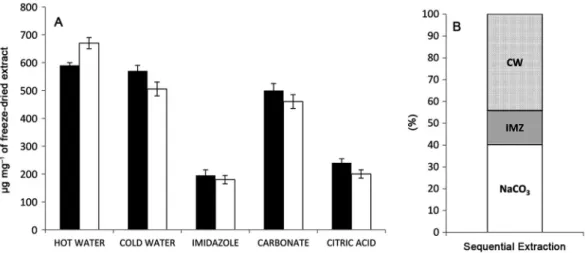
Koch and Pein (1985) have defended the propo-sition that the esterification of galacturonic acid could inhibit the formation of the chromophore furfural de-rivative detected at 450 nm in the xylenol method and thus could sub-estimate galacturonic acid. In order to cleave such possible ester-linkages, saponification of the AIR was carried out prior to the colorimetric assays. A 6 % increase only was observed for the uronic acid con-tent after saponification (from 80 µg mg–1 to 85 µg mg–1) which is within the coefficient of variation linked to the measurements (Figure 1). Either the xylenol method is not influenced by the esterified galacturonic acid resi-dues or these resiresi-dues are not considerably methylated or esterified with other sugars. Alkali treatment with NaOH at high concentrations (1 M and 4 M) was used to yield the fractions rich in hemicelluloses and the cel-lulosic residue (Oechslin et al., 2003). The saponification with 0.1 M NaOH used herein was not enough to cause degradation of hemicelluloses and, thus, the content of total neutral sugars after saponification (90 µg mg–1) roughly equals the non-hydrolysed sample (80 µg mg–1). The water soluble pectin, imidazole soluble pectin and sodium carbonate soluble pectin were respectively 44 %, 16 % and 40 % of the AIR (based on the concen-trations of µg GalA per mg freeze-dried extract) (Figure 2B). Water extracts the pectin polysaccharides loosely attached to the cell wall material, since this condition preserves covalent bonds, and b-elimination does not oc-cur (Basanta et al., 2012). Extraction with hot water was shown to be a more efficient procedure for removing these pectic polysaccharides than cold water (670 mg g–1 AIR vs 505 mg g–1 AIR) (Figure 2A).
The use of imidazole, a strong chelating agent, meant a further 15 % of pectic material could be ob-tained, presumably originating from dimers of homoga-lacturonan chains mediated by calcium ions. The GalA residues can bind to calcium ions allowing the pectic polysaccharide chains to assemble by calcium bridges (Ferreira et al., 2006). Thus, isolated homogalacturo-nans were found cross-linked with calcium ions in the cell junctions (M'sakni et al., 2006). Carbonate soluble pectin, assumed to contain pectic polysaccharides that are covalently bound, via ester-bond, to other cell wall polysaccharides, represents 40 % of total pectic poly-saccharides (Figure 2B). This evidence may suggest the presence of alkali-labile ester bonds between pectic sub-stances and other polysaccharides from the AIR. The
binding of the pectic polysaccharide to cellulose was observed in the cellulosic residue of ripe apples, sup-ported by the neutral sugar distribution and the uronic acid content (Oechslin et al., 2003).
Treatment of pectin with citric acid leads to low-er content of uronic acids (200 mg g–1 AIR, Figure 2A), which is in accordance with other reports showing that the pectin with citric acid treatment contained lower ga-lacturonic acid and higher neutral sugars (Kurita et al., 2008).
Uronic acids, which are attributed to galacturonic acid (GalA), were the major sugars in all extracts of the
BE apple, representing more than 90 mol % for the
ex-tracts obtained with sequential extraction (water, imid-azole, and sodium carbonate) (Table 1). Although there are no studies showing that glucose (Glc) is part of the pectin structure, Glc was found in the pectin extracted in the presence of citric acid (8 mol %). This Glc content might be from non-pectic polysaccharides that were also extracted. Zhang et al. (2013) have reported Glc as the second most abundant component of apple pectin (28.7 mol %), which was ascribed to remnant soluble sugar that was not completely removed during the processing of pectin. However, Nunes et al. (2012) have shown the occurrence of GalA substituted by Glc, and Glc-b-(1-4)– Glc as structural features occurring in pectic polysac-charides, which could account for the Glc found in the composition of pectic material.
The presence of Fuc (4.3 mol %) in apple pectin has been reported (Zhang et al., 2013); however this
monosaccharide was not detected in the BE apple
ex-tracts analyzed herein. Vestigial amount of Fuc and Xyl were reported for the pectin extracted from Yuza pom-ace (Citrus junos) by using combined physical and enzy-matic treatment (Lim et al., 2012).
The unpeeled BE apple extract obtained with cold water contained 94 mol % of GalA. This extract con-tained minor amounts of arabinose (Ara, 2 mol %) and
Figure 2 − Total neutral sugar () content and uronic acid () content of the extracts from unpeeled BE (Bravo de Esmolfe) apple (A) and relative amount of galacturonic acid in the sequential extraction fractions (B). Data represents means with standard deviation bars.
Table 1 – Sugar composition of the pectic polysaccharide extracts from unpeeled BE (Bravo de Esmolfe) apple (Rha, rhamnose; Fuc, fucose; Ara, arabinose; Xyl, xylose; Man, mannose; Gal, galactose; Glc, glucose; GalA, galacturonic acid).
Sugars (mol %)
Total (mg g–1) Rha Fuc Ara Xyl Man Gal Glc GalA
Cold
water 1 0 2 1 0 2 0 94 862
Imidazole 1 0 4 1 0 2 1 91 568
Carbonate 1 0 5 1 0 2 1 90 820
Citric acid 1 0 6 3 0 11 8 71 706
galactose (Gal, 2 mol %). The relative higher proportion of Ara was found for the imidazole (4 mol %) and so-dium carbonate (5 mol %) fractions (Table 1). The lower relative content of GalA (71 mol %) and the correspond-ing higher relative content of neutral sugars, mainly Gal (11 mol %) and Ara (6 mol %), were found for the citric acid fraction. This evidence corroborates the suggestion that citric acid induces the liberation of Gal, in particu-lar from hairy region of pectin, as previously reported by Kurita et al. (2008).
Molar ratios from the sugar composition of the BE apple pectic polysaccharides
Table 2 shows the molar ratios obtained for each extract, in order to give further insights into the struc-ture of BE apple pectin. This heteropolysaccharide is divided into three or four principal domains, the HG, the RG-I, the RG-II and/or XG. HG is a linear homo-polymer of a-1,4-linked-D-GalA. This homopolymer is
and Mohnen, 2009; Harholt et al., 2010). The propor-tions among HG, XG, RG-I, and RG-II are variable, but typically HG is the most abundant polysaccharide, con-stituting about 65 % of the pectin, while RG-I consti-tutes 20 to 35 %. XG and RG-II are minor components, each constituting less than 10 % (Harholt et al., 2010). In fact, the very high GalA/Rha molar ratios (Table 2) suggest that HG is by far the most abundant polysac-charide.
As the molar ratio of Rha to GalA is indicative of the degree of branching, it is predictable that pectin treated with citric acid, showing the lowest GalA/Rha ratio (71), is more branched as was already inferred by the higher content of Gal and Ara observed in this ex-tract, and is thus in accordance with Kurita et al. (2008). Neutral sugars such as Ara and Gal are found in side chains attached to Rha residues forming hairy blocks of RG-I while Fuc may be present in the side chains of RG-II. From the molar ratio (Ara + Gal) / Rha the pres-ence of hairy regions of pectin, in particular RG-I, can be inferred. Table 2 reveals that the (Ara + Gal)/Rha ratio of pectic polymers increased from 4 to 7 for the sequen-tially extracted AIR. This result indicates that the less-substituted RG are extracted first, in agreement with previous reports, which have suggested that a higher substitution in RG-I domains contributes to pectin an-choring in the cell wall matrix (Pena and Carpita, 2004; Vincken et al., 2003).
Pectic polysaccharides extracted in the presence of citric acid showed the highest (Ara + Gal)/Rha ratio (17), confirming that the pectin treated with this acid contains more substituted polymers, especially RG-I, as previously reported (Kurita et al., 2008). XG is the fourth structural unit of pectin, which was recently presumed to be present in modified hairy regions of apple pectin (Arnous and Meyer, 2008). The relatively higher Xyl/ GalA ratio found for the citric acid extract (1:24) dem-onstrates that the XG domain presumably occurs in the pectic material of the unpeeled BE apple.
Conclusion
A ratio of approximately 1: 2 was found between acidic and neutral sugars for the AIR after the additional hydrolysis step, confirming that pre-hydrolysis of AIR is required prior to the application of colorimetric
meth-ods. Extraction with hot water was more efficient in re-moving the pectin polysaccharides loosely attached to the cell wall material than cold water.
References
Arnous, A.; Meyer, A.S. 2008. Comparison of methods for compositional characterization of grape (Vitis vinifera L.) and apple (Malus domestica) skins. Food and Bioproducts Processing 86: 79-86.
Basanta, M.F.; Ponce, N.M.A.; Rojas, A.M.; Stortz, C.A. 2012. Effect of extraction time and temperature on the characteristics of loosely bound pectins from Japanese plum. Carbohydrate Polymers 89: 230-235.
Billy, L.; Mehinagic, E.; Royer, G.; Renard, C.M.G.C.; Arvisenet, G.; Prost, C.; Jourjon, F. 2008. Relationship between texture and pectin composition of two apple cultivars during storage. Postharvest Biology and Technology 47: 315-324.
Blumenkr, N.; Asboehan, G. 1973. New method for quantitative-determination of uronic acids. Analytical Biochemistry 54: 484-489.
Brown, L.; Rosner, B.; Willett, W.W.; Sacks, F.M. 1999. Cholesterol-lowering effects of dietary fiber: a meta-analysis. American Journal of Clinical Nutrition 69: 30-42.
Caffall, K.H.; Mohnen, D. 2009. The structure, function, and biosynthesis of plant cell wall pectic polysaccharides. Carbohydrate Research 344: 1879-1900.
Coimbra, M.A.; Waldron, K.W.; Delgadillo, I.; Selvendran, R.R. 1996. Effect of processing on cell wall polysaccharides of green table olives. Journal of Agricultural and Food Chemistry 44: 2394-2401.
Dalonso, N.; Petkowicz, C.L.D. 2012. Guarana powder polysaccharides: characterisation and evaluation of the antioxidant activity of a pectic fraction. Food Chemistry 134: 1804-1812.
Dubois, M.; Gilles, K.A.; Hamilton, J.K.; Rebers, P.A.; Smith, F. 1956. Colorimetric method for determination of sugars and related substances. Analytical Chemistry 28: 350-356.
Feliciano, R.P.; Antunes, C.; Ramos, A.; Serra, A.T.; Figueira, M.E.; Duarte, C.M.M.; de Carvalho, A.; Bronze, M.R. 2010. Characterization of traditional and exotic apple varieties from Portugal. Part 1. Nutritional, phytochemical and sensory evaluation. Journal of Functional Foods 2: 35-45.
Ferreira, J.A.; Mafra, I.; Soares, M.R.; Evtuguin, D.V.; Coimbra, M.A. 2006. Dimeric calcium complexes of arabinan-rich pectic polysaccharides from Olea europaea L. cell walls. Carbohydrate Polymers 65: 535-543.
Gulfi, M.; Arrigoni, E.; Amado, R. 2006. The chemical characteristics of apple pectin influence its fermentability in vitro. Lwt-Food Science and Technology 39: 1001-1004. Harholt, J.; Suttangkakul, A.; Scheller, H.V. 2010. Biosynthesis of
pectin. Plant Physiology 153: 384-395.
Imprensa Nacional Casa da Moeda [INCM]. 1994. Main characteristics of maçã-bravo de Esmolfe. Diário da República, p. 1498. (in Portuguese)
Jenkins, D.J.A.; Jenkins, A.L. 1995. Nutrition principles and diabetes: a role for lente carbohydrate. Diabetes Care 18: 1491-1498.
Table 2 – Molar ratios for the pectic polysaccharide extracts from unpeeled BE (Bravo de Esmolfe) apple (Rha, rhamnose; Ara, arabinose; Xyl, xylose; Gal, galactose; GalA, galacturonic acid).
Molar Ratio
Xyl/GalA GalA/Rha (Ara + Gal)/ Rha
Cold water 1/94 94 4
Imidazole 1/91 91 6
Carbonate 1/90 90 7
Khondkar, D.; Tester, R.F.; Karkalas, J. 2009. Effect of cross-linking on the resistance to enzymatic hydrolysis of waxy maize starch and low-methoxy pectin. Food Hydrocolloids 23: 387-393. Koch, H.; Pein, J. 1985. Condensation reactions between phenol,
formaldehyde and 5-hydroxymethylfurfural, formed as intermediate in the acid catalyzed dehydratation of starchy products. Polymer Bulletin 13: 525-532.
Kurita, O.; Fujiwara, T.; Yamazaki, E. 2008. Characterization of the pectin extracted from citrus peel in the presence of citric acid. Carbohydrate Polymers 74: 725-730.
Li, Y.H.; Liu, L.; Niu, Y.B.; Feng, J.; Sun, Y.; Kong, X.H.; Chen, Y.C.; Chen, X.Y.; Gan, H.Q.; Cao, S.S.; Mei, Q.B. 2012. Modified apple polysaccharide prevents against tumorigenesis in a mouse model of colitis-associated colon cancer: role of galectin-3 and apoptosis in cancer prevention. European Journal of Nutrition 51: 107-117.
Lim, J.; Yoo, J.; Ko, S.; Lee, S. 2012. Extraction and characterization of pectin from Yuza (Citrus junos) pomace: a comparison of conventional-chemical and combined physical-enzymatic extractions. Food Hydrocolloids 29: 160-165.
M'sakni, N.H.; Majdoub, H.; Roudesli, S.; Picton, L.; Le Cerf, D.; Rihouey, C.; Morvan, C. 2006. Composition, structure and solution properties of polysaccharides extracted from leaves of Mesembryanthenum crystallinum. European Polymer Journal 42: 786-795.
Mafra, I.; Lanza, B.; Reis, A.; Marsilio, V.; Campestre, C.; De Angelis, M.; Coimbra, M.A. 2001. Effect of ripening on texture, microstructure and cell wall polysaccharide composition of olive fruit (Olea europaea). Physiologia Plantarum 111: 439-447.
Maxwell, E.G.; Belshaw, N.J.; Waldron, K.W.; Morris, V.J. 2012. Pectin: an emerging new bioactive food polysaccharide. Trends in Food Science & Technology 24: 64-73.
Mohnen, D. 2008. Pectin structure and biosynthesis. Current Opinion in Plant Biology 11: 266-277.
Moldao-Martins, M.; Beirao-da-Costa, S.M.; Beirao-da-Costa, M.L. 2003. The effects of edible coatings on postharvest quality of the 'Bravo de Esmolfe' apple. European Food Research and Technology 217: 325-328.
Nunes, C.; Silva, L.; Fernandes, A.P.; Guine, R.P.F.; Domingues, M.R.M.; Coimbra, M.A. 2012. Occurrence of cellobiose residues directly linked to galacturonic acid in pectic polysaccharides. Carbohydrate Polymers 87: 620-626.
Oechslin, R.; Lutz, M.V.; Amado, R. 2003. Pectic substances isolated from apple cellulosic residue: structural characterisation of a new type of rhamnogalacturonan I. Carbohydrate Polymers 51: 301-310.
Pena, M.J.; Carpita, N.C. 2004. Loss of highly branched arabinans and debranching of rhamnogalacturonan. I. Accompany loss of firm texture and cell separation during prolonged storage of apple. Plant Physiology 135: 1305-1313.
Reis, S.F.A.R.; Rocha, S.M.; Barros, A.S.; Delgadillo, I.; Coimbra, M.A. 2009. Establishment of the volatile profile of 'Bravo de Esmolfe' apple variety and identification of varietal markers. Food Chemistry 113: 513-521.
Selvendran, R.R.; O’Neill, M.A. 1987. Isolation and analysis of cell-walls from plant-material. Methods of Biochemical Analysis 32: 25-153.
Serra, A.T.; Rocha, J.; Sepodes, B.; Matias, A.A.; Feliciano, R.P.; de Carvalho, A.; Bronze, M.R.; Duarte, C.M.M.; Figueira, M.E. 2012. Evaluation of cardiovascular protective effect of different apple varieties: correlation of response with composition. Food Chemistry 135: 2378-2386.
Umar, S.; Morris, A.P.; Kourouma, F.; Sellin, J.H. 2003. Dietary pectin and calcium inhibit colonic proliferation in vivo by differing mechanisms. Cell Proliferation 36: 361-375.
Vincken, J.P.; Schols, H.A.; Oomen, R.J.F.J.; McCann, M.C.; Ulvskov, P.; Voragen, A.G.J.; Visser, R.G.F. 2003. If homogalacturonan were a side chain of rhamnogalacturonan. I. Implications for cell wall architecture. Plant Physiology 132: 1781-1789.
Voragen, A.G.J.; Coenen, G.J.; Verhoef, R.P.; Schols, H.A. 2009. Pectin, a versatile polysaccharide present in plant cell walls. Structural Chemistry 20: 263-275.
Walter, W.M.; Fleming, H.P.; McFeeters, R.F. 1993. Base-mediated firmness retention of sweet-potato products. Journal of Food Science 58: 813-816.
Yamazaki, E.; Kurita, O. 2007. Extraction and characterization of the pectic substances from Japanese pepper (Zanthoxylum piperitum DC.) fruit. International Journal of Food Properties 10: 505-513.
Zhang, L.F.; Ye, X.Q.; Ding, T.; Sun, X.Y.; Xu, Y.T.; Liu, D.H. 2013. Ultrasound effects on the degradation kinetics, structure and rheological properties of apple pectin. Ultrasonics Sonochemistry 20: 222-231.