FREE THEMES
1 Universidade Estadual do Oeste do Paraná. Av. Tarquínio Joslin dos Santos 1300, Polo Universitário. 85870-650 Foz do Iguaçu PR Brasil.
Challenges in the coordination of children’s healthcare
Abstract This is a qualitative survey with a her-meneutic-dialectic frame of reference, designed to identify how parents and caregivers see the at-tribute ‘coordination’ in children’s healthcare, in terms of resolving problems in children’s health. The interview was held with 16 people responsible for care of children under one year of age, served in Emergency Care Units of a municipality in the south of Brazil, in 2010. With the thematic anal-ysis, the central category was identified as: Effects and results of fragile coordination in Children’s Primary Health Care, with the following themes: Divergences between different health units in the organization of care; functional barriers and de-lays obstructing access to technologies; absence of effective communication; absence of medical transport; need for healthcare on an individual basis; and coordination involving management of healthcare. It was concluded that the absence of coordination results in the absence of a solu-tion-based approach in healthcare for children un-der one year old, showing gaps in the organization of the services and in health management, since communication, access to technologies, referral and counter-referral systems, and secure transport become essential for organizing primary care ser-vices and offering fully rounded care to the child.
Key words Primary Health Care, Care of
chil-dren, Health services, Pediatric nursing
Rosane Meire Munhak da Silva 1 Reinaldo Antônio da Silva Sobrinho 1 Eliane Tatsch Neves 1
S
il
v
a RMM
Introduction
Social transformations have led to high indices of infant mortality all over the world, and initial attempts by those in government have not been fully efficacious in changing this scenario. Con-crete changes in infant mortality indices have only been perceived when the situation of chil-dren has been understood and investments made in wide-ranging public policies, which among
other factors involve socio-economic variables1.
Although there has been a significant reduc-tion in infant mortality in Brazil – to 16 deaths per thousand live births in 2011, thus reaching one of the targets of the Millennium
Develop-ment Goals (MDGs)2, great problems have
re-mained, with high mortality in the neonatal pe-riod, caused by perinatal complications and pre-mature birth – and also the possibility that sen-sitive primary health care actions could reduce
these deaths by 60%1,3,4. Further factors adverse
to children’s health have been avoidable illnesses, and avoidable hospital admissions, which show the fragility of the primary healthcare services in
developing countries, such as Brazil5.
The concept of primary healthcare refers to a group of assistance, equitably distributed to the population, aiming to resolve common problems by the supply of preventive, curative, rehabilitat-ing or palliative actions. To put them into effect, it is essential that a group of attributes should be present, in a manner that is mutually coordinat-ed: access, long-term care, integration and
coor-dination6.
The attribute of coordination, which is the context of this study, seeks to ensure continuity of healthcare, by recognizing problems that need to be accompanied in other parts of the
health-care network3. Such coordination makes
avail-able information on problems that people are suffering from, and also the technologies related
to the care that they demand6,7. For this,
effec-tive communication mechanisms need to exist
between the various points of care3,6,7;
associat-ed with access to the services that are necessary for resolving health problems, and the principle of integral care as an organizer of the healthcare system, including elements that are essential for care, namely: a) a faculty for movement and ad-aptation, construction of care as it is lived; b) interaction, establishment of relationships; c) awareness of and respect for the other, construc-tion and reconstrucconstruc-tion of identity based on the family and through social interactions; d) plas-ticity, the ability and capability to transform; e) a
plan – the factor that creates care; f) desire, caus-ing plans to emerge from actions by free choice, increasing the interest and need for health prac-tices; g) temporality, an aspect of being cared for; h) non-causality, training in humanity through cognitive cause-effect aspects; and i) responsibil-ity, self-comprehension and formative
construc-tion of the human being8.
Guided by these considerations, the aim of this article is to identify the attribute ‘coordina-tion’ in primary healthcare, in the perception of parents/caregivers, for resolution of health prob-lems in children less than one year old, attended in Emergency Care Units (Unidades de Pronto Atendimento or UPAs), in a municipality of the South of Brazil.
Method
This is a survey with a qualitative approach based on the hermeneutic-dialectic methodology as reference frame. The term hermeneutics refers to interpretation and significance of concepts, the comprehensive understanding stimulated by
the practical interest of social groups9,10: a solid
experience of interactions. And it is not limited to a traditional logical repetition of thinking, but seeks to expand thinking through
comprehen-sion and interpretation11.
e C
ole
tiv
a,
20(4):1217-1224,
2015
which were in the urban area of the municipality. For this phase, three collection techniques were used: interviews in the home, ‘spoken maps’ and semi-structured interviews.
Interviews were closed as soon as the data had generated a construct, providing enough ar-guments for logical comprehension of the events,
responding to the objective of the study10.
The results were structured by thematic anal-ysis built up in a horizontal map, and, after re-peated readings, the significant structures and the
categorization by subject were arrived at12. The
analysis was anchored on the reference points relating to the attribute coordination in primary
healthcare6, and elements of integrated care8.
This study was approved by the Research Ethics Committee of the State University of the West of Paraná State (Universidade Estadual do Oeste do Paraná), in accordance with Resolution
466/201213, of the Brazilian National Council for
Health and Human Research. The participants signed the Informed Consent Form. Fragments of interviews presented were identified in the text by the letter S (subject), followed by the ordinal number 1 to 16, ensuring anonymity for the par-ticipants.
Results
The central thematic category was identified as: Effects and results of fragile coordination in children’s primary healthcare, incorporating the following subjects: Differences in organization of care between health units; functional barriers and delay impeding access to technologies for healthcare; absence of effective communication; absence of medical transport; the aim to achieve healthcare for the individual; and coordination involving management of healthcare.
Effects and results of fragile coordination in children’s primary healthcare
One of the fragilities in the coordination of primary healthcare was understood to be the en-try barrier to these services, indicated by the sub-jects, represented by the difficulties in schedul-ing medical appointments, because each service organizes its daily dynamic according to its own needs, so that differences of organization emerge between health units, and care protocols are not standardized.
In the health post of our district of the city it’s difficult to get a vacancy. [...] the doctor is on
hol-iday. [...] there are two areas [Unidade de Saúde da Família (USF) – Family Health Unit], [...] in the other area the doctor can’t see us. So we always have to be looking for another health center or go to the PAC [Posto de Atendimento Continuado – Continued Healthcare Post]. In the health center of the closest adjoining district, we go on Monday morning and make an appointment for sometime in the whole week [...] (S6).
We have to go in the small hours. We have to wait in line, around just after five o’clock in the morning – if you arrive later, the tickets run out and you don’t get one [...] you have to be in line every day, you never get the appointment on the same day, it’s always set for the next day [...] (S10).
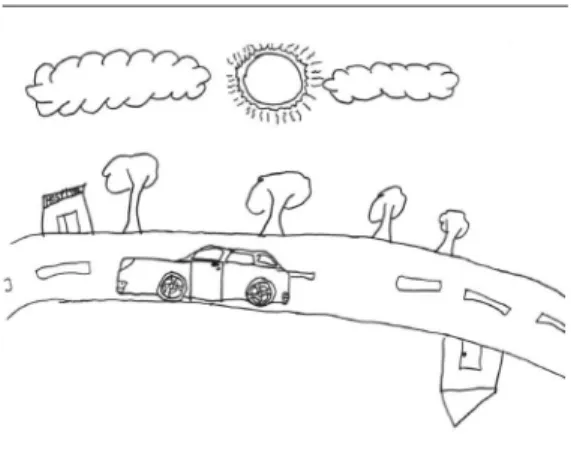
Services that have Primary Healthcare System (APS) as their healthcare coordinators have the capacity to identify and solve problems. They are considered as preferential points of entry to the health system and as entities organizing care, to ensure that families are provided with integrat-ed care, and real solutions. However, as a reality taking place in fact, the Emergency Care Units (UPAs) were considered to be priority when par-ents/caregivers seek care for children, illustrated in Figure 1. The complicated flows and itineraries for families, who have to remain in interminable waiting lines, and the hardly attentive care given by unqualified health professionals, shows the non-existence of coordination and, consequent-ly, the lack of capacity to provide solutions in children’s healthcare.
[...] if I get [an appointment ticket] for three of my children, I have to take two people with me, because they [the receptionists] don’t allow me to take one ticket for the three. [...] or I have to go to
S
il
v
a RMM
the end of the line. [...] this means I suffer, because I have five children [...] (S12).
When it comes to the return visits, some of the services organize themselves so that families do not have to face the whole process over again, while others impose obstacles.
[...] the doctor herself leaves the appointment already scheduled. [...] we arrive with the test re-sults and we are attended immediately [...] (S4).
You have to do it all over again [...]. The whole of the same rush and bother, to reschedule it all for the second time (S6).
After medical consultations have been sched-uled, the waiting time before being attended was also unequal between the units.
There are times that it takes one hour, two hours, it depends a lot (S8).
In the health post of the next-door district [...] it was really quick, didn’t take more than 15 min-utes [...] (S10).
The data show that the access to health ser-vices involves abandonment of barriers, princi-pally functional barriers, which are related to the way in which the services are organized: these related to the attribute coordination. In the reality taking place in fact, one sees functional barriers and delays impeding the access to the technolo-gies for healthcare.
[...] the pediatrician ordered an x-ray, I had to go and get it authorized at the center and wait, I think it was five or six days. Then afterwards I had to set the appointment here at hospital X and wait there, too. After doing it, I had to wait to get the results. [...] I think it needs to be faster, not to have all this delay, all this coming and going [...] (S10).
Health services that aim to provide the
at-tribute coordination over their whole extension
need to include in their practices the use of tech-nologies, categorized as hard, soft-hard or soft, and in view of the need for hard technologies, as a way of contributing to children’s healthcare, these services should be functional to ensure users get directed to them, through the use of pre-established protocols.
At some moments the functional obstacles do not prevent access, but can make it more difficult to use the group of services and technologies that are necessary, due to changes in the dynamics of the services without the community being in-formed.
[...] I went and scheduled the ophthalmologist, I waited a year, my ticket was finally issued and then he [the doctor] simply said: ‘Oh, you have to have a referral’. [...] then in the health post [...] they [the receptionists] said come back tomorrow
morning, we’ll see if we can fix it for you [...]. So I said: ‘How do you manage a consultation for me without my having a referral?’ They said [the re-ceptionists]: ‘Previously one didn’t need one, now it’s only possible with a referral [...]’ (S13).
The slowness of services compromises access to capacity to provide actual solutions in health-care. Services that have an effective coordina-tion, orienting care along all of their points and throughout the life of the community, recognize the problems of families and articulate the net-works of support and attention so that flows take place quickly, without prejudicing the care. This was perceived by the caregivers.
Actually getting an appointment with a spe-cialist is a war: my cousin has been waiting in line for four years to get an appointment with a psychi-atrist, and hasn’t yet succeeded [...] (S6).
[...] tomography, we know it’s expensive [...] it’s unacceptable to have to do it only a year from now. Two years to do an exam like that, I think that’s offensive [...] (S4).
Faced with the slowness of services, families find the only viable solution is to carry out pri-vately-paid tests and consultations, although often they do not have the financial situation for this.
[...] the tests – I didn’t do them through the
health post, because if you wait you’ll have 10 chil-dren before they actually happen. It just takes too long, so we paid for everything [...] (S3).
To achieve an integrated and solution-pro-viding approach, communication between the user and the health team is essential. Thus, this communication should exist between communi-ty services and the levels of healthcare, including in relation to the families that use the services. In this study deficiencies were found in this aspect, since the theme itself has doubts relating to the functioning of the services when transmitting the information, thus giving clear evidence of the absence of effective communication.
[...] I asked ‘Is there a doctor?’ and she [the
health agent] said: “You know something? I don’t know – I’ll call you’. That call never came [...]. Now I asked when the doctor would come back [...], and so far no-one has called me [...]. I have to go there, ask, get an answer, figure it out and organize it my-self [...] (S6).
There was also evidence of deficiencies in in-formation on the workings of Basic Healthcare Units (Unidades Básicas de Saúde – UBS), causing blockages in children’s healthcare.
e C
ole
tiv
a,
20(4):1217-1224,
2015
healthcare unit, [...] she [receptionist] said: ‘They didn’t say anything about its arriving directly by internet? [...]’ (S12).
As well as the acute conditions referred to above, there was a lack of communication and information relating to actions working in favor of health and continuing care.
[...] I didn’t know that I had to file the request for tubal sterilization at the beginning [of the pregnancy] [...], I thought I could do that in the final days. The doctor never told me that [...] [care-giver, mother of five children, who would like to have had a tubal ligation] (S12).
Also, ensuring full integral care for families and their components requires a commitment of the health services to provide efficient and con-tinuous services, which may go beyond the Pri-mary Healthcare service. Healthcare takes place not only inside health units, but at moments of referral to specialized consultants or for tests. For this, it is essential that the services should have adequate transport that guarantees people full care and safety. According to the caregivers, the presence of medical transport that we refer to was not provided.
[...] yesterday a mother arrived [at a Basic
Healthcare Unit] with a child who I think, had fallen off a bicycle, [...] they told the mother to take him to the PAC [Posto de Atendimento Continua-do – Continued Healthcare Post] or to the small health post in the neighboring district. She [the mother] had no way to go there. She was desperate to get there and had to find some way to do so. The child was bleeding, and she had a really small baby on her arm – and even so … (S16).
Although they do not carry out the necessary care for the child, innumerable services do not take responsibility for this, and abandon fam-ilies when their children are ill, asking them to seek care in other services, without any support through the referral system, so that people are left to seek healthcare on their own.
They told me to go to a PAC, but they didn’t give me any referral, ever. (S15)
Looking at this in terms of the attribute co-ordination, even being prevented from providing medical consultations, the health services could still accept and take responsibility for their users. In situations where there are no alternatives oth-er than a medical consultation, they could refoth-er their users to urgent and emergency services, through a system of reference and counter-refer-ence, and secure transport. This conception, in counterpart to the previous one, emerged timidly in the interviews.
[...] they [health professionals] give you a
piece of paper, a referral, and when we arrive at the PAC, it has already received the advice that we had been there [at the Basic Healthcare Unit] and that there was no doctor [...] (S2).
It is understood that an organized health ser-vice, that aims to provide longitudinal and con-tinuous care, does not involve only the partici-pation of the person giving care, but of all those who think and practice healthcare. This compre-hension of amplified health emerged among the spoken responses, because when pointing to the need for health professionals to perceive the chil-dren as human beings, the contribution of those who plan and organize the policies and plans of action in health was also brought into evidence. It emerged that, for Primary Healthcare to be the coordinating entity of healthcare, it is necessary to recognize the health needs in other health services, and integrate the actions carried out in those ser-vices to the care for users who are subscribed to the healthcare unit. Thus, it becomes necessary to understand that the coordination involves man-agement of healthcare, so that there can be an at-titude and practice of providing solutions in chil-dren’s healthcare in Primary Healthcare.
[...] when a mother comes into a health unit, everyone should remember that there is a child there, a life, a human being that needs help, but my complaint is more directed to the prefecture and not to the care given [slight smile] (S15).
Discussion
The families in this reality present themselves as dissatisfied with the care received and, because it does succeed in providing solutions, they seek care in urgency and emergency services, prevent-ing care from beprevent-ing integrated and longitudi-nal, and contributing to the reductionist model focused on medicalization and the figure of the doctor.
Peoples’ satisfaction and happiness represent the way in which patients expect health profes-sionals to perform in accordance with their ca-pacities and the way in which they make tech-nologies available for the purpose of producing
health solutions14. However, the great difficulty
taking place on a day-to-day basis is the trans-formation of the present hegemonic centralized health model into the biological approach which will result from the conversion of work practic-es and participation of the profpractic-essionals in the
S
il
v
a RMM
In the health system one sees various differ-ent health units providing divergdiffer-ent results, al-though they have the same quantity of human and financial resources. The result is defined in accordance with how these resources are
orga-nized and deployed7,15. In this study divergences
were found in aspects including: scheduling of medical consultations and return visits; itiner-aries for simple and complex medical tests; and waiting time for consultations.
Families need to be accepted and welcomed so that they do not feel unsupported when their children get ill. But the way in which techno-logical arrangements have shaped the reality of the health services has tended to dispense with the context of a more wide-ranging clinical ap-proach, separating the moment of actual giving of care to the child, with social as well as other
consequences14.
Welcoming and acceptance is the key point for organizing the points of entry to the health services, since it can integrate spontaneous mands and program actions, based on social
de-terminants and technological arrangements7,16,
without allowing the technological factors to
be-come the central axis of the care given14,16,17.
The proposal to which we refer involves the organization of the health system into care networks, in which its services are coordinated by the Primary Healthcare units, in which the Healthcare Networks (Redes de Atenção a Saúde – RASs) are built on an interdisciplinary mod-el, articulating the relationships between popu-lations distributed by risks, healthcare focus or health actions, defined by the integrated view of health, by demographic or epidemiological situa-tions, and by social determinants present in each
society at a given time17,18. Under this situation,
it might be possible for families using the health services, organized by the RASs, to find happi-ness, and an attitude and practice of solutions.
Based on the elements of integrated health-care, such a situation would promise plasticity, that is to say, transformation in the health orga-nizations and work processes, and also provide the ‘otherness’, interaction and movement in
the construction of children’s care8. Rebuilding
health care requires thinking – following its hav-ing been de-characterized by fragmented and
individualized actions over the course of time14.
In this respect, receptiveness by the health-care service will be understood as an instrument for taking care, contributing to reorganization of work processes and expansion of the capaci-ty and intention in favor of providing real
solu-tions19. Added to this receptiveness is the concept
of complete care16 – providing a foundation for
consolidating efforts toward practicable equita-ble actions by the health services.
This survey has found that coordination of the Primary Healthcare Services (APS) is fragile, and this has effects and consequences in terms of the capacity to provide solutions in children’s health-care – demonstrated by innumerable functional barriers that prevent families’ access to the health services. These services also include the arsenal of technologies and, according to literature, technol-ogies are important coadjuvant factors for
provid-ing solutions in primary healthcare19. In this study,
the technologies highlighted were: medical tests of low and high complexity, specialized consulta-tions, absence of acceptance for care, and the tech-nical and scientific knowledge of the professional.
The availability only of hard technologies20
prevents families from achieving solutions to the children’s health problems, since if the med-ical professional, for example, succeeds in tak-ing the appropriate clinical approach, the other members of the interdisciplinary team could welcome the patient; listen; make referrals, and many problems would be resolved by the Prima-ry Healthcare system.
The shortage of coordination resulted in absence of a culture of solutions, and caused families, although lacking financial resources, to take on the burden of seeking attention from independent supplementary health services
providing the technology that they needed20.
For this purpose, the focus for attention should be the family and the community, based on a central concept of promoting interrelationship
between the services3,6,7,16, including the social
determinants, which in this case means the social
condition for living or working17. For
interrela-tionship to be caused to work, communication is necessary, and it should be between profession-als, sectors and users.
Communication is not restricted to trans-mitting and receiving messages; it involves people living, working and getting on together, relationship, connection and a longitudinal
ap-proach6,16,21. Its absence, between professionals,
services and families, showed that the Primary Healthcare services in this reality are fragile in relation to coordination, as well as deficient in the longitudinal aspect – which requires calls for a link to the population, in an environment of
trust over time22.
e C
ole
tiv
a,
20(4):1217-1224,
2015
any culture and practice of providing solutions, the shortcomings in relation to coordination went beyond these concepts, because though faced with the need for referrals, safe public transport was not offered, and serious situations were described in the survey. The reports showed two factors that are essential for safety and
conti-nuity of care3 were seen to be absent:
communi-cation, and medical transport.
No less importantly, the lack of referrals and counter-referrals also showed the absence of articulation between the services, one of the functions of coordination that tends to erode the
capacity and achievability of solutions17,18. Due
to the inefficiency of the services related to this group of subjects, families had to seek healthcare individually in urgent and emergency services in an attempt to solve their problems, generating a colossal demand for those services and dissatis-faction with the attention received. According
to the literature6, medical transport systems and
processes of referral and counter-referral require planning, movement and interaction between the public health services that exist.
Finally, the subject of management in health-care drew attention to the strong approximation between thinking about and practicing health through innovative practices, work policies and
collective care23. It is not enough that there are
professionals engaged in individual actions seek-ing technical success unless there is desire, a plan, plasticity, movement and interaction of health managers, nor is it sufficient that there should be significant models for healthcare without plas-ticity, movement, otherness, interaction,
tempo-rality, responsibility and non-causality in care8,14.
The concrete nature of these elements in thinking about and in the practice of health gives an idea of the potential for practical success in health actions – indication that it is possible to abandon the biomedical model, achieve coordi-nation in Primary Healthcare, and with it success of services in a solutions-oriented culture in
chil-dren’s healthcare14.
Conclusion
The results of this survey show the fragility of coordination, at the present time, in Brazilian Primary Healthcare, which results in children’s healthcare, in the perception of parents and caregivers, not being centered on, nor achieving, solutions.
Coordination involves and includes articula-tion between health services and practices, with the aim of serving a diversity of objectives that are common to the community. Primary Health-care should be capable of including all Health-care that the user receives at various points of healthcare provision. Thus, communication is essential, as is also access to the technologies, systems of refer-ence and counter-referrefer-ence and safe transport, so as to organize the services in such a way that they do not leave families unsupported when their children become ill.
Thus the way forward that is suggested is: Implementation, consolidation and expansion of the Family Health Strategy (Estratégia Familiar de Saúde, or ESF), on the foundation of the RASs. This proposal emphasizes that Primary Health-care actions reduce the demand for urgent and emergency services, and at the same time lead to a wider concentration on, and capacity for, solu-tions in those services.
It is emphasized that this survey reports the perception of caregivers for children less than one year old in relation to healthcare of the child in the Primary Healthcare services. This could be a limiting aspect for comprehension of the complexity of the subject. The study should be broadened, and through triangulation of data a vision should be obtained from the same point of view from professionals and managers of the health services.
Collaborations
S
il
v
a RMM
Almeida PF, Giovanella L, Mendonça MHM, Esco-rel S. Desafios à coordenação dos cuidados em saúde: estratégias de integração entre níveis assistenciais em grandes centros urbanos. Cad Saude Publica 2010; 26(2):286-298.
Escorel S, Giovanella L, Mendonça MHM, Senna MC. O Programa de Saúde da Família e a construção de um novo modelo para a atenção básica no Brasil. Rev Pana-mericana de Salud Publica 2007; 21(2):164-176. Brasil. Ministério da Saúde (MS). Portaria nº 4.279 de 30 de dezembro de 2010. Institui as Redes de Atenção a Saúde (RAS). Diário Oficial da União 2010; 31 dez. Almeida PF, Fausto MCR, Giovanella L. Fortalecimen-to da atenção primária à saúde: estratégia para poten-cializar a coordenação dos cuidados. Rev Panamericana de Salud Publica 2011; 29(2):84-95.
Merhy EE. Gestão da produção do cuidado e clínica do corpo sem órgãos: novos componentes dos processos de produção do cuidado em saúde. [on-line]. 2007. [15 telas]. [acessado 2012 ago 24]. Disponível em: http:// www.uff.br/saudecoletiva/professores/merhy/artigos -25.pdf
Araújo TCCF. Comunicação em saúde: contribuições do enfoque observacional para pesquisa e atuação. Arq Bras Psicol 2009; 61(2):1-13.
Silva JM, Caldeira AP. Modelo assistencial e indicadores de qualidade da assistência: percepção dos profissionais da atenção primária à saúde. Cad Saude Publica 2010; 26(6):1187-1193.
Carácio FCC, Conterno LO, Oliveira MAC, Oliveira ACH, Marin MJS, Braccialli LAD. A experiência de uma instituição pública na formação o profissional de saúde para atuação em atenção primária. Cien Saude Colet 2014; 19(7):2133-2142.
Article submitted 03/07/2014 Approved 11/01/2014
Final version submitted 10/04/2014 16.
17.
18.
19.
20.
21.
22.
23.
References
Brasil. Ministério da Saúde (MS). Manual de vigilância do óbito infantil e fetal e do comitê de prevenção do óbito infantil e fetal. 2ª ed. Brasília: MS; 2009.
Fundo das Nações Unidas para a Infância (Unicef). Committing to child survival: a promise renewed. New York: Unicef; 2012.
Mendes EV. O cuidado das condições crônicas na atenção primária à saúde: o imperativo da consolidação da estra-tégia da saúde da família. Brasília: Organização Pan-A-mericana de Saúde (OPAS); 2012.
Santos HG, Andrade SM, Silva AMR, Mathias TAF, Ferrari LL, Mesas AE. Mortes infantis evitáveis por in-tervenções do Sistema Único de Saúde: comparação de duas coortes de nascimentos. Cien Saude Colet 2014; 19(3):907-916.
Oliveira BRG, Viera CS, Collet N, Lima RAG. Causas de hospitalização no SUS de crianças de zero a quatro anos no Brasil. Rev Bras Epidemiol 2010; 13(2):268-277. Starfield B. Atenção primária: equilíbrio entre necessi-dades de saúde, serviços e tecnologia. Brasília: Unesco, Ministério da Saúde (MS); 2002.
Mesquita Filho M, Luz BSR, Araújo CS. A Atenção Pri-mária à Saúde e seus atributos: a situação das crianças menores de dois anos segundo suas cuidadoras. Cien Saude Colet 2014; 19(7):2033-2046.
Ayres JRCM. Cuidado e reconstrução das práticas de Saúde. Interface (Botucatu) 2003/2004; 8(14):73-92. Ayres JRCM. Hermenêutica e humanização das prá-ticas de saúde. Cien Saude Colet 2005; 10(3):549-560. Streubert HJ, Carpenter DR. Phenomenology as me-thod. In: Streubert HJ, Carpenter DR, editors. Qua-litative research in nursing: Advancing the humanistic imperative. 5th ed. Lippincott: Willians & Wilkins; 2011. p. 72-95.
Gadamer H. Verdade e método: traços fundamentais de uma hermenêutica filosófica. 9ª ed. Petrópolis: Vozes; 2008.
Minayo MCS. O desafio do conhecimento. Pesquisa qua-litativa em saúde. 11ª ed. São Paulo, Rio de Janeiro: Hu-citec, Fiocruz; 2008.
Brasil. Ministério da Saúde (MS). Conselho Nacional de Saúde. Resolução nº 466, de 12 de dezembro de 2012. Diário Oficial da União 2013; 13 jun.
Ayres JRCM. Organização das Ações de Atenção à Saú-de: modelos e práticas. Saude Soc 2009; 18(Supl. 2):11-23.
Carvalho SR, Cunha GT. A gestão da atenção na saúde: elementos para se pensar a mudança da organização na saúde. In: Campos GWS, Minayo MCS, Akerman M, Junior MD, Carvalho YM, organizadores. Tratado de saúde coletiva. São Paulo, Rio de Janeiro: Hucitec, Fio-cruz; 2007. p. 837-868.
1.
2.
3.
4.
5.
6.
7.
8.
9.
10.
11.
12.
13.
14.