Leverage Web Analytics for Real Time
Website Browsing Recommendations
Claudio Sapateiro1, João Gomes2
1 School of Technology, Polytechnic of Setúbal, Setúbal,Portugal [email protected]
2 Business School, Polytechnic of Setúbal, Setúbal,Portugal [email protected]
Abstract. As a websites’ structure grow it is paramount to accommodate the alignment of user needs and experience with the overall websites’ purposes. Toward this requirement, the proposed website navigation recommendation system suggests to users, pages that might be of her interest based on past successful navigation patterns of overall site’s usage. Most of existing recommendation systems adopts traditionally one of the web mining branches. We take a different stance, on web mining usage, and alternatively considered the real time enactment of web analytic tools supported analysis given their current maturity and affordances. On this basis we provide a model, its implementation and evaluation for navigation based recommendations generation and delivery. The developed prototype adopted a SaaS orientation to promote the underlying functionalities integration within any website. Preliminary evaluation’s results seem to favor the validation of the present contribution rational.
Keywords: Web analytics, Recommendation systems, Web usage recommendation, Navigation recommendations, User experience.
1
Introduction
engines results ranking [3]. Particularly, Web usage mining, had encompassed the application of data mining techniques to aid navigation needs of webpages’ end-users [4]. Typical such analysis pursues usage patterns and fed some application domains as: personalization, recommendation (navigation oriented not content based) or adaptive interfaces e.g. [5][6].
This work focus on the web usage domain, in line with navigation oriented recommendations generation but departing from the more traditional approaches that rooted web mining. Typical web mining endeavours follows the conventional data mining workflow: collect data, pre-process it, apply the elected analysis method and produce and validate a model aiming for prediction and/or classification toward end goals such as personalization or recommendation. The current work may be seen more in line with the evolution of the earlier OLAP (On Line Analytical Processing) systems, a branch of Businesses Intelligence that also started to tackle, as an alternative perspective, the analysis of web related data e.g. [7]. Although integrated in some approaches e.g. [8], one do acknowledge and must put forward the divide of the two perspectives. While web mining had mainly aligned with DM methods, whereas OLAP mainly roots on a more descriptive statistics grounding. We argue that producing DM models rely on representative data featuring which typically requires an explicit offline process to accommodate the stages of their development and validation before coming actionable; further they are prone to regular revisions to accommodate website restructure endeavours, dynamic trends of usage and/or growth of website usage data. Nowadays, the OLAP analysis flavour had experience an evolution given the implantation and maturity of web analytics tools (WAT). Such tools allows to monitor website traffic data at a level that affords to readily identify design issues regarding structure, and usage behaviours. This work departs from the typical website develop-monitor-evaluate-redesign (DMER) cycle fed by current web analytics (WA) based analysis, by using WAT provided APIs to actually enact in real time customized on demand analysis’ results. The current proposal claim that we may provide some assistance to website browsing through recommendations based on other users successful navigation paths supported on data collected and aggregated by WAT, therefore proactively and up-to-date address possible navigation faults while redesign, if needed, would be reconsidered.
2
Background
2.1 Related Work
Traditionally, common applications of recommendation systems are toward e-commerce (product) recommendations or content based recommendation; supported on techniques such as association rules elicitation, clustering or collaborative filtering to list a few e.g. [9] . Considering our current aims we had focused particularly on the body of work in web usage analysis, which had produced contributions according five major orientations: 1) Sessions’ analysis, 2) Cluster analysis and visitor segmentation, 3) Association analysis and 4) Temporal oriented analysis and 5) Classification and prediction based on user transactions [8]. Session analysis is a common form of generating statistically aggregated measures on sessions. Standard statistic techniques are used to gain knowledge about users’ behaviour, considering e.g. time of the day, most frequent: landing, exit or bounce pages; average time on page, etc. Clustering, toward web usage analysis domain, commonly aims to group users either through Web usage mining methods or WA, each within their respective approach variants, focuses on the elicitation of similar browsing patterns. Some works show that behaviour clustering is challenging and often does not presents significant impact on Web surfer behaviour prediction [10]. A possible interpretation of such outcomes may be the lack of sensitivity to user’s context. The other classical web usage analysis technique is the discovery of association rules which targets to find groups of pages (sets) that are commonly accessed together. This enables websites to organize the site content and navigation structure more efficiently. Most common approaches to association discovery are based on one of the myriad of variants of the original
2.2 Web Analytics
Web Analytics Association defines web analytics as the “measurement, collection, analysis and reporting of Internet data for the purposes of understanding and optimizing Web usage”. Despite similar goals had been pursued in the past, the dynamics, volume and complexity of the websites ecosystem had fueled the current state of the art of WAT [13]. Such tools as for instance, Piwik, Adobe Analytics, KISSMetrics, Clicky and Google Analytics (to mention some of the most present nowadays) became a hardly neglectable aid regarding website usage understanding and optimization to further inform user experience design and goals conversion (given the very purpose(s) of the website). To further discuss WA, we must put forward fundamental concepts underlying, WA, WAT (and their concretization in google analytics (GA) in particular - which given its representativeness has supported our developments). WAT collect website traffic data based on users’ sessions’ clickstream. Such data is organized as dimensions (e.g. regional origin, user browser, operating system and device) and metrics (e.g. number of sessions, page views, time on pages, bounce rate). GA also address the WA concepts of goal and goal conversion. Goals can be established quantitatively as for instance, number of users reaching a predefined web page, number of users that visit a given number of pages or number of users that trigger a specific event (e.g. submitted an opt-in form). Accordingly, a user reaching the predefined goals constitutes a conversion. The overall analytical flow concludes, based on the concept of report which may be regarded as the output of an inquiry query to the dataset for selected metrics aggregated for the also selected set of dimensions. Reports are further furnished by the possibility of filtering the query output data for particular subset of values of interest. Therefore, WAT provides an integrated framework that affords multi-dimensional operations (as e.g. slicing and dicing, rolling up and drilling down) over the dataset with different granularity levels on metrics. Therefore, WA paradigm, grounded on the current generation of tools, provided a number of new functional affordances that eased the burden of conducting websites related data analysis and monitoring, and furthermore, due their often present API provided a way to generate integrated, up to date reports on the fly. Moreover, such API, had allowed in fact to induce consequent actions given some analytical indicators in close to real time on an automated manner as explored in the present work. As with any WA based endeavor, the challenge is to bound the almost unlimited set of dimensions and metrics available through WAT to the proper level of coverage and granularity for the given goals.
3
Web Analytics Based Recommendations
3.1 Recommendation Model
One should make a clear distinction on the rational that underlies the proposed model. We are interested on providing browsing suggestions considering similar navigation paths (given the overall website traffic data) and not based or requiring to identify the (returning) user; neither classify her regarding subjects, contents of interest or market segment. So we are not addressing any form of personalization, which its value to recommendations generation in some scenarios is still debatable [14]. Our assumption is that on a given context, given momentarily needs, a user may benefit from being scoped into a behavioral cluster regarding a navigation flow already defined by a set of past users that shared and fulfilled the same needs satisfactorily meeting website designated goals.
The distinctive nature of this work is that such clusters are not inferred by datamining algorithms based on data featuring and required associated processes, but readily and dynamically formed reflecting actual usage measures provided by WAT. Clearly, in order to generate effective recommendations, website usage data must be framed into what constitutes a successful navigation flow. If such care wasn’t accommodated in the model one may end up to suggest meaningless navigational paths fueled up by massive usage data of wander browsing sessions, a distinct form of directed browsing [15]. We relied on the WA concept of goal to support what constitutes the criteria for a successful navigation, i.e. a navigation path that worth to recommend, matching user current browsing behavior with navigation paths of successful (goal conversion) sessions. The definition of goals is delegated for website stakeholders. As so, we particularly focus the scope on websites that include purpose and goals definition policies on their development process.
3.2 Recommendations Notification Model
As stated the proposed model also encompasses another concern within the recommendation arena: how and when are recommendations delivered to the end user? Careful must be taken in order to not be too intrusive or disturb the user experience. While the ultimate form of recommendations as a list may be (re)defined (build upon current provided implementation) by websites developers and/or designers, there is an underlying model for recommendations deliver/notifications that we also grounded on WA data. We specified implementation requirements for recommendations delivery on two aspects: number of recommendations and notification timing. Such concerns were grounded on the basis that if users optionally hold some degree of control, within a non-intrusive process, toward the customization of the interface providing the recommendations they may be more prone to adopt (adapt) it [16]. As so, the number of recommendations to deliver may be defined either by the developer (as he configures the provided model implementation integration within the website) and by the end-user in real time (at a given time user may require more or less suggestions). Additionally, the model foresees the possibility to redefine the timing at which recommendations are provided (delaying/advancing). This customization is available to the website developer and may be made as a function of the average and standard deviation of time on page for the current page extracted from the WAT. This allows that users aren’t immediately notified with recommendations as they enter in a webpage, but also allows to deliver such recommendations before the average time of such page abandon. Nevertheless, as stated, the model also envisioned the ability of end-users easily fine tune such timing, if desired.
4
Functional Prototype
Two main factors guided the functional prototype development: 1) naturally it should strictly follow the requirements specification outlined by the envisioned model for recommendations generation and delivery, and 2) it should be developed within the SaaS perspective and easily integrated within any website. The overall system architecture is depicted in figure 1. The “GoRecommend” is a server service, developed in PHP through the Symfony framework that provides the implementation of the proposed model rational described on section 3. As posited, recommendations are produced based on the results of GA API requests given the respective data provided by the “GoRecommend.js” a customizable client side javascript library that should be integrated in the website. The GoRecommend service is REST compliant and communication with the GoRecommend.js is based on json. The GoRecommend
namely: 1) time frame covered by GA queries, 2) Activate optional dimensions that may be include on GA queries (e.g. language, country or device), 3) real time on page accuracy improvement, 4) recommendation delivery widget appearance (e.g. positioning, background and text colors), 5) Threshold for the number of recommendations to convey and 6) The timing for delivering recommendations notification to end-user. As posited by the model, such time may be a function of average time on page collected by GA. Such time measure often suffers from several distortions; actually getting the accurate time on page and/or delimiting users’ web sessions has posited challenges continuously addressed for some years to the present e.g. [17][18]. We had tackled this problem by implementing a combination of techniques that allows to achieve more accurate measures regarding the GA time on page metric.
Fig. 1. Overall functional prototype architecture
Figure 2 exhibits a time ordered sequence regarding the recommendations notification. In Fig. 2a (left most) the website visitor just entered the home page, after the notifications’ configured timing has been achieved an animation on the upper left corner (default positioning) is showed (highlighted in Fig. 2b) and retracted although maintaining an iconic presence (highlighted in Fig. 2c).
Fig. 2. Time ordered sequence of recommendation widget introduction/appearance in user’s visit to a webpage
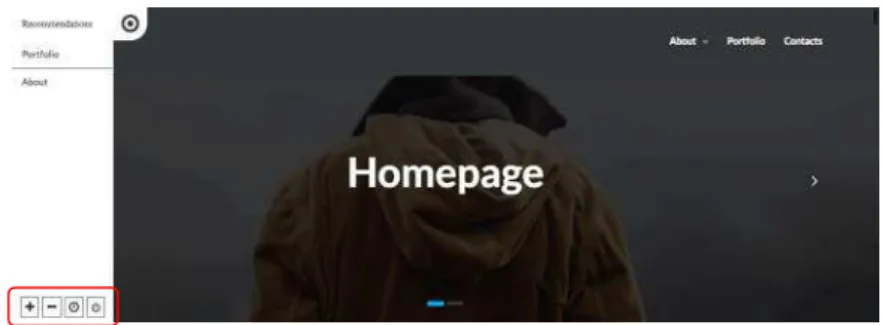
Fig. 3. Recommendation widget customization buttons
5
Evaluation
The evaluation of current proposal was conducted by relying on the GA traffic data from two organizations’ websites. One acknowledge that the evaluation of the current work may encompass several dimensions: 1) Does the implementation is able to provide the envisioned rational of the model, 2) Are the generated recommendations effective for the end user and 3) Is the user experience with the recommendation widget satisfactory. Engaging users in evaluation trials (evaluation dimensions 2 and 3) is often a very demanding endeavor if statistically significant results are pursued. Moreover introduce such widget in an organization website (e.g. produce A/B tests) must at least had some forms of earlier validations support. Clearly, it is not possible to jump directly to evaluation dimensions 2 and 3 without a body of results in dimension 1. This paper presents and discusses the dimension 1 evaluation’s results based on two distinct test cases, provided in the following two subsections.
5.1 First Test Case
Table 1. Partial outcome of recommendations generated on the first test case
Goal: reach “contacts” webpage Goal change: reach “portfolio” webpage (current)
page Recommendation (next page) conversions Rank from (current) page Recommendation (next page) conversions Rank from
/ (home) /contacts 1030 / (home) /portfolio 1920
/portfolio 60 /contacts 450
/about 60 /about 170
/portfolio /contacts 170 /contacts /portfolio 80
/about 110 / 70
/about /contacts 120 /about 60
/portfolio 60 /about /portfolio 100
/ 60
… … … … … …
5.2 Second Test Case
The second test case addresses the natural issue of accumulating simultaneously several goals within the website. For this purpose we have relied on other organization’s website (with a larger structure) traffic data.
Table 2. Partial outcome of recommendations generated on the second test case
Goal: reach “contacts” webpage Simultaneous Goals: ”contacts” & “clients” (current)
page Recommendation (next page) conversions Rank from (current) page Recommendation (next page) conversions Rank from
/ (home) /contacts 560 / (home) /contacts 470
/where 100 /clients 240
/who 60 /where 120
/clients /where 60 /services 60
/who /contacts 230 /clients /contacts 60
/where /contacts 110 /contacts /clients 140
/services /contacts 170 /who 110
/logistics 70 / 90
/services 60
/team /who 70
/projects /team 60
/who /contacts 70
/clients 60
/team 60
/who 60
/where /contacts 140
/clients 90
/services /logistics 100
/contacts 80
/clients 60
After an initial definition of a goal (reach “contacts” webpage) a second goal was added (reach “clients” webpage), and indeed the recommendations had reflected goals coexistence by starting to include recommendations of entry pages in any of the navigation flows that had led to one of the defined goals conversion accordingly (Table 2). One may notice that some recommendations lean toward one of the goals, while others may contemplate both, in consideration for the given navigation path. Additionally in some cases only indirect paths are suggested following the assumed conversions’ threshold.
6
Conclusions
This work proposes an alternative approach to websites’ navigation recommendations generation. Rather than incurring through the common web mining based approaches we redirect the focus to the real time enactment of web analytical tools supported analysis, given their current maturity and functional affordances. We do not claim that traditional web mining approaches have no place, given the assumptions that we have discussed on related work, but rather both approaches may complementary co-exist, leveraging each other strengths. We presented the underlying rational of our model for the recommendations production and delivering. Both aspects were reflected on the consequent functional prototype implementation as highly customizable to readily accommodate its functionality integration within any website; further promoted by the adopted SaaS orientation.
Our overall recommendation logic relies on the assumption that if a website usage and mission policy bounds website’s development process, goals, in the web analytics sense, may be defined and guide navigation recommendations production. Moreover, we focus on website usage patterns, rather than on user’s identification (or any form of personalization) under the assumption that in a given context a user may have navigation requirements closer to those that have pursued and effectively benefited from the same goals’ underlying criteria; rather than those within her classified personalized “segment” or “cluster”.
suggestions matching browsing path records of successful and proficient navigations, as envisioned. Moreover, also for website’s stakeholder, several reasons may dictate that it may be desirable that visitors navigate around (guided by best/rich navigation sessions) before end-goals conversions.
All in all we perform a little step toward to the real time enactment of website usage data analysis’ results given its underlying policies based on a paradigm that may fuel a new perspective on developing adaptive interfaces, as we are currently exploring along with user level validation dimensions.
References
[1] P. Mehtaa, B. Parekh, K. Modi, and P. Solanki, “Web Personalization Using Web Mining: Concept and Research Issue,” Int. J. Inf. Educ. Technol., vol. 2, no. 5, p. 510, 2012. [2] P. Fragkou, “Information extraction versus text segmentation for web content mining,” Int.
J. Softw. Eng. Knowl. Eng., vol. 23, no. 8, pp. 1109–1137, 2013.
[3] C. E. Dinucâ, “Web structure mining,” Ann. Univ. Petrosani Econ., vol. 11, no. 4, pp. 73– 84, 2011.
[4] Q. Han, X. Gao, and W. Wu, “Study on Web Mining Algorithm based on usage mining,” in
9th CAID/CD, 2008, pp. 1121–1124.
[5] P. Ackermann, C. A. Velasco, and C. Power, “Developing a Semantic User and Device Modeling Framework That Supports UI Adaptability of Web 2.0 Applications for People with Special Needs,” in International Cross-Disciplinary Conference on Web Accessibility, 2012.
[6] D. Parra, “Beyond lists: studying the effect of different recommendation visualizations,”
Proc. sixth ACM Conf. Recomm. Syst., pp. 333–336, 2012.
[7] R. Alves, O. Belo, and F. Costa, “Mining Clickstream-Based Data Cubes.,” in 11th Database Engineering and Applications Symposium, 2007, pp. 120–128.
[8] B. Liu, B. Mobasher, and O. Nasraoui, “Web Data Mining,” Web Data Min. Explor. Hyperlinks, Contents, Usage Data, pp. 449–483, 2007.
[9] R. Suguna and D. Sharmila, “An Efficient Web Recommendation System using Collaborative Filtering and Pattern Discovery Algorithms,” Int. J. Comput. Appl., vol. 70, no. 3, pp. 37–44, 2013.
[10] M. T. Hassan and A. Karim, “Impact of behavior clustering on web surfer behavior prediction,” J. Inf. Sci. Eng., vol. 27, no. 6, pp. 1855–1870, 2011.
[11] T. Slimani and A. Lazzez, “Efficient Analysis of Pattern and Association Rule Mining Approaches,” Int. J. Inf. Technol. Comput. Sci., vol. 6, no. 3, pp. 70–81, 2014.
[12] M. Abramson, “Learning Temporal User Profiles of Web Browsing Behavior,” Nav. Res. Lab., pp. 1–9, 2014.
[13] K. Nakatani and T. Chuang, “A web analytics tool selection method: An analytical hierarchy process approach,” Internet Res., vol. 21, no. 2, pp. 171–186, 2011.
[14] C. Li, “When does web-based personalization really work? The distinction between actual personalization and perceived personalization,” Comput. Human Behav., vol. 54, pp. 25–33, 2016.
[15] L. Chiarandini, “Characterizing and Modeling Web Sessions with Applications,” Universitat Pompeu Fabra, 2014.
[16] J. E. Pérez, X. Valencia, M. Arrue, and J. Abascal, “Elaborating a web interface personalization process,” ACM Int. Conf. Proceeding Ser., vol. 07–09–Sept, pp. 1–4, 2015. [17] B. Berendt, B. Mobasher, and M. Spiliopoulou, “Measuring the accurary of sessionizers for