*Correspondence:S. Lautenschlager.E-mail: stephan.lauten [email protected]
Reference
1 Sutton RL. A fissured, granulomatous lesion of the upper labio-alveolar fold.Arch Derm Syphilol1932;26: 425–427.
2 Anderson S, McClain N, Riviello RJ. Genital findings of women after con-sensual and nonconcon-sensual intercourse.J Forensic Nurs2006;2: 59–65. 3 Slaughter L, Brown CR, Crowley S, Peck R. Patterns of genital injury in female sexual assault victims.Am J Obstet Gynecol1997;176: 609–616. 4 McLean I, Roberts SA, White C, Paul S. Female genital injuries resulting
from consensual and non-consensual vaginal intercourse.Forensic Sci Int 2011;204: 27–33.
5 Wong CS, Andrew S, Yell J. Isolated vulval splitting–is this normal or pathological?J Obstet Gynaecol2004;24: 899–902.
6 Edwards L. Vulvar fissures: causes and therapy.Dermatol Ther2004;17: 111–116 Review.
7 Fraser IS, L€ahteenm€aki P, Elomaa Ket al.Variations in vaginal epithelial surface appearance determined by colposcopic inspection in healthy, sex-ually active women.Hum Reprod1999;14: 1974–1978.
8 Schmidt Astrup B, Lykkebo AW. Post-coital genital injury in healthy women: a review.Clin Anat2015;28: 331–338.
9 Bohl TG. Vulvar ulcers and erosions–a dermatologist’s viewpoint. Der-matol Ther2004;17: 55–67.
10 Bucker CB, Neil SM. The genital, perianal, and umbilical regions. In: Burns T, Breathnach S, Cox N, Griffiths C, eds.Rook’s Textbook of Derma-tology, Vol. 71 8th edn. Chapter 71. Wiley-Blackwell, Chichester, UK, 2010: 66.
DOI: 10.1111/jdv.14069
Sunbed use among Portuguese
beach goers: a crave group while
waiting sunbeds to be abolished
Editor
Although sunbed use is considered a complete carcinogen for skin cancer, over the past decades exposure to indoor tanning is becoming more popular.1,2
The risk appears to be stronger for young women, initial use at an early age (less than 35 years) and a higher number of sunbed sessions.3,4
With this study, we aim to better understand the features of sunbed users in Portuguese beach goers, a group at high risk for skin cancer.
A descriptive cross-sectional study was conducted, using the Portuguese Skin Cancer Association questionnaire (used since 2007), applied consecutively to people at the beach entrance (Praia da Falesia, on the south of Portugal), for four consecutive years (2009–2012).
The following items were investigated: demographic, constitu-tional and socio-economic factors and behaviour towards sun exposure.
Data analysis was performed by contingency tables and v2
independence tests. Statistical significance was established at P-value<0.05.
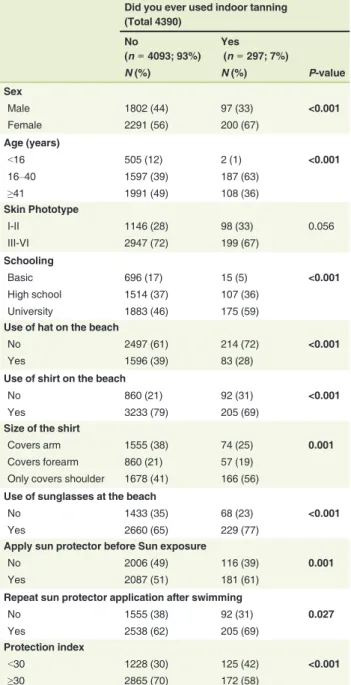
A total of 4390 questionnaires were completed. The use of indoor sunbeds varied from 6% in 2009 and 2010 and 7% in 2011 to 8% in 2012. Results are given in Table 1. Sunbed use was more frequent in young female and higher schooling individuals (P<0.001).
Table 1 Demographic data and risk factors, according to sunbed use (2009–2012)
Did you ever used indoor tanning (Total 4390)
No
(n=4093; 93%) Yes
(n=297; 7%)
N(%) N(%) P-value
Sex
Male 1802 (44) 97 (33) <0.001
Female 2291 (56) 200 (67)
Age (years)
<16 505 (12) 2 (1) <0.001
16–40 1597 (39) 187 (63)
≥41 1991 (49) 108 (36)
Skin Phototype
I-II 1146 (28) 98 (33) 0.056
III-VI 2947 (72) 199 (67)
Schooling
Basic 696 (17) 15 (5) <0.001
High school 1514 (37) 107 (36)
University 1883 (46) 175 (59)
Use of hat on the beach
No 2497 (61) 214 (72) <0.001
Yes 1596 (39) 83 (28)
Use of shirt on the beach
No 860 (21) 92 (31) <0.001
Yes 3233 (79) 205 (69)
Size of the shirt
Covers arm 1555 (38) 74 (25) 0.001
Covers forearm 860 (21) 57 (19)
Only covers shoulder 1678 (41) 166 (56)
Use of sunglasses at the beach
No 1433 (35) 68 (23) <0.001
Yes 2660 (65) 229 (77)
Apply sun protector before Sun exposure
No 2006 (49) 116 (39) 0.001
Yes 2087 (51) 181 (61)
Repeat sun protector application after swimming
No 1555 (38) 92 (31) 0.027
Yes 2538 (62) 205 (69)
Protection index
<30 1228 (30) 125 (42) <0.001
≥30 2865 (70) 172 (58)
©2016 European Academy of Dermatology and Venereology JEADV2017,31,e273–e306
Considering behaviours favouring tanning, sunbed users do not use the hat and do not use shirt when exposed to sunlight (P<0.001). They use sun protection index <30, are exposed between 11 and 17 h (P=0.001) and have more sunburns along life (P=0.002).
They also have attitudes evidencing awareness about sun damage like the use of sunglasses, sunscreen before sun exposure (P<0.001) and repeat of sunscreen after swimming (P=0.027).
Despite its limitations (cross-sectional design, self reported), this study has some strengths (sample size, repeated survey along 4 years and consistent evolution along time with persis-tent low rate of sunbed use) and interesting results. Although the sunbed user’s profile is equivalent to the literature,2,4,5 when comparing with other southern European countries, in this study we found a lower rate of sunbed users (maximum of 8%) in Portuguese beach goers. This rate of use may not be representative of the general population, but it strengthened by the Portuguese Euromelanoma data, where people go moti-vated by skin cancer concern, although using even less the sunbed (from 2009 to 2012, the sunbed use rate was 1% to 3% (unpublished data)). In Italy and Spain, the rate is over 20% of the population. In Spain, 51% of women before 35 years old claimed to use sunbeds.6 A systematic review from Western countries revealed a summary prevalence of ever exposure of 35.7% for adults, 55.0% for university students and 19.3% for adolescents.7
The regulation of indoor tanning devices and inspections is heterogeneous around the world. In Portugal, legislation exists since 2005. It obligates adequate information for users, technical formation for workers, and interdicts the use by pregnant and minors under 18 years, just like the US Food and Drug adminis-tration0s proposed rule.8According to Prosafe, in Portugal the implementation of the law as well as its inspection is being
accomplished.9 Together with the promotion of skin cancer knowledge and prevention campaigns in the last 14 years, this can explain the lower use rate of sunbeds. However, rules and campaigns are not enough, because this complete carcinogen is still used. In the light of current science, the research to date supports a complete ban of indoor tanning all over the world, as has been performed in Brasil and Australia.
While we expect authorities to have a responsible position to reduce the risk of further avoidable morbidity and mortality on skin cancer, sunbed users must be considered a crave group for future prevention campaigns.
A.F. Duarte,1,2,* J.N. Maia Silva,2A. Costa Pereira,3 E. Nagore,4A. Picoto,2O. Correia1,2,5 1
Centro Dermatologia Epidermis, Instituto CUF, Porto, Portugal, 2Portuguese Skin Cancer Association, Lisboa, Portugal,3Center for
Health Technology and Services Research (CINTESIS) and Department of Health Information and Decision Sciences, Faculty of Medicine, University of Porto, Porto, Portugal,4Department of Dermatology, Instituto Valenciano de Oncologia, Valencia, Spain,5Faculty of Medicine, University of Porto, Porto, Portugal *Correspondence:A.F. Duarte.E-mail: [email protected]
References
1 Wehner MR, Chren MM, Nameth Det al.International prevalence of indoor tanning: a systematic review and meta-analysis.JAMA Dermatol 2014;150: 390–400.
2 Grange F, Mortier L, Crine Aet al.Prevalence of sunbed use, and charac-teristics and knowledge of sunbed users: results from the French popula-tion-based Edifice Melanoma survey.J Eur Acad Dermatol Venereol2015; 2: 23–30.
3 Boniol M, Autier P, Boyle P, Gandini S. Cutaneous melanoma attributable to sunbed use: systematic review and meta-analysis.BMJ2012;24: 345: e4757.
4 Schneider S, Diehl K, Bock Cet al.Sunbed use, user characteristics, and motivations for tanning: results from the German population-based SUN-Study 2012.JAMA Dermatol2013;149: 43–49.
5 Schneider S, Kramer H. Who uses sunbeds? A systematic literature review of risk groups in developed countries.J Eur Acad Dermatol Venereol2010; 24: 639–648.
6 Stratigos AJ, Forsea AM, van der Leest RJet al.Euromelanoma: a derma-tology-led European campaign against nonmelanoma skin cancer and cutaneous melanoma. Past, present and future.Br J Dermatol2012;167 (Suppl 2): 99–104.
7 Diehl K, Litaker DG, Greinert R, Zimmermann S, Breitbart EW, Schneider S. The prevalence of current sunbed use and user characteristics: the SUN-Study 2008.Int J Pub Health2010;55: 513–516.
8 Coups EJ, Geller AC, Pagoto SL. The US Food and Drug Administration’s proposed rule to increase regulation of indoor tanning devices.JAMA Der-matol2016;152: 509–510.
9 Joint Market Surveillance Action on Sunbeds and Solarium Services. Co-funded by the European Commission. Directorate General for Health & Consumers (DG SANCO) and Executive Agency for Health and Con-sumers (EAHC) Agreement No: 2009 82 03
DOI: 10.1111/jdv.14070
Table 1 Continued
Did you ever used indoor tanning (Total 4390)
No
(n=4093; 93%) Yes
(n=297; 7%)
N(%) N(%) P-value
Use to be exposed between 11 and 17 h
No 1514 (37) 80 (27) 0.001
Yes 2579 (63) 217 (73)
History of sunburn
No 1433 (35) 78 (26) 0.002†
Yes 2660 (65) 219 (74)
†Chi-squared test.
Statistical significance established at P-value <0.05. Most relevant data in
bold.
©2016 European Academy of Dermatology and Venereology JEADV2017,31,e273–e306