97
Abstract
This work adds the Activity-Based Costing Approach in mining operations with a product mix. After analyzing and collecting data from an aggregate mine located in Brazil, a cost model was built, and from that, a cost management and analysis meth-odology of a mine in operation is created. This work has the innovation advantages of using ABC as a tool for planning the operation of the mine, identifying the more proitable products. At the end, it is concluded that the creation of a cost model to be used in the operation of mining is a rewarding investment as it shows the proitable and unproitable products.
keywords: activity-based costing, mining, mine operation.
Dennis Travagini Cremonese
Pesquisador
Universidade de São Paulo - USP Departamento de Engenharia de Minas e Petróleo - NAP.Mineração
São Paulo - São Paulo - Brasil [email protected]
Giorgio De Tomi
Professor Associado
Universidade de São Paulo - USP Departamento de Engenharia de Minas e Petróleo - NAP.Mineração
São Paulo - São Paulo - Brasil [email protected]
Manoel Rodrigues Neves
Professor
Universidade de São Paulo - USP Departamento de Engenharia de Minas e Petróleo - NAP.Mineração
São Paulo - São Paulo - Brazil [email protected]
Cost modelling of the product
mix from mining operations
using the activity-based
costing approach
Mining
Mineração
http://dx.doi.org/10.1590/0370-44672015690137
1. Introduction
A common challenge in mining is the realistic apportionment of ac-tual costs for each product, co-product, and sub-product that are part of the operation product mix. When cost sharing is done improperly, the proit-ability assessment of each product can be undermined by incorrect information that compromise the strategic decision-making. The introduction of an analysis methodology of indirect costs properly associated with each speciic product can have a signiicant impact on the operation competitiveness.
Arbitrary division of the indirect costs causes distortions, which affect the proitability of each product. As in a new project, where underestimating the costs may cause an unproitable project’s ongoing progress and fail,
while overestimation of cost could re-sult not progressing ahead a potentially proitable project (Sayadi et al., 2014), the same happens with products in a product mix in a mining operation.
Unproitable products continue in production, negatively affecting the cash low. Products that are more proitable are not prioritized, reducing the overall proitability of the mine. With a control of the actual costs of each product, the sales price can be adequate and the most proitable products can be prioritized, positively affecting the company.
The introduction of new man-agement practices, due to mines size, increased automation and the outsourc-ing of non-core activities, increased the indirect costs and decreased the direct costs (Sartorius and Kamala, 2007;
Crowson, 2003). Curry et at. (2014) showed that in a study with 63 mines, the cost related to General and Adminis-tration represents up to 42% of the total mine cost. Therefore, the indirect costs are a signiicant part of the amount to be arbitrarily divided between the products.
98 REM: R. Esc. Minas, Ouro Preto, 69(1), 097-103, jan. mar. | 2016 applied to the mining industry.
In order to overcome observed
bottlenecks in the cost apportionment in product mix in the mining area, this
paper emphasis on the introduction of a methodology to deal with the problem.
2. Materials and methods
There is no best cost-beneit analy-sis, but as Lind (2001) identiied, the Activity-Based Costing (ABC) approach is more appropriate to obtaining operat-ing costs in a South African coal mine than the traditional costing techniques.
ABC is a cost accounting meth-odology, aimed at allocating costs properly. ABC uses cost drivers to ap-point the costs to activities and basis of a cause and effect relationship with the products (Kostakis et al., 2008).
According to Chartered Institute of Management Accountants (2008), there are four steps to implementing ABC. Following are these steps applied to the mining industry.
1. Determine activities
The mining needs to make an analysis of all operating processes that
consist of one or more activities required to generate the product mix.
2. Select resource costs to activities Determine why the cost occurred by tracing costs to cost objects. Costs are categorized in three:
i. Direct costs are traceable direct-ly to one product. The blast and drilling cost that it takes to generate a product in one mine front are an example of it. ii. Indirect costs are not traceable to an individual product. They are used to generate more than one product, but not all of them. Truck and shovel main-tenance costs that are used in more than one product are example of this.
iii. General costs are not trace-able to any product. Whatever product is produced, these costs remain un-changed. Security costs are an example
of this.
The classiication above is differ-ent from the standard Direct, Indirect and Fixed Costs used in which the items are related to production (Pascoe, 1992), not the speciic product.
3. Determine products
Determine products for which an activity segment executes activities and utilizes resources.
4. Appoint activity costs to products
Activity drivers appoint activity costs to products based on the utiliza-tion for each activities. The key to ac-curate cost measurement is the correct distribution of the cost drivers (Ai-hua et al., 2009; Gomes et al., 2015).
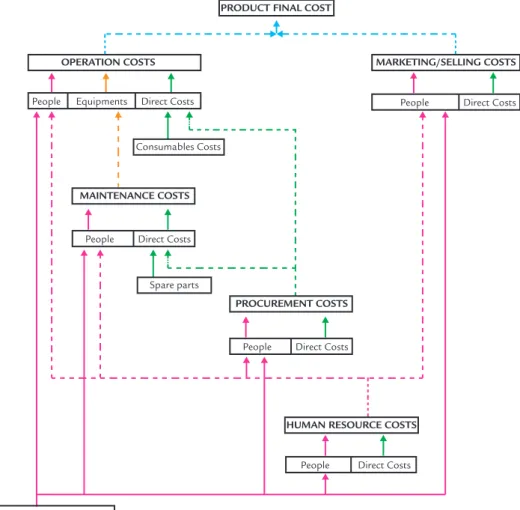
Figure 1 shows the cost low in the case study using the ABC approach.
Figure 1
Cost Flow in the case study using the ABC approach
3. Theory / calculation
3.1 Cost equations
The Total cost of each product has many related activities that generate a
lot of cost information to be included in each product. Below is described each
step to get the Total cost, considering the Cost Flow described in Figure 1.
MAINTENANCE COSTS
PROCUREMENT COSTS
HUMAN RESOURCE COSTS
Salary, taxes and benefits
People Direct Costs Spare parts
MARKETING/SELLING COSTS OPERATION COSTS
People Equipments Direct Costs Consumables Costs
PRODUCT FINAL COST
People Direct Costs
People Direct Costs
99
Where: CpeY = Cost of the employee “Y”;
SpeY = Salary and charges of the em-ployee “Y”;
CHR = Total Cost of Human Resources;
Npe= Number of employees in the mine;
NpeHR = Number of employees in the
Human Resources.
• Direct Cost The Direct costs are:
Pr Pr
NO
NO
C
DC
C
Zpe Z
dcZ
=
+
•
Equation 2
Equation 3
Equation 4
Equation 5
Equation 6
Where: DCZ = Direct Cost of item “Z”;
CpePr = Procurement Cost;
NOZ = Number of orders related to item “Z”; NOPr = Total Number of orders.
• Equipment
The cost of any equipment is:
dceqK MAeqK
eqK
C
C
C
=
+
Where: CMAeqK = Cost of the maintenance the equipment “K”;
CdceqK = Direct cost of equipment “K” (oil, gas, spare parts, …).
• Maintenance
Ali and Reza (2013) showed that maintenance and overhaul represent
from 32% to 64% of the total operating cost for a wheel loader equipped with a cable shovel. So, maintenance cost needs
to be evaluate with attention.
The cost of equipment mainte-nance is:
dcMeqW n
i
peieqW peMi
MAeqW
C
T
C
C
=
∑
•
+
=1
)
%
(
Where: CpeMi= Cost of the maintenance employee;
%TpeieqW = Percentage of time that
maintenance employee “i” works in equipment “W”;
CdcMeqW = Direct maintenance cost
of equipment “W” (broken parts, …).
• Marketing
The cost of any marketing/selling is:
∑
=
•
+
=
ni
peMaiPX peMai
dMarkX
MarkX
C
C
T
C
1
)
%
(
Where: CdMArkX = Direct Cost of Market-ing/selling related to product “X”;
CpeMai= Cost of the Marketing employee “i”; %TpeMaiPX = Percentage of time that
marketing/selling employee “i” works related to product “X”.
• Total Product Cost
The total cost of the Product “X” is:
MarkX dczPX
n
z
dcz n
y
peyPX pey
n
k
eqkPX eqk
PX
C
T
C
T
C
P
C
C
=
∑
•
+
∑
•
+
∑
•
+
= =
=
)
%
(
)
%
(
)
%
(
3 2
1
1 1
1
Where: Ceqk = Cost of the equipment “k”; %TeqkPX = Percentage of time that equipment “k" operating in product “X”
Equation 1
)
(
pe peHRHR peY
peY
N
N
C
S
C
−
+
=
• People
100 REM: R. Esc. Minas, Ouro Preto, 69(1), 097-103, jan. mar. | 2016
Equation 7
or related to it;
Cpey = Cost of the employee “y”;
%TpeyPX = Percentage of time that
em-ployee “y” works related to product “X”;
Cdcz = Direct Cost on step “z”;
%PdczPX = Percentage of direct cost “z"
related to product “X”;
CMarkX = Marketing and Selling costs related to product “X”.
3.2 Shared resources
Section 3.1 describes the equation of each cost. The focus of this section
is to deine the cost drives in shared re-sources, like equipment and employees.
3.2.1 Equipment
In Figure 2 the equipment from sec-ondary crushers are “working” in just one material, which will become the product. Therefore, this equipment “works” 100%
of time in the equivalent product. The dificulty is for the equipment that will produce material for more than one prod-uct, like a primary crusher. In this case,
the primary crusher operates in batches that produce material for each pile, so the cost drive is the time of production for each pile.
Figure 2
Material Flow – Example 1
101
Figure 3 Material Flow with mass – Example 2
Equation 8 shows the equipment cost of product 10.
Equation 8
3.2.2 Employees
The operation, marketing/selling and maintenance employees have the time spent at each equipment or product as cost
drive. The procurement employees have the number of purchase orders as cost drive. The human resources cost is shared
equally by the number of employees.
4. Results and discussion
The Cost Model used the informa-tion collected in the period with the
equa-tions shown in section 3. The result shown in Figure 4 shows the costs by product and
the selling price of each. In the following figure, there is
equipment that produces more than one product and that produces material for
other products in continuous operations. The cost drive in this situation is the mass that the equipment operates. Considering
102 REM: R. Esc. Minas, Ouro Preto, 69(1), 097-103, jan. mar. | 2016
The products 3 and 8 have negative proitability and decrease the mining global proitability as shown in Figure 4.
Figure 5
Global Profitability
Considering that the selling price could not be modiied and that there is demand for other products, the material that generates product 3 can be changed to product 4, which has positive proit-ability.
As seen in Figure 3 the product 8 is produced simultaneously with product 9 and 10. The Product 8 decreases a lot
the proitability of Products 9 and 10. Considering that the selling price can be changed, the Product 3 and 8 can be reviewed to a higher value.
The most common dificulty was to deine the data collection, identiication of activities and selection of cost drivers. As shown by Briers and Chua (2001), the changes are cyclical in a company,
and the input information needs to be always in reevaluation not to make the product cost evaluation obsolete and then abandoned. Even with the advance of information technology and computer application to the mineral sector (Nader et al., 2012), the innovative approach faces challenges to be used in the min-eral area.
5. Conclusion
ABC analysis is more expensive and time-consuming than a tradition-al cost tradition-allocation system, but it can assist in understanding the economic impact of management decisions and in controlling indirect costs.
The appropriate apportionment of cost between the products mix
shows the actual proitability of each. This has shown that some product were not proitable and the range of alternatives that can be followed, such as increasing the selling price, decreasing the costs or no longer produce the product.
This study clearly indicates that
an ABC approach is efficient for analyzing mining costs with product mix.
Activity Based Costing has far wider applications than the aspect described here. One of these applica-tions is as a management-reporting tool that is covered in other sources.
6. References
AI-HUA, Z. et alii. Research on mining cost of coalbed methane based on activity management. Procedia Earth and Planetary Science, v.1, n.1, p. 1668 – 1672, Sept. 2009.
ALI, L. REZA, S. A. Statistical approach to determination of overhaul and mainte-nance cost of loading equipment in surface mining. International Journal of Mi-ning Science and Technology, v.23, p. 441 – 446, 2013.
BRIERS, M., CHUA, W. F. The role of actor-networks and boundary objects in ma-nagement accounting change: a ield study of an implementation of activity-based costing. Accounting, Organization and Society, v. 26, n. 3, p. 237 – 269, Apr. 2001.
Figure 4
103
CROWSON, P. Mine size and the structure of costs. Resources Policy, v. 29, n. 1-2, p. 15 – 36, Mar./June 2003.
CURRY, J. A., ISMAY, M. J. L., JAMESON, G. J. Mine operating costs and the potential impacts of energy and grinding. Minerals Engineering, v. 56, p. 70 – 80, Feb. 2014.
CHARTERED INSTITUTE OF MANAGEMENT ACCOUNTANTS. Activity ba-sed costing; prepared by S. Edwards and Technical Information Service. London, 2008. (Topic Gateway Series No. 1). Disponível em: < http://www.cimaglobal. com/Documents/ImportedDocuments/cid_tg_activity_based_costing_nov08.pdf. pdf >. Acesso em: 10 de março de 2016.
GOMES, R. B., DE TOMI, G., ASSIS, P. S. Impact of quality of iron ore lumps on sus-tainainability of mining operations in the Quadrilatero Ferrifero Area. Minerals Engineering, v. 70, p. 201-206, Jan. 2015.
KOSTAKIS, H. et alii. Integrating activity-based costing with simulation and data mining. International Journal of Accounting & Information Management, v. 16, n. 1, p. 25-35, 2008.
LIND, G. H. Activity based costing: challenging the way we cost underground coal mining systems. The Journal of the South African Institute of Mining and Me-tallurgy, v. 101, p. 77 – 82, Mar/Apr. 2001
NADER, B., DE TOMI, G., PASSOS, A. O. Key performance indicator and the mi-neral value chain integration. REM – Revista Escola de Minas, v. 64, p. 537-542, Oct./Dec. 2012.
PASCOE, R. D. Capital and operating costs of minerals engineering plants – a review of simple estimation techniques. Minerals Engineering, v.5, n.8, p. 883 – 893, Aug. 1992.
SARTORIUS, K. C., KAMALA, E. P. The design and implementation of activity ba-sed costing (ABC): a South African survey. Meditari Accountancy Research, v.15, p. 1 – 21, 2007.
SAYADI, A. R., KHALESI, M. R., BORJI, M. K. A parametric cost model for mineral grinding mills. Minerals Engineering, v.55, p. 96-102, Jan. 2014.