* Extracted of the thesis “Relacionamento com famílias na prática clínica de enfermagem no contexto neonatal e pediátrico: impacto de uma intervenção educativa e proposição de uma escala de autoeicácia”, Escola de Enfermagem, Universidade de São Paulo, 2015. 1 Universidade Federal de São Paulo, Escola Paulista de Enfermagem, São Paulo, SP, Brazil. 2 Universidade de São Paulo, Escola de Enfermagem, Departamento de Enfermagem Materno-Infantil e Psiquiátrica, São Paulo, SP, Brazil. 3 Universidade de São Paulo, Escola de Enfermagem, São Paulo, Brazil.
ABSTRACT
Objective: he purpose of this study was to develop and test the psychometric properties of the Self-eicacy Scale for the Establishment of Good Relationships with Families in Neonatal and Pediatric Hospital Settings. Method: Methodological study grounded on self-eicacy theory was conducted in three phases: conceptual and operational deinition (review of the literature and interviews with the target population), content validity (opinion of ive experts e three clinical nurses), and exploratory factor analysis and internal consistency reliability (cross-sectional survey with a valid sample of 194 nurses). Results: A ten-point Likert scale with 40-item was designed and one item was excluded after review by experts. hree factors emerged from the exploratory factor analysis. he Cronbach’s alpha for all items was 0.983 with item-total correlations in the range 0.657 to 0.847. Cronbach’s alpha value if item deleted were less than or equal to 0.983. Conclusion: he inal version of the scale demonstrated psychometric adequacy. It is a useful tool to be administered in the clinical, educational and research nursing ields to measure nurses’ self-eicacy beliefs concerning the establishment of good relationships with families.
DESCRIPTORS
Self Eicacy; Professional-Family Relations; Family Nursing; Neonatal Nursing; Pediatric Nursing; Validation Studies.
Self-efficacy scale for the establishment of good relationships
with families in neonatal and pediatric hospital settings*
Escala de autoeficacia para el establecimiento de buenas relaciones con las familias en ambientes neonatales y pediátricos
Escala de autoeficácia para o estabelecimento de bons relacionamentos com famílias no contexto neonatal e pediátrico hospitalar
Andréia Cascaes Cruz1, Margareth Angelo2, Bernardo Pereira dos Santos3
How to cite this article:
Cruz AC, Angelo M, Santos BP. Self-efficacy scale for the establishment of good relationships with families in neonatal and pediatric hospital settings. Rev Esc Enferm USP. 2017;51:e03222. DOI: http://dx.doi.org/10.1590/S1980-220X2016033803222
Received: 08/26/2016 Approved: 01/26/2017
Corresponding author:
Andréia Cascaes Cruz Rua Napoleão de Barros, 754 CEP 04024-002 – São Paulo, SP, Brazil [email protected]
INTRODUCTION
he core of nursing is caring, the main component of which is the relationship established between the nurse and the care receiver(1). In the pediatric context, despite the
physical proximity between families and nurses, professionals impose limits on the interpersonal relationships they estab-lish and the care approach is characterized by detachment and provision of information, marginalizing the relational aspect of care(2-3).
Nurses need to acquire knowledge and develop skills and competencies to relate properly with families. However, this is not enough; it is necessary to integrate the concept of self-eicacy in this process, that is, the perception that nurses have about their own their ability to establish good relationships with families in their care settings(4).
he self-eicacy theory was developed by Albert Bandura, a Canadian psychologist who turned his atten-tion to the role of cognitive processes in the acquisiatten-tion and maintenance of behaviors. According to social cogni-tive theory, self-eicacy has a powerful inluence on human behavior and can be deined as beliefs that an individual has in their ability to perform a certain task successfully(5).
People with a strong sense of eicacy welcome diicult and challenging tasks instead of conceiving them as a threat that must be avoided; they increase and sustain their eforts in the face of failure, and recover their sense of eicacy rapidly after failures or setbacks(6).
Relating to families is a challenge for nurses. Relationships between nurses and the families of hospital-ized children are characterhospital-ized by a lack of clarity regarding both roles; as a result, the diiculties of negotiation per-meate the relationships established. Interpersonal relations between nurses and parents are inadequate, inappropriate and inefective(2,7-10).
At present, no tool is available for the assessment of nurses’ self-eicacy for establishing a good relationship with the family. he closest instrument for the evaluation of these concepts is the Family Nursing Practice Scale, developed by Simpson and Tarrant in 2006, which is developed to measure perceived changes in family nursing practice includ-ing nurses attitudes toward workinclud-ing with families, critical appraisal of their family nursing practice and reciprocity in the nurse-family relationship(11).
Considering the importance of the relational aspect of care and the challenges of relating to families, the self-eicacy level perceived by nurses is an important predictor of their behavior in establishing efective relationships with families. In the absence of an instrument that could measure the self-eicacy of nurses to establish good relationships with families, the Self-Eicacy Scale for the Establishment of Good Relationships with Families in Neonatal and Pediatric Hospital Settingswas proposed, developed and validated in this study.
he purpose of this study was to develop and test the psychometric properties of the Self-eicacy Scale for the Establishment of Good Relationships with Families in Neonatal and Pediatric Hospital Settings.
METHOD
Methodological study grounded on self-eicacy theory, whose instrument was developed in line with the method-ology of psychometrics, etymologically represented as the theory and technique of measuring mental processes(12-13)
and following Bandura’s speciications for the construction of instruments for measuring perceived eicacy(14). he study
was conducted in three phases: 1) conceptual and operational deinition; 2) content validity; 3) internal consistency reli-ability and exploratory factor analysis of the new instru-ment. hese three phases were carried out during the period September 2014 to March 2015.
Phase 1: concePtual and oPerational definition
he conceptual deinition deals with the precise insertion of a concept in the theory to which it belongs (self-eicacy theory); it must be precise and clear, as it will contribute to the development of the measuring instrument items and support the construction of the dimensions or factors. he operational deinition refers to the preparation of the scale items(12,14), which should be based on open interview analysis
conducted with the target population(14). So, the conceptual
and operational deinition were generated from a review of the literature and an empirical phase (interviews with the target population).
First a literature review on the concept ‘Good Relationships between Nurses and Families in Neonatal/ Pediatric Hospital Settings’was carried out. Articles were selected in Portuguese, Spanish and English, published between 2010 and 2015 and indexed in the following data-bases: MEDLINE (Literatura Internacional em Ciências da Saúde); Cochrane Collaboration PMC (PubMed Central), EMBASE (he Excerpta Medica Database) and CINAHL (Cumulative Index of Nursing and Allied Health Literature). he search strategies employed were adequate for each one of the databases, in general, the following words were used in combination with the Boolean operators as follows: Nurs* AND Famil* OR Parents AND Relationship OR Interaction* OR Relation* AND Neonatal OR Pediatric NOT Primary Health Care. Data collection was performed in four stages: 1) selection by title; 2) selection by summary; 3) selection by reading the full article and 4) critical evaluation of the qual-ity of the articles. In the end of these stages, 42 studies were included in the literature review for the data analysis.
he second step was to perform interviews with the purpose to understand what mean to have a good relation-ship with families and to identify elements that hinder or inhibit the relationship of nurses with families in pediat-ric/neonatal hospital settings in the perception of nurses, since self-eicacy scale items must represent the challenges and impediments to the smooth running of that particular task(14). he location selected to recruit participants in this
Cruz AC, Angelo M, Santos BP
about the study, checked their interest and willingness to provide an interview and obtained the written consent of participants. he interviews were conducted in a private room within the hospital units.
Of the nine invited nurses, all agreed to be interviewed. One of them was male and eight were female, they were aged between 24 and 49 years and had worked as a nurse for a period ranging between 10 months and 25 years. he interviews lasted an average of 20 minutes and were guided by a script with pre-prepared questions, such as: Tell me about your day-to-day relationship with families, For you, what does it mean a good relationship with families?,For you, in what situations is it most diicult to relate to families? he interviews were recorded and transcribed. To analyze the data we used inductive content analysis from where emerged codes, cat-egories, and emergent themes, without impose preconceived theoretical perspectives on the data(15,16).
Also in this phase, the gradation for the answers and the corresponding nomenclature median values and the end of the scale were deined(14). he instrument uses a Likert
ten-point scale. In the irst version, gradation of responses ranged from 0 to 100, where 0 (zero) represented much uncertainty, 50 (ifty) represented moderate certainty and 100 (one hundred) absolute certainty. After content valida-tion with the committee of experts, the values remained the same, but the nomenclature of scale gradation was modiied, as discussed later.
Phase 2: contentvalidity
he content validation was performed with two groups of participants: one group comprised ive experts (three nurses expert in the family nursing and pediatrics/neona-tology area, one nurse expert in the self-eicacy area and one nurse expert in building measuring instruments). he other group comprised three clinical nurses from the pediatric and neonatal area.
he experts were invited by email and agreed, with written consent, to evaluate the irst version of the scale in terms of: the semantic appropriateness of the statement, the instructions for completing the instrument, the nomencla-ture used in grading responses, relevance and understand-ing of each item. he irst version of the instrument was sent by email to experts, along with instructions on how to carry out the evaluation, questions relating to the concept of self-eicacy and explanations of the concept of a good relationship between nurses and families in pediatric/neo-natal hospital settings.
here was an 80% or more correlation between the statement and the items on the instrument and the experts’ responses(17). After the necessary modiications to the
instru-ment, according to the evaluation of the group of experts, a new version of the instrument was subjected to an additional semantic analysis with three clinical nurses (this followed the recommendation to apply the instrument to a small group of subjects in the target population (three or four)(17).
he clinical nurses of the same location of the irst phase of the study were personally invited by principal researcher to participate in this phase of the study. After agreed with
written consent, nurses answered the new version of the instrument and they were asked the following questions:
What you did understand was being asked by the instrument;
Did you have any diiculty understanding any items on the instrument?; Did you ind it diicult to respond to the items using this type of grading? he nurses sent their answers to the principal researcher by e-mail for further analysis.
Phase 3: internalconsistencyreliabilityand exPloratoryfactoranalysis
A cross-sectional online survey was performed with a convenience sample. To calculate the required sample size it was decided that at least ive responders for each item of the instrument (5 subjects x 39 items = 195 subjects) were needed(18). he population in this study was registered nurses
who were working in assistance roles in a neonatal and/or pediatric hospital setting. A national neonatal and pediatric nursing association provided an accessible population and all members of this association that had agreed to be con-tacted for research purposes were invited to participate in the online survey.
An email was sent to 250 potential participants con-taining: information regarding ethical aspects of the study, the study objectives, collection, analysis, dissemination of data, further consent form and online survey. To ensure the eligibility criteria and characterize the sample, at the end of the survey participants provided information on their gender, age, time in their profession, place of work, unity in the workplace and other variables. A total of 223 nurses responded to the survey, which resulted in a valid sample of 194 nurses after the deletion of 29 respondents who did not actually work in clinical practice. he survey software did not register partially completed survey responses, so the response rate only relects those who completed the survey.
Data were organized in an Excel 2010 program data-base and were exported into Statistical Package for the Social Sciences (SPSS) version 22. he internal consis-tency of the instrument was assessed using three measures: Cronbach’s alpha for the total scale, item-total correlation and Cronbach’s alpha if the item was deleted. he analysis was performed to full scale, and for each factor. Sampling adequacy was measured using Kaiser-Meyer-Olkin (KMO) and using Barlett´s Test of Sphericityfor subsequent verii-cation of the dimensionality of the concept through explor-atory factor analysis. he KMO compares the magnitude of the relationship between correlation coeicients and partial correlation coeicients. Factor analysis is appropriate when the contents of the KMO are high; the measurement var-ies between 0 and 1, and the index must be above 0.5 to perform the factor analysis. he closer KMO is to 1, the better the result. Bartlett’s test of sphericity tests the null hypothesis that the variables in the sample correlation matrix are uncorrelated; the signiicance level should be low enough (less than or equal to 0.05) for its statistics to be relevant, which means that there is a strong relationship between the variables, rejecting the null hypothesis.
factorial analysis of the instrument(19). A common factor
analysis by the extraction method of Principal Axis Factoring
was then conducted in order to calculate the value of the factor loadings for each item. Only those items with factor loadings equal to or greater than 0.30 were considered. While the extraction technique is designed to maximize independent sources of variance in the correlation matrix, the rotation con-sists of delineating factors, i.e., to ensure that each item cor-responds to a single factor of the concept. he axis of rotation may be orthogonal or oblique; in this study oblique rotation was used, in order to facilitate and improve the interpreta-tion of the factor analysis. After the extracinterpreta-tion of factors, an oblique rotation was performed using direct Oblimin solu-tion with Kaiser Normalizasolu-tion, allocating each item to the respective factor, according to the highest value of the factor loadings presented by item for the corresponding factor.
ethical considerations
The study was registered and approved by the Research Ethics National Information System (CAAE nº 29472414.2.0000.5392 and nº 29472414.2.3001.0076) and was approved by the Research Ethics Committees of the School of Nursing of Universidade de São Paulo and the Institution where the study was conducted. All participants gave informed consent following an opportunity to discuss their participation with the researcher. Written consent was obtained from all participants and they were aware that they had the right to stop participating in this study any time without any prejudice to them.
RESULTS
Phase 1: concePtual and oPerational definition
he concept ‘Good Relationships between Nurses and Families in Neonatal/ Pediatric Hospital Settings’ is a phenomenon:
Multidimensional, derived from three spheres: cogni-tive (thoughts and beliefs), afeccogni-tive (feelings), sociocultural (values).
Results from interactions and interpretations that the nurse establishes between her/himself and other individuals, situations, environments and social objects;
Achieved through behaviors or social actions;
Comprised of three interconnected components: con-necting with the family, maintaining efective communica-tions with the family and living in harmony with oneself and the family.
Guided by core elements: inclusivity (embracing the family), reliability, availability, appropriate verbal language, active listening, role clarity, empathy, respect.
Forty items were generated for the irst version of the Self-eicacy Scale for the Establishment of Good Relationships with Families in Neonatal and Pediatric Hospital Settings.
Phase 2: contentvalidity
he content validation, carried out with the ive experts, resulted in: 1) Changes in the statement and scale
instructions: the main change made was the use of the term “conidence” instead of “certainty”; 2) Change in the nomen-clature assigned to the values on grading of the responses, “no conidence”, “moderate conidence” and “absolute con-idence” instead of “much uncertainty”, “moderate certainty” and “absolute certainty”; 3) Deleting one item; 4) Semantic and grammatical changes in ten items.
he second version generated after expert evaluations had 39 items. he semantic analysis with the target popula-tion did not result in changes in the instrument, since there were no reported problems in the interpretation of the state-ment, items or nomenclature and score of responses. hus, the instrument with 39 items was applied to the sample for veriication of the psychometric properties.
Phase 3: internalconsistencyreliabilityand exPloratory factor analysis
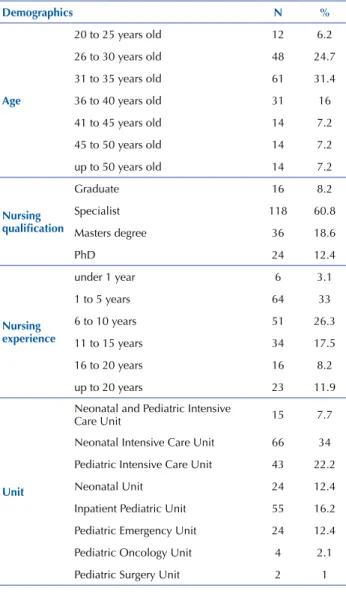
he cross-sectional survey (n=194) comprised predomi-nantly female nurses (95.9%), aged between 31 and 35 years (31.4%), with 1 to 5 years (33%) of professional experience. Additional information about the demographic character-istics is shown in Table 1.
Table 1 – Frequency distribution nurse demographic characteris-tics – São Paulo, SP, Brazil, 2015.
Demographics n %
Age
20 to 25 years old 12 6.2
26 to 30 years old 48 24.7
31 to 35 years old 61 31.4
36 to 40 years old 31 16
41 to 45 years old 14 7.2
45 to 50 years old 14 7.2
up to 50 years old 14 7.2
nursing qualiication
Graduate 16 8.2
Specialist 118 60.8
Masters degree 36 18.6
PhD 24 12.4
nursing experience
under 1 year 6 3.1
1 to 5 years 64 33
6 to 10 years 51 26.3
11 to 15 years 34 17.5
16 to 20 years 16 8.2
up to 20 years 23 11.9
Unit
Neonatal and Pediatric Intensive
Care Unit 15 7.7
Neonatal Intensive Care Unit 66 34
Pediatric Intensive Care Unit 43 22.2
Neonatal Unit 24 12.4
Inpatient Pediatric Unit 55 16.2
Pediatric Emergency Unit 24 12.4
Pediatric Oncology Unit 4 2.1
Cruz AC, Angelo M, Santos BP
he analysis of internal consistency for the 39 items showed a Cronbach alpha coeicient of 0.983. he result of the analysis of internal consistency for each of the 39 items of the scale, using the item-total correlation and Cronbach’s alpha
value if item deleted (Table 2) showed an item-total correla-tion ranging between 0.657 and 0.847. All coeicients of the items deleted were less than or equal to 0.983, indicating the contribution of all itemsto the internal consistency of the scale.
Table 2 – Internal Consistency Reliability for the 39 items on the Self-efficacy Scale for the Establishment of Good Relationships with Families in Neonatal and Pediatric Hospital Settings – São Paulo, SP, Brazil, 2015.
Item correlationItem-total Alpha if item deleted
1. Você teve pouco contato com a família. 0.716 0.982
2. Você não consegue identiicar e/ou atender as necessidades da família. 0.697 0.982
3. A família não está aberta para conversar. 0.709 0.982
4. A família está alterada emocionalmente (nervosa, agressiva, estressada ou triste). 0.796 0.982
5. Você conhece pouco a família. 0.786 0.982
6. A família não compreende o que você está dizendo. 0.799 0.982
7. A família não sabe quem você é. 0.763 0.982
8. A família não sabe qual é o seu papel dentro da unidade. 0.743 0.982
9. A família não se aproxima de você. 0.721 0.982
10. O seu lado pessoal sobrepõe-se ao proissional. 0.716 0.982
11. Aquilo que a família pensa ou faz é muito diferente daquilo que você pensaria ou faria. 0.759 0.982
12. Você não consegue compreender a visão e o modo de viver e agir da família. 0.828 0.982
13. Você sente que tem uma relação mais pessoal do que proissional com a família. 0.657 0.983
14. Você acredita que não está preparada (o) para lidar com a família em determinada situação. 0.795 0.982
15. A família ultrapassa os limites da sua paciência. 0.750 0.982
16. Ocorre o óbito da criança. 0.706 0.982
17. A família está numa situação de grande sofrimento. 0.723 0.982
18. Você está sobrecarregada (o) no trabalho. 0.726 0.982
19. Você já teve conlitos com a família. 0.817 0.982
20. O ambiente não oferece condições mínimas de conforto para a família. 0.783 0.982
21. Falta tempo para você conversar com a família. 0.755 0.982
22. Você está estressada (o), cansada (o), irritada (o), preocupada (o) ou triste. 0.787 0.982
23. Há suspeita de maus tratos à criança. 0.731 0.982
24. Você tem uma impressão negativa da família. 0.820 0.982
25. Há problemas intrafamiliares. 0.817 0.982
26. O primeiro contato da equipe de saúde com a família foi inadequado. 0.832 0.982
27. A criança está em estado grave. 0.800 0.982
28. A família não aceita a condição em que a criança se encontra. 0.816 0.982
29. A família não entende o que está acontecendo com a criança. 0.829 0.982
30. A família é pouco comunicativa. 0.847 0.982
31. Você não tem respostas para determinadas perguntas da família. 0.833 0.982
32. A família faz cobranças sobre o seu trabalho. 0.773 0.982
33. Você sente que a família está responsabilizando você pelo que está acontecendo. 0.735 0.982
34. A instituição na qual você trabalha não valoriza a presença e o cuidado às famílias. 0.755 0.982
35. A família teve experiências prévias negativas com outros proissionais ou com outros serviços de saúde. 0.809 0.982
36. Outros membros da sua equipe não valorizam o relacionamento com as famílias. 0.783 0.982
37. A família solicita demais. 0.753 0.982
38. Você sente que a família não conia em você. 0.716 0.982
he KMO index presented was high, equal to 0.959, indicating that the factor analysis could be performed. he Bartlett’s test of sphericity was statistically signiicant, sug-gesting the suitability of the data for the factor analysis model, indicating that the items were correlated. he paral-lel analysis suggested that the instrument was constituted by three factors. his result reiterated the results of the con-ceptual deinition phase, which also identiied three factors related to the concept in question.
In the factor analysis no item presented a load factor lower than 0.30, thus, no item was excluded after extraction.
Veriication of communality resulted in values ranging from 0.545 and 0.831. he analysis of internal consistency for each of the factors revealed Cronbach’s alpha coeicient of 0.976 for factor1 “Self-eicacy to connect with families”, 0.964 for factor 2 “Self-eicacy to maintain an efective communica-tion with the family” and 0.866 for factor 3 “Self-eicacy to live in harmony with oneself and the family.”
Chart 1 presents the allocation of the 39 items on the Self-eicacy Scale for the Establishment of Good Relationships with Families in Neonatal and Pediatric Hospital Settingsto the corresponding factors.
Chart 1 – Allocation of the 39 items to the corresponding factors – São Paulo, SP, Brazil, 2015.
Factor* Number of items Matching items
1. Self-eficacy to connect with families 22 16, 17, 18, 19, 20, 21, 22, 23, 24, 25, 26, 27, 28, 29, 30, 31, 32, 34, 35, 36, 37, 39
2. Self-eficacy to maintain an effective communication with the family. 13 1, 2, 3, 4, 5, 6, 7, 8, 9, 10, 11, 12, 14 3. Self-eficacy to live in harmony with oneself and the family. 4 13, 15, 33, 38
*Original version in portuguese: 1. Autoeicácia para abrir-se para a família. 2. Autoeicácia para manter uma comunicação eicaz com a família. 3. Autoeicácia para conviver
em equilíbrio consigo e com a família.
finalinstrumentandscoretechnique
he Self-eicacy Scale for the Establishment of Good Relationships with Families in Neonatal and Pediatric Hospital Settingsis a self-report questionnaire that includes 39 items using a Likert ten-point scale. he score of the total scale and corresponding factors is calculated by totaling the values assigned by the subject for the response gradation of each of the items. he higher the score, the greater the self-eicacy the respondent possesses.
Chart 2 – Score of the total scale and corresponding factors – São Paulo, SP, Brazil, 2015.
Low self-eficacy Moderate self-eficacy High self-eficacy
Total scalea 0-195 196-266 267-390
Factor 1b 0-114 115-156 157-220
Factor 2c 0-59 60-87 88-130
Factor 3d 0-17 18-26 27-40
aSelf-eicacy Scale for the Establishment of Good Relationships with Families in
Neonatal and Pediatric Hospital Settings.
bAutoeicácia para abrir-se para a família (Original version in portuguese). cAutoeicácia para manter uma comunicação eicaz com a família (Original version
in portuguese).
dAutoeicácia para conviver em equilíbrio consigo e com a família (Original version
in portuguese).
DISCUSSION
heoretically based on Bandura’s self-eicacy theory, the Self-eicacy Scale for the Establishment of Good Relationships with Families in Neonatal and Pediatric Hospital Settings is an self-report instrument that takes approximately 15 minutes to be responded and evaluate the self-eicacy of nurses for establishing good relationships with families in neonatal and pediatric settings.
here are four primary sources of information whose people use to determine and modify their personal expec-tations of self-eicacy: (a) performance accomplishments (personal mastery experiences), (b) vicarious experience
(observing others succeed through their eforts), (c) verbal persuasion (encouragement of inluential others), and (d) physiological arousal (somatic reactions in relation to poten-tially stressful and taxing situations)(6). Using the role playing
strategy in small groups during educational interventions is potentially valuable as a source of these four self-eicacy categories of information(20).
he Cronbach’s alpha for the entire scale was high at 0.983 while the minimum acceptable value for alpha is 0.70(21). he high value of Cronbach´s alpha in the
Self-eicacy Scale for the Establishment of Good Relationships with Families in Neonatal and Pediatric Hospital Settings indicates that it has high internal consistency and that all items are measuring the same concept.
For item-total correlation, a value greater than 0.3 is recommended(22). he item-total correlation ranged between
0.657 and 0.847, indicating that all items of the scale con-tributed to the measurement of the concept of self-eicacy in question, and a lower Cronbach’s alpha or equal to 0.983, compared to the exclusion of each item, indicated that all items should be kept in the instrument.
In factor analysis, each of the variables can be deined as a linear combination of common factors that explain part of the variance of each variable (communality). he communal-ity may range from 0 to 1; the greater the communalcommunal-ity, the greater the explanatory power of that variable by the factor. Ideally the value of communalities should be greater than 0.5 for a satisfactory factor analysis(18). Veriication of
commu-nality resulted in values between 0.545 and 0.831, indicating that all items were at least 50% represented in the factors.
Cruz AC, Angelo M, Santos BP
an efective communication with the family” includes items indicative of situations that make it diicult to maintain an efective nurse communication with family and Factor 3 “Self-eicacy to live in harmony with oneself and the fam-ily” consists of items representing situations that may hinder the establishment of a harmonious relationship between the self and the family. he elements or situations (items) relect facts, perceptions, thoughts and feelings of nurses in relation to the family and the nurses in relation to themselvesthat, in the perception of nurses, can interfere with their self-eicacy belief, that is, in how much nurses believed themselves to be capable of establishing a good relationship with the family. “People have to judge their eicacy not only to sustain their motivation and task-oriented focus but to manage distress-ing emotional states and self-debilitatdistress-ing thought patterns, which can impair their execution of activities”(23).
Self – eicacy beliefs “contribute signiicantly to the level of motivation and performance. Eicacy beliefs predict not only the behavioral functioning between individuals at difer-ent levels of perceived self-eicacy but also changes in func-tioning in individuals at diferent levels of eicacy over time and even variation within the same individual in the tasks performed and those shunned or attempted but failed”(23).
CONCLUSION
his study provides a scale with psychometric adequacy that allows simple identiication of self-eicacy as well as personal barriers and self-evaluation for the detection of elements that need to be improved in nurses to create and maintain successful relationships with families in neonatal and pediatric settings. he inal version of the instrument is a
ten-point Likert scale with 39 items and three factors, whose the Cronbach’s alpha for all items was 0.983 with item-total correlations in the range 0.657 to 0.847 and Cronbach’s alpha value if item deleted were less than or equal to 0.983. he evaluation made by analysis of participant responses to the Self-eicacy Scale for the Establishment of Good Relationships with Families in Neonatal and Pediatric Hospital Settings may guide development of more efective strategies to prepare and support nursing courses or training strategies to improve nurses’ behaviors for establishing successful relation-ships with families in neonatal and pediatric settings, improv-ing the care that patients and their families receive.
It is proposed to use the scale before and after educa-tional interventions on topics related to patient and family centered care, family systems nursing, communication and interpersonal relationships in the clinical ield, research and education, once the assessment of self-eicacy to establish good relationships with families is recognized as an impor-tant predictor of behavior change.
Regarding the study limitations, the original version of the instrument was constructed and validated in Brazil and it is available in Portuguese, so, for it can be applied with nurses from diferent places around the world, it is necessary a scale translation and validation in other languages, stability assess-ment through test and the establishassess-ment and standardiza-tion of cut-of points in other populastandardiza-tions. Furthermore, for future research it is necessary to verify the criterion-related validity of the Portuguese version of Self-eicacy Scale for the Establishment of Good Relationships with Families in Neonatal and Pediatric Hospital Settings, examining concur-rent relationship of the new instrument with similar scales.
RESUMEn
Objetivo: El propósito de este estudio fue desarrollar y probar las propiedades psicométricas de la Escala de Autoeicacia para el Establecimiento de Buenas Relaciones con las Familias en Ambientes Neonatales y Pediátricos. Método: Estudio metodológico fundamentado en la teoría de la auto-eicacia se realizó en tres fases: conceptual y deinición operacional (revisión de la literatura y entrevistas con la población objetivo), la validez de contenido (opinión de cinco expertos y tres enfermeras clínicas), y el factor de análisis exploratorio e iabilidad interna de consistencia (estudio transversal con una muestra válida de 194 enfermeras). Resultados: La escala de Likert de diez puntos con 40 ítems fue diseñada y un elemento fue excluido después de la revisión por expertos. Hay tres factores que emergieron del análisis factorial exploratorio. El alfa de Cronbach para todas las partidas fue 0,983, con correlaciones ítem-total en el rango de 0,657 a 0.847. El Valor alfa de Cronbach excluyendo el ítem quedo inferior o igual a 0.983. Conclusión: La versión inal de la escala demostró psicometría adecuada. Se trata de una herramienta útil para ser administrada en los campos clínicos, educativos y de enfermería de investigación para medir las creencias de autoeicacia de enfermeros sobre el establecimiento de buenas relaciones con las familias.
DESCRIPTORES
Autoeicacia; Relaciones Profesional-Familia; Enfermería de la Familia; Enfermería Neonatal; Enfermería Pediátrica; Estudios de Validación.
RESUMO
Objetivo: O propósito deste estudo foi desenvolver e testar as propriedades psicométricas da Escala de Autoeicácia para o estabelecimento de bons relacionamentos com famílias no contexto neonatal e pediátrico hospitalar. Método: Estudo metodológico fundamentado na teoria da autoeicácia foi realizado em três fases: deinição conceitual e operacional (revisão de literatura e entrevistas com a população alvo), validade de conteúdo (opinião de cinco especialistas e três enfermeiras clínicas), e análise fatorial exploratória e avaliação de consistência interna (pesquisa transversal com uma amostra válida de 194 enfermeiros). Resultados: Uma escala do tipo Likert de 10 pontos com 40 itens foi desenvolvida e um item foi excluído após a avaliação dos juízes. Três fatores emergiram da análise fatorial. O alfa de Cronbach para todos os itens foi igual a 0,983 com a correlação item-total variando entre 0,657 e 0,847. O alfa de Cronbach caso determinado item fosse excluído foi menor ou igual a 0,983. Conclusão: A versão inal da escala demonstrou adequação psicométrica. Trata-se de uma ferramenta útil que pode ser facilmente aplicada no campo clínico, educacional e de pesquisa para medir o impacto de intervenções nas crenças de autoeicácia dos enfermeiros relacionadas ao estabelecimento de bons relacionamentos com famílias.
DESCRITORES
REFERENCES
1. Princeton DM. The caring phenomenon: a search for absolute good caring. Int J Humanit Sol Sci. 2015;5(1):211-9.
2. Lima AS, Silva VKBA, Collet N, Reichert APS, Oliveira BRG. Relações estabelecidas pelas enfermeiras com a família durante a hospitalização infantil. Texto Contexto Enferm. 2010;19(4):700-8.
3. Coyne I, O’Neill C, Murphy M, Costello T, O’Shea R. What does family-centred care mean to nurses and how do they think it could be enhanced in practice. J Adv Nurs. 2011;67(12):2561-73.
4. Angelo M, Cruz AC. Autoeicácia do enfermeiro para o relacionamento com a família. Rev Referência. 2015;3(IV):151-5.
5. Bandura A. Self-eficacy. In: Ramachandran VS, editor. Encyclopedia of human behavior. New York: Academic Press; 1994. p. 71-81.
6. Bandura A. Self – eficacy: toward a unifying theory of behavioral change. Psychol Rev. 1977;84(2):191-215.
7. Côa TF, Pettengill MAM. The vulnerability experienced by the family of children hospitalized in a pediatric intensive care unit. Rev Esc Enferm USP. 2011;45(4):824-30. DOI: http://dx.doi.org/10.1590/S0080-62342011000400005
8. Cruz AC, Angelo M. Stomas in neonatology: recovering the mother’s memory. Rev Esc Enferm USP. 2012;46(6):1306-13. DOI: http://dx.doi. org/10.1590/S0080-62342012000600004
9. Pimenta EAG, Collet N. Dimension of nursing and family care to hospitalized children: conceptions of nursing. Rev Esc Enferm USP. 2009;43(3):619-26.
10. Quirino DD, Collet N, Neves AFGB. Hospitalização infantil: concepções da enfermagem acerca da mãe acompanhante. Rev Gaúcha Enferm. 2010;31(2):300-6.
11. Simpson P, Tarrant M. Development of the Family Nursing Practice Scale. J Fam Nurs. 2006;12(4):413-25.
12. Pasquali L. Instrumentos psicológicos: manual prático de elaboração. Brasília: LabPAM/IPAPP; 1999.
13. Pasquali L. Psychometrics. Rev Esc Enferm USP. 2009;43(n.spe):992-9.
14. Bandura A. Guide for Constructing Self-Eficacy Scales. In: Pajares F, Urdan T, editors. Self-eficacy beliefs of adolescents. Greenwich: Information Age; 2006. p. 307-37.
15. Elo S, Kääriäinen M, Kanste O, Tarja Pölkki T, Utriainen K, Kyngäs H. Qualitative content analysis: a focus on trustworthiness. SAGE Open. 2014:1-10.
16. Shi C, Tian J, Wang Q, Petkovic J, Ren D, Yang K, et al. How equity is addressed in clinical practice guidelines: a content analysis. BMJ open. 2014;4:e005660.
17. Pasquali L. Psychometrics: theory test in psychology and education. Petropolis: Vozes; 2003.
18. Hair JF, Black WC, Babin BJ, Anderson RE, L TR. Multivariate data analysis. 7ª ed. Upper Saddle River: Prentice Hall; 2009.
19. Horn JL. A Rationale and test for the number of factors in factor analysis. Psychometrika. 1965;30:179-85.
20. Parle M, Maguire P, Heaven C. The development of a training model to improve health professionals´skills, self-eficacy and outcome expectancies when communicating with cancer patients. Soc Sci Med. 1997;44(2):231-40.
21. Streiner DL. Being inconsistent about consistency: when coeficient alpha does and doesn’t matter. J Pers Assess. 2003;80(3):217-22.
22. Kline P. The handbook of psychological testing. 2th ed. London: Routledge; 2000.
23. Bandura A, Locke EA. Negative self-eficacy and goal effects revisited. J Appl Psychol. 2003;88(1):87-99.
Financial support
Conselho Nacional de Desenvolvimento Científico e Tecnológico (CNPq). Process number 142162/2013-2.