1 Universidade Federal do Rio Grande
do Sul, Graduate Program in Nursing, Porto Alegre, RS, Brazil.
2 Hospital de Clínicas de Porto
Alegre, Porto Alegre, RS, Brazil.
ABSTRACT
Objective: To describe how pain is assessed (characteristic, location, and intensity) and managed in clinical practice in patients undergoing endovascular procedures in the catheterization laboratory setting. Method: Cross-sectional study with retrospective data collection. Results: Overall, 345 patients were included; 116 (34%) experienced post-procedural pain; in 107 (92%), pain characteristics were not recorded; the location of pain was reported in 100% of patients, and its intensity in 111 (96%); management was largely pharmacologic; of the patients who received some type of management (n=71), 42 (59%) underwent reassessment of pain. Conclusion: he location and intensity of pain are well reported in clinical practice. Pharmacologic pain management is still prevalent. Additional eforts are needed to ensure recording of the characteristics of pain and its reassessment after interventions.
DESCRIPTORS
Pain; Acute Pain; Pain Management; Endovascular Procedures; Nursing Care.
Pain assessment and management in patients undergoing
endovascular procedures in the catheterization laboratory
Avaliação e manejo da dor em pacientes submetidos a procedimentos endovasculares em laboratório de hemodinâmica
Evaluación y tratamiento del dolor en pacientes sometidos a procedimientos endovasculares en el laboratorio de cateterismo
Thamires de Souza Hilário1,2, Simone Marques dos Santos1,2, Juliana Kruger2, Martha Georgina Goes1,2, Márcia Flores Casco2, Eneida Rejane Rabelo-Silva1,2
How to cite this article:
Hilário TS, Santos SM, Kruger J, Goes MG, Casco MF, Rabelo-Silva ER. Pain assessment and management in patients undergoing endovascular procedures in the catheterization laboratory. Rev Esc Enferm USP. 2017;51:e03229. DOI: http://dx.doi.org/10.1590/S1980-220X2016018003229
Received: 05/19/2016 Approved: 02/14/2017
Corresponding author:
Eneida Rejane Rabelo da Silva Escola de Enfermagem, Universidade Federal do Rio Grande do Sul Rua São Manoel, 963 – Rio Branco CEP 90620-110 – Porto Alegre, RS, Brazil [email protected]
INTRODUCTION
Endovascular procedures involve the insertion of radiopaque catheters, via percutaneous venous or arterial puncture (femoral, brachial, or radial) under luoroscopy guidance, to arrive at the desired location (heart, peripheral vessels, cerebral vessels). hese procedures are carried out in catheterization laboratories (“cath labs”) for purposes both diagnostic (evaluation of blood low) and therapeutic (treatment of obstructions, stenoses, or correction of aneu-rysmal lesions)(1).
A common complaint of patients undergoing endovas-cular procedures is acute pain at the vasendovas-cular access site or discomfort in the chest and lower back area, which may be related to bedrest, restricted movement of the accessed limb, to the trauma of vascular puncture itself, or to the potential vascular complications that may develop during the procedure(2-4). However, other pain complaints, such as
back pain or headache, are also very common in this set-ting(2-6). Considering that the high turnover and dynamics of
cath lab work may hinder proper care of pain, staf must pay special attention to assessment, management, and systematic recording of pain levels.
Despite substantial growth of endovascular procedures in recent decades(3-5), assessment of pain in the post-procedural
period does not appear to be a major concern of care teams. Few studies have addressed this topic as a primary outcome in this setting(6-8); in others, pain was assessed a secondary
or less important outcome(2).
It is known that inadequate management of postop-erative pain can prolong hospitalization, increase health-care expenditures, and have several clinical repercussions, including changes in blood pressure and respiratory rate, anxiety, emotional stress, and sleep disorders, among oth-ers(9-10). Proper pain management is the patient’s right in
every health care context, and must include an assessment that addresses pain characteristics and location, manage-ment, and re-evaluation after intervention(11-12).
In an attempt to bridge this knowledge gap, this study aims to describe how the pain of patients undergoing endo-vascular procedures in a cath lab setting is assessed (charac-teristics, location, and intensity) and managed in daily prac-tice. he relevance of this study is related to the investigation of pain management in a dynamic care context. Data thus generated can be used by providers to improve awareness of pain levels in this patient population, support individualized care, and improve management to relieve pain and increase patient comfort.
METHOD
his cross-sectional study with retrospective data collec-tion was conducted using data from patients’ nursing records (electronic and paper-based). he sample comprised adult patients (aged 18 years or older), of both sexes, who under-went diagnostic or therapeutic endovascular procedures at the catheterization laboratory of Hospital de Clínicas de Porto Alegre (HCPA), state of Rio Grande do Sul, Brazil, from July to December 2013. Patients who recovered at other
units or whose procedures did not involve arterial puncture or venipuncture (e.g., procedures that used dissection or transparietal puncture as access route) were excluded.
HCPA is a public, university-ailiated hospital specializ-ing in high-complexity care. Its cath lab has three procedure suites and performs an average of 300 procedures/month, divided into the following ields of expertise: cardiology (cardiac catheterization, percutaneous coronary interven-tion); cardiac electrophysiology (electrophysiologic study with or without ablation); cardiovascular surgery (deinitive pacemaker, endovascular correction of aneurysm); vascu-lar surgery (arteriography and arterioplasty); neurosurgery (arteriography, embolization of malformations); and inter-ventional radiology (arteriography, cholangiography, embo-lization of vessels, and nephrostomy).
he sample size was calculated in the WinPepi 11.25 software environment, taking into account a 95% conidence level, a 5% margin of error, and a proportion of 50%, on the basis of the existing literature(2,6-7). he sample size was thus
estimated at 385 patient records.
From July to December 2013, 1758 procedures were car-ried out at the catheterization laboratory where the study was conducted. his period was stipulated as a result of the work process, safety standards, and nursing and medical charts readjustment, necessary for international certiication by the International Joint Commission, which took place at the hospital. After this survey, we excluded all patients who had undergone procedures using dissection or transparietal puncture (n=161) and those subjected to procedures who did not recover in the cath lab (62). After these exclusions, with the remaining sample of 1535 procedures, a randomization proportional to the distribution of procedures in the study period was performed; 385 charts were selected, taking into account a 20% attrition rate. Overall, 10% of records were lost during the review stage (patients who did not recover in the cath lab observation room and charts that could not be retrieved). With this percentage of loss, 345 medical records were included in the study.
A speciic instrument was developed by the researchers to collect data on demographic and clinical variables: age, sex, comorbidities (diabetes mellitus, hypertension, smok-ing), type and duration of procedure, and information about pain felt by the patient after the endovascular procedure.
he institution that hosted the study recommends that pain be recorded as the ifth vital sign, and that assessment of pain address its characteristics (as described by the patient, e.g., clenching, twinge, burning…), location, and intensity (through a visual numeric scale or verbal rating scale)(12).
RESULTS
DemographicanD clinical characteristics
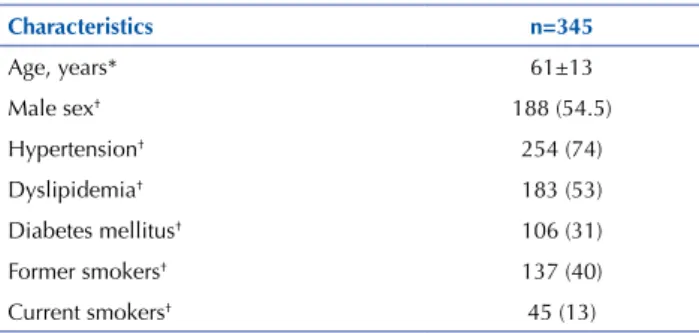
he sample included 385 patients who had undergone endovascular procedures in a catheterization laboratory set-ting. he patients’ mean age was 61±13 years. Most were male, and hypertension was the most common comorbidity; 40% were former smokers. Table 1 describes the sample characteristics.
Table 1 – Demographic and clinical characteristics of patients un-dergoing interventional procedures at a catheterization labora-tory – Porto Alegre, Rio Grande do Sul, Brazil, 2013.
Characteristics n=345
Age, years* 61±13
Male sex† 188 (54.5)
Hypertension† 254 (74)
Dyslipidemia† 183 (53)
Diabetes mellitus† 106 (31)
Former smokers† 137 (40)
Current smokers† 45 (13)
*Continuous variable expressed as mean ± standard deviation; †Categorical variable
expressed as n (%).
Assessment, management, and reassessment of pain after endovascular procedures
Of the 345 patients included, 116 (34%) experienced at least one recorded instance of pain after the procedure. Table 2 illustrates the characteristics, location, and intensity of post-procedural pain as recorded in the sample.
Overall, 67 patients (58%) received pharmacologic treat-ment, 45 (39%) received no intervention for pain, and four (3%) received non-pharmacologic treatment (turning and positioning in bed). In 42 cases (59%), pain was reassessed within 1 hour of the intervention.
Table 2 – Characteristics, location, and intensity of post-proce-dural pain as recorded in the sample – Porto Alegre, Rio Grande do Sul, Brazil, 2013.
n=116 n (%)
Pain characteristics
Not recorded 107 (92)
Crushing 3 (2.6)
Catching 2 (1.7)
Shooting 1 (0.9)
Stabbing 1 (0.9)
Cramping 1 (0.9)
Burning 1 (0.9)
location of pain
Head 30 (26)
Vascular access site 21 (18)
Accessed limb 19 (16.5)
Lumbar area/Back 18 (15.5)
Other locations 16 (14)
Sternum 12 (10)
continued…
…continuation
n=116 n (%) Pain severity
Moderate (4-7) 60 (52)
Mild (1-3) 39 (34)
Intense (8-10) 12 (10)
Not recorded 5 (4)
Pain treatment
Pharmacologic 67 (58)
None 45 (39)
Non-pharmacologic 4 (3)
Provider responsible for recording pain
Nurse technician 107 (92)
Nurse 9 (8)
DISCUSSION
his was the irst study conducted in a cath lab setting that sought to describe pain evaluation and management in patients undergoing endovascular procedures.
We identiied that, among patients who felt pain after the procedure (n=116),in the majority of charts, the char-acteristics of pain were not recorded; conversely, the location of pain was present in all records, and the intensity of pain was assessed in over 90% of cases. Pharmacologic treatment was the mainstay of care, and not all patients who received a pain relief intervention underwent reassessment of pain within 1 hour of said intervention.
he low rate of pain in cath lab patients may be asso-ciated with the nature of percutaneous procedures, which are less invasive and noninjurious to deeper tissues(3-5). In
addition, underreporting of pain may be inluenced by high patient turnover and short recovery times in this setting, thus jeopardizing a more systematic approach to pain assessment. It bears noting that mandatory inclusion of pain parameters in medical prescriptions is a recent practice. Pain assessment is underestimated by the health care team, mainly in contexts of dynamic health care, i.e., units in which patients stay for a short period of time. he dynamic nature of care in such units may create barriers for patients to request support. his behavior fails to consider the potential limitations imposed by pain, which include increased rates of secondary com-plications, prolonged hospital stay, neurovegetative changes, and risk of chroniication(9,13-14).
and nurse’s aides, a lack of patient comprehension was reported as the primary challenge to pain measurement in 77.6% of cases(15). It is believed that, for patients to be able
to describe their pain, they must feel comfortable expressing what they are feeling in their own words, and must under-stand that this information will help the staf treat them.
In the present study, pharmacologic treatment was the main approach used in patients who complained of pain. However, a substantial portion of these patients did not receive any intervention for pain relief. he literature sug-gests that insuicient knowledge about mechanism of action, half-life, drug-drug interactions, and dosage often leads to undertreatment of pain(16-17). Although physicians
are responsible for prescribing analgesic agents, pain man-agement per se is performed by the nursing staf. On the other hand, cath lab staf must also ascribe due importance to the occurrence of post-procedural pain, particularly with proactive use of standing orders for pain management that take pain levels into account.
In this study, non-pharmacological pain treatment – which consisted in relocating the bed so the patient would feel more comfortable – was described in only one case. As non-pharmacological practices may also contribute to relieve pain, the cath lab care team may use other methods, such as cold application to reduce the inlammatory process of acute tissue injury and thus improve swelling and local pain(18).
Other methods, such as music therapy and massage, have been widely studied, mainly for the treatment of chronic pain; these methods can be used in diferent contexts as they reduce pain and improve patient satisfaction(19-20).
Reassessment of pain is essential to ascertain whether pain relief has been achieved. he literature points out that reassessment of pain after analgesia must occur from 30 min to 1 hour after the intervention(21). However, in this
study, 41% of patients who received a pain management intervention never had their pain levels reassessed. his may be associated with achievement of pain relief within 1 hour rather than failure to incorporate reassessment into routine practice at the catheterization laboratory.
Data from a study that sought to characterize the percep-tions and challenges of the nursing staf regarding certain
aspects of pain assessment and provide training in this respect revealed that 84.3% of providers had knowledge of this topic and that 54.9% had acquired such knowledge in the hospital environment(22). his highlights the importance
of institutions in training their providers, so that relevant information is known by all. One study showed that pain management can provide more efective relief when the nursing staf is properly trained to identify and treat pain in a systematic manner(23).
Despite the relevance of these indings, the lack of records may in itself have been a limiting factor in our attempt to relate them directly to clinical practice. Greater eforts are warranted in terms of recording pain and implementing pain management. Training eforts that provide for the entire multidisciplinary team may be helpful, as proper pain man-agement requires that all providers do their part to relieve pain within the care of the patient as a whole.
We are not aware of any previous investigations into this topic conducted in the catheterization laboratory setting. herefore, the results of the present study may contribute to the improvement of pain management in cath lab patients by providing valuable knowledge on the occurrence of pain in this population.
limitations
he limitations of this study include the fact that, in an environment as dynamic such as a catheterization labora-tory, evaluation of records without direct observation of the facts does not provide a complete picture of the care provided.
CONCLUSION
he results of this study demonstrate that a signiicant percentage of patients experience pain after endovascular procedures. In this sample, pain location and intensity were often recorded in clinical practice and pharmacological treat-ment was the predominant method of pain managetreat-ment. Additional eforts must be made to ensure better recording and assessment of pain characteristics, as well as to ensure reassessment of pain after analgesic interventions.
RESUMEn
Objetivo: Describir cómo se evalúa el dolor (características, localización e intensidad) y su manejo en la práctica clínica en pacientes sometidos a procedimientos endovasculares en el laboratorio de cateterización. Método: Estudio transversal con recolección retrospectiva de datos. Resultados: En total, se incluyeron 345 pacientes; 116 (34%) experimentaron dolor post-procedimiento; en 107 (92%), no se registraron las características del dolor; la localización del dolor se informó en el 100% de los pacientes, y su intensidad en 111 (96%); el manejo fue en gran medida farmacológico; de los pacientes que recibieron algún tipo de tratamiento (n=71), 42 (59%) fueron sometidos a reevaluación del dolor. Conclusión: La ubicación y la intensidad del dolor se informan bien en la práctica clínica. El manejo farmacológico del dolor sigue siendo frecuente. Se necesitan esfuerzos adicionales para asegurar el registro de las características del dolor y su reevaluación después de las intervenciones.
DESCRIPTORES
Dolor; Dolor Agudo; Manejo del Dolor; Procedimientos Endovasculares; Atención de Enfermería.
RESUMO
dados retrospectiva. Resultados: Foram incluídos 345 pacientes; 116 (34%) apresentaram dor após o procedimento; em 107 (92%), as características da dor não foram registradas; a localização foi registrada em 100% dos pacientes, e a intensidade da dor em 111 (96%); o principal manejo foi o farmacológico; dos pacientes que receberam algum manejo (n=71), 42 (59%) tiveram sua dor reavaliada. Conclusão: A localização e a intensidade da dor estão bem documentadas na prática clínica. O tratamento farmacológico foi prevalente. Mais esforços são necessários para que as características da dor sejam registradas, assim como sua reavaliação após intervenção.
DESCRITORES
Dor; Dor Aguda; Manejo da Dor; Procedimentos Endovasculares; Cuidados de Enfermagem.
REFERENCES
1. Brito CJ. Cirurgia vascular: cirurgia endovascular angiologia. 3ª ed. Rio de Janeiro: Revinter; 2014.
2. Paganin A, Rabelo ER. Clinical validation of the nursing diagnoses of Impaired Tissue Integrity and Impaired Skin Integrity in patients subjected to cardiac catheterization. J Adv Nurs. 2013;69(6):1338-45.
3. Matte R, Hilário TS, Reich R, Aliti GB, Rabelo-Silva ER. Reducing bed rest time from ive to three hours does not increase complications
after cardiac catheterization: the Three Cath Trial. Rev Latino Am Enfermagem. 2016;24:e2797.
4. Wu PJ, Dai YT, Kao HL, Chang CH, Lou MF. Access site complications following transfemoral coronary procedures: comparison between traditional compression and angioseal vascular closure devices for haemostasis. BMC Cardiovasc Disor [Internet]. 2015 [cited 2016 Sept 04];15:34. Available from: https://www.ncbi.nlm.nih.gov/pmc/articles/PMC4434571/
5. Mahgoub A, Mohamed W, Mohammed M, Abdel-Aziz M, Kishk Y. Impact of early ambulation on patients’ outcome post transfemoral coronary procedures, at Assiut University Hospital. J Educ Practice. 2013;28(4):22-32.
6. Souza KN, Stival MM, Lima LR. Avaliação da dor em pacientes submetidos à angioplastia coronária transluminal percutânea. Universitas Ciências Saúde. 2012;10(1):15-22.
7. Santos MA, Borba RP, Moraes CV, Voltolini I, Azevedo EM, Cardoso CR, et al. Evaluation of radial artery patency after transradial catheterization. Rev Bras Cardiol Invasiva. 2012;20(4):403-7.
8. Dal Piva C, Vaz E, Moraes MA, Goldmeyer S, Linch GFC, Souza EN. Discomfort reported by patients after cardiac catheterization using the femoral or radial approaches. Rev Bras Cardiol Invasiva. 2014;22(1):36-40.
9. Tighe P, Buckenmaier CC, Boezaart AP, Carr DB, Clark LL, Herring AA, et al. Acute pain medicine in the United States: a status report. Pain Med. 2015;16(9):1806-26.
10. Reardon DP, Anger KE, Szumita PM. Pathophysiology, assessment, and management of pain in critically ill adults. Am J Health Syst Pharm. 2015;72(18):1531-43.
11. International Association for the Study of Pain (IASP). Declaration of Montréal. Declaration to Pain Management is a Fundamental Human Right [Internet]. [cited 2016 Sept 04]. Available from: http://www.iasp-pain.org/Advocacy/Content.aspx?ItemNumber=1821
12. Gordon DB. Acute pain assessment tools: let us move beyond simple pain ratings. Curr Opin Anaesthesiol. 2015;28(5):565-9.
13. Louriz M, Belayachi J, Armel B, Dendane T, Abidi K, Madani N, et al. Factors associated to unrelieved pain in a Morrocan Emergency Department. Int Arch Med. 2014;7:48.
14. Tennant F. The physiologic effects of pain on the endocrine system. Pain Ther. 2013;2(2):75-86.
15. Nascimento LA, Kreling MCGD. Assessment of pain as the ifth vital sign: opinion of nurses. Acta Paul Enferm. 2011;24(1):50-4.
16. Wijayanti E. Teaching pain management to student nurses: a literature review. Nurse Med J Nurs. 2014;4(1):715-32.
17. Silva PO, Portella VC. Nursing interventions in pain. Rev Dor. 2014;15(2):145-8.
18. Song M, Sun X, Tian X, Zhang X, Shi T, Sun R, et al. Compressive cryotherapy versus cryotherapy alone in patients undergoing knee surgery: a meta-analysis. Springerplus. 2016;5(1):1074.
19. Palmer JB, Lane D, Mayo D. Collaborating with music therapists to improve patient care. AORN J. 2016;104(3):192-7.
20. Miller J, Dunion A, Fitzmaurice C, Gamboa M, Myers S, Novak P, et al. Effect of a brief massage on pain, anxiety, and satisfaction with pain management in postoperative orthopaedic patients. Orthop Nurs. 2015;34(4):227-34.
21. Hennemann-Krause L. Aspectos práticos da prescrição de analgésicos na dor do cancer. Revista HUPE. 2012;11(2):38-49.
22. Magalhães PAP, Mota FA, Saleh CMR, Secco LM, Fusco SRG, Gouvêa AL. Perception of nursing professionals when identifying, quantifying and treating pain in patients of a trauma intensive care unit. Rev Dor. 2011;12(3):221-5.
23. Silva MAS, Pimenta CAM, Cruz DALM. Pain assessment and training: the impact on pain control after cardiac surgery. Rev Esc Enferm USP. 2013;47(1):84-92. DOI: http://dx.doi.org/10.1590/S0080-62342013000100011
Financial support
Fundo de Incentivo à Pesquisa e Eventos (FIPE), Hospital de Clínicas de Porto Alegre.