Graduates in Portugal:
a typification of professional transition
profiles
Madalena RamosI
Cristina ParenteII
Mónica SantosII
Abstract
Adequacy of educational background to professional situation is a subject that emerges whenever the theme of graduates’ professional transition is approached. This paper intends to analyze the professional situations of Portuguese higher education degree holders five years after they attained their degree, in light of questions related to professional transition. We examine the relationship between the educational system and the labor market by comparing international indicators that serve as a context for the Portuguese case, in order to discuss the empirical results that characterize the professional situation experienced in 2010 by a sample of 1,004 higher education degree holders from two Portuguese universities We define five types of professional situation based on multivariate analysis techniques and then reflect on the profiles found. We concluded that the majority of graduates perform professional activities that are adequate to their education level, with earnings, employment contracts and work hours adequate to those of the specialists in intellectual and scientific activities group. However, a more refined analysis reveals a hierarchical arrangement of
professional situations in a continuum ranging from fragile to
qualifying professional transition, associated with graduates study field. Education, Arts and Humanities degree holders are in the most precarious labor situations, in contrast with an over-representation of Health, Finance, Management and Law degree holders in the most favorable jobs.
Keywords
Professional transition — Professional insertion — Graduates — Higher education degree
I- Instituto Universitário de Lisboa (ISCTE-IUL), CIES-IUL, Lisboa, Portugal.
Contact: [email protected]
Os licenciados em Portugal:
uma tipificação de perfis de
inserção profissional
Madalena RamosI
Cristina ParenteII
Mónica SantosII
Resumo
A adequação entre o nível e tipo de formação académica e a situação profissional é um tema presente sempre que se aborda a temática da inserção profissional dos licenciados. Pretende-se, com este artigo, analisar as situações profissionais de diplomados portugueses do ensino superior cinco anos após a conclusão da licenciatura, à luz da problemática da inserção e transição profissional. Enquadra-se a relação entre sistema de ensino e mercado de trabalho comparando--se indicadores internacionais que contextualizam o caso português, de modo a discutir os resultados empíricos que caracterizam a situação profissional vivida em 2010 por uma amostra de 1.004 diplomados de duas universidades portuguesas. Definem-se cinco tipos de situações profissionais a partir de técnicas de análise multivariadas e reflete-se sobre os perfis encontrados. Conclui-se que a maioria dos licenciados exerce uma atividade profissional adequada ao seu nível de graduação, com rendimentos salariais, vínculos laborais e horários adequados ao grupo dos especialistas das actividades intelectuais e científicas. Porém, a análise mais fina revela-nos uma configuração hierárquica das situações profissionais num continuum que se organiza desde a inserção frágil à inserção qualificante associada às áreas de formação frequentadas. Os diplomados nas áreas de educação, artes e humanidades ocupam as situações profissionais mais precarizantes, contrastando com a sobrerrepresentação nos empregos mais favoráveis dos licenciados das áreas de saúde, economia, gestão e direito.
Palavras-chave
Transição profissional — Inserção profissional — Licenciados — Diploma académico.
I- Instituto Universitário de Lisboa (ISCTE-IUL), CIES-IUL, Lisboa, Portugal.
Contato: [email protected]
Adequacy of educational background to professional situation has become a highly debated subject in Portugal. Is the higher education system meeting the country’s needs, whether in terms of figures or study fields? Although Portugal’s graduation rates remain relatively below European standards, political and media speeches on these subjects tend to reinforce the arguments of excess of graduates, unemployment and an alleged inadequacy of higher education to the real needs of the labor market. In this respect, the role of university is being increasingly debated, and discussions are marked by dichotomies such as between a specialized education and one of a more general character; between transmitting a more theoretical knowledge or a more transversal, vocational one; between the idea of a university
metaphorically represented as an ivory tower,
indifferent to labor market changes, or one that is pervious to labor market’s fickleness, submitting itself to its needs and demands. These reflections have emerged along with the progressive massification of higher education and, consequently, with the dissemination of a blurred, tragic image of graduates’ situation in face of the labor market – a misleading image, as empirical evidence has demonstrated (ALVES, 2000, 2005; ALVES, 2007; CHAVES, 2007).
In a context of deep changes in both education and employment systems, which are felt locally while their causes and consequences cross borders, the question of how adequate the education provided by universities is to labor market is an inevitable one, and it is being posed at a global level.
Based on a representative sample of graduates in different study fields from two
major Portuguese universities, this paper 1
intends to answer the following questions:
1 -This work was funded by Fundos Nacionais through Fundação para a Ciência e Tecnologia (FCT) within the project Percursos de inserção dos licenciados: relações objetivas e subjetivas com o trabalho (PTDC/CS-SOC/104744/2008) at Centro de Estudos em Sociologia da Universidade Nova de Lisboa (CESNOVA).
1- What is the objective situation of graduates regarding work five years after they attained their degrees?
2- What profiles of professional transition are identified amongst these graduates?
3- What is the relationship between the graduates’ professional situation and their academic background? Are the different fields of study equally equipped for moving from the education system to the labor market?
The main novelty of the presented work lies in proposing a typology for graduates’ professional situations, which are hierarchically disposed in a continuum ranging from fragile to qualifying professional transition.
This analysis fits into the studies on professional transition – i.e., moving from the education system to the labor market – in a context of deep changes. Although a university degree still seems to provide greater protection against unemployment, graduates’ increasing difficulties are evident in accessing employment and stabilizing their professional paths, which are often filled with multiple status-related concerns and experiences of being professionally disqualified.
Based on the data from the sample, it was found that the majority of graduates perform professional activities that are adequate to their education level; in addition, their earnings may be considered as reasonable compared to the average net monthly salary for the period (2010). However, a tendency is equally clear towards the fragmentation and diversity of professional situations, as well as the presence of fringes marked by high fragility.
based on indicators such as professional group, working hours and salary, among others. In the next section, professional situation patterns are identified based on a Multiple Correspondence Analysis (MCA) which, combined with a Clusters Analysis, enabled the construction of the typology which is presented in the fifth section. In the sixth section, the relationship between graduates’ professional situation and their academic background is analyzed. Finally, in the last section, the main conclusions are presented and discussed.
Transition from higher education
to labor market: a field under
construction
It was not until Portugal joined the European Economic Community that it saw a somewhat slow but overall convergence in a set of health, labor and education indicators towards the average European and Western standards. As an example, according to the OECD (2011), in 2009 84.6% of youth aged 15 to 19 were attending school, a figure above the average in OECD countries (82.1%), although below the EU-21 average (86.2%). This convergence towards Western patterns is also present among youth aged 20 to 29, 23.9% of which were enrolled in school, but, again, slightly below OECD (26.0%) and EU-21 (26.6%) averages, and far behind countries such as Denmark (36.6%) and Finland (41.4%).
The case of higher education is symptomatic of this convergence. Until mid-1970’s a strong social selectivity guided the recruitment in the Portuguese higher education; from then on, pressure for access gradually intensified, becoming established in late 1980’s through a strong expansion in the offer of private education, given public education’s clear incapacity to meet the increasing demand. The massification of higher education is seen in the increasing participation of the 20 to 24 age group in higher education, which increased from 5.2% in 1981 to 18.6% in 1991, and to 25.3% in 2001 (GONÇALVES, 2009).
According to Observatório da Ciência e do Ensino Superior (OCES), since the mid-1990’s, over 320,000 students have attended higher education, a number that, despite oscillations, has remained until today. In 2010, over 383,000 students were attending higher education in Portugal (EUROSTAT, 2012).
The impact of this overall increase in higher education access has been reflected on an increase in higher-level qualifications among the population: in 2011, out of all the Portuguese population aged between 30 and 34 , 26.1% finished higher education, a figure significantly above the 19.7% recorded in 2007, yet still below the average in EU-27 countries, which was 34.6 In terms of gender, following the trail of the other countries, women start and finish higher education more often than men: 30.5% of Portuguese females aged 30 to 34 are graduates (EU-27:38.5%), whereas only 21.7% of males are in that situation (EU-27: 30.8%).
Reflection over professional transition processes emerges when moving from education system to labor market is no longer automatic, and the transition takes the form of a social problem (DUBAR, 2001). Although degree holders are more protected than non-holders (GIRET, 2000; MAURIN, 2009), the fact is that a university degree, which has long represented a ticket to employment, no longer provides the same guarantees (MARTINEZ, 1999). Data from Instituto Nacional de Estatística (Portuguese Statistics) based on the Portuguese Labour Force Survey that 10.6% of the total unemployed in Portugal finished higher education (INE 2010).
higher education and the labor market needs; the mismatch between the competences and knowledge transmitted during higher education courses and those required by employers; the consequences of higher education massification on work position changes, devaluation of academic credentials, and the alleged democratization of education; the persistence of gender and social background inequality regarding the access to socio-professional structures (TEICHLER, 2009; GIRET, 2000).
According to Muller and Gangl (2003), what is most important to understand about the transition from education to work is the reciprocity between objectives, resources and the mechanisms which guide individual decisions, as well as the context in which these decisions are made.
The different approaches to the concepts of professional transition (more recurring in the Anglo-Saxon context) and professional insertion (mostly in French-speaking countries) are connected to their own national contexts and the mutations that youth employment has experienced over time. For example, in the case of Northern European countries and Germany life course theory (GALLAND, 1991) has a stronger impact due to a greater adjustment in these countries between the education systems and employment, as well as a progressive professional socialization.
Among several French authors who have looked into the subject, the works of Vernières (1997), Vincens (1997, 1998), Rose (1998) and Dubar (1991) stand out. Regardless of theoretical discrepancies, nearly all of these authors consider professional transition as a process that stretches over time, being conditioned by different actors. In a less common perspective, Dubar (1991) approaches professional transition from the viewpoint of the construction of social and professional identities, i.e., as a socialization space that reinforces or alters identities formed along the educational path .
The works of Ashton et al (1994 apud
TROTTIER, 2001) and Raffe (2001), on the
other hand, emphasize the analytical approach to structural factors, such as labor markets restructuring and internationalization, or the information technologies that shape professional transition in each country. The author analyses
the means through which thenational systems
of professional transition¸ understood as aggregates of specifics of national school and education systems, labor market structures, professional transition support institutions, and socio-economic contexts, shape professional transition’s processes and outcomes.
Regardless of theoretical approach, there is a consensus on the increasing difficulty in professional transition, which is visible in the diversity of transition patterns, succession of unemployment periods, precarious and unstable employment, etc. Nevertheless, it is worth noting the greater protection enjoyed by graduates with less qualified youth: the former find a quicker way to stable, better-paid employment – a thesis that is actually found in other studies (MARTINELLI et al., 1999 apud GIRET, 2000; MAURIN, 2009).
Recent studies on the Portuguese case
(PARENTE et al., 2011) reveal its specificity
as they show, in the case of youth (ages 15 to 24), that a degree does not protect them from precariousness. In spite of the positive relationship found between education level and earnings, analyses of employment contracts show that it is among less qualified youth that more stable situations are found. These findings actually agree with those of Oliveira and Carvalho (2010), who concluded precisely that in Portugal, like in England, individuals with the lowest education levels are more protected from precariousness than in any other European country.
transition, sometimes by courses, sometimes by institutions or regions (CHAVES, 2010; ALVES, 2003; MARTINS; ARROTEIA; GONÇALVES, 2002; MARQUES, 2006; ALVES, 2008, 2009; GONÇALVES, 2009), embodying a broad debate of concepts and perspectives in which the use of different methodologies and the deployment of concepts does not always enable comparisons between such works. It is worth noting, however, that unemployment rates, professional transition paces, and the access to a stable, well-paid and education level-compatible job are likely to depend on several factors whose impact is yet to be sufficiently evaluated in the Portuguese case in terms of gender, social background, place of residence, educational institution, seniority, and economy sector. Therefore, in this paper, we aim to give a further contribution for clarifying and deepening the knowledge of this problematics.
Methodology
The target population in this study consists of primary education degree holders who graduated from two Portuguese universities in the school year of 2004/05. The information was collected from November 2010 to January 2011 through a questionnaire administered by telephone to a random sample of 1,004 graduates.
The sample consists of 64.3% females, which illustrates the feminization of higher education. Ages vary from 25 to 72 years, with an average of 30.6 years (SD=5.3); and 75% are 31 years or younger. As for study fields, graduates in Arts and Humanities were the majority (21.4%), followed by graduates in Health (12.7%) and Physical Sciences (12.0%), Education (10.0%), Law (9.7%), Life Sciences (8.6%), Social Sciences and Journalism (7.7%), Finance and Management (6.7%), Mathematics, Statistics and Informatics (6.5%), and Engineering, Manufacturing and (4.9%), thus representing both universities’ diversity. These graduates are from families that vary greatly
in terms of education levels. With regard to parental educational background, higher education is the level most often found: 32.0% of fathers and 30.4% of mothers. However, in the sample there were many graduates on the opposite pole, i.e., whose parents had little education: around 27% of fathers and mothers had no more than 4 years of school education.
The main purpose of this study was to classify the professional situations according to their higher or lower level of vulnerability or stability, which was measured according to the following indicators: professional group, employment contract type, weekly working hours, and monthly net salary. A second investigation approach was a deeper analysis of the relationship between professional situations and cultural capital, considering graduates’ study fields and parental educational background.
Therefore, after identifying the characteristics of graduates’ professional situations, still based on the aforementioned indicators, and with the purpose of identifying different patterns of professional transition, we analyzed the interdependence of these indicators using MCA, a multivariate analysis procedure that enables describing a multidimensional space structured by the interdependence of qualitative indicators, thus allowing to gauge the existence of groups with specific profiles (MEULMAN, 1992; GIFI, 1996; GEER, 1993a; GEER, 1993b; CARVALHO, 2008). Having identified different profiles of professional situations, a cluster analysis was then performed to classify graduates.
Characteristics of graduates’ professional transition
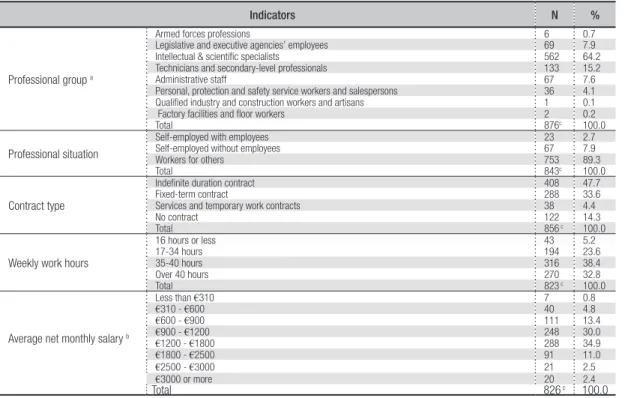
The second largest group consists of technicians and intermediate level professionals (15.2%). Whereas a more conservative perspective would consider such professional transition situation as indicating overqualification, we chose to assume that the positions of legislative
and executive agencies’ employees, intellectual and scientific specialists, technicians and intermediate level professionals, which correspond to the first three groups in the International Classification of Occupations, are usually occupied by graduates.
Indicators N %
Professional group a
Armed forces professions 6 0.7
Legislative and executive agencies’ employees 69 7.9
Intellectual & scientific specialists 562 64.2
Technicians and secondary-level professionals 133 15.2
Administrative staff 67 7.6
Personal, protection and safety service workers and salespersons 36 4.1 Qualified industry and construction workers and artisans 1 0.1
Factory facilities and floor workers 2 0.2
Total 876c 100.0
Professional situation
Self-employed with employees 23 2.7
Self-employed without employees 67 7.9
Workers for others 753 89.3
Total 843c 100.0
Contract type
Indefinite duration contract 408 47.7
Fixed-term contract 288 33.6
Services and temporary work contracts 38 4.4
No contract 122 14.3
Total 856 c 100.0
Weekly work hours
16 hours or less 43 5.2
17-34 hours 194 23.6
35-40 hours 316 38.4
Over 40 hours 270 32.8
Total 823 c 100.0
Average net monthly salary b
Less than €310 7 0.8
€310 - €600 40 4.8
€600 - €900 111 13.4
€900 - €1200 248 30.0
€1200 - €1800 288 34.9
€1800 - €2500 91 11.0
€2500 - €3000 21 2.5
€3000 or more 20 2.4
Total 826 c 100.0
a In the classification by professional type we used Classificação Nacional de Profissões (2010) (1-digit aggregate). b The classes considered for average net monthly salary follow INE’s proposal for 2010.
c The differences in the subtotals above are due to the lack of information for several indicators because of the non-answer rate, which ranged from 15 to 18%.
Table 1 – Professional situation of employed graduates
Regarding the professional transition of degree holders in the rest of the groups, a vertical mismatch was found (EUROSTAT, 2009). Teichler (2007) and Allen and Weert (2007) argue that the increase in education and qualification levels, combined with the innovations in technology, have complexified intermediate level positions, which were previously filled by non-degree holders, thus upgrading the required knowledge and competences. In Portugal, studies conducted recently also choose this interpretation (GONÇALVES, 2009; ALVES, 2009). However, this is not always
since being included into these groups does not require a university degree. Overqualification currently tends to be considered as one of the main indicators of (un)successful professional transition, and studies highlight the negative impact in the future for the build-up of professional disqualification situations (FORGEOT; GAUTIÉ, 1997; NAUZE-FICHET; TOMASINI, 2002).
With regard to professional situation and employment contract type, we found that 89.3% of graduates’ were working for others, and 47.7% had indefinite duration contracts. Among the rest, fixed-term contracts were dominant (33.6%). The bipartition of the sample in terms of contract type, between fixed-term and indefinite duration contracts, indicates a tendency towards flexible labor management that seems to have intensified in the last few years, contradicting the findings of the Portuguese observatory of higher education graduates’ (Sistema de Observação de Percursos de Inserção dos Diplomados do Ensino Superior - ODES) , according to which, 75% of those who got a degree in 1994/95 had entered indefinite duration contracts after five years (ODES, 2002).
With regards to weekly working hours, 38.4% of the individuals work from 35 to 40 hours. However, for 32.8% of these graduates, the number of weekly hours exceeds 40 hours, which may be considered a situation of overemployment, in contrast with the underemployment situation which characterizes those who only work part-time, who are also relevant in the sample, particularly those working from17 to 34 hours per week (23.6%).
Lastly, the net monthly salary analysis shows that there is a large group of graduates
(19.0%) earning less than €900, which is
significantly below the average net monthly income of Portuguese graduates for the same
period, i.e., €1,328 (INE, 2010). The most
frequently found salary range was from€1,200
to 1,800 (34.9%), closely followed by the
€900 to 1,200 group (34.9%). Only 15.9% of
graduates earn more than €1,800.
Professional situation patterns
MCA allowed us to understand specific features of the between the categories of multiple, as well as identifying different configurations of professional situation patterns (Chart 1).
It is worth emphasizing that salaries are distributed in a hierarchical way, from those
making less than €310 (upper left quadrant)
to those making more than €2,500 (lower left
quadrant). It is also important to note that this salary distribution is closely followed by the order found in the working hours category and (albeit not as linearly) in the contract type category – the later ranging from most to least precarious.
Moreover, it is worth noting the existence of a group of categories near the origin of axes, which indicates their transversal character, as with the group of specialists in intellectual and scientific activities: because of its large weight in the sample, this group appears associated with all types of salaries, contracts and number of weekly working hours. The same happens with the category of workers for others. Moving on to describing the different patterns of graduates’ professional situations, in the upper right quadrant we can see a configuration where the professional groups of technicians and intermediate-level professionals, administrative staff and service workers are associated with intermediate salaries
€600-1,200 and with 17-34 weekly working
hours. The dominant contract type associated with these groups is fixed-term contract.
In the lower right quadrant, a profile that combines the categories of indefinite duration contract, between 35 and 40 weekly working hours, and salaries ranging from €1,200 to 1800 can be found. The positioning of intermediate- level professionals and administrative staff (close to zero in the second dimension) indicate a situation where these professional groups are associated either with the first or the last configuration identified.
weekly working hours, both of which are also combined, albeit to a smaller extent (given the distance), with situations of self-employment without employees, involved in service and temporary work contracts or (to an even smaller extent) without a contract.
Finally, in the lower left quadrant, we have a profile that is characterized by higher salaries, associated with over 40 weekly working hours, with a prevalence of situations of self-employment with employees, and legislative employees standing out.
A typology of professional situations
Using individuals’ quantitative features in both MCA-defined structuring dimensions, we then conducted the classificatory analysis.
The exploratory analysis using hierarchical methods allowed establishing the pertinence of a five-group solution; next, the final typology was obtained using an optimization method (k-means), thus optimizing partition in groups.2 Chart 2 presents the complementary projection
of the 5 groups in the MCA plan,3 showing a
clear correspondence between the patterns previously found and the typology.
In order to describe the constructed typology, we will follow a sequential exposition strategy, i.e., from professional situation type 1 through to type 5 (with a series of intermediate positions), thus representing the progressive continuum existingin the labor market, which
2 - Information was available for the indicators used in only 75% of the sample (761 graduates).
3 - The profile of each professional situation type is available for reverence in Chart 2.
3
2
1
0
-1
-2
-3
-3 -2 -1 0 1 2 3
Dimension 2
Professional group Weekly work hours Salary
Professional situation Contract type Less than € 310 16 hours or less
€310-600 or less
Self-employed without employees
Service + temporary work
No contract
Intellectual & sci. specialists
Personal, protection and security service workers and salespersons
17-34 hours Fixed-term contract
€900-1,200 or less
€600 - €900 or less Administrative staff Technicians/secondary-level professionals
Workers for others 35-40 hours Dimension 1
€1,200-1,800 or less Indefinite duration contract
€1,800-2,500 or less
€3000 ou + euros
€3,000 or more
Legislative employees, management and senior management Self-employed with employees
Chart 1-–Disposition of characteristics of graduates’ professional situations
ranges from the most vulnerable, precarious situations, both in material and symbolical terms, to the most favorable ones according to the analyzed indicators.
Although the notion of precariousness is associated with contract instability, this concept acquires a wider significance, since stable employment contracts no longer constitute the standard relationship of professional transition among young people . Rebelo (2004) distinguishes contract instability situations (objective precariousness) from insecurity and uncertainty situations concerning the future, even when individuals have entered indefinite duration contracts (subjective precariousness). Also Paugam (2000, 2006) distinguishes employment precariousness (unstable employment contracts) from job precariousness
(concerning work satisfaction and motivation). Since we are not seeking to evaluate subjective or job precariousness, we chose to define professional situations according to the levels of fragility associated with the different dimensions of an employment relationship: contract nature, weekly working hours, salary earnings, and professional group.
Designated as markedly fragile
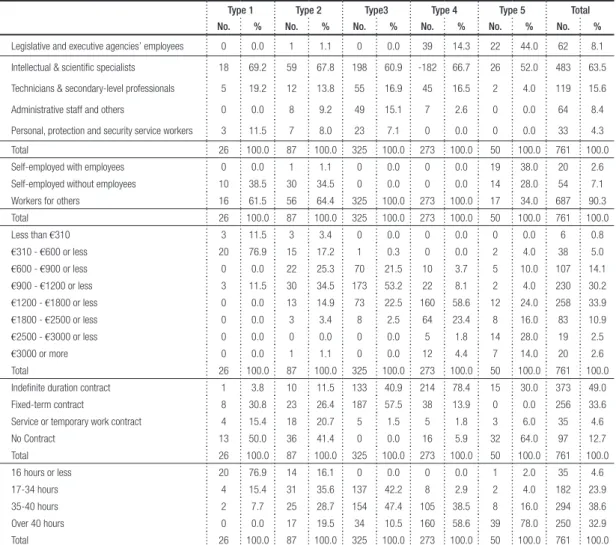
transition, type 1 is both the smallest group and the one with the highest rate of workers without a work contract, overqualified, and in severe underemployment (or part-time job) and underpayment situations. Absence of contract (50.0%) and fixed-term contracts (30.8%) were dominant. Characteristics of this group include fewer working hours, i.e., 16 or less hours per week (76.9%), indicating part-time
Chart 2 – Disposition of professional situation types
3
2
1
0
-1
-2
-1
-3 -2
-3
0 1 2 3
Type 1: Markedly fragile transition (3.4%)
Type 2: Fragile transition (11.4%)
Type 5: Qualifying transition (6.6%)
Type 3: Classic employment transition (42.7%)
Type 4: Qualifying employment transition (35.9%)
Professional group Weekly work hours Salary
Professional situation Contract type Professional Situation Type Less than € 31016 hours or less
€310-600 or less
Self-employed without employees
Service + temporary work
No contract Intellectual & sci. specialists
Personal, protection and security service workers and salespersons
17-34 hours Fixed-term contract
€900-1,200 or less
€600 - €900 or less Administrative staff
Technicians/secondary-level professionals
Workers for others 35-40 hours Dimension 1
€1,200-1,800 or less Indefinite duration contract
€1,800-2,500 or less
€3000 ou + euros
€3,000 or more
Legislative employees, management and senior management Self-employed with employees
work, low salaries (88.4% earn €600 or less), and a significant percentage of technicians and intermediate-level professionals (19.2%), and service workers (11.5%); in the latter case, inadequacy between education level and professional group is assumed.
Type 2, denominated fragile transition, has a few similar characteristics to those of type 1, however with working hours and earnings showing a lower level of vulnerability. Nevertheless, it is also a fragile professional situation, characterized by absence of contract, some degree of overqualification, and less severe underemployment and underpayment situations: 41.4% do not have a work contract, 26.4% have
a fixed-term contract, and 20.7% have either a service contract or a contract with a temporary agency. Moreover, self-employment without employees accounts for 34.5% of this group. In terms of weekly working hours, this group is in
sequence with the markedly fragile transition
type, i.e., a part-time work situation, however, with longer hours, as 35.6% work from 17 to 34 hours per week. The longer hours produce higher salaries; therefore, nearly 60% of the individuals earn between €600 and 1,200, 34.5% of these in the €900 to 1,200 range. In addition, a tendency towards overqualification is found in the two professional groups with 17.2% of the individuals (administrative staff and service workers).
Type 1 Type 2 Type3 Type 4 Type 5 Total
No. % No. % No. % No. % No. % No. %
Legislative and executive agencies’ employees 0 0.0 1 1.1 0 0.0 39 14.3 22 44.0 62 8.1 Intellectual & scientific specialists 18 69.2 59 67.8 198 60.9 -182 66.7 26 52.0 483 63.5 Technicians & secondary-level professionals 5 19.2 12 13.8 55 16.9 45 16.5 2 4.0 119 15.6
Administrative staff and others 0 0.0 8 9.2 49 15.1 7 2.6 0 0.0 64 8.4
Personal, protection and security service workers 3 11.5 7 8.0 23 7.1 0 0.0 0 0.0 33 4.3
Total 26 100.0 87 100.0 325 100.0 273 100.0 50 100.0 761 100.0
Self-employed with employees 0 0.0 1 1.1 0 0.0 0 0.0 19 38.0 20 2.6
Self-employed without employees 10 38.5 30 34.5 0 0.0 0 0.0 14 28.0 54 7.1
Workers for others 16 61.5 56 64.4 325 100.0 273 100.0 17 34.0 687 90.3
Total 26 100.0 87 100.0 325 100.0 273 100.0 50 100.0 761 100.0
Less than €310 3 11.5 3 3.4 0 0.0 0 0.0 0 0.0 6 0.8
€310 - €600 or less 20 76.9 15 17.2 1 0.3 0 0.0 2 4.0 38 5.0
€600 - €900 or less 0 0.0 22 25.3 70 21.5 10 3.7 5 10.0 107 14.1
€900 - €1200 or less 3 11.5 30 34.5 173 53.2 22 8.1 2 4.0 230 30.2
€1200 - €1800 or less 0 0.0 13 14.9 73 22.5 160 58.6 12 24.0 258 33.9
€1800 - €2500 or less 0 0.0 3 3.4 8 2.5 64 23.4 8 16.0 83 10.9
€2500 - €3000 or less 0 0.0 0 0.0 0 0.0 5 1.8 14 28.0 19 2.5
€3000 or more 0 0.0 1 1.1 0 0.0 12 4.4 7 14.0 20 2.6
Total 26 100.0 87 100.0 325 100.0 273 100.0 50 100.0 761 100.0
Indefinite duration contract 1 3.8 10 11.5 133 40.9 214 78.4 15 30.0 373 49.0
Fixed-term contract 8 30.8 23 26.4 187 57.5 38 13.9 0 0.0 256 33.6
Service or temporary work contract 4 15.4 18 20.7 5 1.5 5 1.8 3 6.0 35 4.6
No Contract 13 50.0 36 41.4 0 0.0 16 5.9 32 64.0 97 12.7
Total 26 100.0 87 100.0 325 100.0 273 100.0 50 100.0 761 100.0
16 hours or less 20 76.9 14 16.1 0 0.0 0 0.0 1 2.0 35 4.6
17-34 hours 4 15.4 31 35.6 137 42.2 8 2.9 2 4.0 182 23.9
35-40 hours 2 7.7 25 28.7 154 47.4 105 38.5 8 16.0 294 38.6
Over 40 hours 0 0.0 17 19.5 34 10.5 160 58.6 39 78.0 250 32.9
Total 26 100.0 87 100.0 325 100.0 273 100.0 50 100.0 761 100.0
Above type 2, a tendency of improvement in the employment situation begins to emerge which becomes intensified in professional situations of types 4 and 5.
Type 3, denominated classic employment
transition, is the largest group. Its denomination comes from its work situations being mostly connected to organizations, 47.4% work a full week of 35-40 hours, with fixed term contracts (57.5%) or indefinite duration contracts(40.9%), following the Fordist employment relation model, which became established after the 1930’s crisis in the USA, and after the Second World War in Western Europe; this model is associated with the monopolistic regulation model (BOYER, 1986), which relied on economic growth and eventually guaranteed job stability, as well as direct and indirect earnings. It is noteworthy that 86% of graduates in this group
were receiving a €900 or higher salary (53.2%
earning €1,200 or less, while 22,5% between
€1,200 and 1,800), which represents a higher
income than Portugal’s net monthly average for the same period (€7854). Fixed term or indefinite duration contracts are dominant, in contrast with the previous groups, although graduates in overqualification situations have a slightly superior weight in this group (22.2%).
Type 4 corresponds to Classic qualifying employment transition, which comprehends graduates who work for others only. It differs from the previous group because of its greater job stability, high salaries and long working hours, thus presenting – except for the working hours (58.6% work over 48 weekly hours) – more favorable conditions in terms of symbolic and material capitalization, hence the word qualifying. Indeed, 58.6% receive
salaries ranging from €1,200 to 1,800, while
23.4% are in the €1,800 to 2,500 range; 78.4%
have an indefinite duration contract. In terms of professional group, although intellectual and scientific specialists are the majority, technicians and intermediate-level professionals
4- Source: INE (2010).
(16.5%), and legislative and executive agencies’ employees (14.3%) have some significance.
Finally, type 5 is called qualifying
transition of business owners, consultants and well-capitalized independent professionals, as it is formed by public administration employees and business owners (with or without employees) in professional groups that match their education level, in overemployment and overpayment situations. With regard professional situation, a balanced distribution was found between the self-employed with employees (38.0%) and employees (34.0%). In fact, this is the only group where the self-employed with employees are relevant, although the self-employed without employees (28%) cannot be neglected. Indefinite duration contracts (30.0%) and the absence of an employment contract (64%) are dominant. This group is distinct from the others because of its overpayment and overemployment condition, with 42.0% of individuals receiving salaries
above €2,500, and 78.0% working more than
40 hours per week. It is also the group with the highest proportion of legislative and executive agencies’ employees (44.0%), which means a lower relevance of intellectual and scientific specialists (52.0%) in comparison with the other groups.
Types of professional situation and field of study
One of the questions initially raised, which this study aimed to answer, was the relationship between graduates’ professional situation and their study field, as the latter is often mentioned as one of the main variables for determining the success of professional
paths. Machado et al. (2003) mention the
In our sample, regarding the study field (Chart 3), Arts and Humanities are dominant in professional situation types 1 and 2. These are actually the types in which these fields are most relevant (especially type 1, with 42.3%). In type 2, Arts and Humanities stand out (36.8%), along, to some extent, with Law and Education (both with 17.2%). Although Arts and Humanities are also the most frequent situation in type 3 (28.3%), graduates in Education still have a significant influence in this group, accounting for 18% of cases; Physical Sciences also have some relevance in this group. Type 4 is clearly marked by graduates in the field of Health, who are dominant (20.9%), followed by Economy and Business Management degree holders (15.4%). As for type 5, Law is clearly
dominant (44%), with Arts and Humanities still relatively significant, although their proportion decreases as professional situations become more qualified, with 16% in the most qualifying type of professional situation.
This information allows us to indicate global tendencies, although in an explanatory way: i) the transversality of the presence of Arts and Humanities graduates in the hierarchy of professional situations, although their dominance occurs in the most fragile situations (types 1 and 2); ii) the near inexistence of Education graduates in the most qualified professional situations (types 4 and 5); the presence of Health, Economy, Business Management, and Law in the top levels of professional situation hierarchy.
Chart 3 – Graduates’ field of study by professional situation type
Field of Study Education
Arts & humanities
Social sciences & journalism
Economy & administration
Law
Life sciences
Physical sciences
Mathematics, statistics and informatics
Engineering, manufacturing and construction
Health 100.0%
80.0%
60.0%
40.0%
20.0%
0.0%
Type 1:
markedl
y
fra
gile transition
Type 2:
fra
gile transition Type 3:
Classic
employment transition
Type 4:
Qualifying
employment transition Type 5:
Qualifying
transition
A relationship seems to exist that underlies that of professional situations and study fields, namely, the relationship between graduates’ field of study and parental educational background, which has been pointed by several authors (GIRET, 2000; ALVES, 2009, CHAVES, 2010). In this respect, Alves (2009) stresses the overrepresentation of parents with a background in specific fields like health, life sciences, and law. In his study on young lawyers in Lisbon, Chaves (2010) indicates the clear connection between family wealth and the choice for specific education institutions, which are ranked in the symbolic dimension of social prestige. The relevance of family wealth extends into the labor market through youths’ entry into it: the children of wealthier parents work at large law firms, thus receiving higher salaries.
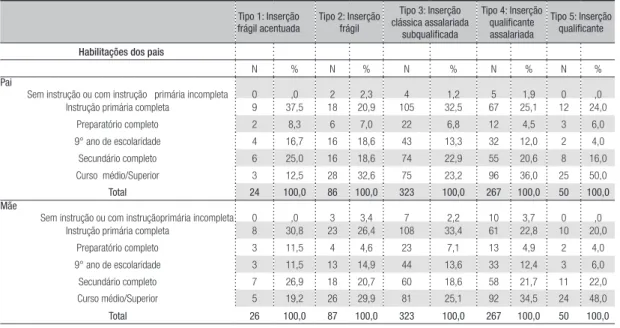
The relevance of parental educational background often emerges as a key factor in students’ chosen field of study; it is strongly associated with a symbolic hierarchy and, consequently, with students’ positioning in the social-professional structure. Therefore, regarding the qualifications of these graduates’ parents, the first thing we must mention is the fact that these are individuals whose parents are highly qualified. Indeed, 32% of the fathers and 30% of
the mothers of these graduates have high school diplomas or university degrees. However, this condition coexists with another relevant group of graduates whose parents However, this condition coexists with another relevant group of licentiates whose parents have primary school education only (about 27% of fathers and mothers). Consequently, it is hardly surprising that both higher and lower qualification levels also have an impact on the various types of professional situation. However, small differences can be detected. A stronger presence of fathers and mothers with university degrees in the most qualified types of professional situations is visible, with around 50% in the most qualifying situation (type 5); in contrast, fathers and mothers with low qualification levels are dominant among graduates in markedly fragile situations (type 1): 43.5% of parents and 47.8% of mothers have only primary school education (Table 3). We can cautiously infer a tendency in line with social reproduction theses (BOURDIEU; BOLTANSKI, 1975). Such social reproduction tends to be reflected on the quality of professional situations, despite the condition of holding a university degree, once viewed as a means to ease classist distinction with an unquestioned power to provide upward social mobility.
Table 3 – Parental educational background by professional transition type
Tipo 1: Inserção frágil acentuada
Tipo 2: Inserção frágil
Tipo 3: Inserção clássica assalariada
subqualificada
Tipo 4: Inserção qualificante assalariada
Tipo 5: Inserção qualificante
Habilitações dos pais
N % N % N % N % N %
Pai
Sem instrução ou com instrução primária incompleta 0 ,0 2 2,3 4 1,2 5 1,9 0 ,0 Instrução primária completa 9 37,5 18 20,9 105 32,5 67 25,1 12 24,0
Preparatório completo 2 8,3 6 7,0 22 6,8 12 4,5 3 6,0
9° ano de escolaridade 4 16,7 16 18,6 43 13,3 32 12,0 2 4,0
Secundário completo 6 25,0 16 18,6 74 22,9 55 20,6 8 16,0
Curso médio/Superior 3 12,5 28 32,6 75 23,2 96 36,0 25 50,0
Total 24 100,0 86 100,0 323 100,0 267 100,0 50 100,0
Mãe
Sem instrução ou com instruçãoprimária incompleta 0 ,0 3 3,4 7 2,2 10 3,7 0 ,0 Instrução primária completa 8 30,8 23 26,4 108 33,4 61 22,8 10 20,0
Preparatório completo 3 11,5 4 4,6 23 7,1 13 4,9 2 4,0
9° ano de escolaridade 3 11,5 13 14,9 44 13,6 33 12,4 3 6,0
Secundário completo 7 26,9 18 20,7 60 18,6 58 21,7 11 22,0
Curso médio/Superior 5 19,2 26 29,9 81 25,1 92 34,5 24 48,0
Final considerations
The data presented above allow us to reject the most pessimistic scenarios about graduates’ professional transition, seeing as human capital theory (BECKER, 1983) appears to remain valid for the studied sample, as education investments have actually produced returns to a considerable part of these graduates through a stable, qualification-adequate, well-paid job. In fact, our findings corroborate those of other national and international studies (TEICHLER, 2007; ALVES, 2009; GONÇALVES, 2009, ODES, 2002) which emphasize the maintenance of favorable indicators in the professional transition of young graduates in a context of real and symbolic devaluation of certificates.
However, it is important to mention a few peculiarities and tendencies. On one hand, data concerning the differentiation of professional situations according to study field may suggest that higher education access inequalities have been transferred to certain courses and institutions. Differentiation in accessing the most favorable jobs is structured according to study field: Health, Economy, Business Administration and Law are overrepresented in this situation in comparison to Education, Arts and Humanities, Law, which prevail in the most precarious situations. This indicates that certain orders provide greater employability because of the public status and prestige of professions and professional groups associated with them. By combining the study field factor
with parental educational background, which seems to impact, albeit less intensely, the social-professional distribution of graduates, we move towards Bourdian tendencies regarding social reproduction. The choices for, and opportunities to enter, particular study fields upon entering university seem to be paramount for the future of professional paths. These choices and opportunities may suggest the relevance of parental educational background.
References
ALLEN, Jim; WEERT, Egbert. What do educational mismatches tell us about skill mismatches ? A cross-country analysis. European Journal of Education, v. 42, n. 1, p. 59-73, 2007.
ALVES, Mariana Gaio. A inserção profissional de diplomados de ensino superior numa perspectiva educativa: o caso da faculdade de ciências e tecnologia. Tese (Doutorado em Ciências da Educação) – Faculdade de Ciências e Tecnologia, Universidade Nova de Lisboa, Lisboa, 2003.
______. A inserção profissional de diplomados de ensino superior numa perspectiva educativa: o caso da Faculdade de Ciências e Tecnologia. Lisboa: Fundação Calouste Gulbenkian/Fundação para a Ciência e Tecnologia, 2007.
ALVES, Natália. Trajectórias académicas e de inserção profissional dos licenciados pela Universidade de Lisboa: 1994-1998 1994-1998: relatório de inquérito realizado em 1999. Lisboa: Gabinete de Apoio ao Estudante, 2000.
______. Trajectórias académicas e de inserção profissional dos licenciados 1999-2003. Lisboa: DST – Divisão de Planeamento e Gestão/UL, 2005.
______. Juventudes e inserção profissional. Lisboa: Educa, 2008.
______. Inserção profissional e formas identitárias: o caso dos licenciados da Universidade de Lisboa. Lisboa: Educa e Unidade de I&D de Ciências da Educação, 2009.
BECKER, Gary. Human Capital. Chicago: Chicago University Press, 1983.
BOURDIEU, Pierre; BOLTANSKI, Luc. Le titre et le poste. Actes de la Recherche en Sciences Sociales, v. 2, p. 95-107, 1975.
BOYER, Robert (Org.). La flexibilité du travail en Europe. Paris: La Découvert, 1986.
CARVALHO, Helena. Análise de multivariada de dados qualitativos: utilização da análise de correspondências múltiplas com o SPSS. Lisboa: Sílabo, 2008.
CHAVES, Miguel. Jovens advogados de Lisboa: uma inserção profissional díspar. Tese (Doutorado em Sociologia) – Universidade Nova de Lisboa, Lisboa, 2007.
______. Confrontos com o trabalho entre jovens advogados: as novas configurações da inserção profissional. Lisboa: Imprensa de Ciência Sociais (ICS), 2010.
DUBAR, Claude. La socialisation: construction des identities sociales et professionnelles. Paris: Armand Colin, 1991.
______. La construction sociale de l’insertion professionnelle. Éducation et Sociétés, n. 7, p. 23-37, 2001.
ESCÁRIA, Vitor. Percursos de inserção no mercado de trabalho dos diplomados do ensino superior. Lisboa: DGEEP, 2006.
EUROSTAT. The Bologna process in higher education in Europe: key indicators on the social dimension and mobility. Luxembourg: Office for Official Publications of the European Communities, 2009.
______. Tertiary educational attainment by sex, age group 30-34 and NUTS 1 regions. 2012. Disponível em: <http://epp. eurostat.ec.europa.eu/tgm/table.do?tab=table&init=1&language=en&pcode=tgs00105&plugin=1>. Acesso em: 26 ago. 2012.
______. Tertiary students (ISCED 5-6) by field of education and sex. 2012. Disponível em: <http://appsso.eurostat.ec.europa. eu/nui/show.do?dataset=educ_enrl5&lang=en>. Acesso em: 26 ago. 2012.
FORGEOT, Gértard; GAUTIÉ, Jérôme. Insertion professionnelle des jeunes et processus de déclassement. Economie et Statistique, n. 304-305, p. 53-74, 1997.
GEER, Van de. Multivariate analysis of categorical data: applications. London: Sage, 1993a.
______. Multivariate analysis of categorical data: theory. London: Sage, 1993b.
GIFI, Albert. Nonlinear multivariate analysis. New York: John Wiley & Sons, 1996.
GIRET, Jean-François. Pour une économie de l’insertion professionnelle des jeunes. Paris: CNRS Éditions, 2000.
GONÇALVES, Carlos (Ed). Licenciados, precariedade e família. Vila da Feira: Estratégias Criativas, 2009.
(INE) INSTITUTO NACIONAL DE ESTATÍSTICA. Disponível em: <http://metaweb.ine.pt/sim/conceitos/Detalhe.aspx?cnc_ cod=1459&cnc_ini=07-04-2006>. Acesso em: 15 mar. 2012.
______. Estatísticas do emprego, 4. trim. 2010.
______. Estatísticas do emprego, 1. trim. 2010
PORDATA, Base de Dados Portugal Contemporâneo. Salário médio mensal dos trabalhadores por conta de outrem: remuneração base e ganho por sexo. 2009. Disponível em: <http://www.pordata.pt/Portugal/Salario+medio+mensal+dos+trabal hadores+por+conta+de+outrem+remuneracao+base+e+ganho+por+sexo-894>. Acesso em: 15 set. 2012.
MACHADO, Fernando Luís et al. Classes sociais e estudantes universitários: origens, oportunidades e orientações. Revista Crítica de Ciências Sociais, n. 66, p. 45-80, 2003.
MARQUES, Ana Paula. Entre o diploma e o emprego: a inserção profissional de jovens engenheiros. Porto: Afrontamento, 2006.
MARTINEZ, Marie-France. L’insertion des jeunes diplomés: une formation à l’aide au choix d’ un premier emploi. In: CHARLOT, Bernard ; GLASMAN, Dominique. Les jeunes, l’insertion, l’emploi. Paris: Presses Universitaires de France, 1999. p. 1-308.
MARTINS, António; ARROTEIA, Jorge Carvalho; GONÇALVES, Maria Manuela. Sistemas de (des)emprego: trajectórias de inserção. Aveiro: UA, 2002.
MAURIN, Eric. La peur du declassement. Seuil: La République des Idées, 2009.
MEULMAN, Jacqueline J. The integration of multidimensional scaling and multivariate analysis with optimal transformations. Psychometrika, v. 57, n. 4, p. 539-565, 1992.
MINISTÉRIO DO TRABALHO E SOLIDARIEDADE SOCIAL (MTSS). Flexibilidade e segurança no mercado de trabalho português. Lisboa: DGEEP/MTSS, 2006.
MULLER, Walter; GANGL, Markus. The transition from school to work. In: MULLER, Walter; GANGL, Markus (Eds.). Transitions from education to work in Europe. Oxford: Oxford Scholarship, 2003. p. 1-19.
NAUZE-FICHET, Emmanuelle; TOMASINI, Magda. Diplôme et insertion sur le marché du travail: approaches socioprofessionnelle et salariale du déclassement. Économie et Statistique, n. 354, p. 21-43, 2002.
OCDE. Education at a glance 2011. OCDE Publishing, 2011.
ODES. Inquérito piloto aos diplomados do ensino superior 1999: primeiros resultados. Lisboa: Inofor, 2000.
______. Apresentação do 1. inquérito de percurso aos diplomados do ensino superior – 2001. Lisboa: Odes/Inofor, 2002.
OLIVEIRA, Luísa; CARVALHO, Helena. Regulação e mercado de trabalho: Portugal e a Europa. Lisboa: Sílabo, 2010.
PARENTE, Cristina et al. Efeitos da escolaridade nos padrões de inserção profissional juvenil em Portugal. Sociologia: Problemas e Práticas, Lisboa, n. 65, p. 69-93, 2011.
______. A desqualificação social: ensaio sobre a nova pobreza. Porto: Porto, 2006.
RAFFE, David. La construction sociale de la recherche transnationale sur l’insertion sociale et professionnelle: le Réseau européen de recherche sur l’insertion professionnelle des jeunes. Education et Sociétés, v. 7, n. 1, p. 111-129, 2001.
REBELO, Glória. Flexibilidade e precariedade no trabalho. Edição da autora, 2004.
ROSE, Jose. Les jeunes face à l’emploi. Paris: Desclée de Brouwer, 1998.
TEICHLER, Ulrich. Does Higher education matter? Lesson from a comparative graduate survey. European Journal of Education, v. 42, n. 1, p. 12-34, 2007.
______. Higher education and the world of work: conceptual frameworks, comparative perspectives, empirical findings. Rotterdam: Sense, 2009.
TEICHLER, Ulrich; KEHM, Barbara. Towards a new understanding of the relationships between higher education and employment. European Journal of Education, v. 30, n. 2, p. 115-132, 1995.
TROTTIER, Claude. La sociologie de l’éducation et l’insertion professionnelle des jeunes. Éducation et Sociétés, n. 7, p. 5-22, 2001.
VERNIÈRES, Michel. L’insertion profissionnelle: analyses et débats. Paris: Economica, 1997.
VINCENS, Jean. L’insertion profissionnelle des jeunes. à la recherche d’une definition conventionnelle. Formation Emploi, n. 60, p. 21-36, 1997.
______. L’insertion profissionnelle des jeunes: quelques réflexions théoriques. Formation Emploi, n. 61, p. 59-72, 1998.
Received on: 12.14.2012
Approved on: 05.22.2013
Madalena Ramos is a Graduate in Sociology, has a PhD in Education, is an Assistant Teacher at Departamento de Métodos de Pesquisa Social do Instituto Universitário de Lisboa (ISCT-IUL) and researcher at Centro de Estudos e Investigação em Sociologia (CIES-IUL).
Cristina Parente is a graduate and has a PhD in Sociology, Masters in Management and Human Reources Policies, is an Assistant Professor with Aggregation at Departamento de Sociologia da Faculdade de Letras da Universidade do Porto (FLUP) and researcher at Instituto de Sociologia da FLUP (IS-FLUP).