Fisioter. Mov., Curitiba, v. 28, n. 1, p. 85-95, Jan./Mar. 2015 Licenciado sob uma Licença Creative Commons DOI: http://dx.doi.org.10.1590/0103-5150.028.001.AO09
[T]
Healthy preterm infants: global motor
coordination and early intervention
[I]
Crianças pré-termo saudáveis: coordenação
motora global e intervenção precoce
[A]
Alice Sá Carneiro Ribeiro[a], Cibelle Kayenne Martins Roberto Formiga[b], Ana Cristina de David[c]*
[a] Centro Integrado Tiradentes (Unit), Maceió, AL, Brazil [b] Universidade Estadual de Goiás (UEG), Goiânia, GO, Brazil [c] Universidade de Brasília (UnB), Brasília, DF, Brazil
[R]
Abstract
Introduction: Studies recommend a participation by preterm children (PT) in Early Intervention Programs (EIP), as the coordination dysfunctions appear to occur more frequently in premature school children. Objectives: Describe the global motor coordination (MC) in PT children that participate in an EIP; verify the difference in MC between the sexes and correlate the coordination results of PT children and those with ges-tation age (GA) and the birth weight (BW); and compare the results of MC between PT children and full-term children (FT). Materials and methods: 57 children (5-6 years old) – 20 PT that participate in EIP, and 37 FT. For the analysis of MC, it was used the Körperkoordination für Kinder (KTK) – Test of Body Coordination for Children. To the comparisons, it was used independent-samples T-test and the Mann-Whitney test (α = 0.05), and the Pearson correlation to verify the influence of GA and BW in the coordinated results. Results: 80% of the PT children presented normal MC; the girls demonstrated a better performance on the tasks balance
86
beam and lateral jumps and with regard to the MC corresponding to the sum of the gross scores on the tasks; the GA and BW did not influence MC; and, there was no difference between MC in PT and FT children. Conclusion: The PT children presented, in their majority, satisfactory levels of MC, and the girls presented better results. In addition, the GA and BW did not interfere in the MC results. Lastly, there was no difference in the coordination performance between PT and FT children.
[P]
Keywords: Coordination. Motor skills. Premature. Child.
[B] Resumo
Introdução: Estudos indicam a participação de crianças pré-termo (PT) em programas de intervenção precoce (PIP), visto que as desordens coordenativas parecem ocorrer com mais frequência em escolares prematuros.
Objetivos: Descrever a coordenação motora (CM) global de crianças PT que participaram de um PIP; verifi -car a diferença da CM entre os sexos e correlacionar os resultados coordenativos das crianças PT com a idade gestacional (IG) e o peso ao nascimento (PN); e comparar os resultados da CM entre crianças PT e a termo (AT). Materiais e métodos: 57 crianças (5-6 anos) – 20 PT, que participaram do PIP, e 37 AT. Para análise da CM, utilizou-se o Teste de Coordenação Corporal para Crianças – Körperkoordination für Kinder (KTK). Para as comparações, utilizaram-se o Teste t de Student para amostras independentes e o Teste de Mann-Whitney
(α = 0,05), além da correlação de Pearson para verificar influência da IG e do PN nos resultados coordenativos.
Resultados: 80% das crianças PT demonstraram CM normal; as meninas apresentaram melhor desempenho nas tarefas trave de equilíbrio e saltos laterais e no resultado da CM correspondente ao somatório dos escores
brutos das tarefas; a IG e o PN não influenciaram na CM e não houve diferença entre as CM das crianças PT e
AT. Conclusão: As crianças PT apresentaram, em sua maioria, níveis satisfatórios de CM, e as meninas
apresen-taram melhores resultados. Além disso, a IG e o PN não interferiram nos resultados coordenativos. Por fim, não
houve diferença de desempenho coordenativo entre as crianças PT e AT. [K]
Palavras-chave: Coordenação. Habilidade motora. Prematuridade. Criança.
Introduction
Children born prematurely, who have not com-pleted their intrauterine development, present func-tional and structural immaturity in their systems (1) which would be related to their greater possibility of developing: delay in their weight and height, altera-tions in the development of motor skills, intellectual deficiency, hearing loss, compromised visual sense, difficulty with linguistics, cardiovascular problems, respiratory problems, attention deficit, hyperactiv -ity, among others (2-4). There is a description by the World Health Organization that classifies the prema -ture child by their gestational age (GA), as late preterm (GA between 32 and 37 incomplete weeks); moderate preterm (GA between 28 and 32 incomplete weeks) and extremely preterm (GA under 28 weeks) (5).
In the preschool and school phases, in what we refer to as motor skills in these children, there is an emphasis on motor skills coordination (MC) and their
components, such as, for example, postural balance (3, 4, 6-9). These investigations are important, since MC is considered a fundamental component for the development of various motor skill abilities. Studies suggest that coordination dysfunctions appear to oc-cur in a greater frequency in premature school chil-dren or preterm (PT) chilchil-dren born under weight or extremely underweight (6-8). On the other hand, a study indicated that there is no influence between the low weight at birth and the MC in a group of PT children from Portugal with ages 7 to 10 (9). The birth weight (BW) considered is classified as follows: low weight (BW < 2500 g), very low weight (BW < 1500 g), and extreme low weight (BW < 1000 g) (10).
87 still exerts influence in the motor skill capacities in
the long term.
One of the tests used to evaluate the MC in chil-dren is the Test of Body Coordination for Chilchil-dren – Körperkoordination für Kinder(KTK), which is applied with children born prematurely (6, 9) and involves corporal coordination components such as dynamic balance, peripheral awareness, velocity, strength in inferior members, and space and time structuring. These components were distributed in four exercises: balance beam, hopping on one leg, jumping sideways and shifting platforms. These tests evaluates both global MC as well as identifies children with coordi -nation or motor skill dysfunctions (13).
Due to the reports and stories regarding the dif-ficulties in development of PT children, still in their school age, some authors highlight the importance of accompanying these children both through follow up or sequential programs as well as early intervention programs (3, 7, 8, 14). As the focus of this study, the early intervention programs verify the multiple risk factors and the guiding protections of development, to elaborate preventive measures and the promotion of infant development (15) including activities, op-portunities, and procedures, destined to promote the development of the child. In this manner, the early intervention programs appear to allow that PT chil-dren develop motor skill strategies to perform their activities (16).
In this context, the objectives of the study were: (a) describe the global MC in children born prematurely, that participate in an early intervention program; (b) verify the difference in global MC between the sexes of PT children; (c) correlate the coordinative results of these children with perinatal variables (gestational age and birth weight); (d) Compare the results of the MC between children born PT and full-term (FT).
Materials and methods
Ethical caution and characterization of the study
The study is classified as a transversal observa -tion type. To all the parents or legal guardians of the children it was explained the procedures of the study, and the participation of the children was guaranteed
after reading and signing the Term of Clarified Free Consent. The present study was approved by the Ethical Committee in Research of the Medical School of University of Brasília (UnB), with protocol number 078/2009, according to Resolution n. 196/96.
Participants
57 children, ages 5 and 6, of which 20 were born PT (9 girls and 11 boys) and 37 (25 girls and 12 boys) were born FT, participated in the study.
In the group of children born PT, those accompa-nied by the early intervention program in Ceilândia – Federal District, Brazil, were also included. It were considered those that entered the program with 4 months (± 2 months) and left the program with at least 3 years and 6 months (± 2 months); those who presented an Apgar value in the 5th minute > 7,
according to the summary on the hospital release form1; and, those that evolved without neuro-motor
or orthopedic alterations, according to the follow-up reports of the program’s team. In the grofollow-up of FT children, the study included those that presented an Apgar value in the 5th minute > 7, according to
the information on the child’s card. Those children that presented a dysfunction or disturbance asso-ciated with intellectual deficiency, neurological pa -thology, orthopedic problems, genetic syndromes, sensory dysfunctions, and congenital malformations were excluded.
Early intervention program
The early intervention program referred to in this study provides assistance to children with neuro-psychomotor developmental delay in the early days/ months. Among these are those born PT that, accord-ing to the Federal District (17), are “[...] considered at risk for being vulnerable and shown delay in their global development, based on Decree 6.571/2008”. The children are accompanied and encouraged from birth to 3 years and 11 months when, after this age, are sent to preschool. Throughout their stay in the program, a multidisciplinary team promotes the de-velopment of the child's strengths (17-19).
88
Within the early intervention program, there is a motor skills intervention made by professional involved with individual intervention for the neuro-motor infant development. The activities developed aimed at multiple motor-sensory experiences.
There is a report in which documents are attached, such as medical treatment, exams performed at the Neonatal Intensive Therapy Unit, copy of the hospital release forms (filled out by the neo-natal doctor) with the pre, peri, and post natal data, as well as the pe-riodic evaluations highlighting the evolution of neu-ropsychomotor development abilities. The variables GA and birth weight (BW) of the PT children were collected from the hospital release forms contained in the individual reports.
Test of Body Coordination for Children – Körperkoordination für Kinder (KTK)
The KTK involves components on corporal coordi-nation distributed into four exercises: balance beam (BB), hopping on one leg (HO), jumping sideways (JS) and shifting platforms (SP). On the balance beam, three different beams are used with widths of 6 cm, 4.5 cm, and 3 cm.
The test was performed following the original de-scriptions with a confidence interval of 0.90 when performing the full battery of tests, which demon-strates the credibility of its application (20). The test is adequate for children from 5 to 14 years and 11 months and its application lasts approximately 10 to 15 minutes per child (13).
For the global MC classification, the origi -nal Kiphard and Schilling (20) tables were used. According to the authors, the final score of each ex -ercise is converted into motor quotient (MQ). This procedure is performed referring to the reference tables for each test, according to the sex and age of the participant to perform a summation and obtain the total MQ. The total MQ indicates, through a ref-erence table, to the final MQ, which allows the clas -sification of the level of coordination performance as: insufficient coordination (MQ ≤ 70), coordination disturbance (71 < MQ < 85), normal coordination (86 < MQ < 115), good coordination (116 < MQ < 130), and very good coordination (MQ ≥ 131) (13).
Even though there is no validation for various populations that participate in the studies published using KTK, including the Brazilian population, many
of the studies still uses the standard tables of the test to classify the MC (21-24). Due to this fact, in the pres-ent study the tables were also used, as it describes the sum of the gross scores (Coordination) acquired in the four proposed exercises, as performed by vari-ous authors (25-26).
Statistical analysis
The study performed the descriptive analysis of the global MC and its components. The normal dis-tribution of the data was verified using the Shapiro-Wilk test. To compare the results of the MC (total MQ, final MQ, and Coordination) between the sexes of the PT children, it was used the independent-samples T-test and the Mann-Whitney test. For the analysis of the correlation between the coordination com-ponents, the result of the global MC and the prena-tal variables (GA and BW), the Pearson correlation test was used. In all of the situations described, the significance level considered was 5%. The program used was the Statistical Package for the Social Science (SPSS) version 17.0.
Results
With regard to PT children, 16 (80%) were classi-fied as late premature and 4 (20%) moderately pre -mature (5). In addition to this, all were classified as underweight at birth, of which 7 (40%) were very un-derweight and 1 (5%), extremely unun-derweight (10).
Table 1 presents the characteristics of the partici-pating children, with birth data and the anthropomet-ric variables collected on the day the KTK motor tests were applied. In this table, the data of the full-term group (FTG) and of the preterm group (PTG) were included, distinguished by sex.
The results of the global MC of the PT children indicate that 5% (1 child) presented good coordina-tion, 80% (16 children) normal coordinacoordina-tion, 10% (2 children) coordination disturbance, and 5% (1 child) insufficient coordination. As such, the majority (85%) of the PT children demonstrated satisfactory levels (normal and good) of global MC.
89 presented levels within normality. As for the girls,
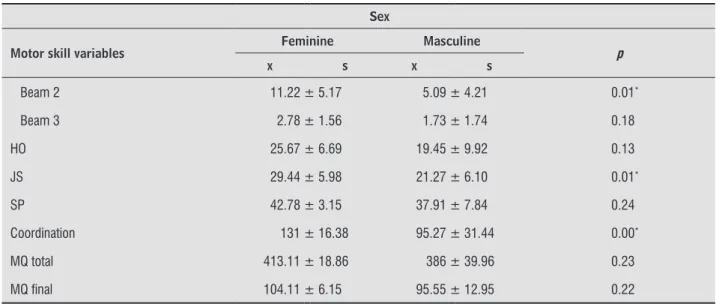
all demonstrated satisfactory levels (normal and good). The comparison between gender coordina-tion results and its components is demonstrated in Table 2. It is important to note that total MQ and final MQ refer to the normal distribution tables of the test, and the Coordination variable to the sum of the gross scores of each test, regardless of the reference values in the KTK.
We can observe that girls presented a better per-formance than boys in the BB and JS tasks (p < 0.05), and in the results of global MC correspond to the sum of the gross scores (Coordination) acquired in the four tasks. Regarding the BB tasks, we can note that the girls presented results significantly better on beams 1 and 2, which correspond to the 6 and 4.5 cm wide beams.
No statistically significant relationship was ob -served between the results of global MC and the pre-natal variables (GA and BW), (p > 0.05).
In the comparison between coordination perfor-mance of PT children (PTG) and full-term (FTG), the majority of children demonstrate MC within the nor-mal distribution (FTG = 28 kids and PTG = 16 kids). In FTG, 16% (6 children) of the children presented good levels of the global MC and in counterpart 5%
(1 child) in the PTG. The same quantity of children in both groups presented disturbance levels (2 children) and insufficiency (1 child) in the MC.
The comparison between the motor skills perfor-mance of the FTG and PTG groups is demonstrated in Table 3.
There was no significant difference between the results of the two groups analyzed, even though it appeared to exist a tendency of disadvantage in the children born prematurely, upon observing the aver-age values of the two groups.
Discussion
According to the objectives proposed in the pres-ent study, it was established that: 1) the majority of PT children analyzed presented satisfactory global MC, classified as normal and good, according to the criteria of the KTK; 2) the PT girls presented a better performance than the boys in the BB and JS tasks and in the global MC results, corresponding to the sum of the gross scores acquired in the four tasks; 3) there was no significant statistical difference between the coordination performance of the FT and PT groups of children.
Table 1 - Characteristics of the study participants (average value ± standard deviation)
Groups Sex GA (weeks) BW (g) Length (cm) Body Mass (kg)
FTG
Feminine (N = 25) 39.61 ± 0.97 3024.60 ± 307.94 116.16 ± 6.05 23.07 ± 6.02
Masculine (N = 12) 39.96 ± 1.15 3132.92 ± 423.84 114.54 ± 6.62 21.58 ± 6.12
TOTAL (N = 30) 39.72 ± 1.03 3059.73 ± 347.49 115.64 ± 6.20 22.58 ± 6.01
PTG
Feminine (N = 9) 33.48 ± 1.83 1582.22 ± 461.95 117.78 ± 4.40 21.26 ± 2.72
Masculine (N = 11) 33.59 ± 2.47 1629.55 ± 420.37 113.55 ± 5.07 20.10 ± 3.10
TOTAL (N = 20) 33.54 ± 2.15 1608.25 ± 428.30 115.45 ± 5.13 20.62 ± 2.92
Note: FTG = full-term group; PTG = PT group; GA = gestational age; BW = birth weight.
Table 2 - Scores in the battery of KTK tests of girls and boys born preterm
Sex Motor skill variables
Feminine Masculine
p
x s x s
BB 33.11 ± 9.60 16.64 ± 10.69 0.00*
Beam 1 19.11 ± 6.05 9.82 ± 6.55 0.01*
90
Table 2 - Scores in the battery of KTK tests of girls and boys born preterm
Sex
Motor skill variables Feminine Masculine p
x s x s
Beam 2 11.22 ± 5.17 5.09 ± 4.21 0.01*
Beam 3 2.78 ± 1.56 1.73 ± 1.74 0.18
HO 25.67 ± 6.69 19.45 ± 9.92 0.13
JS 29.44 ± 5.98 21.27 ± 6.10 0.01*
SP 42.78 ± 3.15 37.91 ± 7.84 0.24
Coordination 131 ± 16.38 95.27 ± 31.44 0.00*
MQ total 413.11 ± 18.86 386 ± 39.96 0.23
MQ inal 104.11 ± 6.15 95.55 ± 12.95 0.22
Note: BB = Balance beam (Beam 1 = 6 cm wide beam; Beam 2 = 4.5 cm wide beam; Beam 3 = 3 cm wide beam); HO = hopping on one leg; JS = jumping sideways; SP = shifting platforms; MQ total = total motor quotient; MQ inal = inal motor quotient; X = average; S = standard deviation; * p < 0.05.
Table 3 - Scores in the battery of KTK tests of the groups of children preterm (PTG) and full-term (FTG)
Classification Variables motor skill
FTG (N = 37) PTG (N = 20)
p
x s x s
BB 23.97 ± 11.37 24.05 ± 13.02 0.98
Beam 1 14.35 ± 6.69 14.00 ± 7.78 0.86
Beam 2 6.57 ± 3.93 7.85 ± 5.51 0.49
Beam 3 3.05 ± 2.43 2.20 ± 1.70 0.27
HO 24.24 ± 12.54 22.25 ± 8.98 0.53
JS 25.05 ± 7.66 24.95 ± 7.21 0.96
SP 42.14 ± 5.91 40.10 ± 6.54 0.50
Coordination 115.41 ± 29.75 111.35 ± 31.08 0.63
MQ total 407.22 ± 41.58 399 ± 35.54 0.46
MQ inal 102.22 ± 13.42 99.65 ± 11.48 0.47
Note: BB = Balance beam (Beam 1 = 6 cm wide beam; Beam 2 = 4.5 cm wide beam; Beam 3 = 3cm wide beam); HO = hopping on one leg; JS = jumping sideways; SP = shifting platforms; MQ total = total motor quotient; MQ inal = inal motor quotient; X = average; S = standard deviation.
(Conclusion)
Matos’ study (9) analyzed global MC, using KTK, of 31 PT children and very underweight, from ages 7 to 10 years. 71% of the children presented a coordina-tion insufficiency, and only 6% presented a normal level of global MC. Even though they used the same
91 A difference in the performance between the sexes was registered in studies regarding motor skill devel-opment in PT children (4, 6, 7, 9, 30-32). The Matos study (9) verified that the girls between 7 and 8 years presented superior scores than the boys in the KTK tasks, with the exemption of the SP task. But, with a significant result only in BB test, as presented in this study. It seems that PT girls presented better perfor-mance in the dynamic balancing task in early or late ages. On the other hand, the Keller et al. (6) study does not demonstrate a significant difference between the genders in the three tasks applied with KTK.
There is still no consensus regarding the differ-ence in coordination behavior between girls and boys born prematurely. And, unfortunately, an account of the use of KTK tests in PT children ages 5 to 6 years old was not found, which makes it difficult an effec -tive comparison between studies. However, the data presented appear to indicate that PT girls evaluated present a better compensation of their motor skills in spite of the prematurity variable. As they have their balance approximately 50% better than boys (p < 0.00), the PT girls studied appear to present a better capacity to adjust their posture to compensate dis-turbances in their balance evoked by the proposed movement. The same adjustment can be related to the results found in the velocity variable, in the JS task. In this perspective, the male sex seems to be a risk factor for the development of premature children and the female sex a protective factor (33).
As no significant difference was observed between the prenatal variables (GA and BW) and the coordina-tion performance results of the PT children, it can be suggested that the level of prematurity (average of 33 weeks from gestation age) appears to not influence global MC. Likewise, an average weight at birth of 1,608 g also appears to not interfere in the coordina-tion results. A similar result was observed by Matos (9) who also emphasized that even considering a very low birth weight (< 1500 g), a significant correlation of this variable and global MC at ages 7-10 years was not observed.
The study observed that a percentage of FT chil-dren (16%) presented a good level of MC in relation to the PT children studies (5%). In both groups, FTG and PTG, the majority of the children demon-strated a normal level of coordination. A difference between the groups in relation to individual results in the KTK tasks and the global MC results was not observed. In the Keller et al. (6) study, the scores of in an early intervention program, as occurred with
the participants of this study.
The Keller et al. study (6) also analyzed the coor-dinative performance using KTK of 20 PT children born very underweight and 14 extremely under-weight, between the ages of 5 and 7 years old. The results indicate worse average values demonstrated by the children born extremely underweight and with younger gestational ages. In the study referenced, the children had also not participated in an early intervention program, only in a follow-up program, with no indication of any type of proper interven-tion during the studies performed in the first three years of life.
There is a difficulty in finding in the literature available studies that demonstrate the coordination performance of children born PT that participated in an early intervention program, as in the case of the present study. For them, various experiences were offered, primarily related to motor skill dominion as seen that good motor skill development reverber-ates in the future life of the child in their social, in-tellectual, and cultural aspects, as the characteristic of the presence of a motor skill deficiency results in the child seeking refuge from any environment in which they do not dominate, and consequently they forgo experiencing, or experience in a lesser frequency, certain activities (27). In addition, the studies mentioned include PT children born very underweight (BW < 1500 g) and/or extremely un-derweight (BW < 1000 g), variables that increase the degree of compromised motor-function according to various authors (6-8, 28, 29). These variables were not frequent in the present study since the major-ity (55%) of the children presented a birth weight between 1500 g and 2500 g.
92
difference between the children studied was not ob-served. This fact indicated that the groups of children demonstrate performance similar to the dominion of global MC, which leads to the possibility of believing that the early intervention program provided for the PT kids in their first years of life influenced the results found. It appears to be a cumulative effect in the ex-periences offered by the program to the PT children studied, as an incentive process for the childhood development promoted by the program, since the criteria of the evaluation in the first years of life could determine a proper intervention, with the aim of chil-dren with a diagnosed delay may follow the same sequence as those children with normal development (40). In addition to this, according to Bonnier (41), the early intervention program appear to be desig-nated for educational and neuro-protection strategies to promote brain development, being, in a certain way, linked to the process of cerebral plasticity.
Authors indicate that PT babies present a pos-tural behavior related to a deficient muscular force to a delay in dynamic balance, to delay in walking independently, and a poor quality in initial gait (42). Maybe with the initial identification of these factors in conjunction to an adequate motor skill interven-tion and observainterven-tion, the PT children pass through a process of motor skill “compensation” and can reach the adequate performance for their development.
Upon considering that the early intervention pro-gram spans diverse aspects of infant development, it is believed that multiple experiences were induced for the PT children of this study. It appears that a stimulating environment that facilitates infant de-velopment enriches their motor-sensory experiences (16, 43). These experiences could have influenced the results encountered. Also, the studies explored by Ballestero (44), in his literature revision, demon-strated that early intervention programs may cause an improvement or progression in MC in a general manner. In addition, the experiences in the first three years of life promotes a unique force in the brain de-velopment of humans, which facilitates the formation of neuronal circuits (45).
Conclusion
The data from the present study describes the levels of body coordination of preterm children re-cruited from an institution that promoted a program the BB task were low, but without a significant dif
-ference, both in the underweight group as well as the extremely underweight group, with lower gestational ages, when compared to children born with proper weight. In the tasks involving jumping (HO and JS), the worst performance was presented by children with extremely low birth weight. And in the SP task, the results were similar for the three groups. The study suggests that the smallest neuromotor capacity of PT children and low birth weight, in combination with a prenatal course, appears to result in a motor skill deficiency at the ages of 5 to 7 years even when they do not present any ostensive neuromuscular deficiency. The Hebestreit et al. study (34), also uti -lized the KTK tests to compare global MC in 33 PT children, ages 6-11 years, with 21 FT children. None of the children presented dysfunctions or limited mo-tor skills. The results of the PT children (final MQ = 92.4 ± 15.4) were inferior (p < 0.05) to those born FT (final MQ = 102.5 ± 13.6).
In both the studies mentioned, the variables of very low weight and extreme low weight at birth were present. Other studies also performed the compari-son of MC between PT and FT children in school age and found worse performance results in the PT chil-dren (4, 8, 31).
According to what is observed in both national and international literature, the children with a his-tory of prematurity appear to present worse mo-tor skills performance when they reach school age. Many of the studies that present disadvantages in the motor skill performance of PT children include in their samples children born very underweight or extremely underweight at birth, what has already been mentioned as being a high risk for limited de-velopment. In addition, these variables appear to not be compensated by the children participating in an intervention program (35-37).
For these motives, authors frequently cite the importance of following the development of these children until school age (7, 8, 14, 32, 38, 39). There also exists those that highlight the importance of in-tervention programs with preventative objectives for PT children and/or those children of low weight (3, 32, 36, 38).
93 8. Magalhães LC, Rezende FCA, Magalhães CM,
Albu-querque PDR. Análise comparativa da coordenação motora de crianças nascidas a termo e pré-termo, aos 7 anos de idade. Rev Bras Saúde Matern Infant. 2009;9(3):293-300.
9. Matos CSDG. Coordenação motora: estudo em crianças ex-prematuras nascidas com muito baixo peso [dis-sertação]. Porto: Universidade do Porto; 2009.
10. DATASUS. Informações de Saúde [Internet]. Brasília: Minstério da Saúde; 2012 [cited 2015 Feb 9]. Avali-able from: http://www2.datasus.gov.br/DATASUS/ index.php?area=02
11. Gaetan EM, Moura-Ribeiro MVL. Developmental study of early posture control in preterm and fullterm in-fants. Arq Neuropsiquiatr. 2002;60(4):954-8.
12. Silva ES, Nunes ML. The influence of gestational age and birth weight in the clinical assessment of the muscle tone of healthy term and preterm newborns Arq Neuropsiquiatr. 2005;63(4):956-62.
13. Gorla JI, Araújo PF, Rodrigues JL. Avaliação motora em educação física adaptada: teste KTK para deficientes mentais. São Paulo: Phorte; 2009.
14. Dall'oglio AM, Rossiello B, Coletti MF, Bultrini M, de Marchis C, Ravà L, et al. Do healthy preterm children need neuropsychological follow-up? Preschool out-comes compared with term peers. Dev Med Child Neurol. 2010;52(10):955-61.
15. Formiga CKMR, Pedrazzani ES. A prevenção de de-ficiências no alvo da educação especial. Rev Bras Ed Esp. 2004;10(1):107-22.
16. Ribeiro ASC, Borges MBS, Formiga CKMR. Desen-volvimento motor de prematuros participantes de um programa de intervenção precoce. Fisioter Bras. 2010;11(4):271-6.
17. Distrito Federal. Secretaria de Estado da Educação. Educação Especial. 2010 [cited 2010 Apr 4]. Avaible from: www.se.df.gov.br/component/content/article/ 255_educacao_especial.html
18. Distrito Federal. Programa de Estimulação Precoce. Brasilia: Governo do Distrito Federal; 2004.
19. Governo do Distrito Federal. Orientação Pedagógica. Brasília: Governo do Distrito Federal; 2010.
20. Kiphard EJ, Schilling VF. Körper-koordinations-test für kinder: KTK. Weinhein: Beltz Test; 1974.
to enhance children's skills. As a result, the majority of these children had satisfactory levels of coordina-tion and the girls demonstrated better results. It was observed that gestational age and birth weight did not interfere in coordinative results. Finally, there was no difference in coordinative performance be-tween preterm and full term infants, suggesting a facilitation of the infant development promoted by early intervention programs. There are few reports of motor skill coordination in children in school age that were born prematurely and participated in early intervention programs in the first years of their lives. All in all, new studies are recommended to perform a longitudinal registry, including not only the motor skill but also the cognitive and behavioral features, since these last two aspects, according to the litera-ture, also appear to be influenced by early interven -tion programs in infants.
References
1. Rugolo LMSS, editor. Manual de neonatologia. 2. ed. Rio de Janeiro: Revinter; 2000.
2. Hack M. Young adult outcomes of very-low-birth-weight children. Semin Fetal Neonatal Med. 2006; 11(2):127-37.
3. Magalhães LC, Catarina PW, Barbosa VM, Mancini MC. Estudo comparativo sobre o desenvolvimento per-ceptual e motor na idade escolar em crianças nas-cidas pré-termo e a termo. Arq Neuropsiquiatr. 2003;61(2-A):250-5.
4. Foulder-Hughes LA, Cooke RW. Motor, cognitive, and behavioural disorders in children born very preterm. Dev Med Child Neurol. 2003;45(2):97-103.
5. World Health Organization. Born too soon: the global action report on preterm birth. Geneva: WHO; 2012.
6. Keller H, Ayub BW, Saigal S, Bar-Or O. Neuromotor ability in 5- to 7-year old children with very low or extremely low birthweight. Dev Med Child Neurol. 1998;40(10):661-6.
94
32. Powls A, Botting N, Cooke RWI, Marlow N. Motor impairment in children 12 to 13 years old with a birthweight of less than 1250 g. Arch Dis Child Fetal Neonatal Ed. 1995;73(2):F62-6.
33. Cunha AL, Fernandes DS, Melo PF, Guedes MH. Fatores associados à asfixia perinatal. Rev Bras Ginecol Obstet. 2004;26(10):799-805.
34. Hebestreit H, Dietz S, Hierner A, Schrank W, Schoro L, Strasburg HM. Body coordination and mechanical efficiency in children born prematurely [abstract]. Pediatr Exerc Sci. 1999;11(3):304.
35. Brooks-Gunn J, McCarton CM, Casey PH, McCormick MC, Bauer CR, Bernbaum JC, et al. Early intervention in low birth weight premature infants. JAMA. 1994; 272(16):1257-62.
36. McCarton CM, Brooks-Gunn J, Wallace IF, Bauer CR, Bennett FC, Bernbaum JC, et al. Results at age 8 years of early intervention for low birth weight premature infants. JAMA. 1997;277(2):123-32.
37. Lee SY, Chow CB, Ma PY, Ho YB, Shek CC. Gross motor skilss of premature, very low-birthweight Chinese children. Ann Trop Paediatr. 2004;24(2):179-83.
38. Magalhães CM, Barbosa VM, Lopes KC, Paixão ML. Estudo longitudinal do desenvolvimento de recém-nascidos pré-termo: avaliação na idade pré-escolar. Rev Bras Neurol. 1999;35(4):87-93.
39. Majnemer A. Motor incoordination in children born preterm: coordinated efforts needed. Dev Med Child Neurol. 2007;49(5):324.
40. Willrich A, Azevedo CCF, Fernandes JO. Desenvolvi-mento motor na infância: influência dos fatores de risco e programas de intervenção. Rev Neurocienc. 2009;17(1):51-6.
41. Bonnier C. Evaluation of early stimulation pro-grams for enhacing brain development. Acta Pae-diatr. 2008;97(7):853-8. doi: 10.1111/j.1651-2227. 2008.00834.x.
42. Fallang B, Hadders-Algra M. Postural behavior in chil-dren born preterm. Neural Plast. 2005;12(2-3):175-82.
43. Formiga CKMR. Programa de intervenção com bebês pré-termo e suas famílias: avaliação e subsídios para prevenção de deficiências [dissertação]. São Carlos: Universidade Federal de São Carlos; 2003.
21. Collet C, Folle A, Pelozin F, Botti M, Nascimento JV. Nível de coordenação motora de escolares da rede estadual da cidade de Florianópolis. Motriz: Rev Educ Fis. 2008;14(4):373-80.
22. Carminato RA. Desempenho motor de escolares através da bateria de teste KTK [dissertação]. Curitiba: Universidade Federal do Paraná; 2010.
23. Lopes LO, Lopes VP, Santos R, Pereira BO. Associações entre actividade física, habilidades e coordenação mo -tra em crianças portuguesas. Rev Bras Cineantropom Desempenho Hum. 2011;13(1):15-21.
24. Pelozin F, Folle A, Collet C, Botti M, Nascimento JV. Nível de coordenação motora de escolares de 9 a 11 anos da rede estadual de ensino da cidade de Florianópolis/SC. Rev Mackenzie Educ Fis Esporte. 2009;8(2):123-32.
25. Valdivia AB, Cartagena LC, Sarria NE, Távara IS, Seabra AFT, Silva RG, et al. Coordinación motora: influencia de la edad, sexo, estatus socio-económico y niveles de adiposidad en niños peruanos Rev Bras Cineantropom Desempenho Hum. 2008;10(1):25-34.
26. Catenassi FZ, Marques I, Bastos CB, Basso L, Ronque ERV, Gerage AM. Relação entre índice de massa corpo-ral e habilidade motora grossa em crianças de quatro a seis anos. Rev Bras Med Esporte. 2007;13(4):227-30.
27. Vigiano AP, Reis CB, Recalde CSS, Mello JISC, Suenari L, Affara CR. A importância em estimular as fases do desenvolvimento motor normal de 0 a 18 meses. Fi-sioter Mov. 1998;10(2):31-43.
28. Kieviet JF, Piek JP, Aarnoudse-Moens CS, Oosterlaan J. Motor development in very preterm and very low birth weight children from birth to adolescence: a meta-analysis. JAMA. 2009;302(20):2235-42. doi: 10.1001/jama.2009.1708.
29. Spittle A, Orton J, Doyle LW, Roslyn B. Early devel-opmental intervention programs post hospital dis-charge to prevent motor and cognitive impairments in preterm infants. Cochrane Database of Syst Rev. 2007;18(2):CD005495.
30. Elliman AM, Bryan EM, Elliman AD, Walker J, Harvey DR. Coordination in LBW seven year olds. Acta Pae-diatric. 1991;80(3):316-22.
95 44. Ballestero CLG. Avaliação da coordenação motora,
ideais fundamentais e investigação empírica a partir da bateria de teste KTK [dissertação]. Porto: Univer-sidade do Porto; 2008.
45. Montagno EA. Aprendendo quando somos jovens [in-ternet]. Cérebro e Mente. 1997 [cited 2015, Feb 5];3. Avaliable at: http://www.cerebromente.org.br/n03/ opiniao/elson1.htm
Received: 01/12/2014 Recebido: 12/01/2014