PAYMENT DEFAULT
RECOVERY PROCESS USING
WEBMETHODS PRODUCT SUITE
KAVITHA S N
Assistant Professor, Department of ISE Rastreeya Vidyalaya college of Engineering
Bangalore, Karnataka, India [email protected]
RAMESHCHANDRA VEETURI Senior QA specialist, Software AG Pvt Ltd
Bangalore, Karnataka, India [email protected]
SHANKREPPA B SAJJAN * M.Tech (Software Engineering) 4th semester Rastreeya Vidyalaya college of Engineering
Bangalore, Karnataka, India [email protected]
Mobile: +919008072325
Abstract:
With credit default rates increasing in the current economic climate, it is imperative for banks to improve quality and consistency of debt resolution interactions with customers, and ensure smooth handoffs between all steps and participants involved in a complex recovery and litigation process.
This paper aims at describing an application framework using webMethods technology, which is centered on optimizing and enhancing the Payment Default Recovery Process. The Payment Default Recovery Process which is Business Process Managementsolution will be running on servers. The application can be accessed by the roles involved from any web browser, providing their credentials. The Payment Default Recovery Process will facilitate both real-time and asynchronous communication among different participating entities involved; manage documentation and information electronically; meet several conditioned deadlines; assists in decision making for litigation. The key aspect is traceability. We can easily trace out the performance loop holes in the process and the problem occurred can be pointed at department level i.e., in branches, regional headquarters or in other headquarter units.
Keywords: Business Process Management, webMethods, Payment Default Recovery Process, Enterprise Service Bus.
1. Introduction
webMethods product suite [3] is an integrated set of design tools, run-time servers, registry/repositories, and Internet browser-based user interfaces that enables to develop and run integration solutions, create and manage a business-to-business integration network, develop and run composite applications, design and run business processes, develop and govern a service-oriented architecture, monitor and improve the performance and efficiency of business activity.
Payment Default Recovery Process (PDRP) is a bank’s or financial organization’s core business process, wherein whenever a loan account is overdue as per the due dates specified in the agreement, the bank will adopt necessary measures to recover it. The Default cases are handled by the collection department of the bank who entrust agencies with the task.
default occurs, this immediately generates a visible high impact on the balance sheet and P&L of the financial institution.
Banks are legally obligated to reserve and execute as a loss payment defaults when they become legally overdue; any payment default recovery constitutes a benefit for financial institutions. The recovery process is complex, implicates different players inside and outside the organization, needs to manage documentation and information and is conditioned by several deadlines.
Currently only certain parts of this whole process are using software products. Document transfers between bank branches, back offices and any third party agencies involved in the recovery process are manually done yet. In this processes, tracing each defaulter loan accounts’ current state is typically cumbersome because of complexity of the collection process.
The complexity of the process comes from the following aspects:
• Several internal players are involved: branches, regional headquarters and several headquarter units. • Several external partners are involved: agencies, notaries, attorneys, courts, etc.
• Documentation and information is based on physical and digital supports. • Process is very time sensitive due to legal conditions.
• Several IT systems are involved in the process, which are specific to activity. • It is a cost sensible process.
• Traceability is required at all the levels as this process has visibly high impact on the balance sheet and P&L of the financial institution.
2. Need for a new Framework for PDRP
The banking and finance sector are facing the problem of unstructured recovery process because of number of roles/users, entities and third party organizations involved. To optimize this process we are using Business Process Management (BPM) [1] [2] technologies to overcome the drawbacks of current process and increase throughput and efficiency.
The main motivation is applying the webMethods technology in the traditional core business-processes of banking to improve overall efficiency of that particular process i.e., Implementation of software framework for Payment default recovery process considering the generic activities involved in it. With credit default rates increasing in the current economic climate, it is imperative for banks to improve quality and consistency of debt resolution interactions with customers, and ensure smooth handoffs between all steps and participants in a complex recovery and litigation process.
The system being developed reduces the error rate while processing the application. Accept new applications in increased number and boost the number of transactions processed per day. Monitoring of the complete process can be done at different levels by various roles and users involved.
The visual depiction of the major components of the technical architecture of BPM include is shown in Figure 1
• The Unified Workspace: User interfaces, monitoring and dashboards, and task inboxes
• The Execution Environment: Business rules engine, the process engine, and the analytics engine • The Simulation Engine
• The Process Design Toolbox: Process modeling, rule definition, KPI definition, process development, and user interface design
• The Metadata Repository: The “container” for process asset descriptions, relationships, and policies
• Web Service Adapters and New Services Development Environment: Provides connections to existing functionality and tools for creation of new services
4. Current state Challenges
The present system is manual and hence it has the usual drawbacks of a manual system, such as inconvenient operation, poor security, and poor efficiency. It also suffers from the different problems like-BPM problem and Enterprise Service Bus (ESB) problem.
The existing systems currently being used in business process does not provide integration of different systems and users involved in complete recovery process, instead some IT systems are used at activity level. And in existing systems, any change in the business process needs recoding or change in the software implementation and hence needs an IT expert to implement them.
5. WebMethods BPM Technology solution to PDRP
The recovery process method is specific to a particular bank. It may change from bank to bank. Software AG’s embedded toolset, configuration settings, business rules engine, process workflows, and automation allow the software to be customized to fit the way you do business. The application is designed to make business easier to manage and more profitable by automating collection tasks and activities performed manually today. It also provides the decision logic which helps in decision making at particular activities.
The deployment of the framework (BPM solution) into the Collections and Recoveries operation can help an organization establish a centralized, consistent operation. It completely eliminates the paper-work flow in the debt collection process, and also auto generates the documents or reports required in the process. It streamlines the flow of documents among various employees and personnel (e.g., Regional Defaults clerk, Regional defaults supervisor, Risk committee supervisor, legal Partner, etc.) electronically.
The solution supports decision making using the Blaze rules, which are deployed and used as Rule services. It suggests best options to the person involved in that activity.
Tracing each of the defaulter status is difficult as there are thousands of defaulters involved with each branch. This BPM solution makes tracing all defaulters’ status easy and convenient.
The business processes are developed using Business Process Management Notation (BPMN). For developing this framework we are using webMethods BPM product suite 8.2.5, which is built on specification BPMN 2.0.
6. Methodology
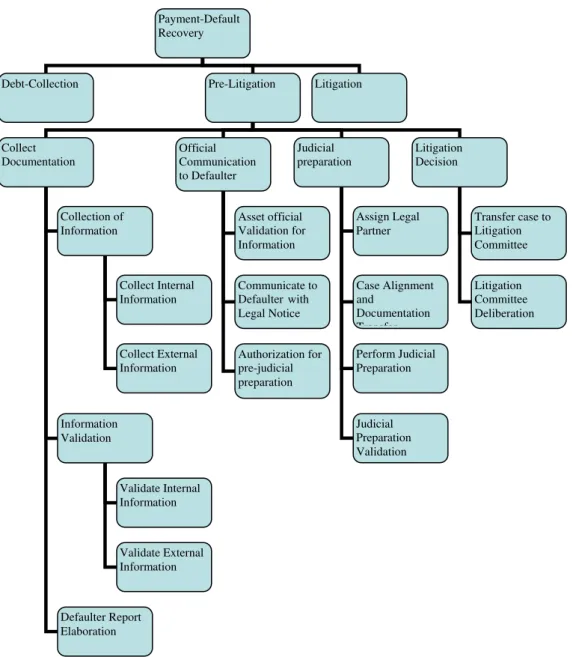
Figure 2. Tree Showing Structure of Referenced BPMN Processes in PDRP
The application is designed using at different levels:
• The business process models involved in PDRP are designed in process Development perspective of webMethods Designer.
• Service development perspective of webMethods Designer – used to develop services (webMethods ESB services) to provide customized solutions to support business process management, SOA initiative and
Payment-Default Recovery
Debt-Collection Pre-Litigation Litigation
Collect Documentation
Official Communication to Defaulter
Judicial preparation
Litigation Decision
Collection of Information
Information Validation
Defaulter Report Elaboration
Collect Internal Information
Collect External Information
Validate Internal Information
Validate External Information
Asset official Validation for Information
Communicate to
Defaulterwith
Legal Notice
Authorization for pre-judicial preparation
Assign Legal Partner
Case Alignment and
Documentation Transfer
Perform Judicial Preparation
Judicial Preparation Validation
Transfer case to Litigation Committee
7. Conclusion
We presented a software framework which transforms conventional Payment Default recovery process of financial organization into extendable BPM solution. This optimization of the process is achieved by developing an application using Software AG webMethods Technology. The developed software solution satisfies the following requirements: Easily Extendable for emerging requirements of any financial organization. As it is developed over ESB, it supports integration with various systems like SAP, Mainframes, various databases, applications running on Java, .Net, etc. Reduces overload on IT expert when business partner increases, as any changes (like rules) in the process after deployment are modifiable by the business people. Automatic generation of reports, handling them electronically and maintaining separate directory, which contains all the reports related to a defaulter. Generation of unique process Instance for each defaulter helps in tracking all the details of defaulter status all along PDRP. Decision making is supported by using the rule services to select the best legal partner for the case and to take litigation decision. A user friendly application with unified interface.
References
[1] BPM Basics for Dummies, Software AG Special Edition, by Kiran Garimella, Michael Lees, and Bruce Williams, Wiley Publishing,
Inc (2008)
[2] Software AG Getting Started with Business Process Management, February 2007.