Advances in Mechanical Engineering 2016, Vol. 8(3) 1–11
ÓThe Author(s) 2016 DOI: 10.1177/1687814016637330 aime.sagepub.com
Inquiring the niche determinants of
social media websites in dynamically
mobile hypercompetitive
communication era
Chih-Cheng Huang
Abstract
This research cross-employs the information communication distribution transaction and analytic network process mod-els to effectively institute the hierarchical evaluated model and utilizes, in specific, fuzzy theory and the grey relation anal-ysis approaches of multiple criteria decision-making methodology into the weight measurements of expert’s questionnaires from three analytical perspectives (user’s satisfaction, corporate commitment, and social trust) of rela-tionship quality in order to explore the niche determinants of the social media websites in the contemporarily hyper-competitive and dynamic online era. Consequently, as for the measured consequences after a series of complicated and systematical calculations, the most valuable findings in this research are (1) the technological interfaces of social media websites is a positive niche in the dynamically mobile hypercompetitive communication era and (2) the ‘‘social media websites’’ is in a position of becoming one of the social media mainstreams in the online technology field based on the measured weights from the detailed survey data collected from experts in this research.
Keywords
Information communication distribution transaction model, analytic network process, multiple criteria decision-making methodology
Date received: 10 November 2015; accepted: 2 February 2016
Academic Editor: Stephen D Prior
Introduction
Nowadays, with reference to the development of mobile communication technology (MCT) from initial web 1.0, web 2.0 to current web 3.0,1 the MCT has been gradually integrated into the diversified and com-plementary applications of the telecommunication, glo-bal position systems (GPS), and TV technologies (such as wireless web-service, blog, Facebook, smartphone, GPS products, and online video games).2Furthermore, it also expanded the technology user base that includes not only the users of traditional MCT (e.g. computers) but also new members of the general public who have become comfortable with the use of various MCT interfaces (e.g. cell phones). In the process, this
expansion created the information telecommunication technology (ICT) in the social media (SM) of the MCT.3 Extensively, the ICT comprises of the tradi-tional online technology (such as Internet technology and web-portals), the comprehensive telecommunica-tion (such as smartphones), the consumer electronic device (such as personal digital assistants and tablets),
Department of Leisure and Recreation, National Formosa University, Huwei, Taiwan, ROC
Corresponding author:
Chih-Cheng Huang, Department of Leisure and Recreation, National Formosa University, 64, Wenhua Road, Huwei, Yulin 63208, Taiwan, ROC. Email: [email protected]
and the television and the GPS online technologies.4In empirical, as a result of the newest statistics from the international telecommunication union (ITU), the rate of global Internet users from 2001 to 2011 has increased about 4.4 times (from 8% to 34.7% per 100 inhabitants). During this same period, the rate of mobile telephone subscriptions has grown 5.6 times (from 15.5% to 86.7%, per 100 inhabitants), active mobile-broadband subscriptions rate has increased from 0% to 17%, fixed (wired)-broadband subscrip-tions rate has expanded 14.2 times (from 0.6% to 8.5%, per 100 inhabitants), and the rate of fixed tele-phone lines has declined as a result of soaring use of mobile phone.5The majority of researches on the MCT have distinctly indicated a main conclusion that the rapid development of the MCT has not only played crucial, extensive roles in people’s lives6but it has also changed human behavior gradually through cross-employment among the MCT.7Furthermore, it is most critical to realize that the newest global developing trend relates to the interactive influences and relation-ships between the integration among these technologies and human behaviors of social transmission.8 The online-technology development of ICT results in the need for enterprises to undergo vigorous tactics in con-fronting greater challenges to meet the desires of more discerning users and market pressures.9 As ICT has gradually played a critically decisive role in people’s daily lives, the lifestyle of users has promptly trans-formed as well, especially with interactive applications among each interrelated MCT and specifically, each user is able to properly operate the cross-employed apparatuses of ICT without the traditional equipment battery.10 As the developed tendency of ICT, the SM has appeared from social networking among the exten-sive users because each user can immediately download and upload the latest word-format and video-format information or news by their mobile smartphone. However, making a comprehensive survey on the rela-tive researches, a majority of recent researches focus on the technological functions of the SM and for this rea-son, this research cross-employs the information com-munication distribution transaction (ICDT) model into the hierarchical analytic network process (ANP) model in order to identify and manifest the interactive inter-plays among technological interfaces of SM and users’ human behaviors of social transmission from three analytical perspectives (user’s satisfaction, corporate commitment, and social trust) of relationship quality (RQ).11The main reasons of this research are (1) man-agement have difficulty in recognizing users’ demands, especially with the traditional professional online-technology users whose numbers have swelled because of the rapid development telecommunicated technolo-gies and the generalization of mobile smartphones and (2) in statistics, the subjectivity of customers are
sometimes misunderstood in the questionnaires con-structed by the Likert scale because the original limita-tion of the seleclimita-tion-item designs of the SM websites. Subsequently, ICDT model is able to effectively execute the empirical analyses based on its four essential asses-sable dimensions, which are comprised of the virtual information space (VIS), the virtual communication space (VCS), the virtual distribution space (VDS), and the virtual transaction space (VTS). Extraordinarily, in order to uplift research reliability and validity, avoid linguistic amphiboly12 and arise the significant degree of the questionnaires,13fuzzy theory (FT) and the grey relation analysis (GRA) approaches of multiple criteria decision-making (MCDM) methodology are utilized into the weight measurements of expert’s question-naires of the ANP model. Consequently, the cross-analytical processes of the research design framework in this study are developed from four principle steps comprised of (1) identifying the research target and motive in order to define the clear research question,14 (2) cross-employing the ICDT and ANP models,15 (3) utilizing three measured approaches of the MCDM methodology to cross-evaluate empirical survey data,16 and (4) integrating the overall analyses in order to inductively make conclusions and recommendations17 in order to effectively explore the niche determinants of the SM websites in the contemporarily hypercompeti-tive and dynamic mobile communication era.18
Literature review
Literatures on theoretical concepts
interfaces; (6) immediate usability: people are currently able to browse and record without any specifically pro-fessional information technology (IT) skills in anytime and anywhere; and (7) permanent record: SM can be altered almost instantaneously by comments or editing in the permanent virtual IT world.20In order to enrich the research representativeness, the analytical perspec-tives (user’s satisfaction, corporate commitment, and social trust) of RQ are directly considered as brief eval-uated dimensions of comprehensive discussion of human behaviors of social transmission. Hence, Crosby et al.21 invent the commitment is the critical assessable perspective of RQ because the enterprises are supposed to sacrifice some short-term commerce profits for respecting the corporate promises in order to completely establish the confident conviction for the long-term benefits. Consequently, the three brief and essential evaluated dimensions comprised of ‘‘satisfaction (customer’s perspective), trust (employ-ee’s perspective), and commitment (corporate perspec-tive)’’ are still generally employed to be appraised perspectives.
Literatures on methodology
Angehrn22 created ICDT model to comprehensively analyze and systematically identify the operations and activities of the electronic commerce (‘‘e-commerce’’) websites in order to induce the effective strategy and the efficient processes for enterprises not only to reduce the competiveness and struck due to the rapid develop-ment of the hardware and software of IT websites sec-tor but to discover any opportunity for making the maximum of profits. The main four segments of ICDT model have been considered as the assessed criteria groups and these are (1) VIS: new channels for eco-nomic agents or enterprises to display and access the relative information, such as marketing and advertis-ing, regarding the products and services. It is the earli-est developed of MCT; (2) VCS: new channels for economic agents or enterprises to engage in relation-ship, ideas, and opinion building activities (such as lob-bying and negotiations). It has been not generally emphasized in the starting period of MCT develop-ment; however, VCS has the most potential benefits for the enterprises;23 (3) VDS: new channels for economic agents or enterprises to distribute real-time text-based, voice-based, and vide-based products and services (such as digital goods and contents, software, and tele-consulting service); and (4) VTS: new channels for eco-nomic agents or enterprises to initiate and execute business-related transactions (such as orders and pay-ments). The most critical issues consisted of the digi-tally transacted securities and the related government regulations were supposed to be considered in the set-tlement of the VTS. For this reason, in order to
effectively increase reliability and validity, clearly pene-trate linguistic amphiboly, and efficiently promote degree of satisfaction in the questionnaires, the analyti-cal hierarchy process (AHP) model has become the research streamline of the related decision-making ana-lytical fields in order to handle more complex research questions. However, other researchers further discov-ered a situation in which there are two kinds of rela-tionships between criteria and sub-criteria, internal/ external dependency and feedback. Hence, Saaty24 fur-ther delivered ANP model to be the new research meth-odology not only to pierce out this limited hypothesis through the Delphi method25,26 and brainstorm approaches to the collect experienced experts’ question-naires data but also to utilize the positive reciprocal matrix and supermatrix27 and the more complex hier-archical analyses to induce the results of collection data under the comprehensive, limited-resource, and difficult-decision environment. Consequently, the typi-cal measurements process where overall related impacted factors are categorized into four groups and then, according to the patterns of ANP evaluation model, these related impacted factor groups are decom-posed as a third hierarchy of criteria of assessments.28 The related impacted factors are also decomposed as a fourth hierarchy of sub-criteria of each criterion and the two-stage algorithm and the consistency index (CI)29 which is exactly considered in each pairwise matrix as described
CI =lmaxn
n1 , Rwi=lmaxwi,
wi=
Xm
j=1
Rij= Pm
i=1
Rij
m
ð1Þ
ipresents the number ofninterviewed questionnaires. The consistency ratio (CR) is calculated as
CR =CI
RI, Rwi=lmaxwi, wi=
Xm
j=1
Rij= Pm
i=1
Rij
m
ð2Þ
jpresents the number ofminterviewed questionnaires and Wi means the weights of interviewed questionnaires.
traditional mathematics which can set up the uncertain and fuzzy research problems. In the hierarchical rela-tions in the last level, each potential supplier has to fit match each assessable sub-criterion matched in each evaluated criterion through pairwise compared criteria of each sub-criteria following.
Hence, with respect to the integration between the ANP evaluated model and FT and the GRA assessed approaches, each expert can give the weights (W1,W2,. . .,Wn) of each pattern, criteria, and sub-cri-teria, and based on the concept of two triangles de-fuzzy, the total fuzzy assessable numbers ( ffiffiffiffiffiffiffiffiffiffiffiffiffiffiffiffiffiPn
i=1Wi n
p
)31 furthermore calculated the interviewed weights in this session and specifically, in terms of defuzzification from the aspect of surveyed questionnaires, i presents the number of n interviewed questionnaires and Wi means the weights of interviewed questionnaires.
Hence, in order to reflect the comparative score for the three types of corporate demand patterns, equation (3) is applied to compute the comprehensively compara-tive related priority weight win the matrix and
‘‘num-bers of similarity measure (S[A,B])’’31are calculated as
d2(A1,A2) = (a1a2)2=
((c1+a1)(c2+a2))2 4
+ ((b1+a1)(b2+a2))
2 4
; a=
(D+D)
2
+(jc1c2j+jb1b2j)
8 ;D
= j(a1+b1)(a2+b2)j
2 ;
D=j(a1+c1)(a2+c2)j
2 ð3Þ
Particularly, as for defuzzification from the aspect of effective order, the S[A,B]32 is utilized by carrying out the calculation of the fuzzy S[A,B]33,34between two measured vectors (A1= (c1,a1,b1) and
A2= (c2,a2,b2)).
In order to distinctly approach the linguistic experts’ comment and to comparatively emend evaluated scores, GRA approach35has been applied to the assessed mea-surements and in particular, the three brief situations have been considered into the GRA measurements as follows:
1. The analytical goal belongs to efficient goal and satisfies the maximized analytical goal (the larger the better, LTB,) as
xi= x
(0)
i (k)minx
(0)
i (k)
maxx(i0)(k)minx(i0)(k),
ipresents the number ofninterviewed questionnaires
ð4Þ
2. The analytical goal belongs to cost goal and satisfies the minimized analytical goal (the
smaller the better, STB) as
xi= minx
(0)
i (k)x
(0)
i (k) maxx(i0)(k)minx(i0)(k)
ipresents the number ofninterviewed questionnaires
ð5Þ
3. The analytical goal belongs to specific goal (nominal the best [NTB])
xi=1 x
(0)
i (k)OB
max maxn hx(i0)(k)iOB,OBminhx(i0)(k)io ,
ipresents the number ofninterviewed questionnaires
ð6Þ
Consequently, this research not only utilizes the five-level quantified figures of evaluation scale between lan-guages of interviewees of pairwise in assessment of Chen and Hwang,36 but it also combined the GRA approach as presented in five level of importance (lan-guage powers) of grey set system in the GRA consisted of Equal is 0.091, Little Important is 0.283, Important is 0.5, Very Important is 0.717, and Extreme Important is 0.919. The measurement of the GRA approach is uti-lized to satisfy two analytical research situations: analy-tical goal belongs to efficient goal and satisfies the maximized analytical goal and analytical goal belongs to cost goal and satisfies the minimized analytical goal. Furthermore, in order to calculate the total score of these three kinds of relations in consolidation, the orga-nized grey relation coefficient results from the calcula-tion after transformacalcula-tion of the qualitative data of survey interviewees’ opinions to the quantitative data. Eventually, in the hierarchical relations in the last level, each potential candidate has to match each assessable sub-criterion matched in each evaluated criterion through computing the comprehensively comparative related priority weight w (eigenvector) in the pairwise
compared matrixes. Hence, the appropriate relations is selected by calculating the synthetically comparative index numbers (SCIN) combining the ‘‘weighted calcu-lations’’ and are calculated as
SICNi=
Xn
i=1
Xm
j=1
AiRj ð7Þ
i presents the number ofn interviewed questionnaires and Ai expresses the weight measurements of first method (ANP approach); j presents the number of m
Research design
Research data collection
Dalkey and Helmer37expressed that there are the least errors of validity and reliability in the Delphi method when the collected questionnaires are, at least, over 10 professional interviewees in the total surveyed data using the Delphi method and expertise brainstorm approach. Hence, in order to effectively increase the full research representativeness in ANP evaluated model, 15 professional experts are the questionnaire interviewees and these consists of five senior SM users who have a published column in relative ICT magazines, five senior managers who have over 10 years of working experience in the related ICT industries, and five academic scholars who understand the flourishing of research and devel-opment in SM technology and human behaviors in social transmission with at least 10 years of research experience. Specifically, the questionnaire data are sur-veyed for the pairwise comparisons at each level and are evaluated with respect to the related interdepen-dence and importance from equal important (1) to extreme important (5).
Research criteria
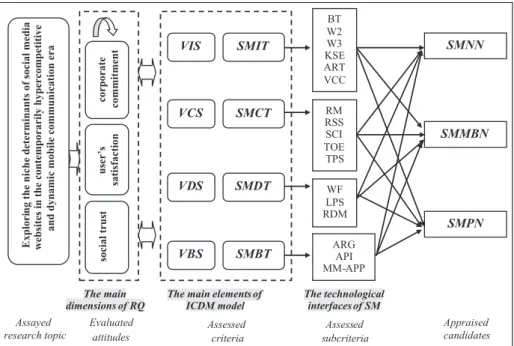
This research comprehensively employs the three analy-tical perspectives (user’s satisfaction, corporate com-mitment, and social trust) of RQ to be appraised attitudes35to pioneer the most influenced 17 assessable elements (sub-criteria) of technological interfaces of SM, categorized into the four assessable criteria of ICDT model in order to induce the best solutions of three potential evaluated candidates,38consisting of (1) the technological interfaces of SM websites is a nega-tive niche in the dynamically mobile hypercompetinega-tive communication era (‘‘SMNN’’), (2) the technological interfaces of SM websites is a may niche in the dynami-cally mobile hypercompetitive communication era (‘‘SMMBN’’), and (3) the technological interfaces of SM websites is a positive niche in the dynamically mobile hypercompetitive communication era (‘‘SMPN’’). Subsequently, the assessed criteria and evaluated sub-criteria are described as follows.
Social media information technology. This criterion was refined from the main aspect of VIS of ICDT model because the online technology developed demands are essentially considered the hardware and software of ICT. In succession, there are six sub-criteria to be con-tained in this criterion and these are (1) behavior tar-geting (BT): online ICT industries collect the preference of users in order to initiate the absorptive subject and content of websites to increase uses; (2) Web 2.0 (W2): online websites develop an interacted interface to
increase users’ satisfaction because the users change from passive readers to active creators;39,40(3) Web 3.0 (W3): online websites currently research and develop new interacted interface technology for the purpose of alluring more users (consumers), such as virtual com-munication interface and three digital or four digital interface technologies; (4) keyword search engine (KSE): online websites produce alluring keyword search messages in the first window search in order to attract users to search the related information; (5) aug-mented reality function (ARF): online websites utilize diversified functions to construct the augmented reality presentation to fascinate each user such as 3D expres-sion; and (6) virtual cloud computing (VCC): due to the flourishing wireless service and high-speed trans-mission of data with the largest bandwidth, the SM is further able to deal with the large calculating, cross-applications and saving through the VCC function without the limitation of the IT operating facilities. This induces that users are able to employ any software without the consideration of the limitation of the trans-mission equipment.41
Social media communication technology. This criterion was developed from the main aspect of VCS of ICDT model because the relationships, ideas, and opinions build the online-technology activities. Sequentially, there are five sub-criteria to be contained in this criterion and these are (1) rich media (RM): online websites provide vari-ous interactive online interfaces, such as JAVA, real audio, real video, and shockwave, in order to exchange media data among users such as YouTube, Google media, and Yahoo Photos; (2) really simple syndication (RSS): online websites supply the function of regular subscription to users in order to obtain the opportuni-ties to put dynamic and static information of users to each social community member; (3) social community integration (SCI): online websites supply the ‘‘social function’’ to assist users to establish their owned virtual society such as Blogs, Twitter, and Facebook;42 (4) third-party organization endorsements (TOE): online websites provide the content to be endorsed from the third-party organizations due to the exactitude and leg-ality of the online website information; and (5) third-party privacy/security seals (TPS): online websites are supposed to secure the privacy seals of the users.43
wireless Internet function to surf the Internet and to send or to receive e-mail on their own mobile phone which results in that the online individual users’ infor-mation can be send to the users of mobile phone imme-diately through WF; (2) location-based service (LPS): online websites offer specific GPS guide and position-ing function in order to provide local information and piloting services and express the nearest users’ location and information;44 and (3) real-time direct messages (RDM): online social communities actively send peri-odical and irregular messages and information of each community member to the users through mobile online transmission service.
Social media business technology. This criterion was pro-duced from the main aspect of VTS of ICDT model because the generalization of the mobile phone is able to offer products or services to an extensive number of users in the meanwhile. Consecutively, there are three sub-criteria to be covered in this criterion and these are (1) alternate reality games (ARG): online websites cre-ate virtual games with the aim of attracting more users in order to put advertisements of products or services or to sell the products or services of virtual games;45(2) application programming interface (API): online web-sites open the ‘‘writing and coding functions’’ of their programs to enhance the functionality and application of their websites in order to attract more users and then put advertisement of products or services in this inter-acted interface, such as Wikipedia (the free encyclope-dia) and Facebook;46 and (3) multiple mobile application (MM-APP): due to the popularization of
smart mobile phones, users of such devices have com-menced to request and use more entertainment-related applications such as media-play, video games, and media telecommunication. Accordingly, IT engineers devoted more research and develop in mobile APP soft-ware to meet the users’ entertainment demands.
Research hierarchy
In accordance with the cross-employment of ANP and ICDT models and MCDM methodology, the research hierarchy is expressed in Figure 1.
Empirical assessment
The three assessment processes are described as follows.
First step: measuring ANP model
ANP model is first applied in the hierarchical analysis to assess the potential niche possibility of the technolo-gical interfaces of SM in the latest online-technology tendency by considering transitivity and consistency of selection among the most potential interplays and rela-tions in the hierarchical assessments of ANP model. Consequently, Table 1 points out not only the entire evaluated hierarchies and relations but it also shows that the highest evaluated score of SMPN is 0.6666. Furthermore, the second highest evaluated SCIN score is 0.2457 which is located at SMMBN through the hier-archical combined measurements of the CR and CI.
Second step: integrating FT approach into ANP model
In order to effectively increase the reliability and validity, clearly penetrate linguistic amphiboly, and efficiently promote degree of interviewed experts’ satis-faction in the questionnaires, FT is utilized to deeply survey the ulterior consequences of the questionnaires. In Table 2, the highest vector of SCIN is (0.7345, 0.6666, 0.6077) and the highest number of S[A,B] is 0.5521 in the SMPN. Significantly, the second higher evaluated score of the standardizing SCIN 0.2451 was SMMBN which is completely familiar with the mea-sured results of ANP model through the amendment of the fuzzificated evaluated score and the defuzzificated equations in assaying process of the merger of ANP model and FT from the 15 experts.Third step: merger GRA approach into ANP model
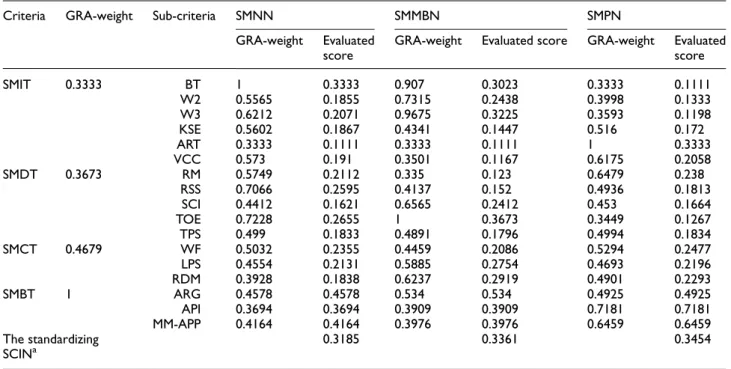
In order to approach the linguistic experts’ comment and to comparatively emend evaluated scores, the grey relation is the equal weights among analytical influ-enced and therefore these equations of GRA approach were utilized for the five times of usage: first usage time for calculating the weights of grey relation coefficients between three assessable patterns, second usage timefor computing the weights of grey relation coefficients between three assessable criteria, third usage time for counting up the weights of GRA between 21 sub-criteria which matched in two sub-criteria group, fourth usage time for figuring the weights of grey relation coefficients for the current related theories, and, finally, in fifth usage time, in order to avoid the errors, the aggregate of the weights of grey relation coefficients is divided for CSI measurement of the merger of ANP model and GRA approach as expressed in Table 3. Contiguously, the highest CSI of the merger of ANP model and GRA approach is 0.3454 which is located at SMPN and the next highest standardizing CSI is 0.3361 located at SMMBN that both are similar with the evaluated consequences of ANP model evaluations.
Conclusion
This research attempts to comprehensively cross-employ ICDT and ANP models and MCDM metho-dology to directly and conscientiously construct the most comprehensive evaluated model to execute the complete cross-analyses of the interactive influences and interrelationships between the swift development of SM technology and human behaviors of social
Table 1. SCIN measurement of ANP model.
Criteria Weight Sub-criteria SMNN SMMBN SMPN
Weight Evaluated score Weight Evaluated score Weight Evaluated score
SMIT 0.0559 BT 0.1 0.0056 0.2604 0.0146 0.6396 0.0357
W2 0.0919 0.0051 0.2566 0.0143 0.6515 0.0364
W3 0.0938 0.0052 0.2614 0.0146 0.6448 0.036
KSE 0.092 0.0051 0.2429 0.0136 0.6651 0.0372
ART 0.0796 0.0045 0.2327 0.0130 0.6877 0.0384
VCC 0.0924 0.0052 0.2348 0.0131 0.6728 0.0376
SMDT 0.1245 RM 0.0925 0.0115 0.2329 0.0290 0.6746 0.084
RSS 0.0958 0.0119 0.2412 0.0300 0.663 0.0826
SCI 0.0871 0.0108 0.2543 0.0317 0.6586 0.082
TOE 0.0961 0.0120 0.2619 0.0326 0.642 0.0799
TPS 0.0898 0.0112 0.2467 0.0307 0.6635 0.0826
SMCT 0.2693 WF 0.0899 0.0242 0.2438 0.0656 0.6663 0.1794
LPS 0.0878 0.0236 0.2517 0.0678 0.6605 0.1778
RDM 0.0842 0.0227 0.2531 0.0682 0.6626 0.1784
SMBT 0.5503 ARG 0.0879 0.0484 0.2492 0.1371 0.6629 0.3648
API 0.0826 0.0455 0.2392 0.1316 0.6782 0.3732
MM-APP 0.0857 0.0472 0.2398 0.1320 0.6745 0.3712
The standardizing SCINa 0.0877 0.2457 0.6666
SCIN: synthetically comparative index number; ANP: analytic network process; SMIT: social media information technology; SMDT: social media delivery technology; SMCT: social media communication technology; SMBT: social media business technology; BT: behavior targeting; W2: Web 2.0; W3: Web 3.0; KSE: keyword search engine; ART: augmented reality function; VCC: virtual cloud computing; RM: rich media; RSS: really simple syndication; SCI: social community integration; TOE: third-party organization endorsements; TPS: third-party privacy/security seals; WF: wideget function; LPS: location-based service; RDM: real-time direct messages; ARG: alternate reality games; API: application programming interface; MM-APP: multiple mobile application.
aThe standardizing SCIN measurement of the ANP cross-measures by cross-employing fuzzy theory into the traditional ANP hierarchically evaluated
Criteria Weight Sub-criteria SMNN SMMBN SMPN
FT-weight FT-evaluated score FT-weight FT-evaluated score FT-weight FT-evaluated score
SMIT 0.0559 BT (0.0727, 0.1, 0.1242) (0.0041, 0.0056, 0.0069) (0.2356, 0.2604, 0.276) (0.0132, 0.0146, 0.0154) (0.6917, 0.6396, 0.5998) (0.0387, 0.0357, 0.0335)
W2 (0.061, 0.0919, 0.118) (0.0034, 0.0051, 0.0066) (0.2241, 0.2566, 0.2744) (0.0125, 0.0143, 0.0153) (0.7149, 0.6515, 0.6076) (0.04, 0.0364, 0.034)
W3 (0.0628, 0.0938, 0.1187) (0.0035, 0.0052, 0.0066) (0.2301, 0.2614, 0.2747) (0.0129, 0.0146, 0.0154) (0.7071, 0.6448, 0.6066) (0.0395, 0.036, 0.0339) KSE (0.0606, 0.092, 0.1186) (0.0034, 0.0051, 0.0066) (0.207, 0.2429, 0.2669) (0.0116, 0.0136, 0.0149) (0.7324, 0.6651, 0.6145) (0.0409, 0.0372, 0.0343) ART (0.0577, 0.0796, 0.1121) (0.0032, 0.0045, 0.0063) (0.208, 0.2327, 0.2622) (0.0116, 0.013, 0.0147) (0.7343, 0.6877, 0.6256) (0.041, 0.0384, 0.035) VCC (0.0638, 0.0924, 0.1173) (0.0036, 0.0052, 0.0066) (0.2016, 0.2348, 0.2644) (0.0113, 0.0131, 0.0148) (0.7346, 0.6728, 0.6183) (0.0411, 0.0376, 0.0346)
SMDT 0.1245 RM (0.0637, 0.0925, 0.117) (0.0079, 0.0115, 0.0146) (0.1987, 0.2329, 0.2639) (0.0247, 0.029, 0.0329) (0.7376, 0.6746, 0.6191) (0.0918, 0.084, 0.0771)
RSS (0.065, 0.0958, 0.1201) (0.0081, 0.0119, 0.015) (0.2066, 0.2412, 0.2679) (0.0257, 0.03, 0.0334) (0.7284, 0.663, 0.612) (0.0907, 0.0826, 0.0762)
SCI (0.0562, 0.0871, 0.1135) (0.007, 0.0108, 0.0141) (0.2208, 0.2543, 0.2728) (0.0275, 0.0317, 0.034) (0.7231, 0.6586, 0.6136) (0.09, 0.082, 0.0764) TOE (0.0658, 0.0961, 0.1212) (0.0082, 0.012, 0.0151) (0.2323, 0.2619, 0.2767) (0.0289, 0.0326, 0.0345) (0.7019, 0.642, 0.6021) (0.0874, 0.0799, 0.075) TPS (0.0585, 0.0898, 0.1154) (0.0073, 0.0112, 0.0144) (0.2105, 0.2467, 0.2687) (0.0262, 0.0307, 0.0335) (0.731, 0.6635, 0.6159) (0.0910, 0.0826, 0.0767)
SMCT 0.2693 WF (0.062, 0.0899, 0.1168) (0.0167, 0.0242, 0.0315) (0.2127, 0.2438, 0.2669) (0.0573, 0.0656, 0.0719) (0.7253, 0.6663, 0.6162) (0.1953, 0.1794, 0.0767)
LPS (0.06, 0.0878, 0.115) (0.0162, 0.0236, 0.031) (0.2236, 0.2517, 0.2711) (0.0602, 0.0678, 0.073) (0.7164, 0.6605, 0.6139) (0.1929, 0.1778, 0.1653)
RDM (0.0557, 0.0842, 0.1113) (0.015, 0.0227, 0.03) (0.2228, 0.2531, 0.2727) (0.06, 0.0682, 0.0734) (0.7214, 0.6626, 0.616) (0.1942, 0.1784, 0.1659)
SMBT 0.5503 ARG (0.0539, 0.0879, 0.1146) (0.0296, 0.0484, 0.0631) (0.2038, 0.2492, 0.2687) (0.1122, 0.1371, 0.1479) (0.7423, 0.6629, 0.6166) (0.4085, 0.3648, 0.3393)
API (0.0575, 0.0826, 0.1104) (0.0316, 0.0455, 0.0608) (0.2151, 0.2392, 0.2632) (0.1184, 0.1316, 0.1449) (0.7275, 0.6782, 0.6264) (0.4004, 0.3732, 0.3447) MM-APP (0.0554, 0.0857, 0.1124) (0.0305, 0.0472, 0.0619) (0.1704, 0.2398, 0.2631) (0.0938, 0.132, 0.1448) (0.7743, 0.6745, 0.6245) (0.4261, 0.3712, 0.3437) The
standardizing SCINa
0.2028 0.2451 0.5521
SCIN: synthetically comparative index number; ANP: analytic network process; FT: fuzzy theory; SMIT: social media information technology; SMDT: social media delivery technology; SMCT: social media
communication technology; SMBT: social media business technology; BT: behavior targeting; W2: Web 2.0; W3: Web 3.0; KSE: keyword search engine; ART: augmented reality function; VCC: virtual cloud computing; RM: rich media; RSS: really simple syndication; SCI: social community integration; TOE: third-party organization endorsements; TPS: third-party privacy/security seals; WF: wideget function; LPS: location-based service; RDM: real-time direct messages; ARG: alternate reality games; API: application programming interface; MM-APP: multiple mobile application.
aThe standardizing SCIN measurement of the merger of the ANP and the FT cross-measures by cross-employing fuzzy theory into the traditional ANP hierarchically evaluated model as well as utilized the
standardization among each the complete SCIN of the three assessable candidates.
Adv
anc
es
in
Mechan
ic
al
Eng
ine
transmission through the evaluated measurements of the weights from experienced experts, empirical indus-trialists, and academic scholars. As a result, the most valuable contribution of this research in the relative SM research fields is that ‘‘The technological interfaces of SM websites is a positive niche in the current mobile communication era (SMPN).’’ This proves that the technological interfaces of SM websites are not only the virtually discussed conceptual noun that resupplies the traditional research gap in the related IT, ICT, and SM research fields but also the directional and poten-tial benefits for empirical enterprises. Although this research has cross-employed the comprehensive evalu-ated theory, the assessable model, and the hierarchical measurements, there are still some more effective meth-odologies that are able to be applied for assaying the related SM research issues. Consequently, the recom-mendation beyond this research is to focus attention on collecting more factors that are more significant and critical influences in order to perceive the fluctuation tendency of the technological interfaces of SM websites in order to achieve the demands and desires of user’s human behaviors of social transmission in this most unpredictable, dynamical, complex, and hypercompeti-tive mobile communication era.
Declaration of conflicting interests
The author(s) declared no potential conflicts of interest with respect to the research, authorship, and/or publication of this article.
Funding
The author(s) received no financial support for the research, authorship, and/or publication of this article.
References
1. Christian F, Wolfgang H, Matthias S, et al. Theoretical foundations of the web: cognition, communication, and co-operation. Towards an understanding of web 1.0, 2.0, 3.0. Future Internet 2010; 2: 41–59. DOI: 10.3390/ fi2010041.
2. Millen DR, Feinberg J and Kerr B. Dogar: social book-marking in the enterprise. In:Proceedings of the confer-ence on computer human interaction, Montre´al, QC, Canada, 22–27 April 2006, pp.111–120. New York: ACM Press.
3. Kaplan AM. If you love something, let it go mobile: mobile marketing and mobile social media 4x4. Bus Horiz 2012; 55: 129–139. DOI: 10.1016/j.bushor.2011.10.009.
4. Egghe L. The Hirsch index and related impact measures.
Annu Rev Inform Sci 2010; 44: 65–114. DOI:
10.1002/aris.2010.1440440109.
Table 3. SCIN measurement of the merger of ANP and GRA.
Criteria GRA-weight Sub-criteria SMNN SMMBN SMPN
GRA-weight Evaluated score
GRA-weight Evaluated score GRA-weight Evaluated score
SMIT 0.3333 BT 1 0.3333 0.907 0.3023 0.3333 0.1111
W2 0.5565 0.1855 0.7315 0.2438 0.3998 0.1333
W3 0.6212 0.2071 0.9675 0.3225 0.3593 0.1198
KSE 0.5602 0.1867 0.4341 0.1447 0.516 0.172
ART 0.3333 0.1111 0.3333 0.1111 1 0.3333
VCC 0.573 0.191 0.3501 0.1167 0.6175 0.2058
SMDT 0.3673 RM 0.5749 0.2112 0.335 0.123 0.6479 0.238
RSS 0.7066 0.2595 0.4137 0.152 0.4936 0.1813
SCI 0.4412 0.1621 0.6565 0.2412 0.453 0.1664
TOE 0.7228 0.2655 1 0.3673 0.3449 0.1267
TPS 0.499 0.1833 0.4891 0.1796 0.4994 0.1834
SMCT 0.4679 WF 0.5032 0.2355 0.4459 0.2086 0.5294 0.2477
LPS 0.4554 0.2131 0.5885 0.2754 0.4693 0.2196
RDM 0.3928 0.1838 0.6237 0.2919 0.4901 0.2293
SMBT 1 ARG 0.4578 0.4578 0.534 0.534 0.4925 0.4925
API 0.3694 0.3694 0.3909 0.3909 0.7181 0.7181
MM-APP 0.4164 0.4164 0.3976 0.3976 0.6459 0.6459
The standardizing SCINa
0.3185 0.3361 0.3454
SCIN: synthetically comparative index number; ANP: analytic network process; GRA: grey relation analysis; SMIT: social media information technology; SMDT: social media delivery technology; SMCT: social media communication technology; SMBT: social media business technology; BT: behavior targeting; W2: Web 2.0; W3: Web 3.0; KSE: keyword search engine; ART: augmented reality function; VCC: virtual cloud computing; RM: rich media; RSS: really simple syndication; SCI: social community integration; TOE: third-party organization endorsements; TPS: third-party privacy/ security seals; WF: wideget function; LPS: location-based service; RDM: real-time direct messages; ARG: alternate reality games; API: application programming interface; MM-APP: multiple mobile application.
aThe standardizing SCIN measurement of the merger of the ANP and the GRA cross-measures by cross-employing fuzzy theory into the traditional
5. European Statistics. Information and communication technologies statistics. Internet usage in 2008: community survey on ICT use by individuals and households, http:// epp.eurostat.ec.europa.eu/cache/ITY_OFFPUB/KS-QA-08-046/EN/KS-QA-08–046-EN.PDF (2008, accessed 31 July 2008).
6. Novak TP, Hoffman DL and Duhachek A. The influ-ence of goal-directed and experiential activities on online flow experiences.J Consum Psychol2003; 13: 3–16. DOI: 10.1207/S15327663JCP13-1&2_01.
7. Zeng L, Salvendy G and Zhang M. Factor structure of web site creativity. Comput Hum Behav 2009; 25: 568–577. DOI: 10.1016/j.chb.2008.12.023.
8. Mathes A. Folksonomies—cooperative classification and communication through shared metadata, http://www.a- dammathes.com/academic/computer-mediated-communi-cation/folksonomies.html (2004, accessed 17 May 2010). 9. Pak R, Pautz S and Iden R. Information organization
and retrieval: an assessment of taxonomical and tagging systems.Cogn Technol2007; 12: 31–44.
10. Lu H and Hsiao KL. Gender differences in reasons for frequent blog posting. Online Inform Rev 2009; 33: 135–156.
11. Medelyan O, Frank E and Witten IH. Human-competi-tive tagging using automatic keyphrase extraction. In: Proceedings of the conference of empirical methods in nat-ural language processing (EMNLP-2009), Singapore, 6–7 August 2009, vol. 3, pp.1318–1327, http://portal.ac-m.org/citation.cfm?id=1699678 (2009, accessed Decem-ber 2010).
12. Hassenzahl M and Ullrich D. To do or not to do? Differ-ences in user experience and retrospective judgments depending on the presence or absence of instrumental goals. Interact Comput 2007; 19: 429–437. DOI: 10.1016/j.intcom.2007.05.001.
13. Bornmann L, Mutz R and Daniel H-D. The h index research output measurement: two approaches to enhance its accuracy.J Informetr2010; 4: 407–414. DOI: 10.1016/j.joi.2010.03.005.
14. Hirsch JE. An index to quantify an individual’s scientific research output. P Natl Acad Sci USA 2005; 102: 16569–16572. DOI: 10.1073/pnas.0507655102.
15. Henseler J and Chin WW. A comparison of approaches for the analysis of interaction effects between latent vari-ables using partial least squares path modeling. Struct
Equ Modeling 2010; 17: 82–109. DOI:
10.1080/10705510903439003.
16. Wolfram D and Olson HA. A method for comparing large scale inter-indexer consistency using IR modeling. In: Proceedings of the 35th conference of the Canadian Association for Information Science (CAIS), Montreal, QC, 10–12 May 2007.
17. Yang MS, Hung WL and Chang-Chien SJ. On a similar-ity measure between LR-type fuzzy numbers and its application to database acquisition.Int J Intell Syst2005; 20: 1001–1016. DOI: 10.1002/int.20102.
18. Zhang P and Von Dran GM. Satisfiers and dissatisfiers: a two-factor model for website design and evaluation.J Am Soc Inform Sci 2000; 51: 1253–1268. DOI: 10.1002/1097-4571(2000)9999:9999\::AID-ASI1039.3.0.
CO;2-O.
19. Kietzmann JH, Hermkens K, McCarthy IP, et al. Social media? Get serious! Understanding the functional build-ing blocks of social media.Bus Horiz2011; 54: 241–251. DOI: 10.1016/j.bushor.2011.01.005.
20. Kaplan AM and Haenlein M. Users of the world, unite! The challenges and opportunities of Social Media. Bus Horiz 2010; 53: 59–68. DOI: 10.1016/j.bushor. 2009.09.003.
21. Crosby LA, Kenneth RE and Deborah C. Relationship quality in services selling: an interpersonal influence per-spective. J Marketing 1990; 54: 68–81. DOI: 10.2307/1251817.
22. Angehrn A. Designing mature Internet business strate-gies: the ICDT model. Eur Manag J 1997; 5: 361–369. DOI: 10.1016/S0263-2373(97)00016-9.
23. Press L. Commercialization of the Internet. Commun ACM1994; 37: 21–56.
24. Saaty TL.Decision making with dependence and feedback: the analytic network process. Pittsburgh, PA: RWS Publi-cations, 1996.
25. Green KC, Armstrong JS and Graefe A. Methods to eli-cit forecasts from groups: Delphi and prediction markets compared.Int J Appl Forecast2007; 8: 17–20.
26. Seker SE. Computerized argument Delphi technique. IEEE Access 2015; 3: 368–380. DOI: 10.1109/ ACCESS.2015.2424703.
27. Saaty TL. Multi-criteria decision making: the analytic hierarchy process. Pittsburgh, PA: RWS Publications, 1998.
28. Zadeh LA. Fuzzy sets.Inform Control1965; 8: 338–353. DOI: 10.1016/S0019-9958(65)90241-X.
29. Ragin CC. Set relations in social research: evaluating their consistency and coverage. Polit Anal 2006; 14: 291–310. DOI: 10.1093/pan/mpj019.
30. Zadeh LA. Fuzzy sets as a basis for a theory of possibil-ity.Fuzzy Set Syst1978; 1: 3–28.
31. Chen SH, Lin HT and Lee HT. Enterprise partner selec-tion for vocaselec-tional educaselec-tion: analytical network process. Int J Manpower 2004; 25: 643–655. DOI: 10.1108/ 01437720410563980.
32. Vink MP and Van Vliet O. Not quite crisp, not yet fuzzy? Assessing the potentials and pitfalls of multi-value QCA. Field Method 2009; 21: 265–289. DOI: 10.1177/ 1525822X09332633.
33. Ragin CC, Drass KA and Davey S. Fuzzy-set/qualitative comparative analysis, version 2.0, http://www.u.arizo-na.edu/cragin/fsQCA/download/Setup_fsQCA.exe (2003, accessed 28 August 2015).
34. Ragin CC and Giesel H. User’s guide to fuzzy-set/qualita-tive comparafuzzy-set/qualita-tive analysis, http://www.u.arizona.edu/cra-gin/fsQCA/download/fsQCAManual.pdf (2003, accessed 28 August 2015).
35. Wang X. Grey analysis of the factors of industry produc-tion.J Grey Syst1992; 4: 173–180.
36. Chen SJ and Hwang CL.Fuzzy multiple attribute decision marketing—methods and application. Berlin, Heidelberg: Springer-Verlag, 1992.
38. Tractinsky N, Cokhavi A, Kirschenbaum M, et al. Evalu-ating the consistency of immediate aesthetic perceptions of web pages.Int J Hum: Comput St2006; 64: 1971–1983. DOI: 10.1016/j.ijhcs.2006.06.009.
39. Styles C. How web 2.0 will change history—possible futures for websites of the National Archives of Austra-lia!http://catherinestyles.files.wordpress.com/2006/08/ web20history1.pdf (2006, accessed 6 February 2010). 40. Anderson P. What is web 2.0? Ideas, technologies and
implications for education. Joint Information Systems Committee, http://www.jisc.ac.uk/media/documents/tech-watch/tsw0701b.pdf (2007, accessed 6 February 2010). 41. Zeng L and Salvendy G. How creative is your website?
In: Proceedings of the 2nd international conference on applied human factors and ergonomics (AEI 2008), Las Vegas, NV, 16 July 2008, pp.1–10. Las Vegas, NV: USA Publishing.
42. Wang YJ, Hernandez MD and Minor MS. Web aes-thetics effects on perceived online service quality and satisfaction in an e-tail environment: the moderating role of purchase task. J Bus Res 2009; 63: 935–942. DOI: 10.1016/j.jbusres.2009.01.016.
43. Rolling L. Indexing consistency, quality and efficiency.
Inform Process Manag 1981; 17: 69–76. DOI:
10.1016/0306-4573(81)90028-5.
44. Diaz De Rada V. Measure and control of non-response in a mail survey.Eur J Marketing2005; 39: 16–32. DOI: 10.1108/03090560510571990.
45. Flavian C, Gurrea R and Orus C. The effect of product presentation mode on the perceived content and conti-nent quality of web sites. Online Inform Rev 2009; 33: 1003–1028. DOI: 10.1108/14684520911011034.