ABSTRACT
Nasalance and nasality at experimental
velopharyngeal openings in palatal prosthesis:
a case study
1, Viviane Cristina de Castro MARINO2, Maria Inês PEGORARO-KROOK3, Plinio
Almeida BARBOSA4 5, Jeniffer de Cassia Rillo DUTKA6
1- PhD, Researcher, Speech Prosody Studies Group, Institute of Language Studies (IEL), Linguistics Department, UNICAMP - University of Campinas, Campinas, SP, Brazil.
2- PhD, Assistant Professor, Department of Speech-Language Pathology and Audiology, UNESP - Univ. Estadual Paulista - Marília, SP, Brazil.
3- PhD, Full Professor, Department of Speech-Language Pathology and Audiology, Bauru School of Dentistry; Hospital for Rehabilitation of Craniofacial Anomalies (HRAC), University of São Paulo, Bauru, SP, Brazil.
4- PhD, Associate Professor, Linguistics Department, Institute of Language Studies (IEL), UNICAMP - University of Campinas, Campinas, SP, Brazil. 5- DDS, Dentist, Palatal Prosthesis Department, Hospital for Rehabilitation of Craniofacial Anomalies (HRAC), University of São Paulo, Bauru, SP, Brazil. 6- PhD, Assistant Professor, Department of Speech-Language Pathology and Audiology, Bauru School of Dentistry; Hospital for Rehabilitation of Craniofacial Anomalies (HRAC), University of São Paulo, Bauru, SP, Brazil.
Corresponding address: Aveliny Mantovan Lima-Gregio - Rua das Opalas, 26 - Jd. São Domingos - 3471-220 - Americana - SP - BRASIL - Phone: 55 19 3407-4383 - e-mail: [email protected]
! "##$ % &' ! "# ( ')'* #$ "#
T
repair of VPI. Understanding the role and measuring the outcome of prosthetic treatment ! and post-treatment outcomes. Experimental openings in speech bulbs have been used for simulating VPI in studies documenting changes in aerodynamic, acoustic and kinematics "# $$% % $ $ " &$'( # !$' investigated nasalance and nasality at the presence of experimental openings drilled $$ "))(* + /$0 (!
% $$% $$122 % $$42
mm2 opening. Five speech-language pathologists performed auditory-perceptual ratings
$' "5(67!8 92"2221%;<post hoc test indicating difference from the no-opening condition. Conclusion: The changes in nasalance $7= $$> changes in transfer of sound energy related to different sizes of velopharyngeal opening.
Key words: Speech acoustics. Palatal obturators. Cleft palate.
INTRODUCTION
Tissue insufficiency after primary repair of cleft palate (primary palatoplasty) is one cause of velopharyngeal dysfunction (VPD), resulting in
hypernasal speech1" % !7
residual condition that occasionally occurs after
primary palatoplasty, may also result in hypernasal
speech5"$% $
G
primary palatoplasty23"
after primary palatoplasty have also been treated "% still remain an important alternative, particularly $ J surgery1-2,14-15.
Prosthetic management of VPD generally involves the use of an acrylic appliance to cover J speech bulb for reducing an opening through the velopharyngeal port. The speech bulb provides a barrier separating the oral and nasal cavities and its success depends on functional movement of the J to embrace the bulb in order for velopharyngeal
closure to be achieved23. Dentists, speech-language
7 $$ of the velopharynx. The use of speech bulbs can be an important strategy to stimulate increased % = treatment and supplying dental needs all at the same time. Because the speech bulb must have adequate retention and stability, must feel comfortable to the patient, and must support and elicit residual and/or compensatory velopharyngeal muscle function, the $$
speech-language pathologists prosthetic treatment is the alternative of choice for G "
Besides the clinical use of prosthetic or combined behavioral-prosthetic management of VDP to achieve adequate speech, prosthetic appliances have also been used in research studies that aimed to improve our understanding of the effect of velopharyngeal openings on speech. Our 7 $ ! subject studies that experimentally manipulated the size of velopharyngeal openings drilled into
prosthetic devices12,16. In most studies in this area
it is assumed that velopharyngeal openings of = % greater opening thought to have more impact on speech than smaller opening sizes.
Sapienza, et al.16 (1996)investigated respiratory,
laryngeal, and supralaryngeal functions associated +/" % authors described a consistent increase of nasal > vocal intensity as the sizes of the experimental %
' 422 hole
= $ " Active physiologic adjustment rather than a passive observed in this study.
Marino, et al.12 (2005) conducted a study that
' palatal opening. This study investigated immediate ! +/= location affected tongue movement direction, = "% although an immediate response (observed as soon +/$ interpreted as indicative of the subject´s attempts "" % sustained perturbation (observed after the subject $+/ % adjustments may help reestablish the requirements to balance air pressure and resonance. Lima-Gregio
and colleagues10(2010) investigated frequency
\][] at different
velopharyngeal openings (10 mm2, 20 mm2 and 30
mm2"#
of the larger openings (20 mm2 and 30 mm2) the
^1 $ \] $
[]%
tongue adjustments (posteriorization).
The above studies described the use of several objective measurements including aerodynamic, acoustic and kinematics to document changes associated to perturbations size introduced during palatal obturators. Changes in nasalance measures %% not been described.
# $ $$'% suggesting that many factors can affect these
variables. Some authors9 reported the possibility
of variability due to sources such as equipment, % $! !$' $' " #% investigating nasalance scores obtained in the % $ possible effects of this device in nasalance results. That is, because nasalance is calculated on the basis of an acoustic ratio of nasal to total oral+nasal acoustic energy, these scores are subject to changes
transmission of acoustic energy17,19.
Scarsellone, et al.17 (1999) reported an increase
in nasalance score associated to the use of maxillary 12"# the placement of the denture altered oral cavity
a~
dimensions, affecting acoustical impedance of the oral cavity leading to higher nasalance scores. 8% that nasalance changes could be explained by !$'$"{% the authors suggested the need for careful use of % $ bulb or palatal lifts).
Some authors19 investigated the relationship
$ |% the entire velum to a position in the nasopharynx % $$"^%%
17. These
authors reported that the introduction of the PLP the nasalance scores for all 43 subjects studied. The authors commented that even though the |% | "}
normal speech nasality (observed by listeners).
All participants in Tachimura, Kotani and Wada19
1220 structural abnormalities (scar tissue) and also had % suggesting the possibility of altered transpalatal and transvelum transfer of acoustical energy into nasal cavity. The authors explained that, different than a denture (that only may alter oral impedance), a lift may change oral and also pharyngeal resonance, %= oral cavity and altering transpalatal and transvelum acoustic transmission.
Further information regarding changes in nasalance associated to the use of palatal "7 $ for predicting changes in size of velopharyngeal openings. This single-subject study, therefore, investigated nasalance and nasality at the presence of experimental openings drilled through a speech bulb. Since the participant of this study presented $$ % 7 = $$
" # $ nasometric measures prior to the experimental $$$ = in different measures of nasalance.
MATERIAL AND METHODS
Participant
The Ethics Committee of the Hospital for Research and Rehabilitation of Craniofacial } % G of Helsinki (Ethics Committee Approval Number: 24J1220"}!! hard and soft palate served as the single subject " #
speech bulb to optimize velopharyngeal functioning during a speech bulb reduction program, since the due to limited movement at the velopharynx.
At the time of this experiment, the participant $$ bulb for over 6 months and her speech (voice, ' $ $$ ! pathologists (SLPs), family and peers. The patient presented no laryngeal, respiratory, otologic, audiologic or speech conditions during the study % "
Replica of the speech bulb
To create controlled openings through the speech bulb, a replica of the subject’s original prosthesis $$ $ $
previously12,16"#$'
7$ collection to adapt to any uncontrollable variances $ " # $' " }% $ ;|$' % $$ adapted, fostering velopharyngeal closure during adequate speech production.
Control and experimental conditions
; $ control and three experimental conditions. The $' ! opening (NO) drilled through it, resulting in normal velopharyngeal function during speech. The three experimental conditions included: (1) no prosthesis
*% 1 12 2 hole (20 mm2),
4 42 2 hole (30 mm2).
# speech bulbs (Figure 1) using a standard shop drill
and 30 mm2"#=$
on earlier research indicating that a hole as small
as 20 mm2 resulted in a substantial changes to
speech12,16. In the present study, speech recordings
obtained at the same session, in random order.
Nasometric assessment
#{=+ /( 7 +G $'/+;/ stimuli for nasometric assessment in this study. } longer passages, data on shorter segments has
been already reported for Portuguese speakers4.
}% controlled phonetic homogeneity for nasometric assessment is frequently used at Hospital for
Rehabilitation of Craniofacial Anomalies (HRAC)4
; #8.
} ;|% % $ nasalance scores for the participant using Kay
Elemetrics’ Nasometer (Model 6220-2, 1994)7.
Calibration, data recording and calculation of procedures described in the Nasometer’s Manual, of the Nasometric sound separator plate. The participant practiced the production of the phrase after instruction from the examiner and repeated the stimuli six times for each of the 4, leading to 24 samples. Another examiner assured stable positioning of the Nasometer’s separator plate $ 7" # + /"#;| $ to the different appliance conditions.
Perceptual ratings of speech nasality
For ratings of speech nasality a standardized
oral passage in Brazilian Portuguese18 %
facilitating SLPs speech ratings of the presence or
$ "# "^;|
related to VPD assessed speech nasality. The SLPs independently performed a live auditory-perceptual $' passage 4 times (one for each condition) at the same day the nasalance measures and nasoendoscopic 7"| $$" #7 $
$ %7 consonants, or changes in pitch, loudness, duration and prosody.
Data analysis
Mean nasalance, standard deviation, minimum, $+ / under controls and experimental conditions. 67!8 the effect of conditions on nasometric measures. ; 2"2 ";<
post hoc post hoc testing. $ ' listeners during auditory-perceptual ratings of "
RESULTS
}
for all conditions (NO, 20 mm2, 30 mm3, NP) has
been presented in Table 1 including nasalance mean and standard deviation (SD), nasalance minimum and maximum values, auditory-perceptual rating of nasality (normal or hypernasal) and listener’s agreement during perceptual ratings.
Particularly for this study, the mean nasalance $ $$ *& $
openings in the bulb (20 mm2, 30 mm2
*"812
mm2 42
mm2 %
* "
* $ ;| = $$ *&" $;|
30 mm2 and NP conditions and by the majority of
the SLPs (60%) for the 20 mm2"*
" ^ *& %
Figure 1- Prostheses with 20 mm2 (left) and 30 mm2 (right)
perceived normal speech nasality.
67!8 evaluate the effect of conditions on nasometric $
conditions (p=0.0002). Scheffé post hoc test
$ 3 experimental conditions.
DISCUSSION
This study investigated nasalance and nasality at the presence of different experimental openings of controlled sizes drilled through a speech bulb. The
norms for Portuguese language4 and to previous
studies in Japanese and English languages that investigated nasalance scores at the presence of
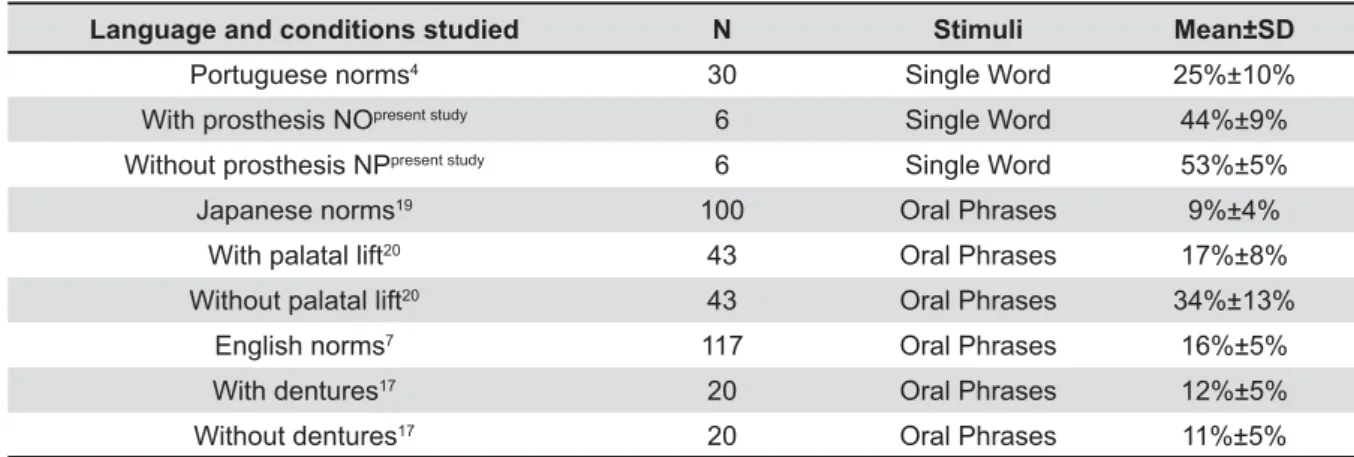
prosthesis17,19. Table 2 presents a summary of
nasalance scores for all studies involving palatal languages studied.
Even at the presence of normal resonance as indicated by listeners, the mean nasalance $ ! 00 higher than normative data reported for Portuguese
language4. DiNinno, et al.4 (2001) reported mean
1 ;G( 10%) for adult females and 21% (SD: 8%) for " #
higher than the proposed cut-off value of 27%
used for oral samples for Portuguese language21.
This result suggests that even at the presence $$ no openings) a lack of complete velopharyngeal closure may actually still exist, leading to nasal air $ but may have been pick-up by the nasometer. Nasal air emission, therefore, may be one explanation "
While mean nasalance found for the participant *& of presence of hypernasality, listeners agreed 22"# $ be partly explained by the use of different stimuli % $
oral passage. Tachimura, Kotani and Wada19 (2004)
$ |% $ palatal lift. While the introduction of the lift resulted all subjects, the authors indicated that the scores findings of normal nasality. Instrumental and
Language and conditions studied N Stimuli Mean±SD
Portuguese norms4 30 Single Word 25%±10%
With prosthesis NOpresent study 6 Single Word 44%±9%
Without prosthesis NPpresent study 6 Single Word 53%±5%
Japanese norms19 100 Oral Phrases 9%±4%
With palatal lift20 43 Oral Phrases 17%±8%
Without palatal lift20 43 Oral Phrases 34%±13%
English norms7 117 Oral Phrases 16%±5%
With dentures17 20 Oral Phrases 12%±5%
Without dentures17 20 Oral Phrases 11%±5%
Table 2- number of samples, speech stimuli, nasalance scores (mean, Standard Deviation)
Condition Mean±SD = Speech \ )
NO 44±9 36–58 Normal 100%
20 mm2 55±2 52–58 Hypernasal 60%
30 mm2 56±2 54–60 Hypernasal 100%
NP 53±5 48–60 Hypernasal 100%
perceptual assessments in the study of Tachimura,
Kotani and Wada19 (2004) also used different speech
% speech and nasalance obtained during production of a short passage. While the authors used a palatal lift for correction of VPI, the present study used a speech bulb (obturator), leading to the possibility of differences in the transfer of energy and oral/ $$"
$ and changes of impedance resulting from the introduction of the prosthesis in oral cavity and % $$ compared to norms) obtained in our study agreed
17,19. While
Scarsellone, Rochet and Wolfaardt17 (1999)
$ associated to the use of maxillary dentures, the $ 1 $ under the norms published for English speakers
(16%)7. Tachimura, Kotani and Wada19 (2004) study
40
lifts. These authors19%%
% higher than the nasalance norms for the Japanese
language20 (9%), speculating that an increase in
speech nasalance values could be the result of changes in transpalatal and transvelum transfer of acoustic energy. Therefore, higher nasometric values obtained in our study could be the result, at least in part, of changes in transpalatal and transvelum transfer of acoustic energy due to the presence of acrylic material used in the prosthetic "^%% to investigate the effect of material and shape prosthetic devices in nasalance scores.
Many aspects of speech may change/adjust $
system during sound production3. Nasometry is
limited to documenting only changes in the transfer " changes in nasalance observed after drilling holes 7= = % can consider nasalance to be sensitive to changes in velopharyngeal function related to different types of physical management (prosthetic and surgical). {$ = %
for the 30 mm2 opening
compared to the 20 mm2 openingcondition(55%).
#1 smaller than the SDs reported in this study agreeing revealed hypernasality for both conditions. This "# $ $$ 4 1 %$ of the possibility of active physiologic adjustments,
such as reported by10,12,16. As the later authors
described respiratory, laryngeal, and supralaryngeal physiological adjustments may take place as the " Future studies monitoring presence of adjustments such as increase or decrease in respiratory support, elevation or depression of larynx, adjustments in tongue posture or mouth opening can further our understanding of the strategies used by the 7 $ speech system during sound production.
While perceptually and instrumentally monitoring the outcome of physical treatment of VPD is
$ 11,13 the use of
nasometry to document outcome has to be done " # this study may be associated to the fact that the *
emission6,22%
be audible to listeners but may be detected by the "# $ including: the use of equal and longer speech stimuli, the use of speech bulbs made of different JJ % measures of transpalatal and transvelum transfer of acoustical energy, and the use of measures to monitor physiologic adjustments.
CONCLUSION
REFERENCES
1- Bzoch KR, ed. Communicative disorders: related to cleft lip and
palate. 5th ed. Austin: Pro-ed; 2004.
2- Carvalho-Teles V, Pegoraro-Krook MI, Lauris JRP. Speech
evaluation with and without palatal obturator in patients submitted
to maxillectomy. J Appl Oral Sci. 2006;14(6):421-6.
3- Dalston RM. The use of nasometry in the assessment and remediation of velopharyngeal inadequacy. In: Bzoch KR, ed.
Communicative disorders related to cleft lip and palate. 5th ed.
Austin: Pro-ed; 2004. p. 495-516.
4- Di Ninno CQMS, Vieira JM, Teles-Magalhães LC, Padovani CR,
Pegoraro-Krook MI. Nasalance values identiication in normal
Brazilian Portuguese speakers. Pró-Fono. 2001;13(1):71-7.
5- Henningsson G, Isberg A. Inluence of palatal istulae on speech
and resonance. Folia Phoniatr (Basel). 1987;39:183-91. 6- Karnell MP. Nasometric discrimination of hypernasality and
turbulent nasal airlow. Cleft Palate Craniofac J. 1995;32(2):146-8.
7- Kay elemetrics Corporation. Instruction manual for the nasometer model 6200. Lincoln Park: Kay elemetrics Corporation; 1994.
8- Kummer AW. Velopharyngeal dysfunction (VPD) and resonance disorders. In: Kummer AW. Cleft palate and craniofacial anomalies: effects on speech and resonance. San Diego: Singular Learning; 2001.
9- Lewis KE, Watterson T, Blanton A. Comparison of short-term
and long-term variability in nasalance scores. Cleft Palate Craniofac J. 2008;45(5):495-500.
10- Lima-Gregio AM, Dutka-Souza JCR, Marino VCC, Pegoraro-Krook MI, Barbosa PA. Achados espectrais das vogais [a] e [ ] em
diferentes aberturas velofaríngeas. Pró-Fono. 2010;22(4):515-20.
11- Lipira A, Grames LM, Molter D, Govier D, Kane A, Woo
A. Videoluoroscopic and nasendoscopic correlates of speech
in velopharyngeal dysfunction. Cleft Palate Craniofac J. 2011;48(5):550-60.
12- Marino VCC, Williams WN, Wharton PW, Paulk MF, Dutka-Souza JC, Schulz GM. Immediate and sustained changes in tongue
movement with an experimental palatal “istula”: a case study.
Cleft Palate Craniofac J. 2005;42(3):286-96.
13- Pegoraro-Krook MI, Dutka-Souza JC, Marino VC. Nasoendoscopy of velopharynx before and during diagnostic therapy. J Appl Oral Sci. 2008;16(3):181-8.
14- Pinto JH, Dalben GS, Pegoraro-Krook MI. Speech intelligibility
of patients with cleft lip and palate after placement of speech
prosthesis. Cleft Palate Craniofac J. 2007;44(6):635-41. 15- Pinto JH, Pegoraro-Krook MI. evaluation of palatal prosthesis for the treatment of velopharyngeal dysfunction. J Appl Oral Sci. 2003;11(3):192-7.
16- Sapienza CM, Brown WS, Williams WN, Wharton PW, Turner GE. Respiratory and laryngeal function associated with experimental
coupling of oral and nasal cavities. Cleft Palate Craniofac J. 1996;33(2):118-26.
17- Scarsellone JM, Rochet AP, Wolfaardt JF. The inluence of
dentures on nasalance values in speech. Cleft Palate Craniofac J. 1999;36(1):51-6.
18- Suguimoto MLCP, Pegoraro-Krook MI. Nasalance values of normal adults, Brazilian Portuguese speakers. Pró-Fono. 1996;8(1):7-12.
19- Tachimura T, Kotani Y, Wada T. Nasalance scores in wearers of a palatal lift prosthesis in comparison with normative data for
Japanese. Cleft Palate Craniofac J. 2004;41(3):315-9.
20- Tachimura T, Mori C, Hirata S, Wada T. Nasalance score variation in normal adult Japanese speakers of Mid-West Japanese dialect. Cleft Palate Craniofac J. 2000;37(5):463-7.
21- Trindade IeK, Genaro KF, Dalston RM. Nasalance scores of normal Brazilian Portuguese speakers. Braz J Dysmorphol Speech Hear Disord. 1997;1(1):23-34.
22- Watterson T, Lewis KE, Deutsch C. Nasalance and nasality in low pressure and high pressure speech. Cleft Palate Craniofac J.
1998;35(4):293-7.
23- Williams WN, Henningsson G, Pegoraro-Krook MI. Radiographic assessment of velopharyngeal function for speech. In: Bzoch KR,
ed. Communicative disorders related to cleft lip and palate. 5th
ed. Austin: Pro-ed; 2004.