Offi cial Publication of the Brazilian Society of Anesthesiology www.sba.com.br
REVISTA
BRASILEIRA DE
ANESTESIOLOGIA
Abstract
Background and objectives: We investigated the effect of Nitrous Oxide (N2O) on controlled
hypotension in low-fl ow isofl urane-dexmedetomidine anesthesia in terms of hemodynamics, anesthetic consumption, and costs.
Methods:
We allocated forty patients randomly into two equal groups. We then maintained dexmedetomidine infusion (0.1 µg.kg-1.min-1) for 10 minutes. Next, we continued it until the last30 minutes of the operation at a dose of 0.7 µg.kg-1.hour-1. We administered thiopental (4-6 mg.
kg-1) and 0.08-0.12 mg.kg-1 vecuronium bromide at induction for both groups. We used isofl urane
(2%) for anesthesia maintenance. Group N received a 50% O2-N2O mixture and Group A received 50% O2-air mixture as carrier gas. We started low-fl ow anesthesia (1 L.min-1) after a 10-minute
period of initial high fl ow (4.4 L.min-1). We recorded values for blood pressure, heart rate,
peripheral O2 saturation, inspiratory isofl urane, expiratory isofl urane, inspiratory O2, expiratory
O2, inspiratory N2O, expiratory N2O, inspiratory CO2, CO2 concentration after expiration, Minimum Alveolar Concentration. In addition, we determined the total consumption rate of fentanyl, dexmedetomidine and isofl urane as well as bleeding.
Results: In each group the heart rate decreased after dexmedetomidine loading. After intubation, values were higher for Group A at one, three, fi ve, 10, and 15 minutes. After intubation, the patients reached desired hypotension values at minute fi ve for Group N and at minute 20 for group A. MAC values were higher for Group N at minute one, three, fi ve, 10, and 15 (p < 0.05). FiO2 values were high between minute fi ve and 60 for Group A, while at minute 90 Group N values
were higher (p < 0.05). Fi Iso (inspiratuvar isofl uran) values were lower in Group N at minute 15 and 30 (p < 0.05).
Conclusion: By using dexmedetomidine instead of nitrous oxide in low fl ow isofl urane anesthesia, we attained desired MAP levels, suffi cient anesthesia depth, hemodynamic stability and safe inspiration parameters. Dexmedetomidine infusion with medical air-oxygen as a carrier gas represents an alternative anesthetic technique.
© 2013 Sociedade Brasileira de Anestesiologia. Published by Elsevier Editora Ltda. All rights reserved.
The Effects of Nitrous Oxide on Controlled
Hypotension During Low Flow Anesthesia
Semiha Barçın
1, Leyla Sahan
1, Dilsen Ornek*
1, Fazilet Sahin
1, Oya Kilci
1,
Serpil Deren
1, Gulay Erdogan
1, Canan Un
1, Mehmet Gamli
1, Bayazit Dikmen
11.Anaesthesia and Reanimation Department, Ankara Numune Training and Research Hospital, Ankara, Turkey Received from the Anaesthesia and Reanimation Department, Ankara Numune Training and Research Hospital, Ulku Mahallesi Talatpasa Bulvari No: 5, Altindag, Ankara 06100, Turkey.
Submitted on December 26, 2011. Approved on February 13, 2012.
Keywords:
Hypotension, Controlled; Anesthesia, Closed-Circuit; Nitrous Oxide; Dexmedetomidine.
SCIENTIFIC ARTICLE
*Corresponding author: Anaesthesia and Reanimation Department, Ankara Numune Training and Research Hospital, Ulku Mahallesi Talatpasa Bulvari No: 5, Altindag, Ankara 06100, Turkey. Telephone: 0 312 508 40 00; Fax: 0 312 311 43 40.
E-mail: [email protected].
Introduction
Controlled hypotension is a method used to improve the surgical environment by providing a dry area in middle ear surgery 1.
For this purpose, patient position and ventilation control can be supplemented with pharmacologic agents like vasodilators, beta-blockers, ganglion blockers and high dose potent inhala-tion anesthetics 1-5.
For controlled hypotension, inhalation agents have poten-tial benefi ts 5, such as ease of administration and availability,
hypotensive and anesthetic effects, and rapid clearance. Isofl urane decreases systemic vascular resistance and maintains cardiac output at normal levels, while reducing mean arterial pressure. However, in some patients rebound hypertension is observed, which prevents refl ex sympathetic stimulation and maintenance of desired hypotension levels 6. For this reason,
additional medicines are often used to alleviate these adverse effects 7-9.
Dexmedetomidine is a α2-adrenoceptor agonist used as a sedative, analgesic, and anxiolytic agent that affects heart rate and decreases arterial pressure. Dexmedetomidine is benefi cial for controlled hypotension 10.
In middle ear surgeries, when the tympanic membrane is placed the middle ear becomes a closed space and the membrane could detach from its original placement if nitrous oxide diffuses into this space. As such, nitrous oxide should be avoided during tympanoplasty or when cutting the graft before placement 11. To avoid the harmful effects of nitrous
oxide, inhalation anesthesia using low fl ow techniques and other agents can be used 12.
The economic and ecological drawbacks of anesthetic gas use can be addressed using low fl ow anesthetic techniques. By using re-inspiration techniques at high levels, anesthetic gas consumption and pollution decreases to minimal levels, as the contamination of the operating room, while any harmful effects are not increased.
We investigated the effects of nitrous oxide in middle ear surgery patients using controlled hypotension created by dexmedetomidine and isofl urane in low fl ow anesthesia.
Methods
The Institution’s ethics committee approved this study and informed consent was obtained from all patients. Forty pa-tients of ages between 18 and 61 years and ASA I or ASA II physical status scheduled to undergo middle ear surgery were included in this prospective, randomized study. Patients with liver failure, diabetes mellitus, cardiovascular system pathol-ogy, anemia, drug allergies, bleeding disorders, or pregnancy were excluded, as were patients using medications affecting the coagulation system. All patients were included in the statistical evaluations and all completed the study. Leakage control of anesthesia circuits and gas monitor calibration was carried out before each operation. For each operation single use anesthesia circuits and bacteria fi lters were employed. The CO2 absorbent was changed daily.
We did not administer any premedication to the patients. We monitored electrocardiography (ECG), heart rate (HBR), noninvasive arterial blood pressure (NABP) and peripheral oxygen saturation (SpO2) in the operating room with an ADU S/5 anesthesia device (Datex–Ohmeda, Finland). Intravenous vascular access (IV) was established via 18G (gauge) or 20G
intravenous cannula and Ringer Lactate infusion initiated with a 5-10 mL.kg-1. Preoxygenation was provided with 100% O
2 via
face mask for ten minutes.
A 22G catheter was placed in the radial artery of the non-dominant hand for invasive blood pressure monitoring. After reading basal values, we started dexmedetomidine serum infusion (4 µg.mL-1 in a total volume of 50 mL). After
dexmedetomidine infusion by injector type infusion pump for 10 minutes at a dose of 0.1 µg.kg-1.min-1, heart rate and blood
pressure values were recorded. Dexmedetomidine infusion was continued until the last 30 minutes of the operation at a dose of 0.7 µg.kg-1.hour-1.
For anesthesia induction, we administered 4–6 mg kg-1
thiopental (Pental Sodyum, İbrahim Ethem Ulagay İlaç Sanayi, İstanbul, Turkey) and 0.08-0.12 mg.kg-1 vecuronium bromide
(Norcuron, Organon, Oss, Holland) until the thiopental wink refl ex disappeared, after which we intubated the patient. After endotracheal intubation, we connected all patients to an ADU S/5 anesthesia device (Datex-Ohmeda, Finland) and maintained the tidal volume at 8-10 mL.kg-1 at 12 breaths.min-1.
A gas analyzer monitor was used for all patients and soda lime (Sorbo-Lime®) was used as a CO2 absorbent.
Patients were randomly assigned to two groups (N and A) using sealed envelopes chosen by the patients before the study. The fresh gas fl ow was as follows: 4.4 L.min-1 (O
2/N2O = 1.4/3)
containing 1.5% isofl urane after induction for providing deni-trogenization and improving anesthesia. After 10 minutes, we reduced Group N (n = 20) fresh gas fl ow to 1 L.min-1 50% O
2 in
N2O, providing a FiO2 value above 0.30 and 2-2.5% isofl urane was administered. Twenty minutes before tympanic membrane placement, we stopped the nitrous oxide fl ow and isofl urane administration continued at 50% O2 in air with 2-2.5% isofl u-rane. For Group A (n = 20), after 10 minutes, fresh gas fl ow was reduced to 1 L.min-1 50% O
2 in air providing a FiO2 value
above 0.30 and 2-2.5% isofl urane was administered.
We chose the isofl urane concentration at values where the baseline MAP is decreased by 30% and was stopped 10 minutes before the end of the operation. Fresh gas fl ow at 6 L.min-1
100% O2 was administered 5 minutes before the end of the operation. After extubation values were recorded, the patients were extubated. Heart rate (HR), mean arterial pressure (MAP), peripheral O2 saturation (SpO2), inspiratory isofl urane (Fi Iso), expiratory isofl urane (ETIso), inspiratory O2 (FiO2), expiratory O2 (ETO2), inspiratory N2O (FiN2O), expiratory N2O (ETN2O), inspiratory CO2 (FiCO2), CO2 concentration after expiration (ETCO2), Minimum Alveolar Concentration (MAC), respiratory tract plateau pressure (Pplato) values were recorded before and after dexmedetomidine loading, after zero, three, fi ve, 10, and 15 minutes after intubation at fi ve minutes intervals to minute 60 and then at 15 minutes intervals. During surgery, monitors were adjusted so that the end tidal carbon dioxide (ETCO2) was between 35-40 mm Hg and FiO2 was above 30%. When ETCO2 rose above 40 mm Hg, or FiO2 or SpO2 fell below 30% or 95, respectively, fresh gas fl ow rate was increased to 4.4 L.min-1 and those patients were then excluded from the
study.
Alfentanil was administered by IV at 7 µg.kg-1 as an
and the isofl urane concentration decreased if the heart rate fell below 50 bpm. When necessary to ensure equivalent an-esthesia depth, the volatile agent was increased by 0.2-0.25. For nausea and vomiting prophylaxis, we gave ondansetron (4 mg) by IV and for postoperative pain control, we adminis-tered 75 mg diclofenac sodium intramuscularly in all patients 30 minutes before the operation’s end. The bleeding rate was determined by the surgeon according to the Fromm–Boezaart Quality Scale where: “0”, no bleeding; “1”- there was no need to remove blood from the surgical fi eld; “2”- sometimes there was the need to remove blood from the surgical fi eld; “3” blood was removed from the operation area frequently; “4” the fi eld could be visualized only upon blood removal; “5”- bleeding did not allow continuation of the operation. In addition, surgeon satisfaction was assessed and recorded as: “good” = 1; “average” = 2; “bad” = 3.
For calculating gas consumption, we performed a repetitive calibration process of the anesthesia device for each patient. At the end of the operation, we recorded the total amount of isofl urane, N2O, and O2 consumed through calculations made by the ADU S/5 anesthesia device. In addition, the amount of dexmedetomidine and additional medicine consumed was also recorded. Complications such as nausea, vomiting, itching and urine retention occurring during the postoperative period were also recorded.
The SPSS 13 package program was used to evaluate data obtained in this study. Normality analysis of data was per-formed by the Shapiro-Wilk test. Student’s t-test was used in independent groups for the data showing normal distribution and the Chi-Square test was used for the variables calculated on a categorical basis. P values < 0.05 were considered statis-tically signifi cant. The patients who participated in the study were randomly determined and a neutrality assumption was achieved. Before this study, the effect size of 0.85, α = 0.05 and theoretical power (1-β) = 0.70 values were accepted and using the Gpower package program the study was performed with 40 subjects where n1 = n2 = 20.
Results
The study groups were matched according to age (year), weight, height, operation period, gender, and ASA scores (p > 0.05) (Table 1 and 2).
Hemodynamic data showed that in each group heart rates decreased after dexmedetomidine loading. After intubation, both groups had the same rate of heart rate increase to return to or slightly exceed basal values. After intubation, Group A had a lower heart rate decrease between 5 and 30 minutes after intubation (p < 0.05; Student’s t-test) (Figure 1).
Table 1 Student’s t-test results and comparison of patient characteristics.
Group N (n=20)
Group A (n=20)
p+
Age (years) 30.5 ± 8.90 34.05 ± 10.27 0.278
Weight (kg) 65.12 ± 13.45 72.40 ± 14.49 0.088
Height (cm) 165.93 ± 5.57 169.27 ± 8.70 0.064
Operation Period (min) 168.12 ± 59.41 156.75 ± 58.49 0.588
Average ± Standard Deviation; +t-test in independent groups.
Table 2 Comparison of patient characteristics and Chi-Square test results.
Group N (n=20)
Group A (n=20)
p
(Chi Square)
Gender (F / E) 15/5 9/11 0.074
ASA I / II 8/12 4/16 0.130
* p < 0.05.
Figure 1 Heart rate distribution.
bd: dexmedetomidine before, ad: after dexmedetomidine loading, ai: after intubation, be: before extubation, ae: after extubation.
Rate/min
100
90
80
70
60
bd ad ai 1 5 10 15 30 45 60 90 120 150 180 210 240 be ae
Min.
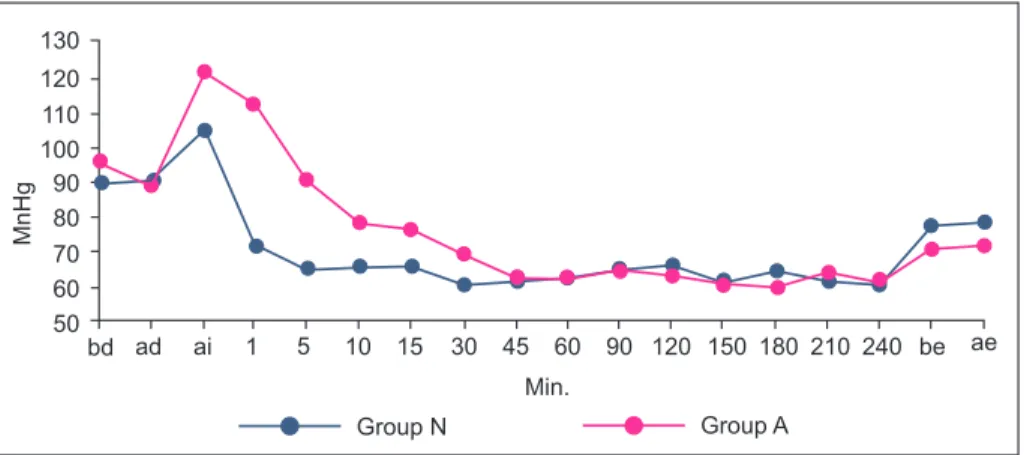
There was no signifi cant difference in MAP for each group after dexmedetomidine loading. After intubation, MAP was higher for minutes 1-15 for Group A (p < 0.05) (Figure 2). Group N reached desired hypotension levels fi ve minutes after intubation, while Group A reached desired levels 20 minutes after intubation. Although we stopped dexmedetomidine in the last 30 minutes, MAP remained similar before and after intubation (Figure 2).
Beginning just after intubation, Group N’s MAC values were slightly higher than Group A’s, with differences at min-utes one, three, fi ve, 10, and 15 (Figure 3) (p < 0.05).
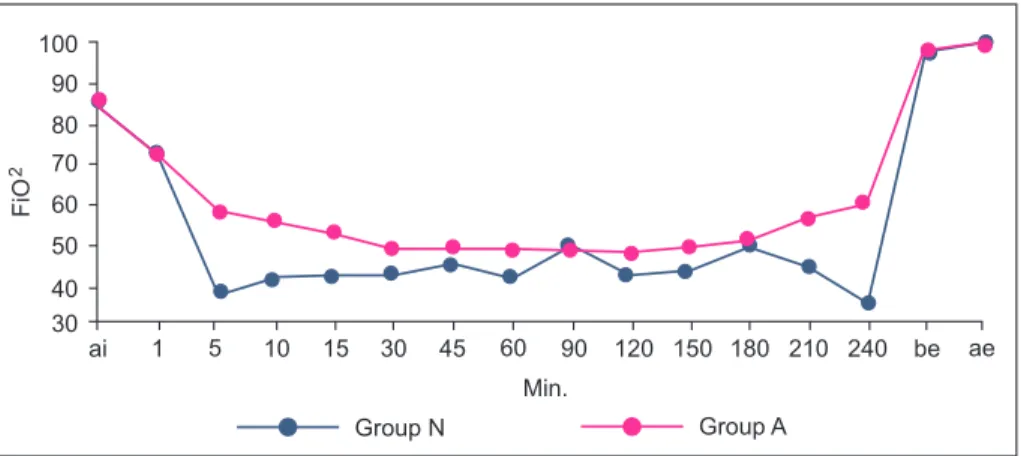
Group N FiO2 values were lower than Group A, although no group had values that fell by more than 30% during any interval. While Group A FiO2 values were higher between fi ve and 60 minutes, by minute 90 Group N had higher values (p < 0.05). Between 150 and 240 minutes, values were again higher in Group A, albeit with no statistically signifi cant dif-ference (Figure 4) (p < 0.05).
Fi Iso values were lower in Group N compared to Group A, starting at 15 minutes. There were statistical differ-ences between the values at minute 15 and 30 (Figure 5). The groups showed no difference between ETIso and ETCO2 pressures or P plateau values.
There was no signifi cant difference between groups with respect to dexmedetomidine (mcg), isofl urane (mL) and Alfentanil (mcg) values. While the dexmedetomidine and isofl urane usage was higher for Group A, the difference was not signifi cant (Table 3).
We did not have to increase the gas fl ow, since no de-crease in oxygen saturation and FiO2 values below 94 or 30%, respectively, occurred, and there were no ETCO2 values over 40 mm Hg. Alfentanil (7 µg.kg-1) was used intravenously for
three and four patients in Groups N and A, respectively, be-cause the MAP fell below desired values. At other time points there was no signifi cant difference between the groups in terms of these data. (p < 0.05).
At minute 15, during which time surgical incisions oc-curred, bleeding with a score of one as per the Fromm-Boezaart Quality Scale was observed for six Group N patients and eight Group A patients. There were no dif-ferences between the groups for other fi ndings or surgeon satisfaction.
MnHg
bd ad ai 1 5 10 15 30 45 60 90 120 150 180 210 240 be ae
Min.
Group A Group N
130
120 110 100 90 80 70 60 50
Figure 2 MAP distribution.
bd: dexmedetomidine before, ad: after dexmedetomidine loading, ai: after intubation, be: before extubation, ae: after extubation.
MAC
ai 1 5 10 15 30 45 60 90 120 150 180 210 240 be ae
Min.
Group A Group N
1,5
1,0
0,5
0,0
Figure 3 MACdistribution.
Discussion
The major risks in low fl ow anesthesia application include hypoxia, use of volatile anesthetics at low or high dosages, development of hypercapnia and accumulation of toxic trace gases 12. Low fl ow anesthesia methods are recommended
for minor and average operations and for patients without signifi cant complaints at the outset. For this reason, class ASA I or II patients were selected.
When applying low flow methods, devices that can monitor and carefully adjust the alarm limit values of air line pressure, the gas volume inhaled, FiO2, concentration of volatile anesthetic agent and CO2 concentrations should
be used 12. Here, the ADU S/5 (Datex- Ohmeda®) anesthesia
device was used, which allows monitoring of these values and electronic control of fresh gas fl ow.
In the low fl ow anesthesia method, there is an initial time period of 6-8 minutes for high fl ows of fresh gas (4-5 L.min-1),
which fi lls the system and adjusts the patient’s functional residual capacity, actualizes N2O equalization, and allows suffi cient anesthesia depth by providing denitrogenization. Afterwards, the fresh gas fl ow rate is decreased to 1 L.min-1
and low fl ow anesthesia is initiated 12. Here, we started
the low fl ow anesthesia application after 10 minutes of denitrogenization.
ai 1 5 10 15 30 45 60 90 120 150 180 210 240 be ae
Min.
Group A Group N
100
90
80
70
60
50
40 30
FiO
2
Table 3 Medicine consumption.
Group N (n=20) Group A (n=20) p+
Dexmedetomidine (mcg) 168.12 ± 51.53 174.55 ± 56.66 0.756
Isofl urane (mL) 21.25 ± 13.72 24.16 ± 7.17 0.070
Alfentanil (mcg) 0.18 ± 0.40 0.22 ± 0.42 0.806
Average ± SS; +t-test in independent groups.
ai 1 5 10 15 30 45 60 90 120 150 180 210 240 be ae
Min.
Group A Group N
2,0
1,5
1,0
0,5
0,0
Filzo
Figure 4 FiO2 distribution.
ai: after intubation, be: before extubation, ae: after extubation.
Figure 5 Fi Iso distribution.
In our study we observed a decrease in hemodynamic data before the operation following dexmedetomidine load-ing, although these values returned to baseline values after intubation (even when calculated hemodynamic values were high for the group without nitrous oxide, suffi cient anesthesia depth and controlled hypotension was achieved). In terms of medicine usage, bleeding, and surgeon satisfaction, no difference was found between groups. These fi ndings are in agreement with those of other studies 13.
The development of anesthesia devices, increased en-vironmental sensitivity awareness, anesthetics with new features and high costs, coupled with the fi nancial limitations of the medical sector worldwide led to the use of low fl ow anesthesia methods 14. In low fl ow anesthesia, the air exhaled
after CO2 absorption, which is used in half-closed systems, is re-exhaled to the patient in ratios of at least 50%. This situation can be achieved by modern re-inhalation systems only if fresh gas fl ow can be decreased 2.0 L.dk-115. According
to the studies, high gas fl ow in the initial phase, which lasts 10 minutes, is obligatory to ensure that fl ow rates will be at least 30% for FiO2,3.0 L.min-1 for N
2O fl ow and 1.4 L.min-1
for oxygen fl ow 16. The isofl urane dose should be adjusted to
1.5% during this initial phase. If these adjustments are made in the fi rst 10 minutes, the general MAC will be 1.3. In our study, the MAC value for the group with nitrous oxide was similar to this value. This value is AD95 and is accepted as suf-fi cient anesthesia depth that guarantees that 95% of patients won’t react to a skin incision. Aantaa et al. 17 reported that
dexmedetomidine used in high dosages decreases isofl urane MAC to 47 %. These low MAC values can produce hypotension at desired levels with lower isofl urane concentrations result-ing from dexmedetomidine usage in both groups.
By decreasing the fl ow in low fl ow anesthesia, an increase could be observed in FiO2 between 30 and 45 minutes with a continuous and slow decrease following this baseline in-crease. When the oxygen alarm limit is reached, oxygen fl ow rate must be increased and N2O must be decreased in same ratio. In our study no patient experienced a decrease under 30% for FiO2, probably because 50% oxygen was used in our low fl ow application.
Although Tobias and Berkenbosch 13 state that after
stopping dexmedetomidine infusion patients’ hemodynamic parameters returned to basal values within 7 minutes, in our study this period continued after extubation. If low fl ow anesthesia were maintained, this prolongation would be expected since the decrease in anesthetic concentrations is slow and late. Also, the reported isofl urane concentration was lower than those used here.
Isofl urane is believed to be the most suitable volatile anesthetic for creating hypotension in healthy patients 18.
In studies on both humans and animals, isofl urane was shown to decrease blood pressure by decreasing vascular resistance 19,20. Macnab et al. 21 stated that MAP could be
decreased effi ciently and the stress response weakened when isofl urane was used in cerebral aneurysm surgery. The limit value of blood fl ow that creates ischemia for patients undergoing carotid endarterectomy is lower for isofl urane compared to enfl urane and halothane. Newman et al. 22 stated that for cerebral aneurysm clips applied to
patients, isofl urane has benefi cial effects on the cerebral
oxygen presentation–requirement ratio. Haraldsted et al.23
also stated that the maximum limit of MAC value at which these benefi cial effects were seen is 2.5.
Madsen et al. 6 reported that rebound hypertension occurs
after stopping isofl urane for cerebral aneurysm clips applied to patients and isofl urane alone could not prevent sympathet-ic stimulation with rebound hypertension prevented by the α2-agonist clonidine. Also, because isofl urane does not com-pletely block baroreceptor refl exes, it can obstruct rebound sympathetic stimulation to reach desired hypotension levels and resistance can develop against the hypertensive effects of isofl urane 6. The combination of isofl urane with agents to
maintain cardiac output will be more suitable than using it alone in higher dosages 24. Toivenen and Kaukinen evaluated
the ability of clonidine to decrease the use of hypertensive agents in middle ear surgery and found that clonidine pre-medication at 4-5 µg.kg-1 decreased the usage of labetalol
or isofl urane in hypotension while also preventing increases in plasma catecholamine levels and causing the subsequent development of rebound hypertension 7. Woodcock et al. 8
administered clonidine premedication (0.6 mg oral) with isofl urane (2%) to middle ear and nasal surgery patients 2 hours before surgery and then tried to achieve hypertensive anesthesia by administering 3% isofl urane. The premedica-tion decreased the amount of hypotensive needed and the isofl urane amount required to obtain hypotension was also decreased.
The combination of isoflurane with medicines that block α-adrenergic or β-adrenergic receptors decreases the negative effects compared to single use of isofl urane as a hypertensive 25,26.Thus, isofl urane should be used as
adjuvant medicine in low concentrations while using con-trolled hypertension. This method has advantages such as decreasing cerebral metabolism and protecting pulmonary gas exchange 27.
Dexmedetomidine is a specifi c α2-adrenoceptor agonist. In addition to being generally used in mechanical ventilation of adults, it is frequently used after cardiac surgery as a sedative. The anxiolytic and anesthetic characteristics and its ability to enhance the effects of opioids make dexme-detomidine a part of a balanced anesthetic management. Dexmedetomidine also could be benefi cial for hypotension because it decreases average artery pressure and heart rate 13.
Premedication with dexmedetomidine at 1.2-2.5 µg.kg-1
dos-ages inhibits the cardiovascular response at laryngoscopy and tracheal intubation 28. Intravenous dexmedetomidine
(0.6 µg.kg-1) given 10 minutes before anesthesia induction
decreases the stress response 29. Compatible with results
obtained with normotensive patients, the stress response to laryngoscopy and endotracheal intubation was also suppressed when dexmedetomidine was administered 10 minutes before anesthesia.
In middle ear surgery, disruption of intra-operative vision due to bleeding is a serious problem. Ülger et al. 10 reported
operations generally occurs between minute 60 and 100 and takes approximately 20 to 30 minutes. During this time period, both groups had bleeding scores of zero and desired average artery pressures. Together, these results indicate that the hypotension level achieved is suffi cient and that dexmedetomidine is effective for controlled hypotension.
During tympanoplasty, the middle ear is open to the atmosphere and there is no pressure increase. When the tympanic membrane is placed, the middle ear again becomes a closed space. If nitrous oxide diffuses to this space, pres-sure in the middle ear will be increased and the membrane could detach from its placement site. If the nitrous oxide fl ow is stopped after membrane placement, a negative pressure could develop and the membrane may collapse from within. For both reasons, nitrous oxide should either be avoided dur-ing tympanoplasty or stopped before graft placement 10.
Low fl ow anesthesia methods minimize problems such as release of nitrous oxide to the atmosphere and operating room contamination 30-32, while maintaining the amount of gas
received by patients and keeping harmful results unchanged. To prevent these problems, the use of nitrous oxide should be avoided in all inhalation anesthesia administrations, in-cluding low fl ow anesthesia methods. Analgesia loss arising from stopping nitrous oxide fl ow could be compensated by opioid usage and hypnotic effect loss could be compensated by increasing volatile agent concentration 12,13.
In conclusion, in low fl ow anesthesia for middle ear sur-gery the desired mean arterial pressure could be achieved in both groups by using isofl urane and dexmedetomidine although the desired mean arterial pressure was reached later for the group without nitrous oxide. However, during surgical membrane placement that occurs in the last phases of the operation, the surgeon would not be affected by this delay, making dexmedetomidine a suitable agent to provide controlled hypotension without nitrous oxide in middle ear surgery.
References
1. Van Aken H, Miller Jr ED - Deliberate hypotension. In: Miller RD(ed). Anesthesia. Fifth edition. New York: Churchill Livingstone; 2000;1470-1490.
2. Degoute CS, Dubreuil C, Ray MJ, et al. - Effects of posture, hypotension and locally applied vasoconstriction on the middle ear microcirculation in anaesthetized humans. Eur J Appl Physiol. 1994;69:414-420.
3. Boezaart AP, van der Merwe J, Coetzee AR - Comparison of sodium nitroprusside-and esmolol-induced controlled hypotension for functional endoscopic sinus surgery. Can J Anaesth. 1995;42:373-376.
4. Pilli G, Güzeldemir ME, Bayhan N - Esmolol for hypotensive anesthesia in middle ear surgery. Acta Anaesthesiol Belg. 1996;47:85-91.
5. Pavlin JD, Colley PS, Weymuller EA Jr et al. - Propofol versus isofl urane for endoscopic sinus surgery. Am J Otolaryngol. 1999;20:96-101.
6. Madsen JB, Cold GE, Hansen ES, Bardrum B, Kruse-Larsen C - Cerebral blood fl ow and metabolism during isofl urane-induced hypotension in patients subjected to surgery for cerebral aneurysms. Br J Anaesth. 1987;59: 1204-1207.
7. Toivonen J, Kaukinen S - Clonidine premedication: a useful adjunct in producing deliberate hypotension. Acta Anaesth Scand. 1990;34:653-357.
8. Woodcock TE, Millard RK, Dixon J, Prys-Roberts C - Clonidine premedication for isoflurane-induced hypotension. Sympathoadrenal responses and a computer-controlled assessment of the vapour requirement. Br J Anaesth. 1988;60:388-394.
9. Aho M, Lehtinen AM, Erkola O, Kallio A, Korttila K - The effect of intravenously administered dexmedetomidine on perioperative hemodynamics and isofl urane requirements in patients undergoing abdominal hysterectomy. Anesthesiology. 1991;74:997-1002.
10. Ülger HM, Demirbilek S, Köroğlu A, Borazan H, Ersoy MÖ - Orta kulak cerrahisinde dexmedetomidin ile kontrollü hipotansiyon. İnönü Üniversitesi Tıp Fakültesi Dergisi. 2004;11:237-241. 11. Imberti R, Preseglio I, Imbriani M, Ghittori S, Cimino F, Mapelli
A - Low fl ow anaesthesia reduces occupational exposure to inhalation anaesthetics. Acta Anaesthesiol Scand. 1995;39:586-591.
12. Baum JA - Low fl ow anaesthesia in clinical practice. In: Baum JA (ed). Low Flow Anaesthesia. The theory and practice of low fl ow, minimal fl ow and closed system anaesthesia (2nd ed). Oxford, Butterworth Heinemann. 2001;220-268.
13. Tobias JD, Berkenbosch JW - Initial experience with dexmedetomidine in paediatric-aged patients. Paediatr Anaesth. 2002;12:171-175.
14. Baxter AD - Low and minimal fl ow inhalation anaesthesia. Can J Anaesth. 1997;44:643-653.
15. Baum JA, Aitkenhead AR - Low-fl ow anaesthesia. Anaesthesia. 1995;50(Suppl):37-44.
16. Barton F, Nunn JF - Totally closed circuit nitrous oxide/oxygen anaesthesia. Br J Anaesth. 1975;47(3):350-357.
17. Aantaa R, Jaakola M-L, Kallio A, Kanto J - Reduction of the Minimum Alveolar Concentration of Isoflurane by Dexmedetomidine. Anesthesiology. 1997;86:1055-1060. 18. Bertrand D, Boivin G, Manel J, Laxenaire MC - Effects of
isofl urane on bleeding in microsurgery of the middle ear. Ann Fr Anesth Reanim. 1987;6:416-418.
19. Lam AM, Gelb AW - Cardiovascular effects of isofl urane-induced hypotension for cerebral aneurysm surgery. Anesth Analg. 1983;62:742-748.
20. Van Aken H, Fitch W, Graham DI, Brüssel T, Themann H - Cardiovascular and cerebrovascular effects of isofl urane-induced hypotension in the baboon. Anesth Analg. 1986;65:565-574.
21. Macnab MS, Manninen PH, Lam AM, Gelb AW - The stress response to induced hypotension for cerebral aneurysm surgery: a comparison of two hypotensive techniques. Can J Anaesth. 1988;35:111-115.
22. Newman B, Gelb AW, Lam AM - The effect of isofl urane-induced hypotension on cerebral blood fl ow and cerebral metabolic rate for oxygen in humans. Anesthesiology. 1986;64:307-310. 23. Haraldsted VY, Asmussen J, Herlevsen P, Cold GE - Cerebral
arteriovenous difference of oxygen during gradual and sudden increase of the concentration of isofl urane for induction of deliberate hypotension. Acta Anaesthesiol Scand. 1992;36:142-144.
24. Dal D, Çeliker V, Özer E, Başgül E, Salman MA, Aypar Ü - Induced hypotension for tympanoplasty: a comparison of desfl urane, isofl urane and sevofl urane. Eur J Anaesthesiol. 2004;21:902-906.
25. Kick O, Van Aken H, Wouters PF, Verbesselt K, Van Hemelrijck J - Vital organ blood fl ow during deliberate hypotension in dogs. Anesth Analg. 1993;77:737-742.
27. Nicholas JF, Lam AM - Isofl urane-induced hypotension does not cause impairment in pulmonary gas exchange. Can Anaesth Soc J. 1984;31:352-358.
28. Aantaa R, Jaakola ML, Kallio A, Kanto J, Scheinin M, Vuorinen J - A comparison of dexmedetomidine, and alpha 2-adrenoceptor agonist, and midazolam as i.m. premedication for minor gynecological surgery. Br J Anaesth. 1991;67:402-409. 29. Jaakola ML, Ali-Melkkilä T, Kanto J, Kallio A, Scheinin H, Scheinin
M - Dexmedetomidine reduces intraocular pressure, intubation responses and anaesthetic requirements in patients undergoing ophthalmic surgery. Br J Anaesth. 1992;68:570-575.
30. Watts A, Luney SR, Lee D, Gelb AW - Effect of nitrous oxide on cerebral blood fl ow velocity after induction of hypocapnia. J Neurosurg Anaesthesiol. 1998;10:142-145.
31. Morgan GE, Mikhail MS, Murray MJ, Larson CP - Clinical Anesthesiology. Third Edition. Lange; 2001;143.