Diarrhea in children and
sanitation and housing
conditions in periurban areas in
the city of Guarulhos, SP
Prevalência de diarreia em crianças e
condições de saneamento e moradia
em áreas periurbanas de Guarulhos,
SP*
Mariana Gutierres Arteiro da Paz
IMárcia Furquim de Almeida
IIWanda Maria Risso Günther
IIII Programa de Pós-Graduação em Ciência Ambiental do Instituto de Eletrotécnica e Energia da Universidade de São Paulo
II Departamento de Epidemiologia da Faculdade de Saúde Pública da Universidade de São Paulo
III Departamento de Saúde Ambiental da Faculdade de Saúde Pública da Universidade de São Paulo
*Master´s research realized between 2005-2007 in the Departamento de Saúde Ambiental, Facul-dade de Saúde Pública, UniversiFacul-dade de São Paulo (Environmental Health Department, School of Public Health, University of Sao Paulo): “Epidemiologic study in periurban locality in Guarulhos city, SP: Sanitation access and child health conditions” was defended in 2007. We state that there is no conlict of interest. - Research funding: ICO-DEV - International Cooperation with Developing Countries mediante contrato ICA4-CT-2002-10061.
Mail responsible author: Mariana G. A. da Paz - Address: Rua Antonio Carlos, 196 ap. 56 A ZIP: 01309-010 - São Paulo/SP Brasil. E-mail: [email protected]
Abstract
A cross-sectional study was carried out to identify the association between diarrhea in 0-2 year-old children and children´s characteristics, access to sanitation and housing conditions in a periurban area served by the Family Health Program, in the city of Guarulhos, SP. Data were obtai-ned from FHP registration forms. Multiple logistic regression showed interaction for
Housing*Sewage (other materials and non
collected wastewater, p < 0.001), age group (4 - 9 months old, p = 0.054; 10 months and older, p = 0.008) as risk factors for diarrhea. Information collected by the Family Health
Program could be an excellent tool to
iden-tify populations with poor housing and sanitation conditions at locations where sanitation indicators are not efficient to identify populations living at risk.
Keywords: Diarrhea. Sanitation. Family
Resumo
Foi realizado estudo transversal em área periurbana do Município de Guarulhos, SP, atendida pelo Programa Saúde da Família (PSF) para verificar associação entre ocor-rência de diarreia em crianças de 0-2 anos de idade e características da criança, condi-ções de saneamento e tipo de moradia. Os dados foram coletados nas fichas de registro do PSF. Foi realizada análise de regressão logística multivariada, a qual indicou a in-teração Moradia*Esgoto (outros materiais e ausência de rede de esgoto, p < 0,001) e
idade (4 - 9 meses, p = 0,054; e 10 meses e
mais, p = 0,008) como fatores de risco para ocorrência de diarreia. Em localidades com falta de dados para compor indicadores de saneamento básico que permitem identifi-car populações que vivem situações de risco para a ocorrência de diarréia, as informa-ções coletadas pelo PSF podem se constituir em excelente ferramenta para identificação de núcleos populacionais com precárias condições de habitação e saneamento.
Palavras-Chave: Diarreia. Saneamento básico. Programa Saúde da Família. Área periurbana. Estudo epidemiológico. Saúde ambiental.
Introduction
Diarrhea is a relevant public health issue related to hygiene conditions and water quality (Özkan et al1, 2007). WHO reports
diarrhea as the second leading cause of death in children, representing about 1.5 million annual deaths in children under five years old (UNICEF/WHO2, 2009). In
global data, diseases related to diarrhea are among the greatest causes of mortality in underdeveloped countries (Fewtrell et al
3, 2005), where they are frequent and can
be fatal (Bozkurt et al4, 2003), especially in
young children (Moe e Rheingans5, 2006).
In these countries, it is estimated that 1.5% of newborn deaths in 1993 (Bozkurt et al4,
2003) and 7.1% of deaths between 1998 and 2002 in Latin America and the Caribbean (Teixeira e Pungirum6, 2005) were caused by
diseases related to diarrhea. Transmission of infectious diseases such as diarrhea is a complex process, with many determi-nants (Trevett el al7, 2005). Nevertheless,
88% of the deaths caused by diarrhea are a consequence of unsafe water, unsuitable sanitation and poor hygiene conditions (UNICEF/WHO2, 2009). This is why water
provision in quality and amount, treatment and removal of domestic waste and pro-motion of sanitation in the community are actions that can be taken to prevent diarrhea in children (UNICEF/WHO2, 2009). These
services must be promoted by the urban infrastructure sector, with participation from the public health sector, jurisdiction of
the Sistema Único de Saúde (SUS – Brazilian
Unified Health System) and community, as stated in the Federal Constitution of 1988 (BRASIL8, 1988).
In many Brazilian localities, populations without urban infrastructure such as sani-tation services and public equipment are served by the Programa de Saúde da Família
(PSF – Family Health Program). This pro-gram was created in 1994 as an alternative health promotion program in the country. Teams of Agentes Comunitários de Saúde
habitation and family and health conditions for records and to compose the Sistema
de Informação da Atenção Básica (SIAB –
Information System for Primary Care). ACS follows the families monthly and records the information regarding housing, sanitation and health of children 0 to 2 years old.
In periurban areas, sanitation services are usually not universal, ergo in many lo-calities there is no access or it occurs irregu-larly. Precarious access is often responsible for a large part of occurrences of diarrhea, and it is associated with poverty (Blakely et al9, 2005).
The objective of this study is to verify if there is an association between the de-pendent variable prevalence of diarrhea and the variables: i) child characteristics (gender, age, nutritional state, breastfeeding and birth weight); ii) sanitation conditions (water supply, home water treatment and sewage); and iii) housing type.
Methods
Area and studied population
The study examined a county in the metropolitan region of São Paulo (RMSP), a low-income periurban settlement with the PSF implemented since 2005. Considering that the PSF can be an instrument in identi-fying priority areas of sanitation investment, a transversal study was done in order to verify the possibility of using information raised by ACS in the health-environment interface. The study field is represented by the Recreio de São Jorge neighborhood, Guarulhos, SP. The locality is attended by he-alth unit Recreio de São Jorge, from PSF and is located in the supply reservoir catchment protection area of the Cabuçu reservoir. In 2006 (research interest period) the Recreio de São Jorge neighborhood had an estima-ted population of 17,502 inhabitants and unsatisfying sanitation indices with 88.7% of the houses served by the public water supply system and only 16.9% served by sewer collection. Considering the number of records in the PSF register for the period
of May 2005 to April 2006, all children be-tween 0 and 2 years old were studied during the reference period (817 children) as well as registered families responsible for these children (771 families).
Variables used and data collection
The dependent variable is the diarrhea
occurrence in children between 0 and 2 years
old. This indicator is used in most studies to assess sanitation impacts on public health Andreazzi et al10 (2007), for response
capaci-ty, viability in its use and easy determination of disease (Heller11, 1997). The exposure
va-riables refer to child characteristics, housing and sanitation conditions. As information sources were used Form A – family charac-teristics and Form C – health conditions form and medical monitoring for children under 2 years old.
From Form A the variables used were: i) Material used in habitation construction: wood, brick, reused material, others; ii) number of rooms in the house; iii) number of residents; iv) adult residents per home, by age; v) water supply conditions: by pu-blic network, by well or spring or others; vi) kind of water treatment in house: by filtration, boiling, chlorination or without treatment; vii) waste disposal: by public collection, burned or buried, waste dump; and viii) sewer destination: sewer, sink or open sewers. The waste disposal variable is not part of the study because according SIAB information, 99% of local families were served by city public collection. Information found on Form A was collected by the ACS between March and April 2005, when the program was implemented, being that there were no sanitary or educational interventions in the referenced period (May 2005 to April 2006).
Information about child characteristics was collected monthly by the ACS during home visits.
Data analysis
Univariate analysis was initially perfor-med between the closure diarrhea occurren-ce and environment and child health varia-bles to the variavaria-bles pre-selection, using the value of p<0.2 (Table 1) as a cutoff. The as-sociation measure was the Prevalence Ratio (PR) for a Confidence Interval (CI) of 95%. To calculate the age PR and the diarrhea
occurrence the Mantel and Haenszel PR to
CI 95%, were used (Kelsey et al12, 1996). This
analysis was used to identify the variables that should be used in the logistical regres-sion analysis. In the multivariate analysis, the multivariate logistic regression model was used, in STATA 9 statistical software.
Three adjustments were made until the final model was complete, selecting the variables that were associated with the closure of sta-tistical level of significance <0.05.
Ethical aspects
The Comitê de Ética em Pesquisa de
Saúde Pública of Universidade de São Paulo
(COEP – Research Ethical Committee) reviewed and approved the Research Protocol N° 1435, according to requirements
of Resolução CNS/196/96 (Resolution of
Brazilian National Health Council).
Results
During the analyzed period 4,048 cases of diarrhea in children between 0-2 years old were recorded. Regarding the characteristics
Table 1 - Child characteristics and prevalence of diarrhea in 0-2 year-old children living in Recreio de São Jorge, Guarulhos, SP, May 2005 to April 2006.
Tabela 1 - Características da criança e prevalência de diarreia em crianças de 0 a 2 anos de idade no Recreio de São Jorge, Guarulhos, SP, maio de 2005 a abril de 2006.
Child characteristics Diarrhea occurrence Total N° PR CI (95%) p
Yes No
N° % N° %
Malnutrition Yes 5 22.7 17 77.3 22 1.49 0.68; 3.28 0.337
No 121 15.2 673 84.8 794 1
Breastfeeding Mixed 89 16.3 458 83.7 547 1.07 0.75; 1.54 0.696
Exclusive 35 15.2 196 84.8 231 1
Gender Male 63 17.4 299 82.6 362 1.14 0.82; 1.58 0.433
Female 59 15.3 327 84.7 386 1
Age group (in months)
0 -3 5 6.0 79 94.0 84 *0.25 0.10; 0.06 <0.001
4 - 9 51 23.9 162 76.1 213 1
10 months or more 70 15.4 386 84.6 456 *0.53 0.38; 0.73 <0.001
Birth weight <2500g 15 24.6 46 75.4 61 1.34 0.74; 2.79 0.242
>=2500g 102 18.4 452 81.6 554 1
Notes: * To evaluate age, Mantel and Haenzel Prevalence Rate –RPMH was calculated
Without information: Malnutrition: 1; Breastfeeding: 39; Sex: 69; Birth weight: 202
Notas: * Para a variável idade foi calculada a Razão de Prevalência de Mantel e Haenszel - RPMH
of children and families in the univariate analysis, greater diarrhea prevalence in children between 4-9 months old was iden-tified. Taking the age group 4-9 months old
as a reference, age group 0-3 months old and
more than 10 months old showed protection
effect to diarrhea occurrence. Table 1 shows that age group was associated to diarrhea
occurrence. The variable elderly also was
associated to malnutrition: all children with
malnutrition (22) lived with adults older
than 55 (chi2=784.00; p<0.001). Due to
colli-nearity between malnutrition and elderly,
the variable elderly was not contemplated in the regression model, while malnutrition
remained in the analysis. Weight when born
variable was not a part of the model because of high loss of record (24.7%).
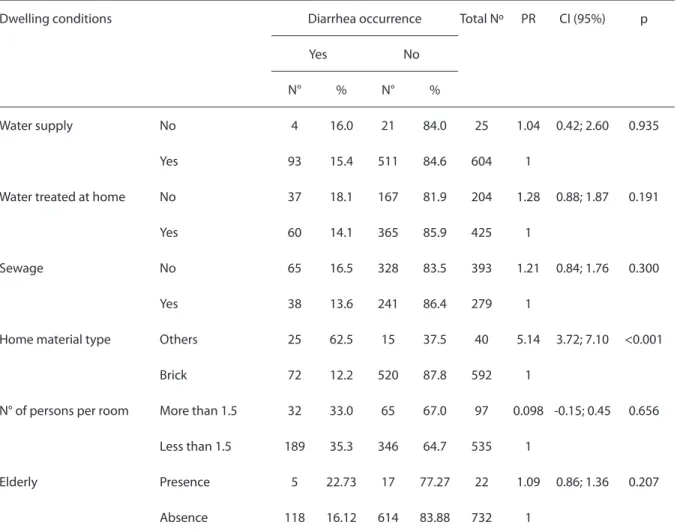
Table 2 shows that material other than
brick used in construction of habitation was
considered a risk factor to diarrhea
occur-rence in children (p<0.001). This variable
portrays family socioeconomic conditions and is highly correlated to sewer destination, when absence of sewage (p<0.001). Because of this high correlation between housing and
Table 2 - Access to sanitation, housing conditions and prevalence of diarrhea in 0-2 year-old children living in Recreio de São Jorge, Guarulhos, SP, May 2005 to April 2006.
Tabela 2 - Acesso ao saneamento e condições de moradia e prevalência de diarreia em crianças de 0 a 2 anos de idade no Recreio de São Jorge, Guarulhos, SP, maio de 2005 a abril de 2006.
Dwelling conditions Diarrhea occurrence Total Nº PR CI (95%) p
Yes No
N° % N° %
Water supply No 4 16.0 21 84.0 25 1.04 0.42; 2.60 0.935
Yes 93 15.4 511 84.6 604 1
Water treated at home No 37 18.1 167 81.9 204 1.28 0.88; 1.87 0.191
Yes 60 14.1 365 85.9 425 1
Sewage No 65 16.5 328 83.5 393 1.21 0.84; 1.76 0.300
Yes 38 13.6 241 86.4 279 1
Home material type Others 25 62.5 15 37.5 40 5.14 3.72; 7.10 <0.001
Brick 72 12.2 520 87.8 592 1
N° of persons per room More than 1.5 32 33.0 65 67.0 97 0.098 -0.15; 0.45 0.656
Less than 1.5 189 35.3 346 64.7 535 1
Elderly Presence 5 22.73 17 77.27 22 1.09 0.86; 1.36 0.207
Absence 118 16.12 614 83.88 732 1
Note: Without information: Water supply: 188; Water treated at home: 188; Presence of Sewer system: 145; type of building material: 185; # of persons per room: 185; Elderly: 63
Notas: Ausência de informação: Abastecimento de água: 188; Tratamento de água no domicílio: 188; Coleta de esgotos: 145; Tipo de material: 185; Número de
sewer destination, an interaction variable was created: housing*sewer to integrate the regression model.
In the first adjustment of the regression model, three variables show significant sta-tistical association with diarrheaoccurrence:
malnutrition (p=0.020), age group (10
mon-ths and more) (p=0.056) and housing*sewer
(p<0.001) as risk factors. In the second adjustment of the regression model, with significant statistical variables to diarrhea
occurrence, malnutrition was excluded.
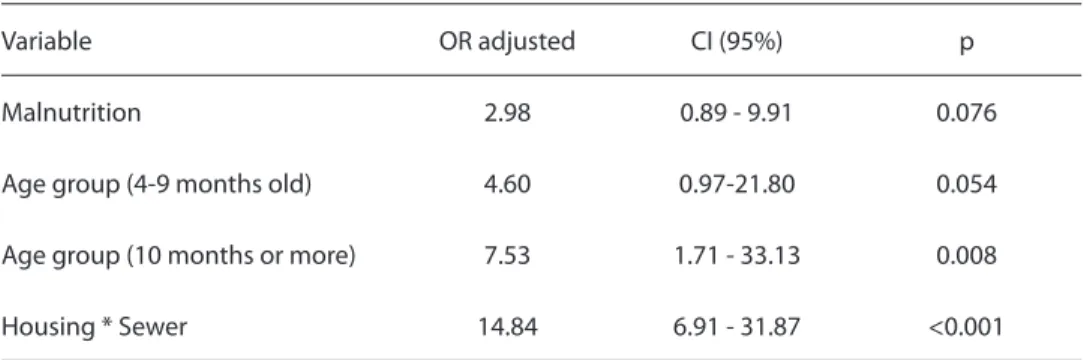
Table 3 shows final logistic regression model: housing*sewer (material other than brick used in construction of habitation
and absence of sewage); and age group (10
months and more) as risk factors to diarrhea
occurrence. The final model showed the
va-riables: housing*sewer (materials other than
bricks used in construction of habitation and
absence of sewage); and age (10 months or
more) as risk factors to diarrhea occurrence
(Table 3), being that the other variables were no longer significant to the closure.
Discussion
The material other than brick used in
the construction of habitation was identified
as a risk factor to diarrhea occurrence in the univariate analysis, suggesting that the precarious housing conditions can result in home hygiene difficulty, a factor that can in-crease the occurrence of diarrheal diseases. On the other hand, this variable is also an
indicator of poverty and low family income (IBGE13 2000).
The absence of sewage was not
asso-ciated with diarrhea occurrence in then univariate analysis; however, an interaction of this variable with the use of precarious material in the construction of habitation has been identified, raising the risk of
diarrhea occurrence by almost 15 times for
children that live in residences where this condition was found. This result confirms the healthy housing concept of Azeredo et al14 (2007), which considers that housing is
a health agent and relates to the geographic and social territory, the materials used in its construction, health education of the inhabitants and other characteristics in the surrounding context.
Absence of sewage interferes with the
health of children by polluting the environ-ment and enabling the spread of excreta related diseases, especially those of the parasitic variety that have diarrhea as the main symptom. Absence of proper sewer disposal systems in urban settlements, is not only an important cause of surface and underground water pollution, but is also a risk to the population’s health, especially when there is no knowledge of waterborne diseases. Giatti15 (2004). Sanitation research
in Iporanga (SP), verified that the researched watercourses presented microbiological indices that indicated the presence of pollution caused by domestic sewage due to local sanitation failure, considering that Table 3 - Final model for the occurrence of diarrhea diseases in children living in Recreio de São Jorge. Guarulhos. SP. May 2005 to April 2006.
Tabela 3 - Modelo inal para ocorrência de doenças diarréicas. em crianças residentes no bairro Recreio de São Jorge. Guarulhos. SP. maio de 2005 a abril de 2006.
Variable OR adjusted CI (95%) p
Malnutrition 2.98 0.89 - 9.91 0.076
Age group (4-9 months old) 4.60 0.97-21.80 0.054
Age group (10 months or more) 7.53 1.71 - 33.13 0.008
91% of the households had feces in trenches, mostly rudimentary.
Scenarios found in Recreio de São Jorge reflect the situation of RMSP´s periurban areas, which are characterized by indices of population increase in protected areas (Porto16, 2003) or legally restricted areas.
This situation generates precarious housing, water and sanitation conditions and contri-butes to environmental degradation mainly in reservoir catchment protected areas, besides the verified public health problems. Studies verified an association between housing in invaded areas or slums and infant mortality in Campinas (Almeida17,
2004) and the southern zone of the city of São Paulo (Shoeps18, 2007); suggest that the
locality of this housing is indicative of social exclusion. In this study interaction between precarious home construction materials and non-existence of sewage indicates so-cial exclusion and increment of conditions to pathogen exposure explains the high risk of diarrhea in children living in precarious housing with poor sanitation.
Water supply access and diarrhea
oc-currence do not show significant
associa-tion with the research results, possibly because almost the whole population has this service. However, according to ACS, many families use water from the public supply together with well and river water because of the high level of intermittence of this service. Access to and consumption of water from public services decrease the probability of diarrheal disease occurrence because of the required potability standard in the system that guarantees the water as a safe for human consumption.
Quality and quantity of water for ba-sic needs are not guaranteed when using alternatives sources of water (Razzolini e Günther19, 2008). However problems with
intermittence in water supply enable sa-tisfactory conditions for the infiltration of pathogens in the water supply network because of a negative pressure on it (Lee e Schwab20, 2005). Another consequence
of interrupted provision is the possibility of storing water in precarious recipients
without sanitation, representing a vulnera-bility factor to water quality.
Checkley et al21 (2004), in periurban
area studies of Lima, Peru, show that young children exposed to precarious sanitation (water source, reservoir localization and sewer destination) present 54% more cases of diarrhea than non exposed children. A study in Asian periurban areas (Briscoe22,
1987) found a 33% reduction in diarrhea in children served by public water supply and sewage.
Vulnerability factors of the public ne-twork such as frequent intermittence of water supply and illegal connections expose water to contamination or housing vulnera-bility factors like: non existence of housing reservoir sanitation, transport and storage in inadequate recipients, introduction of objects into water reservoir and inadequate practices of users. These vulnerability fac-tors pose the risk of water contamination. Regarding child characteristics, it was observed that the age group of 10 months and beyond was more associated with occurrences of diarrhea. In this age group, other kinds of food were introduced into the children’s diets, and without adequate heal-th care in preparation, could present risks of pathogen transmission. Furthermore, children from this age group possess gre-ater mobility, thus increasing the chance of environmental contamination. It was observed that age group 4-9 months is four times more likely to experience occur-rences of diarrhea, but this is statistically insignificant, suggesting that the passage of exclusive breastfeeding to mixing with other foods could have some effect on occurren-ce of diarrhea in this age group. This fact confirms WHO´s recommendation (WHO23
2003) about the necessity of exclusive breas-tfeeding up to 6 months of age for children’s survival and health, especially related to the prevention of diarrheal diseases.
malnutrition and occurrences of diarrhea ( WHO/UNICEF/USAID/SIDA24, 1990).
Elderly presence in families and malnutri-tion were observed collinearly, suggesting that children can live in nontraditional families and such families can present unfa-vorable characteristics (Camarano25, 2004).
Programa Saúde da Família´s
information use in environmental health studies
Results obtained show that SIAB´s in-formation could constitute an important data source to identify populations living in situations of environmental risk.
Often environmental and health studies have been interrupted by the difficulties in obtaining local and specific data. In many cases available information is aggregated on a municipal level, masking heterogeneous living conditions and making it hard to understand the risk factors at local levels. In that sense, SIAB could represent a data source for studies about the interrelation between environment and health, contri-buting to the obtainment of housing, health and sanitation data that respect the hetero-geneity of Brazilian urban areas.
However the use of SIAB data in envi-ronmental studies has some limitations that could be easily attenuated. Data records must be improved; especially the environmental information, which should be periodically updated since the environ-mental conditions are dynamic and can be altered with time. Using families’ samples to inspect the homes and update the recorded information or even to add information to the existing data collection record to obtain indices according to the study’s needs can be a way to handle this difficulty.
SIAB´s information could be utilized in environmental-health studies; incor-porating variables that better characterize environmental and housing conditions. It could also be included as suggestions for improvement, data regarding: water origin from alternatives sources; water quality; water intermittence frequency; existence, type and quantity of domestic animals; housing surrounding conditions; housing at irregular areas or environmental vulnera-bility; waste reaprovement; and sanitation practices. Regarding the form on children, it is important to contain the age and mother or occupation.
A study about environmental health indicators Calijuri et al26 (2009) proposed
some sanitation variables: lack of water in housing to verify the service intermittence and kind of water supply in cases of alter-native sources present. There is also an interesting use of variables that identifies the presence of animals, flies and plants inside the house in the environmental health group.
Conclusion
Large conurbation water and sanitation indicators cannot be efficient in identifying communities that live in at-risk conditions of diarrheal occurrence. Information col-lected by the Programa de Saúde da Família
References
1. Özkan S, Tüzün H, Görer N, Ceyhan M, Aycan S, Albayrak S. Water usage habits and the incidence of
diarrhea in rural Ankara, Turkey.Trans Soc Trop Med Hyg
2007; 101(11): 1131-5.
2. UNICEF-United Nations International Children’s Emergency Fund; WHO-World Health Organization. Diarrhea: why children are still dying and what can be
done. UNICEF; WHO: Geneva; New York; 2009.
3. Fewtrell L, Kaufmann RB, Kay D, Enanoria W, Haller L, Collford JM Jr. Water, sanitation and hygiene interventions to reduce diarrhea in less developed
countries: a systematic review and meta-analysis. Lancet
Infec Dis 2005; 5(1): 42-52.
4. Bozkurt AI, Ozgür S, Ozçirpici B. Association between household conditions and diarrheal diseases among
children in Turkey: a cohort study. Pediatr Int 2003;
45(4): 443-51.
5. Moe CL, Rheingans RD. Global challenges in water,
sanitation and health. J Water Health 2006; 4: 41-57.
6. Teixeira JC, Pungirum MEM de C. Análise da associação entre saneamento e saúde nos países em desenvolvimento da América Latina e do Caribe, empregando dados secundários do banco de dados da
Organização Pan-Americana de Saúde - OPAS. Rev Bras
Epidemiol 2005; 8(4): 356-76.
7. Trevett AF, Carter RC, Tyrrel SF. The importance of domestic water quality management in the context of
fecal-oral disease transmission. J Water Health 2005;
3(3): 259-70.
8. Brasil. Constituição da República Federativa do Brasil (1988). Brasília: Senado; 1988.
9. Blakely T, Hales S, Kieft C, Wilson N, Woodward A. The
global distribution of risk factors by poverty level. Bull
World Health Organ 2005; 83(2): 118-26,.
10. Andreazzi MAR, Barcellos C, Hacon S. Velhos indicadores para novos problemas: a relação entre
saneamento e saúde. Rev Panam Salud Publica 2007;
22(3): 211-7.
11. Heller L. Saneamento e saúde. Brasília: OPAS; 1997.
12. Kelsey JL, Whittemore, AS, Evans, AS, Thompson, WD.
Methods in observational epidemiology. New York:
Oxford University Press; 1996.
13. IBGE-Instituto Brasileiro de Geografia e Estatística.
Censo 2000. Rio de Janeiro: IBGE; 2001.
14. Azeredo CM, Cotta RMM, Schott M, Maia T de M, Marques ES. Avaliação das condições de habitação e saneamento: a importância da visita domiciliar no
contexto do Programa Saúde da Família. Ciênc Saúde
Coletiva 2007; 12(3): 743-53.
15. Giatti LL, Rocha, AA, Santos FA dos, Bitencourt SC, Pieroni SR de M. Condições de saneamento básico em
Iporanga, Estado de São Paulo. Rev Saúde Pública 2004;
38(4): 571-7.
16. Porto M. Recursos hídricos e saneamento na Região
Metropolitana de São Paulo: um desafio do tamanho da
cidade. Brasília: Banco Mundial; 2003.
17. Almeida, SDM, Barros, MBA. Atenção à saúde e
mortalidade neonatal. Rev Bras Epidemiol 2004; 7(1):
22-35.
18. Shoeps D, Almeida MF de, Alencar GP, França Jr I, Novaes HMD, Siqueira AAF et al. Fatores de risco para a
mortalidade neonatal precoce. Rev Saúde Pública 2007;
41(6): 1013-22.
19. Razzolini MTP, Günther WMR. Impacto na saúde das
deficiências de acesso à água. Saúde Soc 2008; 17(1):
21-32.
20. Lee EJ, Schwab KJ. Deficiencies in drinking water
distribution systems in developing countries. J Water
Health 2005; 3(2): 109-27.
21. Checkley W, Gilman R, Black RE, Epstein LD, Sterling CR, Moulton LH. Effect of water and sanitation on childhood
health in a poor Peruvian peri-urban community. Lancet
2004; 363 (9403): 112-8.
22. Briscoe J. Abastecimento de agua y servicios de saneamiento; su función em la revolución de la
supervivencia infantil. Bol Oficina Sanit Panam 1987;
103(4): 325-39.
23. WHO-World Health Organization. Infant and young child feeding: a tool for assessing national practices, policies and programmers. 2003. Disponível em http:// www.who.int/ nutrition/publications/infantfeeding/ [Acessado em 30 de janeiro de 2007]
24. WHO-World Health Organization; UNICEF-United Nations International Children’s Emergency Fund; USAID-United States of America Agency International Development; SIDA-Sweden International Development
Agency. Innocent declaration on the protection,
promotion and support of breastfeeding. Florence: WHO/
25. Camarano, AA. O idoso brasileiro no mercado de trabalho. Instituto Brasileiro de Pesquisa Econômica Aplicada – IPEA, Rio de Janeiro: 2001. Disponível http://www.ipea.gov.br/pub/ td/td_2001/td_0830.pdf [Acessado em 18 de abril de 2008]
26. Calijuri ML, Santiago A da F, Camargo R de A, Moreira Neto RF. Estudo de indicadores de saúde ambiental e
de saneamento em cidade do Norte do Brasil. Eng Sanit
Amb 2009; 14(1): 19-28.