1 Laboratory of Spirometry and Respiratory Therapy, Universidade Federal de São Carlos (UFSCar), São Carlos, SP, Brazil 2 Laboratory of Cardiorespiratory Physical Therapy, Universidade do Sagrado Coração (USC), Bauru, SP, Brazil
Received: 05/13/2013 Revised: 08/13/2013 Accepted: 11/11/2013
a r t i c l e
Validity of the six-minute step test of free cadence in
patients with chronic obstructive pulmonary disease
Bruna V. Pessoa1,2, Juliano F. Arcuri1, Ivana G. Labadessa1, Joyce N. F. Costa1, Anna C. Sentanin1, Valéria A. Pires Di Lorenzo1
ABSTRACT | Objectives: to evaluate the concurrent validity of the six-minute step test (6MST) in assessing exercise capacity of COPD patients using the six-minute walk test (6MWT) as a gold-standard. The predictive validity of the 6MST
was assessed to determine a cut-off point for identiication of low exercise capacity. Method: thirty-two COPD patients (50-87 years old) with mild to very severe obstruction performed the 6MST and 6MWT twice. Results: Concurrent
validity: a strong positive correlation (Pearson) between the number of ascents on the irst (T1), second (T2) and the best of both (T1 or T2) tests during the 6MWT was observed. Although a moderate negative correlation with BODE index and FEV1 was found, it was considered insuficient to test the validity, therefore ROC curves were not applied. The predictive validity (ROC) of the 6MST to identify low physical capacity (compared with the 6MWT) using the performance of T1 or T2, or solely T1 was considered accurate, and the area under the curve was 0.8 (IC95% 0.62-0.98) and 0.85 (IC95% 0.70-0.99), respectively. To classify patients, the cut-off points of 86 and 78 steps were chosen, with both values showing 90% of sensitivity and speciicity of 64% and 68% for T1 or T2, or solely T1, respectively. Conclusion: The number of steps on the 6MST was valid to verify exercise capacity in COPD patients and the cut-off
point of 78 steps was able to identify patients with poor exercise tolerance. Values under this cut-off point are considered
to identify patients with a poorer prognosis.
Keywords: COPD; physical therapy; validity; exercise test.
Article registered in the Clinical trials.gov Identiier: NCT01298661
HOW TO CITE THIS ARTICLE
Pessoa BV, Arcuri JF, Labadessa IG, Costa JNF, Sentanin AC, Pires Di Lorenzo VA. Validity of the six-minute step test of free cadence in patients with chronic obstructive pulmonary disease. Braz J Phys Ther. 2014 May-June; 18(3):228-236. http://dx.doi. org/10.1590/bjpt-rbf.2014.0041
Introduction
Chronic obstructive pulmonary disease (COPD)
is characterized by decreased aerobic capacity
1and
muscle strength
2, culminating in loss of functionality
and exercise intolerance. These changes are the
most important consequences of this disease
3, which
negatively impacts the quality of life of patients
1.
Therefore, it is necessary to evaluate exercise
tolerance in COPD patients through functional tests,
since the tests are able to provide speciic information
concerning functional capacity and physiological
adaptation during physical effort.
The maximal cardiopulmonary test is considered
the gold-standard for assessing exercise tolerance
because it evaluates functional capacity and abnormal
responses of the musculoskeletal, cardiovascular and
respiratory systems. In addition, it has been widely
used in the prescription and monitoring of physical
training in cardiac and pulmonary rehabilitation
4,5.
However, its use is limited in clinical practice due to
the complexity of the equipment, high costs and the
need for trained technicians
6.
Therefore, alternative forms of assessment to the
maximal test, such as the 6-minute walk test (6MWT)
and the 6-minute step test (6MST) began to stand out
for being practical and easy to perform in clinical
settings
7,8. The 6MWT is a test that has been used in
different populations
9-13and is considered valid and
reproducible. In addition, it is a good predictor of
morbidity and mortality of patients with COPD
12,14.
In a recent and large cohort of 2110 COPD patients
Spruit et al.
15determined the distance of 334 m as
62.5 % of the patients with values below this
performance level died, emphasizing the importance
of the prognostic value. Despite the advantages
presented in relation to the 6MWT, the physical space
requirements for its implementation is sometimes a
limiting factor
7,8, especially in primary care. Thus,
inding alternative solutions are important.
On the other hand, the 6MST consists of a
self-paced test performed on a step with ixed dimensions
and it is considered a simple and effective alternative
because it requires less physical space in addition to
being portable
8,16.
Studies conducted for nearly 80 years have
shown the importance of step tests in the evaluation
of physical fitness of healthy individuals by
detecting possible abnormalities in physiological
responses
17,18. Schnaider and Karsten
19observed that
the performance of hospitalized patients with COPD
when doing the 6MST showed good correlation
with the 6MWT, suggesting that it could replace the
6MWT in a hospital environment. Machado et al.
20found signiicant correlations between oxygenation,
fatigue of the lower limbs (LL) and diastolic blood
pressure at the peak of these two tests and concluded
that the 6MST could be an alternative to the 6MWT.
Recently, the 6MST was validated in patients with
interstitial lung disease
8. The study showed that it is
reproducible in addition to it being safe and sensitive
to oxygen desaturation induced by exercise, easy
to use, economical and portable
8. However, there
are currently no guidelines for the use of 6MST
in patients with COPD
21and the literature lacks
concurrent validity and predictive criterion of this
test in patients with COPD.
Therefore, the objectives of this study were to
assess the concurrent validity of the number of steps
on the 6MST in physical capacity of patients with
COPD using the 6MWT as the gold-standard test, as
well as to verify the predictive validity criterion of the
6MST by determining the cut-off value to identify
patients with low exercise capacity and consequently
a poor prognostic outcome.
Method
Study subjects
The present study is part of a major observational,
prospective, cross-sectional study, conducted at the
Laboratory of Spirometry and Respiratory Physical
Therapy, Universidade Federal de São Carlos
(UFSCar), São Carlos, SP, Brazil. The major study
was designed to examine the clinimetric properties
(validity and reliability) of the 6MST and 6MWT
in three different populations (patients with COPD,
young adults, and elderly). The study was registered
in Clinical Trials. Gov. (NCT01298661). The present
study speciically aimed to determine the validity of
the 6MST in patients with COPD.
Thirty-four subjects ( patients), aged 50 to 87 years,
of both sexes, and referred for care at the Special
Unit of Respiratory Therapy - UFSCar - during
the period June 2011 to July 2012, were included
in the study. The participants were invited through
posters in the university and neighbourhood, by local
radio, television and newspapers. Participants were
contacted by phone and were invited to participate in
the study if they it the inclusion criteria.
Inclusion criteria were as follows: clinical and
spirometric diagnosis of COPD, obstruction ranging
from mild to very severe
21, clinically stable and with
no history of infection or exacerbation of respiratory
symptoms in the last three months preceding the
study. The exclusion criteria were: patients with
exacerbated lung disease, decompensated heart
disease, neuromuscular, rheumatic and orthopedic
diseases that prevented performance of the exercise
tests, controlled hypertension without the use of
beta-blockers, those who did not complete one of the tests
and those with peripheral oxygen saturation (SpO
2)
below 80% of physical efforts.
All participants signed a consent form, the
same used in the major study, which described all
evaluations and analyses used in the present study.
The major study was approved by the Research Ethics
of UFSCAR (Protocol No. 009/2011).
Experimental protocol
All patients were submitted to a two day
assessment, with a minimum interval of 48 hours
between them. On the irst day, anthropometric
characteristics, vital signs, medications used,
family history, smoking habits, presence of cough
and dyspnea were obtained. In addition, one of the
tests, 6MST or 6MWT, with the order determined
by lottery, were conducted. On the second day, body
composition was assessed as well as the test that was
not drawn on the irst day.
Six-minute walking test (6MWT)
The 6MWT was performed along a level corridor
instructed and encouraged to walk as far as possible
in six minutes, using standard incentive phrases
every minute
7. The 6MWT was performed twice on
the same day with an interval of 30 minutes between
the tests. The distance covered in each test was used
for analysis.
SpO
2(Nonin
®, model 2500, Minneapolis, Mn,
USA), heart rate (HR, Polar
®Vantage NVTM, Model
1901001, Kempele, Oulu, Finland), symptoms of
dyspnea and fatigue of the lower limbs were veriied
by the Borg modiied scale CR10
22. Blood pressure
(BP) was obtained at rest and immediately after
testing.
Six-minute step test (6MST)
The 6MST was carried out by two raters: one to
control the test and the other to count the steps. A
step (20 cm high with non-slip rubber surfave)
8was
used as the test device. For better reproducibility, the
6MWT test followed the principles of the American
Thoracic Society
7, using standardized phrases every
minute to encourage the patient. Patients were
instructed to step up and down for six minutes,
targeting the maximum number of steps (free
cadence). Patients could alternate the lower limbs but
upper limbs had no support and remained stationary
alongside the body.
Like at the 6MWT, the SpO
2, HR, BP and
symptoms of dyspnea and fatigue of the LL
22were
veriied at rest, immediately after the tests and during
the recovery period. The performance on the test
(number of steps) was used for analysis.
Assessment of body composition
Body composition was performed through
a balance of bioelectrical impedance of bipolar
technology (Tanita
®model CB-553, Illinois, USA).
Analysis of body mass and muscle mass (MM)
23followed by body mass index (BMI) = body
weight (kg) / height
2(m) and fat-free mass index
(FFMI) = MM (kg) / height
2(m)
24, were calculated.
Pulmonary function test
A pre and post-bronchodilator was conducted
by the pulmonologist in order to verify the degree
of obstruction, according to the guidelines of the
American Thoracic Society/European Respiratory
Society (ATS/ERS)
25. The values obtained were
compared to those expected for the Brazilian
population
26.
BODE index
Patients with COPD were assessed in all necessary
measures to calculate the BODE index. This
multidimensional index is composed by the BMI,
the degree of airway obstruction (FEV1% expected
post-bronchodilator)
21.26, dyspnea (dyspnea scale
from the Medical Research Council)
27and by the
distance covered during the 6MWT
7. Patients were
scored according to the results obtained in the four
variables (0-1 to BMI and 0-3 to FEV1, dyspnea and
distance covered during the 6MWD)
28. The BODE
index may be divided into quartiles: quartile 1 is the
score of 0-2, quartile 2 is the score of 3-4, quartile 3
is the score of 5-6 and quartile 4 is the score of 7-10
28.
The higher the score, the higher the probabilty of
mortality of patients
28.
Statistical analysis
To calculate the sample size, the authors considered
that it would be necessary to have a correlation
of r=0.80 between the performances of the tests,
using as the null hypothesis a correlation below
r=0.5, so that the value of r would be considered
moderate - assuming an
α
error of 5% and
β
error
of 20%
29. According to these data, the sample size
was calculated to be 29 subjects, corresponding to a
statistical power of 80%.
The normality of the data was veriied using the
Shapiro-Wilk test. Data were expressed as a mean and
standard deviation for normally distributed data and
as a median (interquartile range) for data not normally
distributed. The level of conidence was set at 5%.
The validity of the 6MST was verified using
the concurrent and predictive validity criteria.
For concurrent validity, a Pearson correlation
coefficient
30,31was conducted between the
performances of the 6MWT and 6MST using the
values of T1 (irst test) or T2 (second test) obtained in
both tests. Correlations were also conducted to verify
the relationship between T1 on the 6MST with the
better of the two tests (T1 or T2) of the 6MWT. To
verify the relationship between performances on the
6MST and BODE index predictor of mortality, the
Spearman correlation coeficient was used. For the
classiication of this coeficient, a criterion of r>0.7
would indicate that the instrument was valid
32.
For the predictive validity criteria, ROC curves
were constructed to verify the sensitivity and
speciicity of the 6MST in classifying patients with
COPD. The cut-off point was determined from
number of ascents on the step test of T1 or T2, and
T1 only. Therefore, the area under the curve was
used as a criterion to determine the validity of the
test. If the test presented values below 0.7, they were
considered to have low accuracy. Values above 0.7
but below 0.9 would be considered to be accurate
for some purposes. Lastly, values over 0.9 would be
considered highly accurate
33. To verify whether the
6MST presented validity to classify patients with
low physical capacity, the 6MWT was used as the
reference test with a cut-off of 334 m
15. According
to Spruit et al.
15, the cut-off value of 334 m is a
predictor of mortality, since patients with COPD who
had values below this cut-off died within a period
of three years, emphasizing the importance of this
prognostic value.
Results
Thirty-four patients were initially included in the
study, however two were excluded for not completing
the assessment (abandoned the study). Of the 32
patients (24 male and eight female) included in the
analysis, two had COPD grade I, nine grade II, 15
grade III and six stage IV
21.
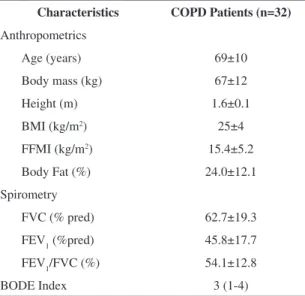
The sample characteristics are shown in Table 1.
Table 2 shows the performance during the 6MWT
and 6MST of the COPD patients evaluated.
Concurrent criterion validity
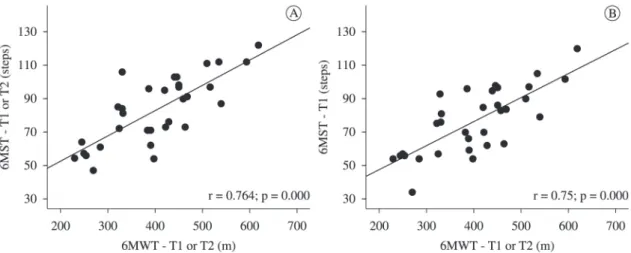
The performance values at T1 and T2, and at T1
or T2 during the 6MST showed a strong and positive
correlation that was statistically signiicant with the
6MWT in all tests, and may be considered valid to
verify the physical capacity of patients with COPD
(Table 3, Figure 1). In addition, we found a signiicant
negative weak correlation between performance on
the 6MST and BODE index, and a signiicant weak
correlation between performances in 6MST and
FEV1. However, these correlations were insuficient
to characterize validity (Table 3).
Predictive criterion validity
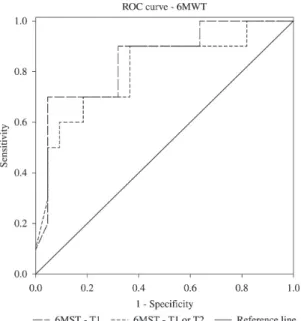
The criterion validity of the 6MST to identify low
physical capacity (compared to the 6MWT), using
the number of the steps at T1 or T2 or only in T1,
was considered accurate for some purposes, with the
area under the curve of 0.8 (95% CI 0.62 to 0.98)
and 0.85 (95% CI 0.70 to 0.99), respectively. For the
number of steps in T1 or T2, the cut-off was set at 86
steps, with sensitivity of 90% and speciicity of 64%
(Figure 2). However, for the number of steps at T1,
the cut-off was set at 78 steps, with 90% sensitivity
and 68% speciicity to classify patients with COPD
(Figure 2).
ROC curves were not plotted for the BODE index
nor the FEV1, since construct validity was not found.
Discussion
To the best of the authors knowledge, this is the
irst study performed to determine the predictive
criterion validity of the 6MST to identify patients
with low physical capacity and consequently poor
prognosis in COPD. The number of steps in 6MST
was valid in assessing exercise capacity in patients
with COPD and could identify patients with low
exercise tolerance and poor prognosis, so we suggest
that this test may be used for this purpose.
The 6MST has shown to be clinically useful
in estimating exercise tolerance in COPD
34, and
requires minimal physical space and only two
evaluators to perform the test
8,16. It is noteworthy
that the 6MST, compared to 6MWT, uses speciic
muscle groups (quadriceps). In addition, according
to Swinburn et al.
35, the 6MST (to climb 15 steps/min
at step height of 25 cm) provides greater metabolic
Table 1. Anthropometric, spirometry and BODE index characteristics of the COPD patients.
Characteristics COPD Patients (n=32)
Anthropometrics
Age (years) 69±10
Body mass (kg) 67±12
Height (m) 1.6±0.1
BMI (kg/m2) 25±4
FFMI (kg/m2) 15.4±5.2
Body Fat (%) 24.0±12.1
Spirometry
FVC (% pred) 62.7±19.3
FEV1 (%pred) 45.8±17.7
FEV1/FVC (%) 54.1±12.8
BODE Index 3 (1-4)
Data are expressed as mean ± standard deviation; median (interquartile range). COPD = chronic obstructive pulmonary disease; BMI = body mass index; FFMI = fat-free mass index;
FVC = forced vital capacity; FEV1 = forced expiratory volume in
one second; FVC/FEV1 =FVC/FEV1 ratio; BODE index = Body
and ventilatory stress compared to exercises on a
cycle ergometer and during the 6MWT in patients
with COPD. Thus, we suggest that the 6MST is a
better test for accessing the level of physical exertion
in these patients.
Pessoa et al.
36concluded that the 6MST, the irst
two minutes of the 6MST, and the two minute
sit-to-stand test may be alternatives to assess the functional
limitations of patients with COPD, since they present
similar metabolic, ventilatory, cardiovascular and
dyspnea responses.
The 6MWT is a test widely used to verify the
physical capacity of patients with COPD. Several
studies have shown the relationship between the
6MWT and peak of oxygen consumption (VO2)
in the cardiopulmonary test which is considered a
gold-standard test
12,37-41. Another study examined the
relationship between the 6MWT and other tests, which
assessed different aspects of functional capacity, and
found a relationship between the distance traveled and
sit-to-stand activity (r=0.67), static balance (r=0.52)
and gait velocity (r=-0.71)
42. In addition, the 6MWT
had its criterion validity determined and can be used
to predict mortality
12,13,15,43. All these features favour
the use of the 6MWT as a comparison test for the
construction validity of other functional tests.
Considering the concurrent criterion validity for the
6MST, we observed a signiicant and strong positive
correlation (r=0.734) between the performances in
the test and the 6MWT. The relationship between
these two tests has been studied by Machado et al.
20in 2008. These authors found no statistical difference
between the physiological (HR and SpO
2) and
subjective (perceived exertion) variables studied
Figure 1. Relationship between performance on the 6MST and the 6MWT in patients with COPD. A = 6MST -T1 or T2 versus 6MWT -T1 or T2; B = 6MST -T1 versus 6MWT -T1 or T2. COPD = chronic obstructive pulmonary disease; 6MWT-T1 or T2 = Best performance on the irst or second six-minute walk test; 6MST-T1= First six minute step test; 6MST-T1 or T2 = Best performance on the irst or second six-minute step test.
Table 2. Performance of COPD patients on the six-minute step test and six-minute walk test.
COPD Patients (n=32)
6MST (steps)
6MWT (distance travelled, m)
T1 76.7±19.6 380.4±107.8
T2 82.4±20.7 391.0±94.0
T1 or T2 83.2±20.2 402.4±102.3
Data are expressed as mean ± standard deviation. COPD = chronic obstructive pulmonary disease; 6MST = six minute step test; 6MWT = six minute walk test; T1 and T2 = performance on the irst and second 6MST or 6MWT, respectively; T1 or T2 = Best performance on the irst or second 6MST or 6MWT, respectively.
Table 3. Correlations between performances on the 6MST and 6MWT in patients with COPD.
COPD Patients 6MST - T1 6MST -T2 6MST - T1 or T2
6MWT - T1 0.734* 0.777* 0.768*
6MWT - T2 0.733* 0.739* 0.739*
6MWT – T1 or T2 0.750* 0.766* 0.764*
FEV1 0.466* 0.376* 0.385*
BODE index -0.503* -0.457* -0.451*
COPD = chronic obstructive pulmonary disease; 6MST = six-minute step test; 6MWT = six-minute walk test; T1 and T2 = performance on the irst and second 6MST or 6MWT, respectively; T1 or T2 = Best performance on the irst or second 6MST or 6MWT,
respectively; FEV1 = forced expiratory volume in one second;
and reported no correlation between the two tests;
however, it is unclear if the performance in both tests
was correlated. Note that, in the study, the height of
the step was 14.5 cm, differing from the present study,
in which the step used was 20 cm in height. Similarly,
Schnaider and Karsten
19observed that the number
of steps on the 6MST with free cadence showed
a good correlation (r=0.706; p<0.001) with the
6MWT in critical, hospitalized patients with COPD.
However, it is worth mentioning that these authors
used a step of 15 cm in height by 40 cm deep and 60
cm wide and conducted only one test. The present
study is the irst to verify that the 6MST compared
to the 6MWT, using the methodological steps
described earlier, can determine reduced functional
capacity resulting from COPD. It also showed that
the 6MST correlated with the BODE prognostic
index and with the FEV
1- although the correlation
was weak - suggesting that the performance at the
6MST can be considered a marker of the severity
of the disease.
Similarly, other studies have shown that the BODE
prognosis index was associated with other methods of
assessing functionality, such as the sit-to-stand in two
minutes, the 6MWT performed on a treadmill
44, the
level of physical activity in daily life
45and limitations
in activities of daily living
46.
Predictive validity criterion was determined at
T1 or T2, or solely at T1, with the 6MST, using the
6MWT as the gold-standard to classify individuals
with COPD concerning their physical capacity.
For both comparisons, the 6MST was shown to
be accurate for some purposes according to the
classiication of Swets
33. This result suggests that the
use of this test as a criterion for indication for surgical
interventions, a lung transplant for example, should
be avoided and new studies should be conducted to
check whether it is appropriate for this purpose.
The fact that T1 presented concurrent and
predictive criterion validity suggests that there is no
need for a familiarization test. It also indicates that
it might be interesting to evaluate the test on a larger
sample. Based on the cut-off of 78 steps, patients
with similar or lower values can be classiied as
having a low physical capacity, suggesting the need
for physical therapy intervention. However, it is
important to consider that the present study had a
lower than ideal sample to verify criterion validity,
suggesting the need of future studies.
Study limitations
The present study had the following limitations. It
was not designed to verify predictive validity, since
a larger sample size would be needed for this type of
analysis. However, it should be emphasised that the
study raised the hypothesis of a relationship between
the 6MST and the prognosis of patients with COPD,
which should be addressed in future studies.
Conclusion
The performance observed on the 6MST was valid
for determining low physical capacity in patients with
COPD with a cut-off of 78 steps, whereas values
below that represented patients having a poorer
prognosis.
Acknowledgements
To all colleagues from the Laboratory of
Spirometry and Respiratory Physical Therapy for
the collaboration as well as to the participants in the
study. We also acknowledge the Conselho Nacional
de Desenvolvimento Cientíico e Tecnológico (CNPq)
(Process: 508310/2010-5) and the Coordenação de
Aperfeiçoamento de Pessoal de Nível Superior
(CAPES), Brazil, for inancial support.
References
1. Dourado VZ, Tanni SE, Vale SA, Faganello MM, Sanchez FF, Godoy I. Systemic manifestations in chronic obstructive pulmonary disease. J Bras Pneumol. 2006;32(2):161-71. PMid:17273586.
2. Spruit MA, Franssen FM, Rutten EP, Wagers SS, Wouters EF. Age-graded reductions in quadriceps muscle strength and peak aerobic capacity in COPD. Rev Bras Fisioter. 2012;16(2):148-56. PMid:22378475. http://dx.doi. org/10.1590/S1413-35552012005000011
3. Corrêa KS, Karloh M, Martins LQ, Santos K, Mayer AF. Can the glittre ADL test differentiate the functional capacity of COPD patients from that of healthy subjects? Rev Bras Fisioter. 2011;15(6):467-73. PMid:22094546. http://dx.doi.org/10.1590/S1413-35552011005000034 4. Neder JA, Nery LE. Teste de exercício cardiopulmonar. J
Bras Pneumol. 2002;28(Suppl. 3):S166-206.
5. American Thoracic Society - ATS, American College of Chest Physicians - ACCP. Statement on cardiopulmonary exercise testing. Am J Respir Crit Care Med. 2003;167:211-77. PMid:12524257. http://dx.doi. org/10.1164/rccm.167.2.211
6. Cataneo DC, Cataneo AJM. Acurácia do teste de escada utilizando o consumo máximo de oxigênio como padrão-ouro. J Bras Pneumol. 2007;33(2):128-33. http://dx.doi. org/10.1590/S1806-37132007000200005
7. American Thoracic Society - ATS. American Thoracic Society statement: guidelines for the six-minute walk test. Am J Respir Crit Care Med. 2002;166(1):111-7. PMid:12091180. http://dx.doi.org/10.1164/ ajrccm.166.1.at1102
8. Dal Corso S, Duarte SR, Neder JA, Malaguti C, Fuccio MB, Castro Pereira CA, et al. A step test to assess exercise-related oxygen desaturation in interstitial lung disease. Eur Respir J. 2007;29(2):330-6. PMid:17050559. http://dx.doi. org/10.1183/09031936.00094006
9. Pires SR, Oliveira AC, Parreira VF, Britto RR. Teste de caminhada de seis minutos em diferentes faixas etárias e índice de massa corporal. Rev Bras Fisioter. 2007;11(2):147-51. http://dx.doi.org/10.1590/ S1413-35552007000200010
10. Aquino ES, Mourão FA, Souza RK, Glicerio BM, Coelho CC. Comparative analysis of the six-minute walk test in healthy children and adolescents. Rev Bras Fisioter. 2010;14(1):75-80. PMid:20414565. http://dx.doi. org/10.1590/S1413-35552010000100012
11. Jones LW, Hornsby WE, Goetzinger A, Forbes LM, Sherrard EL, Quist M, et al. Prognostic significance of functional capacity and exercise behavior in patients with metastatic non-small cell lung cancer. Lung Cancer. 2012;76(2):248-52. PMid:22112290 PMCid:PMC3615546. http://dx.doi.org/10.1016/j. lungcan.2011.10.009
12. Cote CG, Pinto-Plata V, Kasprzyk K, Dordelly LJ, Celli BR. The 6-min walk distance, peak oxygen uptake, and mortality in COPD. Chest. 2007;132(6):1778-85. PMid:17925409. http://dx.doi.org/10.1378/chest.07-2050 13. Enield K, Gammon S, Floyd J, Falt C, Patrie J, Platts-Mills TA, et al. Six-minute walk distance in patients with severe end-stage COPD: association with survival after inpatient pulmonary rehabilitation. J Cardiopulm Rehabil Prev. 2010;30(3):195-202. PMid:20040883 PMCid:PMC3047503. http://dx.doi.org/10.1097/ HCR.0b013e3181c565e4
14. Casanova C, Cote C, Marin JM, Pinto-Plata V, Torres JP, Aguirre-Jaíme A, et al. Distance and oxygen desaturation during the 6-min walk test as predictors of long-term mortality in patients with COPD. Chest. 2008;134(4):746-52. PMid:18625667. http://dx.doi. org/10.1378/chest.08-0520
15. Spruit MA, Polkey MI, Celli B, Edwards LD, Watkins ML, Pinto-Plata V, et al. Predicting outcomes from 6-minute walk distance in chronic obstructive pulmonary disease. J Am Med Dir Assoc. 2012;13(3):291-7. Pmid:21778120. http://dx.doi.org/10.1016/j.jamda.2011.06.009
16. Neder JR, Nery LE. Fisiologia clínica do exercício. São Paulo: Artes Médicas; 2003.
17. Master AM, Oppenheimer ETB. A simple exercise tolerance test for circulatory eficiency with standard tables for normal individuals. Am J Med Sc. 1929;177(2):223-43. http://dx.doi.org/10.1097/00000441-192902000-00010 18. Andrade CHS, Cianci RGC, Malaguti C, Dal Corso S. O
uso de testes do degrau para a avaliação da capacidade de exercício em pacientes com doenças pulmonares crônicas. J Bras Pneumol. 2012;38(1):116-24. PMid:22407048. http://dx.doi.org/10.1590/S1806-37132012000100016 19. Schnaider J, Karsten M. Testes de tolerância ao exercício
em programa de isioterapia hospitalar após exacerbação da doença pulmonar obstrutiva crônica. Fisioter Mov. 2006;19(4):119-26.
20. Machado NC, Natali V, Squassoni SD, Santana VT, Baldin AC, Fiss E. Estudo comparativo entre os resultados do teste de caminhada de seis minutos e do degrau de seis minutos em pacientes com doença pulmonar obstrutiva crônica. Arq Med ABC. 2008;32(Suppl. 2):S47-50. 21. Global Strategy for the Diagnosis, Management,
and Prevention of Chronic Obstructive Pulmonary Disease - GOLD. 2012.
22. Borg GA. Psychophysical bases, of perceived exertion. Med Sci Sports Exerc. 1982;14:377-81. PMid:7154893. http://dx.doi.org/10.1249/00005768-198205000-00012 23. Mendes CCT, Raele R. Avaliação corporal por
bioimpedância. Rev Nutr Pauta. 1997;24:12-4.
PMid:16412624. http://dx.doi.org/10.1016/j. rmed.2005.11.023
25. Miller MR, Crapo R, Hankinson J, Brusasco V, Burgos F, Casaburi R, et al. ATS/ERS task force: standardisation of lung function testing. Eur Respir J. 2005;26:319-38. PMid:16055882. http://dx.doi.org/10.1183/09031936.0 5.00034805
26. Pereira CAC, Sato T, Rodrigues SC. Novos valores de referência para espirometria forçada em brasileiros adultos de raça branca. J Bras Pneumol. 2007;33(4):397-406. PMid:17982531. http://dx.doi.org/10.1590/ S1806-37132007000400008
27. Kovelis D, Segretti NO, Probst VS, Lareau SC, Brunetto AF, Pitta F. Validação do Modiied Pulmonary Functional Status and Dyspnea Questionnaire e da escala do Medical Research Council para o uso em pacientes com doença pulmonar obstrutiva crônica no Brasil. J Bras Pneumol. 2008;34(12):1008-18. PMid:19180335. http://dx.doi. org/10.1590/S1806-37132008001200005
28. Celli BR, Cote CG, Marin JM, Casanova C, Montes de Oca M, Mendez RA, et al. The body-mass index, airlow obstruction, dyspnea, and exercise capacity index in chronic obstructive pulmonary disease. N Engl J Med. 2004;350(10):1005-12. PMid:14999112. http://dx.doi. org/10.1056/NEJMoa021322
29. Browner WS, Cummings SR, Hulley SB. Estimando o tamanho da amostra e o poder estatístico: pontos básicos. In: Hulley SB, Cummings SR, Browner WS, Grady D, Hearst N, Newman TB. Delineando a pesquisa clínica: uma abordagem epidemiológica. 2ª ed. Porto Alegre: Artmed; 2003. p. 108-9.
30. Chaise FO, Candotti CT, Torre ML, Furlanetto TS, Pelinson PP, Loss JF. Validation, repeatability and reproducibility of a noninvasive instrument for measuring thoracic and lumbar curvature of the spine in the sagittal plane. Rev Bras Fisioter. 2011;15(6):511-7. PMid:22045292. http:// dx.doi.org/10.1590/S1413-35552011005000031 31. Araujo VL, Carvalhais VO, Souza TR, Ocarino JM,
Goncalves GG, Fonseca ST. Validity and reliability of clinical tests for assessing passive ankle stiffness. Rev Bras Fisioter. 2011;15(2):166-73. PMID: 21789368. http:// dx.doi.org/10.1590/S1413-35552011000200013 32. Terwee CB, Bot SDM, De Boer MR, Van der Windt DA,
Knol DL, Dekker J, et al. Quality criteria were proposed for measurement properties of health status questionnaires. J Clin Epidemiol. 2007;60:34-42. PMid:17161752. http:// dx.doi.org/10.1016/j.jclinepi.2006.03.012
33. Swets JA. Measuring the accuracy of diagnostic systems. Science. 1988;240:1283-93. http://dx.doi.org/10.1126/ science.3287615
34. Marrara KT, Marino DM, Jamami M, Oliveira AD Jr, Di Lorenzo VAP. Responsiveness of the six-minute step test to a physical training program in patients with COPD. J Bras Pneumol. 2012;38(5):579-87. PMid:23147050. http://dx.doi.org/10.1590/S1806-37132012000500007
35. Swinburn CR, Wakeield JM, Jones PW. Performance, ventilation, and oxygen consumption in three different types of exercise test in patients with chronic obstructive lung disease. Thorax. 1985;40(8):581-6. PMid:4035628 PMCid:PMC1020595. http://dx.doi.org/10.1136/ thx.40.8.581
36. Pessoa BV, Jamami M, Basso RP, Regueiro EMG, Di Lorenzo VAP, Costa D. Teste do degrau e teste da cadeira: comportamento das respostas metábolo-ventilatórias e cardiovasculares na DPOC. Fisioter Mov. 2012;25(1):105-15. http://dx.doi.org/10.1590/S0103-51502012000100011 37. Bernstein ML, Despars JA, Singh NP, Avalos K,
Stansbury DW, Light RW. Reanalysis of the 12-minute walk in patients with chronic obstructive pulmonary disease. Chest. 1994;105(1):163-7. PMid:8275726. http:// dx.doi.org/10.1378/chest.105.1.163
38. Carter R, Holiday DB, Stocks J, Grothues C, Tiep B. Predicting oxygen uptake for men and women with moderate to severe chronic obstructive pulmonary disease. Arch Phys Med Rehabil. 2003;84(8):1158-64. http:// dx.doi.org/10.1016/S0003-9993(03)00047-9
39. Starobin D, Kramer MR, Yarmolovsky A, Bendayan D, Rosenberg I, Sulkes J, et al. Assessment of functional capacity in patients with chronic obstructive pulmonary disease: correlation between cardiopulmonary exercise, 6 minute walk and 15 step exercise oximetry test. Isr Med Assoc J. 2006;8(7):460-3. PMid:16889159.
40. Turner SE, Eastwood PR, Cecins NM, Hillman DR, Jenkins SC. Physiologic responses to incremental and self-paced exercise in COPD: a comparison of three tests. Chest. 2004;126(3):766-73. PMid:15364755. http:// dx.doi.org/10.1378/chest.126.3.766
41. Diaz O, Morales A, Osses R, Klaassen J, Lisboa C, Saldias F. Six-minute-walk test and maximum exercise test in cycloergometer in chronic obstructive pulmonary disease: are the physiological demands equivalent? Arch Bronconeumol. 2010;46(6):294-301. http://dx.doi. org/10.1016/S1579-2129(10)70071-9
42. Harada ND, Chiu V, Stewart AL. Mobility-related function in older adults: assessment with a 6-minute walk test. Arch Phys Med Rehabil. 1999;80:837-41. http:// dx.doi.org/10.1016/S0003-9993(99)90236-8
43. Budweiser S, Jörres RA, Pfeifer M. Treatment of respiratory failure in COPD. Int J Chron Obstruct Pulmon Dis. 2008;3(4):605-18. PMid:19281077 PMCid:PMC2650592.
44. Regueiro EM, Di Lorenzo VA, Basso RP, Pessoa BV, Jamami M, Costa D. Relationship of BODE Index to functional tests in chronic obstructive pulmonary disease. Clinics. 2009;64(10):983-8. PMid:19841705 PMCid:PMC2763073. http://dx.doi.org/10.1590/ S1807-59322009001000008
Rev Bras Fisioter. 2011;15(2):131-7. PMid:21789363. http://dx.doi.org/10.1590/S1413-35552011000200008 46. Simon KM, Carpes MF, Correa KS, Dos Santos K,
Karloh M, Mayer AF. Relationship between daily living activities (ADL) limitation and the BODE index in patients with chronic obstructive pulmonary disease. Rev Bras Fisioter. 2011; 15(3):212-8. PMid:21829985. http://dx.doi. org/10.1590/S1413-35552011000300007
Correspondence
Bruna Varanda Pessoa
Universidade Federal de São Carlos Department of Physical Therapy
Laboratory of Spirometry and Respiratory Therapy Rodovia Washington Luiz, Km 235, Bairro Monjolinho CEP 13565-905, São Carlos, SP, Brasil