
OR
IGI
N
A
L
R
E
S
E
A
R
C
H
Functional exercise capacity
evaluation in an aquatic environment
Avaliação da capacidade funcional de exercício no ambiente aquático
Evaluación de la capacidad funcional del ejercicio hecho en ambiente acuático
Débora Rafaelli de Carvalho1, Eloisa Maria Braga2, Alyne Ferreira Lochini2,Vanessa Suziane Probst3, Fabio Pitta3, Josiane Marques Felcar4
Mailing address: Josiane Marques Felcar. Mailing address: Rua da Aeronáutica, 199 – Jardim Caravelle – CEP: 86039-130 – Londrina (PR), Brasil
E-mail: [email protected] – Presentation: Aug. 2014 – Accepted for publication: Nov. 2015 – Approved by the Bioethics Research Committee of the institution under no. 25023213.1.0000.0108
Study developed at the Research Center of Health Sciences, University of North Paraná – UNOPAR, Londrina, Paraná, Brazil.
1Physical therapist with a master’s degree in Ciências da Reabilitação from Universidade Norte do Paraná (UNOPAR) – Londrina (PR),
Brazil.
2Physical therapist from Universidade Norte do Paraná (UNOPAR) – Londrina (PR), Brazil.
3Physical therapist from Universidade Estadual de Londrina (UEL) – Londrina (PR), Brazil, with a PhD in Physiotherapy and
Rehabilitation Sciences from the Katholieke Universiteit Leuven, Leuven, Belgium.
4Phyical therapist with a PhD in Ciências da Saúde from Universidade Estadual de Londrina (UEL) – Londrina (PR), Brazil.
Professor at Universidade Norte do Paraná (UNOPAR) – Londrina (PR), Brazil.
ABSTRACT | The aim of this study was to investigate the correlation between distance achieved and compare the average speed while walking in the six-minute walk test (6MWT) performed on solid ground and in the three-minute walk test in water (3MWT-W) with healthy young individuals, as well as compare physiological (heart rate, oxygen saturation and blood pressure) and symptomatic variables between tests. It is a cross-sectional study, with a sample of 20 healthy young subjects. All patients underwent spirometry, answered a questionnaire on health and physical activity, in addition to performing the 6MWT and 3MWT-W. Statistical analysis used the Shapiro-Wilk test to evaluate normality of the data, the paired Student’s t-test and Wilcoxon in the comparisons between the variables and the Pearson correlation coeicient to verify associations. Statistical signiicance of p < 0.05 was adopted. The mean age was 22 (±2) years, the mean BMI was 23 (±3) kg/m2 and all subjects had normal pulmonary function. The average distance achieved in the 6MWT was of 657 (±43) meters and in the 3MWT-W of 135 (±13) meters. A weak correlation between the 3MWT-W and 6MWT (r=0.35) was found. The speed during the tests showed a statistically signiicant diference (3MWT-W 0.75±0.07 versus 6MWT 1.85±9.1, p<0.0001). There was no diference in the initial and the inal physiological variables between 3MWT-W and 6MWT. The 3MWT-W may be a good tool for evaluation and exercise prescription in the aquatic environment, but showed a weak correlation with
355
the 6MWT and similar physiological strain, though further studies are suggested to conirm this inding.
Keywords | Exercise Tolerance; Hydrotherapy; Aquatic Environment; Walking.
os testes apresentou diferença estatisticamente signiicante (TC3minA 0,75±0,07 versus TC6min 1,85±9,1, p<0,0001). Não houve diferença nas variáveis isiológicas iniciais e inais entre o TC3minA e o TC6min. Aquele embora possa ser uma boa ferramenta a ser utilizada para avaliação e prescrição de exercício no ambiente aquático mostrou uma fraca correlação com o TC6min e semelhante esforço isiológico, porém novos estudos são sugeridos para comprovar esse achado.
Descritores | Tolerância ao Exercício; Hidroterapia; Ambiente Aquático; Caminhada.
RESUMEN | En este estudio se veriicó la correlación de la distancia recorrida en jóvenes saludables y se comparó la velocidad media durante la caminata mediante el test de caminata de seis minutos (TC6min) realizado en suelo y del test de caminata de tres minutos acuático (TC3minA), así como se contrastó las variables isiológicas (frecuencia cardiaca, saturación periférica de oxígeno y presión arterial) y de síntomas entre los test. Es un estudio transversal con muestra de veinte sujetos jóvenes saludables. Se les sometieron a la espirometría y se les aplicaron un cuestionario sobre salud y actividad física, además de que
realizaron el TC6min y el TC3minA. En el análisis estadístico se utilizó la prueba Shapiro-Wilk para evaluar la normalidad de los datos, la prueba t Student emparejada y Wilcoxon para las comparaciones entre las variables y el coeiciente de correlación de Pearson para veriicar las asociaciones. Se utilizó la signiicancia estadística de p<0,05. El promedio de edad fue el de 22 (±2) años, el IMC de 23 (±3) Kg/m2 y todos los participantes presentaron
valores normales para la función pulmonar. El promedio de distancia recorrida en el TC6min fue de 657 (±43) y en el TC3minA de 135 (±13) metros. Se encontró una débil correlación entre el TC3minA y el TC6min (r=0,35). La velocidad durante los test presentó diferencias estadísticamente signiicativas (TC3minA 0,75±0,07 versus TC6min 1,85±9,1, p<0,0001). No hubo diferencias en las variables isiológicas iniciales y inales entre el TC3minA y el TC6min. Aunque el TC3minA pueda ser una buena herramienta a utilizarse para la evaluación y la prescripción del ejercicio en el ambiente acuático se mostró una débil correlación con el TC6min y semejante esfuerzo isiológico, sin embargo se recomiendan nuevos estudios para comprobarlo.
Palabras clave | Tolerancia al Ejercicio; Hidroterapia; Ambiente Acuático; Caminata.
INTRODUCTION
Physical tests have been commonly used in clinical practice and in exercise prescription in rehabilitation
programs1. he six-minute walk test (6MWT) measures
the functional capacity of exercise, also present a good reproducibility and be a simple and easy to access
test2. It can assess the global and integrated responses
of the systems involved during exercise, including
cardio-respiratory and musculoskeletal systems3. he
evaluation of functional capacity of exercise can provide information on the physical capacity and, furthermore, guide the prescription and progression of exercise in
physical training programs4.
A physical training alternative that has been
commonly used by diferent areas is the hydrotherapy5,6.
In the aquatic environment, thrust results in the reduction of body weight and the drag force increases
the resistance during walking7,8. So, bearing your own
weight in this environment becomes easier when compared to a terrestrial environment, because there will be a minor impact on the musculoskeletal system
and greater ease of movement control7. Physical training
in water has provided physical beneits in diferent
populations9-13. he literature suggests that physical
activity or tests performed in water permit aerobic conditioning maintenance, because the hydrotherapy exercises enable the appropriate use of body mechanics
and the practice of exercises directed to the problem14.
However, few studies have investigated the diferences between walking in the aquatic environment
versus walking on solid ground. Alberto et al.15 and
Barela et al.16 found diferences between walking in
healthy subjects in both environments. In relation to ield-testing, no study appears to have assessed the functional capacity of exercise in the water. Considering the importance of proper evaluation of the functional exercise capacity in an aquatic environment, a speciic ield test to measure exercise capacity and to determine exercise prescription needs to be established. However, there are no indings in the literature regarding the use of a functional capacity test exercise in the aquatic environment, therefore the study proposed to use the three-minute walk test in an aquatic environment (3MWT-W).
ground with the 3MWT-W in healthy young people. In addition to comparing the physiological (heart rate
[HR], oxygen saturation [SpO2] and blood pressure
[BP]) and symptomatic variables (sensation of dyspnea and fatigued legs) before and after the 6MWT on the
ground versus the 3MWT-W.
METHODOLOGY
Sample
his is a cross-sectional study of analytical character, with a sample of 20 young people of both genders. he study was approved by the Bioethics Research Committee, all participants received information on the procedures to be performed in the study and they all signed a free consent form.
Inclusion criteria were: young adults aged between 18 and 30 years, with no musculoskeletal, neurological, heart or pulmonary problems that might prevent the performance in the tests. he study excluded individuals that: could not perform the tests proposed; or opted, at any time, to end their participation in the study.
Procedures
General evaluation
Initially, all participants answered a structured questionnaire, which collected demographic data such as gender, age and comorbidities. In addition, we collected anthropometric data such as weight, using
a scale (Filizola® accurate to 0.1kg and capacity up
to 180kg) and height, measured with the individual in orthostatic position by a stadiometer (Sonny), consisting of a scale graduated in centimeters and accuracy of 0.1cm. From these measurements, the Body Mass Index (BMI) was calculated, using the relationship between body mass and the square
of height (weight/height2), with body weight in
kilograms (kg) and height in meters (m).
Pulmonary Fuction
To conirm the absence of pulmonary alterations, a pulmonary function test was performed using the Pony spirometer (Cosmed, Italy). he participants were
instructed to perform the forced expiratory maneuver
according to the international standardization17. he
reference values for the Brazilian population18 were
used. he collected variables were forced vital capacity (FVC), forced expiratory volume in the irst second
(FEV1) and the FEV1/FVC ratio.
Physical evaluation
To evaluate the level of physical activity, we used the International Physical Activity Questionnaire (IPAQ)
in its reduced version19. he questions were related to
the activities performed in the last week prior to the interview. Subjects were classiied according to IPAQ standards. It classiies individuals as: Sedentary – individuals who do not engage in any physical activity for at least 10 continuous minutes during the week; Irregularly Active – individuals who practiced physical activities for at least 10 continuous minutes per week, but insuiciently to be classiied as active; Active – individuals who meet the following recommendations: a) vigorous physical activity: >3 days/week and >20 minutes/session; b) moderate physical activity or walking >5 days/week and >30 minutes/session; c) any added activity: >5 days/week and >150 min/week; Very Active – subjects who meet the following recommendations: a) vigorous physical activity: >5 days/week and >30 min/ session; b) vigorous physical activity: >3 days/week and >20 min/session + moderate and/or walking 5 days/ week and >30 min/session.
Functional exercise capacity
6MWT and 3MWT-W were performed within a week of each other, with the 6MWT performed irst,
always in the afternoon. In both tests, HR, SpO2 and
PA were collected, in addition to dyspnea and fatigue
of the lower limbs through a modiied Borg scale20.
All physiological and symptomatic variables previously mentioned were collected at the beginning and at the end of the tests. he distance achieved was veriied, with this as the primary variable tested, and the average speed calculated during walking, using the distance achieved in the test divided by the duration of the same. Both tests would be interrupted immediately if, during the course of the same, the participant presented chest pain, dyspnea and/or intolerable fatigue, sweating, oximetry values lower than 88%, paleness, dizziness and/or
Six-minute Walk Test (6MWT)
Functional exercise capacity was evaluated using the conventional 6MWT (on solid ground), according to the European Respiratory Society (ERS)/American
horacic Society (ATS) standardization3. Two tests
were performed, the test with the greater distance achieved was picked for analysis. he reference values
used were for the Brazilian population of Britto et al.21.
Three-minute Walk Test in Water (3MWT-W)
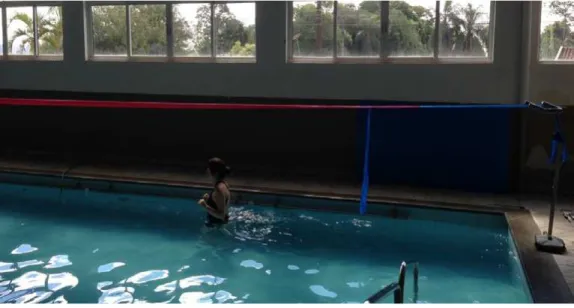
Functional exercise capacity was evaluated by the 3MWT-W (Figure 1). his test was developed by the authors of this study and performed in the pool of the
Physiotherapy Clinic of the University of North Paraná (Unopar), heated (33°C), lat, itted with stairs, ramp and sidebars; with the following dimensions: height 1.13m, width 7.10m and length 12.7m. Capacity of 90,170 liters of water and water depth level of 1m, which should be about the height of the individuals’ umbilicus.
he test was conducted at least two hours after meals. Participants were told to use their own, comfortable clothing to the aquatic environment. Prior to the test, they maintained 10 minutes of rest, during this period their PA, level of dyspnea and lower limb fatigue using
a modiied Borg scale20, SpO2 and HR were evaluated.
he maximum heart rate was calculated according to
the of Karvonen formula (220 - age)22.
Figure 1. Three-minute walk test in water (3MWT-W)
Two tests were performed near the edge of the pool and the one with greater distance achieved was used for analysis. Participants walked on a marked path of 10 meters, every meter per tape also marked. here was an interval of 30 minutes between each test and verbal encouragement of standardized phrases every 45 seconds were used during the exercise. hroughout the test, there was the presence of a physical therapist in the pool for any eventuality.
Statistical Analysis
he sample size calculation was based on the study
by Iriberri et al.23, who found a correlation coeicient
between the 6MWT and the 3MWT on the ground of
0.98. Using the BioEstat® 5.0 software, with power of 80%
and an alpha of 0.05, plus 20% of loss rate, six subjects would be required to detect a statistically signiicant correlation. he sample consisted of 20 participants, therefore larger than necessary to ensure the results.
RESULTS
he sample consisted of 20 healthy young individuals and all participants showed normal values in the pulmonary function test. As for physical activity, 65% of participants were considered physically active or very active and 35% were irregularly active or sedentary. hese and other information about the sample characteristics studied can be found in Table 1.
Table 1. Sample General Characteristics
Variables Values
Gender (M/F) 10/10
Age (years) 22 (±2)
Weight (Kg) 66 (±11)
Height (meters) 1.67 (±0.06) BMI (Kg/m2)
PE (VA/A/IA/S)
23 (±3) 3/10/5/2
FVC (% exp) 87 (±9)
FEV1 (% exp) 88 (±9)
FEV1/FVC (%) 85 (±6) 6MWT (meters) 657 (±43) 3MWT-W (meters) 135 (±13)
M: Male; F: Female; Kg: kilograms; BMI: Body Mass Index; PE: Physical Evaluation; VA: very active; A: active; IA: irregularly active; S: sedentary; FVC = Forced Vital Capacity; FEV1 = Forced
expiratory volume at the irst second; VEF1/CVF = Ratio between forced expiratory volume at
the irst second and forced vital capacity; 6MWT: distance achieved in a six-minute walk test; 3MWT-W: distance achieved in a three-minute walk test in water
he correlation between exercise tests (3MWT-W and 6MWT) in healthy young individuals is shown in Figure 2. here was also a moderate correlation between the distance covered in 3MWT-W and the weight and BMI (r=0.49; r=0.47 respectively, both p≤0.03 for both).
Figure 2. Correlation between the distance achieved in the six-minute walk test (6MWT) with the distance in the three-six-minute walk test in water (3MWT-W)
When comparing the speed during testing, we can observe a signiicant diference (TC3minA 0.75±0.07
versus 6MWT 1.85±9.1, p<0.0001) (Figure 3). When
considering the water depth, 65% of participants had the water level at umbilicus, 10% had a level just above the umbilicus and 25% slightly below, therefore all below the xiphoid process.
Figure 3. Speed comparison between the three-minute walk test in water (3MWT-W) and the six-minute walk test (6MWT)
Regarding the initial and inal physiological and
symptomatic (HR, SpO2, PA, Borg dyspnea and Borg
lower members) variables in the tests (3MWT-W and 6MWT), no signiicant diferences were presented, except for initial diastolic blood pressure (DBP) (Table 2).
Table 2. Physiological variable comparison between the three-minute walk test in water (3MWT-W) and the six-three-minute walk test (6MWT)
Variables 3MWT-W 6MWT p
Arterial Pres-sure (mmHg)
Systolic Initial 110 [100-110] 110 [100-120] 0.14
Systolic Final 135 [122-140] 130 [120-140] 0.91
Diastolic Initial 80 [80-80] 70 [70-80] 0.004
Diastolic Final 80 [70-80] 80 [72-80] 0.22
Borg (points)
Borg
Dyspnea Initial 0 [0-0] 0 [0-0] 0.50
Borg Dyspnea
Final 2 [1-3] 2 [0-3] 0.69
Borg Fatigue
MMII Initial 0 [0-0] 0 [0-0] 0.37
Borg Fatigue
MMII Final 3 [2-4] 3 [2-4] 0.88
Heart Rate
Initial (bpm) 85 [78-91] 90 [78-95] 0.23
% HRimax 43 [41-46] 45 [40-47] 0.29
Final (bpm) 148 [120-161] 132 [107-144] 0.05
% HRfmax 74 [62-79] 67 [54-72] 0.08
DISCUSSION
In this study, 3MWT-W correlated weakly with 6MWT in healthy young individuals. When investigating the speed achieved in both tests performed, 3MWT-W showed a slower speed. Lastly, we found that the subjects had similar physiological variables in 3MWT-W when compared to the 6MWT.
Several authors have investigated the physical activity
in the young population. Matsudo et al.24, in their study
of physical activity in adolescents and children from two diferent regions of socioeconomic development, observed that the studied population showed low levels of physical activity. When comparing indings, the study by Matsudo
et al.24 observed worst physical activity values, i.e. below
values found in this study (65% active and very active). he level of physical activity found in this study was also higher
than that found in the study by Mechelen et al.25. Despite
the data, the fact that individuals in this study have higher levels of physical activity compared to the other two studies cited above, can be explained by the population belonging to a university physiotherapy course, where they might receive greater incentives to perform physical activity.
Iriberri et al.23, in their study, comparing the three
and six-minute walk test in a solid environment, observed a high correlation (r=0.98) in distance achieved during both tests. In this study, the subjects showed a weak correlation between the 3MWT-W and the 6MWT. Despite such result, there are several diferences between the aquatic and terrestrial environments, which leads to the conclusion that the 3MWT-W can be a good tool to be used for evaluation of functional capacity in water exercise. Moreover, it a moderate 3MWT-W correlation can be observed with the weight and BMI of the subjects. Although not performed in an aquatic environment, the study by
Price et al.26, to assess the physical activity directly and
indirectly in young adults, showed that BMI correlated with the level of physical activity of the individuals. Another study, which aimed to evaluate the level of physical activity and body composition, observed that an active lifestyle has a signiicant correlation with
the body composition parameters27. It is worthy to
note that physical activity is not the same as exercise capacity, but this inding leads to the conclusion that the level of exercise capacity relates to the BMI.
he indings of this study regarding speed exerted during the tests show that the water speed was one half to one third of the speed achieved on the ground, and
that the water depth at the umbilicus level was observed in 65% individuals. hese data was similar to the
indings of Barela et al.28, who observed that when the
water depth was at the waist, approximately one-half to one-third of the walking or racing speed was required for the same level of energy expenditure of activities performed in the soil. To obtain the same physiological intensity of efort between these media, the solo exercise speed needs to be double the speed of the exercise
performed in water29. his fact can be explained by the
diferences in physical properties between the terrestrial and water environments, with the physical properties of the water not only easier but also more resistant to
certain immersion movements30. Resistance is imposed
in the aquatic environment by the drag force, a physical property of the water, which related to speed, generating diferent force magnitudes for the limbs that perform
the movements in this enviroment31.
It is noteworthy that the physiological variables showed no statistical diferences between the 3MWT-W and the 6MWT, so both tests showed similar physiological strain. Although the initial DBP showed a signiicant diference, this was not clinically signiicant, since it was within the range considered
normal for this age group32. Fujishima et al.33 showed
in their study that the HR did not show signiicant diferences between the maximum test eforts performed in the aquatic and terrestrial environment, coming in line with the indings of this study.
Despite every efort, this study shows some limitations. Regarding the sample, although above the size calculation, the small number of participants limits the analysis, making it impossible to perform a more in-depth comparison. Another topic that should be addressed, is the small size of the pool in used in testing (3MWT-W), which may have inluenced the study results. hus, this study opens the door for future research to deepen knowledge on functional capacity testing of exercise in an aquatic environment in healthy young people and in other populations to be studied.
CONCLUSION
environments were observed. herefore, the 3MWT-W seems to be a good tool for evaluation and exercise prescription in the aquatic environment.
REFERENCES
1. Palange P, Ward SA, Carlsen KH, Casaburi R, Gallagher CG, Gosselink R, et al. Recommendations on the use of exercise testing in clinical practice. Eur Respir J. 2007;(29):185-209. 2. Morales-Blanhir JE, Vidal CDP, Romero MJR, Castro MMG,
Villergas AL, Zamboni M. Teste de caminhada de seis minutos: uma ferramenta valiosa na avaliação do comprometimento pulmonar. J Bras Pneumol. 2011;37(1):110-7.
3. Holland AE, Spruit MA, Troosters T, Puhan MA, Pepin V, Saey D, et al. An oicial European Respiratory Society/American Thoracic Society technical standard: ield walking tests in chronic respiratory disease. Eur Resp J. 2014;44(6):1428-46. 4. Nici L, Donner C, Wouters E, ZuWallack R, Ambrosino N,
Bourbeau J, et al. American Thoracic Society/European Respiratory Society statement on pulmonary rehabilitation. Am J Respir Crit Care Med. 2006;173:1390-413.
5. Biasoli MC, Machado CMC. Hidroterapia: aplicabilidades clínicas. Rev Bras Med. 2006;63(5):225-37.
6. Abdalla TCR, Prudente COM, Ribeiro MFM, Souza JS. Análise da evolução do equilíbrio em pé de crianças com paralisia cerebral submetidas à reabilitação virtual, terapia aquática e isioterapia tradicional. Rev Mov. 2010;3(4):181-9.
7. Suomi R, Collier D. Efects of arthritis exercise programs on functional itness and perceived activities of daily living measures in older adults with arthritis. Arch Phys Med Rehabil. 2003;84(11):1589-94.
8. Chu KS, Rhodes EC. Physiological and cardiovascular changes associated with deep water running in the young. Possible implications for the elderly. Sports Med 2001;31:33-46.
9. Biasoli MC, Machado CMC. Hidroterapia: técnicas e aplicabilidades nas disfunções reumatológicas. Temas Reumatol Clín. 2006;7(3):78-87.
10. Perk J, Perk L, Bodén C. Cardiorespiratory adaptation of COPD patients to physical training on land and in water. Eur Respir J. 1996;9:248-52.
11. Cider A, Schaufelberger M, Sunnerhagen KS, Andersson B. Hydrotherapy: a new approach to improve function in the older patient with chronic heart failure. Eur J Heart Fail. 2003;5(4):527-35.
12. Willen C, Sunnerhagen KS, Grimby G. Dynamic water exercise in individuals with late poliomyelitis. Arch Phys Med Rehabil. 2001;82(1):66-72.
13. Mannerkorpi K, Nyberg B, Ahlmen M, Ekdahl C. Pool exercise combined with an education program for patients with ibromyalgia syndrome. A prospective, randomized study. J Rheumatol. 2000;27(10):2473-81.
14. Chu KS, Rhodes EC. Physiological and cardiovascular changes associated with deep water running in the young. Possible implications for the elderly. Sports Med. 2001;31(1):33-46.
15. Alberton CL, Cadore EL, Pinto SS, Tartaruga MP, Silva EM, Kruel LFM. Cardiorespiratory, neuromuscular and kinematic responses to stationary running performed in water and on dry land. Eur J Appl Physiol. 2011;111(6):1157-66.
16. Barela AMF, Duarte M. Biomechanical characteristics of elderly individuals walking on land and in water. J Electromyogr Kinesiol. 2008;18:446-54.
17. Miller MR, Hankinson J, Brusasco V, Burgos F, Casaburi R, Coates A, et al. Standardisation of spirometry. Eur Respir J. 2005;26(2):319-38.
18. Pereira CAC, Sato T, Rodrigues SC. Novos valores de referência para espirometria forçada em brasileiros adultos de raça branca. J Bras Pneumol. 2007;33(4):397-406. 19. Matsudo SM, Araújo TL, Matsudo VKR, Andrade DR, Andrade
EL, Oliveira LC, et al. Questionário Internacional de Atividade Física (IPAQ): estudo de validade e reprodutibilidade no Brasil. Rev Bras Ativ Saúde. 2001;10:5-18.
20. Borg GA. Psychophysical bases of perceived exertion. Med Sci Sports Exerc. 1982;14(5):377-81.
21. Britto RR, Probst VS, Andrade AFD, Samora GAR, Hernandes NA, Marinho PEM, et al. Reference equations for the six-minute walk distance based on a Brazilian multicenter study. Braz J Phys Ter. 2013;17(6):556-63.
22. Karvonen MJ, Kentala E, Mustala O. The efects of training on heart rate: a longitudinal study. Ann Med Exp Biol Fenn. 1957;35(3):307-15.
23. Iriberri M, Gáldiz JB, Gorostiza A, Ansola P, Jaca C. Comparison of the distances covered during 3 and 6 min walking test. Respir Med. 2002;96:812-6.
24. Matsudo SMN, Araújo VKR, Andrade DR, Valquer W. Nível de atividade física em crianças de diferentes regiões de desenvolvimento. Rev Bras Ativ Fís Saúde. 1998;3(4):14-25. 25. Mechelen WV, Twisk JWR, Post GB, Snel J, Kemper
HCG. Physical activity of young people: the Amsterdam Longitudinal Growth and Health Study. Med Sci Sports Exerc. 2000;32(9):1610-6.
26. Prince SA, Adamo KB, Hamel ME, Hardt J, Connor Gorber S, Tremblay M. A comparison of direct versus self-report measures for assessing physical activity in adults: a systematic review. Int J Behav Nutr Phys Act. 2008;5:56.
27. Zaccagni L, Barbieri D, Gualdi-Russo E. Body composition and physical activity in Italian university students. J Transl Med. 2014;12:120.
28. Barela AMF, Stolf SF, Duarte M. Biomechanical characteristics of adults walking in shallow water and on land. J Electromyogr Kinesiol. 2006;16:250-6.
29. Silva EM, Kruel LFM. Caminhada em ambiente aquático e terrestre: revisão de literatura sobre a comparação das respostas neuromusculares e cardiorrespiratórias. Rev Bras Med Esporte. 2008;14(6):553-6.
30. Ribas DIR, Israel VL, Manfra EF, Araújo CC. Estudo comparativo dos parâmetros angulares da marcha humana em ambiente aquático e terrestre em indivíduos hígidos adultos jovens. Rev Bras Med Esporte. 2007;13(6):371-5.
USP; 2004 [acesso em 2015 abril 15]. Disponível em: http:// demotu.org/pubs/agua2004.pdf
32. Mancia G, Fagard R, Narkiewicz N, Redón J, Zanchetti A, Böhm M, et al. ESH/ESC. Guidelines for the management of arterial hypertension. J Hipertens. 2013;31(7):1281-357.
![Table 2. Physiological variable comparison between the three- three-minute walk test in water (3MWT-W) and the six-three-minute walk test (6MWT) Variables 3MWT-W 6MWT p Arterial Pres-sure (mmHg) Systolic Initial 110 [100-110] 110 [100-120] 0.14 Systoli](https://thumb-eu.123doks.com/thumbv2/123dok_br/15168141.523406/5.884.458.820.653.1092/physiological-variable-comparison-variables-arterial-systolic-initial-systoli.webp)
