Artigo
*e-mail: [email protected];
#alternative e-mail: [email protected]
SULFONIC ACID-FUNCTIONALIZED LUS-1: AN EFFICIENT CATALYST FOR ONE-POT SYNTHESIS OF 2,4-DIAMINO PYRIMIDINE-5-CARBONITRILE DERIVATIVES
Mahshid Rahimifard,a Ghodsi Mohammadi Ziarania,*,# and Alireza Badieib
aDepartment of Chemistry, Alzahra University, Vanak Square, Tehran, Iran bSchool of Chemistry, College of Science, University of Tehran, Tehran, Iran
Recebido em 09/01/2016; aceito em 06/04/2016; publicado na web em 17/06/2016
An efficient acidic functionalization of mesoporous silica LUS-1 (Laval University Silica) and its application as a recyclable heterogeneous catalyst in the synthesis of 2,4-diamino pyrimidine-5-carbonitriles via condensation reaction of aromatic aldehydes, malononitrile and guanidine carbonate in solvent-free condition has been reported. This green method offers a number of advantages such as short reaction time, good yields, simple work-up procedure, recyclable catalyst and environmentally friendly conditions. Keywords: sulfonic acid functionalized LUS-1; 2,4-diamino pyrimidine-5-carbonitrile; guanidine carbonate; nanoporous heterogeneous acid catalyst; solvent-free condition.
INTRODUCTION
Mesoporous silica materials have recently received significant attention because of their potential applications as catalyst. Grafting organo-acidic groups (e.g., propyl sulfonic acid) to the pore walls of the mesoporous silica materials create various heterogeneous acid catalysts for a wide variety of organic reactions.1-6 The LUS-1 is an
ordered mesoporous silica with high surface area (800 cm2 g-1), long
range ordered pores (average pore diameter 2-3 nm) and hydrothermal stability,7 which has the potential to be used as a support material for
heterogeneous catalysts. One of the most specific advantages of this material in comparison to other ordered mesoporous silica is diffe-rent dispersion of hydroxyl groups on the silica surface that leads to higher hydrothermal stability. Furthermore, due to the presence of more SiOH groups on the silica surface, LUS-1 will be able to react with more surface modifying groups.8
Guanidine is a strongly alkaline and water-soluble compound that plays a key role in many biological activities. For example, guanidine affects on the neuromuscular transmission by modifying the release of acetylcholine from the motor nerve.9 Also in peptides,
residue of arginine has a guanidine structure in the protonated form as guanidinium ion, which functions as an efficient identification moiety of anionic substrates such as carboxylate, nitronate, and phosphate functionalities.10 The guanidine groups specify chemical properties
of many compounds of medical interest.11 For example, sulfadiazine,
one of the essential medicines in World Health Organization list, is a sulfonamide antibiotic that contains guanidine substructure.12
Using guanidine and its salt as reagent in multicomponent reactions usually leads to the formation of amino pyrimidines, which are a very important class of therapeutic agents and exhibit a wide spectrum of biological activities, such as Tyrosine Kinase inhibitory,13
anti--bacterial, 14 antifolate,15 and antitumor activities.15 There are only few
reports for the synthesis of 2,4-diamino pyrimidine-5-carbonitriles via multicomponent reactions of aldehydes, malononitrile and gua-nidine.16-21 However, many of these reported methods suffer from
drawbacks such as long reaction times, formation of side products, multistep synthesis, the use of organic solvents, large amount of catalyst and catalysts that cannot be recycled. In continuation of our
previous works on the application of heterogeneous solid catalysts in organic synthesis,22-31 herein, we would like to report a highly efficient
method in the synthesis of 2,4-diamino pyrimidine-5-carbonitriles using LUS-Pr-SO3H under solvent-free conditions.
EXPERIMENTAL
Melting points were measured using the capillary tube method with an electro thermal 9200 apparatus. IR spectra were recorded from KBr disk using a FT-IR Bruker Tensor 27 instrument. The 1H
NMR was run on a Bruker, 250 MHz. The 13C NMR was run on a
Bruker, 62.9 MHz. Mass spectrometry (MS) analysis was performed on a model 5973 mass-selective detector (Agilent). The N2 adsorption/
desorption measurements were conducted at liquid nitrogen tempera-ture (77 K) using BELSORP-mini II. X-ray powder diffraction (XRD) patterns were obtained on a Philips X’PERT diffractometer using Cu Kα radiation at 40 kV and 40 mA. Scanning electron microscopy (SEM) was carried out on a LEO 1445V microscope. The TGA was carried out using a PL-Thermal science PL-STA 1500 instrument. Elemental analyses were performed on a Thermo Finnigan Flash EA 1112 series elemental analyzer.
Synthesis of LUS-1
Colloidal silica Ludox (15.5 g, 0.26 mol) was added to sodium hydroxide (2 g, 5×10⁻² mol) in distilled water (50 mL) and the mixture
was stirred at 70 °C until a clear solution was obtained (about 24 h). A second solution of cetyltrimethylammonium p-toluene sulfonate (2.5 g, 5.5×10⁻³ mol) in distilled water (90 mL) was stirred at 40 °C
during 1 h. The first solution was added drop wise to the second one and then the mixture was stirred at 40 °C for 2 h. The resulting sol-gel was heated at an autoclave at 130 °C for 20 h. The surfactant was removed by treatment with HCl 0.1 mol L-1 in ethanol for 2 h. After
filtration and washing with distilled water, the synthesized solid was dried under vacuum at 100 °C.32
Functionalization of LUS-1
5-carbonitrile derivatives
The sulfonic acid functionalized LUS-1 (0.02 g) was activated in vacuum at 100 °C and then after cooling to room temperature, aromatic aldehyde 1 (1 mmol), malononitrile 2 (1 mmol) and gua-nidine carbonate 3 (0.5 mmol) were added to it. The mixture was heated (70 °C) in solvent free condition for an appropriate time, as shown in Table 2, and the reaction was monitored by TLC. After the completion of the reaction, the mixture was dissolved in ethyl acetate and filtered to remove heterogeneous catalyst. Ethyl acetate solution was washed several times with water to remove unreacted guanidine carbonate. The ethyl acetate layer was dried with anhydrous magnesium carbonate and concentrated to afford the pure product.
The catalyst was washed with diluted acid solution, water and then acetone, dried under vacuum and reused for several times with-out loss of significant activity. The spectral data for all compounds are given below.
Spectroscopic data
2,4-Diamino-6-(4-chlorophenyl)pyrimidine-5-carbonitrile
(4a):1H-NMR (300 MHz, DMSO-d
6): δ = 7.15-7.76 (m, 8H, 4CH
arom & 2NH2) ppm;
2113C-NMR (75 MHz, DMSO-d
6): δ = 76.15,
117.23, 128.52, 131.04, 135.51, 136.72, 163.30, 165.28,168.65 ppm;21 MS (E. I.) (70 eV): m/z (%) 247 (18) (M+2)+, 245 (55) (M+),
203 (25), 75 (25), 43 (100), 28 (58); IR (KBr): υmax = 3506, 3428, 3374, 3145, 2205, 1685, 1617, 1582, 1549, 1490, 1448, 1416, 1276, 1225, 1179, 1145, 1093, 1044, 1014, 873, 836, 791, 711, 646, 598, 531, 481 cm-1.
2,4-Diamino-6-(phenyl)pyrimidine-5-carbonitrile (4b): 1H-NMR (300 MHz, DMSO-d
6): δ = 7.12 (brs, 4H, 2NH2),
7.53-7.76 (m, 5H, 5CH arom) ppm;2113C-NMR (75 MHz, DMSO-d 6):
δ = 79.21, 116.25, 128.03, 128.56, 130.72, 136.18, 162.87, 164.92, 169.05 ppm;21 IR (KBr): υ
max = 3509, 3424, 3377, 3153, 2204, 1735,
1674, 1611, 1544, 1490, 1453, 1431, 1276, 1225, 1182, 1143, 1078, 1043, 886, 803, 776, 736, 700, 587, 539, 502 cm-1.
2,4-Diamino-6-p-tolylpyrimidine-5-carbonitrile (4c): 1H-NMR
(300 MHz, DMSO-d6): δ = 2.41 (s, 3H, CH3), 7.09-7.85 (m, 8H, 4CH
arom & 2NH2) ppm;
21 13C-NMR (75 MHz, DMSO-d
6): δ = 21.93,
80.73, 118.57, 128.59, 130.62, 134.80, 140.53, 163.45, 165.56, 169.67 ppm;21 MS (E. I.) (70 eV): m/z (%) 226 (7) (M+1)+, 225 (40) (M+), 183
(20), 155 (20), 116 (18), 89 (22), 65 (25), 43 (100), 28 (46); IR (KBr): υmax = 3428, 3377, 3349, 3165, 2203, 1715, 1634, 1541, 1444, 1409, 1371, 1274, 1186, 1114, 1039, 889, 831, 794, 613, 568, 485 cm-1.
2,4-Diamino-6-(4-methoxyphenyl)pyrimidine-5-carbonitrile
(4d): 1H-NMR (300 MHz, DMSO-d
6): δ = 3.70 (s, 3H, OCH3),
6.94-7.78 (m, 8H, 4CH arom & 2NH2) ppm;21 13C-NMR (75 MHz,
DMSO-d6): δ = 55.31, 75.21, 113.51, 118.32, 129.33, 129.85, 160.94,
162.94, 165.21, 168.56 ppm;21 MS (E. I.) (70 eV): m/z (%) 242 (5)
(M+1)+, 241 (38) (M+), 199 (12), 66 (12), 43 (100), 28 (32); IR (KBr):
υmax = 3424, 3380, 3147, 2837, 2203, 1675, 1609, 1584, 1547, 1515, 1493, 1444, 1412, 1303, 1257, 1170, 1116, 1024, 890, 841, 796, 745, 673, 574, 530, 495 cm-1.
226 (14), 198 (15), 127 (12), 69 (30), 57(42), 43 (100); IR (KBr): υmax = 3424, 3360, 3141, 2918, 2648, 2199, 1678, 1630, 1560, 1509, 1447, 1426, 1401, 1291, 1243, 1142, 1054, 929, 872, 795, 780 cm-1.
Anal. calcd. for C12H11N5O: C, 59.74; H, 4.60; N, 29.03 %. Found:
C, 59.69; H, 4.57; N, 29.11 %.
2,4-Diamino-6-(4-fluorophenyl)pyrimidine-5-carbonitrile (4f): 1H -NMR (300 MHz, DMSO-d
6): δ = 7.05-7.85 (m, 7H, 3CH arom
& 2NH2) ppm;2113C-NMR (75 MHz, DMSO-d6): δ = 75.84, 115.07,
115.36, 117.92, 130.57, 133.61, 162.96, 165.02, 168.31 ppm;21 IR
(KBr): υmax =3509, 3426, 3380, 3148, 2812. 2686, 2205, 1685, 1617, 1547, 1515, 1450, 1414, 1300, 1278, 1238, 1158, 1102, 1044, 1016, 892, 841, 807, 792, 741, 708, 647, 626, 568, 533, 515, 478 cm-1.
2,4-Diamino-6-(naphthalen-1-yl)pyrimidine-5-carbonitrile
(4g): 1H-NMR (250 MHz, DMSO-d
6): δ = 7.04 (brs, 2H, 1NH2),
7.18 (brs, 2H, 1NH2), 7.50-7.60 (m, 4H, 4CH arom), 7.76 (d, 1H,
J=7.5 Hz, 1CH arom), 7.96-8.02 (m, 2H, 2CH arom) ppm; 13C-NMR
(62.9 MHz, DMSO-d6): δ = 79.89, 117.56, 125.550, 126.62, 127.07,
128.68, 129.76, 130.36, 133.47, 135.69, 140.06, 163.32, 164.86, 171.26 ppm; MS (E. I.) (70 eV): m/z (%) 262 (12) (M+1)+, 261 (33)
(M+), 217 (35), 191 (22), 126 (14), 43 (100); IR (KBr): υ
max = 3568,
3428, 3327, 3140, 2205, 1639, 1533, 1454, 1419, 1374, 1277, 1235, 1087, 1034, 892, 795, 776, 711, 544 cm-1. Anal. calcd. for
C12H11N5O: C, 68.95; H, 4.24; N, 26.80 %. Found: C, 68.65; H, 4.21;
N, 26.92 %.
2,4-Diamino-6-(furan-2-yl)pyrimidine-5-carbonitrile (4h): 1H-NMR (300 MHz, DMSO-d
6): δ = 6.71-7.93 (m, 7H, 3CH arom
& 2NH2) ppm;
2113C-NMR (75 MHz, DMSO-d
6): δ = 72.51, 112.28,
114.16, 117.43, 145.57, 150.15, 157.22, 162.96, 165.02 ppm;21 IR
(KBr): υmax = 3363, 3143, 2205, 1626, 1533, 1501, 1477, 1451, 1288, 1146, 1087, 1013, 942, 884, 838, 788, 747, 594, 528 cm-1.
2,4-Diamino-6-(3,4-dimethoxyphenyl)pyrimidine-5-carboni-trile (4i):1H NMR (300 MHz, CDCl
3): δ = 2.2 (brs, 2H, NH2), 3.8
(s, 3H, OCH3), 3.9 (s, 3H, OCH3), 6.75-7.00 (dd, 2H, 2CH arom),
7.43-7.49 (m, 2H, CH arom), 9.9 (s, 2H, NH2) ppm;
2013C-NMR
(75 MHz, CDCl3): δ = 19.30, 25.40, 56.01, 67.00, 109.30, 110.50,
121.30, 126.90, 135.00, 144.80, 149.20, 154.60, 170.60 ppm;20 IR
(KBr): υmax =3509, 3424, 3379, 3148, 2966, 2937, 2838, 2202, 1675, 1610, 1548, 1515, 1444, 1410, 1303, 1255, 1174, 1115, 1024, 889, 840, 794, 743, 674, 652, 619, 573, 532, 494 cm-1.
RESULTS AND DISCUSSION
The synthesis of 2,4-diamino pyrimidine-5-carbonitrile 4 were achieved via the three component condensation reaction of aromatic aldehydes 1, malononitrile 2 and guanidine carbonate 3 using LUS-Pr-SO3H as a heterogeneous acid catalyst (Scheme 1). As previously
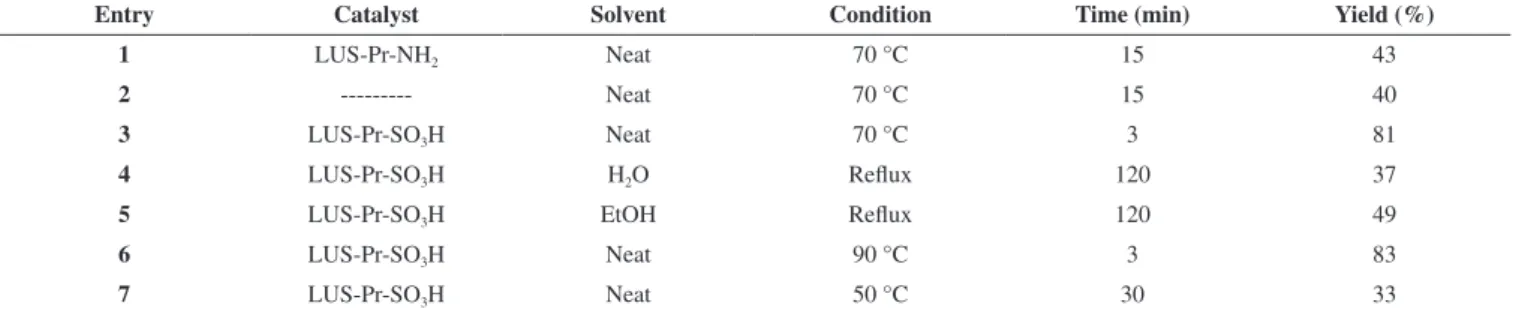
reported in Introduction section, all reported literature used basic catalysts for synthesis of these compound, so we first studied a reaction of 4-chlorobenzaldehyde in the presence of LUS-Pr-NH2 at
70 oC (Table 1, entry 1). We also studied catalyst free system in the
reaction in the presence of LUS-Pr-SO3H in the same condition. As
shown in Table 1, entry 3, the acidic catalyst exhibits good activity for synthesis of 2,4-diamino pyrimidine-5-carbonitriles. In order to determine the optimized conditions, we examined the influence of different conditions as shown results in Table 1, entries 4-7. Among the tested conditions the best result was obtained after 3 min at 70 °C in the presence of LUS-Pr-SO3H in solvent-free condition.
After optimizing the reaction conditions, we next developed the best condition for the synthesis of other derivatives using several aromatic aldehydes, as shown results in Table 2. By these condi-tions, the reactions were carried out easily to produce 2,4-diamino pyrimidine-5-carbonitriles in good yields. This methodology has the ability to tolerate a variety of functional groups such as methyl, methoxy and halides under the reaction conditions. For all substrates, the reaction could be completed in 1-7 min with high yields. After the completion of the reaction, the mixture was dissolved in ethyl acetate and filtered to remove heterogeneous catalyst. Ethyl acetate solution was washed several times with water to remove unreacted guanidine carbonate. The ethyl acetate layer was dried with anhydrous mag-nesium carbonate and concentrated to afford the pure product. The products were characterized by melting points, 1H NMR, 13C NMR,
MS and IR spectroscopic analyses. Melting points are compared with reported values in literature as shown in Table 2.
The acid catalyst can be reactivated by simple washing subse-quently with diluted acid solution, water and acetone, and then reused without noticeable loss of reactivity. The reusability of the catalyst
was investigated under optimized conditions for the synthesis of the model compound 4a. As shown in Figure 1, the recycling process was completed four times with no significant decrease in the activity of the catalyst. The yields for the four runs were found to be 81, 78, 75, and 74%, respectively.
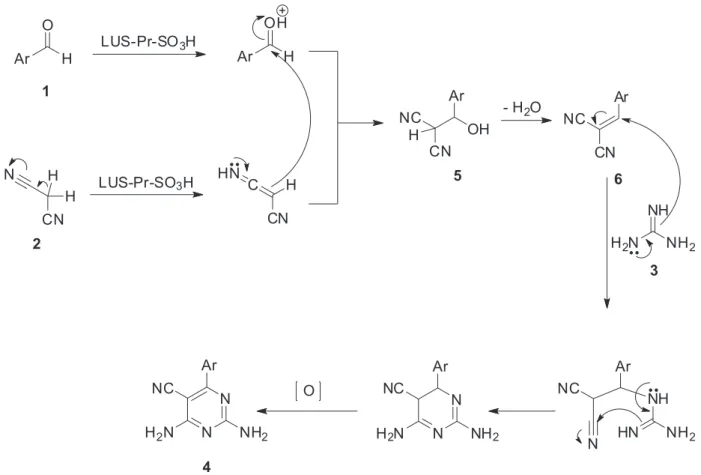
In these processes, LUS-Pr-SO3H plays an important role in the
acceleration of reaction. A suggested mechanism for this transfor-mation is proposed in Scheme 2. LUS-Pr-SO3H acts as a source of
H+, which can protonate the carbonyl group of aldehyde and also
tautomerize malononitrile. In this reaction, intermediate 5 is formed
Table 1. The optimization of reaction conditions for the synthesis of 4a using LUS-Pr-SO3H
Entry Catalyst Solvent Condition Time (min) Yield (%)
1 LUS-Pr-NH2 Neat 70 °C 15 43
2 --- Neat 70 °C 15 40
3 LUS-Pr-SO3H Neat 70 °C 3 81
4 LUS-Pr-SO3H H2O Reflux 120 37
5 LUS-Pr-SO3H EtOH Reflux 120 49
6 LUS-Pr-SO3H Neat 90 °C 3 83
7 LUS-Pr-SO3H Neat 50 °C 30 33
Scheme 1. Synthesis of 2,4-diamino pyrimidine-5-carbonitriles 4 in the presence of LUS-Pr-SO3H
Table 2. LUS-Pr-SO3H catalyzed the synthesis of 2,4-diamino pyrimidine-5-carbonitriles 4 under solvent-free condition
Entry Ar Product Time (min) Yield (%) mp (oC) mp (Lit)
1 4-ClC6H4 4a 3 81 279-281 28119
2 C6H5 4b 2 85 234-236 235-23721
3 4-CH3C6H4 4c 2 76 255-257 255-25716
4 4-CH3OC6H4 4d 1 75 238-240 238-240
21
5 3-CH3OC6H4 4e 2 83 261-263 New
6 4-FC6H4 4f 4 81 256-258 243-24516
7 1-naphthyl 4g 5 69 273-275 New
8 1-furyl 4h 7 65 255-257 265-26716
9 3,4-(CH3O)2C6H3 4i 2 75 209-211 205
20
through the Knoevenagel reaction between malononitrile and aldehy-de, and subsequently olefin 6 is produced by dehydration. Subsequent condensation of the guanidine 3 and olefin 6 followed by cyclization and oxidation affords the corresponding products 4 (a-i). The high yields of reactions are attributed to the effect of nano pore of solid acid catalyst, which could act as nano-reactor.
The synthesis of 2,4-diamino pyrimidine-5-carbonitriles have been studied with several conditions in literature as shown in Table 3. In comparison with other existing methods, the present methodology offers several advantages such as short reaction times, green and reusable catalyst, simple procedure, good yields, simple work-up and solvent-free conditions.
Synthesis and functionalization of LUS-1
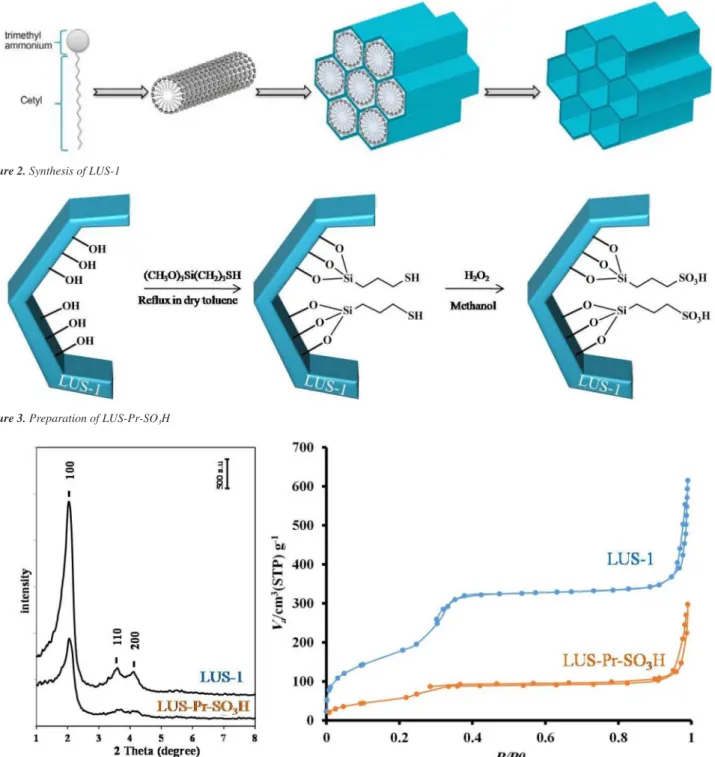
The mesoporous compound LUS-1 was prepared and functionali-zed according to a previously reported method.31 As shown in Figure
2, a solution of cetyltrimethylammonium p-toluene sulfonate was added to a mixture of colloidal silica Ludox and sodium hydroxide solution. The LUS-1 was isolated after heating, filtering and removing the surfactant from solid product.
Prepared LUS-1 was functionalized with (3-mercaptopropyl) trimethoxy silane and then, the thiol groups were oxidized to sulfonic acid by hydrogen peroxide (Figure 3).
The catalyst was analyzed by different methods such as TGA, XRD, BET and SEM methods which have confirmed that propyl sulfonic acid groups were immobilized into the pores.31 Figure 4
illustrates XRD pattern (Figure 4, left) and N2 adsorption-desorption
isotherms (Figure 4, right) of LUS-1 and LUS-Pr-SO3H. The XRD
pattern of LUS-1 and LUS-Pr-SO3H exhibits that grafting of organic
group did not affect the structural nature of LUS-1 and volumetric analyses shows “Type IV” N2 adsorption-desorption isotherms with
“H1-type” hysteresis which are characteristic of periodic mesoporous materials.
Scheme 2. Proposed mechanism for the synthesis of 2,4-diamino pyrimidine-5-carbonitriles 4
Table 3. Comparison of different conditions in the synthesis of 2,4-diamino pyrimidine-5-carbonitriles 4
Entry Catalyst Solvent Condition Time Yield (%) YearRef.
1 High surface area MgO CH3CN reflux 15 min 88 200918
2 NaOH --- 70 °C Not indicated 85 201016
3 NaHCO3 H2O/EtOH reflux 5 h 81 200817
4 (Et)3N Toluene MW Irradiation 25 min 92 2008
17
5 --- --- 200 °C 2 h 85 199019
6 K2CO3 H2O/TBAB reflux 4 h 63 200820
7 --- [bmim]OH MW Irradiation (100 W, 60 °C) 2 min 94 201121
SEM images of both LUS and LUS-Pr-SO3H shows the same
morphology, it means the morphology of solid didn’t change during the surface modifications (Figure 5).
Figure 2. Synthesis of LUS-1
Figure 3. Preparation of LUS-Pr-SO3H
CONCLUSION
In conclusion, we have established LUS-Pr-SO3H as an efficient
and recyclable heterogeneous acid catalyst for the synthesis of 2,4-diamino pyrimidine-5-carbonitrile derivatives. The current me-thod does not involve any hazardous organic solvents and the short reaction times and simplicity of the procedure provide significant improvements in comparison to other existing methods.
ACKNOWLEDGMENTS
We gratefully acknowledge the financial support from the Research Council of Alzahra University and the University of Tehran.
Figure 4. X-ray diffraction pattern (left) and nitrogen adsorption-desorption isotherms (right) for LUS-1 and LUS-Pr-SO3H
3. Onaka, M.; Hashimoto, N.; Kitabata, Y.; Yamasaki, R.; Appl. Catal. A-Gen. 2003, 241, 307.
4. Kureshy, R. I.; Ahmad, I.; Pathak, K.; Khan, N. H.; Abdi; S. H. R.; Jasra, R. V.; Catal. Commun. 2009, 10, 572.
5. Karimi, B.; Zareyee, D.; Org. Lett. 2008, 10, 3989.
6. Mohammadi Ziarani, G.; Lashgari, N.; Badiei; A.; J. Mol. Catal. A: Chem. 2015, 397, 166.
7. Bonneviot, L.; Morin, M.; Badiei; US patent 0133868 2003.
8. Reinert, P.; Garcia, B.; Morin, C.; Badiei, A.; Perriat, P.; Tillement, O.; Bonneviot, L.; Cationic tern plating with organic counterion for superstable mesoporous silica; Elsevier, 2003; Vol. 146.
9. Gundersen, C. B.; Jenden, D. J.; Br. J. Pharmacol.1981, 72, 461. 10. Kamenskaya, M. A.; Elmqvist, D.; Thesleff, S.; Arch. Neurol. 1975, 32,
510.
11. Wyss, P. C.; Gerber, P.; Hartman, P. G.; Hubschwerlen, C.; Locher, H.; Marty, H.-P.; Stahl, M.; J. Med. Chem. 2003, 46, 2304.
12. Petersen, E.; Schmidt, D. R.; Expert Rev. Anti-infect. Ther. 2003, 1, 175. 13. Boschelli, D. H.; Wu, Z.; Klutchko, S. R.; Showalter, H. D. H.; Hamby,
J. M.; Lu, G. H.; Major, T. C.; Dahring, T. K.; Batley, B.; Panek, R. L.; Keiser, J.; Hartl, B. G.; Kraker, A. J.; Klohs, W. D.; Roberts, B. J.; Patmore, S.; Elliott, W. L.; Steinkampf, R.; Bradford, L. A.; Hallak, H.; Doherty, A. M.; J. Med. Chem. 1998, 41, 4365.
14. Deshmukh, M. B.; Salunkhe, S. M.; Patil, D. R.; Anbhule, P. V.; Eur. J. Med. Chem. 2009, 44, 2651.
15. Gangjee, A.; Vidwans, A.; Elzein, E.; McGuire, J. J.; Queener, S. F.; Kisliuk, R. L.; J. Med. Chem. 2001, 44, 1993.
647.
20. Deshmukh, M.; Anbhule, P.; Jadhav, S.; Jagtap, S.; Patil, D.; Salunkhe, S.; Sankpal, S.; Indian J. Chem. Sec. B 2008, 47, 792.
21. Raghuvanshi, D. S.; Singh, K. N.; J. Heterocycl. Chem. 2011, 48, 582. 22. Mohammadi Ziarani, G.; Badiei, A.; Khaniania, Y.; Haddadpour, M.;
Iran. J. Chem. Chem. Eng. 2010, 29, 1.
23. Mohammadi Ziarani, G.; Badiei, A.; Haddadpour, M.; Int. J. Chem.
2011, 3, 87.
24. Gholamzadeh, P.; Mohammadi Ziarani, G.; Badiei, A.; Bahrami, Z.; Eur. J. Chem. 2012, 3, 279.
25. Mohammadi Ziarani, G.; Lashgari, N.; Badiei, A.; R. Sci. Iran. 2013, 20, 580.
26. Mohammadi Ziarani, G.; Faramarzi, S.; Asadi, S.; Badiei, A.; Bazl, R.; Amanlou, M.; DARU J. Pharm. Sci. 2013, 21, 3.
27. Mohammadi Ziarani, G.; Mousavi, S.; Rahimifard, M.; Badiei, A.; J. Mex. Chem. Soc. 2014, 58, 168.
28. Mohammadi Ziarani, G.; Hosseini Nasab, N.; Rahimifard, M.; Abolhasani Soorki, A.; J. Saudi Chem. Soc. 2015, 19, 676.
29. Mohammadi Ziarani, G.; Rahimifard, M.; Nouri, F.; Badiei, A.; J. Serb. Chem. Soc. 2015, 80, 1265.
30. Mohammadi Ziarani, G.; Nouri, F.; Rahimifard, M.; Badiei, A.; Abolhassani Soorki, A.; Rev. Roum. Chim. 2015, 60, 331.
31. Rahimifard, M.; Mohammadi Ziarani, G.; Badiei, A.; Asadi, S.; Abolhasani Soorki, A.; Res. Chem. Intermed. 2016, 42, 3847