Article
Kováts Retention Indexes of Monounsaturated C
12, C
14, and C
16Alcohols, Acetates and
Aldehydes Commonly Found in Lepidopteran Pheromone Blends.
Francisco de A. Marquesa,b*, J. S. McElfresha and Jocelyn G. Millara
a
Department of Entomology, University of California, Riverside CA 92521, U.S.A.
b
Permanent address: Departmento de Química, Universidade Federal do Paraná, CP 19081, 81531-990, Curitiba - PR, Brazil
Muitos feromônios de lepidópteras são constituídos por misturas de álcoois, aldeídos e acetatos, monoinsaturados. O fato de tais compostos normalmente estarem presentes em escala de nanogramas em extratos obtidos das glândulas de lepidópteras, praticamente descarta a possibilidade de se empregar métodos espectroscópicos clássicos na identificação estrutural dos mesmos. A utilização de índices de retenção obtidos via cromatografia gasosa, em combinação com os dados acumulados através da análise do extrato via CG-EM e eletroantenografia, fornecem importantes informações sobre a estrutura de substâncias presentes nos extratos em pequenas quantidades. A comparação dos índices de Kováts (KIs) de substâncias desconhecidas com padrões pode levar à identificação das mesmas ou, ao menos, limitar o número de possíveis estruturas. A alta reprodutibilidade dos KIs possibilita que comparações sejam feitas através de valores determinados em qualquer laboratório, sem a necessidade de se ter os padrões. Nesse trabalho foram calculados os KIs de quase todos os possíveis isômeros monoinsaturados de álcoois, aldeídos e acetatos de 12, 14 e 16 átomos de carbono, analisados em colunas de fase estacionária apolar (DB-5) e polar (DB-WAX).
Many lepidopteran pheromones consist of blends of monounsaturated alcohols, aldehydes and acetates. These compounds frequently are obtained in only nanogram quantities from pheromone gland extracts, prohibiting use of most standard spectroscopic methods. However, use of GC retention indexes, particularly in combination with mass spectrometry and electroantennograms, can provide substantial information about trace amounts of unknowns. Comparison of Kováts indexes (KIs) of an unknown with those of standards can provide an unambiguous identification, or at least, limit the number of possible structures to a few compounds. Furthermore, because KIs are highly reproducible, a full set of standards is not necessary; comparisons can be made using tables of KIs determined in another laboratory. We provide here tables of the KIs of almost all possible isomers of monounsaturated alcohols, aldehydes, and acetates with 12, 14, or 16 carbon chain lengths, measured on nonpolar (DB-5) and polar (DB-WAX) stationary phases.
Keywords: Kováts retention index, pheromone, Lepidoptera
*e-mail: [email protected].
Introduction
To date, pheromone blends have been identified for more than 1,000 lepidopteran species1. A substantial fraction of the components that comprise these blends are monounsaturated straight-chain alcohols, aldehydes and acetates with chain lengths of 12, 14, or 16 carbons. These compounds are usually found in amounts that vary from picograms to micrograms per individual, depending on species. Consequently, they are rarely isolated in quantities sufficient to carry out the full range of spectroscopic tests
of compounds without losing them altogether can be technically challenging. The problem is exacerbated by the fact that whereas mass spectrometry can frequently be used to determine the gross structure of a monounsaturated alcohol, aldehyde, or acetate pheromone component, in general the mass spectrum provides insufficient information to determine either the position or the geometry of the double bond reliably; for example, the mass spectra of most monounsaturated acetates of a given chain length are quite similar. Furthermore, because different types of mass spectrometers (e.g., quadrupole, magnetic sector, or
ion trap) produce slightly different spectra, matchups with literature spectra cannot be relied upon for determinations of double bond positions or geometries.
Because of these problems, GC retention time data has been used extensively in the identification of lepidopteran pheromones, with matching retention times between an unknown compound and a standard of known structure providing strong support for a tentative identification. However, a retention time match is not conclusive, because isomers may have very similar retention times. Nevertheless, retention time matches, particularly on two or more GC columns of differing polarity, can at least narrow the possibilities to a few structures, providing that standards of all possible structures are available for comparison. This is frequently not the case, particularly for laboratories that have not accumulated a library of standards.
The necessity of having a full set of standards can be circumvented by careful use of retention index data, because retention indexes, within a small margin of error, are a function only of the GC column and the operating conditions. As long as these are faithfully reproduced, the retention index of an unknown compound can be replicated in any laboratory. Thus, calculation of the retention index of an unknown compound and comparison with tabulated values of standards run under the same conditions provides a piece of data of enormous value in the identification of an unknown. At the very least, comparison of retention indexes usually allows all but a few isomers to be eliminated from consideration. The most widely used system of retention indexes is that introduced by Kováts3, in which retention indexes are calculated relative to straight-chain alkane standards. Other sets of standards have also been used to a lesser extent, such as saturated fatty acid methyl esters, or acetate esters of alkanols4.
Although tables of retention index data have probably been compiled by laboratories that work frequently with lepidopteran pheromones, to our knowledge these compilations have not been published. To remedy this deficiency, and to provide a resource for laboratories that cannot obtain extensive libraries of standards, we provide
here the Kováts retention indexes (KI’s) of most of the isomers of monounsaturated C12, C14, and C16 alcohols, aldehydes and acetates, determined on both nonpolar and polar GC stationary phases.
Experimental
Preparation of standards for analysis
The monoene alcohols, aldehydes and acetates were taken from our library of standards, assembled over many years from a number of sources, including The Pherobank (Research Institute for Plant Protection, Wageningen, The Netherlands) and the collection of the Plant Biotechnology Institute (National Research Council of Canada, Saskatoon, Sask., Canada). Stock solutions of alcohols and acetates in dichloromethane (~1mg cm-3) were checked for purity by thin-layer chromatography on silica gel (E. Merck, Type 5554 plates; Fisher Scientific, Pittsburgh, PA). When necessary, compounds were purified by chromatography on silica gel as follows. Solutions in CH2Cl2 (0.2 cm3, 1 mg cm-3) were added to a Pasteur pipet packed with silica gel (3.5 cm). Compounds were eluted with mixtures of hexane/ethyl acetate (alcohols, 4:1; acetates, 19:1), collecting 1 cm3 fractions. Fractions contained the desired compound were combined and concentrated under reduced pressure to ~0.05 cm3.
Aldehydes were prepared by oxidation of the corres-ponding alcohols. Thus, pyridinium chlorochromate (PCC, 500 mg) and powdered 4Å molecular sieves (500 mg) were ground to fine powder and the mixture (10 mg) was added to a vial with CH2Cl2 (0.15 cm3). The alcohol solution in CH2Cl2 (0.05 cm3, ca. 1mg cm-3) was added and the flask was manually agitated every 5 min for 30 min. Heptane (0.8 cm3) was then added, the vial was vortexing for 10 s, and the precipitate was left to settle for 10 min. The mixture was then filtered through a Pasteur pipet packed with powdered MgSO4 (2.5 cm).
PCC oxidation of homoallylic alcohols to the corresponding aldehydes was not successful due to extensive isomerization. Instead Collin’s oxidation was used; the oxidation of (E)-3-tetradecenol is representative.
To confirm the positions of double bonds in selected compounds, dimethyldisulfide (DMDS) adducts were made for GC-MS analysis2. Thus, a solution of DMDS in hexane (1 cm3, 10% v/v) was mixed with a solution of iodine in ether (0.4 cm3, 50 mg cm-3). An aliquot of the resulting solution (0.1 cm3) was added to a solution of a monoene in CH2Cl2 (0.05 cm3, 1mg cm-3) and heated for 20 h at 55oC in a tightly closed screw-cap vial. Sodium thiosulphate solution (5% w/v) was added dropwise to the cooled solution with vortexing until the mixture was colorless. Pentane (0.5 cm3) was then added and the mixture was vortexed for 10 s. The organic phase was transferred to a clean vial and the solution was concentrated under a stream of nitrogen for GC-MS analysis.
Analysis conditions
For efficiency, mixtures of the alcohol, aldehyde, and acetate of the same chain lengths, double bond position, and geometry were analyzed as a single solution, in final concentrations of ~ 50 to 100 µg cm-3, with C
13-C28 hydrocarbons added (5 to 10 µg cm-3) for retention index calculations. Compounds were analyzed by GC in splitless mode on a Hewlett-Packard 5890A or 5890 Series II GC (HP, Palo Alto CA), equipped with either a DB-5 column (30 m x 0.25 mm ID, 0.25 µm film, J&W Scientific, Folsom CA; temp. program 100oC/1min, 5oC/min to 275oC for 3 min, 128 kPa head pressure, 29.4 cm/sec linear velocity) or a DB-WAX column (30 m x 0.32 mm ID, 0.25 µm film, J&W Scientific; temp. program 100oC/1min, 5oC/min to 240oC for 0 min, 138 kPa head pressure, 43 cm/s linear velocity). Selected compounds were also analyzed by GC-MS using an HP 5890 GC interfaced to an HP 5970B mass selective detector in electron impact ionization mode (70 eV). The GC-MS was equipped with a DB-5MS column (20 m x 0.2 mm ID), using a temperature program of 100ºC/ 1 min, 10ºC/min to 250ºC for 5 min. Helium was used as carrier gas for all GC and GC-MS analyses. The following solutions containing alcohols, aldehydes and acetates were analyzed by GC-MS to verify the gross structures of one or more of the constituents: 6E-12, 5Z-12, 4Z-12, 4E-12, 3Z
-12, 3E-12, 3E-14, 3Z-14, 3Z-16. Another subset of
single-component samples, including 4Z-12:OH, 3E-12:OH, 3E
-14:OH, 7E-16:OH, 11E-16:OH, 4E-16:OAc, were
derivatized with DMDS as described above and analyzed by GC-MS to confirm the double bond positions.
Kováts retention indexes of each compound on each column were calculated using the formula5:
KI = 100y + 100(z-y) X tr(x) – tr(y)
where y and z are the carbon numbers of the hydrocarbon standards on either side of a given compound, tr(x) is the retention time of the compound, and t r(y) and t r(z) are the retention times of the hydrocarbon standards. The specific hydrocarbon standards used in the calculation of the retention indexes of each group of compounds are listed in the table and figure captions.
Results and Discussion
DB-5 (Tables 2-4, Figures 1-3) and DB-WAX (Tables 5-7, Figures 4-6) bonded stationary phases were chosen for calculation of KI values because they represent typical examples of the common nonpolar 5% phenyl-95% dimethylpolysiloxane and polar Carbowax (polyethyl-eneglycol) stationary phases that are available from all major suppliers of capillary GC columns (see Table 1 for list of equivalent columns from other manufacturers). KI values calculated on any of these equivalent columns will be close to the values reported here, as will the overall shapes of plots of KI versus double bond position. Furthermore, retention indexes were calculated using temperature programmed rather than isothermal analyses for two reasons. First, crude extracts of pheromone glands contain numerous compounds of different volatility, so temperature programming is required in order to elute all compounds of interest within a timely fashion, and without significant peak broadening for later-eluting compounds. Second, with temperature programming, the equation for calculation of Kováts indexes simplifies considerably5: with isothermal runs, the equation requires use of the logarithms of the adjusted retention times, whereas with temperature programming, the relationship between retention time and retention index becomes approximately linear, so that the logarithmic terms in the equation can be replaced with the simple retention times. In theory, as long as the same stationary phase and operating conditions are used, retention indexes should be highly reproducible between laboratories. In practice, slight variability between laboratories may occur due to aging of stationary phases with use and other factors. Nevertheless, it has been estimated that if operating conditions are reproduced carefully, interlaboratory variations of no more than 2-5 retention index units are easily attainable5. This variability can probably be decreased further if one or more standards of the alkenes in questions are available as markers. That is, by measuring the retention indexes of the standards and determining how much they differ from the tabulated values presented here, the expected values of the remaining compounds can be adjusted accordingly.
Table 1. Cross reference table of capillary GC stationary phases similar to DB-5 and DB-WAX, available from different manufacturers. Manufacturer DB-5 equivalent DB-WAX equivalent
Restek RTX-5 RTX-WAX, Stabilwax
Supelco SPB-5 Supelcowax 10
Hewlett-Packard HP-5, Ultra-2 HP-20M /Agilent
Alltech ATF-5 AT-WAX
SGE BP-5, BPX-5 BP-20
Chrompack CP sil 8 CB CP-WAX 52 CB
Table 2. Kováts indexes of C12 monoene aldehydes, alcohols, and acetates on the DB-5 column*.
Aldehyde Alcohol Acetate
Bond position E Z E Z E Z
saturated 1407 1473 1609
2 1466** 1467**
3 1399 1399 1451 1457 1593 1591 4 1396 1393 1460 1457 1596 1589 5 1394 1389 1464 1461 1597 1592 6 1396 1394 1462 1461 1598 1593 7 1397 1396 1465 1463 1600 1598 8 1399 1401 1466 1468 1602 1605 9 1403 1407 1470 1473 1607 1611 10 1412 1424 1478 1490 1615 1630
11 1401 1466 1604
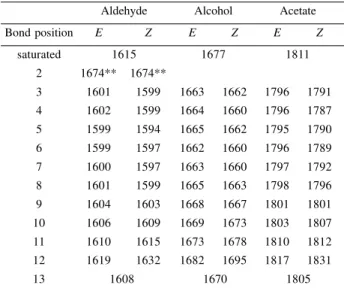
* Hydrocarbon standards used: for aldehydes, C13 and C15, for alcohols, C14 and C15, for acetates, C15 and C17; ** Because of facile isomerization of α,β -unsaturated aldehydes, the stereochemistry of the double bond is uncertain. Table 3. Kováts indexes of C14 monoene aldehydes, alcohols, and
acetates on the DB-5 column*.
Aldehyde Alcohol Acetate
Bond position E Z E Z E Z
saturated 1615 1677 1811
2 1674** 1674**
3 1601 1599 1663 1662 1796 1791 4 1602 1599 1664 1660 1796 1787 5 1599 1594 1665 1662 1795 1790 6 1599 1597 1662 1660 1796 1789 7 1600 1597 1663 1660 1797 1792 8 1601 1599 1665 1663 1798 1796 9 1604 1603 1668 1667 1801 1801 10 1606 1609 1669 1673 1803 1807 11 1610 1615 1673 1678 1810 1812 12 1619 1632 1682 1695 1817 1831
13 1608 1670 1805
* Hydrocarbon standards used: for aldehydes, C15 and C17, for alcohols, C16 and C17, for acetates, C17 and C19; ** Because of facile isomerization of α,β-unsaturated aldehydes, the stereochemistry of the double bond is uncertain.
Table 4. Kováts indexes of C16 monoene aldehydes, alcohols, and acetates on the DB-5 column*.
Aldehyde Alcohol Acetate
Bond position E Z E Z E Z
saturated 1819 1882 2013
2 1880** 1879**
3 1808 1807 1865 1868 1994 1994 4 1806 1804 1868 1865 2000 1987 5 1803 1799 1869 1867 1995 1989 6 1803 1799 1866 1863 1997 1987 7 1804 1798 1871 1862 1995 1988 8 1803 1798 1866 1862 1995 1990 9 1804 1800 1868 1863 1998 1993 1 0 1806 1804 1869 1867 2000 1998 1 1 1810 1809 1877 1874 2004 2004 1 2 1813 1816 1877 1879 2008 2011 1 3 1815 1820 1878 1884 2010 2016 1 4 1824 1838 1887 1902 2018 2033 * Hydrocarbon standards used: for aldehydes, C17 and C19, for alcohols, C18 and C20, for acetates, C19 and C21; ** Because of facile
isomerization of α,β-unsaturated aldehydes, the stereochemistry of the double bond is uncertain.
Table 5. Kováts indexes of C12 monoene aldehydes, alcohols, and acetates on the DB-WAX column*.
Aldehyde Alcohol Acetate
Bond position E Z E Z E Z
saturated 1700 1970 1880
2 1844** 1846**
3 1736 1736 1965 1989 1894 1896 4 1732 1733 1995 1996 1899 1891 5 1725 1724 2003 2007 1904 1901 6 1731 1734 2001 2007 1905 1905 7 1732 1737 2004 2009 1908 1911 8 1733 1743 2005 2016 1910 1920 9 1742 1752 2013 2024 1920 1929 10 1763 1781 2035 2054 1942 1961
11 1753 2023 1930
* Hydrocarbon standards used: for aldehydes, C17 and C19, for alcohols, C19 and C21, for acetates, C18 and C20; * Because of facile isomerization of α,β-unsaturated aldehydes, the stereochemistry of the double bond is uncertain.
Table 6. Kováts indexes of C14 monoene aldehydes, alcohols, and acetates on the DB-WAX column*.
Aldehyde Alcohol Acetate
Bond position E Z E Z E Z
saturated 1910 2177 2087
2 2059** 2060**
3 1940 1945 2201 2196 2104 2101 4 1940 1940 2201 2201 2104 2093 5 1932 1930 2207 2209 2108 2103 6 1936 1937 2203 2207 2107 2103 7 1935 1937 2204 2206 2108 2108 8 1938 1940 2207 2210 2111 2113 9 1942 1946 2211 2215 2116 2120 1 0 1943 1954 2212 2223 2118 2128 1 1 1953 1963 2221 2232 2129 2137 1 2 1976 1994 2243 2263 2150 2169
1 3 1964 2231 2137
* Hydrocarbon standards used: for aldehydes, C19 and C21, for alcohols, C21 and C23, for acetates, C20 and C22.
Figure 1. Plots of Kováts retention indexes determined on DB-5 stationary phase versus double bond position for C12 monounsaturated aldehydes, alcohols, and acetates. Hydrocarbon standards used: for aldehydes, C13 and C15, for alcohols, C14 and C15, for acetates, C15 and C17. The dashed line indicates the retention index of the saturated analogs.
Figure 2. Plots of Kováts retention indexes determined on DB-5 stationary phase versus double bond position for C14 monounsaturated aldehydes, alcohols, and acetates. Hydrocarbon standards used: for aldehydes, C15 and C17, for alcohols, C16 and C17, for acetates, C17 and C19. The dashed line indicates the retention index of the saturated analogs.
Figure 3. Plots of Kováts retention indexes determined on DB-5 stationary phase versus double bond position for C16 monounsaturated aldehydes, alcohols, and acetates. Hydrocarbon standards used: for aldehydes, C17 and C19, for alcohols, C18 and C20, for acetates, C19 and C21. The dashed line indicates the retention index of the saturated analogs. Table 7. Kováts indexes of C16 monoene aldehydes, alcohols, and
acetates on the DB-WAX column*.
Aldehyde Alcohol Acetate
Bond position E Z E Z E Z
saturated 2120 2385 2294
2 2279** 2278**
3 2158*** 2158*** 2384 2407 2307 2310
4 2151 2151 2409 2410 2314 2300
5 2143 2140 2415 2417 2314 2308
6 2146 2145 2410 2412 2313 2306
7 2144 2144 2413 2410 2312 2308
8 2144 2144 2411 2411 2314 2312
9 2146 2147 2413 2413 2317 2315
1 0 2150 2152 2416 2419 2321 2322 1 1 2156 2159 2423 2427 2325 2330 1 2 2157 2168 2422 2433 2328 2339 1 3 2166 2177 2430 2441 2337 2347 1 4 2189 2210 2451 2472 2359 2379 * Hydrocarbon standards used: for aldehydes, C21 and C24, for alcohols, C22 and C25, for acetates, C22 and C24.
** Because of facile isomerization of α,β-unsaturated aldehydes, the stereochemistry of the double bond is uncertain.
Comparisons of the retention behavior of a compound on polar and nonpolar stationary phases can provide significant amounts of information about the structure. First, an alkene with one or more isolated double bonds usually has a retention time shorter than that of the saturated analog on a nonpolar column, whereas an alkene with the double bond(s) anywhere in the molecule always increases the retention time on a polar column relative to the saturated compound. Second, conjugation of an alkene double bond with a carbonyl or with another carbon-carbon double bond always increases the retention time on both nonpolar and polar columns relative to the saturated analog. Third, the elution order of aldehydes, alcohols, and acetates of the same chain length changes between DB-5 and DB-WAX columns. On nonpolar DB-5 (Tables 2-4, Figures 1-3), retention indexes increase in the order aldehyde, alcohol, acetate, whereas on DB-WAX (Tables 5-7, Figures 4-6), the elution order is aldehyde, acetate, alcohol. Fourth, the differences in retention indexes between two compounds can provide useful information. For example, on DB-5 (Tables 2-4, Figures 1-3), an alcohol and an acetate of the same chain length have KI values approximately 50-70 units and 190-205 units larger respectively than that of the corresponding aldehyde. On DB-WAX (Tables 5-7, Figures 4-6), these differences in KI Figure 5. Plots of Kováts retention indexes determined on
DB-WAX stationary phase versus double bond position for C14 monounsaturated aldehydes, alcohols, and acetates. Hydrocarbon standards used: for aldehydes, C19 and C21, for alcohols, C21 and C23, for acetates, C20 and C22.
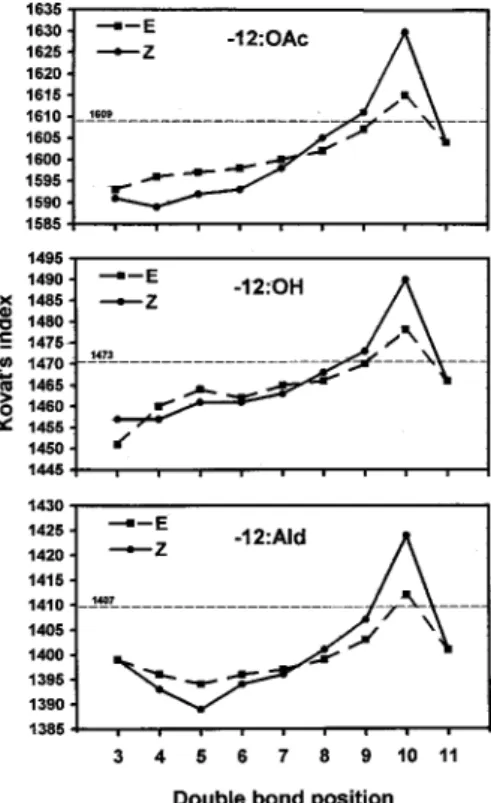
Figure 6. Plots of Kováts retention indexes determined on DB-WAX stationary phase versus double bond position for C12
monounsaturated aldehydes, alcohols, and acetates. Hydrocarbon standards used: for aldehydes, C21 and C24, for alcohols, C22 and C25, for acetates, C22 and C24.
values range from approximately 260-280 (alcohol versus aldehyde) and 160-180 (acetate versus aldehyde).
Plots of KI values versus double bond position were similar for all three functional groups and all three chain lengths, on both the nonpolar (DB-5, Figures 1-3) and polar (DB-WAX, Figures 3-6) stationary phases respectively. KI values generally increased as the double bond was moved from position 3 to position n-3 (where n = the chain length), increased sharply at position n-2, and then dropped sharply for the terminal double bond. On DB-5 (Figures 1-3), for compounds with the double bond closer to the functional group than to the distal end of the molecule, Z-isomers
almost always had smaller KIs than the corresponding
E-isomers, but this trend reversed as the double bond was moved towards the distal end of the chain. On DB-WAX (Figures 4-6), there was generally little difference between the KIs of compounds with the double bond closer to the functional group than to the distal end of the molecule, with the exception of 3-alkenols, in which the KIs of the
E-isomers were considerably lower than those of the Z
-isomers for the C12 and C16 compounds. For compounds with the double bond in the latter half of the chain, the KIs of the Z-isomers was always higher than that of the
corresponding E-isomers.
Looked at on finer scale, there were some apparent anomalies, such as the noticeable decrease in KI values for compounds such as Z5-12:Ald (Figures 1and 4), Z4-14:OAc
(Figures 2 and 5), and Z5-14:Ald (Figures 2 and 5) on both
DB-5 and DB-WAX. However, these apparent anomalies were determined to be real by a) running the samples again, b) checking the anomolous samples by MS to ensure that the gross structure was correct, and c) forming the DMDS adducts of the compounds, followed by MS analysis to unambiguously determine the position of the double bond. In all cases, the structures were confirmed. In fact, these anomalies can be very useful by providing a distinct break in a general trend, and thus providing a KI value for which there can be fewer possible structures. For example, the position and geometry of the double bond in Z5-12:Ald or Z4-14:OAc can be determined from their KI values on
DB-5 alone. In analogous fashion, the KI values of Z4-14:OAc
and Z4-16:OAc on DB-WAX unambigously determine the
double bonds in these two compounds. Overall, in the best case, the combination of KI values of any given compound on the two columns would allow the reliable assignment of the double bond position and geometry in an unknown compound. Even in the worst case, careful use of the retention indexes limits the number of possibilities to only a few isomers from the many possible, greatly reducing the number of compounds that must be synthesized to confirm the identification. Furthermore,
other data, such as careful comparison of the mass spectrum of the unknown with those of some of the possible structures, or testing the antennal responses of male moths to possible structures, can further narrow the possibilities, frequently to only a single compound.
The power of retention indexes for structure identification can be illustrated best with several case studies from the recent literature. For example, extracts of the sex pheromone gland of the African white rice stem borer Maliarpha separatella (Lepidoptera: Pyralidae)4
contained Z9-14:OH, Z9,E12-14:OH, and E10,E
12-14:OH, in a ratio of 2: 3.5: 1. The average amount of the major component per insect was only 0.4 ng, providing only enough material for determination of retention times, and EI and CI mass spectra. By careful use of retention indexes, the identities of all three compounds were unambiguously determined, and subsequently corroborated in field bioassays. Interestingly, Z9-14:OH
inhibited attraction of male moths, suggesting that it is not a component of the pheromone even though it was present in the pheromone gland.
In studies of the soybean pod borer Etiella behrii
(Lepidoptera: Pyralidae)6, four compounds in pheromone gland extracts were found to stimulate male moth antennae in electroantennogram studies. The amounts of the active components (<0.2 ng/female) were insufficient to obtain any spectral data, and consequently identifications were carried out entirely by use of retention indexes, determined on polar (DB-WAX) and nonpolar (HP-1) columns. Based solely on this information, 3 of the 4 compounds were identified unambiguously as 12:OAc, E9-12:OAc, and Z11-14:OAc, and the identity of the 4th component was
restricted to 2 possibilities, either Z9- or E11-14:OAc. The
identity of the 4th component was verified as E11-14:OAc by field tests.
In an extreme example, extracts of pheromone glands from females of the leafminer moth Lyonetia prunifoliella
Based only on this information, the two compounds were tentatively identified as dimethylheptadecane and 5,9-dimethyloctadecane. A mass spectrum obtained for the third, major component, suggested that it was a monounsaturated analog of 5,9-dimethyloctadecane, and this was supported by the fact that this component eluted earlier than 5,9-dimethyloctadecane on the nonpolar DB-5 column, and later on the polar DB-23 and DB-210 columns. This information, coupled with the fact that a methyl-branched octadecene with terminal unsaturation had been reported from another lyonetid species, suggested the structure 10,14-dimethyl-1-octadecene, and this identification was confirmed by mass spectral and retention times matches with an authentic standard, and verified in field trials.
Conclusions
When used methodically, retention indexes can provide crucial data for use in the identification of lepidopteran pheromone components, particularly when the small amounts of materials available do not allow a mass spectrum to be obtained. The power of the method can be extended to picogram and even femtogram quantities by use of live male moth antennae as detectors in coupled gas chromatrography-electroantennography7,8. Furthermore, related species frequently produce similar pheromone components, allowing short lists of likely structures to be compiled. Comparison of the retention indexes of these likely structures with the retention indexes of the pheromone components in an extract can rapidly eliminate some structures from further consideration, while retention index matches, particularly on more than one type of stationary phase, provide strong evidence for a correct identification.
Acknowledgements
We thank the Brazilian Council for the Development of Science and Technology (CNPq) for financial support for F.A.M. J.G.M. thanks Professor Paulo Zarbin and his colleagues in the Department of Chemistry, Federal University of Parana, for the invitation and support to participate in the first Brazilian Meeting on Chemical Ecology. We are grateful to the Plant Biotechnology Institute, National Research Council of Canada, Saskatoon, Canada, for the gift of authentic standards.
References
1. (a) Arn, H.; Toth, M.; Priesner, E. 1991. List of Sex Pheromones of Lepidoptera and Related Attractants. Int.
Organization for Biological Control, Secretariat General, 149, Rue de Bercy, F-75595 Paris, Cedex 12, France. (b) The Pherolist, http://www.nysaes.cornell.edu/pheronet/. 2. Attygalle, A. B.; Microchemical Techniques, In Methods in Chemical Ecology; Millar, J. G.; Haynes,
K. F., Ed.; Vol. 1: Chemical Methods; Chapman &
Hall; New York, 1998, p 207.
3. Kováts, E. Adv. Chromatogr. 1965, 1, 229.
4. Cork, A.; Agyen-Sampong, M.; Fannah, S. J.; Beevor, P. S.; Hall, D. R. J. Chem. Ecol. 1991, 17, 1205.
5. Robards, K.; Haddad, P. R.; Jackson, P. E. Principles and Practice of Modern Chromatographic Methods;
Academic Press; New York, 1994.
6. Wakamura, S.; Hattori, M.; Igata, K.; Yasuda, K.; Tridjaka Entomol. Exp. Appl. 1999, 91, 413.
7. Gries, R.; Gries, G.; King, G. G. S.; Maier, C. T. J. Chem. Ecol. 1997, 23, 1119.
8. Millar, J. G.; Knudson, A. E.; McElfresh, J. S.; Gries, R.; Gries, G.; Davis, J. H. Bioorg. Med. Chem. 1996, 4, 331.